CANNABIS A DRUG OF ABUSE
OVERVIEW Introduction History World drug report Data Forms and modes of usage Chemistry Mechanism of action Long term effects Short term effects Analysis References
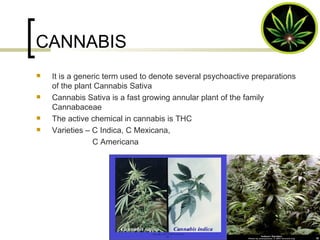
CANNABIS It is a generic term used to denote several psychoactive preparations of the plant Cannabis Sativa Cannabis Sativa is a fast growing annular plant of the family Cannabaceae The active chemical in cannabis is THC Varieties – C Indica, C Mexicana, C Americana
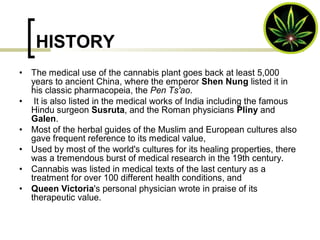
HISTORY
UN Office On Drugs and Crime WORLD DRUG REPORT 2006 Approximately 4 per cent of the world's adults-some 162 million people-use cannabis every year, making it the world's most widely used illicit drug.  “ the annual prevalence of abuse among the age group of 15-64 in India is 3.2 per cent for cannabis, 0.4 per cent for opiates and 0.01 per cent for Ecstasy”    i.e.  about 2.3 million people are dependent on cannabis in India alone
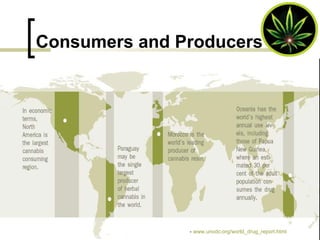
Consumers and Producers -  www.unodc.org/world_drug_report.html
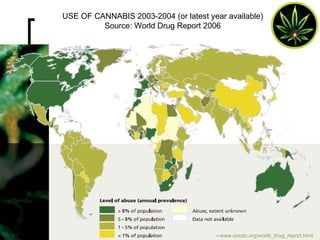
USE OF CANNABIS 2003-2004 (or latest year available)  Source: World Drug Report 2006  -  www.unodc.org/world_drug_report.html
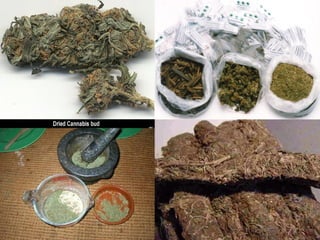
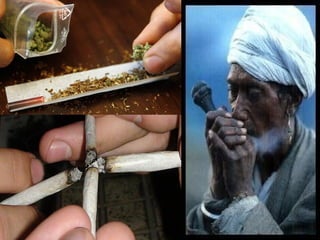
Forms and modes of usage Herbal Cannabis Marijuana  -combination of the flowering tops and leaves.   Bhang   – dried mature leaves, twigs and fruiting shoots of    male and female plant, least potent   - sabji, satti, sidhi Ganja   – flowering or fruiting tops, coated with exude of    female plant   - rusty green colour - joint sticks,Thaisticks, buddha sticks Marijuana and ganja are smoked in hand rolled cigarettes, pipe or chillum or can be brewed as tea
 
 
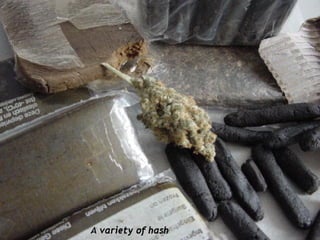
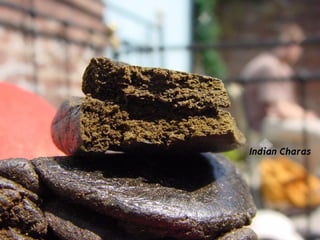
Contd…. Charas Crude   resin   from leaves and flowering tops of female plant Green to brown to black Hashish, Black Moroccan, sulpha, nasha, kif, khit, red seal, red Lebanese Smoked in pipe or by placing a bit on tip of cigarette , baked or eaten as hash cookies THC content – 4% - 12%
 
 
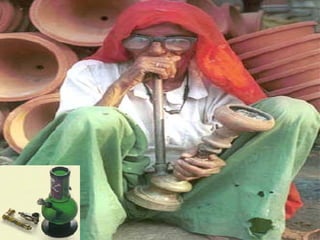
Contd…. Hashish oil Thick, oily liquid ,  extracted from hashish   by solvent extraction Golden brown to black Hash oil, red oil, honey oil Smoked in a bong or hookah or by putting a few drops on cigarette or joint THC content – 20% to 60%
 
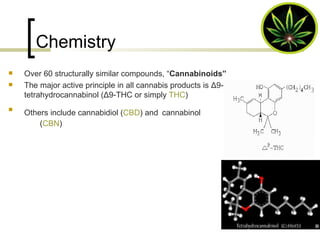
Chemistry Over 60 structurally similar compounds, “ Cannabinoids” The major active principle in all cannabis products is Δ9- tetrahydrocannabinol (Δ9-THC or simply  THC )  Others include cannabidiol ( CBD ) and   cannabinol  ( CBN )
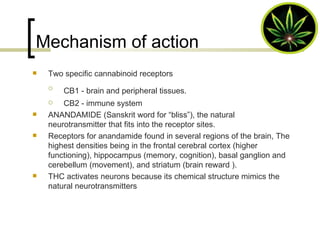
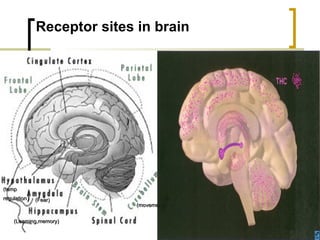
Mechanism of action Two specific cannabinoid receptors CB1 - brain and peripheral tissues.   CB2 - immune system ANANDAMIDE (Sanskrit word for “bliss”), the natural neurotransmitter that fits into the receptor sites. Receptors for anandamide found in several regions of the brain, The highest densities being in the frontal cerebral cortex (higher functioning), hippocampus (memory, cognition), basal ganglion and cerebellum (movement), and striatum (brain reward ). THC activates neurons because its chemical structure mimics the natural neurotransmitters
Receptor sites in brain (movement) ) (Learning,memory) (temp regulation ) (Fear)
Long Term Effects Brain &CNS Dulls sensory & cognitive skills Impairs short term memory Alters motor coordination Reduced   Concentration Immune system Impair the   ability to fight off microbial and viral infection   Cardiovascular system Increased heart rate Decreased blood flow to the limbs Decreased blood pressure Reduced oxygen carrying capacity of blood
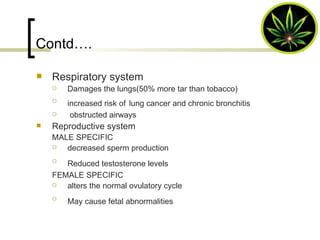
Contd…. Respiratory system Damages the lungs(50% more tar than tobacco) increased risk of   lung cancer and chronic bronchitis obstructed airways Reproductive system MALE SPECIFIC decreased sperm production Reduced testosterone levels   FEMALE SPECIFIC alters the normal ovulatory cycle May cause fetal abnormalities
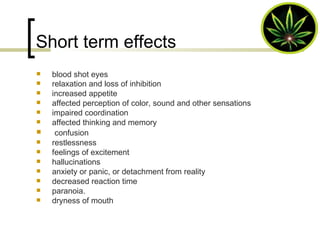
Short term effects blood shot eyes relaxation and loss of inhibition   increased appetite  affected perception of color, sound and other sensations  impaired coordination  affected thinking and memory confusion  restlessness  feelings of excitement  hallucinations  anxiety or panic, or detachment from reality  decreased reaction time  paranoia.  dryness of mouth
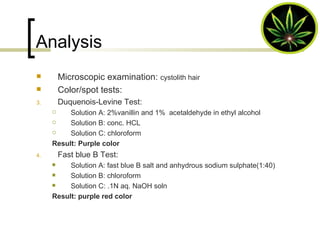
Analysis Microscopic examination:  cystolith hair Color/spot tests: Duquenois-Levine Test: Solution A: 2%vanillin and 1%  acetaldehyde in ethyl alcohol Solution B: conc. HCL Solution C: chloroform Result: Purple color  Fast blue B Test: Solution A: fast blue B salt and anhydrous sodium sulphate(1:40) Solution B: chloroform Solution C: .1N aq. NaOH soln Result: purple red color
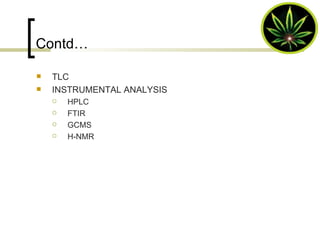
TLC INSTRUMENTAL ANALYSIS HPLC FTIR GCMS H-NMR Contd…
references Encyclopedia of Narcotic Drugs and Psychotropic substances; Giri Raj Shah Handbook of CNS agents and local anesthetics; Matthew Verderane Hallucinogens- A Forensic Drug Handbook; edited by Richard R Laing, Jay A Siegel Clarke’s isolation and identification of drugs in pharmaceutical body fluids and postmortem material- A. C Moffat Essentials of Medical Pharmacology; 5 th  edition, KD Tripathi Modi’s Medical Jurisprudence and Toxicology; edited by BV Subrahmanyam Toxicology-A case oriented approach; by John Joseph Fenton Casarett and Doulls Toxicology- The Basic Science of Poisons; edited by John Doull, Curtiss D Klassen, Mary O Amdur
Textbook of Forensic Medicine and Toxicology;2 nd  edition, Krishnan Vij www.who.int/substance_abuse/facts/cannabis/en www.nida.nih.gov www.emedicine.com www.unodc.org/world drug report.html Contd…

Canabbis

  • 1.
  • 2.
    OVERVIEW Introduction HistoryWorld drug report Data Forms and modes of usage Chemistry Mechanism of action Long term effects Short term effects Analysis References
  • 3.
    CANNABIS It isa generic term used to denote several psychoactive preparations of the plant Cannabis Sativa Cannabis Sativa is a fast growing annular plant of the family Cannabaceae The active chemical in cannabis is THC Varieties – C Indica, C Mexicana, C Americana
  • 4.
  • 5.
    UN Office OnDrugs and Crime WORLD DRUG REPORT 2006 Approximately 4 per cent of the world's adults-some 162 million people-use cannabis every year, making it the world's most widely used illicit drug. “ the annual prevalence of abuse among the age group of 15-64 in India is 3.2 per cent for cannabis, 0.4 per cent for opiates and 0.01 per cent for Ecstasy” i.e. about 2.3 million people are dependent on cannabis in India alone
  • 6.
    Consumers and Producers- www.unodc.org/world_drug_report.html
  • 7.
    USE OF CANNABIS2003-2004 (or latest year available) Source: World Drug Report 2006 - www.unodc.org/world_drug_report.html
  • 8.
    Forms and modesof usage Herbal Cannabis Marijuana -combination of the flowering tops and leaves.   Bhang – dried mature leaves, twigs and fruiting shoots of male and female plant, least potent - sabji, satti, sidhi Ganja – flowering or fruiting tops, coated with exude of female plant - rusty green colour - joint sticks,Thaisticks, buddha sticks Marijuana and ganja are smoked in hand rolled cigarettes, pipe or chillum or can be brewed as tea
  • 9.
  • 10.
  • 11.
    Contd…. Charas Crude resin from leaves and flowering tops of female plant Green to brown to black Hashish, Black Moroccan, sulpha, nasha, kif, khit, red seal, red Lebanese Smoked in pipe or by placing a bit on tip of cigarette , baked or eaten as hash cookies THC content – 4% - 12%
  • 12.
  • 13.
  • 14.
    Contd…. Hashish oilThick, oily liquid , extracted from hashish by solvent extraction Golden brown to black Hash oil, red oil, honey oil Smoked in a bong or hookah or by putting a few drops on cigarette or joint THC content – 20% to 60%
  • 15.
  • 16.
    Chemistry Over 60structurally similar compounds, “ Cannabinoids” The major active principle in all cannabis products is Δ9- tetrahydrocannabinol (Δ9-THC or simply THC ) Others include cannabidiol ( CBD ) and cannabinol ( CBN )
  • 17.
    Mechanism of actionTwo specific cannabinoid receptors CB1 - brain and peripheral tissues. CB2 - immune system ANANDAMIDE (Sanskrit word for “bliss”), the natural neurotransmitter that fits into the receptor sites. Receptors for anandamide found in several regions of the brain, The highest densities being in the frontal cerebral cortex (higher functioning), hippocampus (memory, cognition), basal ganglion and cerebellum (movement), and striatum (brain reward ). THC activates neurons because its chemical structure mimics the natural neurotransmitters
  • 18.
    Receptor sites inbrain (movement) ) (Learning,memory) (temp regulation ) (Fear)
  • 19.
    Long Term EffectsBrain &CNS Dulls sensory & cognitive skills Impairs short term memory Alters motor coordination Reduced Concentration Immune system Impair the ability to fight off microbial and viral infection Cardiovascular system Increased heart rate Decreased blood flow to the limbs Decreased blood pressure Reduced oxygen carrying capacity of blood
  • 20.
    Contd…. Respiratory systemDamages the lungs(50% more tar than tobacco) increased risk of lung cancer and chronic bronchitis obstructed airways Reproductive system MALE SPECIFIC decreased sperm production Reduced testosterone levels FEMALE SPECIFIC alters the normal ovulatory cycle May cause fetal abnormalities
  • 21.
    Short term effectsblood shot eyes relaxation and loss of inhibition increased appetite affected perception of color, sound and other sensations impaired coordination affected thinking and memory confusion restlessness feelings of excitement hallucinations anxiety or panic, or detachment from reality decreased reaction time paranoia. dryness of mouth
  • 22.
    Analysis Microscopic examination: cystolith hair Color/spot tests: Duquenois-Levine Test: Solution A: 2%vanillin and 1% acetaldehyde in ethyl alcohol Solution B: conc. HCL Solution C: chloroform Result: Purple color Fast blue B Test: Solution A: fast blue B salt and anhydrous sodium sulphate(1:40) Solution B: chloroform Solution C: .1N aq. NaOH soln Result: purple red color
  • 23.
    TLC INSTRUMENTAL ANALYSISHPLC FTIR GCMS H-NMR Contd…
  • 24.
    references Encyclopedia ofNarcotic Drugs and Psychotropic substances; Giri Raj Shah Handbook of CNS agents and local anesthetics; Matthew Verderane Hallucinogens- A Forensic Drug Handbook; edited by Richard R Laing, Jay A Siegel Clarke’s isolation and identification of drugs in pharmaceutical body fluids and postmortem material- A. C Moffat Essentials of Medical Pharmacology; 5 th edition, KD Tripathi Modi’s Medical Jurisprudence and Toxicology; edited by BV Subrahmanyam Toxicology-A case oriented approach; by John Joseph Fenton Casarett and Doulls Toxicology- The Basic Science of Poisons; edited by John Doull, Curtiss D Klassen, Mary O Amdur
  • 25.
    Textbook of ForensicMedicine and Toxicology;2 nd edition, Krishnan Vij www.who.int/substance_abuse/facts/cannabis/en www.nida.nih.gov www.emedicine.com www.unodc.org/world drug report.html Contd…