Translation & Interpretation

        A Global Career

        By Masud Hasnain
        mhasnain@clearedtranslators.com


                                          1
What is Translation?
   Transferring written text from a
   source language into the target
   language while maintaining the author’s
   intent


                                             2
What is Interpretation?
   Interpretation is the transfer of
   spoken speech from a source
   language into a target language while
   maintaining the speaker’s intent.

   Interpreters must go in both directions,
   so they have to speak both equally well.

                                           3
Basic Definitions:

   From: Source Language


   To: Target Language


                           4
Language Pair is


Source Language + Target Language

          Arabic/English
          English/Arabic


                                    5
What gets translated?
   •   Business contracts
   •   Government documents
   •   Court/Legal documents
   •   Personal documents
   •   Literary works
   •   Software
   •   Film sub-titles
   •   Advertisements
   •   Medical records

       ANYTHING IN TYPE!
                               6
Types of Interpreting:
       Consecutive

       Simultaneous / Conference

       Escort

       Voice-Over

       Transcription
                                   7
Where do Translators and
Interpreters Work?
     As Free-lancers / Independent Contractors
     In-house
      •   Business
      •   Hospitals
      •   Legal / Courts
      •   Government
      •   Literary
      •   Technology / Computers
      •   Government / U.N. / Consulates
      •   Escort


                                                 8
How can I qualify to be a translator?
     Knowledge of foreign language(s)
     Education
     Excellent writer
     Attention to detail
     Computer literate
     Able to focus and follow through
     Reliable & professional
     Flexible

                                        9
To be a translator you must
     Know the target language perfectly
     Understand the source language very well
     Be prepared to study and review grammar
     regularly
     Have access to appropriate dictionaries
     Be a good proofreader or get someone
     else
     Read regularly in both your languages
     Know the culture(s) of the people that
     speak the languages that you work with
                                                10
How do I qualify to be an interpreter?
     Have a pleasant voice
     Ethical
     Reliable & professional
     Educated
     Have patience
     Flexible
     Experienced
     Accessible

                                     11
To be an interpreter you must...
     Know both the source and target languages equally well
     Must use the tone of the original speaker
     Must convey the speakers’ exact messages
     Have a great store of knowledge in your short or long-term
     memory
     Learn as many dialects and regional jargon as possible
     within your languages
     Keep your cool under pressure and tension
     Establish trust with those you work for

                                                                  12
Some Interpretation Specialties
   Schools
   Court/Judiciary
   Medical
   Conferences
   Escort or seminar (State Dept.)
   Diplomatic/Embassies
   Many more …
                                     13
Necessary Investments
    Have a computer and Internet access
    Software in both your languages
    Learn to use Word

    Membership in ATA and local translation
    association
    Have office space or space in a home office
    Have business cards, résumé and brochure
    Dictionaries & reference materials
                                                  14
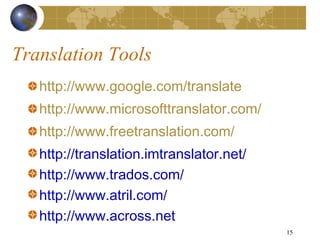
Translation Tools
   http://www.google.com/translate
   http://www.microsofttranslator.com/
   http://www.freetranslation.com/
   http://translation.imtranslator.net/
   http://www.trados.com/
   http://www.atril.com/
   http://www.across.net
                                          15
Translation & Interpretation Organizations
     NCATA: National Capital Area Translation Association www.ncata.org

     ATA: American Translators Association www.atanet.org

     NAJIT: National Association of Judiciary Interpreters and Translators
     www.najit.org

     AIIC: International Association of Conference Interpreters www.aiic.net

     National Center for State Courts www.ncsconline.org.

     National Council on Interpreting in Health Care – NCIHC
     www.ncihc.org


                                                                             16
Practice interpretation with a relative or a
                   friend


                                           17
Q&A

      18

Translation

  • 1.
    Translation & Interpretation A Global Career By Masud Hasnain mhasnain@clearedtranslators.com 1
  • 2.
    What is Translation? Transferring written text from a source language into the target language while maintaining the author’s intent 2
  • 3.
    What is Interpretation? Interpretation is the transfer of spoken speech from a source language into a target language while maintaining the speaker’s intent. Interpreters must go in both directions, so they have to speak both equally well. 3
  • 4.
    Basic Definitions: From: Source Language To: Target Language 4
  • 5.
    Language Pair is SourceLanguage + Target Language Arabic/English English/Arabic 5
  • 6.
    What gets translated? • Business contracts • Government documents • Court/Legal documents • Personal documents • Literary works • Software • Film sub-titles • Advertisements • Medical records ANYTHING IN TYPE! 6
  • 7.
    Types of Interpreting: Consecutive Simultaneous / Conference Escort Voice-Over Transcription 7
  • 8.
    Where do Translatorsand Interpreters Work? As Free-lancers / Independent Contractors In-house • Business • Hospitals • Legal / Courts • Government • Literary • Technology / Computers • Government / U.N. / Consulates • Escort 8
  • 9.
    How can Iqualify to be a translator? Knowledge of foreign language(s) Education Excellent writer Attention to detail Computer literate Able to focus and follow through Reliable & professional Flexible 9
  • 10.
    To be atranslator you must Know the target language perfectly Understand the source language very well Be prepared to study and review grammar regularly Have access to appropriate dictionaries Be a good proofreader or get someone else Read regularly in both your languages Know the culture(s) of the people that speak the languages that you work with 10
  • 11.
    How do Iqualify to be an interpreter? Have a pleasant voice Ethical Reliable & professional Educated Have patience Flexible Experienced Accessible 11
  • 12.
    To be aninterpreter you must... Know both the source and target languages equally well Must use the tone of the original speaker Must convey the speakers’ exact messages Have a great store of knowledge in your short or long-term memory Learn as many dialects and regional jargon as possible within your languages Keep your cool under pressure and tension Establish trust with those you work for 12
  • 13.
    Some Interpretation Specialties Schools Court/Judiciary Medical Conferences Escort or seminar (State Dept.) Diplomatic/Embassies Many more … 13
  • 14.
    Necessary Investments Have a computer and Internet access Software in both your languages Learn to use Word Membership in ATA and local translation association Have office space or space in a home office Have business cards, résumé and brochure Dictionaries & reference materials 14
  • 15.
    Translation Tools http://www.google.com/translate http://www.microsofttranslator.com/ http://www.freetranslation.com/ http://translation.imtranslator.net/ http://www.trados.com/ http://www.atril.com/ http://www.across.net 15
  • 16.
    Translation & InterpretationOrganizations NCATA: National Capital Area Translation Association www.ncata.org ATA: American Translators Association www.atanet.org NAJIT: National Association of Judiciary Interpreters and Translators www.najit.org AIIC: International Association of Conference Interpreters www.aiic.net National Center for State Courts www.ncsconline.org. National Council on Interpreting in Health Care – NCIHC www.ncihc.org 16
  • 17.
    Practice interpretation witha relative or a friend 17
  • 18.
    Q&A 18