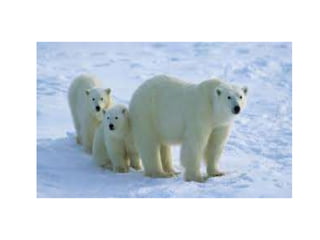
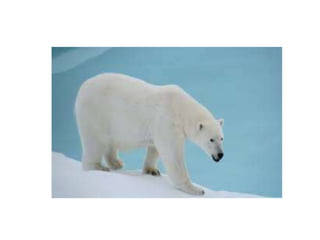
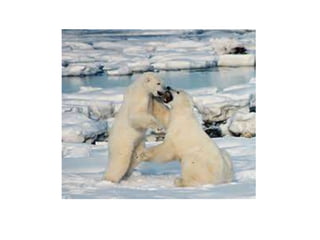
Today’s class will be about…..
POLAR BEARS
How much do we know
about them?
Let’s read about them
• Polar bears live in the Far North in a cold place called the
Arctic. They are big, powerful, white bears. Adult males
normally weigh 1,200 pounds Polar bears are perfectly adapted
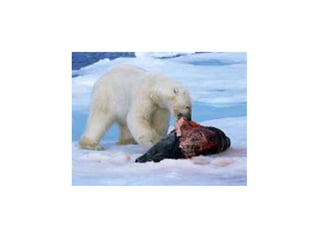
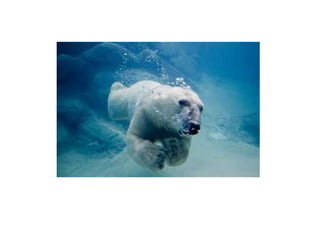
for life on the sea ice. They hunt their main prey there: seals.
Polar bears don’t hibernate. Most of them remain on the sea
ice all winter long to hunt seals. Pregnant female bears dig
snow dens in the fall to give birth—but this is not a true
hibernation. They remain in the dens for four to eight months.
During that time, they don’t eat or drink and must live off their
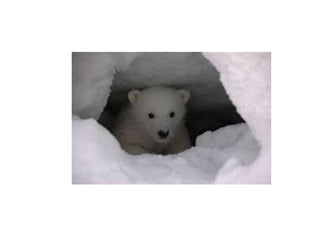
fat reserves. Polar bears mothers usually give birth to twins.
Polar bear cubs weigh just over one pound at birth! Polar bear
cubs remain with their mother in the den until they are three
or four months old, drinking her rich milk. The cubs snuggle
close to mom to stay warm. When the cubs are big enough, the
family leaves the den so the mother can return to the sea ice to
hunt seals. Polar bears are at risk in a warming world. They
need sea ice to hunt seals, and the sea ice is melting. This is
caused by global warming from greenhouse gases.
• The good news is that it is not too late!
What have we learnt about polar
bears?
Take the questions/ answer sheet
and answer the questions
THANK YOU
Teacher: Fernanda Davalos Avila

G2.davalos.avila.maria.fernanda.ett

  • 1.
    Today’s class willbe about…..
  • 3.
    POLAR BEARS How muchdo we know about them?
  • 9.
  • 10.
    • Polar bearslive in the Far North in a cold place called the Arctic. They are big, powerful, white bears. Adult males normally weigh 1,200 pounds Polar bears are perfectly adapted for life on the sea ice. They hunt their main prey there: seals. Polar bears don’t hibernate. Most of them remain on the sea ice all winter long to hunt seals. Pregnant female bears dig snow dens in the fall to give birth—but this is not a true hibernation. They remain in the dens for four to eight months. During that time, they don’t eat or drink and must live off their fat reserves. Polar bears mothers usually give birth to twins. Polar bear cubs weigh just over one pound at birth! Polar bear cubs remain with their mother in the den until they are three or four months old, drinking her rich milk. The cubs snuggle close to mom to stay warm. When the cubs are big enough, the family leaves the den so the mother can return to the sea ice to hunt seals. Polar bears are at risk in a warming world. They need sea ice to hunt seals, and the sea ice is melting. This is caused by global warming from greenhouse gases. • The good news is that it is not too late!
  • 11.
    What have welearnt about polar bears? Take the questions/ answer sheet and answer the questions
  • 12.