TRANSFORMATIVE
CURRICULUM

Based on HENDERSON AND
   HAWTHORNE, 2001
    By Esperanza Vera
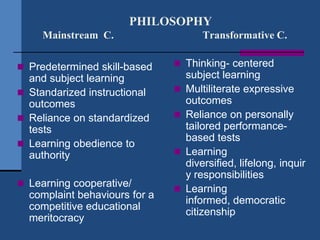
PHILOSOPHY
     Mainstream C.                     Transformative C.

 Predetermined skill-based     Thinking- centered
  and subject learning             subject learning
 Standarized instructional       Multiliterate expressive
  outcomes                         outcomes
 Reliance on standardized        Reliance on personally
  tests                            tailored performance-
                                   based tests
 Learning obedience to
  authority                       Learning
                                   diversified, lifelong, inquir
                                   y responsibilities
 Learning cooperative/
                                  Learning
  complaint behaviours for a
                                   informed, democratic
  competitive educational
                                   citizenship
  meritocracy
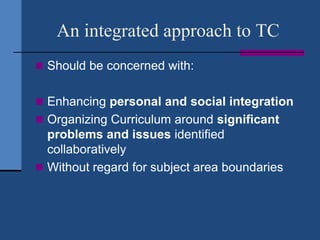
An integrated approach to TC
 Should be concerned with:


 Enhancing personal and social integration
 Organizing Curriculum around significant
  problems and issues identified
  collaboratively
 Without regard for subject area boundaries
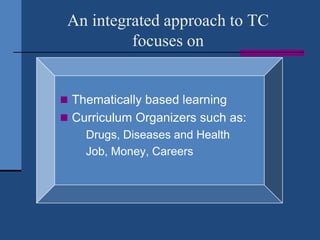
An integrated approach to TC
          focuses on


 Thematically based learning
 Curriculum Organizers such as:
     Drugs, Diseases and Health
     Job, Money, Careers
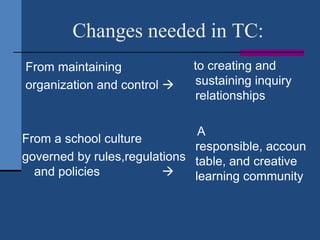
Changes needed in TC:
From maintaining             to creating and
organization and control    sustaining inquiry
                             relationships

                               A
From a school culture
                              responsible, accoun
governed by rules,regulations table, and creative
  and policies               learning community
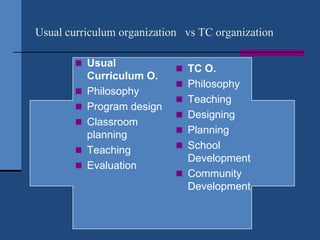
Usual curriculum organization vs TC organization

         Usual
                              TC O.
            Curriculum O.
                              Philosophy
           Philosophy
                              Teaching
           Program design
                              Designing
           Classroom
            planning          Planning

           Teaching          School
                               Development
           Evaluation
                              Community
                               Development
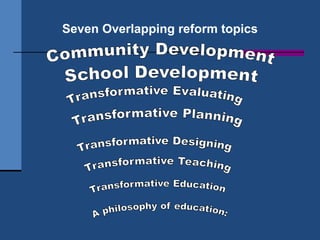
Seven Overlapping reform topics
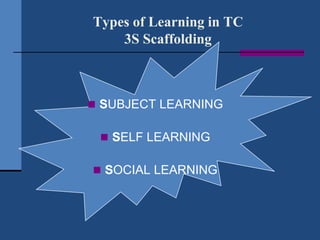
Types of Learning in TC
    3S Scaffolding


 SUBJECT LEARNING

  SELF LEARNING

 SOCIAL LEARNING
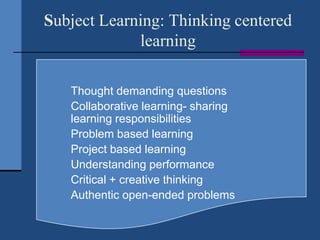
Subject Learning: Thinking centered
             learning

     Thought demanding questions
     Collaborative learning- sharing
      learning responsibilities
     Problem based learning
     Project based learning
     Understanding performance
     Critical + creative thinking
     Authentic open-ended problems
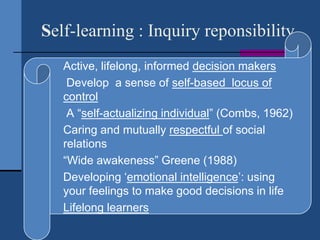
Self-learning : Inquiry reponsibility
    Active, lifelong, informed decision makers
     Develop a sense of self-based locus of
     control
     A “self-actualizing individual” (Combs, 1962)
    Caring and mutually respectful of social
     relations
    “Wide awakeness” Greene (1988)
    Developing „emotional intelligence‟: using
     your feelings to make good decisions in life
    Lifelong learners
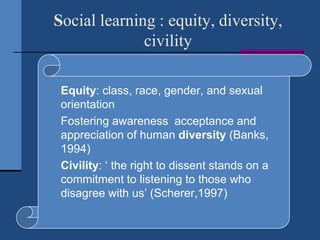
Social learning : equity, diversity,
              civility

   Equity: class, race, gender, and sexual
    orientation
   Fostering awareness acceptance and
    appreciation of human diversity (Banks,
    1994)
   Civility: „ the right to dissent stands on a
    commitment to listening to those who
    disagree with us‟ (Scherer,1997)
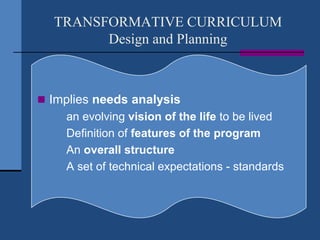
TRANSFORMATIVE CURRICULUM
        Design and Planning


 Implies needs analysis
     an evolving vision of the life to be lived
     Definition of features of the program
     An overall structure
     A set of technical expectations - standards
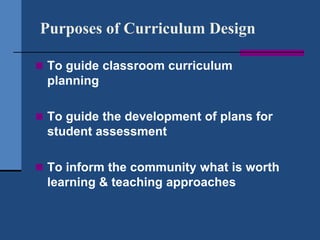
Purposes of Curriculum Design

 To guide classroom curriculum
 planning

 To guide the development of plans for
 student assessment

 To inform the community what is worth
 learning & teaching approaches
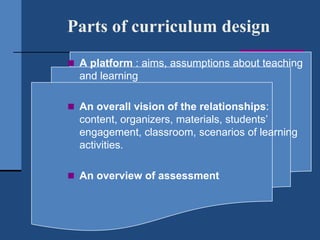
Parts of curriculum design
 A platform : aims, assumptions about teaching
  and learning

 An overall vision of the relationships:
  content, organizers, materials, students‟
  engagement, classroom, scenarios of learning
  activities.

 An overview of assessment
PRACTICAL ACTIVITY


 How can you use the fable of the
 “RED HEN” to foster subject
 learning, self-learning and social
 learning within a transformative
 curriculum framework?
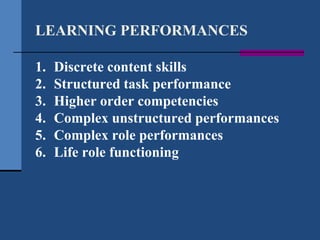
LEARNING PERFORMANCES

1.   Discrete content skills
2.   Structured task performance
3.   Higher order competencies
4.   Complex unstructured performances
5.   Complex role performances
6.   Life role functioning
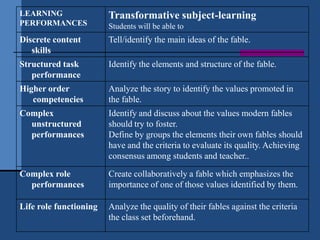
LEARNING                Transformative subject-learning
PERFORMANCES            Students will be able to
Discrete content        Tell/identify the main ideas of the fable.
   skills
Structured task         Identify the elements and structure of the fable.
   performance
Higher order            Analyze the story to identify the values promoted in
   competencies         the fable.
Complex                 Identify and discuss about the values modern fables
  unstructured          should try to foster.
  performances          Define by groups the elements their own fables should
                        have and the criteria to evaluate its quality. Achieving
                        consensus among students and teacher..

Complex role            Create collaboratively a fable which emphasizes the
  performances          importance of one of those values identified by them.

Life role functioning   Analyze the quality of their fables against the criteria
                        the class set beforehand.
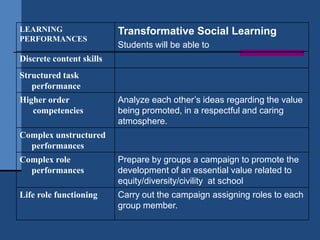
LEARNING                  Transformative Social Learning
PERFORMANCES
                          Students will be able to
Discrete content skills
Structured task
   performance
Higher order              Analyze each other‟s ideas regarding the value
   competencies           being promoted, in a respectful and caring
                          atmosphere.
Complex unstructured
  performances
Complex role              Prepare by groups a campaign to promote the
  performances            development of an essential value related to
                          equity/diversity/civility at school
Life role functioning     Carry out the campaign assigning roles to each
                          group member.
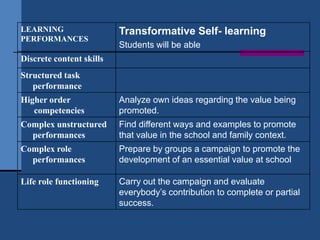
LEARNING                  Transformative Self- learning
PERFORMANCES
                          Students will be able
Discrete content skills
Structured task
   performance
Higher order              Analyze own ideas regarding the value being
   competencies           promoted.
Complex unstructured      Find different ways and examples to promote
  performances            that value in the school and family context.
Complex role              Prepare by groups a campaign to promote the
  performances            development of an essential value at school

Life role functioning     Carry out the campaign and evaluate
                          everybody‟s contribution to complete or partial
                          success.
Assessing student learning

         What have students learnt?
  What students can do with what they know &
   how + insights
 Quality of school life + quality of sts‟ learning –
   ACTION RESEARCH
Forms:
1. Performance assessment
2. Portfolio assessment
HOW WOULD YOU ASSESS
THE SUBJECT, SOCIAL, AND
SELF LEARNING IN THE
PREVIOUS UNIT?

Transformative curriculum

  • 1.
    TRANSFORMATIVE CURRICULUM Based on HENDERSONAND HAWTHORNE, 2001 By Esperanza Vera
  • 2.
    PHILOSOPHY Mainstream C. Transformative C.  Predetermined skill-based  Thinking- centered and subject learning subject learning  Standarized instructional  Multiliterate expressive outcomes outcomes  Reliance on standardized  Reliance on personally tests tailored performance- based tests  Learning obedience to authority  Learning diversified, lifelong, inquir y responsibilities  Learning cooperative/  Learning complaint behaviours for a informed, democratic competitive educational citizenship meritocracy
  • 3.
    An integrated approachto TC  Should be concerned with:  Enhancing personal and social integration  Organizing Curriculum around significant problems and issues identified collaboratively  Without regard for subject area boundaries
  • 4.
    An integrated approachto TC focuses on  Thematically based learning  Curriculum Organizers such as:  Drugs, Diseases and Health  Job, Money, Careers
  • 5.
    Changes needed inTC: From maintaining to creating and organization and control  sustaining inquiry relationships A From a school culture responsible, accoun governed by rules,regulations table, and creative and policies  learning community
  • 6.
    Usual curriculum organizationvs TC organization  Usual  TC O. Curriculum O.  Philosophy  Philosophy  Teaching  Program design  Designing  Classroom planning  Planning  Teaching  School Development  Evaluation  Community Development
  • 7.
  • 8.
    Types of Learningin TC 3S Scaffolding  SUBJECT LEARNING  SELF LEARNING  SOCIAL LEARNING
  • 9.
    Subject Learning: Thinkingcentered learning  Thought demanding questions  Collaborative learning- sharing learning responsibilities  Problem based learning  Project based learning  Understanding performance  Critical + creative thinking  Authentic open-ended problems
  • 10.
    Self-learning : Inquiryreponsibility  Active, lifelong, informed decision makers  Develop a sense of self-based locus of control  A “self-actualizing individual” (Combs, 1962)  Caring and mutually respectful of social relations  “Wide awakeness” Greene (1988)  Developing „emotional intelligence‟: using your feelings to make good decisions in life  Lifelong learners
  • 11.
    Social learning :equity, diversity, civility  Equity: class, race, gender, and sexual orientation  Fostering awareness acceptance and appreciation of human diversity (Banks, 1994)  Civility: „ the right to dissent stands on a commitment to listening to those who disagree with us‟ (Scherer,1997)
  • 12.
    TRANSFORMATIVE CURRICULUM Design and Planning  Implies needs analysis  an evolving vision of the life to be lived  Definition of features of the program  An overall structure  A set of technical expectations - standards
  • 13.
    Purposes of CurriculumDesign  To guide classroom curriculum planning  To guide the development of plans for student assessment  To inform the community what is worth learning & teaching approaches
  • 14.
    Parts of curriculumdesign  A platform : aims, assumptions about teaching and learning  An overall vision of the relationships: content, organizers, materials, students‟ engagement, classroom, scenarios of learning activities.  An overview of assessment
  • 15.
    PRACTICAL ACTIVITY  Howcan you use the fable of the “RED HEN” to foster subject learning, self-learning and social learning within a transformative curriculum framework?
  • 16.
    LEARNING PERFORMANCES 1. Discrete content skills 2. Structured task performance 3. Higher order competencies 4. Complex unstructured performances 5. Complex role performances 6. Life role functioning
  • 17.
    LEARNING Transformative subject-learning PERFORMANCES Students will be able to Discrete content Tell/identify the main ideas of the fable. skills Structured task Identify the elements and structure of the fable. performance Higher order Analyze the story to identify the values promoted in competencies the fable. Complex Identify and discuss about the values modern fables unstructured should try to foster. performances Define by groups the elements their own fables should have and the criteria to evaluate its quality. Achieving consensus among students and teacher.. Complex role Create collaboratively a fable which emphasizes the performances importance of one of those values identified by them. Life role functioning Analyze the quality of their fables against the criteria the class set beforehand.
  • 18.
    LEARNING Transformative Social Learning PERFORMANCES Students will be able to Discrete content skills Structured task performance Higher order Analyze each other‟s ideas regarding the value competencies being promoted, in a respectful and caring atmosphere. Complex unstructured performances Complex role Prepare by groups a campaign to promote the performances development of an essential value related to equity/diversity/civility at school Life role functioning Carry out the campaign assigning roles to each group member.
  • 19.
    LEARNING Transformative Self- learning PERFORMANCES Students will be able Discrete content skills Structured task performance Higher order Analyze own ideas regarding the value being competencies promoted. Complex unstructured Find different ways and examples to promote performances that value in the school and family context. Complex role Prepare by groups a campaign to promote the performances development of an essential value at school Life role functioning Carry out the campaign and evaluate everybody‟s contribution to complete or partial success.
  • 20.
    Assessing student learning What have students learnt?  What students can do with what they know & how + insights  Quality of school life + quality of sts‟ learning – ACTION RESEARCH Forms: 1. Performance assessment 2. Portfolio assessment
  • 21.
    HOW WOULD YOUASSESS THE SUBJECT, SOCIAL, AND SELF LEARNING IN THE PREVIOUS UNIT?