ALIGARH MUSLIM UNIVERSITY
DEPARTMENT OF EDUCATION
M.ED. (II SEMISTER)
PRESENTED BY:- ABUL HASAN
abulhasanranaamu2007@gmail.com
TOPIC:
INCLUSIV
E
EDUCATIO
NPRESENTED
BY:-
ABUL HASAN
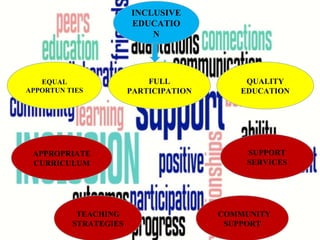
INCLUSIVE
EDUCATIO
N
EQUAL
APPORTUN TIES
FULL
PARTICIPATION
QUALITY
EDUCATION
APPROPRIATE
CURRICULUM
TEACHING
STRATEGIES
SUPPORT
SERVICES
COMMUNITY
SUPPORT
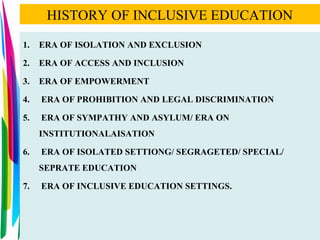
1. ERA OF ISOLATION AND EXCLUSION
2. ERA OF ACCESS AND INCLUSION
3. ERA OF EMPOWERMENT
4. ERA OF PROHIBITION AND LEGAL DISCRIMINATION
5. ERA OF SYMPATHY AND ASYLUM/ ERA ON
INSTITUTIONALAISATION
6. ERA OF ISOLATED SETTIONG/ SEGRAGETED/ SPECIAL/
SEPRATE EDUCATION
7. ERA OF INCLUSIVE EDUCATION SETTINGS.
HISTORY OF INCLUSIVE EDUCATION
REPORTS AND SCHOOLS
1. In 1944, Sergent Report . According to this report,
handicapped children were to be sent to special
schools only when the nature and extent of their
defects mede this necessary.
2. The Kothari commission (1964-66) the first
education commission of independent india,
observed: “the education of the handicapped
children should be an inseparable part of the
education system.”
3. The first school for blind was established in 1887.
4. An institute for deaf and mute, was set up in 1888.
5. The first school for mentally challenged being
established in 1934 (Mishra, 2000).
MEANING OF INCLUSIVE EDUCATION
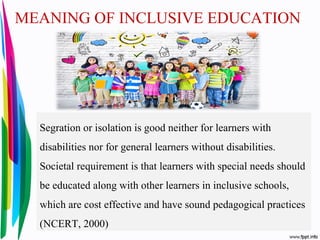
Segration or isolation is good neither for learners with
disabilities nor for general learners without disabilities.
Societal requirement is that learners with special needs should
be educated along with other learners in inclusive schools,
which are cost effective and have sound pedagogical practices
(NCERT, 2000)
DEEFINITION OF INCLUSIVE
EDUCATION
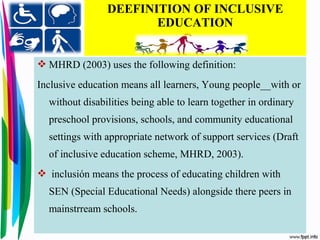
 MHRD (2003) uses the following definition:
Inclusive education means all learners, Young people__with or
without disabilities being able to learn together in ordinary
preschool provisions, schools, and community educational
settings with appropriate network of support services (Draft
of inclusive education scheme, MHRD, 2003).
 inclusión means the process of educating children with
SEN (Special Educational Needs) alongside there peers in
mainstrream schools.
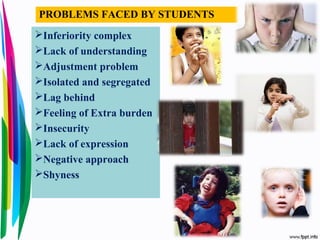
Inferiority complex
Lack of understanding
Adjustment problem
Isolated and segregated
Lag behind
Feeling of Extra burden
Insecurity
Lack of expression
Negative approach
Shyness
PROBLEMS FACED BY STUDENTS
SPECIFIC TARGETED MEASURES TO PROMOTE
INCLUSIVE EDUCATION
1. Removing the barriers to inclusive education.
2. Working and supporting parents.
3. Early childhood and care services.
4. Ensuring access and availability of inclusive education.
5. Creating inclusive learning environments.
6. Securing appropriate individualized support for children with
disabilities.
7. Developing inclusive curricula, teaching and learning methods.
8. Introdcution of rights based and inclusive student assessments.
9. Investment in teacher training.
10. Support within schools for teachers.
11. Establishing resources to provide specialist support.
12. A child-centered, safe and healthy environment.
https://www.unicef.org/ceecis/education_18613.html
References:
1. (3.3) Position Paper National Focus Group On Education Of
Children With Special Needs ISBN 81-7450-494-X
2. https://www.unicef.org/ceecis/education_18613.html.
3. Images downloads from Google .
4. Video download from YOUTUBE
https://youtu.be/8HPh4RoV63s
INCLUSIVE EDUCATION

INCLUSIVE EDUCATION

  • 1.
    ALIGARH MUSLIM UNIVERSITY DEPARTMENTOF EDUCATION M.ED. (II SEMISTER) PRESENTED BY:- ABUL HASAN abulhasanranaamu2007@gmail.com
  • 2.
  • 3.
  • 4.
    1. ERA OFISOLATION AND EXCLUSION 2. ERA OF ACCESS AND INCLUSION 3. ERA OF EMPOWERMENT 4. ERA OF PROHIBITION AND LEGAL DISCRIMINATION 5. ERA OF SYMPATHY AND ASYLUM/ ERA ON INSTITUTIONALAISATION 6. ERA OF ISOLATED SETTIONG/ SEGRAGETED/ SPECIAL/ SEPRATE EDUCATION 7. ERA OF INCLUSIVE EDUCATION SETTINGS. HISTORY OF INCLUSIVE EDUCATION
  • 5.
    REPORTS AND SCHOOLS 1.In 1944, Sergent Report . According to this report, handicapped children were to be sent to special schools only when the nature and extent of their defects mede this necessary. 2. The Kothari commission (1964-66) the first education commission of independent india, observed: “the education of the handicapped children should be an inseparable part of the education system.” 3. The first school for blind was established in 1887. 4. An institute for deaf and mute, was set up in 1888. 5. The first school for mentally challenged being established in 1934 (Mishra, 2000).
  • 6.
    MEANING OF INCLUSIVEEDUCATION Segration or isolation is good neither for learners with disabilities nor for general learners without disabilities. Societal requirement is that learners with special needs should be educated along with other learners in inclusive schools, which are cost effective and have sound pedagogical practices (NCERT, 2000)
  • 7.
    DEEFINITION OF INCLUSIVE EDUCATION MHRD (2003) uses the following definition: Inclusive education means all learners, Young people__with or without disabilities being able to learn together in ordinary preschool provisions, schools, and community educational settings with appropriate network of support services (Draft of inclusive education scheme, MHRD, 2003).  inclusión means the process of educating children with SEN (Special Educational Needs) alongside there peers in mainstrream schools.
  • 8.
    Inferiority complex Lack ofunderstanding Adjustment problem Isolated and segregated Lag behind Feeling of Extra burden Insecurity Lack of expression Negative approach Shyness PROBLEMS FACED BY STUDENTS
  • 9.
    SPECIFIC TARGETED MEASURESTO PROMOTE INCLUSIVE EDUCATION 1. Removing the barriers to inclusive education. 2. Working and supporting parents. 3. Early childhood and care services. 4. Ensuring access and availability of inclusive education. 5. Creating inclusive learning environments. 6. Securing appropriate individualized support for children with disabilities.
  • 10.
    7. Developing inclusivecurricula, teaching and learning methods. 8. Introdcution of rights based and inclusive student assessments. 9. Investment in teacher training. 10. Support within schools for teachers. 11. Establishing resources to provide specialist support. 12. A child-centered, safe and healthy environment. https://www.unicef.org/ceecis/education_18613.html
  • 11.
    References: 1. (3.3) PositionPaper National Focus Group On Education Of Children With Special Needs ISBN 81-7450-494-X 2. https://www.unicef.org/ceecis/education_18613.html. 3. Images downloads from Google . 4. Video download from YOUTUBE https://youtu.be/8HPh4RoV63s