Parent Functions and
Transformations
Transformation of Functions
Recognize graphs of common functions
Use shifts to graph functions
Use reflections to graph functions
Graph functions w/ sequence of transformations
The following basic graphs will be used
extensively in this section. It is important
to be able to sketch these from memory.
The identity function
f(x) = x
The quadratic function
2
)
( x
x
f 
x
x
f 
)
(
The square root function
x
x
f 
)
(
The absolute value function
3
)
( x
x
f 
The cubic function
The rational function
1
( )
f x
x

We will now see how certain
transformations (operations) of a
function change its graph. This will give
us a better idea of how to quickly
sketch the graph of certain functions.
The transformations are
(1) translations, (2) reflections, and (3)
stretching.
Vertical Translation
OUTSIDE IS TRUE!
Vertical Translation
the graph of y = f(x) + d is
the graph of y = f(x) shifted
up d units;
the graph of y = f(x)  d is the
graph of y = f(x) shifted down
d units.
2
( )
f x x
 2
( ) 3
f x x
 
2
( ) 2
f x x
 
Horizontal Translation
INSIDE LIES!
Horizontal Translation
the graph of y = f(x  c) is the
graph of y = f(x) shifted right
c units;
the graph of y = f(x + c) is the
graph of y = f(x) shifted left c
units.
2
( )
f x x

 
2
2
y x
   
2
2
y x
 
The values that translate the graph of a
function will occur as a number added or
subtracted either inside or outside a
function.
Numbers added or subtracted inside
translate left or right, while numbers
added or subtracted outside translate up
or down.
( )
y f x c d
  
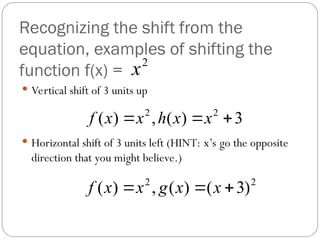
Recognizing the shift from the
equation, examples of shifting the
function f(x) =
 Vertical shift of 3 units up
 Horizontal shift of 3 units left (HINT: x’s go the opposite
direction that you might believe.)
3
)
(
,
)
( 2
2


 x
x
h
x
x
f
2
2
)
3
(
)
(
,
)
( 

 x
x
g
x
x
f
2
x
Use the basic graph to sketch the
following:
( ) 3
f x x
 
2
( ) 5
f x x
 
3
( ) ( 2)
f x x
  ( ) 3
f x x
 
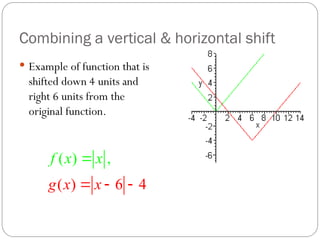
Combining a vertical & horizontal shift
 Example of function that is
shifted down 4 units and
right 6 units from the
original function.
( ) 6
)
4
( ,
g x x
f x x
 


Use the basic graph to sketch the
following:
( )
f x x

( )
f x x
 
2
( )
f x x

( )
f x x

The big picture…
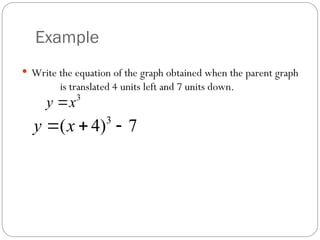
Example
 Write the equation of the graph obtained when the parent graph
is translated 4 units left and 7 units down.
3
y x

3
( 4) 7
y x
  
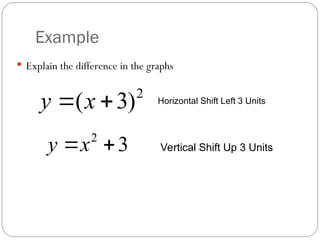
Example
 Explain the difference in the graphs
2
( 3)
y x
 
2
3
y x
 
Horizontal Shift Left 3 Units
Vertical Shift Up 3 Units
 Describe the differences between the graphs
 Try graphing them…
2
y x
 2
4
y x
 2
1
4
y x

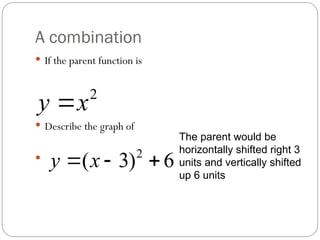
A combination
 If the parent function is
 Describe the graph of

2
y x

2
( 3) 6
y x
  
The parent would be
horizontally shifted right 3
units and vertically shifted
up 6 units
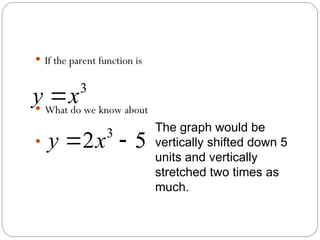
 If the parent function is
 What do we know about

3
y x

3
2 5
y x
 
The graph would be
vertically shifted down 5
units and vertically
stretched two times as
much.
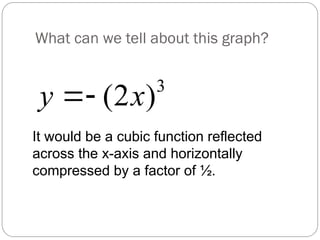
What can we tell about this graph?
3
(2 )
y x

It would be a cubic function reflected
across the x-axis and horizontally
compressed by a factor of ½.

parent functions and transformations.ppt

  • 1.
  • 2.
    Transformation of Functions Recognizegraphs of common functions Use shifts to graph functions Use reflections to graph functions Graph functions w/ sequence of transformations
  • 3.
    The following basicgraphs will be used extensively in this section. It is important to be able to sketch these from memory.
  • 4.
  • 5.
  • 6.
  • 7.
  • 8.
    3 ) ( x x f  Thecubic function
  • 9.
  • 10.
    We will nowsee how certain transformations (operations) of a function change its graph. This will give us a better idea of how to quickly sketch the graph of certain functions. The transformations are (1) translations, (2) reflections, and (3) stretching.
  • 11.
    Vertical Translation OUTSIDE ISTRUE! Vertical Translation the graph of y = f(x) + d is the graph of y = f(x) shifted up d units; the graph of y = f(x)  d is the graph of y = f(x) shifted down d units. 2 ( ) f x x  2 ( ) 3 f x x   2 ( ) 2 f x x  
  • 12.
    Horizontal Translation INSIDE LIES! HorizontalTranslation the graph of y = f(x  c) is the graph of y = f(x) shifted right c units; the graph of y = f(x + c) is the graph of y = f(x) shifted left c units. 2 ( ) f x x    2 2 y x     2 2 y x  
  • 13.
    The values thattranslate the graph of a function will occur as a number added or subtracted either inside or outside a function. Numbers added or subtracted inside translate left or right, while numbers added or subtracted outside translate up or down. ( ) y f x c d   
  • 14.
    Recognizing the shiftfrom the equation, examples of shifting the function f(x) =  Vertical shift of 3 units up  Horizontal shift of 3 units left (HINT: x’s go the opposite direction that you might believe.) 3 ) ( , ) ( 2 2    x x h x x f 2 2 ) 3 ( ) ( , ) (    x x g x x f 2 x
  • 15.
    Use the basicgraph to sketch the following: ( ) 3 f x x   2 ( ) 5 f x x   3 ( ) ( 2) f x x   ( ) 3 f x x  
  • 16.
    Combining a vertical& horizontal shift  Example of function that is shifted down 4 units and right 6 units from the original function. ( ) 6 ) 4 ( , g x x f x x    
  • 17.
    Use the basicgraph to sketch the following: ( ) f x x  ( ) f x x   2 ( ) f x x  ( ) f x x 
  • 18.
  • 19.
    Example  Write theequation of the graph obtained when the parent graph is translated 4 units left and 7 units down. 3 y x  3 ( 4) 7 y x   
  • 20.
    Example  Explain thedifference in the graphs 2 ( 3) y x   2 3 y x   Horizontal Shift Left 3 Units Vertical Shift Up 3 Units
  • 21.
     Describe thedifferences between the graphs  Try graphing them… 2 y x  2 4 y x  2 1 4 y x 
  • 22.
    A combination  Ifthe parent function is  Describe the graph of  2 y x  2 ( 3) 6 y x    The parent would be horizontally shifted right 3 units and vertically shifted up 6 units
  • 23.
     If theparent function is  What do we know about  3 y x  3 2 5 y x   The graph would be vertically shifted down 5 units and vertically stretched two times as much.
  • 24.
    What can wetell about this graph? 3 (2 ) y x  It would be a cubic function reflected across the x-axis and horizontally compressed by a factor of ½.