1
ORGANISATIONAL STRUCTURE
• Systematic arrangement of people working in an
organization in order to achieve the predefined
goals.
• It defines the authority and responsibility relations
between various positions.
• It shows interrelationships and relative position of
each department.
4
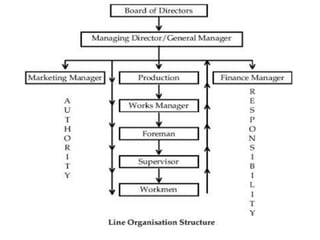
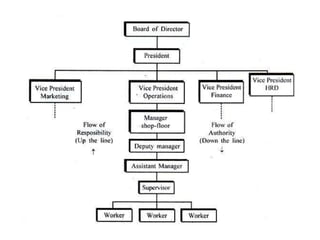
Advantages
• Simple and easy to understand
• It is flexible, easy to expand
• Makes clear division of authority
• Clear channel of communication, no confusion.
• Strong in discipline
• Encourages speedy action
Disadvantages
• Neglects specialists
• Overloads a few key executives.
• Limited to small organizations
5
Cont…
• Lack of specialization
• More wastage of resources such as material and man
hours.
Applications
• Small organizations
• Automatic and continuous process industries such as
paper, sugar, textile etc.
6
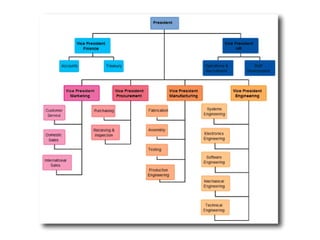
9
Advantages
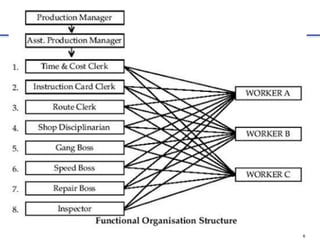
• Makes use of experts
• Expert guidance reduces wastage, accidents etc.
• No need of all round executives.
• Quality of work is improved
Disadvantages
• Difficult to maintain discipline
• All round executives cannot be developed.
• Makes industrial relationships more complex
• Workers are not given opportunity to use their
initiative and drive.
10
Applications
• The functional organization as such is obsolete.
• In modified form it is used in some most modern and
advanced concerns.
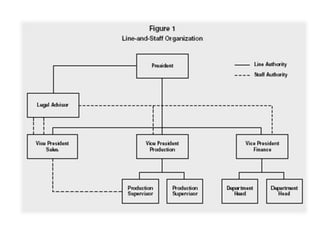
13
Advantages
• Expert advice from specialist staff executives.
• Line executives are relieved of some of their loads and
can devote more attention towards production.
• Less wastage of resources.
• Improved quality of production
• There is no confusion as exists in functional
organization.
Disadvantages
• High salaries of staff executives increases product
cost.
14
Cont …
• Some times staff department may infringe upon the
rights and responsibilities of line departments.
• Frictions and jealousies may develop between line and
staff executives.
• Line executives if they depending too much on staff
executives may loose their initiative and drive .
Application
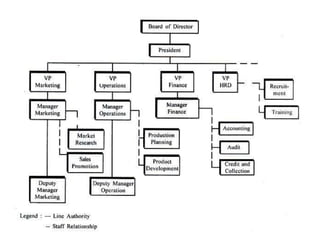
• Line and staff organization is very common among the
medium and larger enterprises.
15
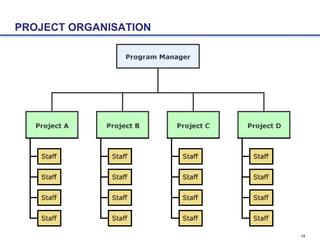
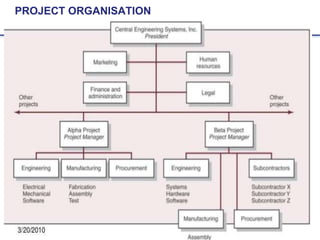
PROJECT ORGANISATION
16
PROJECT ORGANISATION
17
18
19
20
21
APPLICATIONS
• Electronics
• Chemicals
• Advertising
• Aerospace
• Banking
• Insurance
• Hospitals

Types of organisation

  • 1.
    1 ORGANISATIONAL STRUCTURE • Systematicarrangement of people working in an organization in order to achieve the predefined goals. • It defines the authority and responsibility relations between various positions. • It shows interrelationships and relative position of each department.
  • 4.
    4 Advantages • Simple andeasy to understand • It is flexible, easy to expand • Makes clear division of authority • Clear channel of communication, no confusion. • Strong in discipline • Encourages speedy action Disadvantages • Neglects specialists • Overloads a few key executives. • Limited to small organizations
  • 5.
    5 Cont… • Lack ofspecialization • More wastage of resources such as material and man hours. Applications • Small organizations • Automatic and continuous process industries such as paper, sugar, textile etc.
  • 6.
  • 9.
    9 Advantages • Makes useof experts • Expert guidance reduces wastage, accidents etc. • No need of all round executives. • Quality of work is improved Disadvantages • Difficult to maintain discipline • All round executives cannot be developed. • Makes industrial relationships more complex • Workers are not given opportunity to use their initiative and drive.
  • 10.
    10 Applications • The functionalorganization as such is obsolete. • In modified form it is used in some most modern and advanced concerns.
  • 13.
    13 Advantages • Expert advicefrom specialist staff executives. • Line executives are relieved of some of their loads and can devote more attention towards production. • Less wastage of resources. • Improved quality of production • There is no confusion as exists in functional organization. Disadvantages • High salaries of staff executives increases product cost.
  • 14.
    14 Cont … • Sometimes staff department may infringe upon the rights and responsibilities of line departments. • Frictions and jealousies may develop between line and staff executives. • Line executives if they depending too much on staff executives may loose their initiative and drive . Application • Line and staff organization is very common among the medium and larger enterprises.
  • 15.
  • 16.
  • 17.
  • 18.
  • 19.
  • 20.
  • 21.
    21 APPLICATIONS • Electronics • Chemicals •Advertising • Aerospace • Banking • Insurance • Hospitals