Transdermal Delivery Systems
PRESENTED BY : SHUBHRAT MAHESHWARI
M.PHARMA 1st
YEAR (1st
sem.)
BRANCH : PHARMACEUTICS
DRUG DELIVERY SYSTEM (MPH 102T)
SRMS COLLEGE OF ENGINEERING & TECHNOLOGY
BAREILLY
CONTENTS
• INTRODUCTION
• DEFINITION
• ADVANTAGES
• DISADVANTAGES
• TRANSDERMAL ROUTE OF DRUG DELIVERY PROSPECTS
• ROUTES OF DRUG PENETRATION THROUGH SKIN
• PROPERTIES OF INFLUENCE TRANSDERMAL DELIVERY
• FACTOR AFFECTING TRANSDERMAL PERMEATION
• TECHNOLOGIES FOR DEVELOPING TDDS
• COMPONENTS OF TDDS
• COMPONENTS OF TRANSDERMAL PATCHES
• TYPES OF TRANSDERMAL PATCHES
• EVALUATION PARAMETER
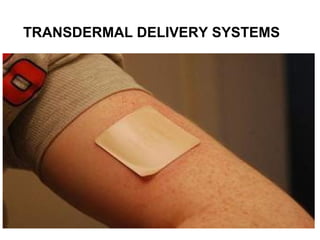
TRANSDERMAL DELIVERY SYSTEMS
INTRODUCTION
• Transdermal drug delivery is hardly an old technology, since 1800’s and the technology is no longer just
adhesive patches. Due to recent advances in technology and the ability to apply the drug to the site of
action without rupturing the skin membrane, transdermal route is becoming a widely accepted route of
drug administration.
• Definition:
• Transdermal drug delivery system can deliver the drugs through the skin portal to systemic circulation at
predetermined rate and maintain clinically the effective concentrations over a prolonged period of time.
• Transdermal drug delivery systems (TDDSs) facilitate the passage of therapeutic quantities of drug
substances through the skin and into the general circulation for their systemic effects.
• In 1965, Stoughton first conceived of the percutaneous absorption of drug substances.
• The first transdermal system, Transderm Scop (Baxter), was approved by the Food and Drug
Administration (FDA) in 1979 for prevention of nausea and vomiting associated with travel, particularly at
sea.
• Over the last two decades more than 35 Transdermal patch products have been approved in US.
Advantages of Transdermal Drug delivery System
• Avoids chemically hostile GI environment (drug degradation in acidic and basic environments is
prevented).
• No GI distress and the factors like Gastric emptying, intestinal motility, transit time, donot effect this route
as in oral route.
• Avoidance of significant presystemic metabolism (degradation in GIT or by the liver) and therefore need
lower doses.
• Allows effective use of drugs with short biological half-life.
• Allow administration of drugs with narrow therapeutic window because drug levels are maintained within
the therapeutic window for prolonged periods of time.
• Reduced inter and intra patient variability.
• Enhance therapeutic efficacy, reduced fluctuations (rapid blood level spikes-low and high) due to
optimization of blood concentration – time profile.
• Reduction of dosing frequency and enhancement of patient compliance.
• Provides controlled plasma levels of very potent drugs.
• Can provide adequate absorption of certain drugs.
• Avoids the risk and inconveniences of parenteral therapy (Painless method of drug administration).
• Drug input can be promptly interrupted simply by removal of the patch when toxicity occurs.
• Provides suitability of self medication.
Disadvantages of Transdermal Drug delivery System
• Transdermal drug delivery system cannot deliver ionic drugs.
• It cannot achieve high drug levels in blood.
• It cannot develop for drugs of large molecular size.
• It cannot deliver drugs in a pulsatile fashion.
• It cannot develop if drug or formulation causes irritation to skin.
• Possibility of local irritation at site of application.
• May cause allergic reaction.
• Sufficient aqueous and lipid solubility, a log P (octanol/ water) between 1 and 3 is required for permeate to
transverse stratum corneum and underlying aqueous layer.
• Only potent drugs are suitable candidates for transdermal patch because of the natural limits of drug entry
imposed by the skin’s impermeability.
• Long time adherence is difficult.
• Uncomfortable to wear.
• May not be economical.
Transdermal route and drug delivery prospects
• Skin
• Largest organ ofthehuman body
• Covers surface areaapproximately 2 sq.m.
• Receives one third of blood circulation through the body
• Serves as a permeability barrier against transdermal absorption
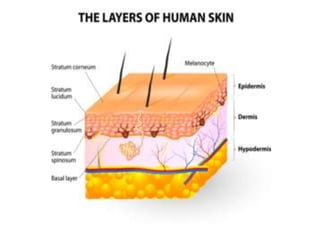
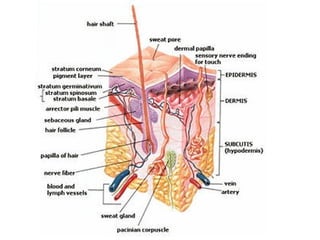
Anatomy of skin-
The structure of human skin can be categorized into four main layers
 The epidermis
 The viable epidermis
 A non-viable epidermis (Stratum corneum
 The overlying dermis
 The innermost subcutaneous fat layer (Hypodermis)
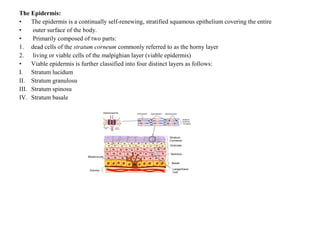
The Epidermis:
• The epidermis is a continually self-renewing, stratified squamous epithelium covering the entire
• outer surface of the body.
• Primarily composed of two parts:
1. dead cells of the stratum corneum commonly referred to as the horny layer
2. living or viable cells of the malpighian layer (viable epidermis)
• Viable epidermis is further classified into four distinct layers as follows:
I. Stratum lucidum
II. Stratum granulosu
III. Stratum spinosu
IV. Stratum basale
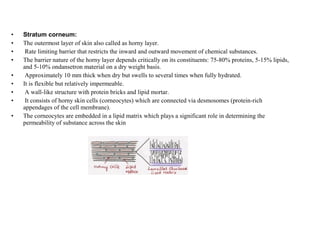
• Stratum corneum:
• The outermost layer of skin also called as horny layer.
• Rate limiting barrier that restricts the inward and outward movement of chemical substances.
• The barrier nature of the horny layer depends critically on its constituents: 75-80% proteins, 5-15% lipids,
and 5-10% ondansetron material on a dry weight basis.
• Approximately 10 mm thick when dry but swells to several times when fully hydrated.
• It is flexible but relatively impermeable.
• A wall-like structure with protein bricks and lipid mortar.
• It consists of horny skin cells (corneocytes) which are connected via desmosomes (protein-rich
appendages of the cell membrane).
• The corneocytes are embedded in a lipid matrix which plays a significant role in determining the
permeability of substance across the skin
• Viable epidermis:
• This is situated beneath the stratum corneum and varies in thickness from 0.06 mm on the eyelids to 0.8mm
on the palms.
• Going inwards, it consists of various layers as stratum lucidum, stratum granulosum, stratum spinosum,
and the stratum basale. In the basale layer, mitosis of the cells constantly renews the epidermis and this
proliferation compensates the loss of dead horny cells from the skin surface. As the cells produced by the
basale layer move outward, they itself alter morphologically and histochemically, undergoing
keratinization to form the outermost layer of stratum corneum.
• Dermis :
• Dermis is the layer of skin just beneath the epidermis which is 3 to 5 mm thick layer.
• It is composed of a matrix of connective tissues, which contains blood vessels, and nerve.
• Cutaneous blood supply has essential function in regulation of body temperature.
• It also provides nutrients and oxygen to the skin, while removing toxins and waste products.
• The capillaries reach to within 0.2 mm of skin surface and provide sink conditions for most molecules
penetrating the skin barrier.
• The blood supply thus keeps the dermal concentration of permeate very low, and the resulting
concentration difference across the epidermis provides the essential driving force for transdermal
permeation.
• In terms of transdermal drug delivery, this layer is often viewed as essentially gelled water, and thus
provides a minimal barrier to the delivery of most polar drugs, although the dermal barrier may be
significant when delivering highly lipophillic molecules.
• Hypodermis ( subcutaneous) :
• The hypodermis fat tissue supports the dermis and epidermis.
• It serves as a fat storage area.
• This layer helps regulate temperature, provides nutritional support and mechanical protection.
• It carries principal blood vessels and nerve to skin and may contain sensory pressure organs.
• For transdermal drug delivery, drug has to penetrate through all three layer and reach in systemic
circulation.
• Percutaneous absorption :
• Before a topically applied drug can act either locally or systemically, it must penetrate through stratum
corneum.
• Percutaneous absorption is defined as penetration of substances into various layers of skin and permeation
across the skin into systemic circulation.
• Percutaneous absorption of drug molecules is of particular importance in transdermal drug delivery system
because the drug has to be absorbed to an adequate extent and rate to achieve and maintain uniform,
systemic, therapeutic levels throughout the duration of use.
• In general once drug molecule cross the stratum corneal barrier, passage into deeper dermal layers and
systemic uptake occurs relatively quickly and easily.
• 1. Dissolution within and release from the formulation
• 2. Partitioning into the skin’s outermost layer, the stratum corneum (SC)
• 3. Diffusion through the SC, principally via a lipidic intercellular pathway.
• 4. Partitioning from the SC into the aqueous viable epidermis, diffusion through the viable
epidermis and into the upper dermis, uptake into the papillary dermis (capillary system) and into the
microcirculation.
• Routes of drug penetration through skin:
• In the process of percutaneous permeation, a drug molecule may pass through the epidermis itself or may
get diffuse through shunts, particularly those offered by the relatively widely distributed hair follicles and
endocrine glands.
• In the initial transient diffusion stage, drug molecules may penetrate the skin along the hair follicles or
sweat ducts and then absorbed through the follicular epithelium and the sebaceous glands.
• When a steady state has been reached the diffusion through the intact Stratum corneum becomes the
primary pathway for transdermal permeation.
• For any molecules applied to the skin, two main routes of skin permeation can be defined:
• A. Transepidermal route
• B. Transfollicular route
• A. Transepidermal route:
• In transepidermal transport, molecules cross the intact horny layer.
• Two potential micro-routes of entry exist, the transcellular (or intracellular) and the intercellular pathway.
• Both polar and non-polar substances diffuse via transcellular and intercellular routes by different
mechanism.The polar molecules mainly diffuse through the polar pathway consisting of “bound water”
within the hydrated stratum corneum whereas the non-polar molecules dissolve and diffuse through the
non-aqueous lipid matrix of the stratum corneum.
• Thus the principal pathway taken by a penetrant is decided mainly by the partition coefficient (log K).
Hydrophilic drugs partition preferentially into the intracellular domains, whereas lipophillic permeants
(octanol/water log K > 2) traverse the stratum corneum via the intercellular route. Most molecules pass the
stratum corneum by both routes.
• B. Transfollicular route (Shunt pathway):
• This route comprises transport via the sweat glands and the hair follicles with their associated sebaceous
glands.
• Although these routes offer high permeability, they are considered to be of minor importance because of
their relatively small area, approximately 0.1% area of the total skin.
• This route seems to be most important for ions and large polar molecules which hardly permeate through
the stratum corneum.
• Fundamentals of skin permeation :
• Until the last century the skin was supposed to be impermeable with exception to gases.
• However, in the current century the study indicated the permeability to lipid soluble drugs. Also it was
recognized that various layers of skin are not equally permeable i.e. epidermis is less permeable than
dermis.
• After a large controversy, all doubts about stratum permeability were removed and using isotropic tracers,
it was suggested that stratum corneum greatly hamper permeation.
• a. Stratum corneum as skin permeation barrier
• The average human skin contains 40-70 hair follicles and 200-250 sweat ducts per square centimeter.
• Especially water-soluble substances pass faster through these ducts, still these ducts don’t contribute much
for skin permeation.
• Therefore most neutral molecules pass through stratum corneum by passive diffusion.
• b. Intracellular verses transcellular diffusion
• Intracellular regions in stratum corneum are filled with lipid rich amorphous material.
• In drystratum corneum intracellular volume may be 5% to 1% in fully hydrated stratum corneum.
• c. Permeation pathways:
• Percutaneous absorption involves passive diffusion of the substances through the skin.
• A molecule may use two diffusional routes to penetrate normal intact skin, the appendageal route and the
epidermal route.
•
1. Appendageal route:
Appendageal route comprises transport via sweat glands and hair follicles with their associated sebaceous
glands. These routes circumvent penetration through the stratum corneum and are therefore known as
“shunt” routes. This route is considered to be of minor importance because of its relatively small area,
approximately 0.1 % of the total skin area.
• 2. Epidermal route:
• For drugs, which mainly cross-intact horney layer, two potential micro routes of entry exists, the
transcellular (intracellular) and intercellular pathways.
• i)Transcellular : Transcellular pathway means transport of molecules across epithelial cellular membrane.
These include passive transport of small molecules, active transport of ionic and polar compounds and
endocytosis and transcytosis of macromolecules.
• ii) Paracellular : Paracellular pathway means transport of molecules around or between the cells and tight
junctions or similar situations exist between the cells.
• The principal pathway taken by a permeant is decided mainly by the partition coefficient (log k).
Hydrophilic drugs partition preferentially into the intracellular domains, whereas lipophilic permeants
traverse the stratum corneum via the intercellular route. Most permeants permeate the stratum corneum by
both routes. However, the tortuous intercellular pathway is widely considered to provide the principal route
and major barrier to the permeation of most drugs.
• C. Barrier functions of the skin:
• The top layer of skin is most important function in maintaining the effectiveness of the barrier. Here the
individual cells overlie each other and are tightly packed, preventing bacteria from entry and maintaining
the water holding properties of the skin.
• Stratum corneum mainly consists of the keratinized dead cell and water content is also less as compared to
the other skin components. Lipids are secreted by the cells from the base layer of the skin to the top. These
lipid molecules join up and form a tough connective network, in effect acting as the mortar between the
bricks of a wall.
• D. Basic Principal of Transdermal permeation :
• Transdermal permeation is based on passive diffusion. Skin is the most intensive and readily accessible
organ of the body as only a fraction of millimeter of tissue separates its surface from the underlying
capillary network. The release of a therapeutic agent from a formulation applied to the skin surface and its
transport to the systemic circulation is a multistep process, which includes
• 1) Diffusion of drug from drug to the rate controlling membrane.
• 2) Dissolution within and release from the formulation.
• 3) Sorption by stratum corneum and penetration through viable epidermis.
• 4) Uptake of drug by capillary network in the dermal papillary layer.
• 5) Effect on the target organ.
• 6) Partitioning into the skin’s outermost layer, the stratum corneum.
• 7) Diffusion through the stratum corneum, principal via a lipidic intercellular pathway.
• Properties that influence transdermal delivery:
1.Release of the medicament from the vehicle
2.Penetration through the skin barrier.
3.Activation of the pharmacological response.
• Kinetics of transdermal permeation:
• Skin permeation kinetics is important for the successful development of the transdermal systems.
Transdermal permeation of a drug involves the following steps,
• a. Sorption by stratum corneum
• b. Penetration of drug through viable epidermis
• c. Uptake of the drug in the dermal papillary layer
• The rate of permeation across the skin is given by, eqn 1
• Where, Ps is the overall permeability constant of the skin tissue to the penetrant Cd is concentration of
skin penetrant in the donor compartment (e.g., on the surface of stratum corneum) Cr is concentration in
the receptor compartment (e.g., body)
• Where,
• Ks is the partition coefficient for the interfacial partitioning of the penetrant molecule from a solution
medium onto the stratum corneum Dss apparent diffusivity of the penetrant molecule hs overall thickness
of skin tissues
• As Ks, Dss and hs are constant under given conditions, the permeability coefficient (Ps) for a skin
penetrant can be considered to be constant. From Eq.1 it is clear that a constant rate of drug permeation can
be obtained only when i.e., the drug concentration at the surface of the stratum corneum (Cd) is greater
than the drug concentration in the body (Cr) then Eq.1 becomes, eqn
• And the rate of skin permeation is constant provided the magnitude of Cd remains fairly constant
throughout the course of skin permeation. For keeping Cd constant the drug should be released from the
device at a rate Rr i.e. either constant or greater than the rate of skin uptake Ra i.e. . Since Rr >> Ra , the
drug concentration on the skin surface Cd is maintained at a level equal to or greater than the equilibrium
solubility of the drug in the stratum corneum Cs .i.e. Cd>>Cs. Therefore a maximum rate of skin
permeation is obtained and is given by the equation,
• From the above equation it can be seen that the maximum rate of skin permeation depends upon the skin
permeability coefficient Ps and equilibrium solubility in the stratum corneum Cs. Thus skin permeation
appears to be stratum corneum limited
• The membrane limited flux (J) under steady state condition is described by equation,
• Where,
• J is amount of drug passing through membrane system per unit area per unit time
• D is diffusion coefficient of drug within the membrane
• C is concentration gradient across the membrane
• K is the membrane / vehicle partition coefficient
• h is the membrane thickness.
Factors affecting transdermal permeation
•Biological factor:
•1. Skin conditions: The intact skin itself acts as barrier but many agents like acids ,alkali cross the barrier
cells and penetrates through the skin ,many solvents open the complex dense structure of horny layer Solvents
like methanol, chloroform remove lipid fraction, forming artificial shunts through which drug molecules can
pass easily.
•2. Skin age: It is seen that the skin of adults and young ones are more permeable than the older ones but there
is no dramatic difference .Children shows toxic effects because of the greater surface area per unit body
weight .thus potent steroids, boric acid, hexachlorophene have produced severe side effects.
•3. Blood Supply: Changes in peripheral circulation can affect transdermal absorption.
•4. Regional skin site: Thickness of skin, nature of stratum corneum and density of appendages vary site to site.
These factors affect significantly penetration
•5. Skin metabolism: Skin metabolizes steroids, hormones, chemical carcinogens and some drugs. So skin
metabolism determines efficacy of drug permeated through the skin.
•6. Species differences: The skin thickness, density of appendages and keratinization of skin vary species to
species, so affects the penetration.
• Physicochemical factors:
• 1. Skin hydration : In contact with water the permeability of skin increases significantly. Hydration is
most important factor increasing the permeation of skin. So use of humectant is done in transdermal
delivery.
• 2. Temperature and pH : The permeation of drug increases ten folds with temperature variation. The
diffusion coefficient decreases as temperature falls. Weak acids and weak bases dissociate depending on
the pH and pKa or pKb values. The proportion of unionized drug determines the drug concentration in
skin. Thus, temperature and pH are important factors affecting drug penetration
• 3. Diffusion coefficient : Penetration of drug depends on diffusion coefficient of drug. At a constant
temperature the diffusion coefficient of drug depends on properties of drug, diffusion medium and
interaction between them.
• 4. Drug concentration : The flux is proportional to the concentration gradient across the barrier and
concentration gradient will be higher if the concentration of drug will be more across the barrier.
• 5. Partition coefficient : The optimal partition coefficient (K) is required for good action. Drugs with high
K are not ready to leave the ipid portion of skin. Also, drugs with low K will not be permeated.
• 6. Molecular size and shape : Drug absorption is inversely related to molecular weight, small molecules
penetrate faster than large ones.
• Environmental factors:
• 1. Sunlight : Due to Sunlight the walls of blood vessels become thinner leading to bruising with only
minor trauma in sun-exposed areas. Also pigmentation: The most noticeable sun-induced pigment change
is a freckle or solar lentigo.
• 2 Cold Season : Often result in itchy, dry skin. Skin responds by increasing oil production to compensate
for the weather’s drying effects. A good moisturizer will help ease symptoms of dry skin. Also, drinking
lots of water can keep your skin hydrated and looking radiant.
• 3 Air Pollution : Dust can clog pores and increase bacteria on the face and surface of skin, both of which
lead to acne or spots. This affects drug delivery through the skin. Invisible chemical pollutants in the air
can interfere with skin’s natural protection system, breaking down the natural skin’s oils that normally trap
moisture in skin and keep it supple.
• Effect of Heat on Transdermal patch :
• Heat induced high absorption of transdermal delivered drugs. Patient should be advised to avoid exposing
the patch application site to external heat source like heated water bags, hot water bottles. Even high body
temperature may also increase the transdermally delivered drugs. In this case the patch should be removed
immediately. Transdermal drug patches are stored in their original packing and keep in a cool, dry place
until they are ready to used.
• Design of transdermal delivery system The basic components of any transdermal delivery system include
the drug dissolved or dispersed in an inert polymer matrix that provides support and platform for drug
release. There are two basic designs of the patch system that dictate drug release characteristics and patch
behavior:
• i) Matrix or Monolithic : The inert polymer matrix binds with the drug and controls it’s release from the
device.
• ii) Reservoir or Membrane : The polymer matrix does not control drug release. Instead, a rate controlling
membrane present between the drug matrix and the adhesive layer provides the rate limiting barrier for
drug release from the device.
• Technologies for developing transdermal drug delivery
systems :
• The technologies can be classified in four basic approaches :
• A) Polymer membrane partition-controlled TDD systems
• In this type of systems, the drug reservoir is sandwiched between a drug-impermeable backinglaminate and
a rate controlling polymeric membrane. The drug is allowed to permeate only through the rate controlling
membrane. The drug solids are homogeneously dispersed in a solid polymer matrix, suspended in an
unleachable, viscous liquid medium e.g. silicone fluid to form a paste like suspension or dissolved in a
releasable solvent e.g. alkyl alcohol to form a clear drug solution. The rate controlling membrane can be
either a microporous or a nonporous polymeric membrane e.g. ethylene-vinyl acetate copolymer, with
specific drug permeability. On the external surface of the polymeric membrane a thin layer of drug-
compatible, hypoallergenic pressure sensitive adhesive polymer e.g. silicone adhesive may be applied to
provide intimate contact of TDDS with the skin surface.
• Varying the composition of drug reservoir formulation, the permeability coefficient and thickness of rate
controlling membrane can alter the drug release rate.e.g. Some FDA approved systems – Transderm- Nitro
for angina pectoris, Transderm-Scop for motion sickness, Catapres-TTS system for hypertension.
•The intrinsic rate of drug release from this type of TDD system is defined by
•dq/dt = (Km/r.Ka/m.Da.Dm/Km/r.Dm.ha+Ka/m Dahm) CR
•where, C R is drug concentration in reservoir compartment.
• Km / r the partition coefficient for the interfacial partitioning of drug from the reservoir to the membrane.
•Ka / m the partition coefficient for the interfacial partitioning of drug from membrane to adhesive.
• Da diffusion coefficient in rate controlling membrane.
•Dm diffusion coefficient in adhesive layer.
•ha thickness of rate controlling membrane.
•hm thickness of adhesive layer.
• B) Polymer matrix diffusion-controlled TDD systems
• In this system, the drug reservoir is formed by homogeneously dispersing the drug solids in a hydrophilic
or lipophilic polymer matrix and then the medicated polymer formed is molded into medicated disks with
defined surface area and thickness. This drug reservoir containing polymer disk is then mounted on
occlusive baseplate in a compartment fabricated from a drug-impermeable plastic backing.
• Instead of coating adhesive polymer directly on the surface of medicated disk, it is applied along the
circumference of the patch to form a strip of adhesive rim surrounding the medicated disk. e.g. Nitro-Dur
system and NTS system for angina pectoris.
• The rate of release from polymer matrix drug dispersion-type is
• dq/dt =(LdCpDp/ 2t)1/2
• where, L d is drug loading dose initially dispersed in polymer matrix.
• Cp is solubility of drug in polymer matrix.
• Dp is diffusivity of drug in polymer matrix.
• Only drug dissolved in polymer matrix can diffuse, Cp is practically equal to CR Alternately, the polymer
matrix drug dispersion type TDDS can be fabricated by directly dispersing drug in a pressure-sensitive
adhesive polymer e.g. polyacrylate and then coating the drug-dispersed adhesive polymer by solvent
casting or hot melt onto a flat sheet of drug- impermeable backing laminate to form a single layer of drug
reservoir, this yields a thinner patch.eg. Minitran system, Nitro-Dur II system for angina pectoris.
• C) Drug reservoir gradient-controlled TDD systems
• Polymer matrix drug dispersion-type TDDS can be modified to have the drug loading level varied in an
incremental manner, forming a gradient of drug reservoir along the diffusional path across the
multilaminate adhesive layers.
• D) Microreservoir dissolution-controlled TDD systems
• This thermodynamically unstable system is quickly stabilized by immediately cross-linking the polymer
chains in situ, which produces a medicated polymer disk with a constant surface area and a fixed thickness.
Medicated disk is mounted at the center of an adhesive pad.
• eg : Nitrodisk system for angina pectoris.
Components of TDDS
• The main components of a transdermal patch are :
• i. Release Liner
• Protects the patch during storage. The liner is removed prior to use.
• ii. Drug reservoir
• The most important part of TDDS is drug reservoir. It consists of drug particles dissolved or dispersed in
the matrix. To make the drug soluble, solvents and cosolvents are used. The effect of solvent and cosolvent
should be considered while doing selection.
• iii. Adhesive
• Serves to adhere the components of the patch together along with adhering the patch to the skin.The
adhesive must posses sufficient adhesion property so that the TDDS should remain in place for a long time.
Pressure sensitive adhesives are commonly used for transdermal patch to hold the skin. Commonly used
adhesives are silicone adhesives, poly iso butylenes adhesives and polyacrylate based adhesives.
• iv. Membrane
• Membrane controls the release of the drug from the reservoir and multi-layer patches. It may or may not
contain rate-controlling membrane. It should be flexible enough not to split or crack on bending or
stretching. Some of rate-controlling membranes are polyethylene sheets, ethylene vinyl acetate copolymer
and cellulose acetate.
Components of transdermal patches
• 1.Drug reservoir
• The most important part of TDDS is drug reservoir. It consists of drug particles dissolved or dispersed in
the matrix. To make the drug soluble, solvents and cosolvents are used. The effect of solvent and cosolvent
should be considered while doing selection
• Physicochemical properties:
• • The drug should have a molecular weight less than 1000 Daltons.
• • The drug should have affinity for both lipophilic and hydrophilic phasea. Extreme partitioning
characteristics are not conductive to successful drug delivery via the skin.
• • The drug should have low melting point.
• • Along with these properties the drug should be potent, having short half life and be non-irritating.
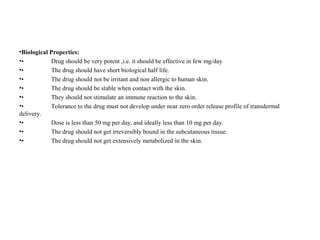
•Biological Properties:
•• Drug should be very potent ,i.e. it should be effective in few mg/day
•• The drug should have short biological half life.
•• The drug should not be irritant and non allergic to human skin.
•• The drug should be stable when contact with the skin.
•• They should not stimulate an immune reaction to the skin.
•• Tolerance to the drug must not develop under near zero order release profile of transdermal
delivery.
•• Dose is less than 50 mg per day, and ideally less than 10 mg per day.
•• The drug should not get irreversibly bound in the subcutaneous tissue.
•• The drug should not get extensively metabolized in the skin.
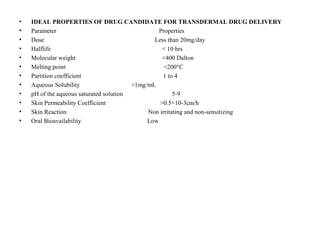
• IDEAL PROPERTIES OF DRUG CANDIDATE FOR TRANSDERMAL DRUG DELIVERY
• Parameter Properties
• Dose Less than 20mg/day
• Halflife < 10 hrs
• Molecular weight <400 Dalton
• Melting point <200°C
• Partition coefficient 1 to 4
• Aqueous Solubility >1mg/mL
• pH of the aqueous saturated solution 5-9
• Skin Permeability Coefficient >0.5×10⁻³cm/h
• Skin Reaction Non irritating and non-sensitizing
• Oral Bioavailability Low
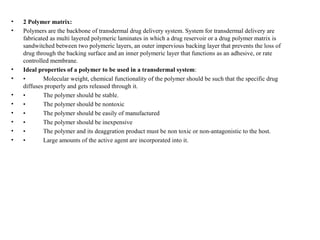
• 2 Polymer matrix:
• Polymers are the backbone of transdermal drug delivery system. System for transdermal delivery are
fabricated as multi layered polymeric laminates in which a drug reservoir or a drug polymer matrix is
sandwitched between two polymeric layers, an outer impervious backing layer that prevents the loss of
drug through the backing surface and an inner polymeric layer that functions as an adhesive, or rate
controlled membrane.
• Ideal properties of a polymer to be used in a transdermal system:
• • Molecular weight, chemical functionality of the polymer should be such that the specific drug
diffuses properly and gets released through it.
• • The polymer should be stable.
• • The polymer should be nontoxic
• • The polymer should be easily of manufactured
• • The polymer should be inexpensive
• • The polymer and its deaggration product must be non toxic or non-antagonistic to the host.
• • Large amounts of the active agent are incorporated into it.
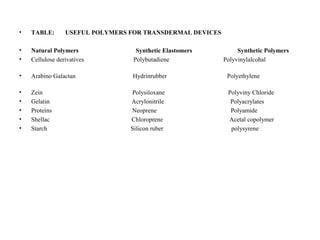
• TABLE: USEFUL POLYMERS FOR TRANSDERMAL DEVICES
• Natural Polymers Synthetic Elastomers Synthetic Polymers
• Cellulose derivatives Polybutadiene Polyvinylalcohal
• Arabino Galactan Hydrinrubber Polyethylene
• Zein Polysiloxane Polyviny Chloride
• Gelatin Acrylonitrile Polyacrylates
• Proteins Neoprene Polyamide
• Shellac Chloroprene Acetal copolymer
• Starch Silicon ruber polysyrene
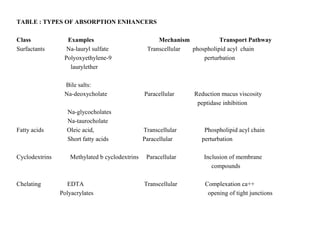
TABLE : TYPES OF ABSORPTION ENHANCERS
Class Examples Mechanism Transport Pathway
Surfactants Na-lauryl sulfate Transcellular phospholipid acyl chain
Polyoxyethylene-9 perturbation
laurylether
Bile salts:
Na-deoxycholate Paracellular Reduction mucus viscosity
peptidase inhibition
Na-glycocholates
Na-taurocholate
Fatty acids Oleic acid, Transcellular Phospholipid acyl chain
Short fatty acids Paracellular perturbation
Cyclodextrins Methylated b cyclodextrins Paracellular Inclusion of membrane
compounds
Chelating EDTA Transcellular Complexation ca++
Polyacrylates opening of tight junctions
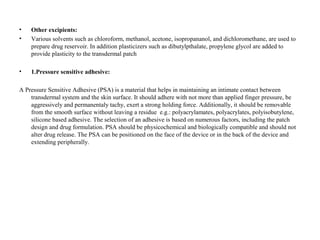
• Other excipients:
• Various solvents such as chloroform, methanol, acetone, isopropananol, and dichloromethane, are used to
prepare drug reservoir. In addition plasticizers such as dibutylpthalate, propylene glycol are added to
provide plasticity to the transdermal patch
• 1.Pressure sensitive adhesive:
A Pressure Sensitive Adhesive (PSA) is a material that helps in maintaining an intimate contact between
transdermal system and the skin surface. It should adhere with not more than applied finger pressure, be
aggressively and permanentaly tachy, exert a strong holding force. Additionally, it should be removable
from the smooth surface without leaving a residue e.g.: polyacrylamates, polyacrylates, polyisobutylene,
silicone based adhesive. The selection of an adhesive is based on numerous factors, including the patch
design and drug formulation. PSA should be physicochemical and biologically compatible and should not
alter drug release. The PSA can be positioned on the face of the device or in the back of the device and
extending peripherally.
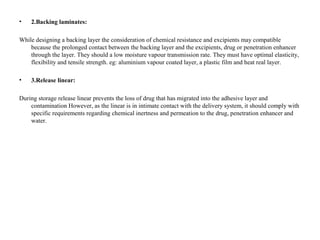
• 2.Backing laminates:
While designing a backing layer the consideration of chemical resistance and excipients may compatible
because the prolonged contact between the backing layer and the excipients, drug or penetration enhancer
through the layer. They should a low moisture vapour transmission rate. They must have optimal elasticity,
flexibility and tensile strength. eg: aluminium vapour coated layer, a plastic film and heat real layer.
• 3.Release linear:
During storage release linear prevents the loss of drug that has migrated into the adhesive layer and
contamination However, as the linear is in intimate contact with the delivery system, it should comply with
specific requirements regarding chemical inertness and permeation to the drug, penetration enhancer and
water.
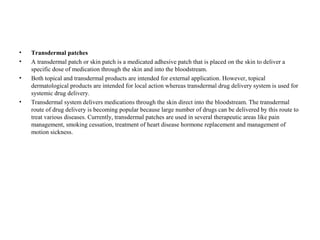
• Transdermal patches
• A transdermal patch or skin patch is a medicated adhesive patch that is placed on the skin to deliver a
specific dose of medication through the skin and into the bloodstream.
• Both topical and transdermal products are intended for external application. However, topical
dermatological products are intended for local action whereas transdermal drug delivery system is used for
systemic drug delivery.
• Transdermal system delivers medications through the skin direct into the bloodstream. The transdermal
route of drug delivery is becoming popular because large number of drugs can be delivered by this route to
treat various diseases. Currently, transdermal patches are used in several therapeutic areas like pain
management, smoking cessation, treatment of heart disease hormone replacement and management of
motion sickness.
TYPES OF TRANSDERMAL PATCHES:
a) Single layer drug in adhesive:
In this type the adhesive layer contains the drug. The adhesive layer not only serves to adhere the various layers
together and also responsible for the releasing the drug to the skin. The adhesive layer is surrounded by a
temporary liner and a backing.
b) Multi -layer drug in adhesive:
This type is also similar to the single layer but it contains a immediate drug release layer and other layer will be
a controlled release along with the adhesive layer. The adhesive layer is responsible for the releasing of the
drug. This patch also has a temporary liner-layer and a permanent backing.
c) Vapour patch:
In this type of patch the role of adhesive layer not only serves to adhere the various layers together but also
serves market, commonly used for releasing of essential oils in decongestion. Various other types of vapor
patches are also available in the market which are used to improve the quality of sleep and reduces the cigarette
smoking conditions.
d) Reservoir system:
In this system the drug reservoir is embedded between an impervious backing layer and a rate controlling
membrane. The drug releases only through the rate controlling membrane, which can be micro porous or non
porous. In the drug reservoir compartment, the drug can be in the form of a solution, suspension, gel or
dispersed in a solid polymer matrix. Hypoallergenic adhesive polymer can be applied as outer surface polymeric
membrane which comfortable with drug.
e) Matrix system:
i. Drug-in-adhesive system:
In this type the drug reservoir is formed by dispersing the drug in an adhesive polymer and then spreading the medicated
adhesive polymer by solvent casting or melting (in the case of hot-melt adhesives) on an impervious backing layer. On top
of the reservoir, unmediated adhesive polymer layers are applied for protection purpose.
ii. Matrix-dispersion system:
In this type the drug is dispersed homogenously in a hydrophilic or lipophilic polymer matrix. This drug containing
polymer disk is fixed on to an occlusive base plate in a compartment fabricated from a drug impermeable backing layer.
Instead of applying the adhesive on the face of the drug reservoir, it is spread along with the circumference to form a strip
of adhesive rim.
f) Microreservoir system:
In this type the drug delivery system is a combination of reservoir and matrix-dispersion system. The drug reservoir is
formed by first suspending the drug in an aqueous solution of water soluble polymer and then dispersing the solution
homogeneously in a lipophilic polymer to form thousands of unreachable, microscopic microscopic spheres of drug
reservoirs. This thermodynamically unstable dispersion is stabilized quickly by immediately cross-linking the polymer in
situ by using cross linking agents.
• Various methods for preparation of transdermal drug delivery systems :
• 1. Asymmetric TPX membrane method:
• A prototype patch can be fabricated by a heat sealable polyester film (type 1009, 3m) with a concave of
1cm diameter used as the backing membrane. Drug sample is dispensed into the concave membrane,
covered by a TPX {poly (4-methyl-1-pentene)} asymmetric membrane, and sealed by adhesive.
• 1.1 Asymmetric TPX membrane preparation
• These are fabricated by using the dry/wet inversion process. TPX is dissolved in a mixture of solvent
(cyclohexane) and nonsolvent additives at 60°c to form a polymer solution. The polymer solution is kept at
40°C for 24 hrs and cast on a glass plate to a pre-determined thickness with a gardener knife. After that the
casting film is evaporated at 50°C for 30 sec, then the glass plate is to be immersed immediately in
coagulation bath [maintained the temperature at 25°C]. After 10 minutes of immersion, the membrane can
be removed, air dry in a circulation oven at 50°C for 12 hrs].
2. Circular teflon mould method:
• Solutions containing polymers in various ratios are used in an organic solvent. Calculated amount of drug
is dissolved in half the quantity of same organic solvent. Enhancers in different concentrations are
dissolved in the other half of the organic solvent and then added. Di-N-butylphthalate is added as a
plasticizer into drug polymer solution. The total contents are to be stirred for 12 h and then poured into a
circular teflon mould. The moulds are placed on a leveled surface and covered with an inverted funnel to
control solvent vaporization in a laminar flow hood model with speed of air 1/2 m /sec. The solvent is
allowed to evaporate for 24 h. Before evaluation the dried films are to be stored for another 24 h at 25±0.5
°C in a desiccators containing silica gel before to eliminate aging effects. These types of films are to be
evaluated within one week of their preparation. 6
• 3.Mercury substrate method:
• In this method drug is dissolved in polymer solution along with plasticizer. The above solution is to be
stirred for 10-15 min to produce a homogeneous dispersion and poured in to a leveled mercury surface.
Then the solution is covered with inverted funnel to control solvent evaporation.
• 4.By using “IPM membranes” method:
• In this method drug is dispersed in a mixture of water and propylene glycol containing carbomer
940polymer and stirred for 12 hrs in magnetic stirrer. The dispersion is to be neutralized and made viscous
by the addition of triethanolamine. Buffer pH 7.4 can be used in order to obtain solution gel, if the drug
solubility in aqueous solution is very poor. The formed gel will be incorporated in the IPM membrane.
• 5. By using “EVAC membranes” method:
• In order to prepare the target transdermal therapeutic system, 1% carbopol reservoir gel, polyethelene (PE),
ethylene vinyl acetate copolymer (EVAC) membranes can be used as rate control membranes. If the drug is
not soluble in water, propylene glycol is used for the preparation of gel. Drug is dissolved in propylene
glycol, carbopol resin will be added to the above solution and neutralized by using 5% w/w sodium
hydroxide solution. The drug (in gel form) is placed on a sheet of backing layer covering the specified area.
A rate controlling membrane will be placed over the gel and the edges will be sealed by heat to obtain a
leak proof device.
• 6. Aluminium backed adhesive film method:
• Transdermal drug delivery system may produce unstable matrices if the loading dose is greater than 10 mg.
Aluminium backed adhesive film method is a suitable one for preparation of same, chloroform is choice of
solvent, because most of the drugs as well as adhesive are soluble in chloroform. The drug is dissolved in
chloroform and adhesive material will be added to the drug solution and dissolved. A custammade
aluminium former is lined with aluminium foil and theends blanked off with tightly fitting cork blocks.
• 7. Preparation of TDDS by using proliposomes:
• The proliposomes are prepared by carrier method using film deposition technique. From the earlier
reference drug and lecithin in the ratio of 1:2 can be used as an optimized ratio. The proliposomes are
prepared by taking 5mg of mannitol powder in a 100ml round bottom flask which is kept at 60-70 °C
temperature and the flask is rotated at 80-90 rpm and dried the mannitol at vacuum for 30 min. After
drying, the temperature of the water bath is adjusted to 20- 30 °C. Drug and lecithin are dissolved in a
suitable organic solvent mixture. Aliquot of 0.5 ml of the organic solution is introduced into the round
bottomed flask at 37 °C containing mannitol after complete drying second aliquots (0.5ml) of the solution
is to be added. After the last loading, the flask containing proliposomes are connected in a lyophilizer and
subsequently drug loaded mannitol powders (proliposomes) are placed in desiccators over night and then
sieved through 100 mesh. The collected powder is transferred in to a glass bottle and stored at the freeze
temperature until characterization.
• 8.By using free film method:
• Free film of cellulose acetate is prepared by casting on mercury surface. A polymer solution 2% w/w is
prepared by using chloroform. Plasticizers are incorporated at a concentration of 40% w/w of polymer
weight. Five ml of polymer solution was poured in a glass ring which is placed over the mercury surface in
a glass petri dish. The rate of evaporation of the solvent is controlled by placing an inverted funnel over the
petridish. The film formation is noted by observing the mercury surface after complete evaporation of the
solvent. The dry film will be separated out and stored between the sheets of wax paper in desiccators until
use. Free films of different thickness can be prepared by changing the volume of the polymer solution.
• Desirable features for transdermal patches:
• • Composition relatively invariant in use.
• • System size reasonable.
• • Defined site for application.
• • Application technique highly reproducible.
• • Delivery is zero order.
• • Delivery is efficient.
• Conditions in which patches are used:
• • When the patient has intolerable side effects (including constipation) and who is unable
• • to take oral medication (dysphagia) and is requesting an alternative method of drug
• • delivery.
• • Where the pain control might be improved by reliable administration. This might be
•
• useful in patients with cognitive impairment or those who for other reasons are not able
• • to self-medicate with their analgesia.
• • It can be used in combination with other enhancement strategies to produce synergistic
• • effects.
• Conditions in which patches are not used:
• • Cure for acute pain is required.
• • Where rapid dose titration is required.
• • Where requirement of dose is equal to or less than 30 mg/24 hrs.
• Evaluation parameters :
• Interaction studies: Excipients are integral components of almost all pharmaceutical dosage forms. The stability of a
formulation amongst other factors depends on the compatibility of the drug with the excipients. The drug and the
excipients must be compatible with one another to produce a product that is stable, thus it is mandatory to detect any
possible physical or chemical interaction as it can affect the bioavailability and stability of the drug. If the excipients
are new and have not been used in formulations containing the active substance, the compatibility studies play an
important role in formulation development. Interaction studies are commonly carried out in Thermal analysis, FT-IR,
UV and chromatographic techniques by comparing their physicochemical characters such as assay, melting
endotherms, characteristic wave numbers, absorption maxima etc.,
• 2. Thickness of the patch: The thickness of the drug loaded patch is measured in different points by using a digital
micrometer and determines the average thickness and standard deviation for the same to ensure the thickness of the
prepared patch.
• 3. Weight uniformity: The prepared patches are to be dried at 60°c for 4hrs before testing. A specified area of patch
is to be cut in different parts of the patch and weigh in digital balance. The average weight and standard deviation
values are to be calculated from the individual weights.
• 4. Folding endurance: A strip of specific are is to be cut evenly and repeatedly folded at the same place till it broke.
The number of times the film could be folded at the same place without breaking gave the value of the folding
endurance.
• 5. Percentage Moisture content: The prepared films are to be weighed individually and to be kept in a desiccator
containing fused calcium chloride at room temperature for 24 hrs. After 24 hrs the films are to be reweighed and
determine the percentage moisture content from the below mentioned formula.
• Percentage moisture content = [Initial weight- Final weight/ Final weight] ×100.
• 6. Percentage Moisture uptake: The weighed films are to be kept in a desiccator at room
temperature for 24 hrs containing saturated solution of potassium chloride in order to maintain
84% RH. After 24 hrs the films are to be reweighed and determine the percentage moisture
uptake from the below mentioned formula.
• Percentage moisture uptake = [Final weight- Initial weight/ initial weight] ×100.
• 7. Water vapour permeability (WVP) evaluation: Water vapour permeability can be determined
with foam dressing method the air forced oven is replaced by a natural air circulation oven. The
WVP can be determined by the following formula
• WVP=W/A
• Where, WVP is expressed in gm/m2 per 24hrs, W is the amount of vapour permeated through
the patch expressed in gm/24hrs and A is the surface area of the exposure samples expressed in
m2
• 8. Drug content: A specified area of patch is to be dissolved in a suitable solvent in specific
volume. Then the solution is to be filtered through a filter medium and analyse the drug contain
with the suitable method (UV or HPLC technique). Each value represents average of three
different samples.
9. Uniformity of dosage unit test: An accurately weighed portion of the patch is to be cut into small pieces
and transferred to a specific volume volumetric flask, dissolved in a suitable solvent and sonicate for complete
extraction of drug from the patch and made up to the mark with same. The resulting solution was allowed to
settle for about an hour, and the supernatant was suitably diluted to give the desired concentration with suitable
solvent. The solution was filtered using 0.2m membrane filter and analysed by suitable analytical technique
(UV or HPLC) and the drug content per piece will be calculated.
10. Polariscope examination: This test is to be performed to examine the drug crystals from patch by
polariscope. A specific surface area of the piece is to be kept on the object slide and observe for the drugs
crystals to distinguish whether the drug is present as crystalline form or amorphous form in the patch.
11. Shear Adhesion test: This test is to be performed for the measurement of the cohesive strength of an
adhesive polymer. It can be influenced by the molecular weight, the degree of crosslinking and the composition
of polymer, type and the amount of tackifier added. An adhesive coated tape is applied onto a stainless steel
plate; a specified weight is hung from the tape, to affect it pulling in a direction parallel to the plate. Shear
adhesion strength is determined by measuring the time it takes to pull the tape off the plate different samples.
The longer the time take for removal, greater is the shear strength.
• 12. Peel Adhesion test: In this test force required to remove an adhesive coating form a test substrate is
referred to as peel adhesion. Molecular weight of adhesive polymer, the type and amount of additives are
the variables that determined the peel adhesion properties. A single tape is applied to a stainless steel
plate or a backing membrane of choice and then tape is pulled from the substrate at a 180o angle, and the
force required for tape removed is measured.
• 13. Thumb tack test: It is a qualitative test applied for tack property determination of adhesive. The thumb
is simply pressed on the adhesive and the relative tack property is detected.
• 14. Flatness test: Three longitudinal strips are to be cut from each film at different portion like one from
the center, other one from the left side, and another one from the right side. The length of each strip was
measured and the variation in length because of non-uniformity in flatness was measured by determining
percent constriction, with 0% constriction equivalent to 100% flatness.
• 15. Percentage Elongation break test: The percentage elongation break is to be determined by noting the
length just before the break point, the percentage elongation can be determined from the below mentioned
formula.
• Elongation percentage = L1-L2/L2 ×100
• Where, L1is the final length of each strip and L2 is the initial length of each strip.
• 16. Rolling ball tack test: This test measures the softness of a polymer that relates to talk. In this test,
stainless steel ball of 7/16 inches in diameter is released on an inclined track so that it rolls down and
comes into contact with horizontal, upward facing adhesive. The distance the ball travels along the
adhesive provides the measurement of tack, which is expressed in inch.
17. Quick Stick (peel-tack) test: In this test, the tape is pulled away from the substrate at 90oC at a speed of 12
inches/min. The peel force required to break the bond between adhesive and substrate is measured and recorded
as tack value, which is expressed in ounces or grams per inch width.
18. Probe Tack test: In this test the tip of a clean probe with a defined surface roughness is brought into
contact with adhesive, and when a bond is formed between probe and adhesive. The subsequent removal of the
probe mechanically breaks it. The force required to pull the probe away from the adhesive at fixed rate is
recorded as tack and it is expressed in grams.
19. In vitro drug release studies:
The paddle over disc method (USP apparatus V) can be employed for assessment of the release of the drug from
the prepared patches. Dry films of known thickness is to be cut into definite shape, weighed, and fixed over a
glass plate with an adhesive. The glass plate was then placed in a 500-mL of the dissolution medium or
phosphate buffer (pH 7.4), and the apparatus was equilibrated to 32± 0.5°C. The paddle was then set at a
distance of 2.5 cm from the glass plate and operated at a speed of 50 rpm. Samples (5- mL aliquots) can be
withdrawn at appropriate time intervals up to 24 h and analyzed by UV spectrophotometer or HPLC. The
experiment is to be performed in triplicate and the mean value can be calculated.
• 20. In vitro skin permeation studies:
• An in vitro permeation study can be carried out by using diffusion cell. Full thickness abdominal skin of
male Wistar rats weighing 200 to 250g. Hair from the abdominal region is to be removed carefully by
using a electric clipper; the dermal side of the skin was thoroughly cleaned with distilled water to remove
any adhering tissues or blood vessels, equilibrated for an hour in dissolution medium or phosphate buffer
pH 7.4 before starting the experiment and was placed on a magnetic stirrer with a small magnetic needle
for uniform distribution of the diffusant. The temperature of the cell was maintained at 32 ± 0.5°C using a
thermostatically controlled heater. The isolated rat skin piece is to be mounted between the compartments
of the diffusion cell, with the epidermis facing upward into the donor compartment. Sample volume of
definite volume is to be removed from the receptor compartment at regular intervals, and an equal volume
of fresh medium is to be replaced. Samples are to be filtered through filtering medium and can be analyzed
spectrophotometrically or HPLC. Flux can be determined directly as the slope of the curve between the
steady-state values of the amount of drug permeated (mg cm-2) vs. time in hours and permeability
coefficients were deduced by dividing the flux by the initial drug load (mg cm-2).
• 21. Skin Irritation study: Skin irritation and sensitization testing can be performed on healthy rabbits
(average weight 1.2 to 1.5 kg). The dorsal surface (50cm2) of the rabbit is to be cleaned and remove the
hair from the clean dorsal surface by shaving and clean the surface by using rectified spirit and the
representative formulations can be applied over the skin. The patch is to be removed after 24 hr and the
skin is to be observed and classified into 5 grades on the basis of the severity of skin injury.
• 22. Stability studies: Stability studies are to be conducted according to the ICH guidelines by storing the
TDDS samples at 40±0.5°c and 75±5% RH for 6 months. The samples were withdrawn at 0, 30, 60, 90 and
180 days and analyze suitably for the drug content.
• 24. In vivo Studies:
• Transdermal patches can be in vivo evaluated in terms of In vivo evaluations are the true depiction of the drug
performance. The variables which cannot be taken into account during in vitro studies can be fully explored
during in vivo studies. In vivo evaluation of TDDS can be carried out using animal models human volunteers.
• Animal models:
• Considerable time and resources are required to carry out human studies, so animal studies are preferred at
small scale. The most common animal species used for evaluating transdermal drug delivery system are mouse,
hairless rat, hairless dog, hairless rhesus monkey, rabbit, guinea pig etc. Various experiments conducted leads
to a conclusion that hairless animals are preferred over hairy animals in both in vitro and in vivo experiments.
Rhesus monkey is one of the most reliable models for in vivo evaluation of transdermal drug delivery in man.
• Human model The final stage of the development of a transdermal device involves collection of
pharmacokinetic and pharmacodynamic data following application of the patch to human volunteers.39
Clinical trials have been conducted to assess the efficacy, risk involved, side effects, patient compliance etc.
Phase I clinical trials are conducted to determine mainly safety in volunteers and phase II clinical trials
determine short term safety and mainly effectiveness in patients. Phase III trials indicate the safety and
effectiveness in large number of patient population and phase IV trials at post marketing surveillance are done
for marketed patches to detect adverse drug reactions. Though human studies require considerable resources
best to assess the performance of the drug.
• Limitation
• • TDDS cannot deliver ionic drugs.
• • TDDS cannot achieve high drug levels in blood/plasma.
• • It cannot develop for drugs of large molecular size.
• • TDDS cannot deliver drugs in a pulsatile fashion.
• • TDDS cannot develop if drug or formulation causes irritation to skin
THANKING YOU.

Shubh tdds

  • 1.
    Transdermal Delivery Systems PRESENTEDBY : SHUBHRAT MAHESHWARI M.PHARMA 1st YEAR (1st sem.) BRANCH : PHARMACEUTICS DRUG DELIVERY SYSTEM (MPH 102T) SRMS COLLEGE OF ENGINEERING & TECHNOLOGY BAREILLY
  • 2.
    CONTENTS • INTRODUCTION • DEFINITION •ADVANTAGES • DISADVANTAGES • TRANSDERMAL ROUTE OF DRUG DELIVERY PROSPECTS • ROUTES OF DRUG PENETRATION THROUGH SKIN • PROPERTIES OF INFLUENCE TRANSDERMAL DELIVERY • FACTOR AFFECTING TRANSDERMAL PERMEATION • TECHNOLOGIES FOR DEVELOPING TDDS • COMPONENTS OF TDDS • COMPONENTS OF TRANSDERMAL PATCHES • TYPES OF TRANSDERMAL PATCHES • EVALUATION PARAMETER
  • 3.
  • 4.
    INTRODUCTION • Transdermal drugdelivery is hardly an old technology, since 1800’s and the technology is no longer just adhesive patches. Due to recent advances in technology and the ability to apply the drug to the site of action without rupturing the skin membrane, transdermal route is becoming a widely accepted route of drug administration. • Definition: • Transdermal drug delivery system can deliver the drugs through the skin portal to systemic circulation at predetermined rate and maintain clinically the effective concentrations over a prolonged period of time. • Transdermal drug delivery systems (TDDSs) facilitate the passage of therapeutic quantities of drug substances through the skin and into the general circulation for their systemic effects.
  • 5.
    • In 1965,Stoughton first conceived of the percutaneous absorption of drug substances. • The first transdermal system, Transderm Scop (Baxter), was approved by the Food and Drug Administration (FDA) in 1979 for prevention of nausea and vomiting associated with travel, particularly at sea. • Over the last two decades more than 35 Transdermal patch products have been approved in US.
  • 6.
    Advantages of TransdermalDrug delivery System • Avoids chemically hostile GI environment (drug degradation in acidic and basic environments is prevented). • No GI distress and the factors like Gastric emptying, intestinal motility, transit time, donot effect this route as in oral route. • Avoidance of significant presystemic metabolism (degradation in GIT or by the liver) and therefore need lower doses. • Allows effective use of drugs with short biological half-life. • Allow administration of drugs with narrow therapeutic window because drug levels are maintained within the therapeutic window for prolonged periods of time. • Reduced inter and intra patient variability. • Enhance therapeutic efficacy, reduced fluctuations (rapid blood level spikes-low and high) due to optimization of blood concentration – time profile.
  • 7.
    • Reduction ofdosing frequency and enhancement of patient compliance. • Provides controlled plasma levels of very potent drugs. • Can provide adequate absorption of certain drugs. • Avoids the risk and inconveniences of parenteral therapy (Painless method of drug administration). • Drug input can be promptly interrupted simply by removal of the patch when toxicity occurs. • Provides suitability of self medication.
  • 8.
    Disadvantages of TransdermalDrug delivery System • Transdermal drug delivery system cannot deliver ionic drugs. • It cannot achieve high drug levels in blood. • It cannot develop for drugs of large molecular size. • It cannot deliver drugs in a pulsatile fashion. • It cannot develop if drug or formulation causes irritation to skin. • Possibility of local irritation at site of application. • May cause allergic reaction. • Sufficient aqueous and lipid solubility, a log P (octanol/ water) between 1 and 3 is required for permeate to transverse stratum corneum and underlying aqueous layer. • Only potent drugs are suitable candidates for transdermal patch because of the natural limits of drug entry imposed by the skin’s impermeability. • Long time adherence is difficult. • Uncomfortable to wear. • May not be economical.
  • 9.
    Transdermal route anddrug delivery prospects • Skin • Largest organ ofthehuman body • Covers surface areaapproximately 2 sq.m. • Receives one third of blood circulation through the body • Serves as a permeability barrier against transdermal absorption Anatomy of skin- The structure of human skin can be categorized into four main layers  The epidermis  The viable epidermis  A non-viable epidermis (Stratum corneum  The overlying dermis  The innermost subcutaneous fat layer (Hypodermis)
  • 12.
    The Epidermis: • Theepidermis is a continually self-renewing, stratified squamous epithelium covering the entire • outer surface of the body. • Primarily composed of two parts: 1. dead cells of the stratum corneum commonly referred to as the horny layer 2. living or viable cells of the malpighian layer (viable epidermis) • Viable epidermis is further classified into four distinct layers as follows: I. Stratum lucidum II. Stratum granulosu III. Stratum spinosu IV. Stratum basale
  • 13.
    • Stratum corneum: •The outermost layer of skin also called as horny layer. • Rate limiting barrier that restricts the inward and outward movement of chemical substances. • The barrier nature of the horny layer depends critically on its constituents: 75-80% proteins, 5-15% lipids, and 5-10% ondansetron material on a dry weight basis. • Approximately 10 mm thick when dry but swells to several times when fully hydrated. • It is flexible but relatively impermeable. • A wall-like structure with protein bricks and lipid mortar. • It consists of horny skin cells (corneocytes) which are connected via desmosomes (protein-rich appendages of the cell membrane). • The corneocytes are embedded in a lipid matrix which plays a significant role in determining the permeability of substance across the skin
  • 14.
    • Viable epidermis: •This is situated beneath the stratum corneum and varies in thickness from 0.06 mm on the eyelids to 0.8mm on the palms. • Going inwards, it consists of various layers as stratum lucidum, stratum granulosum, stratum spinosum, and the stratum basale. In the basale layer, mitosis of the cells constantly renews the epidermis and this proliferation compensates the loss of dead horny cells from the skin surface. As the cells produced by the basale layer move outward, they itself alter morphologically and histochemically, undergoing keratinization to form the outermost layer of stratum corneum.
  • 15.
    • Dermis : •Dermis is the layer of skin just beneath the epidermis which is 3 to 5 mm thick layer. • It is composed of a matrix of connective tissues, which contains blood vessels, and nerve. • Cutaneous blood supply has essential function in regulation of body temperature. • It also provides nutrients and oxygen to the skin, while removing toxins and waste products. • The capillaries reach to within 0.2 mm of skin surface and provide sink conditions for most molecules penetrating the skin barrier. • The blood supply thus keeps the dermal concentration of permeate very low, and the resulting concentration difference across the epidermis provides the essential driving force for transdermal permeation. • In terms of transdermal drug delivery, this layer is often viewed as essentially gelled water, and thus provides a minimal barrier to the delivery of most polar drugs, although the dermal barrier may be significant when delivering highly lipophillic molecules.
  • 16.
    • Hypodermis (subcutaneous) : • The hypodermis fat tissue supports the dermis and epidermis. • It serves as a fat storage area. • This layer helps regulate temperature, provides nutritional support and mechanical protection. • It carries principal blood vessels and nerve to skin and may contain sensory pressure organs. • For transdermal drug delivery, drug has to penetrate through all three layer and reach in systemic circulation.
  • 17.
    • Percutaneous absorption: • Before a topically applied drug can act either locally or systemically, it must penetrate through stratum corneum. • Percutaneous absorption is defined as penetration of substances into various layers of skin and permeation across the skin into systemic circulation. • Percutaneous absorption of drug molecules is of particular importance in transdermal drug delivery system because the drug has to be absorbed to an adequate extent and rate to achieve and maintain uniform, systemic, therapeutic levels throughout the duration of use. • In general once drug molecule cross the stratum corneal barrier, passage into deeper dermal layers and systemic uptake occurs relatively quickly and easily. • 1. Dissolution within and release from the formulation • 2. Partitioning into the skin’s outermost layer, the stratum corneum (SC) • 3. Diffusion through the SC, principally via a lipidic intercellular pathway. • 4. Partitioning from the SC into the aqueous viable epidermis, diffusion through the viable epidermis and into the upper dermis, uptake into the papillary dermis (capillary system) and into the microcirculation.
  • 18.
    • Routes ofdrug penetration through skin: • In the process of percutaneous permeation, a drug molecule may pass through the epidermis itself or may get diffuse through shunts, particularly those offered by the relatively widely distributed hair follicles and endocrine glands. • In the initial transient diffusion stage, drug molecules may penetrate the skin along the hair follicles or sweat ducts and then absorbed through the follicular epithelium and the sebaceous glands. • When a steady state has been reached the diffusion through the intact Stratum corneum becomes the primary pathway for transdermal permeation. • For any molecules applied to the skin, two main routes of skin permeation can be defined: • A. Transepidermal route • B. Transfollicular route
  • 19.
    • A. Transepidermalroute: • In transepidermal transport, molecules cross the intact horny layer. • Two potential micro-routes of entry exist, the transcellular (or intracellular) and the intercellular pathway. • Both polar and non-polar substances diffuse via transcellular and intercellular routes by different mechanism.The polar molecules mainly diffuse through the polar pathway consisting of “bound water” within the hydrated stratum corneum whereas the non-polar molecules dissolve and diffuse through the non-aqueous lipid matrix of the stratum corneum. • Thus the principal pathway taken by a penetrant is decided mainly by the partition coefficient (log K). Hydrophilic drugs partition preferentially into the intracellular domains, whereas lipophillic permeants (octanol/water log K > 2) traverse the stratum corneum via the intercellular route. Most molecules pass the stratum corneum by both routes.
  • 20.
    • B. Transfollicularroute (Shunt pathway): • This route comprises transport via the sweat glands and the hair follicles with their associated sebaceous glands. • Although these routes offer high permeability, they are considered to be of minor importance because of their relatively small area, approximately 0.1% area of the total skin. • This route seems to be most important for ions and large polar molecules which hardly permeate through the stratum corneum.
  • 21.
    • Fundamentals ofskin permeation : • Until the last century the skin was supposed to be impermeable with exception to gases. • However, in the current century the study indicated the permeability to lipid soluble drugs. Also it was recognized that various layers of skin are not equally permeable i.e. epidermis is less permeable than dermis. • After a large controversy, all doubts about stratum permeability were removed and using isotropic tracers, it was suggested that stratum corneum greatly hamper permeation.
  • 22.
    • a. Stratumcorneum as skin permeation barrier • The average human skin contains 40-70 hair follicles and 200-250 sweat ducts per square centimeter. • Especially water-soluble substances pass faster through these ducts, still these ducts don’t contribute much for skin permeation. • Therefore most neutral molecules pass through stratum corneum by passive diffusion.
  • 23.
    • b. Intracellularverses transcellular diffusion • Intracellular regions in stratum corneum are filled with lipid rich amorphous material. • In drystratum corneum intracellular volume may be 5% to 1% in fully hydrated stratum corneum.
  • 24.
    • c. Permeationpathways: • Percutaneous absorption involves passive diffusion of the substances through the skin. • A molecule may use two diffusional routes to penetrate normal intact skin, the appendageal route and the epidermal route.
  • 25.
    • 1. Appendageal route: Appendagealroute comprises transport via sweat glands and hair follicles with their associated sebaceous glands. These routes circumvent penetration through the stratum corneum and are therefore known as “shunt” routes. This route is considered to be of minor importance because of its relatively small area, approximately 0.1 % of the total skin area.
  • 26.
    • 2. Epidermalroute: • For drugs, which mainly cross-intact horney layer, two potential micro routes of entry exists, the transcellular (intracellular) and intercellular pathways. • i)Transcellular : Transcellular pathway means transport of molecules across epithelial cellular membrane. These include passive transport of small molecules, active transport of ionic and polar compounds and endocytosis and transcytosis of macromolecules. • ii) Paracellular : Paracellular pathway means transport of molecules around or between the cells and tight junctions or similar situations exist between the cells. • The principal pathway taken by a permeant is decided mainly by the partition coefficient (log k). Hydrophilic drugs partition preferentially into the intracellular domains, whereas lipophilic permeants traverse the stratum corneum via the intercellular route. Most permeants permeate the stratum corneum by both routes. However, the tortuous intercellular pathway is widely considered to provide the principal route and major barrier to the permeation of most drugs.
  • 27.
    • C. Barrierfunctions of the skin: • The top layer of skin is most important function in maintaining the effectiveness of the barrier. Here the individual cells overlie each other and are tightly packed, preventing bacteria from entry and maintaining the water holding properties of the skin. • Stratum corneum mainly consists of the keratinized dead cell and water content is also less as compared to the other skin components. Lipids are secreted by the cells from the base layer of the skin to the top. These lipid molecules join up and form a tough connective network, in effect acting as the mortar between the bricks of a wall.
  • 28.
    • D. BasicPrincipal of Transdermal permeation : • Transdermal permeation is based on passive diffusion. Skin is the most intensive and readily accessible organ of the body as only a fraction of millimeter of tissue separates its surface from the underlying capillary network. The release of a therapeutic agent from a formulation applied to the skin surface and its transport to the systemic circulation is a multistep process, which includes • 1) Diffusion of drug from drug to the rate controlling membrane. • 2) Dissolution within and release from the formulation. • 3) Sorption by stratum corneum and penetration through viable epidermis. • 4) Uptake of drug by capillary network in the dermal papillary layer. • 5) Effect on the target organ. • 6) Partitioning into the skin’s outermost layer, the stratum corneum. • 7) Diffusion through the stratum corneum, principal via a lipidic intercellular pathway.
  • 29.
    • Properties thatinfluence transdermal delivery: 1.Release of the medicament from the vehicle 2.Penetration through the skin barrier. 3.Activation of the pharmacological response.
  • 30.
    • Kinetics oftransdermal permeation: • Skin permeation kinetics is important for the successful development of the transdermal systems. Transdermal permeation of a drug involves the following steps, • a. Sorption by stratum corneum • b. Penetration of drug through viable epidermis • c. Uptake of the drug in the dermal papillary layer • The rate of permeation across the skin is given by, eqn 1 • Where, Ps is the overall permeability constant of the skin tissue to the penetrant Cd is concentration of skin penetrant in the donor compartment (e.g., on the surface of stratum corneum) Cr is concentration in the receptor compartment (e.g., body) • Where, • Ks is the partition coefficient for the interfacial partitioning of the penetrant molecule from a solution medium onto the stratum corneum Dss apparent diffusivity of the penetrant molecule hs overall thickness of skin tissues • As Ks, Dss and hs are constant under given conditions, the permeability coefficient (Ps) for a skin penetrant can be considered to be constant. From Eq.1 it is clear that a constant rate of drug permeation can be obtained only when i.e., the drug concentration at the surface of the stratum corneum (Cd) is greater than the drug concentration in the body (Cr) then Eq.1 becomes, eqn
  • 31.
    • And therate of skin permeation is constant provided the magnitude of Cd remains fairly constant throughout the course of skin permeation. For keeping Cd constant the drug should be released from the device at a rate Rr i.e. either constant or greater than the rate of skin uptake Ra i.e. . Since Rr >> Ra , the drug concentration on the skin surface Cd is maintained at a level equal to or greater than the equilibrium solubility of the drug in the stratum corneum Cs .i.e. Cd>>Cs. Therefore a maximum rate of skin permeation is obtained and is given by the equation, • From the above equation it can be seen that the maximum rate of skin permeation depends upon the skin permeability coefficient Ps and equilibrium solubility in the stratum corneum Cs. Thus skin permeation appears to be stratum corneum limited • The membrane limited flux (J) under steady state condition is described by equation, • Where, • J is amount of drug passing through membrane system per unit area per unit time • D is diffusion coefficient of drug within the membrane • C is concentration gradient across the membrane • K is the membrane / vehicle partition coefficient • h is the membrane thickness.
  • 32.
    Factors affecting transdermalpermeation •Biological factor: •1. Skin conditions: The intact skin itself acts as barrier but many agents like acids ,alkali cross the barrier cells and penetrates through the skin ,many solvents open the complex dense structure of horny layer Solvents like methanol, chloroform remove lipid fraction, forming artificial shunts through which drug molecules can pass easily. •2. Skin age: It is seen that the skin of adults and young ones are more permeable than the older ones but there is no dramatic difference .Children shows toxic effects because of the greater surface area per unit body weight .thus potent steroids, boric acid, hexachlorophene have produced severe side effects. •3. Blood Supply: Changes in peripheral circulation can affect transdermal absorption. •4. Regional skin site: Thickness of skin, nature of stratum corneum and density of appendages vary site to site. These factors affect significantly penetration •5. Skin metabolism: Skin metabolizes steroids, hormones, chemical carcinogens and some drugs. So skin metabolism determines efficacy of drug permeated through the skin. •6. Species differences: The skin thickness, density of appendages and keratinization of skin vary species to species, so affects the penetration.
  • 33.
    • Physicochemical factors: •1. Skin hydration : In contact with water the permeability of skin increases significantly. Hydration is most important factor increasing the permeation of skin. So use of humectant is done in transdermal delivery. • 2. Temperature and pH : The permeation of drug increases ten folds with temperature variation. The diffusion coefficient decreases as temperature falls. Weak acids and weak bases dissociate depending on the pH and pKa or pKb values. The proportion of unionized drug determines the drug concentration in skin. Thus, temperature and pH are important factors affecting drug penetration • 3. Diffusion coefficient : Penetration of drug depends on diffusion coefficient of drug. At a constant temperature the diffusion coefficient of drug depends on properties of drug, diffusion medium and interaction between them. • 4. Drug concentration : The flux is proportional to the concentration gradient across the barrier and concentration gradient will be higher if the concentration of drug will be more across the barrier. • 5. Partition coefficient : The optimal partition coefficient (K) is required for good action. Drugs with high K are not ready to leave the ipid portion of skin. Also, drugs with low K will not be permeated. • 6. Molecular size and shape : Drug absorption is inversely related to molecular weight, small molecules penetrate faster than large ones.
  • 34.
    • Environmental factors: •1. Sunlight : Due to Sunlight the walls of blood vessels become thinner leading to bruising with only minor trauma in sun-exposed areas. Also pigmentation: The most noticeable sun-induced pigment change is a freckle or solar lentigo. • 2 Cold Season : Often result in itchy, dry skin. Skin responds by increasing oil production to compensate for the weather’s drying effects. A good moisturizer will help ease symptoms of dry skin. Also, drinking lots of water can keep your skin hydrated and looking radiant. • 3 Air Pollution : Dust can clog pores and increase bacteria on the face and surface of skin, both of which lead to acne or spots. This affects drug delivery through the skin. Invisible chemical pollutants in the air can interfere with skin’s natural protection system, breaking down the natural skin’s oils that normally trap moisture in skin and keep it supple.
  • 35.
    • Effect ofHeat on Transdermal patch : • Heat induced high absorption of transdermal delivered drugs. Patient should be advised to avoid exposing the patch application site to external heat source like heated water bags, hot water bottles. Even high body temperature may also increase the transdermally delivered drugs. In this case the patch should be removed immediately. Transdermal drug patches are stored in their original packing and keep in a cool, dry place until they are ready to used. • Design of transdermal delivery system The basic components of any transdermal delivery system include the drug dissolved or dispersed in an inert polymer matrix that provides support and platform for drug release. There are two basic designs of the patch system that dictate drug release characteristics and patch behavior: • i) Matrix or Monolithic : The inert polymer matrix binds with the drug and controls it’s release from the device. • ii) Reservoir or Membrane : The polymer matrix does not control drug release. Instead, a rate controlling membrane present between the drug matrix and the adhesive layer provides the rate limiting barrier for drug release from the device.
  • 36.
    • Technologies fordeveloping transdermal drug delivery systems : • The technologies can be classified in four basic approaches : • A) Polymer membrane partition-controlled TDD systems • In this type of systems, the drug reservoir is sandwiched between a drug-impermeable backinglaminate and a rate controlling polymeric membrane. The drug is allowed to permeate only through the rate controlling membrane. The drug solids are homogeneously dispersed in a solid polymer matrix, suspended in an unleachable, viscous liquid medium e.g. silicone fluid to form a paste like suspension or dissolved in a releasable solvent e.g. alkyl alcohol to form a clear drug solution. The rate controlling membrane can be either a microporous or a nonporous polymeric membrane e.g. ethylene-vinyl acetate copolymer, with specific drug permeability. On the external surface of the polymeric membrane a thin layer of drug- compatible, hypoallergenic pressure sensitive adhesive polymer e.g. silicone adhesive may be applied to provide intimate contact of TDDS with the skin surface. • Varying the composition of drug reservoir formulation, the permeability coefficient and thickness of rate controlling membrane can alter the drug release rate.e.g. Some FDA approved systems – Transderm- Nitro for angina pectoris, Transderm-Scop for motion sickness, Catapres-TTS system for hypertension.
  • 37.
    •The intrinsic rateof drug release from this type of TDD system is defined by •dq/dt = (Km/r.Ka/m.Da.Dm/Km/r.Dm.ha+Ka/m Dahm) CR •where, C R is drug concentration in reservoir compartment. • Km / r the partition coefficient for the interfacial partitioning of drug from the reservoir to the membrane. •Ka / m the partition coefficient for the interfacial partitioning of drug from membrane to adhesive. • Da diffusion coefficient in rate controlling membrane. •Dm diffusion coefficient in adhesive layer. •ha thickness of rate controlling membrane. •hm thickness of adhesive layer.
  • 38.
    • B) Polymermatrix diffusion-controlled TDD systems • In this system, the drug reservoir is formed by homogeneously dispersing the drug solids in a hydrophilic or lipophilic polymer matrix and then the medicated polymer formed is molded into medicated disks with defined surface area and thickness. This drug reservoir containing polymer disk is then mounted on occlusive baseplate in a compartment fabricated from a drug-impermeable plastic backing. • Instead of coating adhesive polymer directly on the surface of medicated disk, it is applied along the circumference of the patch to form a strip of adhesive rim surrounding the medicated disk. e.g. Nitro-Dur system and NTS system for angina pectoris. • The rate of release from polymer matrix drug dispersion-type is • dq/dt =(LdCpDp/ 2t)1/2 • where, L d is drug loading dose initially dispersed in polymer matrix. • Cp is solubility of drug in polymer matrix. • Dp is diffusivity of drug in polymer matrix. • Only drug dissolved in polymer matrix can diffuse, Cp is practically equal to CR Alternately, the polymer matrix drug dispersion type TDDS can be fabricated by directly dispersing drug in a pressure-sensitive adhesive polymer e.g. polyacrylate and then coating the drug-dispersed adhesive polymer by solvent casting or hot melt onto a flat sheet of drug- impermeable backing laminate to form a single layer of drug reservoir, this yields a thinner patch.eg. Minitran system, Nitro-Dur II system for angina pectoris.
  • 39.
    • C) Drugreservoir gradient-controlled TDD systems • Polymer matrix drug dispersion-type TDDS can be modified to have the drug loading level varied in an incremental manner, forming a gradient of drug reservoir along the diffusional path across the multilaminate adhesive layers.
  • 40.
    • D) Microreservoirdissolution-controlled TDD systems • This thermodynamically unstable system is quickly stabilized by immediately cross-linking the polymer chains in situ, which produces a medicated polymer disk with a constant surface area and a fixed thickness. Medicated disk is mounted at the center of an adhesive pad. • eg : Nitrodisk system for angina pectoris.
  • 41.
    Components of TDDS •The main components of a transdermal patch are : • i. Release Liner • Protects the patch during storage. The liner is removed prior to use. • ii. Drug reservoir • The most important part of TDDS is drug reservoir. It consists of drug particles dissolved or dispersed in the matrix. To make the drug soluble, solvents and cosolvents are used. The effect of solvent and cosolvent should be considered while doing selection. • iii. Adhesive • Serves to adhere the components of the patch together along with adhering the patch to the skin.The adhesive must posses sufficient adhesion property so that the TDDS should remain in place for a long time. Pressure sensitive adhesives are commonly used for transdermal patch to hold the skin. Commonly used adhesives are silicone adhesives, poly iso butylenes adhesives and polyacrylate based adhesives. • iv. Membrane • Membrane controls the release of the drug from the reservoir and multi-layer patches. It may or may not contain rate-controlling membrane. It should be flexible enough not to split or crack on bending or stretching. Some of rate-controlling membranes are polyethylene sheets, ethylene vinyl acetate copolymer and cellulose acetate.
  • 43.
    Components of transdermalpatches • 1.Drug reservoir • The most important part of TDDS is drug reservoir. It consists of drug particles dissolved or dispersed in the matrix. To make the drug soluble, solvents and cosolvents are used. The effect of solvent and cosolvent should be considered while doing selection • Physicochemical properties: • • The drug should have a molecular weight less than 1000 Daltons. • • The drug should have affinity for both lipophilic and hydrophilic phasea. Extreme partitioning characteristics are not conductive to successful drug delivery via the skin. • • The drug should have low melting point. • • Along with these properties the drug should be potent, having short half life and be non-irritating.
  • 44.
    •Biological Properties: •• Drugshould be very potent ,i.e. it should be effective in few mg/day •• The drug should have short biological half life. •• The drug should not be irritant and non allergic to human skin. •• The drug should be stable when contact with the skin. •• They should not stimulate an immune reaction to the skin. •• Tolerance to the drug must not develop under near zero order release profile of transdermal delivery. •• Dose is less than 50 mg per day, and ideally less than 10 mg per day. •• The drug should not get irreversibly bound in the subcutaneous tissue. •• The drug should not get extensively metabolized in the skin.
  • 45.
    • IDEAL PROPERTIESOF DRUG CANDIDATE FOR TRANSDERMAL DRUG DELIVERY • Parameter Properties • Dose Less than 20mg/day • Halflife < 10 hrs • Molecular weight <400 Dalton • Melting point <200°C • Partition coefficient 1 to 4 • Aqueous Solubility >1mg/mL • pH of the aqueous saturated solution 5-9 • Skin Permeability Coefficient >0.5×10⁻³cm/h • Skin Reaction Non irritating and non-sensitizing • Oral Bioavailability Low
  • 46.
    • 2 Polymermatrix: • Polymers are the backbone of transdermal drug delivery system. System for transdermal delivery are fabricated as multi layered polymeric laminates in which a drug reservoir or a drug polymer matrix is sandwitched between two polymeric layers, an outer impervious backing layer that prevents the loss of drug through the backing surface and an inner polymeric layer that functions as an adhesive, or rate controlled membrane. • Ideal properties of a polymer to be used in a transdermal system: • • Molecular weight, chemical functionality of the polymer should be such that the specific drug diffuses properly and gets released through it. • • The polymer should be stable. • • The polymer should be nontoxic • • The polymer should be easily of manufactured • • The polymer should be inexpensive • • The polymer and its deaggration product must be non toxic or non-antagonistic to the host. • • Large amounts of the active agent are incorporated into it.
  • 47.
    • TABLE: USEFULPOLYMERS FOR TRANSDERMAL DEVICES • Natural Polymers Synthetic Elastomers Synthetic Polymers • Cellulose derivatives Polybutadiene Polyvinylalcohal • Arabino Galactan Hydrinrubber Polyethylene • Zein Polysiloxane Polyviny Chloride • Gelatin Acrylonitrile Polyacrylates • Proteins Neoprene Polyamide • Shellac Chloroprene Acetal copolymer • Starch Silicon ruber polysyrene
  • 48.
    TABLE : TYPESOF ABSORPTION ENHANCERS Class Examples Mechanism Transport Pathway Surfactants Na-lauryl sulfate Transcellular phospholipid acyl chain Polyoxyethylene-9 perturbation laurylether Bile salts: Na-deoxycholate Paracellular Reduction mucus viscosity peptidase inhibition Na-glycocholates Na-taurocholate Fatty acids Oleic acid, Transcellular Phospholipid acyl chain Short fatty acids Paracellular perturbation Cyclodextrins Methylated b cyclodextrins Paracellular Inclusion of membrane compounds Chelating EDTA Transcellular Complexation ca++ Polyacrylates opening of tight junctions
  • 49.
    • Other excipients: •Various solvents such as chloroform, methanol, acetone, isopropananol, and dichloromethane, are used to prepare drug reservoir. In addition plasticizers such as dibutylpthalate, propylene glycol are added to provide plasticity to the transdermal patch • 1.Pressure sensitive adhesive: A Pressure Sensitive Adhesive (PSA) is a material that helps in maintaining an intimate contact between transdermal system and the skin surface. It should adhere with not more than applied finger pressure, be aggressively and permanentaly tachy, exert a strong holding force. Additionally, it should be removable from the smooth surface without leaving a residue e.g.: polyacrylamates, polyacrylates, polyisobutylene, silicone based adhesive. The selection of an adhesive is based on numerous factors, including the patch design and drug formulation. PSA should be physicochemical and biologically compatible and should not alter drug release. The PSA can be positioned on the face of the device or in the back of the device and extending peripherally.
  • 50.
    • 2.Backing laminates: Whiledesigning a backing layer the consideration of chemical resistance and excipients may compatible because the prolonged contact between the backing layer and the excipients, drug or penetration enhancer through the layer. They should a low moisture vapour transmission rate. They must have optimal elasticity, flexibility and tensile strength. eg: aluminium vapour coated layer, a plastic film and heat real layer. • 3.Release linear: During storage release linear prevents the loss of drug that has migrated into the adhesive layer and contamination However, as the linear is in intimate contact with the delivery system, it should comply with specific requirements regarding chemical inertness and permeation to the drug, penetration enhancer and water.
  • 51.
    • Transdermal patches •A transdermal patch or skin patch is a medicated adhesive patch that is placed on the skin to deliver a specific dose of medication through the skin and into the bloodstream. • Both topical and transdermal products are intended for external application. However, topical dermatological products are intended for local action whereas transdermal drug delivery system is used for systemic drug delivery. • Transdermal system delivers medications through the skin direct into the bloodstream. The transdermal route of drug delivery is becoming popular because large number of drugs can be delivered by this route to treat various diseases. Currently, transdermal patches are used in several therapeutic areas like pain management, smoking cessation, treatment of heart disease hormone replacement and management of motion sickness.
  • 52.
    TYPES OF TRANSDERMALPATCHES: a) Single layer drug in adhesive: In this type the adhesive layer contains the drug. The adhesive layer not only serves to adhere the various layers together and also responsible for the releasing the drug to the skin. The adhesive layer is surrounded by a temporary liner and a backing. b) Multi -layer drug in adhesive: This type is also similar to the single layer but it contains a immediate drug release layer and other layer will be a controlled release along with the adhesive layer. The adhesive layer is responsible for the releasing of the drug. This patch also has a temporary liner-layer and a permanent backing. c) Vapour patch: In this type of patch the role of adhesive layer not only serves to adhere the various layers together but also serves market, commonly used for releasing of essential oils in decongestion. Various other types of vapor patches are also available in the market which are used to improve the quality of sleep and reduces the cigarette smoking conditions. d) Reservoir system: In this system the drug reservoir is embedded between an impervious backing layer and a rate controlling membrane. The drug releases only through the rate controlling membrane, which can be micro porous or non porous. In the drug reservoir compartment, the drug can be in the form of a solution, suspension, gel or dispersed in a solid polymer matrix. Hypoallergenic adhesive polymer can be applied as outer surface polymeric membrane which comfortable with drug.
  • 53.
    e) Matrix system: i.Drug-in-adhesive system: In this type the drug reservoir is formed by dispersing the drug in an adhesive polymer and then spreading the medicated adhesive polymer by solvent casting or melting (in the case of hot-melt adhesives) on an impervious backing layer. On top of the reservoir, unmediated adhesive polymer layers are applied for protection purpose. ii. Matrix-dispersion system: In this type the drug is dispersed homogenously in a hydrophilic or lipophilic polymer matrix. This drug containing polymer disk is fixed on to an occlusive base plate in a compartment fabricated from a drug impermeable backing layer. Instead of applying the adhesive on the face of the drug reservoir, it is spread along with the circumference to form a strip of adhesive rim. f) Microreservoir system: In this type the drug delivery system is a combination of reservoir and matrix-dispersion system. The drug reservoir is formed by first suspending the drug in an aqueous solution of water soluble polymer and then dispersing the solution homogeneously in a lipophilic polymer to form thousands of unreachable, microscopic microscopic spheres of drug reservoirs. This thermodynamically unstable dispersion is stabilized quickly by immediately cross-linking the polymer in situ by using cross linking agents.
  • 54.
    • Various methodsfor preparation of transdermal drug delivery systems : • 1. Asymmetric TPX membrane method: • A prototype patch can be fabricated by a heat sealable polyester film (type 1009, 3m) with a concave of 1cm diameter used as the backing membrane. Drug sample is dispensed into the concave membrane, covered by a TPX {poly (4-methyl-1-pentene)} asymmetric membrane, and sealed by adhesive. • 1.1 Asymmetric TPX membrane preparation • These are fabricated by using the dry/wet inversion process. TPX is dissolved in a mixture of solvent (cyclohexane) and nonsolvent additives at 60°c to form a polymer solution. The polymer solution is kept at 40°C for 24 hrs and cast on a glass plate to a pre-determined thickness with a gardener knife. After that the casting film is evaporated at 50°C for 30 sec, then the glass plate is to be immersed immediately in coagulation bath [maintained the temperature at 25°C]. After 10 minutes of immersion, the membrane can be removed, air dry in a circulation oven at 50°C for 12 hrs].
  • 55.
    2. Circular teflonmould method: • Solutions containing polymers in various ratios are used in an organic solvent. Calculated amount of drug is dissolved in half the quantity of same organic solvent. Enhancers in different concentrations are dissolved in the other half of the organic solvent and then added. Di-N-butylphthalate is added as a plasticizer into drug polymer solution. The total contents are to be stirred for 12 h and then poured into a circular teflon mould. The moulds are placed on a leveled surface and covered with an inverted funnel to control solvent vaporization in a laminar flow hood model with speed of air 1/2 m /sec. The solvent is allowed to evaporate for 24 h. Before evaluation the dried films are to be stored for another 24 h at 25±0.5 °C in a desiccators containing silica gel before to eliminate aging effects. These types of films are to be evaluated within one week of their preparation. 6 • 3.Mercury substrate method: • In this method drug is dissolved in polymer solution along with plasticizer. The above solution is to be stirred for 10-15 min to produce a homogeneous dispersion and poured in to a leveled mercury surface. Then the solution is covered with inverted funnel to control solvent evaporation. • 4.By using “IPM membranes” method: • In this method drug is dispersed in a mixture of water and propylene glycol containing carbomer 940polymer and stirred for 12 hrs in magnetic stirrer. The dispersion is to be neutralized and made viscous by the addition of triethanolamine. Buffer pH 7.4 can be used in order to obtain solution gel, if the drug solubility in aqueous solution is very poor. The formed gel will be incorporated in the IPM membrane.
  • 56.
    • 5. Byusing “EVAC membranes” method: • In order to prepare the target transdermal therapeutic system, 1% carbopol reservoir gel, polyethelene (PE), ethylene vinyl acetate copolymer (EVAC) membranes can be used as rate control membranes. If the drug is not soluble in water, propylene glycol is used for the preparation of gel. Drug is dissolved in propylene glycol, carbopol resin will be added to the above solution and neutralized by using 5% w/w sodium hydroxide solution. The drug (in gel form) is placed on a sheet of backing layer covering the specified area. A rate controlling membrane will be placed over the gel and the edges will be sealed by heat to obtain a leak proof device. • 6. Aluminium backed adhesive film method: • Transdermal drug delivery system may produce unstable matrices if the loading dose is greater than 10 mg. Aluminium backed adhesive film method is a suitable one for preparation of same, chloroform is choice of solvent, because most of the drugs as well as adhesive are soluble in chloroform. The drug is dissolved in chloroform and adhesive material will be added to the drug solution and dissolved. A custammade aluminium former is lined with aluminium foil and theends blanked off with tightly fitting cork blocks. • 7. Preparation of TDDS by using proliposomes: • The proliposomes are prepared by carrier method using film deposition technique. From the earlier reference drug and lecithin in the ratio of 1:2 can be used as an optimized ratio. The proliposomes are prepared by taking 5mg of mannitol powder in a 100ml round bottom flask which is kept at 60-70 °C temperature and the flask is rotated at 80-90 rpm and dried the mannitol at vacuum for 30 min. After drying, the temperature of the water bath is adjusted to 20- 30 °C. Drug and lecithin are dissolved in a suitable organic solvent mixture. Aliquot of 0.5 ml of the organic solution is introduced into the round bottomed flask at 37 °C containing mannitol after complete drying second aliquots (0.5ml) of the solution is to be added. After the last loading, the flask containing proliposomes are connected in a lyophilizer and subsequently drug loaded mannitol powders (proliposomes) are placed in desiccators over night and then sieved through 100 mesh. The collected powder is transferred in to a glass bottle and stored at the freeze temperature until characterization.
  • 57.
    • 8.By usingfree film method: • Free film of cellulose acetate is prepared by casting on mercury surface. A polymer solution 2% w/w is prepared by using chloroform. Plasticizers are incorporated at a concentration of 40% w/w of polymer weight. Five ml of polymer solution was poured in a glass ring which is placed over the mercury surface in a glass petri dish. The rate of evaporation of the solvent is controlled by placing an inverted funnel over the petridish. The film formation is noted by observing the mercury surface after complete evaporation of the solvent. The dry film will be separated out and stored between the sheets of wax paper in desiccators until use. Free films of different thickness can be prepared by changing the volume of the polymer solution. • Desirable features for transdermal patches: • • Composition relatively invariant in use. • • System size reasonable. • • Defined site for application. • • Application technique highly reproducible. • • Delivery is zero order. • • Delivery is efficient.
  • 58.
    • Conditions inwhich patches are used: • • When the patient has intolerable side effects (including constipation) and who is unable • • to take oral medication (dysphagia) and is requesting an alternative method of drug • • delivery. • • Where the pain control might be improved by reliable administration. This might be • • useful in patients with cognitive impairment or those who for other reasons are not able • • to self-medicate with their analgesia. • • It can be used in combination with other enhancement strategies to produce synergistic • • effects. • Conditions in which patches are not used: • • Cure for acute pain is required. • • Where rapid dose titration is required. • • Where requirement of dose is equal to or less than 30 mg/24 hrs.
  • 59.
    • Evaluation parameters: • Interaction studies: Excipients are integral components of almost all pharmaceutical dosage forms. The stability of a formulation amongst other factors depends on the compatibility of the drug with the excipients. The drug and the excipients must be compatible with one another to produce a product that is stable, thus it is mandatory to detect any possible physical or chemical interaction as it can affect the bioavailability and stability of the drug. If the excipients are new and have not been used in formulations containing the active substance, the compatibility studies play an important role in formulation development. Interaction studies are commonly carried out in Thermal analysis, FT-IR, UV and chromatographic techniques by comparing their physicochemical characters such as assay, melting endotherms, characteristic wave numbers, absorption maxima etc., • 2. Thickness of the patch: The thickness of the drug loaded patch is measured in different points by using a digital micrometer and determines the average thickness and standard deviation for the same to ensure the thickness of the prepared patch. • 3. Weight uniformity: The prepared patches are to be dried at 60°c for 4hrs before testing. A specified area of patch is to be cut in different parts of the patch and weigh in digital balance. The average weight and standard deviation values are to be calculated from the individual weights. • 4. Folding endurance: A strip of specific are is to be cut evenly and repeatedly folded at the same place till it broke. The number of times the film could be folded at the same place without breaking gave the value of the folding endurance. • 5. Percentage Moisture content: The prepared films are to be weighed individually and to be kept in a desiccator containing fused calcium chloride at room temperature for 24 hrs. After 24 hrs the films are to be reweighed and determine the percentage moisture content from the below mentioned formula. • Percentage moisture content = [Initial weight- Final weight/ Final weight] ×100.
  • 60.
    • 6. PercentageMoisture uptake: The weighed films are to be kept in a desiccator at room temperature for 24 hrs containing saturated solution of potassium chloride in order to maintain 84% RH. After 24 hrs the films are to be reweighed and determine the percentage moisture uptake from the below mentioned formula. • Percentage moisture uptake = [Final weight- Initial weight/ initial weight] ×100. • 7. Water vapour permeability (WVP) evaluation: Water vapour permeability can be determined with foam dressing method the air forced oven is replaced by a natural air circulation oven. The WVP can be determined by the following formula • WVP=W/A • Where, WVP is expressed in gm/m2 per 24hrs, W is the amount of vapour permeated through the patch expressed in gm/24hrs and A is the surface area of the exposure samples expressed in m2 • 8. Drug content: A specified area of patch is to be dissolved in a suitable solvent in specific volume. Then the solution is to be filtered through a filter medium and analyse the drug contain with the suitable method (UV or HPLC technique). Each value represents average of three different samples.
  • 61.
    9. Uniformity ofdosage unit test: An accurately weighed portion of the patch is to be cut into small pieces and transferred to a specific volume volumetric flask, dissolved in a suitable solvent and sonicate for complete extraction of drug from the patch and made up to the mark with same. The resulting solution was allowed to settle for about an hour, and the supernatant was suitably diluted to give the desired concentration with suitable solvent. The solution was filtered using 0.2m membrane filter and analysed by suitable analytical technique (UV or HPLC) and the drug content per piece will be calculated. 10. Polariscope examination: This test is to be performed to examine the drug crystals from patch by polariscope. A specific surface area of the piece is to be kept on the object slide and observe for the drugs crystals to distinguish whether the drug is present as crystalline form or amorphous form in the patch. 11. Shear Adhesion test: This test is to be performed for the measurement of the cohesive strength of an adhesive polymer. It can be influenced by the molecular weight, the degree of crosslinking and the composition of polymer, type and the amount of tackifier added. An adhesive coated tape is applied onto a stainless steel plate; a specified weight is hung from the tape, to affect it pulling in a direction parallel to the plate. Shear adhesion strength is determined by measuring the time it takes to pull the tape off the plate different samples. The longer the time take for removal, greater is the shear strength.
  • 62.
    • 12. PeelAdhesion test: In this test force required to remove an adhesive coating form a test substrate is referred to as peel adhesion. Molecular weight of adhesive polymer, the type and amount of additives are the variables that determined the peel adhesion properties. A single tape is applied to a stainless steel plate or a backing membrane of choice and then tape is pulled from the substrate at a 180o angle, and the force required for tape removed is measured. • 13. Thumb tack test: It is a qualitative test applied for tack property determination of adhesive. The thumb is simply pressed on the adhesive and the relative tack property is detected. • 14. Flatness test: Three longitudinal strips are to be cut from each film at different portion like one from the center, other one from the left side, and another one from the right side. The length of each strip was measured and the variation in length because of non-uniformity in flatness was measured by determining percent constriction, with 0% constriction equivalent to 100% flatness. • 15. Percentage Elongation break test: The percentage elongation break is to be determined by noting the length just before the break point, the percentage elongation can be determined from the below mentioned formula. • Elongation percentage = L1-L2/L2 ×100 • Where, L1is the final length of each strip and L2 is the initial length of each strip. • 16. Rolling ball tack test: This test measures the softness of a polymer that relates to talk. In this test, stainless steel ball of 7/16 inches in diameter is released on an inclined track so that it rolls down and comes into contact with horizontal, upward facing adhesive. The distance the ball travels along the adhesive provides the measurement of tack, which is expressed in inch.
  • 63.
    17. Quick Stick(peel-tack) test: In this test, the tape is pulled away from the substrate at 90oC at a speed of 12 inches/min. The peel force required to break the bond between adhesive and substrate is measured and recorded as tack value, which is expressed in ounces or grams per inch width. 18. Probe Tack test: In this test the tip of a clean probe with a defined surface roughness is brought into contact with adhesive, and when a bond is formed between probe and adhesive. The subsequent removal of the probe mechanically breaks it. The force required to pull the probe away from the adhesive at fixed rate is recorded as tack and it is expressed in grams. 19. In vitro drug release studies: The paddle over disc method (USP apparatus V) can be employed for assessment of the release of the drug from the prepared patches. Dry films of known thickness is to be cut into definite shape, weighed, and fixed over a glass plate with an adhesive. The glass plate was then placed in a 500-mL of the dissolution medium or phosphate buffer (pH 7.4), and the apparatus was equilibrated to 32± 0.5°C. The paddle was then set at a distance of 2.5 cm from the glass plate and operated at a speed of 50 rpm. Samples (5- mL aliquots) can be withdrawn at appropriate time intervals up to 24 h and analyzed by UV spectrophotometer or HPLC. The experiment is to be performed in triplicate and the mean value can be calculated.
  • 64.
    • 20. Invitro skin permeation studies: • An in vitro permeation study can be carried out by using diffusion cell. Full thickness abdominal skin of male Wistar rats weighing 200 to 250g. Hair from the abdominal region is to be removed carefully by using a electric clipper; the dermal side of the skin was thoroughly cleaned with distilled water to remove any adhering tissues or blood vessels, equilibrated for an hour in dissolution medium or phosphate buffer pH 7.4 before starting the experiment and was placed on a magnetic stirrer with a small magnetic needle for uniform distribution of the diffusant. The temperature of the cell was maintained at 32 ± 0.5°C using a thermostatically controlled heater. The isolated rat skin piece is to be mounted between the compartments of the diffusion cell, with the epidermis facing upward into the donor compartment. Sample volume of definite volume is to be removed from the receptor compartment at regular intervals, and an equal volume of fresh medium is to be replaced. Samples are to be filtered through filtering medium and can be analyzed spectrophotometrically or HPLC. Flux can be determined directly as the slope of the curve between the steady-state values of the amount of drug permeated (mg cm-2) vs. time in hours and permeability coefficients were deduced by dividing the flux by the initial drug load (mg cm-2). • 21. Skin Irritation study: Skin irritation and sensitization testing can be performed on healthy rabbits (average weight 1.2 to 1.5 kg). The dorsal surface (50cm2) of the rabbit is to be cleaned and remove the hair from the clean dorsal surface by shaving and clean the surface by using rectified spirit and the representative formulations can be applied over the skin. The patch is to be removed after 24 hr and the skin is to be observed and classified into 5 grades on the basis of the severity of skin injury. • 22. Stability studies: Stability studies are to be conducted according to the ICH guidelines by storing the TDDS samples at 40±0.5°c and 75±5% RH for 6 months. The samples were withdrawn at 0, 30, 60, 90 and 180 days and analyze suitably for the drug content.
  • 65.
    • 24. Invivo Studies: • Transdermal patches can be in vivo evaluated in terms of In vivo evaluations are the true depiction of the drug performance. The variables which cannot be taken into account during in vitro studies can be fully explored during in vivo studies. In vivo evaluation of TDDS can be carried out using animal models human volunteers. • Animal models: • Considerable time and resources are required to carry out human studies, so animal studies are preferred at small scale. The most common animal species used for evaluating transdermal drug delivery system are mouse, hairless rat, hairless dog, hairless rhesus monkey, rabbit, guinea pig etc. Various experiments conducted leads to a conclusion that hairless animals are preferred over hairy animals in both in vitro and in vivo experiments. Rhesus monkey is one of the most reliable models for in vivo evaluation of transdermal drug delivery in man. • Human model The final stage of the development of a transdermal device involves collection of pharmacokinetic and pharmacodynamic data following application of the patch to human volunteers.39 Clinical trials have been conducted to assess the efficacy, risk involved, side effects, patient compliance etc. Phase I clinical trials are conducted to determine mainly safety in volunteers and phase II clinical trials determine short term safety and mainly effectiveness in patients. Phase III trials indicate the safety and effectiveness in large number of patient population and phase IV trials at post marketing surveillance are done for marketed patches to detect adverse drug reactions. Though human studies require considerable resources best to assess the performance of the drug. • Limitation • • TDDS cannot deliver ionic drugs. • • TDDS cannot achieve high drug levels in blood/plasma. • • It cannot develop for drugs of large molecular size. • • TDDS cannot deliver drugs in a pulsatile fashion. • • TDDS cannot develop if drug or formulation causes irritation to skin
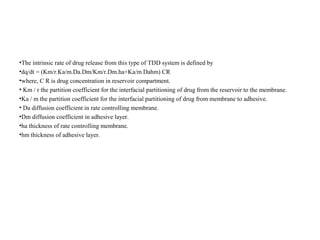
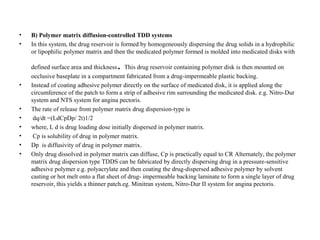
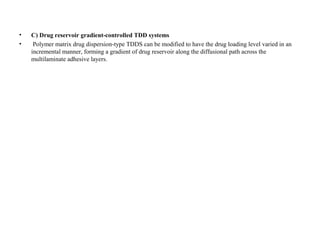
  • 66.