TRANSDERMAL DRUG DELIVERY SYSTEM (TDDS)
Introduction: Transdermal drug delivery systems (TDDS), also known as “patches,”
are dosage forms designed to deliver a therapeutically effective amount of drug
across a patient’s skin. TDD is a painless method of delivering drugs systemically by
applying a drug formulation onto intact and healthy skin. The drug initially
penetrates through the stratum corneum and then passes through the deeper
epidermis and dermis without drug accumulation in the dermal layer. When drug
reaches the dermal layer, it becomes available for systemic absorption via the dermal
microcirculation. Transdermal delivery provides a leading edge over injectables and
oral routes by increasing patient compliance and avoiding first pass metabolism
respectively. Transdermal delivery not only provides controlled, constant
administration of the drug, but also allows continuous input of drugs with short
biological half-lives and eliminates pulsed entry into systemic circulation, which
often causes undesirable side effects.
Definition: Transdermal drug delivery is defined as a self contained discrete dosage
form, which when applied to the intact skin, will deliver the drug at a controlled rate
to the systemic circulation. OR Transdermal drug delivery systems (patches) are
dosage forms designed to deliver a therapeutically effective amount of drug across a
patient’s skin also defined as Medicated adhesive patch that is placed on the skin to
deliver a specific dose of Medication through the skin and into the blood stream.
Advantages
1. Avoids the stomach environment;
2. No GI distress or other physiological contraindications of the oral route exist;
3. Easy to use, patches can Increases compliance & Reduce medical costs;
4. avoids the first-pass effect;
5. If a transdermal delivery system is used in place of a needle, then medical waste
can also be reduced , again, reduced healthcare costs.
6. Allows for the effective use of drugs with short biological half-lives
7. Allows for the administration of drugs with narrow therapeutic windows
8. Provides steady plasma levels of highly potent drugs
9. TDDS, especially simple patches, are easy to use and noninvasive and patients like
noninvasive therapies.
Disadvantages
1. Drugs that require high blood levels cannot be administered
2. The adhesive used may not adhere well to all types of skin
3. Drug or drug formulation may cause skin irritation or sensitization
4. The patches can be uncomfortable to wear
5. May not be economical for some patients.
Skin : site of drug delivery
STRUCTURE OF SKIN
• Epidermis:
Stratum corneum (Horny cell layer)
Stratum lucidum (Clear layer)
Stratum granulosum ( Granular Layer)
Stratum spinosum (Prickly layer)
Stratum germinativum
• Dermis:
• Hypodermis or Subcutaneous layer:
Epidermis It is the outermost layer of the skin, which is approximately 150
micrometers thick. Cell from lowers layers of the skin travel upward during their life
cycle and become flat dead cell of the corneum. The source of energy for lower
portions of epidermis is also glucose, and the end product of metabolism, lactic acid
accumulates in skin. Stratum Germinativum- Basal cells are nucleated, columnar.
Cells of this layer have high mitotic index and constantly renew the epidermis
andthis proliferation in healthy skin balances the loss of dead horny cells from the
skin surface. Malpighion Layer- The basal cell also include melanocytes which
produce the distribute melanin granules to the keratinocytes required for
pigmentation a protective measure against radiation. Stratum Spinosum- The cell of
this layer is produced by morphological and histochemical alteration of the cells
basal layers as they moved upward. The cells flatten and their nuclei shrink. They are
interconnected by fine prickles and form intercellular bridge the desmosomes. These
links maintain the integrity of the epidermis. Stratum Granulosum- This layer is
above the keratinocytes. They manufacturing basic staining particle, the
keratinohylline granules. This keratogenous or transitional zone is a region of intense
biochemical activity and morphological change. •Stratum Lucidum- In the palm of
the hand and sole of the foot, and zone forms a thin, translucent layer immediately
above the granule layer. The cells are non-nuclear. •Stratum corneum- At the final
stage of differentiation, epidermal cell construct the most superficial layer of
epidermis, stratum corneum. At friction surface of the body like palms and soles
adapt for weight bearing and membranous stratum corneum over the remainder of the
body is flexible but impermeable. The horny pads (sole and palm) are at least 40
times thicker than the membranous horny layer.
Dermis :Non-descriptive region lying in between the epidermis and the subcutaneous
fatty region. It consist mainly of the dense network of structural protein fibre i.e.
collagen, reticulum and elastin, embedded in the semigel matrix of
mucopolysaccaridic 'ground substance'. The elasticity of skin is due to the network or
gel structure of the cell. Beneath the dermis the fibrous tissue open outs and merges
with the fat containing subcutaneous tissue. Upper formed into ridges or papillae
protecting into the epidermis, which contain blood vessel, lymphatic and nerve
endings. Protein synthesis is a key factor in dermal metabolism. Subcutaneous tissue
This layer consist of sheet of fat rich areolar tissue, know as superficial fascia,
attaching the dermis to the underlying structure. Large arteries and vein are present
only in the superficial region. Skin Appendages The skin is interspersed with hair
follicle and associated sebaceous gland like regions two types of sweat glands
eccrine and apocrine. Collectively these are referred to as skin appendages.
Hypodermis: Subcutaneous, or hypodermis in histology, is the third layer beneath
the dermis. Subcutaneous is an elastic layer and includes a large amount of fat cells
that work as a shock absorber for blood vessels and nerve endings. The thickness of
this layer is 4 to 9 mm on average. However, the actual thickness differs from person
to person and it depends on the body region. When a molecule reaches intact skin, it
contacts with the cellular debris, normal flora of microorganisms, sebum and other
materials.
Routes of skin penetration: The main route of transport for water-soluble molecules
is transcellular. It involves the passage through the cytoplasm of corneocytes and
lipid arrangement of the stratum corneum9. The pathway of transport for lipid
soluble molecules is intercellular; it implicates the passage apparently through the
endogenous lipid within the stratum corneum. The transcellular and intercellular
route is collectively known as trans-epidermal route as shown below.
Solute molecules may penetrate the skin through the hair follicles, sweat duct or
through the sebaceous glands. These passages are collectively known as shunt or
appendageal route. It is generally accepted that the skin appendages comprises of
approximately 0.1% of fractional area for drug permeation. Thus, the main focus is to
develop permeation strategies through the stratum corneum rather than through the
appendages. The main barriers to absorption are the dead cells of the SC, restricting
the inward and outward movement of drug substances and having high electrical
resistance. The SC is a heterogeneous tissue, composed of flattened keratinized cells.
The outer layers of these cells are less densely packed than those adjacent to the
underlying granular layer. Therefore, the epidermal barrier becomes more
impermeable in the 6 lower part and this fact has led to suggestion that a separate
barrier exists at this level, the socalled SC. Thus as molecules move from the
environment into the skin, the rate limiting barrier i.e. the tissue that presents the
greatest resistance to the movement of molecules, is the SC. Once the dosage form is
applied topically, the percutaneous absorption or transdermal permeation can be
visualized as a composite of a series of steps. a. Adsorption of a penetrant molecule
onto the surface layers of SC. b. Diffusion through SC and through viable epidermis.
Percutaneous Absorption It is a step-wise process of penetration of substances into
various layers of skin and permeation across the skin into systemic circulations and
can be divided into three parts: a. Penetration: the entry of a substance into a
particular layer. b. Permeation: the penetration from one layer into another, and is
different both functionally and structurally from the first layer. c. Absorption: the
uptake of a substance into systemic circulation. Factors affecting Permeation The
principle transport mechanism across mammalian skin is by passive diffusion
through primarily the trans-epidermal route at steady state or through trans-
appendageal route at initially, non-steady state.
The factors that affect the permeability of the skin are classified into following three
categories:
A. Physicochemical properties of the permeate molecule
i. Partition co-efficient: Drug possessing both water and lipid solubility are
favorably absorbed through the skin. Transdermal permeability co-efficient shows a
linear dependence on partition coefficient. Varying the vehicle may also alter a
lipid/water partition co-efficient of a drug molecule. The partition co-efficient of a
drug molecule may be altered by chemical modification without affecting the
pharmacological activity of the drug.
ii. Molecular size: There is an inverse relationship existed between transdermal flux
and molecular weight of the molecule. The drug molecule selected as candidates for
transdermal delivery tend to lie within narrow range of molecular weight (100-500
Dalton). iii. Solubility / Melting point: Lipophilicity is a desired property of
transdermal candidates as lipophilic molecules tend to permeate through the skin
faster than more hydrophilic molecules. Drugs with high melting points have
relatively low aqueous solubility at normal temperature and pressure.
iv. PH condition: The pH mainly affects the rates of absorption of acidic and basic
drugs whereas unchanged form of drug has better penetrating capacity. Transport of
ionizable species from aqueous solutions shows strong pH dependence. According to
pH partition hypothesis, only the unionized form of the drugs can permeate through
the lipid barrier in significant amounts.
B. Physicochemical properties of the drug delivery system i. The affinity of the
vehicle for the drug molecules: It can influence the release of the drug molecule from
the carrier. Solubility in the carrier determines the release rate of the drug. The
mechanism of drug release depends on whether the drug is dissolved or suspended in
the delivery/carrier system and on the interfacial partition co-efficient of the drug
from the delivery system to skin tissue. ii. Composition of drug delivery system:
Composition of drug delivery system may affect not only the rate of drug release but
also the permeability of the SC by means of hydration. iii. Enhancement of
transdermal permeation: Due to the dead nature of the SC the release of the drug
from the dosage form is less. Penetration enhancers thus can cause the
physicochemical or physiological changes in SC and increase the penetration of the
drug through the skin. Various chemical substances are found to possess such drug
penetration enhancing property. C. Physiological and pathological condition of the
skin: a. Skin age: Foetal and infant skin appears to be more permeable than mature
adult skin and therefore percutaneous absorption of topical steroids occurs more
rapidly in children than in adults whereas, water permeation has shown to be same in
adults and in children. b. Lipid film: The thin lipid film on skin surface is formed by
the excretion of sebaceous glands and cell lipids like sebum and epidermal cell which
contain emulsifying agent may provide a protective film to prevent the removal of
natural moisturising factor from the skin and help in maintaining the barrier function
of the SC. c. Skin hydration: Hydration of SC can enhance transdermal permeability.
The rate of penetration study of salicylic acid through skin with dry and hydrated
corneum showed that when the tissues were hydrated, the rate of penetration of the
most water-soluble esters increased more than that of the other esters. d. Skin
temperature: Raising skin temperature results in an increase in the rate of skin
permeation. Rise in skin temperature may also increase vasodilation of blood vessels,
which are in contact with skin leading to an increase in percutaneous absorption. e.
Cutaneous drug metabolism: After crossing the SC barrier, some of the drug reaches
the general circulation in active form and some of this in inactive form or metabolic
form, because of the presence of metabolic enzymes present in the skin layers. It was
reported that more than 95% of testosterone absorbed was metabolized as it present
through the skin. f. Species differences: Mammalian skin from different species
display wide differences in anatomy in such characteristics as the thickness of SC,
number of sweat glands and hair follicles per unit surface area. g. Pathological injury
to the skin: Injuries to the skin can cause the disturbance in the continuity of SC and
leads to increase in skin permeability.
Permeation enhancers
Permeation enhancers are those substances which promote the absorption of drug
through the skin temporarily by transiently enhancing the skin permeability. They are
employed to transfer the delivery of drugs which are ionizable (Example: timolol
maleate) and impermeable (Example: heparin); to maintain drug levels in blood, to
provide higher dose of less potentially active drugs (Example: Oxymorphane), to
deliver high molecular weight hormones and peptides and to lessen the lag time of
transdermal drug delivery system.
Ideal Characteristics of Permeation Enhancers:
1. These materials should be biocompatible i.e. it should not cause irritation or any
allergic response both in the short as well as the long run. Also it should not induce
toxicity.
2. It should be compatible with the drug being given.
3. It should not exhibit any adverse pharmacological activity inside the body.
4. It should not be expensive and possess good solvent properties.
5. It should not have color, odor and taste.
6. It should be stable chemically as well as physically.
7. The course of action should be reproducible, sustainable and rapid.
8. It should be tested in vitro also.
9. It should not cause leakage of body fluids and endogenous materials.
Approaches for permeation enhancement: There are mainly three approaches for the
penetration enhancement
. a) Chemical approach b) Biochemical approach c) Physical approach
A. Chemical Approach: Mechanism: Penetration enhancers follow three main
routes, they are: 1. Causing disruptions in the highly organized structure of stratum
corneum.
2. Interaction with proteins present intercellularly.
3. Improved drug partitionin the stratum corneum with help of co-enhancer (i.e.
solvent)
The enhancers act by manipulating either of the three pathways. There are two ways
to achieve this, by bringing about a conformational change in the skin proteins or by
swelling of the solvent.
Various permeation enhancers have been discovered so far and are being used for
decades to benefit mankind, some of the most widely used are: Alcohols, Polyols:
Propylene glycol (PG), Short chain glycerides like glyceryl mono-caprylate, Amines
and Amides (Urea). Cyclodextrines, Fatty acids,Azones, DMSO, Surface active
agents (Anionic and cataionic) etc
B. Biochemical Approach: I. Synthesis of bio-convertible pro-drugs: Prodrugs help
to obtain an optimal partition coefficient for entering the skin barrier. After
absorption and diffusion to the viable tissues, enzymes convert the prodrug into the
active form.
C: Physical Approach:
Iontophoresis: The mechanism involves diffusion, migration or electro-osmosis of
drug through the skin across a concentration gradient. In electro-osmosis bulk of the
fluid and counter ions flow in the same direction. Iontophoresis is based on the
principle of the motion of this fluid flow without any concentration gradient. Under
normal conditions the skin is slightly negatively charged and counter ions form the
cations. Following the electro-osmotic principle, flow takes place from cathode to
anode. This increases the absorption of cationic drugs by increasing their flux.
Iontophoresis increases skin permeation as it alters the barrier function the SC.
Sonophoresis: Sonophoresis is the phenomenon in which the permeability of skin is
increased under the influence of ultrasound. Mechanism of action: According to
many scientific studies there are a number of phenomena that take place in the skin
when exposed to US (ultrasound).
basic components of TDDS
Polymer matrix/drug reservoir•
Membrane•
Drug•
Permeation enhancers•
Pressure-sensitive adhesives (PSA)•
Backing laminates
Release liner•
Other excipients like plasticizers and solvent
Polymer matrix/drug reservoirPolymers are the backbone of TDDS, which control the
release of the drug from the device. A polymer matrix can be prepared by dispersion of
drug in a liquid or solid state synthetic polymer base. Polymers used in TDDS should have
biocompatibility and chemical compatibility with the drug and other components of the
system.
Natural polymers: Cellulose derivatives, zein, gelatin, waxes, proteins and their derivatives
Synthetic elastomers: Polybutadiene, hydrin rubber, polysiloxane silicone rubber, nitrile,
acrylonitrile,
Synthetic polymers: Polyvinylalcohol, polyvinylchloride, polyethylene, polypropylene,
polyacrylate etc.
Membrane:
A membrane may be sealed to the backing to form a pocket to enclose the drug-containing
matrix or used as a single layer in the patch construction. The diffusion properties of the
membrane are used to control availability of the drug and/or excipients to the skin. For
example, ethylene vinyl acetate, silicone rubber, polyurethrane, etc. are used as a rate-
controlling membrane
Drug
For successfully developing a TDDS, the drug should be chosen with great care.
Transdermal patches offer many advantages to drugs that undergo extensive first-
pass metabolism, drugs with narrow therapeutic window or drugs with a short half-life, which
cause noncompliance due to frequent dosing.
Ideal properties of drugs for TDDS
Dose should be less than 20mg/day
Half life – 10 or less(hr)
Molecular weight – Less than 400Dalton
Partition coef – between 1 and 4
Oral bioavailability – low
Permeation enhancers: One long-standing approach for improving TDD uses penetration
enhancers (also called sorption promoters or accelerants), which increase the permeability
of the SC so as to attain higher therapeutic levels of the drug candidate. Penetration
enhancers interact with structural components of the SC thus modifying the barrier
functions, leading to increased permeability. Three pathways are suggested for drug
penetration through the skin: polar, nonpolar and polar/nonpolar. The enhancers act by
altering one of these pathways.
Backing laminates: Backings are chosen for appearance, flexibility and need for
occlusion; hence, while designing a backing layer, the consideration of chemical resistance
of the material is most important. Excipient compatibility should also be considered
because the prolonged contact between the backing layer and the excipients may cause the
additives to leach out of the backing layer or may lead to diffusion of excipients, drug or
penetration enhancer through the layer.
Release liner:
During storage, the patch is covered by a protective liner that is removed and discarded
before the application of the patch to the skin. Because the liner is in intimate
contact with the TDDS, the liner should be chemically inert. Typically, a release
liner is composed of a base layer that may be nonocclusive (e.g, paper fabric) or
occlusive (e.g, polyethylene, polyvinyl chloride) and a release coating layer made up of
silicon or Teflon. Other materials used for TDDS release liner are polyester foil and
metalized laminates
Formulation approaches
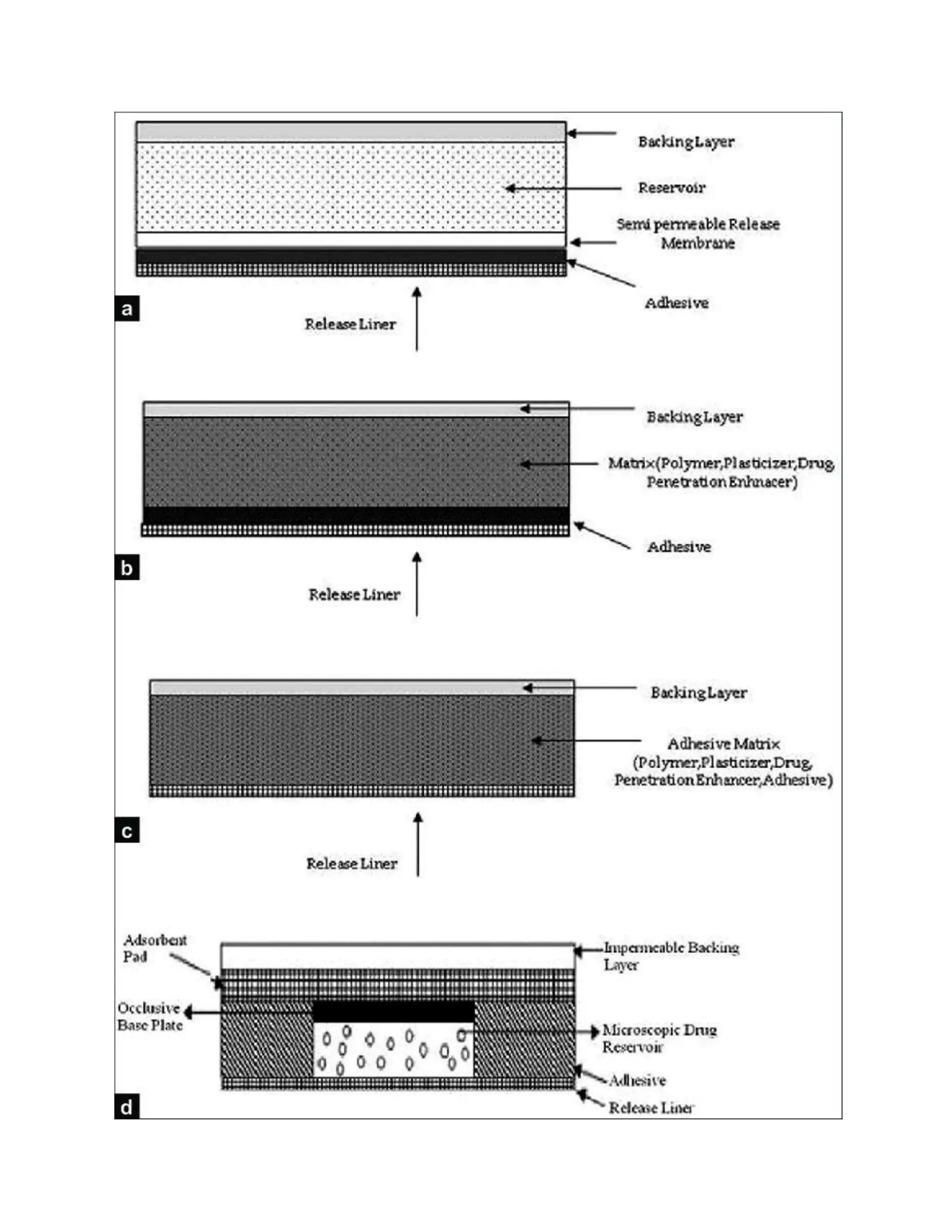
Reservoir system: In this transdermal system, the drug reservoir is embedded between an
impervious backing layer and a rate-controlling microporous or non-porous membrane. The
drug releases only through the rate-controlling membrane. In the drug reservoir
compartment, the drug can be in the form of a solution, suspension or gel, or may be
dispersed in a solid polymer matrix. Hypoallergenic adhesive polymer can be applied as a
continuous layer between the membrane and the release liner or in a concentric
configuration around the membrane.
Eg :- nitroglycerin releasing TDDS.
Matrix system Drug-in-adhesive system: In this type, the drug reservoir is formed by
dispersing the drug in an adhesive polymer and then spreading the medicated adhesive
polymer by solvent casting or melting (in the case of hot melt adhesives) on an impervious
backing layer. On the top face of the reservoir, unmedicated adhesive polymer layers are
applied for protection purpose.
It is used for the administration of verapamil.
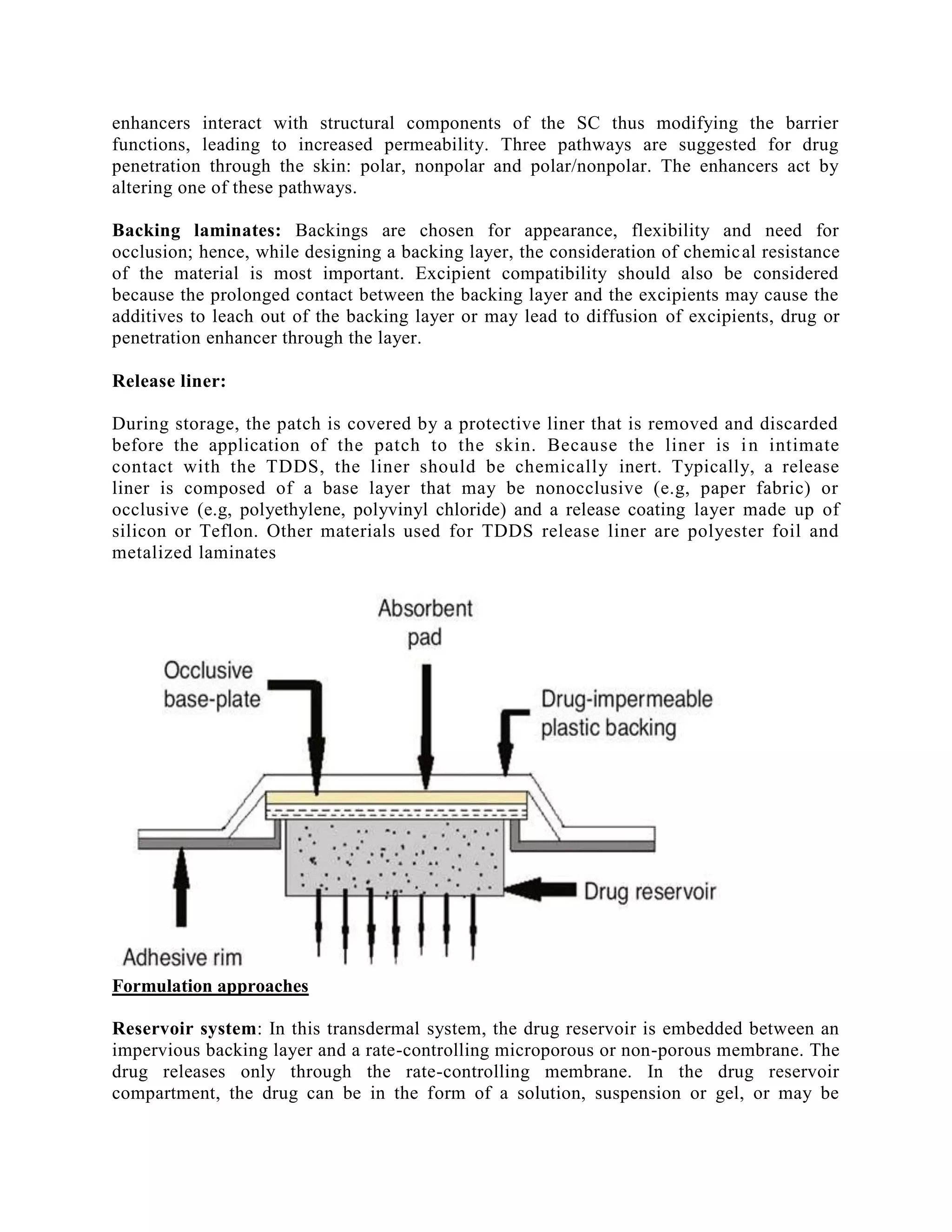
Matrix-dispersion system: The drug is dispersed homogenously in a hydrophilic or
lipophilic polymer matrix. This drug-containing polymer disk is then fixed onto an
occlusive base plate in a compartment fabricated from a drug-impermeable backing layer.
Instead of applying the adhesive on the face of the drug reservoir, it is spread along the
circumference to form a strip of adhesive rim.
Eg; of this type of system is nitro-dur I and nitro-dur II
Microreservoir systems: This TDDS is a combination of a reservoir and a matrix-
dispersion system. The drug reservoir is formed by first suspending the drug in an aqueous
solution of water-soluble polymer and then dispersing the solution homogenously in a
lipophilic polymer to form thousands of unleachable, microscopic spheres of drug
reservoirs. The thermodynamically unstable dispersion is stabilized quickly by immediately
cross-linking the polymer in situ.
It is successfully utilized in the preparation of nitro-disc, a nitroglycerine releasing trans dermal
therapeutic system used in angina pectoris.This system followed zero order release of drug
without the danger of dose dumping.
TDDS.docx

TDDS.docx

  • 1.
    TRANSDERMAL DRUG DELIVERYSYSTEM (TDDS) Introduction: Transdermal drug delivery systems (TDDS), also known as “patches,” are dosage forms designed to deliver a therapeutically effective amount of drug across a patient’s skin. TDD is a painless method of delivering drugs systemically by applying a drug formulation onto intact and healthy skin. The drug initially penetrates through the stratum corneum and then passes through the deeper epidermis and dermis without drug accumulation in the dermal layer. When drug reaches the dermal layer, it becomes available for systemic absorption via the dermal microcirculation. Transdermal delivery provides a leading edge over injectables and oral routes by increasing patient compliance and avoiding first pass metabolism respectively. Transdermal delivery not only provides controlled, constant administration of the drug, but also allows continuous input of drugs with short biological half-lives and eliminates pulsed entry into systemic circulation, which often causes undesirable side effects. Definition: Transdermal drug delivery is defined as a self contained discrete dosage form, which when applied to the intact skin, will deliver the drug at a controlled rate to the systemic circulation. OR Transdermal drug delivery systems (patches) are dosage forms designed to deliver a therapeutically effective amount of drug across a patient’s skin also defined as Medicated adhesive patch that is placed on the skin to deliver a specific dose of Medication through the skin and into the blood stream. Advantages 1. Avoids the stomach environment; 2. No GI distress or other physiological contraindications of the oral route exist; 3. Easy to use, patches can Increases compliance & Reduce medical costs; 4. avoids the first-pass effect; 5. If a transdermal delivery system is used in place of a needle, then medical waste can also be reduced , again, reduced healthcare costs. 6. Allows for the effective use of drugs with short biological half-lives 7. Allows for the administration of drugs with narrow therapeutic windows 8. Provides steady plasma levels of highly potent drugs
  • 2.
    9. TDDS, especiallysimple patches, are easy to use and noninvasive and patients like noninvasive therapies. Disadvantages 1. Drugs that require high blood levels cannot be administered 2. The adhesive used may not adhere well to all types of skin 3. Drug or drug formulation may cause skin irritation or sensitization 4. The patches can be uncomfortable to wear 5. May not be economical for some patients. Skin : site of drug delivery STRUCTURE OF SKIN • Epidermis: Stratum corneum (Horny cell layer) Stratum lucidum (Clear layer) Stratum granulosum ( Granular Layer)
  • 3.
    Stratum spinosum (Pricklylayer) Stratum germinativum • Dermis: • Hypodermis or Subcutaneous layer: Epidermis It is the outermost layer of the skin, which is approximately 150 micrometers thick. Cell from lowers layers of the skin travel upward during their life cycle and become flat dead cell of the corneum. The source of energy for lower portions of epidermis is also glucose, and the end product of metabolism, lactic acid accumulates in skin. Stratum Germinativum- Basal cells are nucleated, columnar. Cells of this layer have high mitotic index and constantly renew the epidermis andthis proliferation in healthy skin balances the loss of dead horny cells from the skin surface. Malpighion Layer- The basal cell also include melanocytes which produce the distribute melanin granules to the keratinocytes required for pigmentation a protective measure against radiation. Stratum Spinosum- The cell of this layer is produced by morphological and histochemical alteration of the cells basal layers as they moved upward. The cells flatten and their nuclei shrink. They are interconnected by fine prickles and form intercellular bridge the desmosomes. These links maintain the integrity of the epidermis. Stratum Granulosum- This layer is above the keratinocytes. They manufacturing basic staining particle, the keratinohylline granules. This keratogenous or transitional zone is a region of intense biochemical activity and morphological change. •Stratum Lucidum- In the palm of the hand and sole of the foot, and zone forms a thin, translucent layer immediately above the granule layer. The cells are non-nuclear. •Stratum corneum- At the final stage of differentiation, epidermal cell construct the most superficial layer of epidermis, stratum corneum. At friction surface of the body like palms and soles adapt for weight bearing and membranous stratum corneum over the remainder of the body is flexible but impermeable. The horny pads (sole and palm) are at least 40 times thicker than the membranous horny layer. Dermis :Non-descriptive region lying in between the epidermis and the subcutaneous fatty region. It consist mainly of the dense network of structural protein fibre i.e. collagen, reticulum and elastin, embedded in the semigel matrix of
  • 4.
    mucopolysaccaridic 'ground substance'.The elasticity of skin is due to the network or gel structure of the cell. Beneath the dermis the fibrous tissue open outs and merges with the fat containing subcutaneous tissue. Upper formed into ridges or papillae protecting into the epidermis, which contain blood vessel, lymphatic and nerve endings. Protein synthesis is a key factor in dermal metabolism. Subcutaneous tissue This layer consist of sheet of fat rich areolar tissue, know as superficial fascia, attaching the dermis to the underlying structure. Large arteries and vein are present only in the superficial region. Skin Appendages The skin is interspersed with hair follicle and associated sebaceous gland like regions two types of sweat glands eccrine and apocrine. Collectively these are referred to as skin appendages. Hypodermis: Subcutaneous, or hypodermis in histology, is the third layer beneath the dermis. Subcutaneous is an elastic layer and includes a large amount of fat cells that work as a shock absorber for blood vessels and nerve endings. The thickness of this layer is 4 to 9 mm on average. However, the actual thickness differs from person to person and it depends on the body region. When a molecule reaches intact skin, it contacts with the cellular debris, normal flora of microorganisms, sebum and other materials. Routes of skin penetration: The main route of transport for water-soluble molecules is transcellular. It involves the passage through the cytoplasm of corneocytes and lipid arrangement of the stratum corneum9. The pathway of transport for lipid soluble molecules is intercellular; it implicates the passage apparently through the endogenous lipid within the stratum corneum. The transcellular and intercellular route is collectively known as trans-epidermal route as shown below.
  • 5.
    Solute molecules maypenetrate the skin through the hair follicles, sweat duct or through the sebaceous glands. These passages are collectively known as shunt or appendageal route. It is generally accepted that the skin appendages comprises of approximately 0.1% of fractional area for drug permeation. Thus, the main focus is to develop permeation strategies through the stratum corneum rather than through the appendages. The main barriers to absorption are the dead cells of the SC, restricting the inward and outward movement of drug substances and having high electrical resistance. The SC is a heterogeneous tissue, composed of flattened keratinized cells. The outer layers of these cells are less densely packed than those adjacent to the underlying granular layer. Therefore, the epidermal barrier becomes more impermeable in the 6 lower part and this fact has led to suggestion that a separate barrier exists at this level, the socalled SC. Thus as molecules move from the environment into the skin, the rate limiting barrier i.e. the tissue that presents the greatest resistance to the movement of molecules, is the SC. Once the dosage form is applied topically, the percutaneous absorption or transdermal permeation can be visualized as a composite of a series of steps. a. Adsorption of a penetrant molecule onto the surface layers of SC. b. Diffusion through SC and through viable epidermis. Percutaneous Absorption It is a step-wise process of penetration of substances into various layers of skin and permeation across the skin into systemic circulations and
  • 6.
    can be dividedinto three parts: a. Penetration: the entry of a substance into a particular layer. b. Permeation: the penetration from one layer into another, and is different both functionally and structurally from the first layer. c. Absorption: the uptake of a substance into systemic circulation. Factors affecting Permeation The principle transport mechanism across mammalian skin is by passive diffusion through primarily the trans-epidermal route at steady state or through trans- appendageal route at initially, non-steady state. The factors that affect the permeability of the skin are classified into following three categories: A. Physicochemical properties of the permeate molecule i. Partition co-efficient: Drug possessing both water and lipid solubility are favorably absorbed through the skin. Transdermal permeability co-efficient shows a linear dependence on partition coefficient. Varying the vehicle may also alter a lipid/water partition co-efficient of a drug molecule. The partition co-efficient of a drug molecule may be altered by chemical modification without affecting the pharmacological activity of the drug. ii. Molecular size: There is an inverse relationship existed between transdermal flux and molecular weight of the molecule. The drug molecule selected as candidates for transdermal delivery tend to lie within narrow range of molecular weight (100-500 Dalton). iii. Solubility / Melting point: Lipophilicity is a desired property of transdermal candidates as lipophilic molecules tend to permeate through the skin faster than more hydrophilic molecules. Drugs with high melting points have relatively low aqueous solubility at normal temperature and pressure. iv. PH condition: The pH mainly affects the rates of absorption of acidic and basic drugs whereas unchanged form of drug has better penetrating capacity. Transport of ionizable species from aqueous solutions shows strong pH dependence. According to pH partition hypothesis, only the unionized form of the drugs can permeate through the lipid barrier in significant amounts. B. Physicochemical properties of the drug delivery system i. The affinity of the vehicle for the drug molecules: It can influence the release of the drug molecule from the carrier. Solubility in the carrier determines the release rate of the drug. The
  • 7.
    mechanism of drugrelease depends on whether the drug is dissolved or suspended in the delivery/carrier system and on the interfacial partition co-efficient of the drug from the delivery system to skin tissue. ii. Composition of drug delivery system: Composition of drug delivery system may affect not only the rate of drug release but also the permeability of the SC by means of hydration. iii. Enhancement of transdermal permeation: Due to the dead nature of the SC the release of the drug from the dosage form is less. Penetration enhancers thus can cause the physicochemical or physiological changes in SC and increase the penetration of the drug through the skin. Various chemical substances are found to possess such drug penetration enhancing property. C. Physiological and pathological condition of the skin: a. Skin age: Foetal and infant skin appears to be more permeable than mature adult skin and therefore percutaneous absorption of topical steroids occurs more rapidly in children than in adults whereas, water permeation has shown to be same in adults and in children. b. Lipid film: The thin lipid film on skin surface is formed by the excretion of sebaceous glands and cell lipids like sebum and epidermal cell which contain emulsifying agent may provide a protective film to prevent the removal of natural moisturising factor from the skin and help in maintaining the barrier function of the SC. c. Skin hydration: Hydration of SC can enhance transdermal permeability. The rate of penetration study of salicylic acid through skin with dry and hydrated corneum showed that when the tissues were hydrated, the rate of penetration of the most water-soluble esters increased more than that of the other esters. d. Skin temperature: Raising skin temperature results in an increase in the rate of skin permeation. Rise in skin temperature may also increase vasodilation of blood vessels, which are in contact with skin leading to an increase in percutaneous absorption. e. Cutaneous drug metabolism: After crossing the SC barrier, some of the drug reaches the general circulation in active form and some of this in inactive form or metabolic form, because of the presence of metabolic enzymes present in the skin layers. It was reported that more than 95% of testosterone absorbed was metabolized as it present through the skin. f. Species differences: Mammalian skin from different species display wide differences in anatomy in such characteristics as the thickness of SC, number of sweat glands and hair follicles per unit surface area. g. Pathological injury
  • 8.
    to the skin:Injuries to the skin can cause the disturbance in the continuity of SC and leads to increase in skin permeability. Permeation enhancers Permeation enhancers are those substances which promote the absorption of drug through the skin temporarily by transiently enhancing the skin permeability. They are employed to transfer the delivery of drugs which are ionizable (Example: timolol maleate) and impermeable (Example: heparin); to maintain drug levels in blood, to provide higher dose of less potentially active drugs (Example: Oxymorphane), to deliver high molecular weight hormones and peptides and to lessen the lag time of transdermal drug delivery system. Ideal Characteristics of Permeation Enhancers: 1. These materials should be biocompatible i.e. it should not cause irritation or any allergic response both in the short as well as the long run. Also it should not induce toxicity. 2. It should be compatible with the drug being given. 3. It should not exhibit any adverse pharmacological activity inside the body. 4. It should not be expensive and possess good solvent properties. 5. It should not have color, odor and taste. 6. It should be stable chemically as well as physically. 7. The course of action should be reproducible, sustainable and rapid. 8. It should be tested in vitro also. 9. It should not cause leakage of body fluids and endogenous materials. Approaches for permeation enhancement: There are mainly three approaches for the penetration enhancement . a) Chemical approach b) Biochemical approach c) Physical approach A. Chemical Approach: Mechanism: Penetration enhancers follow three main routes, they are: 1. Causing disruptions in the highly organized structure of stratum corneum. 2. Interaction with proteins present intercellularly. 3. Improved drug partitionin the stratum corneum with help of co-enhancer (i.e. solvent)
  • 9.
    The enhancers actby manipulating either of the three pathways. There are two ways to achieve this, by bringing about a conformational change in the skin proteins or by swelling of the solvent. Various permeation enhancers have been discovered so far and are being used for decades to benefit mankind, some of the most widely used are: Alcohols, Polyols: Propylene glycol (PG), Short chain glycerides like glyceryl mono-caprylate, Amines and Amides (Urea). Cyclodextrines, Fatty acids,Azones, DMSO, Surface active agents (Anionic and cataionic) etc B. Biochemical Approach: I. Synthesis of bio-convertible pro-drugs: Prodrugs help to obtain an optimal partition coefficient for entering the skin barrier. After absorption and diffusion to the viable tissues, enzymes convert the prodrug into the active form. C: Physical Approach: Iontophoresis: The mechanism involves diffusion, migration or electro-osmosis of drug through the skin across a concentration gradient. In electro-osmosis bulk of the fluid and counter ions flow in the same direction. Iontophoresis is based on the principle of the motion of this fluid flow without any concentration gradient. Under normal conditions the skin is slightly negatively charged and counter ions form the cations. Following the electro-osmotic principle, flow takes place from cathode to anode. This increases the absorption of cationic drugs by increasing their flux. Iontophoresis increases skin permeation as it alters the barrier function the SC. Sonophoresis: Sonophoresis is the phenomenon in which the permeability of skin is increased under the influence of ultrasound. Mechanism of action: According to many scientific studies there are a number of phenomena that take place in the skin when exposed to US (ultrasound). basic components of TDDS Polymer matrix/drug reservoir• Membrane• Drug• Permeation enhancers• Pressure-sensitive adhesives (PSA)•
  • 10.
    Backing laminates Release liner• Otherexcipients like plasticizers and solvent Polymer matrix/drug reservoirPolymers are the backbone of TDDS, which control the release of the drug from the device. A polymer matrix can be prepared by dispersion of drug in a liquid or solid state synthetic polymer base. Polymers used in TDDS should have biocompatibility and chemical compatibility with the drug and other components of the system. Natural polymers: Cellulose derivatives, zein, gelatin, waxes, proteins and their derivatives Synthetic elastomers: Polybutadiene, hydrin rubber, polysiloxane silicone rubber, nitrile, acrylonitrile, Synthetic polymers: Polyvinylalcohol, polyvinylchloride, polyethylene, polypropylene, polyacrylate etc. Membrane: A membrane may be sealed to the backing to form a pocket to enclose the drug-containing matrix or used as a single layer in the patch construction. The diffusion properties of the membrane are used to control availability of the drug and/or excipients to the skin. For example, ethylene vinyl acetate, silicone rubber, polyurethrane, etc. are used as a rate- controlling membrane Drug For successfully developing a TDDS, the drug should be chosen with great care. Transdermal patches offer many advantages to drugs that undergo extensive first- pass metabolism, drugs with narrow therapeutic window or drugs with a short half-life, which cause noncompliance due to frequent dosing. Ideal properties of drugs for TDDS Dose should be less than 20mg/day Half life – 10 or less(hr) Molecular weight – Less than 400Dalton Partition coef – between 1 and 4 Oral bioavailability – low Permeation enhancers: One long-standing approach for improving TDD uses penetration enhancers (also called sorption promoters or accelerants), which increase the permeability of the SC so as to attain higher therapeutic levels of the drug candidate. Penetration
  • 11.
    enhancers interact withstructural components of the SC thus modifying the barrier functions, leading to increased permeability. Three pathways are suggested for drug penetration through the skin: polar, nonpolar and polar/nonpolar. The enhancers act by altering one of these pathways. Backing laminates: Backings are chosen for appearance, flexibility and need for occlusion; hence, while designing a backing layer, the consideration of chemical resistance of the material is most important. Excipient compatibility should also be considered because the prolonged contact between the backing layer and the excipients may cause the additives to leach out of the backing layer or may lead to diffusion of excipients, drug or penetration enhancer through the layer. Release liner: During storage, the patch is covered by a protective liner that is removed and discarded before the application of the patch to the skin. Because the liner is in intimate contact with the TDDS, the liner should be chemically inert. Typically, a release liner is composed of a base layer that may be nonocclusive (e.g, paper fabric) or occlusive (e.g, polyethylene, polyvinyl chloride) and a release coating layer made up of silicon or Teflon. Other materials used for TDDS release liner are polyester foil and metalized laminates Formulation approaches Reservoir system: In this transdermal system, the drug reservoir is embedded between an impervious backing layer and a rate-controlling microporous or non-porous membrane. The drug releases only through the rate-controlling membrane. In the drug reservoir compartment, the drug can be in the form of a solution, suspension or gel, or may be
  • 12.
    dispersed in asolid polymer matrix. Hypoallergenic adhesive polymer can be applied as a continuous layer between the membrane and the release liner or in a concentric configuration around the membrane. Eg :- nitroglycerin releasing TDDS. Matrix system Drug-in-adhesive system: In this type, the drug reservoir is formed by dispersing the drug in an adhesive polymer and then spreading the medicated adhesive polymer by solvent casting or melting (in the case of hot melt adhesives) on an impervious backing layer. On the top face of the reservoir, unmedicated adhesive polymer layers are applied for protection purpose. It is used for the administration of verapamil. Matrix-dispersion system: The drug is dispersed homogenously in a hydrophilic or lipophilic polymer matrix. This drug-containing polymer disk is then fixed onto an occlusive base plate in a compartment fabricated from a drug-impermeable backing layer. Instead of applying the adhesive on the face of the drug reservoir, it is spread along the circumference to form a strip of adhesive rim. Eg; of this type of system is nitro-dur I and nitro-dur II Microreservoir systems: This TDDS is a combination of a reservoir and a matrix- dispersion system. The drug reservoir is formed by first suspending the drug in an aqueous solution of water-soluble polymer and then dispersing the solution homogenously in a lipophilic polymer to form thousands of unleachable, microscopic spheres of drug reservoirs. The thermodynamically unstable dispersion is stabilized quickly by immediately cross-linking the polymer in situ. It is successfully utilized in the preparation of nitro-disc, a nitroglycerine releasing trans dermal therapeutic system used in angina pectoris.This system followed zero order release of drug without the danger of dose dumping.