With the arrival of the Europeans the demand for slaves in the Americas increased significantly. As disease reduced the native populations in Spanish conquered territories, the Spanish began relying on imported slaves from Africa.
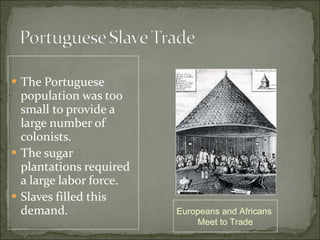
The Portuguese population was too small to provide a large number of colonists. The sugar plantations required a large labor force. Slaves filled this demand. Europeans and Africans  Meet to Trade
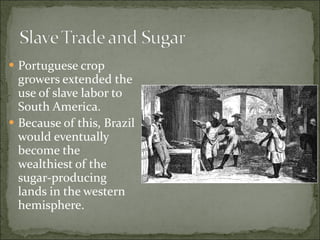
Portuguese crop growers extended the use of slave labor to South America. Because of this, Brazil would eventually become the wealthiest of the sugar-producing lands in the western hemisphere.
 
In 1518, the first shipment of slaves went directly from West Africa to the Caribbean where the slaves worked on sugar plantations. By the 1520s, the Spanish had introduced slaves to Mexico, Peru, and Central America where they worked as farmers and miners. By the early 17 th  century, the British had introduced slaves to North America.
 
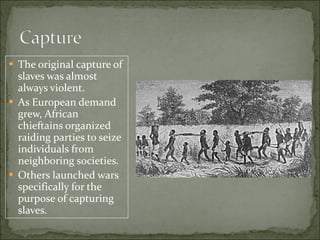
The original capture of slaves was almost always violent. As European demand grew, African chieftains organized raiding parties to seize individuals from neighboring societies. Others launched wars specifically for the purpose of capturing slaves.
“ Africans became enslaved mainly through four ways:   first , criminals sold by the chiefs as punishment;  secondly , free Africans obtained from raids by African and a few European gangs;  thirdly , domestic slaves resold, and  fourthly ; prisoners of war."  (Adu Boahen (University of Ghana).
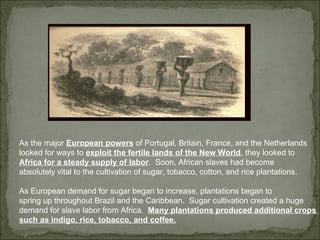
As the major  European powers  of Portugal, Britain, France, and the Netherlands looked for ways to  exploit the fertile lands of the New World , they looked to Africa for a steady supply of labor .  Soon, African slaves had become absolutely vital to the cultivation of sugar, tobacco, cotton, and rice plantations. As European demand for sugar began to increase, plantations began to spring up throughout Brazil and the Caribbean.  Sugar cultivation created a huge demand for slave labor from Africa.  Many plantations produced additional crops  such as indigo, rice, tobacco, and coffee.
After crossing the Atlantic, most African slaves went to plantations in the tropical or subtropical regions of the western hemisphere. The first was established by the Spanish on Hispaniola in 1516. Originally the predominant crop was sugar. In addition to sugar, plantations produced crops like tobacco, indigo, and cotton. In the 1530s Portuguese began organizing plantations in Brazil, and Brazil became the world’s leading supplier of sugar.
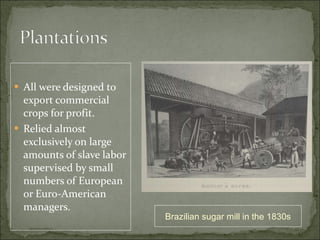
All were designed to export commercial crops for profit. Relied almost exclusively on large amounts of slave labor supervised by small numbers of European or Euro-American managers. Brazilian sugar mill in the 1830s
Impact of Slave Trade on the Americas Cultural Diffusion –  --The slave trade  spread ideas   and  goods   between cultures  (cultural diffusion).  -- Europeans  brought  new weapons to Africa . -- Africans  brought part of  their culture   (like music food, traditions, Language )  to  the  Americas .

Trans atlantic slave trade2011

  • 1.
  • 2.
    With the arrivalof the Europeans the demand for slaves in the Americas increased significantly. As disease reduced the native populations in Spanish conquered territories, the Spanish began relying on imported slaves from Africa.
  • 3.
    The Portuguese populationwas too small to provide a large number of colonists. The sugar plantations required a large labor force. Slaves filled this demand. Europeans and Africans Meet to Trade
  • 4.
    Portuguese crop growersextended the use of slave labor to South America. Because of this, Brazil would eventually become the wealthiest of the sugar-producing lands in the western hemisphere.
  • 5.
  • 6.
    In 1518, thefirst shipment of slaves went directly from West Africa to the Caribbean where the slaves worked on sugar plantations. By the 1520s, the Spanish had introduced slaves to Mexico, Peru, and Central America where they worked as farmers and miners. By the early 17 th century, the British had introduced slaves to North America.
  • 7.
  • 8.
    The original captureof slaves was almost always violent. As European demand grew, African chieftains organized raiding parties to seize individuals from neighboring societies. Others launched wars specifically for the purpose of capturing slaves.
  • 9.
    “ Africans becameenslaved mainly through four ways: first , criminals sold by the chiefs as punishment; secondly , free Africans obtained from raids by African and a few European gangs; thirdly , domestic slaves resold, and fourthly ; prisoners of war." (Adu Boahen (University of Ghana).
  • 10.
    As the major European powers of Portugal, Britain, France, and the Netherlands looked for ways to exploit the fertile lands of the New World , they looked to Africa for a steady supply of labor . Soon, African slaves had become absolutely vital to the cultivation of sugar, tobacco, cotton, and rice plantations. As European demand for sugar began to increase, plantations began to spring up throughout Brazil and the Caribbean. Sugar cultivation created a huge demand for slave labor from Africa. Many plantations produced additional crops such as indigo, rice, tobacco, and coffee.
  • 11.
    After crossing theAtlantic, most African slaves went to plantations in the tropical or subtropical regions of the western hemisphere. The first was established by the Spanish on Hispaniola in 1516. Originally the predominant crop was sugar. In addition to sugar, plantations produced crops like tobacco, indigo, and cotton. In the 1530s Portuguese began organizing plantations in Brazil, and Brazil became the world’s leading supplier of sugar.
  • 12.
    All were designedto export commercial crops for profit. Relied almost exclusively on large amounts of slave labor supervised by small numbers of European or Euro-American managers. Brazilian sugar mill in the 1830s
  • 13.
    Impact of SlaveTrade on the Americas Cultural Diffusion – --The slave trade spread ideas and goods between cultures (cultural diffusion). -- Europeans brought new weapons to Africa . -- Africans brought part of their culture (like music food, traditions, Language ) to the Americas .

Editor's Notes

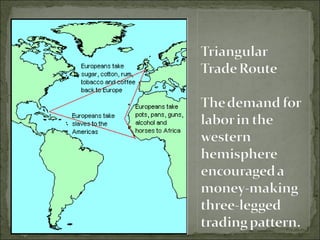
  • #6 Triangular Trade The triangular trade demonstrates how people were reduced to commodities to be sold. Goods such as metal, cloth, beads and guns went from Britain to Africa, enslaved Africans went to America and the Caribbean, and raw products such as sugar, tobacco and cotton came back to Britain. Show the picture of the sugar nippers.          One of the reasons the trade lasted for so long was because it was incredibly profitable. The British appeared to have an insatiable appetite for luxury goods from the Caribbean, especially sugar and this demand fuelled supply.          Before the twentieth century, sugar came in cones from which chunks would be nipped off and used to sweeten the bitter taste of coffee, chocolate and tea. What people consumed in one part of the world altered forever the lives of those from other parts of the world.