Tranexamic acid in hip
hemiarthroplasty
Conrad Lee, Richard Freeman,
Mark Edmonson, Ben Rogers
Does it reduce blood loss and transfusion rates
Background
• Hip surgery is associated with intraoperative blood loss 1, 2
• Post operative anaemia have a negative impact on
functional recovery 2
• Blood transfusion has associated high costs and risks 3
• Hip fracture patients are most affected by postoperative
anaemia 2
Background
• Several blood conservation methods 4
• Tranexamic acid (TXA)
– antifibrinolytic
– Prevents conversion of plasminogen to plasmin
– Half-life 180 mins
– Most effective when given before hyperfibinolysis cased by
tissue injury during surgery
– 1g given intravenously as prophylaxis in RSCH (based on surgeon
preference)
• Much evidence for TXA use in elective THR / TKR 5, 6
Aim
• Does prophylactic TXA given before incision
reduce postoperative transfusion requirement
in hip hemiarthroplasty?
• Does it reduce postoperative haemoglobin
drop?
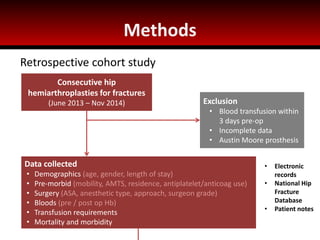
Methods
Consecutive hip
hemiarthroplasties for fractures
(June 2013 – Nov 2014)
Retrospective cohort study
Exclusion
• Blood transfusion within
3 days pre-op
• Incomplete data
• Austin Moore prosthesis
Data collected
• Demographics (age, gender, length of stay)
• Pre-morbid (mobility, AMTS, residence, antiplatelet/anticoag use)
• Surgery (ASA, anesthetic type, approach, surgeon grade)
• Bloods (pre / post op Hb)
• Transfusion requirements
• Mortality and morbidity
• Electronic
records
• National Hip
Fracture
Database
• Patient notes
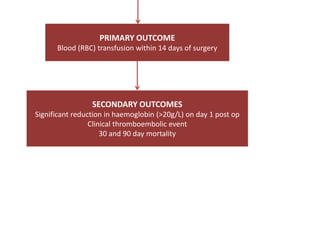
PRIMARY OUTCOME
Blood (RBC) transfusion within 14 days of surgery
SECONDARY OUTCOMES
Significant reduction in haemoglobin (>20g/L) on day 1 post op
Clinical thromboembolic event
30 and 90 day mortality
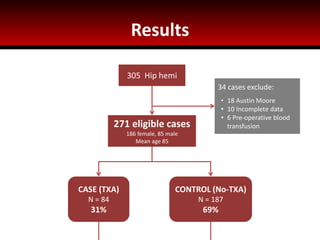
Results
305 Hip hemi
271 eligible cases
186 female, 85 male
Mean age 85
34 cases exclude:
• 18 Austin Moore
• 10 Incomplete data
• 6 Pre-operative blood
transfusion
CASE (TXA)
N = 84
31%
CONTROL (No-TXA)
N = 187
69%
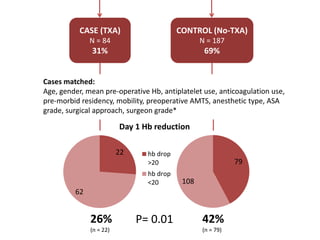
CASE (TXA)
N = 84
31%
CONTROL (No-TXA)
N = 187
69%
Cases matched:
Age, gender, mean pre-operative Hb, antiplatelet use, anticoagulation use,
pre-morbid residency, mobility, preoperative AMTS, anesthetic type, ASA
grade, surgical approach, surgeon grade*
22
62
hb drop
>20
hb drop
<20
79
108
26%
(n = 22)
42%
(n = 79)
P= 0.01
Day 1 Hb reduction
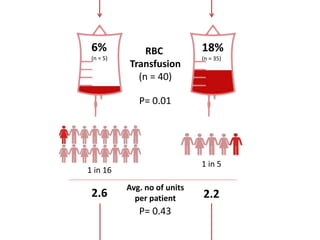
6%
(n = 5)
18%
(n = 35)
P= 0.01
RBC
Transfusion
(n = 40)
Avg. no of units
per patient2.6 2.2
P= 0.43
1 in 16
1 in 5
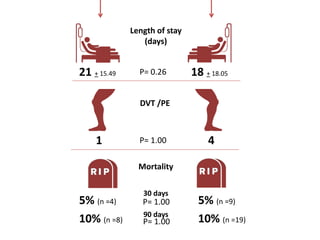
21 + 15.49 18 + 18.05P= 0.26
Length of stay
(days)
DVT /PE
Mortality
1 4P= 1.00
5% (n =4) 5% (n =9)P= 1.00
10% (n =8) 10% (n =19)P= 1.00
30 days
90 days
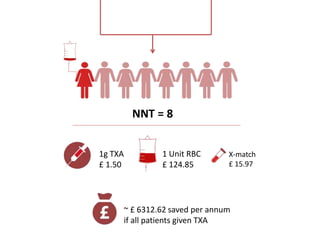
NNT = 8
1g TXA
£ 1.50
1 Unit RBC
£ 124.85
X-match
£ 15.97
~ £ 6312.62 saved per annum
if all patients given TXA
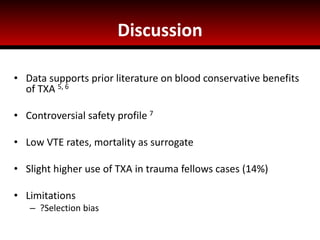
Discussion
• Data supports prior literature on blood conservative benefits
of TXA 5, 6
• Controversial safety profile 7
• Low VTE rates, mortality as surrogate
• Slight higher use of TXA in trauma fellows cases (14%)
• Limitations
– ?Selection bias
Conclusion
• TXA reduces postoperative Hb drop and
transfusion requirements in hip
hemiarthroplasties
• TXA is safe and cost effective
• Prophylactic TXA is recommended for patients
undergoing hip hemiarthroplasties
References
1. Zufferey PJ, Miquet M, Quenet S, Martin P, Adam P, Albaladejo P, et al. Tranexamic acid in hip fracture surgery: a
randomized controlled trial. Br J Anaesth [Internet]. 2010 Jan [cited 2015 Feb 2];104(1):23–30. Available from:
http://www.ncbi.nlm.nih.gov/pubmed/19926634
2. Lawrence VA, Silverstein JH, Cornell JE, Pederson T, Noveck H, Carson JL. Higher Hb level is associated with better
early functional recovery after hip fracture repair. Transfusion [Internet]. 2003 Dec [cited 2015 Feb
2];43(12):1717–22. Available from: http://www.ncbi.nlm.nih.gov/pubmed/14641869
3. Kadar A, Chechik O, Steinberg E, Reider E, Sternheim A. Predicting the need for blood transfusion in patients with
hip fractures. Int Orthop [Internet]. 2013 Apr [cited 2015 Feb 4];37(4):693–700. Available from:
http://www.pubmedcentral.nih.gov/articlerender.fcgi?artid=3609993&tool=pmcentrez&rendertype=abstract
4. Lemaire R. Strategies for blood management in orthopaedic and trauma surgery. J Bone Joint Surg Br [Internet].
2008 Sep [cited 2015 Feb 2];90(9):1128–36. Available from: http://www.ncbi.nlm.nih.gov/pubmed/18757950
5. Poeran J, Rasul R, Suzuki S, Danninger T, Mazumdar M, Opperer M, et al. Tranexamic acid use and postoperative
outcomes in patients undergoing total hip or knee arthroplasty in the United States: retrospective analysis of
effectiveness and safety. BMJ [Internet]. 2014 Jan 12 [cited 2014 Dec 7];349(aug12_8):g4829. Available from:
http://www.bmj.com/content/349/bmj.g4829
6. Zhou X, Tao L, Li J, Wu L. Do we really need tranexamic acid in total hip arthroplasty? A meta-analysis of nineteen
randomized controlled trials. Arch Orthop Trauma Surg [Internet]. 2013 Jul [cited 2015 Jan 4];133(7):1017–27.
Available from: http://www.ncbi.nlm.nih.gov/pubmed/23615973
7. Ho KM, Ismail H. Use of intravenous tranexamic acid to reduce allogeneic blood transfusion in total hip and knee
arthroplasty: a meta-analysis. Anaesth Intensive Care [Internet]. 2003 Oct [cited 2015 Jan 29];31(5):529–37.
Available from: http://www.ncbi.nlm.nih.gov/pubmed/14601276

Tranexamic acid in hip hemiarthroplasty

  • 1.
    Tranexamic acid inhip hemiarthroplasty Conrad Lee, Richard Freeman, Mark Edmonson, Ben Rogers Does it reduce blood loss and transfusion rates
  • 2.
    Background • Hip surgeryis associated with intraoperative blood loss 1, 2 • Post operative anaemia have a negative impact on functional recovery 2 • Blood transfusion has associated high costs and risks 3 • Hip fracture patients are most affected by postoperative anaemia 2
  • 3.
    Background • Several bloodconservation methods 4 • Tranexamic acid (TXA) – antifibrinolytic – Prevents conversion of plasminogen to plasmin – Half-life 180 mins – Most effective when given before hyperfibinolysis cased by tissue injury during surgery – 1g given intravenously as prophylaxis in RSCH (based on surgeon preference) • Much evidence for TXA use in elective THR / TKR 5, 6
  • 4.
    Aim • Does prophylacticTXA given before incision reduce postoperative transfusion requirement in hip hemiarthroplasty? • Does it reduce postoperative haemoglobin drop?
  • 5.
    Methods Consecutive hip hemiarthroplasties forfractures (June 2013 – Nov 2014) Retrospective cohort study Exclusion • Blood transfusion within 3 days pre-op • Incomplete data • Austin Moore prosthesis Data collected • Demographics (age, gender, length of stay) • Pre-morbid (mobility, AMTS, residence, antiplatelet/anticoag use) • Surgery (ASA, anesthetic type, approach, surgeon grade) • Bloods (pre / post op Hb) • Transfusion requirements • Mortality and morbidity • Electronic records • National Hip Fracture Database • Patient notes
  • 6.
    PRIMARY OUTCOME Blood (RBC)transfusion within 14 days of surgery SECONDARY OUTCOMES Significant reduction in haemoglobin (>20g/L) on day 1 post op Clinical thromboembolic event 30 and 90 day mortality
  • 7.
    Results 305 Hip hemi 271eligible cases 186 female, 85 male Mean age 85 34 cases exclude: • 18 Austin Moore • 10 Incomplete data • 6 Pre-operative blood transfusion CASE (TXA) N = 84 31% CONTROL (No-TXA) N = 187 69%
  • 8.
    CASE (TXA) N =84 31% CONTROL (No-TXA) N = 187 69% Cases matched: Age, gender, mean pre-operative Hb, antiplatelet use, anticoagulation use, pre-morbid residency, mobility, preoperative AMTS, anesthetic type, ASA grade, surgical approach, surgeon grade* 22 62 hb drop >20 hb drop <20 79 108 26% (n = 22) 42% (n = 79) P= 0.01 Day 1 Hb reduction
  • 9.
    6% (n = 5) 18% (n= 35) P= 0.01 RBC Transfusion (n = 40) Avg. no of units per patient2.6 2.2 P= 0.43 1 in 16 1 in 5
  • 10.
    21 + 15.4918 + 18.05P= 0.26 Length of stay (days) DVT /PE Mortality 1 4P= 1.00 5% (n =4) 5% (n =9)P= 1.00 10% (n =8) 10% (n =19)P= 1.00 30 days 90 days
  • 11.
    NNT = 8 1gTXA £ 1.50 1 Unit RBC £ 124.85 X-match £ 15.97 ~ £ 6312.62 saved per annum if all patients given TXA
  • 12.
    Discussion • Data supportsprior literature on blood conservative benefits of TXA 5, 6 • Controversial safety profile 7 • Low VTE rates, mortality as surrogate • Slight higher use of TXA in trauma fellows cases (14%) • Limitations – ?Selection bias
  • 13.
    Conclusion • TXA reducespostoperative Hb drop and transfusion requirements in hip hemiarthroplasties • TXA is safe and cost effective • Prophylactic TXA is recommended for patients undergoing hip hemiarthroplasties
  • 14.
    References 1. Zufferey PJ,Miquet M, Quenet S, Martin P, Adam P, Albaladejo P, et al. Tranexamic acid in hip fracture surgery: a randomized controlled trial. Br J Anaesth [Internet]. 2010 Jan [cited 2015 Feb 2];104(1):23–30. Available from: http://www.ncbi.nlm.nih.gov/pubmed/19926634 2. Lawrence VA, Silverstein JH, Cornell JE, Pederson T, Noveck H, Carson JL. Higher Hb level is associated with better early functional recovery after hip fracture repair. Transfusion [Internet]. 2003 Dec [cited 2015 Feb 2];43(12):1717–22. Available from: http://www.ncbi.nlm.nih.gov/pubmed/14641869 3. Kadar A, Chechik O, Steinberg E, Reider E, Sternheim A. Predicting the need for blood transfusion in patients with hip fractures. Int Orthop [Internet]. 2013 Apr [cited 2015 Feb 4];37(4):693–700. Available from: http://www.pubmedcentral.nih.gov/articlerender.fcgi?artid=3609993&tool=pmcentrez&rendertype=abstract 4. Lemaire R. Strategies for blood management in orthopaedic and trauma surgery. J Bone Joint Surg Br [Internet]. 2008 Sep [cited 2015 Feb 2];90(9):1128–36. Available from: http://www.ncbi.nlm.nih.gov/pubmed/18757950 5. Poeran J, Rasul R, Suzuki S, Danninger T, Mazumdar M, Opperer M, et al. Tranexamic acid use and postoperative outcomes in patients undergoing total hip or knee arthroplasty in the United States: retrospective analysis of effectiveness and safety. BMJ [Internet]. 2014 Jan 12 [cited 2014 Dec 7];349(aug12_8):g4829. Available from: http://www.bmj.com/content/349/bmj.g4829 6. Zhou X, Tao L, Li J, Wu L. Do we really need tranexamic acid in total hip arthroplasty? A meta-analysis of nineteen randomized controlled trials. Arch Orthop Trauma Surg [Internet]. 2013 Jul [cited 2015 Jan 4];133(7):1017–27. Available from: http://www.ncbi.nlm.nih.gov/pubmed/23615973 7. Ho KM, Ismail H. Use of intravenous tranexamic acid to reduce allogeneic blood transfusion in total hip and knee arthroplasty: a meta-analysis. Anaesth Intensive Care [Internet]. 2003 Oct [cited 2015 Jan 29];31(5):529–37. Available from: http://www.ncbi.nlm.nih.gov/pubmed/14601276

Editor's Notes

  • #4 Tranexamic acid (TXA) is an antifibrinolytic which works by competitively blocking lysine binding sites on plasminogen which in turn prevents conversion of plasminogen to plasmin, thus preventing fibrinolysis and clot breakdown. Tissues injured during surgery release tissue plasminogen activator to activate the fibrinolytic system, TXA counters this physiological response. The optimal timing and duration of treatment with TXA is controversial (refs – Tanaka 2001, PC lin 2012, Benoni 2000 ). The approximate half-life of TXA is 180 minutes therefore its use before skin incision would appropriately cover the duration for most hemiarthroplasties. Previous studies have suggested that using TXA before hyperfibrinolysis is more effective. (ref- Zufferey 2010, Tanaka 2001)