

















































®ACTSol & Associates (Avinash Consulting & Turnkey Solutions & Associates) 
Website: www.actsol.in, E – Mail: connect@actsol.in Cell No: +91 94835 11055 
Regd Off: Bangalore; Representations: Gulbarga (Admin) Hyderabad, Pune, New Delhi, Nagpur, Kolhapur, Cochin, Ahmedabad, Bhubaneswar,UK (Cambridge), Barcelona (Spain), Qatar, Kuwait & South Africa (JHB)
Competitive Intelligence Can Be Defined As Knowledge And Foreknowledge 
About The External Operating Environment
Competitive Intelligence Can Be Defined As Knowledge And Foreknowledge 
About The External Operating Environment 
The Ultimate Goal Of Each Intelligence Process Is To 
Facilitate Decision – Making That Leads To Action
The Intelligence Process Enables Turning Information Into Intelligence By 
Processing It Via ……
The Intelligence Process Enables Turning Information Into Intelligence By 
Processing It Via …… 
Analysis….
The Intelligence Process Enables Turning Information Into Intelligence By 
Processing It Via …… 
Analysis…. 
Synthesis….
The Intelligence Process Enables Turning Information Into Intelligence By 
Processing It Via …… 
Analysis…. 
Synthesis…. 
Interpretation….
The Intelligence Process Enables Turning Information Into Intelligence By 
Processing It Via …… 
Analysis…. 
Synthesis…. 
Interpretation…. 
And Utilizing It In The Future – Oriented, “Decision – Making”
Competitive Intelligence Is Not Market Research Or Industrial Espionage
Competitive Intelligence Is Not Market Research Or Industrial Espionage 
“Market Research” Focuses On Fulfilling A Specific Information Need Or Set 
Of Needs, Intelligence Is A Completely Legal Ongoing Process Of Developing 
A Holistic Picture Of The Operating Environment Including Competitors, 
Customers And Markets
Competitive Intelligence Is Not Market Research Or Industrial Espionage 
“Market Research” Focuses On Fulfilling A Specific Information Need Or Set 
Of Needs, Intelligence Is A Completely Legal Ongoing Process Of Developing 
A Holistic Picture Of The Operating Environment Including Competitors, 
Customers And Markets 
An Effective Intelligence Process Continuously 
Contributes To An Organization’s Knowledge Base 
And Leads To Cumulative Organizational Learning
The Term – “Intelligence” Has Somewhat Been Blurred, New Terms Emerge 
As The Intelligence Discipline Matures Within The Corporate Setting …..
The Term – “Intelligence” Has Somewhat Been Blurred, New Terms Emerge 
As The Intelligence Discipline Matures Within The Corporate Setting ….. 
And These New Terms Are …..
The Term – “Intelligence” Has Somewhat Been Blurred, New Terms Emerge 
As The Intelligence Discipline Matures Within The Corporate Setting ….. 
And These New Terms Are ….. 
Competitive Intelligence, Business Intelligence, Market Intelligence & 
Corporate Intelligence
The Term – “Intelligence” Has Somewhat Been Blurred, New Terms Emerge 
As The Intelligence Discipline Matures Within The Corporate Setting ….. 
And These New Terms Are ….. 
Competitive Intelligence, Business Intelligence, Market Intelligence & 
Corporate Intelligence 
Are Often Used Interchangeably Or As Synonyms, While …..
The Term – “Intelligence” Has Somewhat Been Blurred, New Terms Emerge 
As The Intelligence Discipline Matures Within The Corporate Setting ….. 
And These New Terms Are ….. 
Competitive Intelligence, Business Intelligence, Market Intelligence & 
Corporate Intelligence 
Are Often Used Interchangeably Or As Synonyms, While ….. 
Strategic Intelligence, Customer Intelligence, Competitor Intelligence and 
Technology Intelligence
The Term – “Intelligence” Has Somewhat Been Blurred, New Terms Emerge 
As The Intelligence Discipline Matures Within The Corporate Setting ….. 
And These New Terms Are ….. 
Competitive Intelligence, Business Intelligence, Market Intelligence & 
Corporate Intelligence 
Are Often Used Interchangeably Or As Synonyms, While ….. 
Strategic Intelligence, Customer Intelligence, Competitor Intelligence and 
Technology Intelligence 
Add A Dimension Of Specificity To The Subject
Eventually, All Intelligence Terms Refer To Using Systematic Methods To Collect, 
Analyze And Disseminate Information That Supports Decision - Making
Eventually, All Intelligence Terms Refer To Using Systematic Methods To Collect, 
Analyze And Disseminate Information That Supports Decision - Making 
Competitive Intelligence (CI) Is Regarded As The Broadest Scope Of Intelligence 
Activities Covering The Whole External Operating Environment Of The Company 
And Targeting All Levels Of Decision – Making ….. Viz ……
Eventually, All Intelligence Terms Refer To Using Systematic Methods To Collect, 
Analyze And Disseminate Information That Supports Decision - Making 
Competitive Intelligence (CI) Is Regarded As The Broadest Scope Of Intelligence 
Activities Covering The Whole External Operating Environment Of The Company 
And Targeting All Levels Of Decision – Making ….. Viz …… 
Strategic, Tactical And Operative
Eventually, All Intelligence Terms Refer To Using Systematic Methods To Collect, 
Analyze And Disseminate Information That Supports Decision - Making 
Competitive Intelligence (CI) Is Regarded As The Broadest Scope Of Intelligence 
Activities Covering The Whole External Operating Environment Of The Company 
And Targeting All Levels Of Decision – Making ….. Viz …… 
Strategic, Tactical And Operative 
The Key Goal Of CI Is To Facilitate More Effective Strategic 
Planning And, As Such, It’s One Of The Most Important 
Strategic Tools That Management Possesses
In Other Words, The Purpose Of The Intelligence Production Is To Put The Fragments 
Of Information Into A Coherent Puzzle, A Picture Of The Forthcoming Future
In Other Words, The Purpose Of The Intelligence Production Is To Put The Fragments 
Of Information Into A Coherent Puzzle, A Picture Of The Forthcoming Future 
The Essential Notion, Again, Is That Information Is Turned Into Something That Can 
Be Acted Upon
In Other Words, The Purpose Of The Intelligence Production Is To Put The Fragments 
Of Information Into A Coherent Puzzle, A Picture Of The Forthcoming Future 
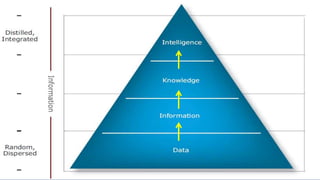
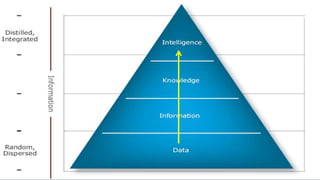
While Information Is Factual, Consisting Of Numbers, Statistics And Scattered Bits Of 
Data, Intelligence, On The Contrary, Is A Collection Of Pieces Of Information That 
Have Been Filtered, Distilled And Analyzed 
The Essential Notion, Again, Is That Information Is Turned Into Something That Can 
Be Acted Upon
Always Remember That ………..
……. Intelligence Is The Lifeblood Of Strategy
1
1 
Definition of Competitive Intelligence
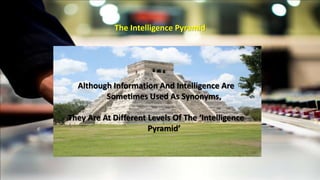
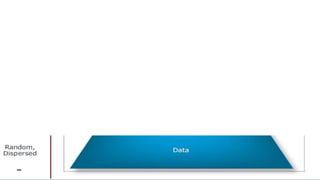
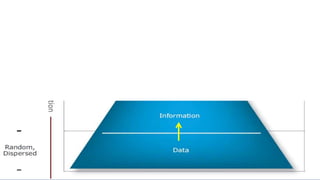
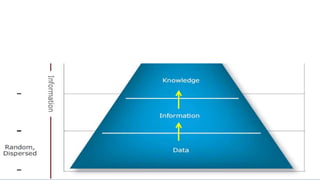
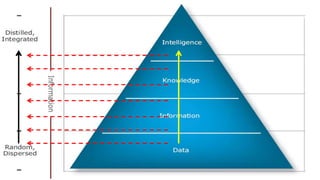
The Intelligence Pyramid
The Intelligence Pyramid 
Although Information And Intelligence Are 
Sometimes Used As Synonyms, 
They Are At Different Levels Of The ‘Intelligence 
Pyramid’
Eventually, All “Intelligence” Terms Refer To Using Systematic Methods To Collect, 
Analyze And Disseminate Information That Supports Decision – Making
2
2 
Levels & Different Terminology Of Competitive intelligence
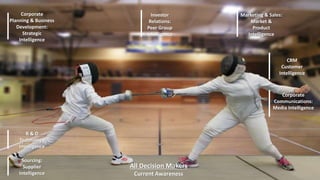
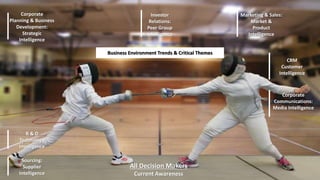
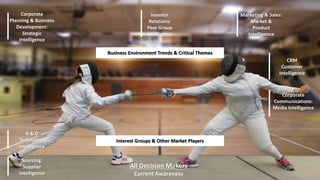
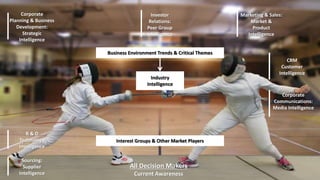
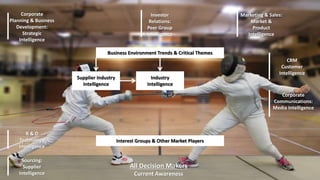
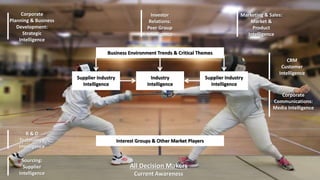
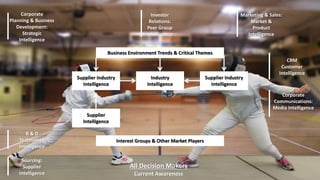
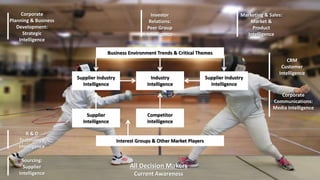
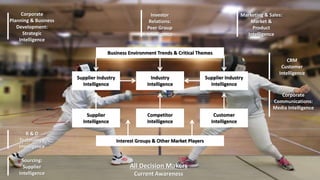
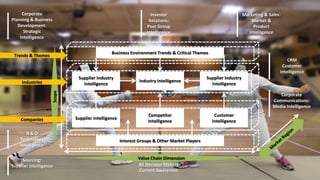
The Scope of Competitive Intelligence
Corporate 
Planning & Business 
Development: 
Strategic 
Intelligence
Investor 
Relations: 
Peer Group 
Intelligence 
Corporate 
Planning & Business 
Development: 
Strategic 
Intelligence
Investor 
Relations: 
Peer Group 
Intelligence 
Marketing & Sales: 
Market & 
Product 
Intelligence 
Corporate 
Planning & Business 
Development: 
Strategic 
Intelligence
Investor 
Relations: 
Peer Group 
Intelligence 
CRM 
Marketing & Sales: 
Customer 
Intelligence 
Market & 
Product 
Intelligence 
Corporate 
Planning & Business 
Development: 
Strategic 
Intelligence
Investor 
Relations: 
Peer Group 
Intelligence 
CRM 
Marketing & Sales: 
Customer 
Intelligence 
Corporate 
Market & 
Product 
Intelligence 
Communications: 
Media Intelligence 
Corporate 
Planning & Business 
Development: 
Strategic 
Intelligence
Investor 
Relations: 
Peer Group 
Intelligence 
CRM 
Marketing & Sales: 
Customer 
Intelligence 
Corporate 
Market & 
Product 
Intelligence 
Communications: 
Media Intelligence 
Corporate 
Planning & Business 
Development: 
Strategic 
Intelligence 
R & D 
Technology 
Intelligence
Investor 
Relations: 
Peer Group 
Intelligence 
CRM 
Marketing & Sales: 
Customer 
Intelligence 
Corporate 
Market & 
Product 
Intelligence 
Communications: 
Media Intelligence 
Corporate 
Planning & Business 
Development: 
Strategic 
Intelligence 
R & D 
Technology 
Intelligence 
Sourcing: 
Supplier 
Intelligence
Investor 
Relations: 
Peer Group 
Intelligence 
CRM 
Marketing & Sales: 
Customer 
Intelligence 
Corporate 
Market & 
Product 
Intelligence 
Communications: 
Media Intelligence 
All Decision Makers 
Current Awareness 
Corporate 
Planning & Business 
Development: 
Strategic 
Intelligence 
R & D 
Technology 
Intelligence 
Sourcing: 
Supplier 
Intelligence
Investor 
Relations: 
Peer Group 
Intelligence 
Business Environment Trends & Critical Themes 
CRM 
Marketing & Sales: 
Customer 
Intelligence 
Corporate 
Market & 
Product 
Intelligence 
Communications: 
Media Intelligence 
All Decision Makers 
Current Awareness 
Corporate 
Planning & Business 
Development: 
Strategic 
Intelligence 
R & D 
Technology 
Intelligence 
Sourcing: 
Supplier 
Intelligence
Investor 
Relations: 
Peer Group 
Intelligence 
Business Environment Trends & Critical Themes 
Interest Groups & Other Market Players 
CRM 
Marketing & Sales: 
Customer 
Intelligence 
Corporate 
Market & 
Product 
Intelligence 
Communications: 
Media Intelligence 
All Decision Makers 
Current Awareness 
Corporate 
Planning & Business 
Development: 
Strategic 
Intelligence 
R & D 
Technology 
Intelligence 
Sourcing: 
Supplier 
Intelligence
Business Environment Trends & Critical Themes 
Industry 
Intelligence 
Interest Groups & Other Market Players 
CRM 
Marketing & Sales: 
Customer 
Intelligence 
Corporate 
Market & 
Product 
Intelligence 
Communications: 
Media Intelligence 
All Decision Makers 
Current Awareness 
Corporate 
Planning & Business 
Development: 
Strategic 
Intelligence 
R & D 
Technology 
Intelligence 
Sourcing: 
Supplier 
Intelligence 
Investor 
Relations: 
Peer Group 
Intelligence
Investor 
Relations: 
Peer Group 
Intelligence 
Business Environment Trends & Critical Themes 
Interest Groups & Other Market Players 
Supplier Industry 
Intelligence 
Industry 
Intelligence 
CRM 
Marketing & Sales: 
Customer 
Intelligence 
Corporate 
Market & 
Product 
Intelligence 
Communications: 
Media Intelligence 
All Decision Makers 
Current Awareness 
Corporate 
Planning & Business 
Development: 
Strategic 
Intelligence 
R & D 
Technology 
Intelligence 
Sourcing: 
Supplier 
Intelligence
Business Environment Trends & Critical Themes 
Interest Groups & Other Market Players 
Supplier Industry 
Intelligence 
Industry 
Intelligence 
Marketing & Sales: 
Supplier Industry 
Intelligence 
Investor 
Relations: 
Peer Group 
Intelligence 
CRM 
Customer 
Intelligence 
Corporate 
Market & 
Product 
Intelligence 
Communications: 
Media Intelligence 
All Decision Makers 
Current Awareness 
Corporate 
Planning & Business 
Development: 
Strategic 
Intelligence 
R & D 
Technology 
Intelligence 
Sourcing: 
Supplier 
Intelligence
Investor 
Relations: 
Peer Group 
Intelligence 
Business Environment Trends & Critical Themes 
Supplier Industry 
Intelligence 
Supplier 
Intelligence 
Industry 
Intelligence 
Marketing & Sales: 
Supplier Industry 
Intelligence 
Interest Groups & Other Market Players 
CRM 
Customer 
Intelligence 
Corporate 
Market & 
Product 
Intelligence 
Communications: 
Media Intelligence 
All Decision Makers 
Current Awareness 
Corporate 
Planning & Business 
Development: 
Strategic 
Intelligence 
R & D 
Technology 
Intelligence 
Sourcing: 
Supplier 
Intelligence
Investor 
Relations: 
Peer Group 
Intelligence 
Business Environment Trends & Critical Themes 
Supplier Industry 
Intelligence 
Supplier 
Intelligence 
Industry 
Intelligence 
Supplier Industry 
Intelligence 
Competitor 
Intelligence 
Interest Groups & Other Market Players 
CRM 
Customer 
Intelligence 
Corporate 
Communications: 
Media Intelligence 
Corporate 
Planning & Business 
Development: 
Strategic 
Intelligence 
Marketing & Sales: 
Market & 
Product 
Intelligence 
All Decision Makers 
Current Awareness 
R & D 
Technology 
Intelligence 
Sourcing: 
Supplier 
Intelligence
Business Environment Trends & Critical Themes 
Supplier Industry 
Intelligence 
Supplier 
Intelligence 
Industry 
Intelligence 
Supplier Industry 
Intelligence 
Competitor 
Intelligence 
Interest Groups & Other Market Players 
Customer 
Intelligence 
Investor 
Relations: 
Peer Group 
Intelligence 
CRM 
Customer 
Intelligence 
Corporate 
Communications: 
Media Intelligence 
Corporate 
Planning & Business 
Development: 
Strategic 
Intelligence 
R & D 
Technology 
Intelligence 
Sourcing: 
Supplier 
Intelligence 
Marketing & Sales: 
Market & 
Product 
Intelligence 
All Decision Makers 
Current Awareness
Scope 
Investor 
Relations: 
Peer Group 
Intelligence 
CRM 
Customer 
Intelligence 
Corporate 
Communications: 
Media Intelligence 
Corporate 
Planning & Business 
Development: 
Strategic 
Intelligence 
Industries 
R & D 
Technology 
Intelligence 
Business Environment Trends & Critical Themes 
Supplier Industry 
Intelligence 
Supplier Intelligence 
Industry Intelligence 
Supplier Industry 
Intelligence 
Competitor 
Intelligence 
Interest Groups & Other Market Players 
Customer 
Intelligence 
Sourcing: 
Supplier Intelligence 
Marketing & Sales: 
Market & 
Product 
Intelligence 
All Decision Makers 
Current Awareness 
Trends & Themes 
Companies 
Value Chain Dimension
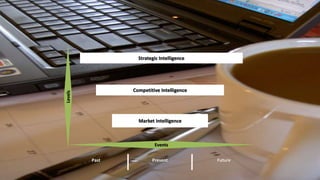
The Scope of Strategic Intelligence
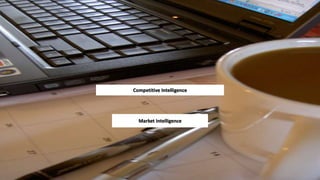
Market Intelligence
Competitive Intelligence 
Market Intelligence
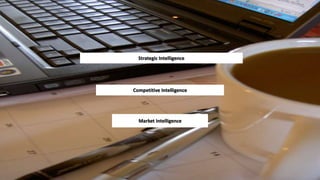
Strategic Intelligence 
Competitive Intelligence 
Market Intelligence
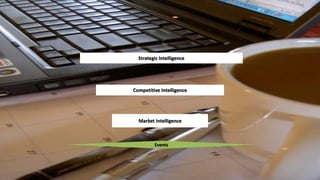
Strategic Intelligence 
Competitive Intelligence 
Market Intelligence 
Events
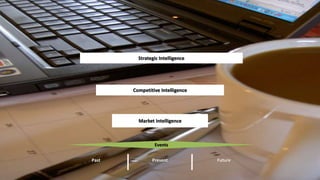
Strategic Intelligence 
Competitive Intelligence 
Market Intelligence 
Events 
Past Present Future
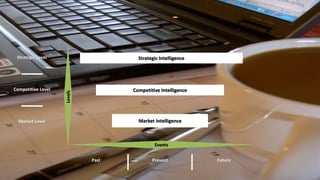
Strategic Intelligence 
Competitive Intelligence 
Market Intelligence 
Events 
Past Present Future 
Levels
Strategic Intelligence 
Competitive Intelligence 
Market Intelligence 
Events 
Past Present Future 
Levels 
Strategic Level 
Competitive Level 
Market Level
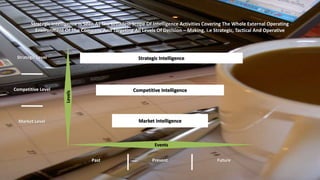
Strategic Intelligence Is Seen As The Broadest Scope Of Intelligence Activities Covering The Whole External Operating 
Environment Of The Company And Targeting All Levels Of Decision – Making, i.e Strategic, Tactical And Operative 
Strategic Intelligence 
Competitive Intelligence 
Market Intelligence 
Events 
Levels 
Strategic Level 
Competitive Level 
Market Level 
Past Present Future
3
3 
Elements Of Competitive Intelligence
In Order To Target Intelligence Efforts In A Coordinated Way, It Is Feasible To 
Divide The Field Of Competitive Intelligence Into Elements That Correspond 
To The Company’s Business Information Needs
In Order To Target Intelligence Efforts In A Coordinated Way, It Is Feasible To 
Divide The Field Of Competitive Intelligence Into Elements That Correspond 
To The Company’s Business Information Needs 
This Way, Competitive Intelligence Efforts Can Be First Targeted At The 
Most Critical Elements, While Development Regarding Less Critical 
Elements Can Be Started In Later Phases
Always Remember That ………..
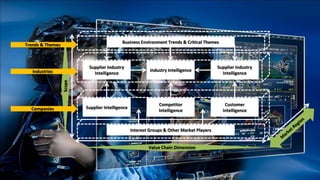
The Elements Of Competitive Intelligence Reflect Strongly The 
Categorization Of Business Information Types
Scope 
Business Environment Trends & Critical Themes 
Supplier Industry 
Intelligence 
Supplier Intelligence 
Industry Intelligence 
Supplier Industry 
Intelligence 
Competitor 
Intelligence 
Interest Groups & Other Market Players 
Customer 
Intelligence 
Trends & Themes 
Industries 
Companies 
Value Chain Dimension
An Extension To This View, Is To Divide Market Intelligence Into Smaller Components Such As 
Industry / Product Intelligence And Country Intelligence
An Extension To This View, Is To Divide Market Intelligence Into Smaller Components Such As 
Industry / Product Intelligence And Country Intelligence 
In Some Cases, Supplier Or Partner Intelligence Is Brought In As An Additional Category
An Extension To This View, Is To Divide Market Intelligence Into Smaller Components Such As 
Industry / Product Intelligence And Country Intelligence 
In Some Cases, Supplier Or Partner Intelligence Is Brought In As An Additional Category 
While Most Of The Elements Concentrate On One Part Of The Value Chain, The Category “General 
Trend Intelligence” Includes Business Information Types And Themes Along The Whole 
Length Of The Value Chain
An Extension To This View, Is To Divide Market Intelligence Into Smaller Components Such As 
Industry / Product Intelligence And Country Intelligence 
In Some Cases, Supplier Or Partner Intelligence Is Brought In As An Additional Category 
While Most Of The Elements Concentrate On One Part Of The Value Chain, The Category “General 
Trend Intelligence” Includes Business Information Types And Themes Along The Whole 
Length Of The Value Chain 
Similarly, The Category “Interest Group Intelligence” Covers Companies That Don’t Belong To The 
Company’s Value Chain But Are Strongly Linked With It
An Extension To This View, Is To Divide Market Intelligence Into Smaller Components Such As 
Industry / Product Intelligence And Country Intelligence 
In Some Cases, Supplier Or Partner Intelligence Is Brought In As An Additional Category 
While Most Of The Elements Concentrate On One Part Of The Value Chain, The Category “General 
Trend Intelligence” Includes Business Information Types And Themes Along The Whole 
Length Of The Value Chain 
Similarly, The Category “Interest Group Intelligence” Covers Companies That Don’t Belong To The 
Company’s Value Chain But Are Strongly Linked With It 
In This General Categorization, The Value Chain Only Includes Three Nodes But It Can Naturally Be 
Extended At Both Ends
On The Supplier Side, Information May Be Needed On Previous Stages, Starting From Raw Material 
Extraction
On The Supplier Side, Information May Be Needed On Previous Stages, Starting From Raw Material 
Extraction 
On The Customer Side, It May Be Necessary To Consider End – User Segments As The Ultimate 
Business Drivers
On The Supplier Side, Information May Be Needed On Previous Stages, Starting From Raw Material 
Extraction 
On The Customer Side, It May Be Necessary To Consider End – User Segments As The Ultimate 
Business Drivers 
Yet Another Dimension To Consider Is Intelligence About End – Users
On The Supplier Side, Information May Be Needed On Previous Stages, Starting From Raw Material 
Extraction 
On The Customer Side, It May Be Necessary To Consider End – User Segments As The Ultimate 
Business Drivers 
Yet Another Dimension To Consider Is Intelligence About End – Users 
On The Other Hand, An Organization May Trust That Its Customers Have Taken Their Own 
Customers Into Account When Making Operative Business Decisions
On The Supplier Side, Information May Be Needed On Previous Stages, Starting From Raw Material 
Extraction 
On The Customer Side, It May Be Necessary To Consider End – User Segments As The Ultimate 
Business Drivers 
Yet Another Dimension To Consider Is Intelligence About End – Users 
On The Other Hand, An Organization May Trust That Its Customers Have Taken Their Own 
Customers Into Account When Making Operative Business Decisions 
Thus, Sophisticated Customer Intelligence Will Likely Bring In Good Intelligence About The End - 
Customers As Well
The Matrix Framework Is Useful When Considering Target Areas For A Company’s Competitive 
Intelligence Development
The Matrix Framework Is Useful When Considering Target Areas For A Company’s Competitive 
Intelligence Development 
However, The Presented Framework Is Very Generic And It Should Always Be Adapted To Each 
Company’s Specific Requirements
4
4 
Competitive Intelligence Cycle
The Core Of Any Intelligence System In A Company Is An Intelligence Cycle
The Core Of Any Intelligence System In A Company Is An Intelligence Cycle 
In Discussing The Transformation Of Data And Information Into Actionable Intelligence, A Process 
Perspective Is Useful Given That A Continuous Chain Of Action Is Required
The Core Of Any Intelligence System In A Company Is An Intelligence Cycle 
In Discussing The Transformation Of Data And Information Into Actionable Intelligence, A Process 
Perspective Is Useful Given That A Continuous Chain Of Action Is Required 
The Process, Usually Called The Competitive Intelligence Cycle, Begins With Determining The 
Intelligence Needs
The Core Of Any Intelligence System In A Company Is An Intelligence Cycle 
In Discussing The Transformation Of Data And Information Into Actionable Intelligence, A Process 
Perspective Is Useful Given That A Continuous Chain Of Action Is Required 
The Process, Usually Called The Competitive Intelligence Cycle, Begins With Determining The 
Intelligence Needs 
The Cycle Includes Setting Goals, Obtaining Data, Comparing Information From Different Sources 
And Estimating Possible Future Developments
The Core Of Any Intelligence System In A Company Is An Intelligence Cycle 
In Discussing The Transformation Of Data And Information Into Actionable Intelligence, A Process 
Perspective Is Useful Given That A Continuous Chain Of Action Is Required 
The Process, Usually Called The Competitive Intelligence Cycle, Begins With Determining The 
Intelligence Needs 
The Cycle Includes Setting Goals, Obtaining Data, Comparing Information From Different Sources 
And Estimating Possible Future Developments 
Finally, The Results Have To Be Utilized In A Timely Fashion
Effective Intelligence Processes Set The Intelligent Customers, i. e. The Users, As The Starting Point 
For The Entire Function
Effective Intelligence Processes Set The Intelligent Customers, i. e. The Users, As The Starting Point 
For The Entire Function 
The Users Are Given Intelligence They Require, Analyzed To A Level That Serves Them Best, And 
Delivered In A Form They Desire
Effective Intelligence Processes Set The Intelligent Customers, i. e. The Users, As The Starting Point 
For The Entire Function 
The Users Are Given Intelligence They Require, Analyzed To A Level That Serves Them Best, And 
Delivered In A Form They Desire 
Numerous Sources Need To Be Continuously Monitored In Order To Find The Appropriate Material
Effective Intelligence Processes Set The Intelligent Customers, i. e. The Users, As The Starting Point 
For The Entire Function 
The Users Are Given Intelligence They Require, Analyzed To A Level That Serves Them Best, And 
Delivered In A Form They Desire 
Numerous Sources Need To Be Continuously Monitored In Order To Find The Appropriate Material 
Monitoring Can Be Seen As Continuous Surveillance Of Formal And Informal Sources, Whereas The 
Actual Collection Calls For A More Specified Need
Effective Intelligence Processes Set The Intelligent Customers, i. e. The Users, As The Starting Point 
For The Entire Function 
The Users Are Given Intelligence They Require, Analyzed To A Level That Serves Them Best, And 
Delivered In A Form They Desire 
Numerous Sources Need To Be Continuously Monitored In Order To Find The Appropriate Material 
Monitoring Can Be Seen As Continuous Surveillance Of Formal And Informal Sources, Whereas The 
Actual Collection Calls For A More Specified Need 
On The Other Hand, Active Monitoring Is Also Likely To Create New Needs
In Practice, Monitoring And Collection Are Overlapping Phases In The Intelligence Cycle
In Practice, Monitoring And Collection Are Overlapping Phases In The Intelligence Cycle 
The Needed Information Calls For Active Gathering Measures Often Implemented By A Corporate 
Library Function, Especially In The Case Of Using External Sources
In Practice, Monitoring And Collection Are Overlapping Phases In The Intelligence Cycle 
The Needed Information Calls For Active Gathering Measures Often Implemented By A Corporate 
Library Function, Especially In The Case Of Using External Sources 
The Role Of Human Intelligence, i. e,. Intelligence That Is Not Documented But Possessed By 
Individual Employees, Is Also Significant
Human Intelligence, Also Referred To As “Tacit Knowledge”, Seems To Set Organizations Apart 
Regarding Their Intelligence Capabilities And, Eventually, Competitiveness
Human Intelligence, Also Referred To As “Tacit Knowledge”, Seems To Set Organizations Apart 
Regarding Their Intelligence Capabilities And, Eventually, Competitiveness 
Decision – Makers Generally Prefer A Timely Answer To A Totally Accurate Answer
Human Intelligence, Also Referred To As “Tacit Knowledge”, Seems To Set Organizations Apart 
Regarding Their Intelligence Capabilities And, Eventually, Competitiveness 
Decision – Makers Generally Prefer A Timely Answer To A Totally Accurate Answer 
It Is Argued That Only 70 Percent Of The Delivered Intelligence Needs To Be Totally Accurate If It Is 
Delivered On Time
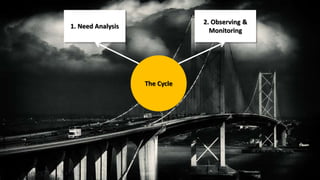
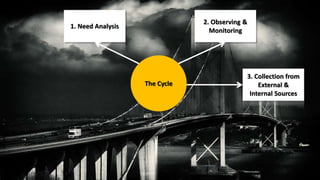
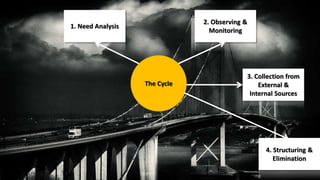
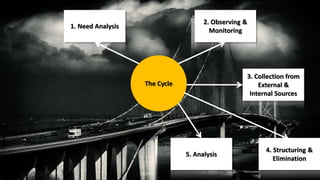
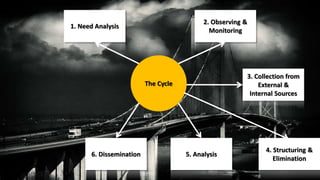
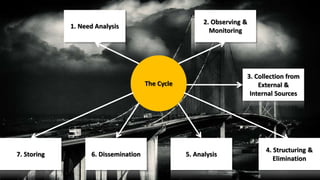
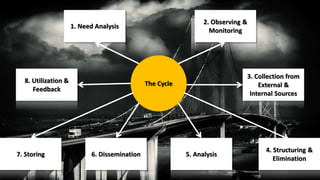
The Cycle
The Cycle 
1. Need Analysis
The Cycle 
1. Need Analysis 
2. Observing & 
Monitoring
The Cycle 
1. Need Analysis 
2. Observing & 
Monitoring 
3. Collection from 
External & 
Internal Sources
The Cycle 
1. Need Analysis 
2. Observing & 
Monitoring 
3. Collection from 
External & 
Internal Sources 
4. Structuring & 
Elimination
The Cycle 
1. Need Analysis 
2. Observing & 
Monitoring 
4. Structuring & 
Elimination 
5. Analysis 
3. Collection from 
External & 
Internal Sources
The Cycle 
1. Need Analysis 
2. Observing & 
Monitoring 
4. Structuring & 
Elimination 
6. Dissemination 5. Analysis 
3. Collection from 
External & 
Internal Sources
The Cycle 
1. Need Analysis 
2. Observing & 
Monitoring 
4. Structuring & 
Elimination 
6. Dissemination 5. Analysis 
3. Collection from 
External & 
Internal Sources 
7. Storing
The Cycle 
1. Need Analysis 
2. Observing & 
Monitoring 
7. Storing 6. Dissemination 
4. Structuring & 
Elimination 
5. Analysis 
3. Collection from 
External & 
Internal Sources 
8. Utilization & 
Feedback
Imagine There Are No Competitors For You In The Market!
Imagine There Are No Competitors For You In The Market! 
Even, If They Are, Then You Have Read Them, Studied Them, Analyzed Them 
& The Market, Utilized The Information Gathered And Acted In Tandem 
With Your Core Business Strategy!
Imagine There Are No Competitors For You In The Market! 
Even, If They Are, Then You Have Read Them, Studied Them, Analyzed Them 
& The Market, Utilized The Information Gathered And Acted In Tandem 
With Your Core Business Strategy! 
Then There Is No Stopping You In Becoming The No. 1 Business Organization 
In Your Industry Segment!
Imagine There Are No Competitors For You In The Market! 
Even, If They Are, Then You Have Read Them, Studied Them, Analyzed Them 
& The Market, Utilized The Information Gathered And Acted In Tandem 
With Your Core Business Strategy! 
Then There Is No Stopping You In Becoming The No. 1 Business Organization 
In Your Industry Segment! 
Because You Have Killed Your Competition!
Now Wrapping Up
Competitive Intelligence Is Not Market Research, Nor Is It Industrial Espionage
Competitive Intelligence Is Not Market Research, Nor Is It Industrial Espionage 
It Is A Completely Legal And Increasingly Essential Element In The Formulation Of Corporate 
Competitive Strategy Which Provides The Decision – Maker With Invaluable Insight Into The 
Competitor’s Capabilities And Intentions
Competitive Intelligence Is Not Market Research, Nor Is It Industrial Espionage 
It Is A Completely Legal And Increasingly Essential Element In The Formulation Of Corporate 
Competitive Strategy Which Provides The Decision – Maker With Invaluable Insight Into The 
Competitor’s Capabilities And Intentions 
It Serves As An Early Warning Of Future Events, Which May Have An Impact On Company 
Performance
Competitive Intelligence Is Not Market Research, Nor Is It Industrial Espionage 
It Is A Completely Legal And Increasingly Essential Element In The Formulation Of Corporate 
Competitive Strategy Which Provides The Decision – Maker With Invaluable Insight Into The 
Competitor’s Capabilities And Intentions 
It Serves As An Early Warning Of Future Events, Which May Have An Impact On Company 
Performance 
While Market Research Often Focuses On Fulfilling A Specific Information Need Or Set Of Needs, 
Intelligence Is An Ongoing Process Of Developing A Holistic Picture Of The Operating Environment 
Including Competitors, Customers And Markets
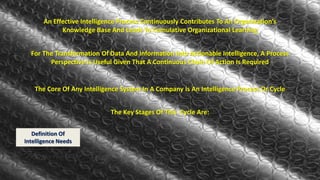
An Effective Intelligence Process Continuously Contributes To An Organization’s 
Knowledge Base And Leads To Cumulative Organizational Learning
An Effective Intelligence Process Continuously Contributes To An Organization’s 
Knowledge Base And Leads To Cumulative Organizational Learning 
For The Transformation Of Data And Information Into Actionable Intelligence, A Process 
Perspective Is Useful Given That A Continuous Chain Of Action Is Required
An Effective Intelligence Process Continuously Contributes To An Organization’s 
Knowledge Base And Leads To Cumulative Organizational Learning 
For The Transformation Of Data And Information Into Actionable Intelligence, A Process 
Perspective Is Useful Given That A Continuous Chain Of Action Is Required 
The Core Of Any Intelligence System In A Company Is An Intelligence Process Or Cycle
An Effective Intelligence Process Continuously Contributes To An Organization’s 
Knowledge Base And Leads To Cumulative Organizational Learning 
For The Transformation Of Data And Information Into Actionable Intelligence, A Process 
Perspective Is Useful Given That A Continuous Chain Of Action Is Required 
The Core Of Any Intelligence System In A Company Is An Intelligence Process Or Cycle 
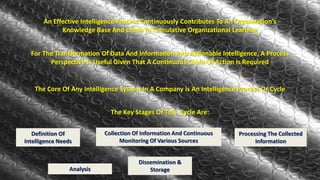
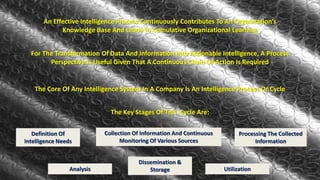
The Key Stages Of This Cycle Are:
An Effective Intelligence Process Continuously Contributes To An Organization’s 
Knowledge Base And Leads To Cumulative Organizational Learning 
For The Transformation Of Data And Information Into Actionable Intelligence, A Process 
Perspective Is Useful Given That A Continuous Chain Of Action Is Required 
The Core Of Any Intelligence System In A Company Is An Intelligence Process Or Cycle 
The Key Stages Of This Cycle Are: 
Definition Of 
Intelligence Needs
An Effective Intelligence Process Continuously Contributes To An Organization’s 
Knowledge Base And Leads To Cumulative Organizational Learning 
For The Transformation Of Data And Information Into Actionable Intelligence, A Process 
Perspective Is Useful Given That A Continuous Chain Of Action Is Required 
The Core Of Any Intelligence System In A Company Is An Intelligence Process Or Cycle 
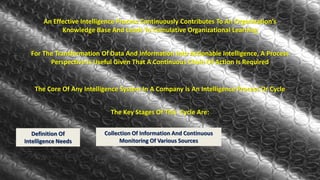
Collection Of Information And Continuous 
Monitoring Of Various Sources 
Definition Of 
Intelligence Needs 
The Key Stages Of This Cycle Are:
An Effective Intelligence Process Continuously Contributes To An Organization’s 
Knowledge Base And Leads To Cumulative Organizational Learning 
For The Transformation Of Data And Information Into Actionable Intelligence, A Process 
Perspective Is Useful Given That A Continuous Chain Of Action Is Required 
The Core Of Any Intelligence System In A Company Is An Intelligence Process Or Cycle 
The Key Stages Of This Cycle Are: 
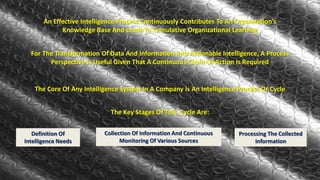
Collection Of Information And Continuous 
Monitoring Of Various Sources 
Definition Of 
Intelligence Needs 
Processing The Collected 
Information
An Effective Intelligence Process Continuously Contributes To An Organization’s 
Knowledge Base And Leads To Cumulative Organizational Learning 
For The Transformation Of Data And Information Into Actionable Intelligence, A Process 
Perspective Is Useful Given That A Continuous Chain Of Action Is Required 
The Core Of Any Intelligence System In A Company Is An Intelligence Process Or Cycle 
The Key Stages Of This Cycle Are: 
Collection Of Information And Continuous 
Monitoring Of Various Sources 
Definition Of 
Intelligence Needs 
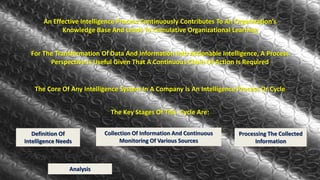
Processing The Collected 
Information 
Analysis
An Effective Intelligence Process Continuously Contributes To An Organization’s 
Knowledge Base And Leads To Cumulative Organizational Learning 
For The Transformation Of Data And Information Into Actionable Intelligence, A Process 
Perspective Is Useful Given That A Continuous Chain Of Action Is Required 
The Core Of Any Intelligence System In A Company Is An Intelligence Process Or Cycle 
The Key Stages Of This Cycle Are: 
Collection Of Information And Continuous 
Monitoring Of Various Sources 
Definition Of 
Intelligence Needs 
Processing The Collected 
Information 
Analysis 
Dissemination & 
Storage
An Effective Intelligence Process Continuously Contributes To An Organization’s 
Knowledge Base And Leads To Cumulative Organizational Learning 
For The Transformation Of Data And Information Into Actionable Intelligence, A Process 
Perspective Is Useful Given That A Continuous Chain Of Action Is Required 
The Core Of Any Intelligence System In A Company Is An Intelligence Process Or Cycle 
The Key Stages Of This Cycle Are: 
Collection Of Information And Continuous 
Monitoring Of Various Sources 
Definition Of 
Intelligence Needs 
Processing The Collected 
Information 
Analysis 
Dissemination & 
Storage Utilization
And Always Remember That ………..
……. Intelligence Is The Lifeblood Of Strategy
……. Intelligence Is The Lifeblood Of Strategy 
But Managerial Input, i. e. Adequate Planning And 
Direction, Is Essential In Order To Initialize The Cycle 
And Then Keep It Functional
Hello! 
Sadashiv Borgaonkar 
Management Strategist, Educator & Consultant 
ACTSol & Associates 
www.actsol.in 
@sada_borg11 
@actsol_connect 
sadashiv@actsol.in 
http://in.linkedin.com/in/sadashivborgaonkar/
Training Material - Competitive Intelligence - The Life Blood Of Strategy - An Introduction

Training Material - Competitive Intelligence - The Life Blood Of Strategy - An Introduction

  • 1.
    ®ACTSol & Associates(Avinash Consulting & Turnkey Solutions & Associates) Website: www.actsol.in, E – Mail: connect@actsol.in Cell No: +91 94835 11055 Regd Off: Bangalore; Representations: Gulbarga (Admin) Hyderabad, Pune, New Delhi, Nagpur, Kolhapur, Cochin, Ahmedabad, Bhubaneswar,UK (Cambridge), Barcelona (Spain), Qatar, Kuwait & South Africa (JHB)
  • 2.
    Competitive Intelligence CanBe Defined As Knowledge And Foreknowledge About The External Operating Environment
  • 3.
    Competitive Intelligence CanBe Defined As Knowledge And Foreknowledge About The External Operating Environment The Ultimate Goal Of Each Intelligence Process Is To Facilitate Decision – Making That Leads To Action
  • 4.
    The Intelligence ProcessEnables Turning Information Into Intelligence By Processing It Via ……
  • 5.
    The Intelligence ProcessEnables Turning Information Into Intelligence By Processing It Via …… Analysis….
  • 6.
    The Intelligence ProcessEnables Turning Information Into Intelligence By Processing It Via …… Analysis…. Synthesis….
  • 7.
    The Intelligence ProcessEnables Turning Information Into Intelligence By Processing It Via …… Analysis…. Synthesis…. Interpretation….
  • 8.
    The Intelligence ProcessEnables Turning Information Into Intelligence By Processing It Via …… Analysis…. Synthesis…. Interpretation…. And Utilizing It In The Future – Oriented, “Decision – Making”
  • 9.
    Competitive Intelligence IsNot Market Research Or Industrial Espionage
  • 10.
    Competitive Intelligence IsNot Market Research Or Industrial Espionage “Market Research” Focuses On Fulfilling A Specific Information Need Or Set Of Needs, Intelligence Is A Completely Legal Ongoing Process Of Developing A Holistic Picture Of The Operating Environment Including Competitors, Customers And Markets
  • 11.
    Competitive Intelligence IsNot Market Research Or Industrial Espionage “Market Research” Focuses On Fulfilling A Specific Information Need Or Set Of Needs, Intelligence Is A Completely Legal Ongoing Process Of Developing A Holistic Picture Of The Operating Environment Including Competitors, Customers And Markets An Effective Intelligence Process Continuously Contributes To An Organization’s Knowledge Base And Leads To Cumulative Organizational Learning
  • 12.
    The Term –“Intelligence” Has Somewhat Been Blurred, New Terms Emerge As The Intelligence Discipline Matures Within The Corporate Setting …..
  • 13.
    The Term –“Intelligence” Has Somewhat Been Blurred, New Terms Emerge As The Intelligence Discipline Matures Within The Corporate Setting ….. And These New Terms Are …..
  • 14.
    The Term –“Intelligence” Has Somewhat Been Blurred, New Terms Emerge As The Intelligence Discipline Matures Within The Corporate Setting ….. And These New Terms Are ….. Competitive Intelligence, Business Intelligence, Market Intelligence & Corporate Intelligence
  • 15.
    The Term –“Intelligence” Has Somewhat Been Blurred, New Terms Emerge As The Intelligence Discipline Matures Within The Corporate Setting ….. And These New Terms Are ….. Competitive Intelligence, Business Intelligence, Market Intelligence & Corporate Intelligence Are Often Used Interchangeably Or As Synonyms, While …..
  • 16.
    The Term –“Intelligence” Has Somewhat Been Blurred, New Terms Emerge As The Intelligence Discipline Matures Within The Corporate Setting ….. And These New Terms Are ….. Competitive Intelligence, Business Intelligence, Market Intelligence & Corporate Intelligence Are Often Used Interchangeably Or As Synonyms, While ….. Strategic Intelligence, Customer Intelligence, Competitor Intelligence and Technology Intelligence
  • 17.
    The Term –“Intelligence” Has Somewhat Been Blurred, New Terms Emerge As The Intelligence Discipline Matures Within The Corporate Setting ….. And These New Terms Are ….. Competitive Intelligence, Business Intelligence, Market Intelligence & Corporate Intelligence Are Often Used Interchangeably Or As Synonyms, While ….. Strategic Intelligence, Customer Intelligence, Competitor Intelligence and Technology Intelligence Add A Dimension Of Specificity To The Subject
  • 18.
    Eventually, All IntelligenceTerms Refer To Using Systematic Methods To Collect, Analyze And Disseminate Information That Supports Decision - Making
  • 19.
    Eventually, All IntelligenceTerms Refer To Using Systematic Methods To Collect, Analyze And Disseminate Information That Supports Decision - Making Competitive Intelligence (CI) Is Regarded As The Broadest Scope Of Intelligence Activities Covering The Whole External Operating Environment Of The Company And Targeting All Levels Of Decision – Making ….. Viz ……
  • 20.
    Eventually, All IntelligenceTerms Refer To Using Systematic Methods To Collect, Analyze And Disseminate Information That Supports Decision - Making Competitive Intelligence (CI) Is Regarded As The Broadest Scope Of Intelligence Activities Covering The Whole External Operating Environment Of The Company And Targeting All Levels Of Decision – Making ….. Viz …… Strategic, Tactical And Operative
  • 21.
    Eventually, All IntelligenceTerms Refer To Using Systematic Methods To Collect, Analyze And Disseminate Information That Supports Decision - Making Competitive Intelligence (CI) Is Regarded As The Broadest Scope Of Intelligence Activities Covering The Whole External Operating Environment Of The Company And Targeting All Levels Of Decision – Making ….. Viz …… Strategic, Tactical And Operative The Key Goal Of CI Is To Facilitate More Effective Strategic Planning And, As Such, It’s One Of The Most Important Strategic Tools That Management Possesses
  • 22.
    In Other Words,The Purpose Of The Intelligence Production Is To Put The Fragments Of Information Into A Coherent Puzzle, A Picture Of The Forthcoming Future
  • 23.
    In Other Words,The Purpose Of The Intelligence Production Is To Put The Fragments Of Information Into A Coherent Puzzle, A Picture Of The Forthcoming Future The Essential Notion, Again, Is That Information Is Turned Into Something That Can Be Acted Upon
  • 24.
    In Other Words,The Purpose Of The Intelligence Production Is To Put The Fragments Of Information Into A Coherent Puzzle, A Picture Of The Forthcoming Future While Information Is Factual, Consisting Of Numbers, Statistics And Scattered Bits Of Data, Intelligence, On The Contrary, Is A Collection Of Pieces Of Information That Have Been Filtered, Distilled And Analyzed The Essential Notion, Again, Is That Information Is Turned Into Something That Can Be Acted Upon
  • 25.
  • 26.
    ……. Intelligence IsThe Lifeblood Of Strategy
  • 27.
  • 28.
    1 Definition ofCompetitive Intelligence
  • 29.
  • 30.
    The Intelligence Pyramid Although Information And Intelligence Are Sometimes Used As Synonyms, They Are At Different Levels Of The ‘Intelligence Pyramid’
  • 37.
    Eventually, All “Intelligence”Terms Refer To Using Systematic Methods To Collect, Analyze And Disseminate Information That Supports Decision – Making
  • 38.
  • 39.
    2 Levels &Different Terminology Of Competitive intelligence
  • 40.
    The Scope ofCompetitive Intelligence
  • 41.
    Corporate Planning &Business Development: Strategic Intelligence
  • 42.
    Investor Relations: PeerGroup Intelligence Corporate Planning & Business Development: Strategic Intelligence
  • 43.
    Investor Relations: PeerGroup Intelligence Marketing & Sales: Market & Product Intelligence Corporate Planning & Business Development: Strategic Intelligence
  • 44.
    Investor Relations: PeerGroup Intelligence CRM Marketing & Sales: Customer Intelligence Market & Product Intelligence Corporate Planning & Business Development: Strategic Intelligence
  • 45.
    Investor Relations: PeerGroup Intelligence CRM Marketing & Sales: Customer Intelligence Corporate Market & Product Intelligence Communications: Media Intelligence Corporate Planning & Business Development: Strategic Intelligence
  • 46.
    Investor Relations: PeerGroup Intelligence CRM Marketing & Sales: Customer Intelligence Corporate Market & Product Intelligence Communications: Media Intelligence Corporate Planning & Business Development: Strategic Intelligence R & D Technology Intelligence
  • 47.
    Investor Relations: PeerGroup Intelligence CRM Marketing & Sales: Customer Intelligence Corporate Market & Product Intelligence Communications: Media Intelligence Corporate Planning & Business Development: Strategic Intelligence R & D Technology Intelligence Sourcing: Supplier Intelligence
  • 48.
    Investor Relations: PeerGroup Intelligence CRM Marketing & Sales: Customer Intelligence Corporate Market & Product Intelligence Communications: Media Intelligence All Decision Makers Current Awareness Corporate Planning & Business Development: Strategic Intelligence R & D Technology Intelligence Sourcing: Supplier Intelligence
  • 49.
    Investor Relations: PeerGroup Intelligence Business Environment Trends & Critical Themes CRM Marketing & Sales: Customer Intelligence Corporate Market & Product Intelligence Communications: Media Intelligence All Decision Makers Current Awareness Corporate Planning & Business Development: Strategic Intelligence R & D Technology Intelligence Sourcing: Supplier Intelligence
  • 50.
    Investor Relations: PeerGroup Intelligence Business Environment Trends & Critical Themes Interest Groups & Other Market Players CRM Marketing & Sales: Customer Intelligence Corporate Market & Product Intelligence Communications: Media Intelligence All Decision Makers Current Awareness Corporate Planning & Business Development: Strategic Intelligence R & D Technology Intelligence Sourcing: Supplier Intelligence
  • 51.
    Business Environment Trends& Critical Themes Industry Intelligence Interest Groups & Other Market Players CRM Marketing & Sales: Customer Intelligence Corporate Market & Product Intelligence Communications: Media Intelligence All Decision Makers Current Awareness Corporate Planning & Business Development: Strategic Intelligence R & D Technology Intelligence Sourcing: Supplier Intelligence Investor Relations: Peer Group Intelligence
  • 52.
    Investor Relations: PeerGroup Intelligence Business Environment Trends & Critical Themes Interest Groups & Other Market Players Supplier Industry Intelligence Industry Intelligence CRM Marketing & Sales: Customer Intelligence Corporate Market & Product Intelligence Communications: Media Intelligence All Decision Makers Current Awareness Corporate Planning & Business Development: Strategic Intelligence R & D Technology Intelligence Sourcing: Supplier Intelligence
  • 53.
    Business Environment Trends& Critical Themes Interest Groups & Other Market Players Supplier Industry Intelligence Industry Intelligence Marketing & Sales: Supplier Industry Intelligence Investor Relations: Peer Group Intelligence CRM Customer Intelligence Corporate Market & Product Intelligence Communications: Media Intelligence All Decision Makers Current Awareness Corporate Planning & Business Development: Strategic Intelligence R & D Technology Intelligence Sourcing: Supplier Intelligence
  • 54.
    Investor Relations: PeerGroup Intelligence Business Environment Trends & Critical Themes Supplier Industry Intelligence Supplier Intelligence Industry Intelligence Marketing & Sales: Supplier Industry Intelligence Interest Groups & Other Market Players CRM Customer Intelligence Corporate Market & Product Intelligence Communications: Media Intelligence All Decision Makers Current Awareness Corporate Planning & Business Development: Strategic Intelligence R & D Technology Intelligence Sourcing: Supplier Intelligence
  • 55.
    Investor Relations: PeerGroup Intelligence Business Environment Trends & Critical Themes Supplier Industry Intelligence Supplier Intelligence Industry Intelligence Supplier Industry Intelligence Competitor Intelligence Interest Groups & Other Market Players CRM Customer Intelligence Corporate Communications: Media Intelligence Corporate Planning & Business Development: Strategic Intelligence Marketing & Sales: Market & Product Intelligence All Decision Makers Current Awareness R & D Technology Intelligence Sourcing: Supplier Intelligence
  • 56.
    Business Environment Trends& Critical Themes Supplier Industry Intelligence Supplier Intelligence Industry Intelligence Supplier Industry Intelligence Competitor Intelligence Interest Groups & Other Market Players Customer Intelligence Investor Relations: Peer Group Intelligence CRM Customer Intelligence Corporate Communications: Media Intelligence Corporate Planning & Business Development: Strategic Intelligence R & D Technology Intelligence Sourcing: Supplier Intelligence Marketing & Sales: Market & Product Intelligence All Decision Makers Current Awareness
  • 57.
    Scope Investor Relations: Peer Group Intelligence CRM Customer Intelligence Corporate Communications: Media Intelligence Corporate Planning & Business Development: Strategic Intelligence Industries R & D Technology Intelligence Business Environment Trends & Critical Themes Supplier Industry Intelligence Supplier Intelligence Industry Intelligence Supplier Industry Intelligence Competitor Intelligence Interest Groups & Other Market Players Customer Intelligence Sourcing: Supplier Intelligence Marketing & Sales: Market & Product Intelligence All Decision Makers Current Awareness Trends & Themes Companies Value Chain Dimension
  • 58.
    The Scope ofStrategic Intelligence
  • 59.
  • 60.
  • 61.
    Strategic Intelligence CompetitiveIntelligence Market Intelligence
  • 62.
    Strategic Intelligence CompetitiveIntelligence Market Intelligence Events
  • 63.
    Strategic Intelligence CompetitiveIntelligence Market Intelligence Events Past Present Future
  • 64.
    Strategic Intelligence CompetitiveIntelligence Market Intelligence Events Past Present Future Levels
  • 65.
    Strategic Intelligence CompetitiveIntelligence Market Intelligence Events Past Present Future Levels Strategic Level Competitive Level Market Level
  • 66.
    Strategic Intelligence IsSeen As The Broadest Scope Of Intelligence Activities Covering The Whole External Operating Environment Of The Company And Targeting All Levels Of Decision – Making, i.e Strategic, Tactical And Operative Strategic Intelligence Competitive Intelligence Market Intelligence Events Levels Strategic Level Competitive Level Market Level Past Present Future
  • 67.
  • 68.
    3 Elements OfCompetitive Intelligence
  • 69.
    In Order ToTarget Intelligence Efforts In A Coordinated Way, It Is Feasible To Divide The Field Of Competitive Intelligence Into Elements That Correspond To The Company’s Business Information Needs
  • 70.
    In Order ToTarget Intelligence Efforts In A Coordinated Way, It Is Feasible To Divide The Field Of Competitive Intelligence Into Elements That Correspond To The Company’s Business Information Needs This Way, Competitive Intelligence Efforts Can Be First Targeted At The Most Critical Elements, While Development Regarding Less Critical Elements Can Be Started In Later Phases
  • 71.
  • 72.
    The Elements OfCompetitive Intelligence Reflect Strongly The Categorization Of Business Information Types
  • 73.
    Scope Business EnvironmentTrends & Critical Themes Supplier Industry Intelligence Supplier Intelligence Industry Intelligence Supplier Industry Intelligence Competitor Intelligence Interest Groups & Other Market Players Customer Intelligence Trends & Themes Industries Companies Value Chain Dimension
  • 74.
    An Extension ToThis View, Is To Divide Market Intelligence Into Smaller Components Such As Industry / Product Intelligence And Country Intelligence
  • 75.
    An Extension ToThis View, Is To Divide Market Intelligence Into Smaller Components Such As Industry / Product Intelligence And Country Intelligence In Some Cases, Supplier Or Partner Intelligence Is Brought In As An Additional Category
  • 76.
    An Extension ToThis View, Is To Divide Market Intelligence Into Smaller Components Such As Industry / Product Intelligence And Country Intelligence In Some Cases, Supplier Or Partner Intelligence Is Brought In As An Additional Category While Most Of The Elements Concentrate On One Part Of The Value Chain, The Category “General Trend Intelligence” Includes Business Information Types And Themes Along The Whole Length Of The Value Chain
  • 77.
    An Extension ToThis View, Is To Divide Market Intelligence Into Smaller Components Such As Industry / Product Intelligence And Country Intelligence In Some Cases, Supplier Or Partner Intelligence Is Brought In As An Additional Category While Most Of The Elements Concentrate On One Part Of The Value Chain, The Category “General Trend Intelligence” Includes Business Information Types And Themes Along The Whole Length Of The Value Chain Similarly, The Category “Interest Group Intelligence” Covers Companies That Don’t Belong To The Company’s Value Chain But Are Strongly Linked With It
  • 78.
    An Extension ToThis View, Is To Divide Market Intelligence Into Smaller Components Such As Industry / Product Intelligence And Country Intelligence In Some Cases, Supplier Or Partner Intelligence Is Brought In As An Additional Category While Most Of The Elements Concentrate On One Part Of The Value Chain, The Category “General Trend Intelligence” Includes Business Information Types And Themes Along The Whole Length Of The Value Chain Similarly, The Category “Interest Group Intelligence” Covers Companies That Don’t Belong To The Company’s Value Chain But Are Strongly Linked With It In This General Categorization, The Value Chain Only Includes Three Nodes But It Can Naturally Be Extended At Both Ends
  • 79.
    On The SupplierSide, Information May Be Needed On Previous Stages, Starting From Raw Material Extraction
  • 80.
    On The SupplierSide, Information May Be Needed On Previous Stages, Starting From Raw Material Extraction On The Customer Side, It May Be Necessary To Consider End – User Segments As The Ultimate Business Drivers
  • 81.
    On The SupplierSide, Information May Be Needed On Previous Stages, Starting From Raw Material Extraction On The Customer Side, It May Be Necessary To Consider End – User Segments As The Ultimate Business Drivers Yet Another Dimension To Consider Is Intelligence About End – Users
  • 82.
    On The SupplierSide, Information May Be Needed On Previous Stages, Starting From Raw Material Extraction On The Customer Side, It May Be Necessary To Consider End – User Segments As The Ultimate Business Drivers Yet Another Dimension To Consider Is Intelligence About End – Users On The Other Hand, An Organization May Trust That Its Customers Have Taken Their Own Customers Into Account When Making Operative Business Decisions
  • 83.
    On The SupplierSide, Information May Be Needed On Previous Stages, Starting From Raw Material Extraction On The Customer Side, It May Be Necessary To Consider End – User Segments As The Ultimate Business Drivers Yet Another Dimension To Consider Is Intelligence About End – Users On The Other Hand, An Organization May Trust That Its Customers Have Taken Their Own Customers Into Account When Making Operative Business Decisions Thus, Sophisticated Customer Intelligence Will Likely Bring In Good Intelligence About The End - Customers As Well
  • 84.
    The Matrix FrameworkIs Useful When Considering Target Areas For A Company’s Competitive Intelligence Development
  • 85.
    The Matrix FrameworkIs Useful When Considering Target Areas For A Company’s Competitive Intelligence Development However, The Presented Framework Is Very Generic And It Should Always Be Adapted To Each Company’s Specific Requirements
  • 86.
  • 87.
  • 88.
    The Core OfAny Intelligence System In A Company Is An Intelligence Cycle
  • 89.
    The Core OfAny Intelligence System In A Company Is An Intelligence Cycle In Discussing The Transformation Of Data And Information Into Actionable Intelligence, A Process Perspective Is Useful Given That A Continuous Chain Of Action Is Required
  • 90.
    The Core OfAny Intelligence System In A Company Is An Intelligence Cycle In Discussing The Transformation Of Data And Information Into Actionable Intelligence, A Process Perspective Is Useful Given That A Continuous Chain Of Action Is Required The Process, Usually Called The Competitive Intelligence Cycle, Begins With Determining The Intelligence Needs
  • 91.
    The Core OfAny Intelligence System In A Company Is An Intelligence Cycle In Discussing The Transformation Of Data And Information Into Actionable Intelligence, A Process Perspective Is Useful Given That A Continuous Chain Of Action Is Required The Process, Usually Called The Competitive Intelligence Cycle, Begins With Determining The Intelligence Needs The Cycle Includes Setting Goals, Obtaining Data, Comparing Information From Different Sources And Estimating Possible Future Developments
  • 92.
    The Core OfAny Intelligence System In A Company Is An Intelligence Cycle In Discussing The Transformation Of Data And Information Into Actionable Intelligence, A Process Perspective Is Useful Given That A Continuous Chain Of Action Is Required The Process, Usually Called The Competitive Intelligence Cycle, Begins With Determining The Intelligence Needs The Cycle Includes Setting Goals, Obtaining Data, Comparing Information From Different Sources And Estimating Possible Future Developments Finally, The Results Have To Be Utilized In A Timely Fashion
  • 93.
    Effective Intelligence ProcessesSet The Intelligent Customers, i. e. The Users, As The Starting Point For The Entire Function
  • 94.
    Effective Intelligence ProcessesSet The Intelligent Customers, i. e. The Users, As The Starting Point For The Entire Function The Users Are Given Intelligence They Require, Analyzed To A Level That Serves Them Best, And Delivered In A Form They Desire
  • 95.
    Effective Intelligence ProcessesSet The Intelligent Customers, i. e. The Users, As The Starting Point For The Entire Function The Users Are Given Intelligence They Require, Analyzed To A Level That Serves Them Best, And Delivered In A Form They Desire Numerous Sources Need To Be Continuously Monitored In Order To Find The Appropriate Material
  • 96.
    Effective Intelligence ProcessesSet The Intelligent Customers, i. e. The Users, As The Starting Point For The Entire Function The Users Are Given Intelligence They Require, Analyzed To A Level That Serves Them Best, And Delivered In A Form They Desire Numerous Sources Need To Be Continuously Monitored In Order To Find The Appropriate Material Monitoring Can Be Seen As Continuous Surveillance Of Formal And Informal Sources, Whereas The Actual Collection Calls For A More Specified Need
  • 97.
    Effective Intelligence ProcessesSet The Intelligent Customers, i. e. The Users, As The Starting Point For The Entire Function The Users Are Given Intelligence They Require, Analyzed To A Level That Serves Them Best, And Delivered In A Form They Desire Numerous Sources Need To Be Continuously Monitored In Order To Find The Appropriate Material Monitoring Can Be Seen As Continuous Surveillance Of Formal And Informal Sources, Whereas The Actual Collection Calls For A More Specified Need On The Other Hand, Active Monitoring Is Also Likely To Create New Needs
  • 98.
    In Practice, MonitoringAnd Collection Are Overlapping Phases In The Intelligence Cycle
  • 99.
    In Practice, MonitoringAnd Collection Are Overlapping Phases In The Intelligence Cycle The Needed Information Calls For Active Gathering Measures Often Implemented By A Corporate Library Function, Especially In The Case Of Using External Sources
  • 100.
    In Practice, MonitoringAnd Collection Are Overlapping Phases In The Intelligence Cycle The Needed Information Calls For Active Gathering Measures Often Implemented By A Corporate Library Function, Especially In The Case Of Using External Sources The Role Of Human Intelligence, i. e,. Intelligence That Is Not Documented But Possessed By Individual Employees, Is Also Significant
  • 101.
    Human Intelligence, AlsoReferred To As “Tacit Knowledge”, Seems To Set Organizations Apart Regarding Their Intelligence Capabilities And, Eventually, Competitiveness
  • 102.
    Human Intelligence, AlsoReferred To As “Tacit Knowledge”, Seems To Set Organizations Apart Regarding Their Intelligence Capabilities And, Eventually, Competitiveness Decision – Makers Generally Prefer A Timely Answer To A Totally Accurate Answer
  • 103.
    Human Intelligence, AlsoReferred To As “Tacit Knowledge”, Seems To Set Organizations Apart Regarding Their Intelligence Capabilities And, Eventually, Competitiveness Decision – Makers Generally Prefer A Timely Answer To A Totally Accurate Answer It Is Argued That Only 70 Percent Of The Delivered Intelligence Needs To Be Totally Accurate If It Is Delivered On Time
  • 104.
  • 105.
    The Cycle 1.Need Analysis
  • 106.
    The Cycle 1.Need Analysis 2. Observing & Monitoring
  • 107.
    The Cycle 1.Need Analysis 2. Observing & Monitoring 3. Collection from External & Internal Sources
  • 108.
    The Cycle 1.Need Analysis 2. Observing & Monitoring 3. Collection from External & Internal Sources 4. Structuring & Elimination
  • 109.
    The Cycle 1.Need Analysis 2. Observing & Monitoring 4. Structuring & Elimination 5. Analysis 3. Collection from External & Internal Sources
  • 110.
    The Cycle 1.Need Analysis 2. Observing & Monitoring 4. Structuring & Elimination 6. Dissemination 5. Analysis 3. Collection from External & Internal Sources
  • 111.
    The Cycle 1.Need Analysis 2. Observing & Monitoring 4. Structuring & Elimination 6. Dissemination 5. Analysis 3. Collection from External & Internal Sources 7. Storing
  • 112.
    The Cycle 1.Need Analysis 2. Observing & Monitoring 7. Storing 6. Dissemination 4. Structuring & Elimination 5. Analysis 3. Collection from External & Internal Sources 8. Utilization & Feedback
  • 113.
    Imagine There AreNo Competitors For You In The Market!
  • 114.
    Imagine There AreNo Competitors For You In The Market! Even, If They Are, Then You Have Read Them, Studied Them, Analyzed Them & The Market, Utilized The Information Gathered And Acted In Tandem With Your Core Business Strategy!
  • 115.
    Imagine There AreNo Competitors For You In The Market! Even, If They Are, Then You Have Read Them, Studied Them, Analyzed Them & The Market, Utilized The Information Gathered And Acted In Tandem With Your Core Business Strategy! Then There Is No Stopping You In Becoming The No. 1 Business Organization In Your Industry Segment!
  • 116.
    Imagine There AreNo Competitors For You In The Market! Even, If They Are, Then You Have Read Them, Studied Them, Analyzed Them & The Market, Utilized The Information Gathered And Acted In Tandem With Your Core Business Strategy! Then There Is No Stopping You In Becoming The No. 1 Business Organization In Your Industry Segment! Because You Have Killed Your Competition!
  • 117.
  • 118.
    Competitive Intelligence IsNot Market Research, Nor Is It Industrial Espionage
  • 119.
    Competitive Intelligence IsNot Market Research, Nor Is It Industrial Espionage It Is A Completely Legal And Increasingly Essential Element In The Formulation Of Corporate Competitive Strategy Which Provides The Decision – Maker With Invaluable Insight Into The Competitor’s Capabilities And Intentions
  • 120.
    Competitive Intelligence IsNot Market Research, Nor Is It Industrial Espionage It Is A Completely Legal And Increasingly Essential Element In The Formulation Of Corporate Competitive Strategy Which Provides The Decision – Maker With Invaluable Insight Into The Competitor’s Capabilities And Intentions It Serves As An Early Warning Of Future Events, Which May Have An Impact On Company Performance
  • 121.
    Competitive Intelligence IsNot Market Research, Nor Is It Industrial Espionage It Is A Completely Legal And Increasingly Essential Element In The Formulation Of Corporate Competitive Strategy Which Provides The Decision – Maker With Invaluable Insight Into The Competitor’s Capabilities And Intentions It Serves As An Early Warning Of Future Events, Which May Have An Impact On Company Performance While Market Research Often Focuses On Fulfilling A Specific Information Need Or Set Of Needs, Intelligence Is An Ongoing Process Of Developing A Holistic Picture Of The Operating Environment Including Competitors, Customers And Markets
  • 122.
    An Effective IntelligenceProcess Continuously Contributes To An Organization’s Knowledge Base And Leads To Cumulative Organizational Learning
  • 123.
    An Effective IntelligenceProcess Continuously Contributes To An Organization’s Knowledge Base And Leads To Cumulative Organizational Learning For The Transformation Of Data And Information Into Actionable Intelligence, A Process Perspective Is Useful Given That A Continuous Chain Of Action Is Required
  • 124.
    An Effective IntelligenceProcess Continuously Contributes To An Organization’s Knowledge Base And Leads To Cumulative Organizational Learning For The Transformation Of Data And Information Into Actionable Intelligence, A Process Perspective Is Useful Given That A Continuous Chain Of Action Is Required The Core Of Any Intelligence System In A Company Is An Intelligence Process Or Cycle
  • 125.
    An Effective IntelligenceProcess Continuously Contributes To An Organization’s Knowledge Base And Leads To Cumulative Organizational Learning For The Transformation Of Data And Information Into Actionable Intelligence, A Process Perspective Is Useful Given That A Continuous Chain Of Action Is Required The Core Of Any Intelligence System In A Company Is An Intelligence Process Or Cycle The Key Stages Of This Cycle Are:
  • 126.
    An Effective IntelligenceProcess Continuously Contributes To An Organization’s Knowledge Base And Leads To Cumulative Organizational Learning For The Transformation Of Data And Information Into Actionable Intelligence, A Process Perspective Is Useful Given That A Continuous Chain Of Action Is Required The Core Of Any Intelligence System In A Company Is An Intelligence Process Or Cycle The Key Stages Of This Cycle Are: Definition Of Intelligence Needs
  • 127.
    An Effective IntelligenceProcess Continuously Contributes To An Organization’s Knowledge Base And Leads To Cumulative Organizational Learning For The Transformation Of Data And Information Into Actionable Intelligence, A Process Perspective Is Useful Given That A Continuous Chain Of Action Is Required The Core Of Any Intelligence System In A Company Is An Intelligence Process Or Cycle Collection Of Information And Continuous Monitoring Of Various Sources Definition Of Intelligence Needs The Key Stages Of This Cycle Are:
  • 128.
    An Effective IntelligenceProcess Continuously Contributes To An Organization’s Knowledge Base And Leads To Cumulative Organizational Learning For The Transformation Of Data And Information Into Actionable Intelligence, A Process Perspective Is Useful Given That A Continuous Chain Of Action Is Required The Core Of Any Intelligence System In A Company Is An Intelligence Process Or Cycle The Key Stages Of This Cycle Are: Collection Of Information And Continuous Monitoring Of Various Sources Definition Of Intelligence Needs Processing The Collected Information
  • 129.
    An Effective IntelligenceProcess Continuously Contributes To An Organization’s Knowledge Base And Leads To Cumulative Organizational Learning For The Transformation Of Data And Information Into Actionable Intelligence, A Process Perspective Is Useful Given That A Continuous Chain Of Action Is Required The Core Of Any Intelligence System In A Company Is An Intelligence Process Or Cycle The Key Stages Of This Cycle Are: Collection Of Information And Continuous Monitoring Of Various Sources Definition Of Intelligence Needs Processing The Collected Information Analysis
  • 130.
    An Effective IntelligenceProcess Continuously Contributes To An Organization’s Knowledge Base And Leads To Cumulative Organizational Learning For The Transformation Of Data And Information Into Actionable Intelligence, A Process Perspective Is Useful Given That A Continuous Chain Of Action Is Required The Core Of Any Intelligence System In A Company Is An Intelligence Process Or Cycle The Key Stages Of This Cycle Are: Collection Of Information And Continuous Monitoring Of Various Sources Definition Of Intelligence Needs Processing The Collected Information Analysis Dissemination & Storage
  • 131.
    An Effective IntelligenceProcess Continuously Contributes To An Organization’s Knowledge Base And Leads To Cumulative Organizational Learning For The Transformation Of Data And Information Into Actionable Intelligence, A Process Perspective Is Useful Given That A Continuous Chain Of Action Is Required The Core Of Any Intelligence System In A Company Is An Intelligence Process Or Cycle The Key Stages Of This Cycle Are: Collection Of Information And Continuous Monitoring Of Various Sources Definition Of Intelligence Needs Processing The Collected Information Analysis Dissemination & Storage Utilization
  • 132.
    And Always RememberThat ………..
  • 133.
    ……. Intelligence IsThe Lifeblood Of Strategy
  • 134.
    ……. Intelligence IsThe Lifeblood Of Strategy But Managerial Input, i. e. Adequate Planning And Direction, Is Essential In Order To Initialize The Cycle And Then Keep It Functional
  • 135.
    Hello! Sadashiv Borgaonkar Management Strategist, Educator & Consultant ACTSol & Associates www.actsol.in @sada_borg11 @actsol_connect sadashiv@actsol.in http://in.linkedin.com/in/sadashivborgaonkar/