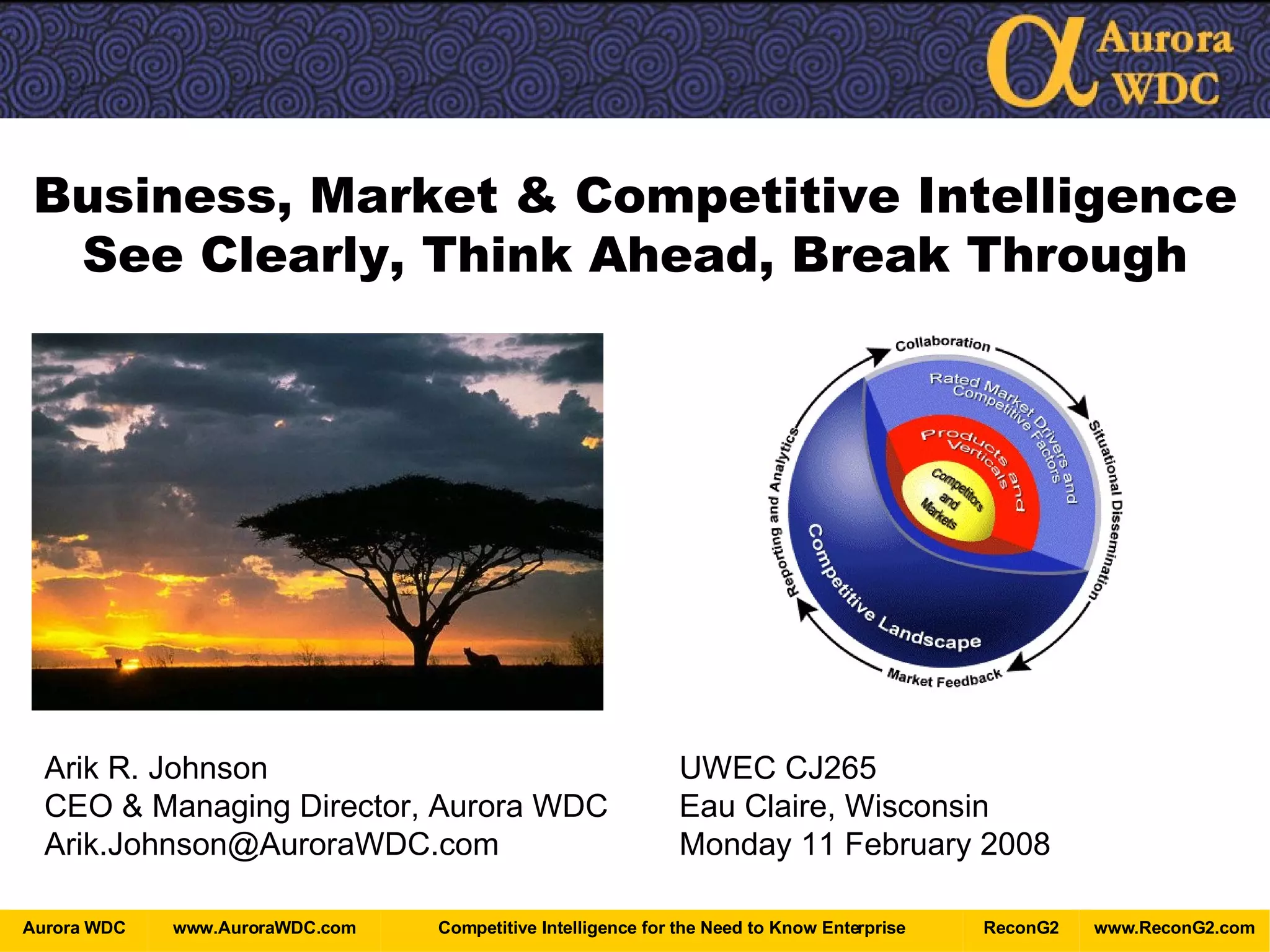
Business, Market & Competitive Intelligence See Clearly, Think Ahead, Break Through Arik R. Johnson UWEC CJ265 CEO & Managing Director, Aurora WDC Eau Claire, Wisconsin Arik.Johnson@AuroraWDC.com  Monday 11 February 2008
Why do cars have brakes? How you answer that question reveals a great deal about how you approach risk. Most people would say brakes help slow you down… we think brakes help you go faster.
Strategic Competitive Intelligence The controls that accompany Enterprise Risk Management are a lot like the brakes on a car. Intelligence is a sensory amalgam of mechanisms to enhance those controls: headlights (tactical) GPS (strategic) in-dash performance indicators (operational)
CI is About Minimizing Threats & Maximizing Opportunities   Minimizing Competitive Threats, e.g. Understanding Threats to Current Business Status Quo: Competitors, Legislation, Technology Shifts, Obsolescence, Substitutes, Customers Backwards Integrating, Vendors Forwards Integrating, etc. Maximizing Market Opportunities, e.g. Identifying New Sales, Revenue and Profit Centers Develop New, Innovative Products & Services Benchmarking Cost Reduction and Efficiencies from Direct Rivals & Best-of-Breed non-competitors
SCIP Code of Ethics To continually strive to increase respect and recognition for the profession.   To pursue one's duties with zeal and diligence while maintaining the highest degree of professionalism and avoiding all unethical practices.   To faithfully adhere to and abide by one's company's policies, objectives and guidelines.   To comply with all applicable laws.   To accurately disclose all relevant information, including one's identity and organization, prior to all interviews.   To fully respect all requests for confidentiality of information.   To promote and encourage full compliance with these ethical standards within one's company, with third party contractors, and within the entire profession.
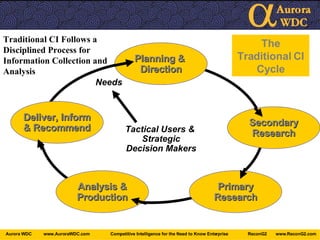
Traditional CI Follows a Disciplined Process for Information Collection and Analysis Deliver, Inform & Recommend Planning &  Direction Secondary Research Analysis & Production Primary Research Tactical Users &  Strategic Decision Makers Needs The Traditional CI Cycle
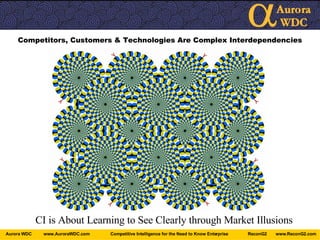
Competitors, Customers & Technologies Are Complex Interdependencies CI is About Learning to See Clearly through Market Illusions
Three Intelligence Trends Organizational Acculturation  – Everyone in the Firm is a Virtual Member of the CI Team Corporate Governance  – Board-level Priority for Ensuring Reliability of the Earnings Forecast (Vioxx/Celebrex Impact, SarbOx 402, etc.) Disruptive Innovation  – Predicting Outcome of Competitive Battles based on Product Strategy & Predictable Dynamics
CI is About Better Decision-Making Strategic Decisions What Business are We in and Where are New Opportunities for Growth? Operational Decisions How do we structure those business units to most effectively compete for and win Market Share? Tactical Decisions Which customers are available to us and how can we convince them to select us over any and all functional equivalents?
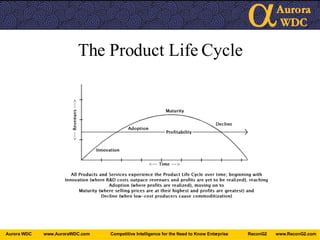
The Product Life Cycle
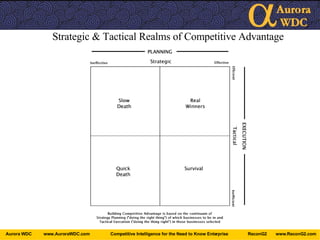
Strategic & Tactical Realms of Competitive Advantage
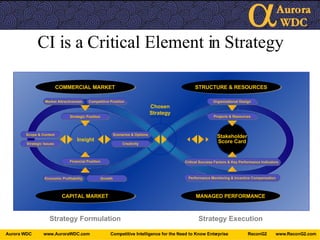
CI is a Critical Element in Strategy COMMERCIAL MARKET STRUCTURE & RESOURCES Strategic Position Strategic Position Competitive Position Market Attractiveness Scope & Context Strategic Issues Insight Stakeholder Score Card Financial Position Growth Economic Profitability Critical Success Factors & Key Performance Indicators  Performance Monitoring & Incentive Compensation Organizational Design Projects & Resources CAPITAL MARKET MANAGED PERFORMANCE Chosen Strategy Scenarios & Options Creativity Strategy Execution Strategy Formulation
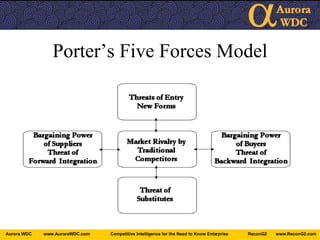
Porter’s Five Forces Model
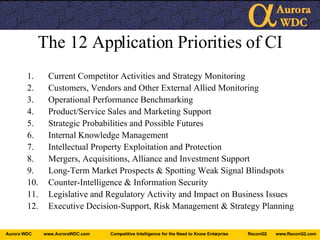
The 12 Application Priorities of CI Current Competitor Activities and Strategy Monitoring Customers, Vendors and Other External Allied Monitoring Operational Performance Benchmarking Product/Service Sales and Marketing Support Strategic Probabilities and Possible Futures Internal Knowledge Management Intellectual Property Exploitation and Protection Mergers, Acquisitions, Alliance and Investment Support Long-Term Market Prospects & Spotting Weak Signal Blindspots Counter-Intelligence & Information Security Legislative and Regulatory Activity and Impact on Business Issues Executive Decision-Support, Risk Management & Strategy Planning
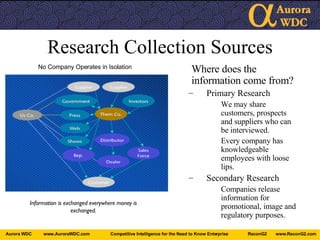
Research Collection Sources Where does the information come from? Primary Research We may share customers, prospects and suppliers who can be interviewed. Every company has knowledgeable employees with loose lips. Secondary Research Companies release information for promotional, image and regulatory purposes. No Company Operates in Isolation Information is exchanged everywhere money is exchanged.
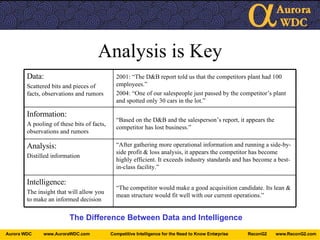
Analysis is Key The Difference Between Data and Intelligence “ The competitor would make a good acquisition candidate. Its lean & mean structure would fit well with our current operations.” Intelligence: The insight that will allow you to make an informed decision “ After gathering more operational information and running a side-by-side profit & loss analysis, it appears the competitor has become highly efficient. It exceeds industry standards and has become a best-in-class facility.” Analysis: Distilled information “ Based on the D&B and the salesperson’s report, it appears the competitor has lost business.” Information: A pooling of these bits of facts, observations and rumors 2001: “The D&B report told us that the competitors plant had 100 employees.” 2004: “One of our salespeople just passed by the competitor’s plant and spotted only 30 cars in the lot.” Data: Scattered bits and pieces of facts, observations and rumors
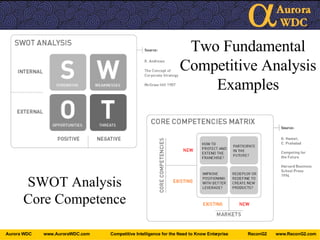
Two Fundamental Competitive Analysis Examples SWOT Analysis Core Competence
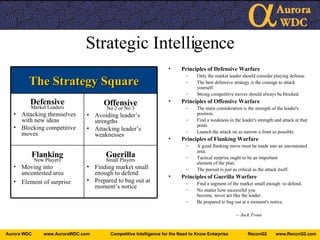
Strategic Intelligence Principles of Defensive Warfare Only the market leader should consider playing defense. The best defensive strategy is the courage to attack  yourself. Strong competitive moves should always be blocked. Principles of Offensive Warfare The main consideration is the strength of the leader's position. Find a weakness in the leader's strength and attack at that point. Launch the attack on as narrow a front as possible. Principles of Flanking Warfare A good flanking move must be made into an uncontested area. Tactical surprise ought to be an important  element of the plan. The pursuit is just as critical as the attack itself. Principles of Guerilla Warfare Find a segment of the market small enough  to defend. No matter how successful you  become, never act like the leader. Be prepared to bug out at a moment's notice. -- Jack Trout Guerilla Small Players Finding market small enough to defend Prepared to bug out at moment’s notice Flanking New Players Moving into uncontested area Element of surprise Offensive No 2 or No 3 Avoiding leader’s strengths Attacking leader’s weaknesses Defensive Market Leaders Attacking themselves with new ideas Blocking competitive moves The Strategy Square
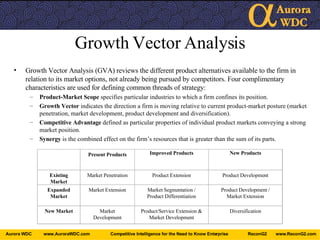
Growth Vector Analysis Growth Vector Analysis (GVA) reviews the different product alternatives available to the firm in relation to its market options, not already being pursued by competitors. Four complimentary characteristics are used for defining common threads of strategy: Product-Market Scope  specifies particular industries to which a firm confines its position. Growth Vector  indicates the direction a firm is moving relative to current product-market posture (market penetration, market development, product development and diversification). Competitive Advantage  defined as particular properties of individual product markets conveying a strong market position. Synergy  is the combined effect on the firm’s resources that is greater than the sum of its parts.   Present Products Improved Products New Products Existing Market Market Penetration Product Extension Product Development Expanded Market Market Extension Market Segmentation / Product Differentiation Product Development / Market Extension New Market Market Development Product/Service Extension & Market Development Diversification
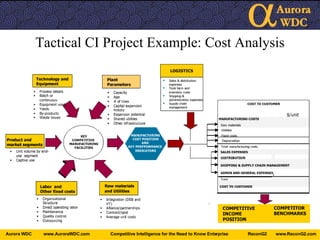
Tactical CI Project Example: Cost Analysis
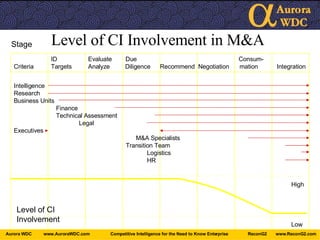
Level of CI Involvement in M&A Stage   ID   Evaluate  Due    Consum- Criteria    Targets   Analyze  Diligence  Recommend  Negotiation  mation  Integration Level of CI Involvement High Low Intelligence Research Business Units   Finance   Technical Assessment   Legal Executives   M&A Specialists Transition Team   Logistics   HR
Seven Steps to Effective Competitive Benchmarking Determine functional areas within your operation to be benchmarked . This is likely to be those areas that will benefit most from the benchmarking process, based upon the cost, importance and potential of changes following the study. Identify the key factors and variables  with which to measure those functions. Two general forms – wherewithal/resources and goals/strategy. Select the best-in-class companies  for each area to be benchmarked -- those companies that perform each function at the lowest cost, with the highest degree of customer satisfaction, etc. The companies you select will be those that do whatever you’re measuring better than you do and/or are ones you wish to emulate or copy. Measure performance of the comparison companies  for each benchmark being considered. Measure your own performance  for each variable and begin comparing the results in an "apples-to-apples" format to determine the gap between your firm and the best-in-class examples. Specify programs and actions  to meet and surpass the competition based on a plan developed to enhance those areas that show potential for compliment. Implement your improvement program  by setting specific improvement targets and deadlines, and by developing a monitoring process to review and update the analysis over time. This will also form the basis for ongoing monitoring, revision and recalibration of measurements in future benchmarking studies.
Key Intelligence Topics (KITs) Process of Interactive Dialog with Decision-Makers through KIT Interviews; Consists of 3 Protocols w/Subtle Differences: Strategic Decisions/Issues Key Marketplace Players Early-Warning Topics
KITs – Strategic Issues Strategic Investment Decisions: Identify and assess changes in the competitive environment, possible future investments, including alliances, acquisitions, etc. Should we expand our current production capacity or build new capacity with a more cost-effective manufacturing process? What plans and actions must we take to maintain (our) technological competitiveness as compared with competitive alternatives? New Product Development and New Market Launch: Assessment of leading competitors and the status of competing technologies.How and when will the competitors respond and how could they affect our plans? Sales & Marketing Strategy as Positioning in the industry. Protection of IP and proprietary information and technology: Competitors efforts to acquire or undermine it, and are there others interested in it? Provide advice for developing the company’s ongoing strategic plan by assessing the role of risks and opportunities in achieving our business goals. Globalization & Outsourcing in the Industry: How/with whom should we proceed? International Market Development: Assess the current competitive situation and describe the most likely future situational scenarios.
KITs – Key Players Context-specific Company & Market Profile Assessments of our competitors, including strategic plans, competitive strategies, financial & market performance, organization & key personnel, R&D, operations, sales & marketing, etc. Identify Emerging Competitors, particularly those coming from different industries. Describe & Assess Current & Future Competitive Environment, including: customers and competitors; markets and suppliers; production and product technologies; political and environmental; and the industry’s structure, including changes and trends. New Customers, their changing needs and future interests: What are they and how are our competitors trying to satisfy them? Identify and assess new industry/market players, including: suppliers, distributors, customers and/or competitors, that are considering entry into our business. New Technology Development: Who are they and what are their plans and strategies for competing in our industry? Marketshare and Historical Growth Data, including that of our competitors for comparison. Management support for regulatory and environmental activities for decision making. Industry, financial & customer community views, attitudes and perceptions regarding the Positioning or Value of our brand, products and services. Perceptions by Financial & Investment Community of our Business & Industry
KITs – Early Warning Potential Areas for Disruptive Technological Breakthrough that could dramatically affect our current and future competitiveness, positively or negatively. Technological Process Developments affecting either production capabilities, costs or product development, and their uses by competitors and others. Performance of Key Suppliers - financial health, cost & quality issues, potential acquisition or alliances. Potential for Disruption in Supply Chain and Change in Industry Procurement Practices. Change in Customer & Competitors Perceptions of our company, products and services. Companies and/or Combinations of Companies, considering possible entry into our business or markets. Changes in international political, social, economic, environmental or regulatory situations that could effect our competitiveness. Regulatory Issues: near-term changes and deviations in long-term trends; legislative changes that could impact current regulatory status quo. Intelligence on Alliances, Acquisitions, and Divestitures among our Competitors, Customers and Suppliers: Understanding the forces causing them and purposes of each deal.
Creating the Integrated Watch List Norm-Deviating Behavior & Explanatory Hypotheses Three Methods for Developing KIT Indicators (Watch List): Inference (Anomaly Scanning, Sensing & Weaving) Scenarios (Planning for Alternative Futures & Potential Outcomes) Ex Post Facto (Historical Change Indicators) Pattern Recognition & Linkage Analysis are Key to Postulating About the Future Connecting the Dots
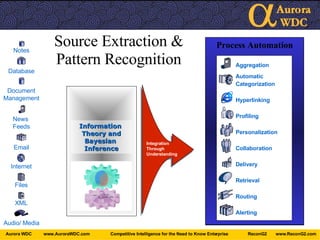
Source Extraction & Pattern Recognition Aggregate content, tag & categorize Hypertext links to similar content Personalization from forms/questionnaires  geodemographic profiling   Searching for information E-mailing  information to relevant  recipients Reformatting for multi- channel delivery, e.g. PDF to XML Answering customer inquiries via a help desk Manual Processes Process Automation Aggregation Automatic Categorization Hyperlinking Profiling Personalization Collaboration Delivery Retrieval Routing Alerting Integration Through Understanding Information  Theory and Bayesian  Inference Notes News  Feeds Email Internet Database Files Document Management XML Audio/ Media
Success Breeds Complacency “ It is a classic conundrum for business titans: How much money and attention should be focused on a new, but growing, operation that is far less profitable than the core business?” - Prof. Clayton Christensen,  The Innovator's Dilemma
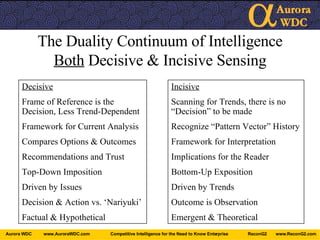
The Duality Continuum of Intelligence Both  Decisive & Incisive Sensing Incisive Scanning for Trends, there is no “Decision” to be made Recognize “Pattern Vector” History Framework for Interpretation Implications for the Reader Bottom-Up Exposition Driven by Trends Outcome is Observation Emergent & Theoretical Decisive Frame of Reference is the Decision, Less Trend-Dependent Framework for Current Analysis Compares Options & Outcomes Recommendations and Trust Top-Down Imposition Driven by Issues Decision & Action vs. ‘Nariyuki’ Factual & Hypothetical
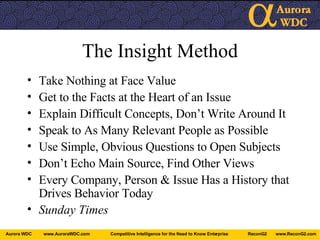
The Insight Method Take Nothing at Face Value Get to the Facts at the Heart of an Issue Explain Difficult Concepts, Don’t Write Around It Speak to As Many Relevant People as Possible Use Simple, Obvious Questions to Open Subjects Don’t Echo Main Source, Find Other Views Every Company, Person & Issue Has a History that Drives Behavior Today Sunday Times
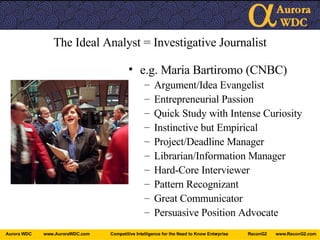
The Ideal Analyst = Investigative Journalist e.g. Maria Bartiromo (CNBC) Argument/Idea Evangelist Entrepreneurial Passion Quick Study with Intense Curiosity Instinctive but Empirical Project/Deadline Manager Librarian/Information Manager Hard-Core Interviewer Pattern Recognizant Great Communicator Persuasive Position Advocate
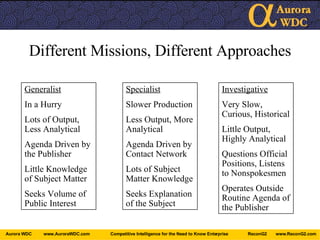
Different Missions, Different Approaches Specialist Slower Production Less Output, More Analytical Agenda Driven by Contact Network Lots of Subject Matter Knowledge Seeks Explanation of the Subject Investigative Very Slow, Curious, Historical Little Output, Highly Analytical Questions Official Positions, Listens to Nonspokesmen Operates Outside Routine Agenda of the Publisher Generalist In a Hurry Lots of Output, Less Analytical Agenda Driven by the Publisher Little Knowledge of Subject Matter Seeks Volume of Public Interest
Consumers “Hire” Products to Do “Jobs” for Them Concentrate Less on What Customers “Want” and More on What Customers “Need”
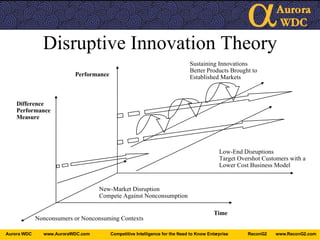
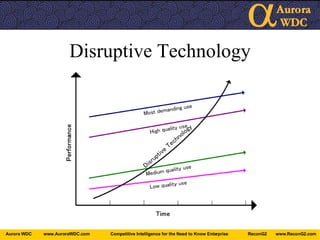
Disruptive Innovation Theory Sustaining Innovations Better Products Brought to Established Markets Low-End Disruptions Target Overshot Customers with a Lower Cost Business Model New-Market Disruption Compete Against Nonconsumption Difference Performance Measure Time Nonconsumers or Nonconsuming Contexts Performance
Disruptive Technology
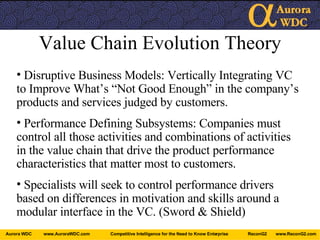
Value Chain Evolution Theory Disruptive Business Models: Vertically Integrating VC to Improve What’s “Not Good Enough” in the company’s products and services judged by customers. Performance Defining Subsystems: Companies must control all those activities and combinations of activities in the value chain that drive the product performance characteristics that matter most to customers. Specialists will seek to control performance drivers based on differences in motivation and skills around a modular interface in the VC. (Sword & Shield)
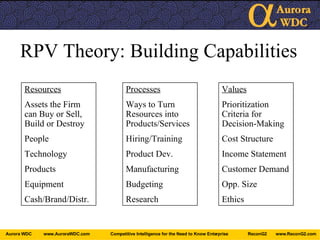
RPV Theory: Building Capabilities Processes Ways to Turn Resources into Products/Services Hiring/Training Product Dev. Manufacturing Budgeting Research Values Prioritization Criteria for Decision-Making Cost Structure Income Statement Customer Demand Opp. Size Ethics Resources Assets the Firm can Buy or Sell, Build or Destroy People Technology Products Equipment Cash/Brand/Distr.
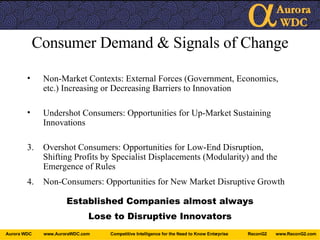
Consumer Demand & Signals of Change Non-Market Contexts: External Forces (Government, Economics, etc.) Increasing or Decreasing Barriers to Innovation Undershot Consumers: Opportunities for Up-Market Sustaining Innovations Overshot Consumers: Opportunities for Low-End Disruption, Shifting Profits by Specialist Displacements (Modularity) and the Emergence of Rules Non-Consumers: Opportunities for New Market Disruptive Growth Established Companies almost always Lose to Disruptive Innovators
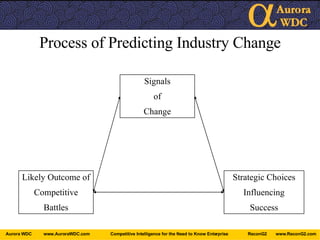
Process of Predicting Industry Change Signals of Change Strategic Choices Influencing Success Likely Outcome of Competitive Battles
Marshall McLuhan “ I don’t know who discovered water, but it wasn’t a fish.” Strategy is concerned with what the corporation wants to do in the world, while Intelligence is focused on what the world wants to do to the corporation.
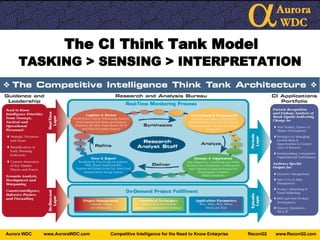
The CI Think Tank Model TASKING > SENSING > INTERPRETATION
Questions or Comments? www.ReconG2.com  www.AuroraWDC.com  Arik R. Johnson Intelligence Leadership Institute [email_address] +01-715-720-1616 Derek L. Johnson Research & Analysis Bureau [email_address] +01-608-268-3470

Uwec Cj265 20080211

  • 1.
    Business, Market &Competitive Intelligence See Clearly, Think Ahead, Break Through Arik R. Johnson UWEC CJ265 CEO & Managing Director, Aurora WDC Eau Claire, Wisconsin Arik.Johnson@AuroraWDC.com Monday 11 February 2008
  • 2.
    Why do carshave brakes? How you answer that question reveals a great deal about how you approach risk. Most people would say brakes help slow you down… we think brakes help you go faster.
  • 3.
    Strategic Competitive IntelligenceThe controls that accompany Enterprise Risk Management are a lot like the brakes on a car. Intelligence is a sensory amalgam of mechanisms to enhance those controls: headlights (tactical) GPS (strategic) in-dash performance indicators (operational)
  • 4.
    CI is AboutMinimizing Threats & Maximizing Opportunities Minimizing Competitive Threats, e.g. Understanding Threats to Current Business Status Quo: Competitors, Legislation, Technology Shifts, Obsolescence, Substitutes, Customers Backwards Integrating, Vendors Forwards Integrating, etc. Maximizing Market Opportunities, e.g. Identifying New Sales, Revenue and Profit Centers Develop New, Innovative Products & Services Benchmarking Cost Reduction and Efficiencies from Direct Rivals & Best-of-Breed non-competitors
  • 5.
    SCIP Code ofEthics To continually strive to increase respect and recognition for the profession. To pursue one's duties with zeal and diligence while maintaining the highest degree of professionalism and avoiding all unethical practices. To faithfully adhere to and abide by one's company's policies, objectives and guidelines. To comply with all applicable laws. To accurately disclose all relevant information, including one's identity and organization, prior to all interviews. To fully respect all requests for confidentiality of information. To promote and encourage full compliance with these ethical standards within one's company, with third party contractors, and within the entire profession.
  • 6.
    Traditional CI Followsa Disciplined Process for Information Collection and Analysis Deliver, Inform & Recommend Planning & Direction Secondary Research Analysis & Production Primary Research Tactical Users & Strategic Decision Makers Needs The Traditional CI Cycle
  • 7.
    Competitors, Customers &Technologies Are Complex Interdependencies CI is About Learning to See Clearly through Market Illusions
  • 8.
    Three Intelligence TrendsOrganizational Acculturation – Everyone in the Firm is a Virtual Member of the CI Team Corporate Governance – Board-level Priority for Ensuring Reliability of the Earnings Forecast (Vioxx/Celebrex Impact, SarbOx 402, etc.) Disruptive Innovation – Predicting Outcome of Competitive Battles based on Product Strategy & Predictable Dynamics
  • 9.
    CI is AboutBetter Decision-Making Strategic Decisions What Business are We in and Where are New Opportunities for Growth? Operational Decisions How do we structure those business units to most effectively compete for and win Market Share? Tactical Decisions Which customers are available to us and how can we convince them to select us over any and all functional equivalents?
  • 10.
  • 11.
    Strategic & TacticalRealms of Competitive Advantage
  • 12.
    CI is aCritical Element in Strategy COMMERCIAL MARKET STRUCTURE & RESOURCES Strategic Position Strategic Position Competitive Position Market Attractiveness Scope & Context Strategic Issues Insight Stakeholder Score Card Financial Position Growth Economic Profitability Critical Success Factors & Key Performance Indicators Performance Monitoring & Incentive Compensation Organizational Design Projects & Resources CAPITAL MARKET MANAGED PERFORMANCE Chosen Strategy Scenarios & Options Creativity Strategy Execution Strategy Formulation
  • 13.
  • 14.
    The 12 ApplicationPriorities of CI Current Competitor Activities and Strategy Monitoring Customers, Vendors and Other External Allied Monitoring Operational Performance Benchmarking Product/Service Sales and Marketing Support Strategic Probabilities and Possible Futures Internal Knowledge Management Intellectual Property Exploitation and Protection Mergers, Acquisitions, Alliance and Investment Support Long-Term Market Prospects & Spotting Weak Signal Blindspots Counter-Intelligence & Information Security Legislative and Regulatory Activity and Impact on Business Issues Executive Decision-Support, Risk Management & Strategy Planning
  • 15.
    Research Collection SourcesWhere does the information come from? Primary Research We may share customers, prospects and suppliers who can be interviewed. Every company has knowledgeable employees with loose lips. Secondary Research Companies release information for promotional, image and regulatory purposes. No Company Operates in Isolation Information is exchanged everywhere money is exchanged.
  • 16.
    Analysis is KeyThe Difference Between Data and Intelligence “ The competitor would make a good acquisition candidate. Its lean & mean structure would fit well with our current operations.” Intelligence: The insight that will allow you to make an informed decision “ After gathering more operational information and running a side-by-side profit & loss analysis, it appears the competitor has become highly efficient. It exceeds industry standards and has become a best-in-class facility.” Analysis: Distilled information “ Based on the D&B and the salesperson’s report, it appears the competitor has lost business.” Information: A pooling of these bits of facts, observations and rumors 2001: “The D&B report told us that the competitors plant had 100 employees.” 2004: “One of our salespeople just passed by the competitor’s plant and spotted only 30 cars in the lot.” Data: Scattered bits and pieces of facts, observations and rumors
  • 17.
    Two Fundamental CompetitiveAnalysis Examples SWOT Analysis Core Competence
  • 18.
    Strategic Intelligence Principlesof Defensive Warfare Only the market leader should consider playing defense. The best defensive strategy is the courage to attack yourself. Strong competitive moves should always be blocked. Principles of Offensive Warfare The main consideration is the strength of the leader's position. Find a weakness in the leader's strength and attack at that point. Launch the attack on as narrow a front as possible. Principles of Flanking Warfare A good flanking move must be made into an uncontested area. Tactical surprise ought to be an important element of the plan. The pursuit is just as critical as the attack itself. Principles of Guerilla Warfare Find a segment of the market small enough to defend. No matter how successful you become, never act like the leader. Be prepared to bug out at a moment's notice. -- Jack Trout Guerilla Small Players Finding market small enough to defend Prepared to bug out at moment’s notice Flanking New Players Moving into uncontested area Element of surprise Offensive No 2 or No 3 Avoiding leader’s strengths Attacking leader’s weaknesses Defensive Market Leaders Attacking themselves with new ideas Blocking competitive moves The Strategy Square
  • 19.
    Growth Vector AnalysisGrowth Vector Analysis (GVA) reviews the different product alternatives available to the firm in relation to its market options, not already being pursued by competitors. Four complimentary characteristics are used for defining common threads of strategy: Product-Market Scope specifies particular industries to which a firm confines its position. Growth Vector indicates the direction a firm is moving relative to current product-market posture (market penetration, market development, product development and diversification). Competitive Advantage defined as particular properties of individual product markets conveying a strong market position. Synergy is the combined effect on the firm’s resources that is greater than the sum of its parts.   Present Products Improved Products New Products Existing Market Market Penetration Product Extension Product Development Expanded Market Market Extension Market Segmentation / Product Differentiation Product Development / Market Extension New Market Market Development Product/Service Extension & Market Development Diversification
  • 20.
    Tactical CI ProjectExample: Cost Analysis
  • 21.
    Level of CIInvolvement in M&A Stage ID Evaluate Due Consum- Criteria Targets Analyze Diligence Recommend Negotiation mation Integration Level of CI Involvement High Low Intelligence Research Business Units Finance Technical Assessment Legal Executives M&A Specialists Transition Team Logistics HR
  • 22.
    Seven Steps toEffective Competitive Benchmarking Determine functional areas within your operation to be benchmarked . This is likely to be those areas that will benefit most from the benchmarking process, based upon the cost, importance and potential of changes following the study. Identify the key factors and variables with which to measure those functions. Two general forms – wherewithal/resources and goals/strategy. Select the best-in-class companies for each area to be benchmarked -- those companies that perform each function at the lowest cost, with the highest degree of customer satisfaction, etc. The companies you select will be those that do whatever you’re measuring better than you do and/or are ones you wish to emulate or copy. Measure performance of the comparison companies for each benchmark being considered. Measure your own performance for each variable and begin comparing the results in an "apples-to-apples" format to determine the gap between your firm and the best-in-class examples. Specify programs and actions to meet and surpass the competition based on a plan developed to enhance those areas that show potential for compliment. Implement your improvement program by setting specific improvement targets and deadlines, and by developing a monitoring process to review and update the analysis over time. This will also form the basis for ongoing monitoring, revision and recalibration of measurements in future benchmarking studies.
  • 23.
    Key Intelligence Topics(KITs) Process of Interactive Dialog with Decision-Makers through KIT Interviews; Consists of 3 Protocols w/Subtle Differences: Strategic Decisions/Issues Key Marketplace Players Early-Warning Topics
  • 24.
    KITs – StrategicIssues Strategic Investment Decisions: Identify and assess changes in the competitive environment, possible future investments, including alliances, acquisitions, etc. Should we expand our current production capacity or build new capacity with a more cost-effective manufacturing process? What plans and actions must we take to maintain (our) technological competitiveness as compared with competitive alternatives? New Product Development and New Market Launch: Assessment of leading competitors and the status of competing technologies.How and when will the competitors respond and how could they affect our plans? Sales & Marketing Strategy as Positioning in the industry. Protection of IP and proprietary information and technology: Competitors efforts to acquire or undermine it, and are there others interested in it? Provide advice for developing the company’s ongoing strategic plan by assessing the role of risks and opportunities in achieving our business goals. Globalization & Outsourcing in the Industry: How/with whom should we proceed? International Market Development: Assess the current competitive situation and describe the most likely future situational scenarios.
  • 25.
    KITs – KeyPlayers Context-specific Company & Market Profile Assessments of our competitors, including strategic plans, competitive strategies, financial & market performance, organization & key personnel, R&D, operations, sales & marketing, etc. Identify Emerging Competitors, particularly those coming from different industries. Describe & Assess Current & Future Competitive Environment, including: customers and competitors; markets and suppliers; production and product technologies; political and environmental; and the industry’s structure, including changes and trends. New Customers, their changing needs and future interests: What are they and how are our competitors trying to satisfy them? Identify and assess new industry/market players, including: suppliers, distributors, customers and/or competitors, that are considering entry into our business. New Technology Development: Who are they and what are their plans and strategies for competing in our industry? Marketshare and Historical Growth Data, including that of our competitors for comparison. Management support for regulatory and environmental activities for decision making. Industry, financial & customer community views, attitudes and perceptions regarding the Positioning or Value of our brand, products and services. Perceptions by Financial & Investment Community of our Business & Industry
  • 26.
    KITs – EarlyWarning Potential Areas for Disruptive Technological Breakthrough that could dramatically affect our current and future competitiveness, positively or negatively. Technological Process Developments affecting either production capabilities, costs or product development, and their uses by competitors and others. Performance of Key Suppliers - financial health, cost & quality issues, potential acquisition or alliances. Potential for Disruption in Supply Chain and Change in Industry Procurement Practices. Change in Customer & Competitors Perceptions of our company, products and services. Companies and/or Combinations of Companies, considering possible entry into our business or markets. Changes in international political, social, economic, environmental or regulatory situations that could effect our competitiveness. Regulatory Issues: near-term changes and deviations in long-term trends; legislative changes that could impact current regulatory status quo. Intelligence on Alliances, Acquisitions, and Divestitures among our Competitors, Customers and Suppliers: Understanding the forces causing them and purposes of each deal.
  • 27.
    Creating the IntegratedWatch List Norm-Deviating Behavior & Explanatory Hypotheses Three Methods for Developing KIT Indicators (Watch List): Inference (Anomaly Scanning, Sensing & Weaving) Scenarios (Planning for Alternative Futures & Potential Outcomes) Ex Post Facto (Historical Change Indicators) Pattern Recognition & Linkage Analysis are Key to Postulating About the Future Connecting the Dots
  • 28.
    Source Extraction &Pattern Recognition Aggregate content, tag & categorize Hypertext links to similar content Personalization from forms/questionnaires geodemographic profiling Searching for information E-mailing information to relevant recipients Reformatting for multi- channel delivery, e.g. PDF to XML Answering customer inquiries via a help desk Manual Processes Process Automation Aggregation Automatic Categorization Hyperlinking Profiling Personalization Collaboration Delivery Retrieval Routing Alerting Integration Through Understanding Information Theory and Bayesian Inference Notes News Feeds Email Internet Database Files Document Management XML Audio/ Media
  • 29.
    Success Breeds Complacency“ It is a classic conundrum for business titans: How much money and attention should be focused on a new, but growing, operation that is far less profitable than the core business?” - Prof. Clayton Christensen, The Innovator's Dilemma
  • 30.
    The Duality Continuumof Intelligence Both Decisive & Incisive Sensing Incisive Scanning for Trends, there is no “Decision” to be made Recognize “Pattern Vector” History Framework for Interpretation Implications for the Reader Bottom-Up Exposition Driven by Trends Outcome is Observation Emergent & Theoretical Decisive Frame of Reference is the Decision, Less Trend-Dependent Framework for Current Analysis Compares Options & Outcomes Recommendations and Trust Top-Down Imposition Driven by Issues Decision & Action vs. ‘Nariyuki’ Factual & Hypothetical
  • 31.
    The Insight MethodTake Nothing at Face Value Get to the Facts at the Heart of an Issue Explain Difficult Concepts, Don’t Write Around It Speak to As Many Relevant People as Possible Use Simple, Obvious Questions to Open Subjects Don’t Echo Main Source, Find Other Views Every Company, Person & Issue Has a History that Drives Behavior Today Sunday Times
  • 32.
    The Ideal Analyst= Investigative Journalist e.g. Maria Bartiromo (CNBC) Argument/Idea Evangelist Entrepreneurial Passion Quick Study with Intense Curiosity Instinctive but Empirical Project/Deadline Manager Librarian/Information Manager Hard-Core Interviewer Pattern Recognizant Great Communicator Persuasive Position Advocate
  • 33.
    Different Missions, DifferentApproaches Specialist Slower Production Less Output, More Analytical Agenda Driven by Contact Network Lots of Subject Matter Knowledge Seeks Explanation of the Subject Investigative Very Slow, Curious, Historical Little Output, Highly Analytical Questions Official Positions, Listens to Nonspokesmen Operates Outside Routine Agenda of the Publisher Generalist In a Hurry Lots of Output, Less Analytical Agenda Driven by the Publisher Little Knowledge of Subject Matter Seeks Volume of Public Interest
  • 34.
    Consumers “Hire” Productsto Do “Jobs” for Them Concentrate Less on What Customers “Want” and More on What Customers “Need”
  • 35.
    Disruptive Innovation TheorySustaining Innovations Better Products Brought to Established Markets Low-End Disruptions Target Overshot Customers with a Lower Cost Business Model New-Market Disruption Compete Against Nonconsumption Difference Performance Measure Time Nonconsumers or Nonconsuming Contexts Performance
  • 36.
  • 37.
    Value Chain EvolutionTheory Disruptive Business Models: Vertically Integrating VC to Improve What’s “Not Good Enough” in the company’s products and services judged by customers. Performance Defining Subsystems: Companies must control all those activities and combinations of activities in the value chain that drive the product performance characteristics that matter most to customers. Specialists will seek to control performance drivers based on differences in motivation and skills around a modular interface in the VC. (Sword & Shield)
  • 38.
    RPV Theory: BuildingCapabilities Processes Ways to Turn Resources into Products/Services Hiring/Training Product Dev. Manufacturing Budgeting Research Values Prioritization Criteria for Decision-Making Cost Structure Income Statement Customer Demand Opp. Size Ethics Resources Assets the Firm can Buy or Sell, Build or Destroy People Technology Products Equipment Cash/Brand/Distr.
  • 39.
    Consumer Demand &Signals of Change Non-Market Contexts: External Forces (Government, Economics, etc.) Increasing or Decreasing Barriers to Innovation Undershot Consumers: Opportunities for Up-Market Sustaining Innovations Overshot Consumers: Opportunities for Low-End Disruption, Shifting Profits by Specialist Displacements (Modularity) and the Emergence of Rules Non-Consumers: Opportunities for New Market Disruptive Growth Established Companies almost always Lose to Disruptive Innovators
  • 40.
    Process of PredictingIndustry Change Signals of Change Strategic Choices Influencing Success Likely Outcome of Competitive Battles
  • 41.
    Marshall McLuhan “I don’t know who discovered water, but it wasn’t a fish.” Strategy is concerned with what the corporation wants to do in the world, while Intelligence is focused on what the world wants to do to the corporation.
  • 42.
    The CI ThinkTank Model TASKING > SENSING > INTERPRETATION
  • 43.
    Questions or Comments?www.ReconG2.com www.AuroraWDC.com Arik R. Johnson Intelligence Leadership Institute [email_address] +01-715-720-1616 Derek L. Johnson Research & Analysis Bureau [email_address] +01-608-268-3470