PMO KICK-OFF
JUNE 2019
By Ebru Seiwert
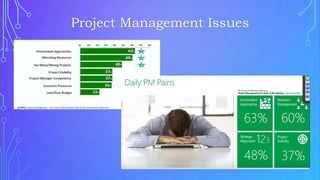
Project Management Issues
An organizational body…
assigned various responsibilities related to the
centralized and coordinated management of those
projects under its domain.
There in no such thing as a "universal solution"
To be effective, a PMO must be tailored to the
organization's project types, management/staff
capabilities, and the organization's culture.
What is PMO?
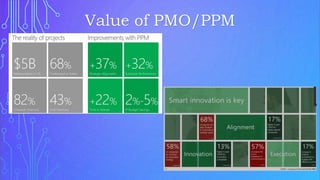
Value of PMO/PPM
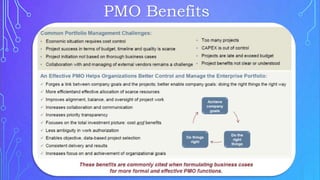
PMO Benefits
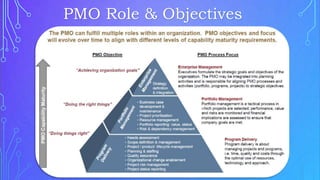
PMO Role & Objectives
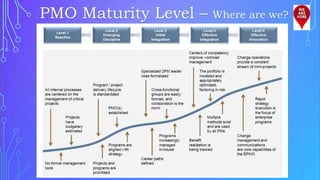
PMO Maturity Level – Where are we?
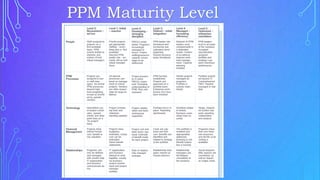
PPM Maturity Level
 0 Non-Existent – Not applied
 1 Initial – Ad hoc and disorganized
 2 Repeatable – Follow regular pattern
 3 Defined – Documented/communicated
 4 Managed – Monitored and measured
 5 Optimized – Best practices followed/ automated
Source: CobiT 3rd Edition, Management Guidelines
CobiT® Maturity Levels
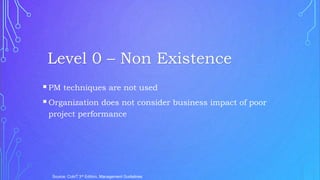
PM techniques are not used
Organization does not consider business impact of poor
project performance
Source: CobiT 3rd Edition, Management Guidelines
Level 0 – Non Existence
 Aware of need for project structure and risks of poorly managed projects
 Use of PM techniques left to the individual
 Projects are generally poorly defined and do not incorporate business or
technical objectives of the organization or stakeholders
 Lack of management commitment and project ownership
 Critical project decisions are made without user management or
customer input
 Little or no customer and user involvement in defining IT projects
 No clear organization within IT projects and roles/responsibilities are not
defined
 Project schedules and milestones are poorly defined
 Project staff time and expenses are not tracked and compared to budgets
Source: CobiT 3rd Edition, Management Guidelines
Level 1 – Initial/Ad Hoc
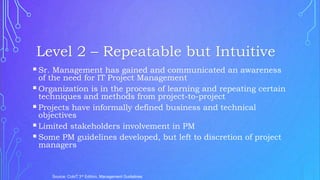
Sr. Management has gained and communicated an awareness
of the need for IT Project Management
Organization is in the process of learning and repeating certain
techniques and methods from project-to-project
Projects have informally defined business and technical
objectives
Limited stakeholders involvement in PM
Some PM guidelines developed, but left to discretion of project
managers
Source: CobiT 3rd Edition, Management Guidelines
Level 2 – Repeatable but Intuitive
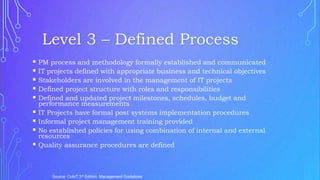
 PM process and methodology formally established and communicated
 IT projects defined with appropriate business and technical objectives
 Stakeholders are involved in the management of IT projects
 Defined project structure with roles and responsibilities
 Defined and updated project milestones, schedules, budget and
performance measurements
 IT Projects have formal post systems implementation procedures
 Informal project management training provided
 No established policies for using combination of internal and external
resources
 Quality assurance procedures are defined
Source: CobiT 3rd Edition, Management Guidelines
Level 3 – Defined Process
 Formal and standardized project metrics
 PM measure and evaluated throughout organization not just IT
 PM process enhancement formalized and communicated, and project team
members are trained on all enhancements
 Risk management performed as part of PM
 Stakeholders actively participate in projects or lead them
 Project milestones and criteria for evaluating success at each milestones are
established
 Value and risk are measured and managed prior to, during, and after project
completion
 Management has established a program management function within IT
 Projects are defined, staffed, and managed to address organizational goals,
rather than only IT specific ones.
Source: CobiT 3rd Edition, Management Guidelines
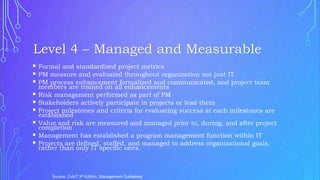
Level 4 – Managed and Measurable
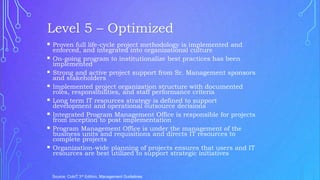
 Proven full life-cycle project methodology is implemented and
enforced, and integrated into organizational culture
 On-going program to institutionalize best practices has been
implemented
 Strong and active project support from Sr. Management sponsors
and stakeholders
 Implemented project organization structure with documented
roles, responsibilities, and staff performance criteria
 Long term IT resources strategy is defined to support
development and operational outsource decisions
 Integrated Program Management Office is responsible for projects
from inception to post implementation
 Program Management Office is under the management of the
business units and requisitions and directs IT resources to
complete projects
 Organization-wide planning of projects ensures that users and IT
resources are best utilized to support strategic initiatives
Source: CobiT 3rd Edition, Management Guidelines
Level 5 – Optimized
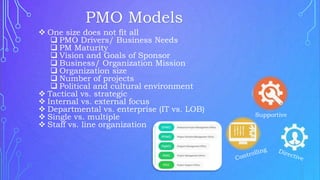
 One size does not fit all
 PMO Drivers/ Business Needs
 PM Maturity
 Vision and Goals of Sponsor
 Business/ Organization Mission
 Organization size
 Number of projects
 Political and cultural environment
 Tactical vs. strategic
 Internal vs. external focus
 Departmental vs. enterprise (IT vs. LOB)
 Single vs. multiple
 Staff vs. line organization
PMO Models
Supportive
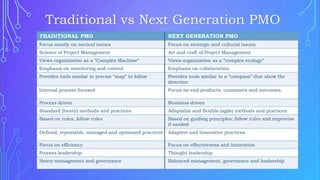
TRADITIONAL PMO NEXT GENERATION PMO
Focus mostly on tactical issues Focus on strategic and cultural issues
Science of Project Management Art and craft of Project Management
Views organization as a “Complex Machine” Views organization as a “complex ecology”
Emphasis on monitoring and control Emphasis on collaboration
Provides tools similar to precise “map” to follow Provides tools similar to a “compass” that show the
direction
Internal process focused Focus on end products, customers and outcomes
Process driven Business driven
Standard (heavy) methods and practices Adaptable and flexible (agile) methods and practices
Based on rules; follow rules Based on guiding principles; follow rules and improvise
if needed
Defined, repeatable, managed and optimized practices Adaptive and Innovative practices
Focus on efficiency Focus on effectiveness and innovation
Process leadership Thought leadership
Heavy management and governance Balanced management, governance and leadership
Traditional vs Next Generation PMO
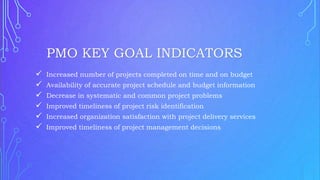
 Increased number of projects completed on time and on budget
 Availability of accurate project schedule and budget information
 Decrease in systematic and common project problems
 Improved timeliness of project risk identification
 Increased organization satisfaction with project delivery services
 Improved timeliness of project management decisions
PMO KEY GOAL INDICATORS
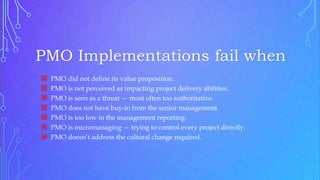
PMO Implementations fail when
 PMO did not define its value proposition.
 PMO is not perceived as impacting project delivery abilities.
 PMO is seen as a threat — most often too authoritative.
 PMO does not have buy-in from the senior management.
 PMO is too low in the management reporting.
 PMO is micromanaging — trying to control every project directly.
 PMO doesn’t address the cultural change required.
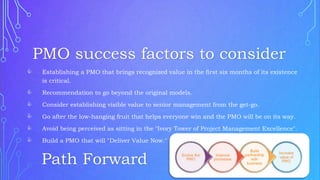
 Establishing a PMO that brings recognized value in the first six months of its existence
is critical.
 Recommendation to go beyond the original models.
 Consider establishing visible value to senior management from the get-go.
 Go after the low-hanging fruit that helps everyone win and the PMO will be on its way.
 Avoid being perceived as sitting in the "Ivory Tower of Project Management Excellence".
 Build a PMO that will "Deliver Value Now."
PMO success factors to consider
Path Forward
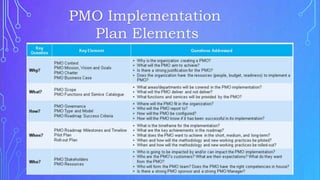
PMO Implementation
Plan Elements
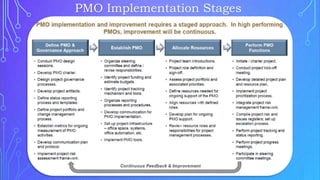
PMO Implementation Stages
PMO Kick-Off Presentation

PMO Kick-Off Presentation

  • 1.
  • 2.
  • 3.
    An organizational body… assignedvarious responsibilities related to the centralized and coordinated management of those projects under its domain. There in no such thing as a "universal solution" To be effective, a PMO must be tailored to the organization's project types, management/staff capabilities, and the organization's culture. What is PMO?
  • 4.
  • 5.
  • 6.
    PMO Role &Objectives
  • 7.
    PMO Maturity Level– Where are we?
  • 8.
  • 9.
     0 Non-Existent– Not applied  1 Initial – Ad hoc and disorganized  2 Repeatable – Follow regular pattern  3 Defined – Documented/communicated  4 Managed – Monitored and measured  5 Optimized – Best practices followed/ automated Source: CobiT 3rd Edition, Management Guidelines CobiT® Maturity Levels
  • 10.
    PM techniques arenot used Organization does not consider business impact of poor project performance Source: CobiT 3rd Edition, Management Guidelines Level 0 – Non Existence
  • 11.
     Aware ofneed for project structure and risks of poorly managed projects  Use of PM techniques left to the individual  Projects are generally poorly defined and do not incorporate business or technical objectives of the organization or stakeholders  Lack of management commitment and project ownership  Critical project decisions are made without user management or customer input  Little or no customer and user involvement in defining IT projects  No clear organization within IT projects and roles/responsibilities are not defined  Project schedules and milestones are poorly defined  Project staff time and expenses are not tracked and compared to budgets Source: CobiT 3rd Edition, Management Guidelines Level 1 – Initial/Ad Hoc
  • 12.
    Sr. Management hasgained and communicated an awareness of the need for IT Project Management Organization is in the process of learning and repeating certain techniques and methods from project-to-project Projects have informally defined business and technical objectives Limited stakeholders involvement in PM Some PM guidelines developed, but left to discretion of project managers Source: CobiT 3rd Edition, Management Guidelines Level 2 – Repeatable but Intuitive
  • 13.
     PM processand methodology formally established and communicated  IT projects defined with appropriate business and technical objectives  Stakeholders are involved in the management of IT projects  Defined project structure with roles and responsibilities  Defined and updated project milestones, schedules, budget and performance measurements  IT Projects have formal post systems implementation procedures  Informal project management training provided  No established policies for using combination of internal and external resources  Quality assurance procedures are defined Source: CobiT 3rd Edition, Management Guidelines Level 3 – Defined Process
  • 14.
     Formal andstandardized project metrics  PM measure and evaluated throughout organization not just IT  PM process enhancement formalized and communicated, and project team members are trained on all enhancements  Risk management performed as part of PM  Stakeholders actively participate in projects or lead them  Project milestones and criteria for evaluating success at each milestones are established  Value and risk are measured and managed prior to, during, and after project completion  Management has established a program management function within IT  Projects are defined, staffed, and managed to address organizational goals, rather than only IT specific ones. Source: CobiT 3rd Edition, Management Guidelines Level 4 – Managed and Measurable
  • 15.
     Proven fulllife-cycle project methodology is implemented and enforced, and integrated into organizational culture  On-going program to institutionalize best practices has been implemented  Strong and active project support from Sr. Management sponsors and stakeholders  Implemented project organization structure with documented roles, responsibilities, and staff performance criteria  Long term IT resources strategy is defined to support development and operational outsource decisions  Integrated Program Management Office is responsible for projects from inception to post implementation  Program Management Office is under the management of the business units and requisitions and directs IT resources to complete projects  Organization-wide planning of projects ensures that users and IT resources are best utilized to support strategic initiatives Source: CobiT 3rd Edition, Management Guidelines Level 5 – Optimized
  • 16.
     One sizedoes not fit all  PMO Drivers/ Business Needs  PM Maturity  Vision and Goals of Sponsor  Business/ Organization Mission  Organization size  Number of projects  Political and cultural environment  Tactical vs. strategic  Internal vs. external focus  Departmental vs. enterprise (IT vs. LOB)  Single vs. multiple  Staff vs. line organization PMO Models Supportive
  • 17.
    TRADITIONAL PMO NEXTGENERATION PMO Focus mostly on tactical issues Focus on strategic and cultural issues Science of Project Management Art and craft of Project Management Views organization as a “Complex Machine” Views organization as a “complex ecology” Emphasis on monitoring and control Emphasis on collaboration Provides tools similar to precise “map” to follow Provides tools similar to a “compass” that show the direction Internal process focused Focus on end products, customers and outcomes Process driven Business driven Standard (heavy) methods and practices Adaptable and flexible (agile) methods and practices Based on rules; follow rules Based on guiding principles; follow rules and improvise if needed Defined, repeatable, managed and optimized practices Adaptive and Innovative practices Focus on efficiency Focus on effectiveness and innovation Process leadership Thought leadership Heavy management and governance Balanced management, governance and leadership Traditional vs Next Generation PMO
  • 18.
     Increased numberof projects completed on time and on budget  Availability of accurate project schedule and budget information  Decrease in systematic and common project problems  Improved timeliness of project risk identification  Increased organization satisfaction with project delivery services  Improved timeliness of project management decisions PMO KEY GOAL INDICATORS
  • 19.
    PMO Implementations failwhen  PMO did not define its value proposition.  PMO is not perceived as impacting project delivery abilities.  PMO is seen as a threat — most often too authoritative.  PMO does not have buy-in from the senior management.  PMO is too low in the management reporting.  PMO is micromanaging — trying to control every project directly.  PMO doesn’t address the cultural change required.
  • 20.
     Establishing aPMO that brings recognized value in the first six months of its existence is critical.  Recommendation to go beyond the original models.  Consider establishing visible value to senior management from the get-go.  Go after the low-hanging fruit that helps everyone win and the PMO will be on its way.  Avoid being perceived as sitting in the "Ivory Tower of Project Management Excellence".  Build a PMO that will "Deliver Value Now." PMO success factors to consider Path Forward
  • 21.
  • 22.