How to Measure Strategic
                                                            Market and Competitive
                                                           Intelligence Performance


                                         A Complimentary Webinar from Aurora WDC
                                      12:00 Noon Eastern /// Wednesday 19 December 2012


                                                          ~ featuring ~


                                          Craig McHenry               Dr. Craig Fleisher

                                                                                           Powered by
The Intelligence Collaborative
http://IntelCollab.com #IntelCollab
Are you worth the price?

      The lifespan of the average CI group is between three
       to four years! (SCIP Surveys)
      Today’s hyper-competitive environments create
       economic pressure on firms.
      Are you prepared to
       articulate, well and
       often, the value of CI
       to your stakeholders?


                                                    Powered by
The Intelligence Collaborative
http://IntelCollab.com #IntelCollab
What is in it for me…
 besides my job?

            When done effectively, demonstrating and measuring
             CI value:
                Affects the success of your company and
                 organization
                Provides a means to improve and grow
                        - Understand what is working, is not working, & why?
                        - Expands CI influence to areas of the organization

                Moves you from overhead and cost center
                 to profit center and enabling function
                        - Captures CI performance in financial terms
                        - Reminds stakeholders of what you do and why

                                                                               Powered by
The Intelligence Collaborative
http://IntelCollab.com #IntelCollab
Acknowledge, But Overcome The
 Barriers And Excuses
      No time to do it
      Don’t know how
      No complaints = satisfaction?
      CI value is too
       deeply embedded
       in other activities
           Return on Investment = CI Benefits / CI Costs
            (calculating the numerator is the problem)
           Other groups support decisions-making too


                                                  Powered by
The Intelligence Collaborative
http://IntelCollab.com #IntelCollab
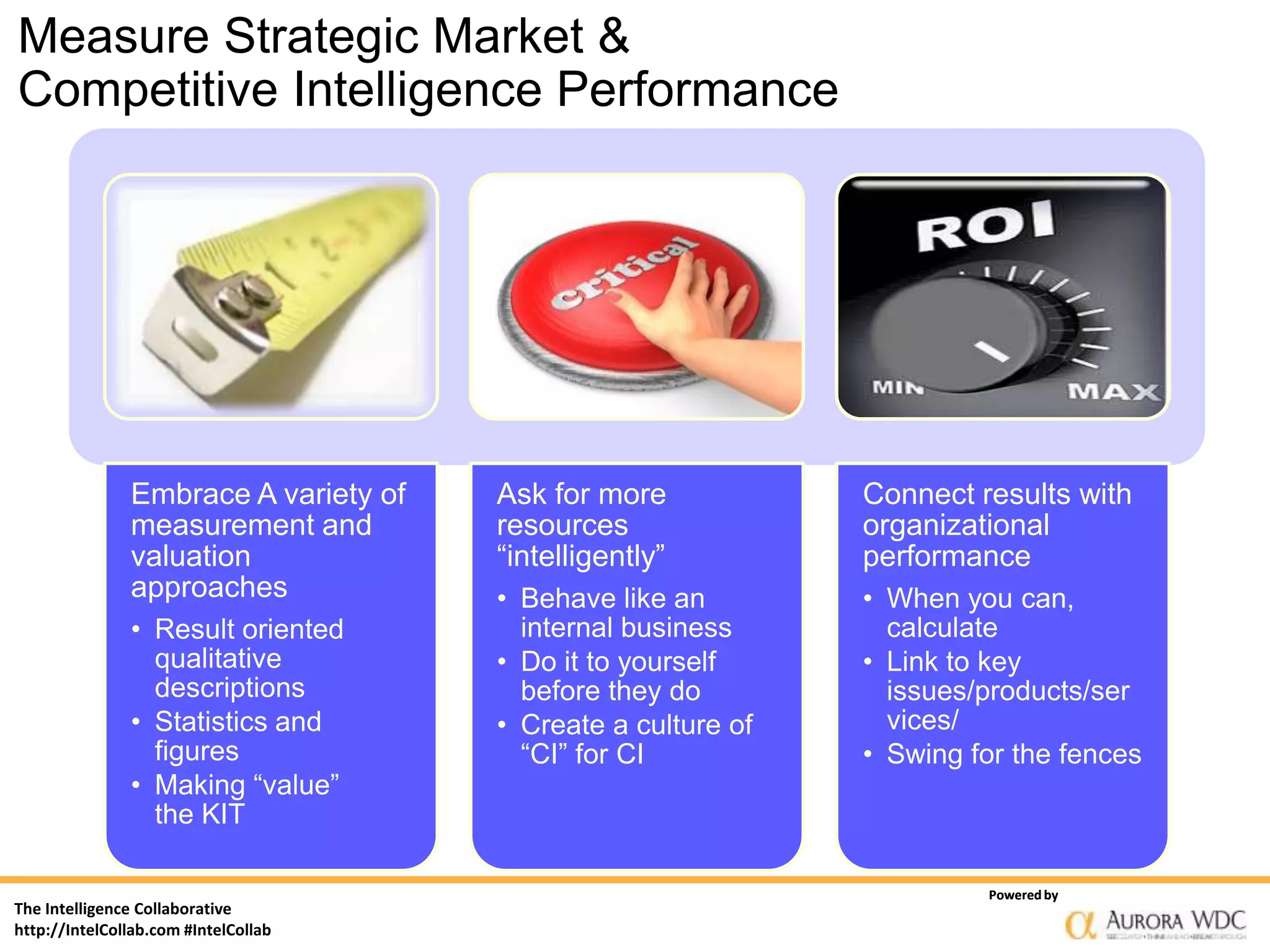
Measure Strategic Market &
Competitive Intelligence Performance


               Embrace A variety of   Ask for more            Connect results with
               measurement and        resources               organizational
               valuation              “intelligently”         performance
               approaches             • Behave like an        • When you can,
               • Result oriented        internal business       calculate
                 qualitative          • Do it to yourself     • Link to key
                 descriptions           before they do          issues/products/ser
               • Statistics and       • Create a culture of     vices/
                 figures                “CI” for CI           • Swing for the fences
               • Making “value”
                 the KIT

                                                                       Powered by
The Intelligence Collaborative
http://IntelCollab.com #IntelCollab
Tell The Story –
 Clearly and Often
          How CI caused your stakeholder to do something
           different
           or differently
               Without CI = X
                   but with CI = Y
          Consider: The STAR Technique
               Situation – Describe the business issue
               Task – What was CI’s role
               Action – What did you do and why
               Result – Describe the outcome of CI research and
                   overall business impact

                                                          Powered by
The Intelligence Collaborative
http://IntelCollab.com #IntelCollab
Measure! - “What gets
 measured gets managed”
     Statistics = good, but don’t tell the whole story
         Number of: projects, project hours, KITs, reports, etc.
         How many: unique interactions, business functions,
         Budgets: CI dept. budget, CI headcount, project $,
     Metrics that hint at quality of work done
         Not just were we right, but what was confirmed / new information/
             revised (before decision)
         What sources were used (internal vs external) (how many, of what
             caliber)
         How much “repeat” business do you get?
     Decisions – Size/monetary impact, time under consideration, etc.


                                                                    Powered by
The Intelligence Collaborative
http://IntelCollab.com #IntelCollab
An idea! - treat the value question
 like its own CI project
   Elicit the information from the organization
        Formal discussion with key stakeholder(s) after
         delivering results – part of the project plan
        Probe on the perceived value of the work done
               - What is the expected value to the company of the decision made?
               - If money were not an issue, what would you be willing to pay for this
                  information?
               - What would you had done if CI had not been an option?

        Consider using a 3rd party


                                                                                    Powered by
The Intelligence Collaborative
http://IntelCollab.com #IntelCollab
Points To Keep Mind

    Caution: stakeholder involvement bias
    Keep legal informed of your work - they can be an
     important ally
    Sometimes you can infer value
        When the CI budget comes from the product
         groups, they are expecting a benefit or return to
         their bottom line – e.g. voting for CI with their
         budget.
        Compare CI research to other market and
         customer analytics

                                                  Powered by
The Intelligence Collaborative
http://IntelCollab.com #IntelCollab
When The Time Comes To
 Ask For More Resources…
     Behave like an you are running your own business
     Face the inevitable - do it to yourself before they do
     Create a culture of Continuous Improvement for CI –
      meaning you should be able to tell others where the
      improvement occurred, how much, and at what quality
      levels


                                                        Powered by
The Intelligence Collaborative
http://IntelCollab.com #IntelCollab
Behave Like An You Are Running
Your Own Business
     Benchmark but be skeptical
         Use comparisons only as a guide
         Give more weight to internal metrics
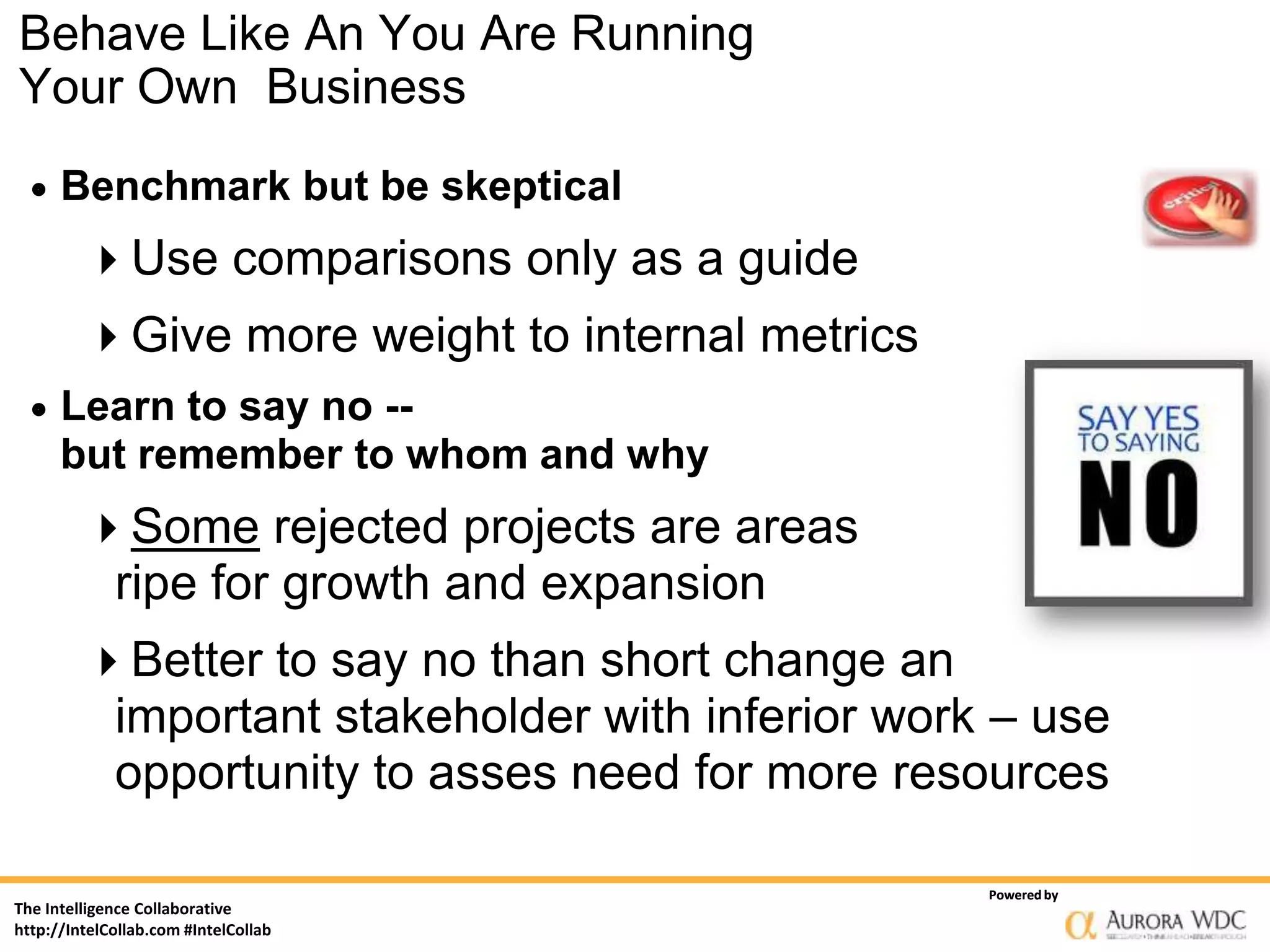
     Learn to say no --
      but remember to whom and why
         Some rejected projects are areas
          ripe for growth and expansion
         Better to say no than short change an
          important stakeholder with inferior work – use
          opportunity to asses need for more resources

                                                  Powered by
The Intelligence Collaborative
http://IntelCollab.com #IntelCollab
If necessary face the inevitable
and do it to yourself before they do
   Get out in front of obvious business
    changes and step up to the challenge
       Track project deliverables and
        perceived value
               - Know where you would do more and where less work

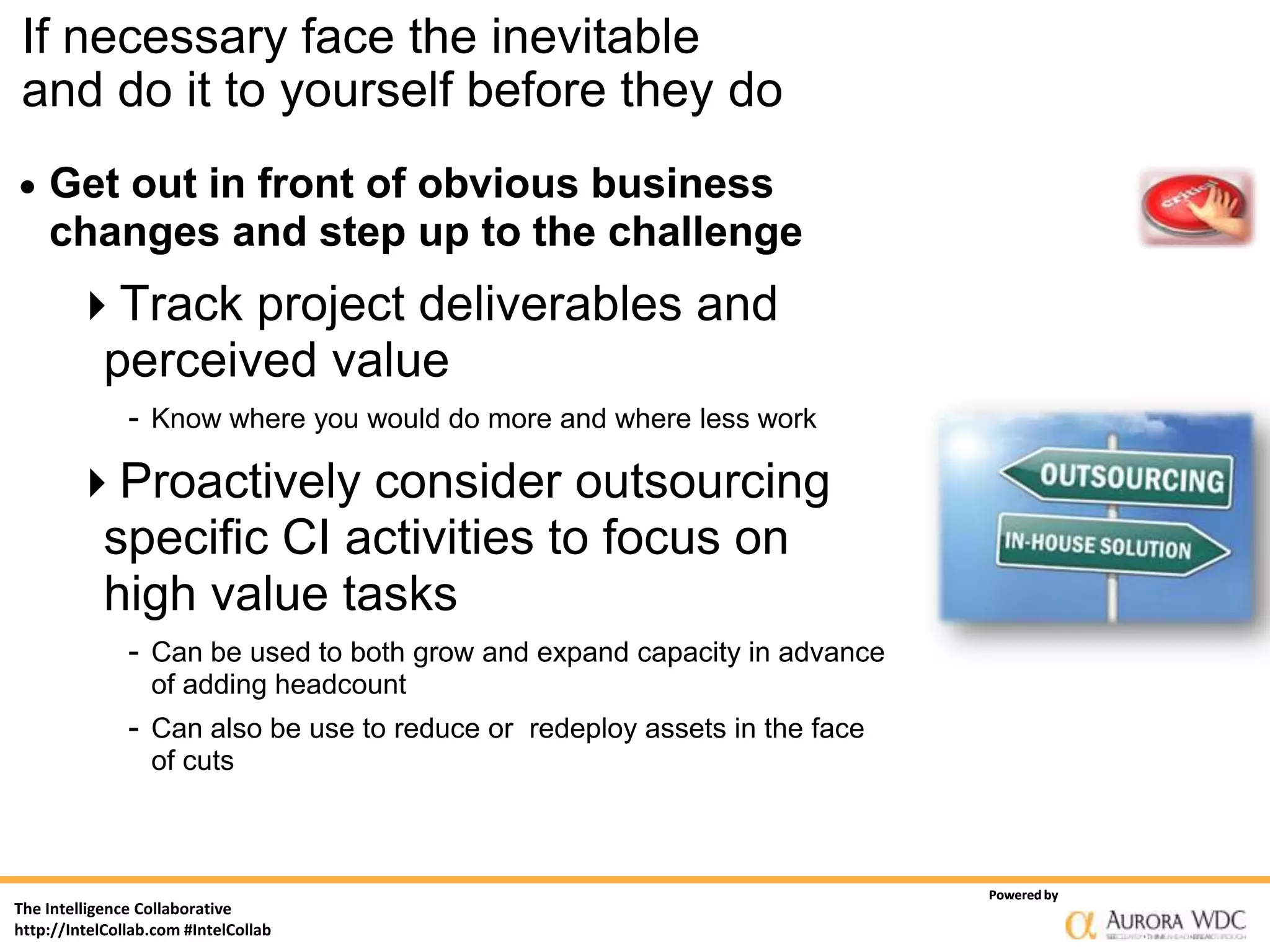
       Proactively consider outsourcing
        specific CI activities to focus on
        high value tasks
               - Can be used to both grow and expand capacity in advance
                  of adding headcount
               - Can also be use to reduce or redeploy assets in the face
                  of cuts


                                                                            Powered by
The Intelligence Collaborative
http://IntelCollab.com #IntelCollab
Create a culture of Continuous
Improvement for CI
     Consider: After Action Assessments any time CI
      work is done for a team
         As part of project wrap up, capture project
          details and feedback from all involved
                 - How complex was the question/business issue?
                 - How well did we describe the risks associated with what “we knew we didn’t
                    knew?”
                 - Did we fully leverage our internal knowledge?
                 - What are the lasting consequences of this project?
                 - If we found a discontinuous change, is there any way to anticipate or
                    compensate for that next time

         Provide feedback and learning to
          stakeholders

                                                                                     Powered by
The Intelligence Collaborative
http://IntelCollab.com #IntelCollab
Quantifiably Connect CI Results
With Organizational Performance
      If possible, calculate return on investment
      Link CI effort to key specific issues /products
       /services
      Swing for the fence – One homerun at the right time
       can make the whole season


                                                         Powered by
The Intelligence Collaborative
http://IntelCollab.com #IntelCollab
If The Data Exists, Calculate
Project Return On Investment (ROI)
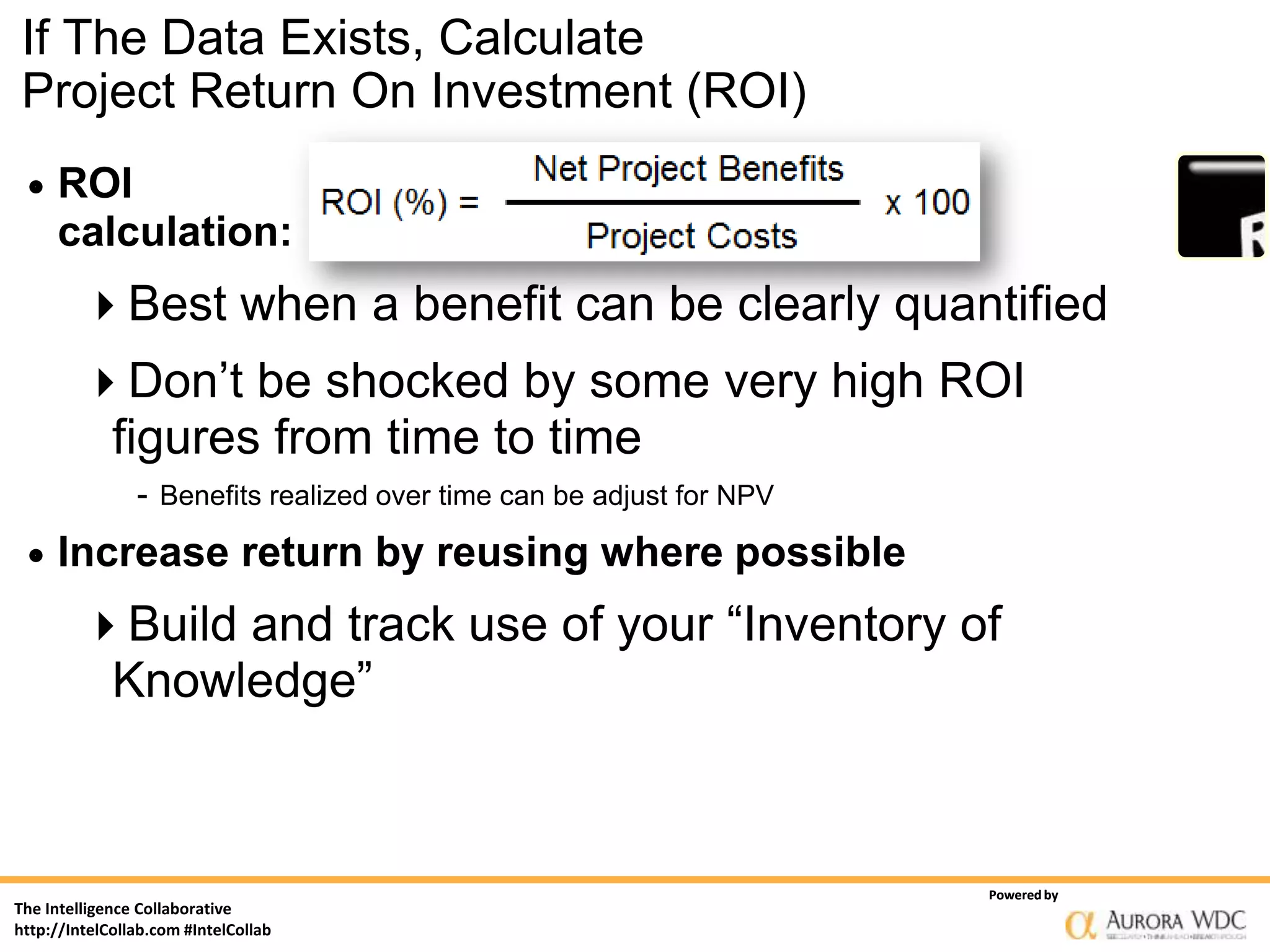
    ROI
     calculation:
         Best when a benefit can be clearly quantified
         Don’t be shocked by some very high ROI
             figures from time to time
                - Benefits realized over time can be adjust for NPV
    Increase return by reusing where possible
         Build and track use of your “Inventory of
          Knowledge”


                                                                      Powered by
The Intelligence Collaborative
http://IntelCollab.com #IntelCollab
Link CI Projects To Key
 Issues/Products/Services
       Track product performance relevant to CI projects
        done
           Look for changes related to CI supported
            decisions
           Areas without active CI work offer points of
            comparison – use caution here
       Identify inflection points
           What if scenarios aren’t always reliable, but
            can point to likely benefits from CI projects


                                                    Powered by
The Intelligence Collaborative
http://IntelCollab.com #IntelCollab
Swing for the fences – one homerun
can make the entire season
    Although infrequent they are gold
        Look for those projects where you can
         obtain concrete data on the benefits
        Write up the work as a short case study
             for internal circulation and promotion
                - Example: A change in strategy based on actionable CI work which
                   cost $100k and added $5mm sales to product’s bottom line
                - ROI – ($5mm/ $100k) * 100 = 5,000% !!!

        Success like this can influence
         stakeholders for years to come


                                                                                    Powered by
The Intelligence Collaborative
http://IntelCollab.com #IntelCollab
Questions and Comments


                          Craig McHenry
                              www.linkedin.com/in/mchenrydc


                          Dr. Craig Fleisher
                              www.linkedin.com/in/drcraigsfleisher


                                                              Powered by
The Intelligence Collaborative
http://IntelCollab.com #IntelCollab
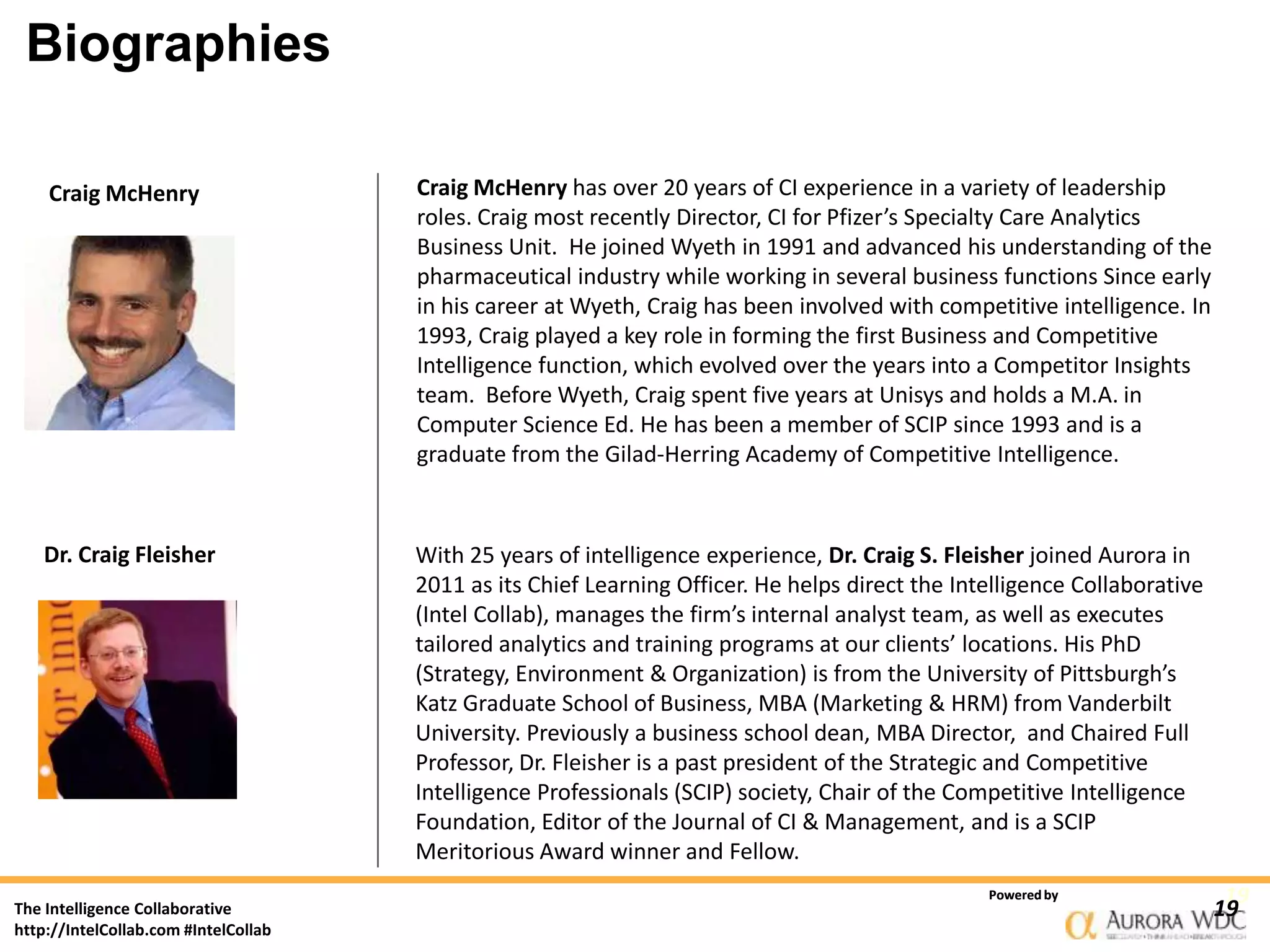
Biographies

    Craig McHenry                     Craig McHenry has over 20 years of CI experience in a variety of leadership
                                      roles. Craig most recently Director, CI for Pfizer’s Specialty Care Analytics
                                      Business Unit. He joined Wyeth in 1991 and advanced his understanding of the
                                      pharmaceutical industry while working in several business functions Since early
                                      in his career at Wyeth, Craig has been involved with competitive intelligence. In
                                      1993, Craig played a key role in forming the first Business and Competitive
                                      Intelligence function, which evolved over the years into a Competitor Insights
                                      team. Before Wyeth, Craig spent five years at Unisys and holds a M.A. in
                                      Computer Science Ed. He has been a member of SCIP since 1993 and is a
                                      graduate from the Gilad-Herring Academy of Competitive Intelligence.


    Dr. Craig Fleisher                With 25 years of intelligence experience, Dr. Craig S. Fleisher joined Aurora in
                                      2011 as its Chief Learning Officer. He helps direct the Intelligence Collaborative
                                      (Intel Collab), manages the firm’s internal analyst team, as well as executes
                                      tailored analytics and training programs at our clients’ locations. His PhD
                                      (Strategy, Environment & Organization) is from the University of Pittsburgh’s
                                      Katz Graduate School of Business, MBA (Marketing & HRM) from Vanderbilt
                                      University. Previously a business school dean, MBA Director, and Chaired Full
                                      Professor, Dr. Fleisher is a past president of the Strategic and Competitive
                                      Intelligence Professionals (SCIP) society, Chair of the Competitive Intelligence
                                      Foundation, Editor of the Journal of CI & Management, and is a SCIP
                                      Meritorious Award winner and Fellow.
                                                                                                 Powered by                 19
The Intelligence Collaborative                                                                                             19
http://IntelCollab.com #IntelCollab

How to Measure Strategic Market and Competitive Intelligence Performance

  • 1.
    How to MeasureStrategic Market and Competitive Intelligence Performance A Complimentary Webinar from Aurora WDC 12:00 Noon Eastern /// Wednesday 19 December 2012 ~ featuring ~ Craig McHenry Dr. Craig Fleisher Powered by The Intelligence Collaborative http://IntelCollab.com #IntelCollab
  • 2.
    Are you worththe price?  The lifespan of the average CI group is between three to four years! (SCIP Surveys)  Today’s hyper-competitive environments create economic pressure on firms.  Are you prepared to articulate, well and often, the value of CI to your stakeholders? Powered by The Intelligence Collaborative http://IntelCollab.com #IntelCollab
  • 3.
    What is init for me… besides my job?  When done effectively, demonstrating and measuring CI value: Affects the success of your company and organization Provides a means to improve and grow - Understand what is working, is not working, & why? - Expands CI influence to areas of the organization Moves you from overhead and cost center to profit center and enabling function - Captures CI performance in financial terms - Reminds stakeholders of what you do and why Powered by The Intelligence Collaborative http://IntelCollab.com #IntelCollab
  • 4.
    Acknowledge, But OvercomeThe Barriers And Excuses  No time to do it  Don’t know how  No complaints = satisfaction?  CI value is too deeply embedded in other activities Return on Investment = CI Benefits / CI Costs (calculating the numerator is the problem) Other groups support decisions-making too Powered by The Intelligence Collaborative http://IntelCollab.com #IntelCollab
  • 5.
    Measure Strategic Market& Competitive Intelligence Performance Embrace A variety of Ask for more Connect results with measurement and resources organizational valuation “intelligently” performance approaches • Behave like an • When you can, • Result oriented internal business calculate qualitative • Do it to yourself • Link to key descriptions before they do issues/products/ser • Statistics and • Create a culture of vices/ figures “CI” for CI • Swing for the fences • Making “value” the KIT Powered by The Intelligence Collaborative http://IntelCollab.com #IntelCollab
  • 6.
    Tell The Story– Clearly and Often  How CI caused your stakeholder to do something different or differently Without CI = X but with CI = Y  Consider: The STAR Technique Situation – Describe the business issue Task – What was CI’s role Action – What did you do and why Result – Describe the outcome of CI research and overall business impact Powered by The Intelligence Collaborative http://IntelCollab.com #IntelCollab
  • 7.
    Measure! - “Whatgets measured gets managed”  Statistics = good, but don’t tell the whole story Number of: projects, project hours, KITs, reports, etc. How many: unique interactions, business functions, Budgets: CI dept. budget, CI headcount, project $,  Metrics that hint at quality of work done Not just were we right, but what was confirmed / new information/ revised (before decision) What sources were used (internal vs external) (how many, of what caliber) How much “repeat” business do you get?  Decisions – Size/monetary impact, time under consideration, etc. Powered by The Intelligence Collaborative http://IntelCollab.com #IntelCollab
  • 8.
    An idea! -treat the value question like its own CI project  Elicit the information from the organization Formal discussion with key stakeholder(s) after delivering results – part of the project plan Probe on the perceived value of the work done - What is the expected value to the company of the decision made? - If money were not an issue, what would you be willing to pay for this information? - What would you had done if CI had not been an option? Consider using a 3rd party Powered by The Intelligence Collaborative http://IntelCollab.com #IntelCollab
  • 9.
    Points To KeepMind  Caution: stakeholder involvement bias  Keep legal informed of your work - they can be an important ally  Sometimes you can infer value When the CI budget comes from the product groups, they are expecting a benefit or return to their bottom line – e.g. voting for CI with their budget. Compare CI research to other market and customer analytics Powered by The Intelligence Collaborative http://IntelCollab.com #IntelCollab
  • 10.
    When The TimeComes To Ask For More Resources…  Behave like an you are running your own business  Face the inevitable - do it to yourself before they do  Create a culture of Continuous Improvement for CI – meaning you should be able to tell others where the improvement occurred, how much, and at what quality levels Powered by The Intelligence Collaborative http://IntelCollab.com #IntelCollab
  • 11.
    Behave Like AnYou Are Running Your Own Business  Benchmark but be skeptical Use comparisons only as a guide Give more weight to internal metrics  Learn to say no -- but remember to whom and why Some rejected projects are areas ripe for growth and expansion Better to say no than short change an important stakeholder with inferior work – use opportunity to asses need for more resources Powered by The Intelligence Collaborative http://IntelCollab.com #IntelCollab
  • 12.
    If necessary facethe inevitable and do it to yourself before they do  Get out in front of obvious business changes and step up to the challenge Track project deliverables and perceived value - Know where you would do more and where less work Proactively consider outsourcing specific CI activities to focus on high value tasks - Can be used to both grow and expand capacity in advance of adding headcount - Can also be use to reduce or redeploy assets in the face of cuts Powered by The Intelligence Collaborative http://IntelCollab.com #IntelCollab
  • 13.
    Create a cultureof Continuous Improvement for CI  Consider: After Action Assessments any time CI work is done for a team As part of project wrap up, capture project details and feedback from all involved - How complex was the question/business issue? - How well did we describe the risks associated with what “we knew we didn’t knew?” - Did we fully leverage our internal knowledge? - What are the lasting consequences of this project? - If we found a discontinuous change, is there any way to anticipate or compensate for that next time Provide feedback and learning to stakeholders Powered by The Intelligence Collaborative http://IntelCollab.com #IntelCollab
  • 14.
    Quantifiably Connect CIResults With Organizational Performance  If possible, calculate return on investment  Link CI effort to key specific issues /products /services  Swing for the fence – One homerun at the right time can make the whole season Powered by The Intelligence Collaborative http://IntelCollab.com #IntelCollab
  • 15.
    If The DataExists, Calculate Project Return On Investment (ROI)  ROI calculation: Best when a benefit can be clearly quantified Don’t be shocked by some very high ROI figures from time to time - Benefits realized over time can be adjust for NPV  Increase return by reusing where possible Build and track use of your “Inventory of Knowledge” Powered by The Intelligence Collaborative http://IntelCollab.com #IntelCollab
  • 16.
    Link CI ProjectsTo Key Issues/Products/Services  Track product performance relevant to CI projects done Look for changes related to CI supported decisions Areas without active CI work offer points of comparison – use caution here  Identify inflection points What if scenarios aren’t always reliable, but can point to likely benefits from CI projects Powered by The Intelligence Collaborative http://IntelCollab.com #IntelCollab
  • 17.
    Swing for thefences – one homerun can make the entire season  Although infrequent they are gold Look for those projects where you can obtain concrete data on the benefits Write up the work as a short case study for internal circulation and promotion - Example: A change in strategy based on actionable CI work which cost $100k and added $5mm sales to product’s bottom line - ROI – ($5mm/ $100k) * 100 = 5,000% !!! Success like this can influence stakeholders for years to come Powered by The Intelligence Collaborative http://IntelCollab.com #IntelCollab
  • 18.
    Questions and Comments  Craig McHenry www.linkedin.com/in/mchenrydc  Dr. Craig Fleisher www.linkedin.com/in/drcraigsfleisher Powered by The Intelligence Collaborative http://IntelCollab.com #IntelCollab
  • 19.
    Biographies Craig McHenry Craig McHenry has over 20 years of CI experience in a variety of leadership roles. Craig most recently Director, CI for Pfizer’s Specialty Care Analytics Business Unit. He joined Wyeth in 1991 and advanced his understanding of the pharmaceutical industry while working in several business functions Since early in his career at Wyeth, Craig has been involved with competitive intelligence. In 1993, Craig played a key role in forming the first Business and Competitive Intelligence function, which evolved over the years into a Competitor Insights team. Before Wyeth, Craig spent five years at Unisys and holds a M.A. in Computer Science Ed. He has been a member of SCIP since 1993 and is a graduate from the Gilad-Herring Academy of Competitive Intelligence. Dr. Craig Fleisher With 25 years of intelligence experience, Dr. Craig S. Fleisher joined Aurora in 2011 as its Chief Learning Officer. He helps direct the Intelligence Collaborative (Intel Collab), manages the firm’s internal analyst team, as well as executes tailored analytics and training programs at our clients’ locations. His PhD (Strategy, Environment & Organization) is from the University of Pittsburgh’s Katz Graduate School of Business, MBA (Marketing & HRM) from Vanderbilt University. Previously a business school dean, MBA Director, and Chaired Full Professor, Dr. Fleisher is a past president of the Strategic and Competitive Intelligence Professionals (SCIP) society, Chair of the Competitive Intelligence Foundation, Editor of the Journal of CI & Management, and is a SCIP Meritorious Award winner and Fellow. Powered by 19 The Intelligence Collaborative 19 http://IntelCollab.com #IntelCollab

Editor's Notes

  • #9 Numbers or estimate are best
  • #14 Be seen as constantly and actively looking for ways to improve and add value