TRAINING  AND DEVELOPMENT
HOW ARE TRAINING NEEDS SPOTTED? Identification tools?
Why Training?   Sales were flat in spite of variety of  advertisements. Customers attracted by the ads were not coming  back. Problem Identified  – Poor customer service
Solution To train employees. Newly hired employees spent a week in the practice facility. This was followed by another week of on-the-job training.  Training helped to provide quick customer service.
Why Training? Employees are selected on the basis of their predicted likelihood of succeeding on the job. Most of them get time to grow in their new jobs. This growth process is helped by the training programs designed for the purpose.
What is Training? Consists of an organizations planned efforts to help employees acquire job-related knowledge, skills, abilities and behaviors with the goal of applying these on the job. The systematic acquisition of attitudes, concepts, knowledge, roles or skills that result in improved performance at work.
Training, Education & Development Refer to the imparting of specific KSA to an employee. These terms are somewhat different. Training  refers to the process of imparting specific skills. Education  is confined to theoretical learning in classrooms. These two terms are complementary. No training is complete without an element of education. Both are part of organizational training program.
Development  refers to those learning opportunities designed to help the organization grow. Provides general knowledge and attitudes which will help employees in higher positions. Training- Operatives Development – Higher positions Education - General
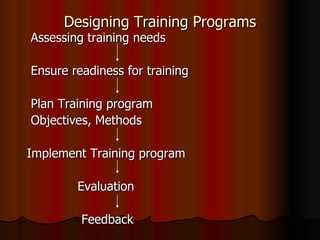
Designing Training Programs Assessing training needs Ensure readiness for training Plan Training program Objectives, Methods Implement Training program Evaluation Feedback
Assessing Training Needs Organizational Analysis Looks at training needs in the light of organizational strategy, resources available for training and management support for training activities. 2.  Training is more effective if there is a supportive climate. 3.  It looks at the system wide factors that facilitate or retard transfer of skills.
Person Analysis Process used to determine an individual’s need and readiness to training. Seeks to answer 2 questions. Who within the organization needs training? 2. What kind of training is needed? Mostly based on performance appraisal. Self evaluations are also useful. May be directed to future needs. SME’s usually articulate the KSA’s needed for future requirements.
Plan Training Program Who are the trainees? Selected on the basis of self nomination, recommendations of supervisors/HR department. Who are the trainers? Immediate supervisors, peers, HR staff, other specialists, consultants, industry associations and faculty members at universities. Selection will be based on where the program is held and the skill that is being taught.
Methods Of Training On-Site Training Methods On-the-job training Oldest and most common method. Employees are trained on-the-job. No special equipment or space is needed. Instructors are more established workers. Learning is by observation and imitation of behaviour. Ensures transfer of training. Limitations  Briefly and poorly structured. Viewed as nuisance by trainers.
2. Job Rotation Workers rotate through a variety of jobs. Used with both blue-collars production workers and white collar managers. Benefits  Acquaints workers with many jobs in a company Gives an opportunity to learn by doing. Creates flexibility and marketability. Provides work on systematic basis. More common for employees early in their career. Limitations Due to individual differences, people are not equally suited for all jobs. Challenges the concept of job-person fit. Willingness to learn is important.
3. Apprentice Training One of the oldest types of training programs. Particularly common in skilled trades. New worker is “tutored” by and experienced worker for a long period. (5 years) Apprentice serves as an assistant. Often used in plumbing, carpentry and electrical trades. Training is intense, lengthy & on a one-to-one basis. Weakness Amount of time an apprenticeship lasts is pre-determined by members of trade. Individual differences are not allowed.
Off-Site Training Methods Lectures Popular form of instruction. Benefits a) Large number of people can be taught at the same time. b) Cost effective Limitations Utility for imparting specialized knowledge is limited. One-way communication Effective with a homogenous audience. Not the best method for skill acquisition.
2 . Audiovisual Material Covers a variety of training techniques such as films, slides and videotapes. Good at capturing interest. After the initial cost of creating such a program, the cost of repeated use is minimal. Useful for training people in a work process or sequence. Limitations: Difficult to modify audiovisual material. Production costs of training films is substantial
3 . Conferences Stresses two-way communication. Effective when the ratio of trainees to trainers is not very large. Useful when the material needs clarification/elaboration or when discussion will facilitate understanding. Sometimes lecture method is followed by conference. Success of this method depends on the skills and personality of the leader/trainer. Relies on the learning principles of motivation and feedback. Participants join in the discussion and then receive feedback on their ideas. Used to enhance knowledge or attitudinal development. Participants willingness to acquire new knowledge or explore attitudinal change influences the success of this method.
4.  Programmed Instruction (PI) Involves an actual piece of equipment or a specially constructed paper booklet. 3 main characteristics Participants are active and determine their own learning pace. Subject to be learned has many discrete pieces of material and participants get immediate feedback. Material is divided into an organized sequence. Time consuming to develop. Common features: Frame - Single piece of information presented Program – All frames taken together
c) Participant answers the first frame. If the answer is correct, then he/she proceeds to the next frame. d) Frames are arranged in the exact sequence that occurs in the work process. e) Emphasis is on correct answers rather than work speed. f) Initially a criterion of mastery has been set, if this level is reached then the training program ends. If this criterion is not met then the program is repeated. Advantages: Immediate feedback No gaps in presentation Participants are active learners. Efficient way to train people on material that is structured and rote..
Disadvantages Time – consuming – Material is broken down into logical steps. Each frame has to be checked to make sure it is accurate. Some work procedures are hard to break into exact sequence. It cannot be used for all training needs.
Computer-Assisted Instruction (CAI) Most recently developed training. Used to teach a wide range of skills. Some CAI programs are similar to human interaction. This enhances motivation. Advantages: Individualized instruction Reduced training time Elimination of travel for training. Self paced learning Disadvantage: Training program development is far behind computer development.
Simulation Designed to replicate the essential characteristics of the real world necessary to produce learning and transfer. Purpose is to produce  psychological fidelity –  to reproduce those KSA’s necessary to perform the job. Environment is recreated under the control of trainer. Permits the trainer to expand, compress or repeat time, depending on the needs of trainees. Final job behaviour to be learned is too complex to be handled safely in real-life situation.
Many simulations use games. Business games  trains employees in certain skills. Games may stimulate interpersonal relations, problems, financial, budgeting issues and resource allocation decisions. An objective is stated and participants are evaluated in terms of whether they can achieve the objective. Business games are used for training managers and executives particularly financial matters. Problem with games is that the participants may not take it seriously. Advantage is a high degree of transfer of training.
Role playing Aimed at enhancing skills and human relations skills or sales techniques. Involves many people. The enactment is followed by a discussion where participants suggest how the problem could be handled more effectively. Many variations are possible. An enactment may be repeated several times or roles may be switched. Advantage: Participants are highly active, understand from others point of view
Evaluation Main objective is to determine whether the program has achieved the training objectives. To determine their cost effectiveness. To explain failure of program, if it occurs. Success enhances the credibility of training and development. Four criteria  are used to evaluate Reaction criteria  - immediate reactions Learning criteria  – How much has been learned Behavioral criteria  – actual changes in performance when back on job. Results criteria  – economic value of the training program to the company.

T&D

  • 1.
    TRAINING ANDDEVELOPMENT
  • 2.
    HOW ARE TRAININGNEEDS SPOTTED? Identification tools?
  • 3.
    Why Training? Sales were flat in spite of variety of advertisements. Customers attracted by the ads were not coming back. Problem Identified – Poor customer service
  • 4.
    Solution To trainemployees. Newly hired employees spent a week in the practice facility. This was followed by another week of on-the-job training. Training helped to provide quick customer service.
  • 5.
    Why Training? Employeesare selected on the basis of their predicted likelihood of succeeding on the job. Most of them get time to grow in their new jobs. This growth process is helped by the training programs designed for the purpose.
  • 6.
    What is Training?Consists of an organizations planned efforts to help employees acquire job-related knowledge, skills, abilities and behaviors with the goal of applying these on the job. The systematic acquisition of attitudes, concepts, knowledge, roles or skills that result in improved performance at work.
  • 7.
    Training, Education &Development Refer to the imparting of specific KSA to an employee. These terms are somewhat different. Training refers to the process of imparting specific skills. Education is confined to theoretical learning in classrooms. These two terms are complementary. No training is complete without an element of education. Both are part of organizational training program.
  • 8.
    Development refersto those learning opportunities designed to help the organization grow. Provides general knowledge and attitudes which will help employees in higher positions. Training- Operatives Development – Higher positions Education - General
  • 9.
    Designing Training ProgramsAssessing training needs Ensure readiness for training Plan Training program Objectives, Methods Implement Training program Evaluation Feedback
  • 10.
    Assessing Training NeedsOrganizational Analysis Looks at training needs in the light of organizational strategy, resources available for training and management support for training activities. 2. Training is more effective if there is a supportive climate. 3. It looks at the system wide factors that facilitate or retard transfer of skills.
  • 11.
    Person Analysis Processused to determine an individual’s need and readiness to training. Seeks to answer 2 questions. Who within the organization needs training? 2. What kind of training is needed? Mostly based on performance appraisal. Self evaluations are also useful. May be directed to future needs. SME’s usually articulate the KSA’s needed for future requirements.
  • 12.
    Plan Training ProgramWho are the trainees? Selected on the basis of self nomination, recommendations of supervisors/HR department. Who are the trainers? Immediate supervisors, peers, HR staff, other specialists, consultants, industry associations and faculty members at universities. Selection will be based on where the program is held and the skill that is being taught.
  • 13.
    Methods Of TrainingOn-Site Training Methods On-the-job training Oldest and most common method. Employees are trained on-the-job. No special equipment or space is needed. Instructors are more established workers. Learning is by observation and imitation of behaviour. Ensures transfer of training. Limitations Briefly and poorly structured. Viewed as nuisance by trainers.
  • 14.
    2. Job RotationWorkers rotate through a variety of jobs. Used with both blue-collars production workers and white collar managers. Benefits Acquaints workers with many jobs in a company Gives an opportunity to learn by doing. Creates flexibility and marketability. Provides work on systematic basis. More common for employees early in their career. Limitations Due to individual differences, people are not equally suited for all jobs. Challenges the concept of job-person fit. Willingness to learn is important.
  • 15.
    3. Apprentice TrainingOne of the oldest types of training programs. Particularly common in skilled trades. New worker is “tutored” by and experienced worker for a long period. (5 years) Apprentice serves as an assistant. Often used in plumbing, carpentry and electrical trades. Training is intense, lengthy & on a one-to-one basis. Weakness Amount of time an apprenticeship lasts is pre-determined by members of trade. Individual differences are not allowed.
  • 16.
    Off-Site Training MethodsLectures Popular form of instruction. Benefits a) Large number of people can be taught at the same time. b) Cost effective Limitations Utility for imparting specialized knowledge is limited. One-way communication Effective with a homogenous audience. Not the best method for skill acquisition.
  • 17.
    2 . AudiovisualMaterial Covers a variety of training techniques such as films, slides and videotapes. Good at capturing interest. After the initial cost of creating such a program, the cost of repeated use is minimal. Useful for training people in a work process or sequence. Limitations: Difficult to modify audiovisual material. Production costs of training films is substantial
  • 18.
    3 . ConferencesStresses two-way communication. Effective when the ratio of trainees to trainers is not very large. Useful when the material needs clarification/elaboration or when discussion will facilitate understanding. Sometimes lecture method is followed by conference. Success of this method depends on the skills and personality of the leader/trainer. Relies on the learning principles of motivation and feedback. Participants join in the discussion and then receive feedback on their ideas. Used to enhance knowledge or attitudinal development. Participants willingness to acquire new knowledge or explore attitudinal change influences the success of this method.
  • 19.
    4. ProgrammedInstruction (PI) Involves an actual piece of equipment or a specially constructed paper booklet. 3 main characteristics Participants are active and determine their own learning pace. Subject to be learned has many discrete pieces of material and participants get immediate feedback. Material is divided into an organized sequence. Time consuming to develop. Common features: Frame - Single piece of information presented Program – All frames taken together
  • 20.
    c) Participant answersthe first frame. If the answer is correct, then he/she proceeds to the next frame. d) Frames are arranged in the exact sequence that occurs in the work process. e) Emphasis is on correct answers rather than work speed. f) Initially a criterion of mastery has been set, if this level is reached then the training program ends. If this criterion is not met then the program is repeated. Advantages: Immediate feedback No gaps in presentation Participants are active learners. Efficient way to train people on material that is structured and rote..
  • 21.
    Disadvantages Time –consuming – Material is broken down into logical steps. Each frame has to be checked to make sure it is accurate. Some work procedures are hard to break into exact sequence. It cannot be used for all training needs.
  • 22.
    Computer-Assisted Instruction (CAI)Most recently developed training. Used to teach a wide range of skills. Some CAI programs are similar to human interaction. This enhances motivation. Advantages: Individualized instruction Reduced training time Elimination of travel for training. Self paced learning Disadvantage: Training program development is far behind computer development.
  • 23.
    Simulation Designed toreplicate the essential characteristics of the real world necessary to produce learning and transfer. Purpose is to produce psychological fidelity – to reproduce those KSA’s necessary to perform the job. Environment is recreated under the control of trainer. Permits the trainer to expand, compress or repeat time, depending on the needs of trainees. Final job behaviour to be learned is too complex to be handled safely in real-life situation.
  • 24.
    Many simulations usegames. Business games trains employees in certain skills. Games may stimulate interpersonal relations, problems, financial, budgeting issues and resource allocation decisions. An objective is stated and participants are evaluated in terms of whether they can achieve the objective. Business games are used for training managers and executives particularly financial matters. Problem with games is that the participants may not take it seriously. Advantage is a high degree of transfer of training.
  • 25.
    Role playing Aimedat enhancing skills and human relations skills or sales techniques. Involves many people. The enactment is followed by a discussion where participants suggest how the problem could be handled more effectively. Many variations are possible. An enactment may be repeated several times or roles may be switched. Advantage: Participants are highly active, understand from others point of view
  • 26.
    Evaluation Main objectiveis to determine whether the program has achieved the training objectives. To determine their cost effectiveness. To explain failure of program, if it occurs. Success enhances the credibility of training and development. Four criteria are used to evaluate Reaction criteria - immediate reactions Learning criteria – How much has been learned Behavioral criteria – actual changes in performance when back on job. Results criteria – economic value of the training program to the company.

Editor's Notes

  • #11 Eg: downsizing requires training for both the people who will be laid off as well as people who will be retained.
  • #13 Interpersonal skills may be taught at universities. Large organizations may have their own training departments.
  • #23 Eg:how to speak a foreign language to how to fly helicopters.
  • #26 Eg; scenario where one participant takes the role of an irrate customer and the other is the clerk who attends the customer.