Training, Coaching & Mentoring Subject : Organization Development MMS II, Sem III Date : 26/09/09 Submitted to : Mr. Kuldeep Singh
Group Members : Gauri Mahalle  C-20 Rupali Mehta C-22 Jayashree Prabhu C-43 Devika Shinde P-34
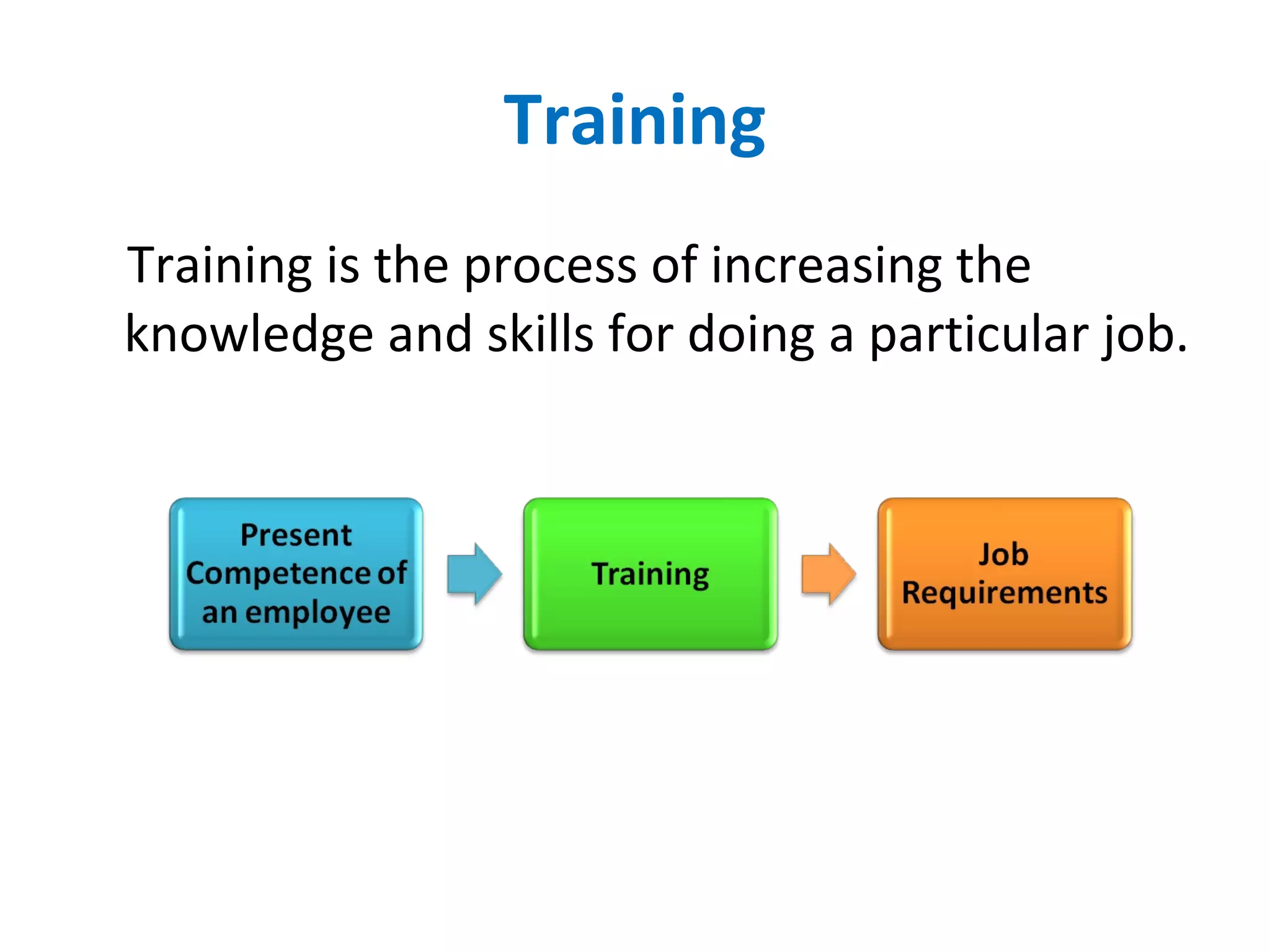
Training Training is the process of increasing the knowledge and skills for doing a particular job.
“  Personally, I am always ready to learn, although I do not always like being taught.” -Winston Churchill
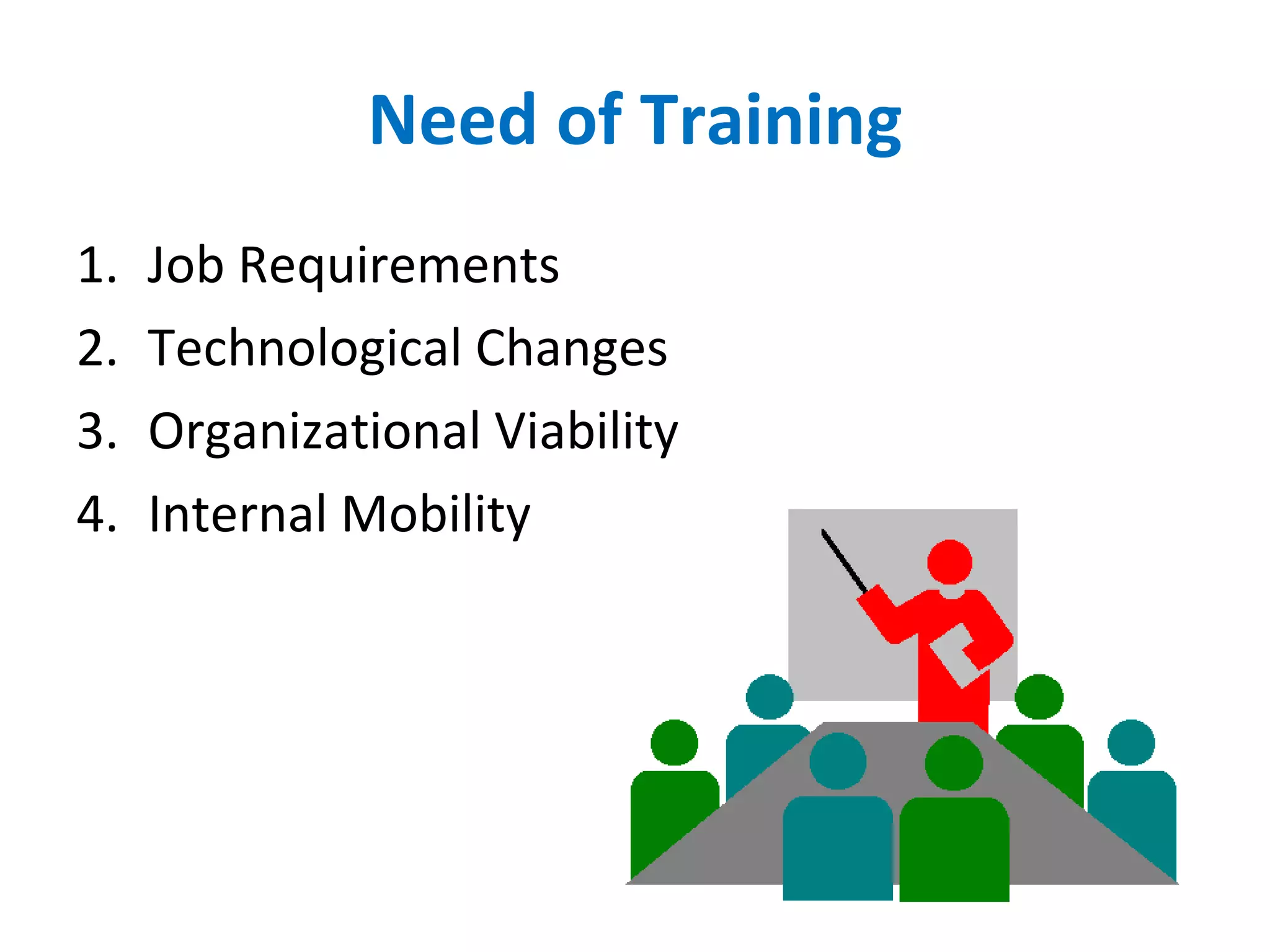
Need of Training Job Requirements Technological Changes Organizational Viability Internal Mobility
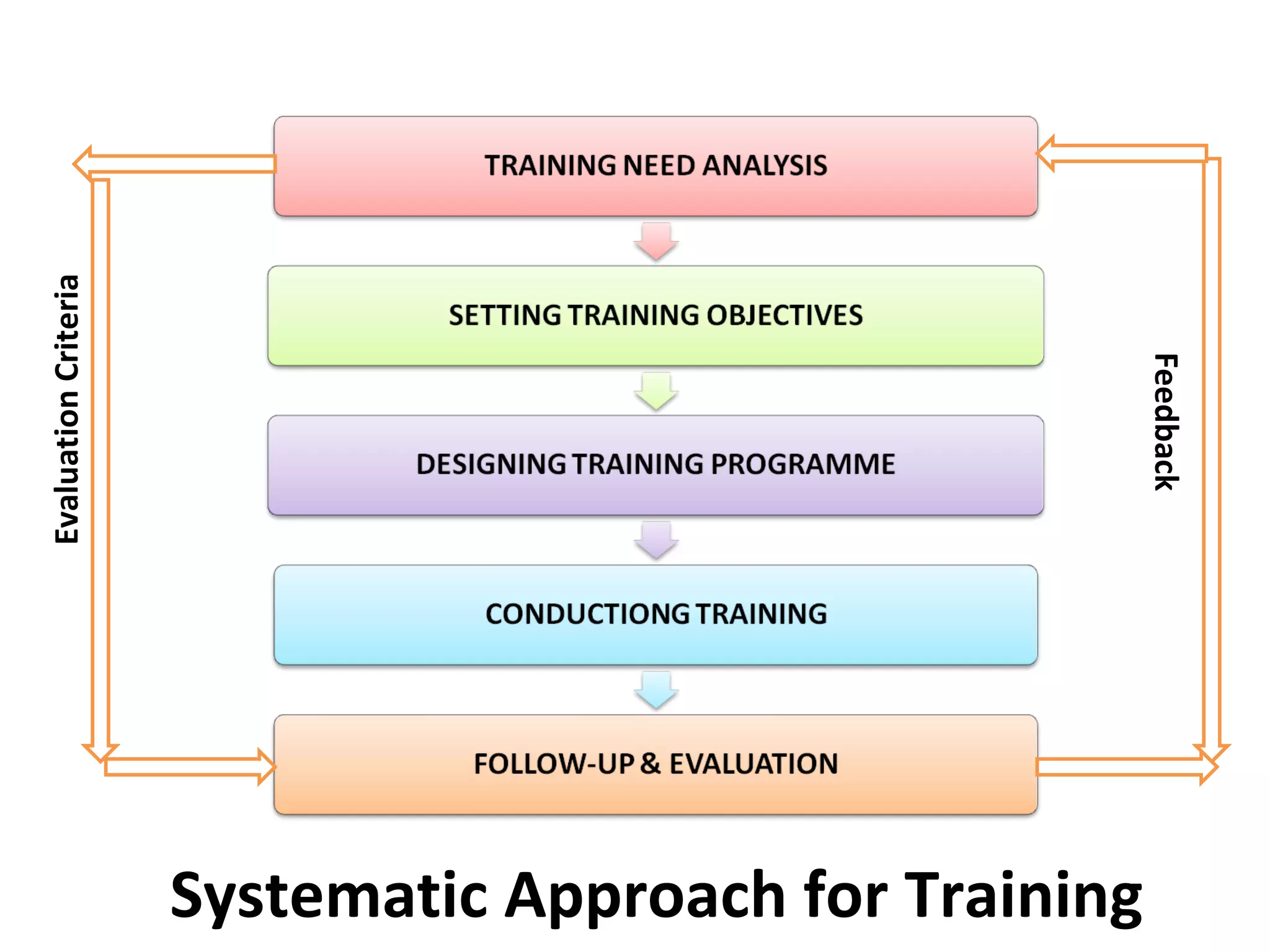
Evaluation Criteria Feedback Systematic Approach for Training
Training   Need   Analysis
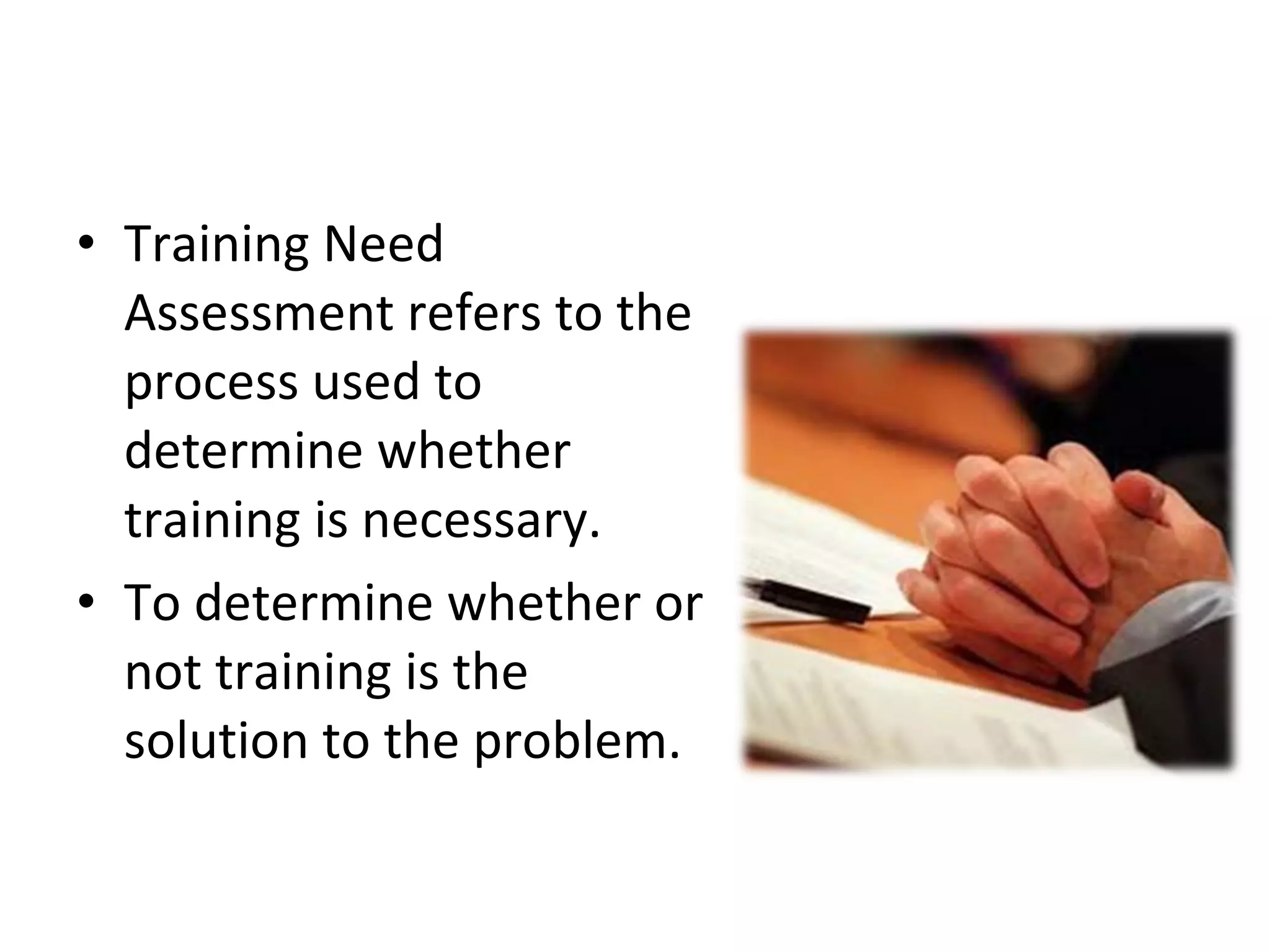
Training Need Assessment refers to the process used to determine whether training is necessary. To determine whether or not training is the solution to the problem.
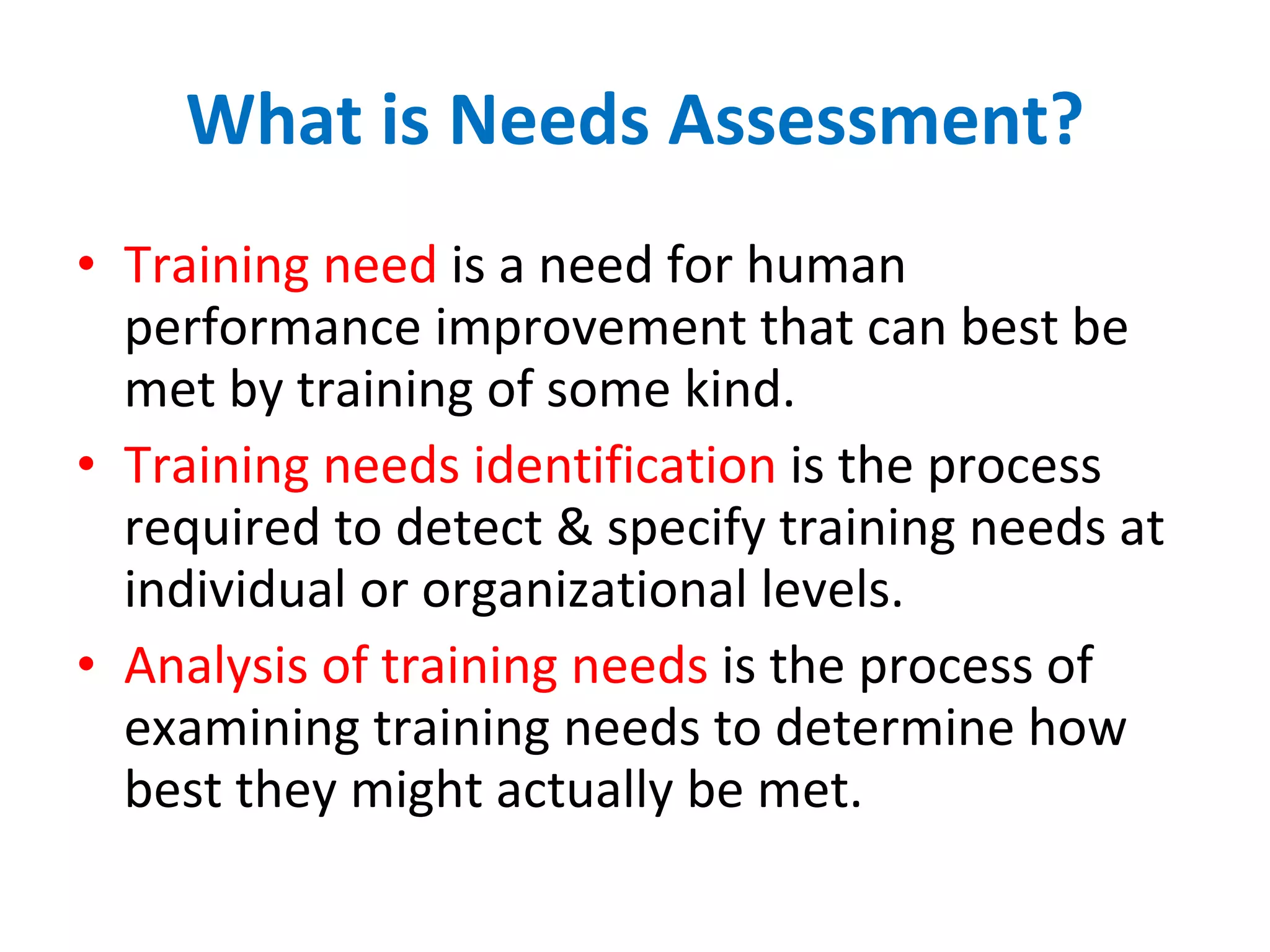
What is Needs Assessment? Training need  is a need for human performance improvement that can best be met by training of some kind. Training needs identification  is the process required to detect & specify training needs at individual or organizational levels. Analysis of training needs  is the process of examining training needs to determine how best they might actually be met.
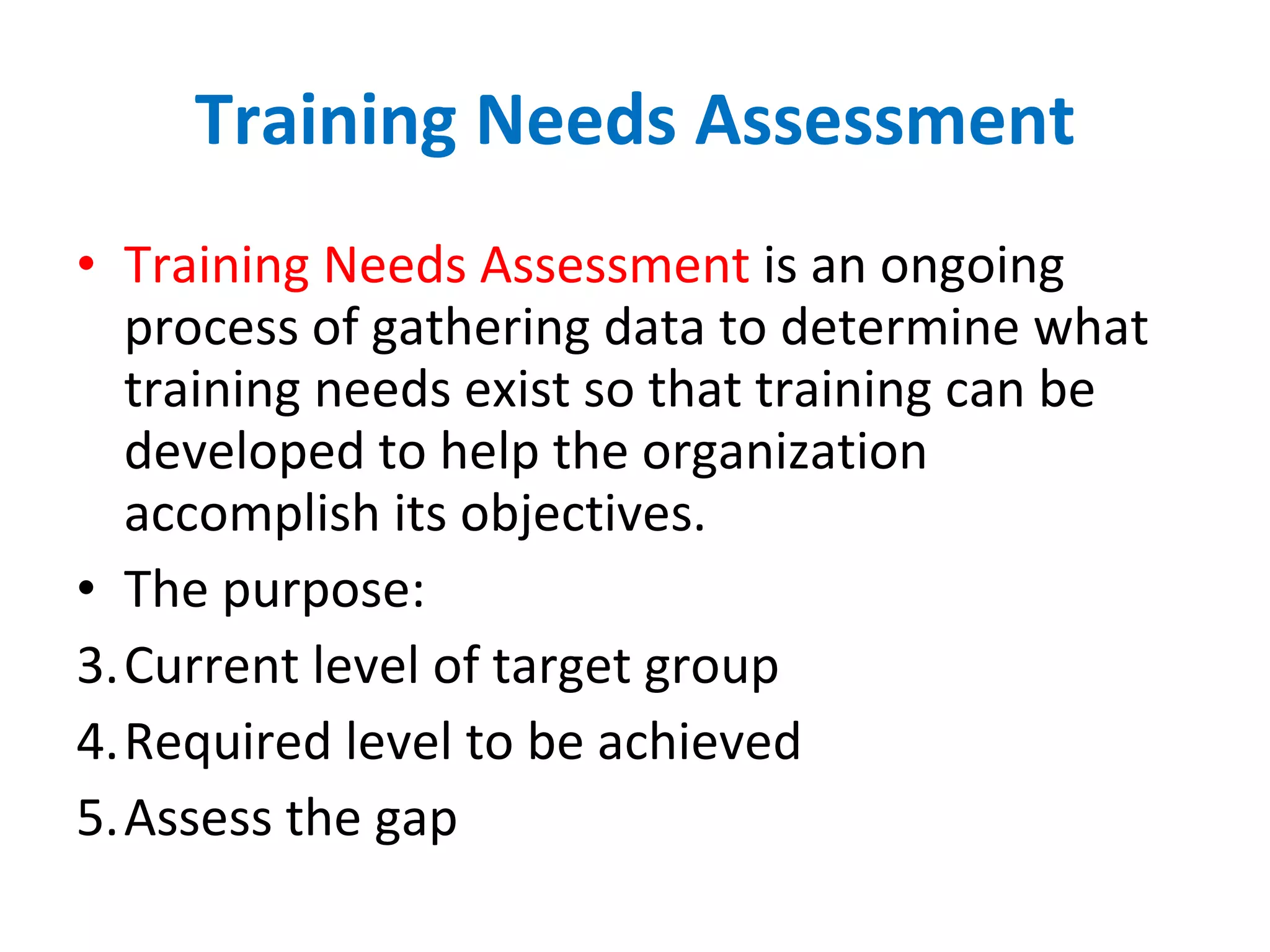
Training   Needs   Assessment Training Needs Assessment  is an ongoing process of gathering data to determine what training needs exist so that training can be developed to help the organization accomplish its objectives. The purpose: Current level of target group Required level to be achieved Assess the gap
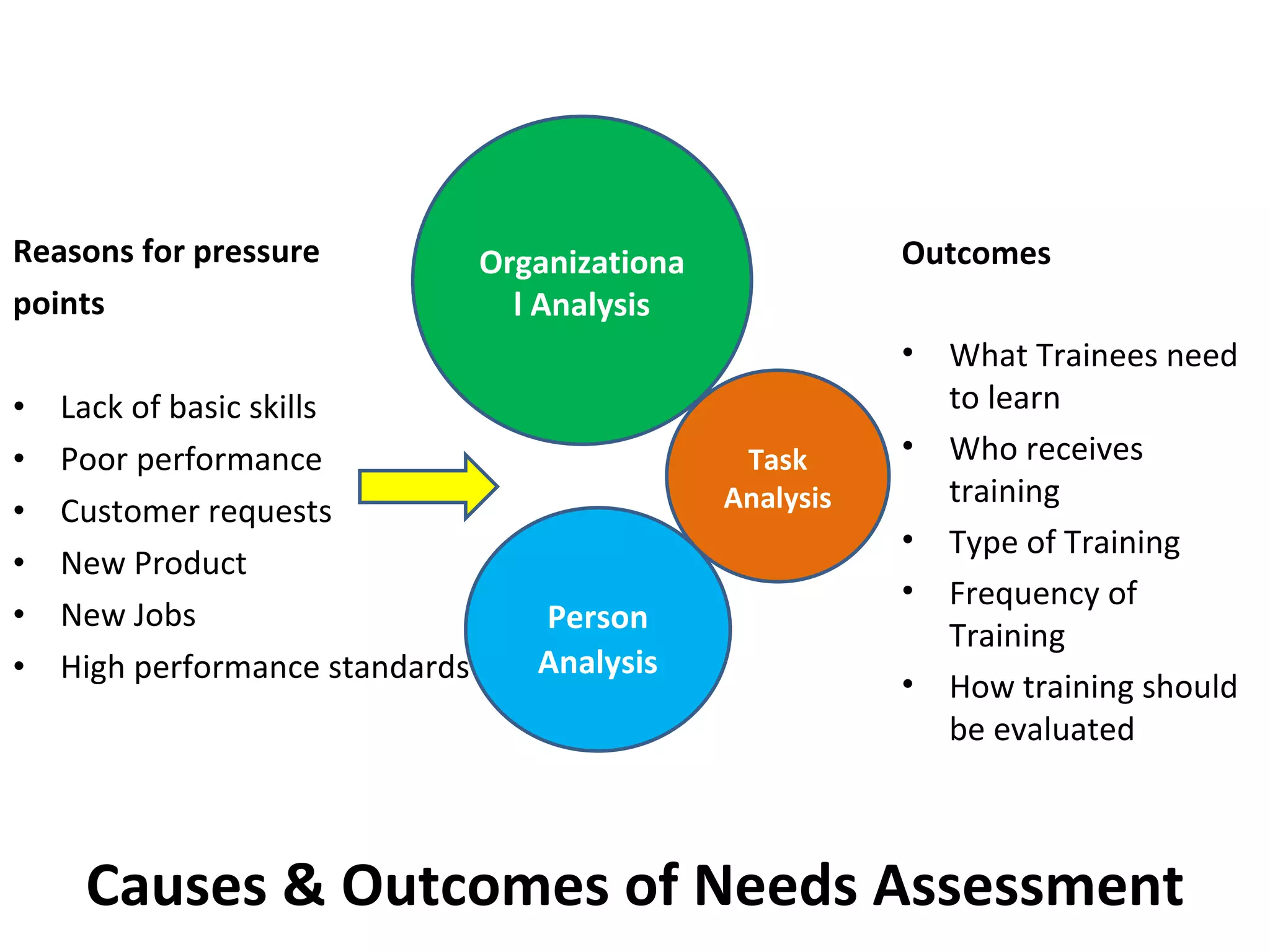
Causes & Outcomes of Needs Assessment Reasons for pressure  points Lack of basic skills Poor performance Customer requests New Product New Jobs High performance standards Task Analysis Person   Analysis Organizational Analysis Outcomes What Trainees need to learn Who receives training Type of Training Frequency of Training How training should be evaluated
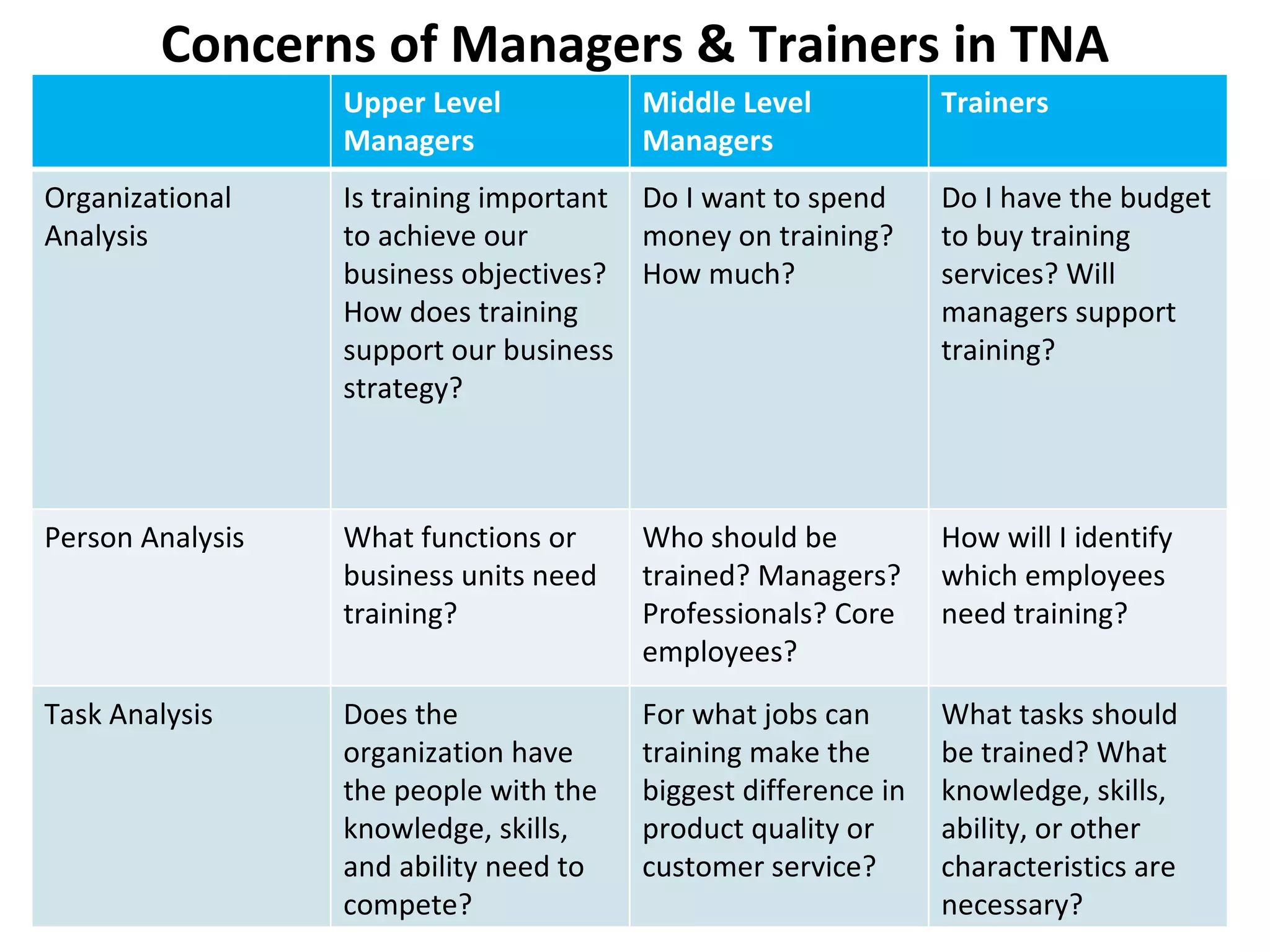
Concerns of Managers & Trainers in TNA Upper Level Managers Middle Level Managers Trainers Organizational Analysis Is training important to achieve our business objectives? How does training support our business strategy? Do I want to spend money on training? How much? Do I have the budget to buy training services? Will managers support training? Person Analysis What functions or business units need training? Who should be trained? Managers? Professionals? Core employees? How will I identify which employees need training? Task Analysis Does the organization have the people with the knowledge, skills, and ability need to compete? For what jobs can training make the biggest difference in product quality or customer service? What tasks should be trained? What knowledge, skills, ability, or other characteristics are necessary?
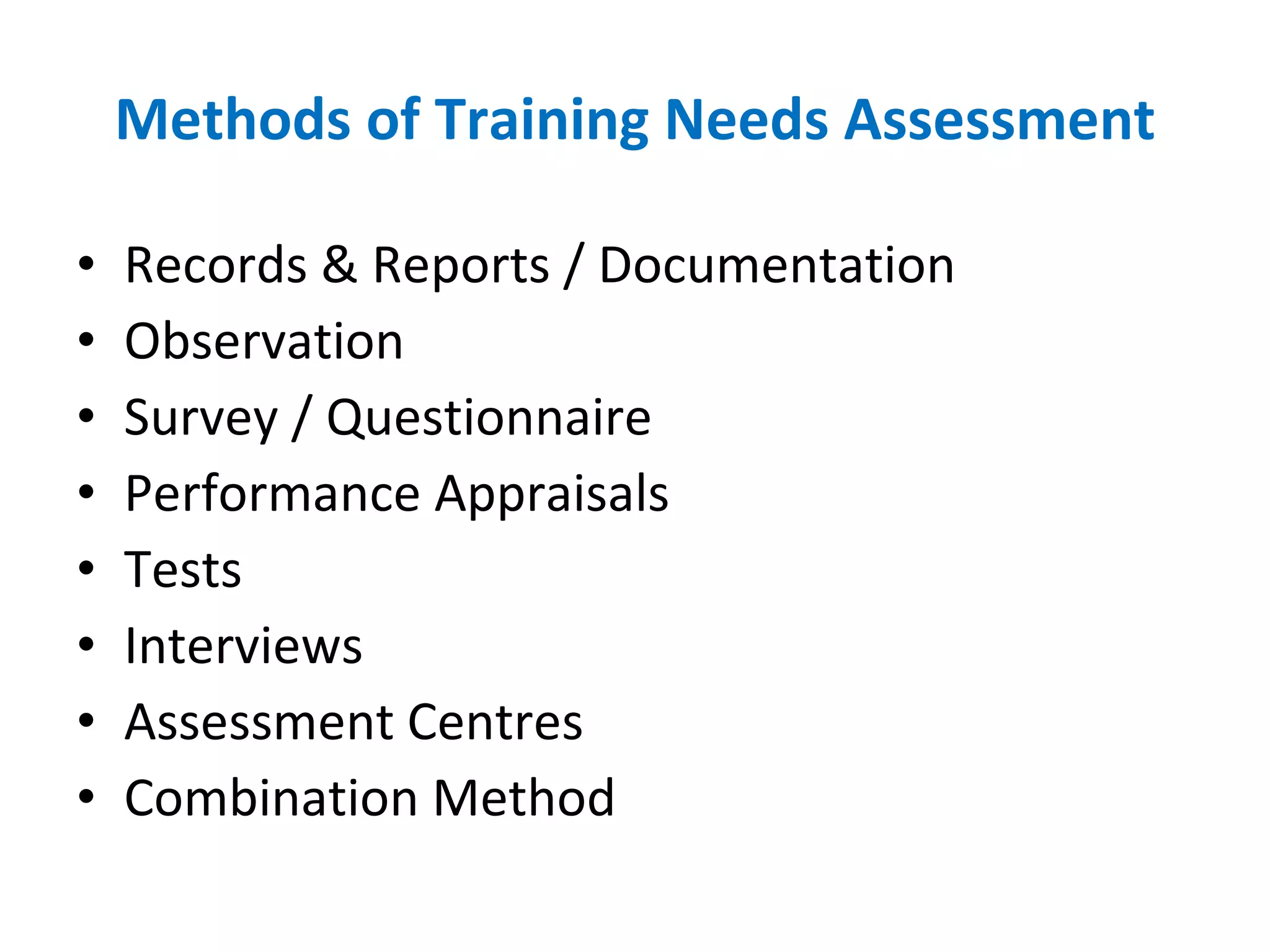
Methods of Training Needs Assessment Records & Reports / Documentation Observation Survey / Questionnaire Performance Appraisals Tests Interviews Assessment Centres Combination Method
Training Design
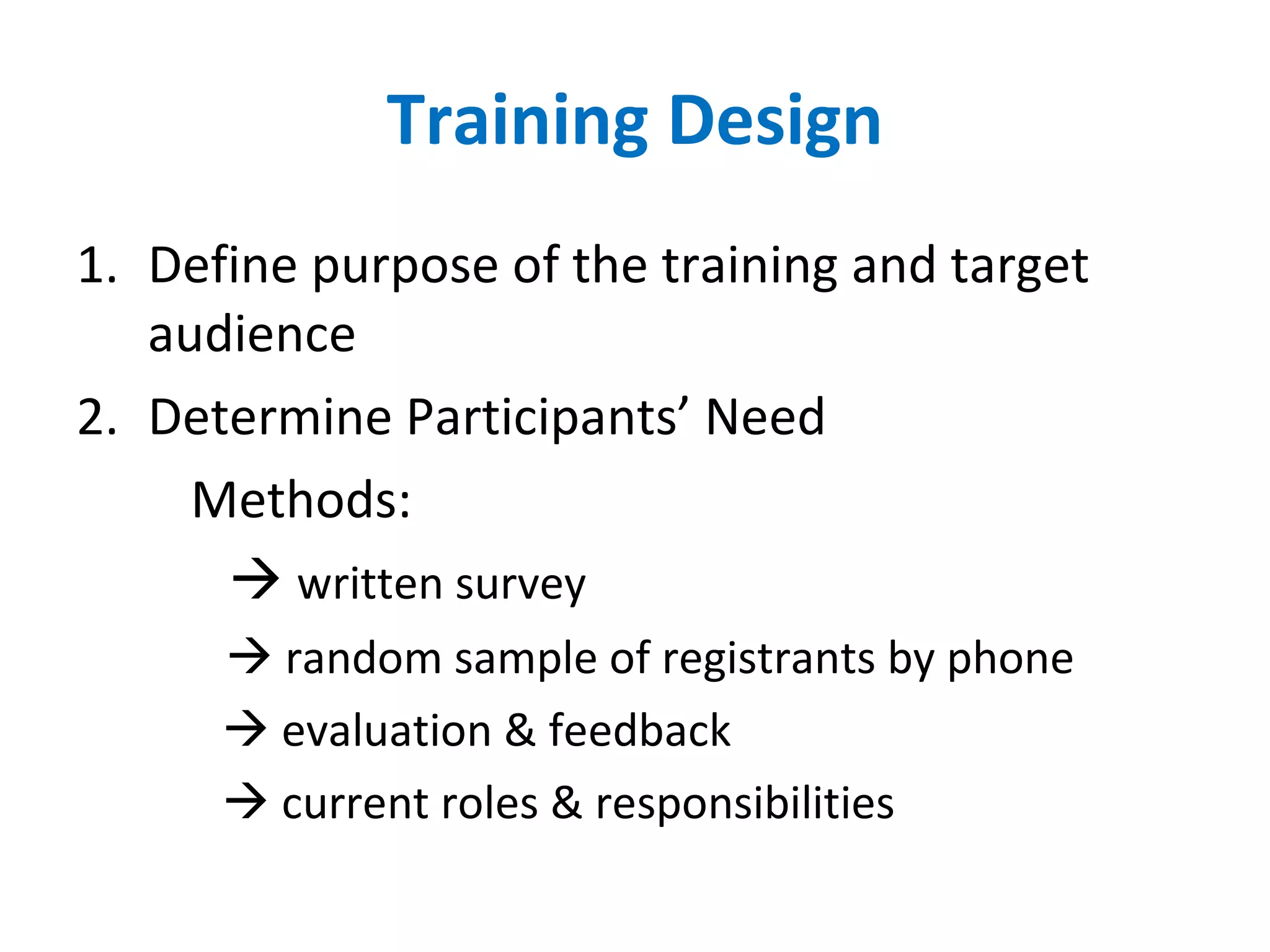
Training Design Define purpose of the training and target audience Determine Participants’ Need Methods:    written survey      random sample of registrants by phone    evaluation & feedback    current roles & responsibilities
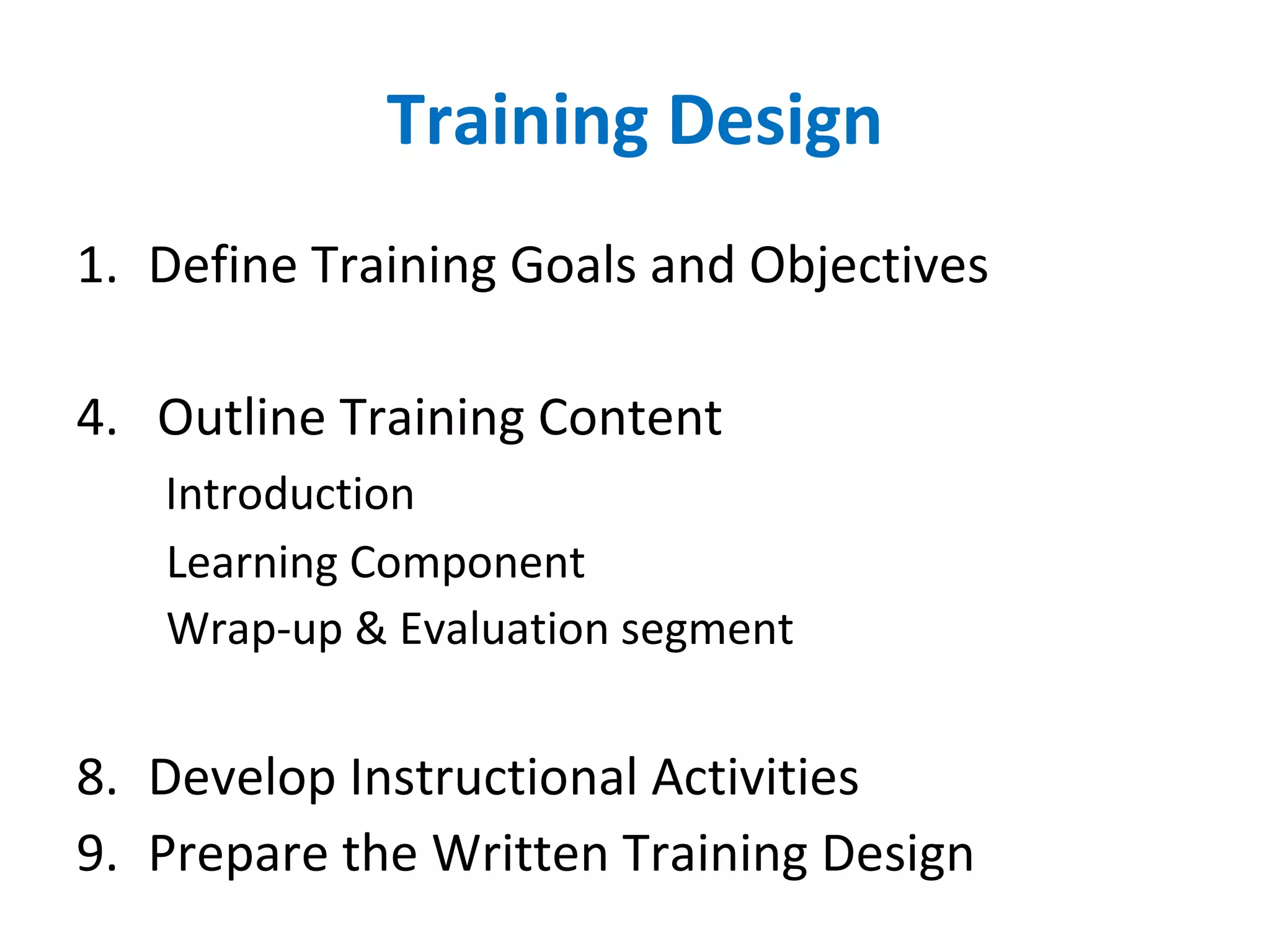
Training Design Define Training Goals and Objectives 4.  Outline Training Content Introduction Learning Component Wrap-up & Evaluation segment Develop Instructional Activities Prepare the Written Training Design
Training Design 7.  Prepare Participant Evaluation Forms Issues:    Did participants acquire knowledge & skills that the training was supposed to provide?    Were the trainers knowledgeable about the training content?    Were the activities interesting & effective enough?    Was the training format appropriate? 8.  Determine Follow-up activities for the event
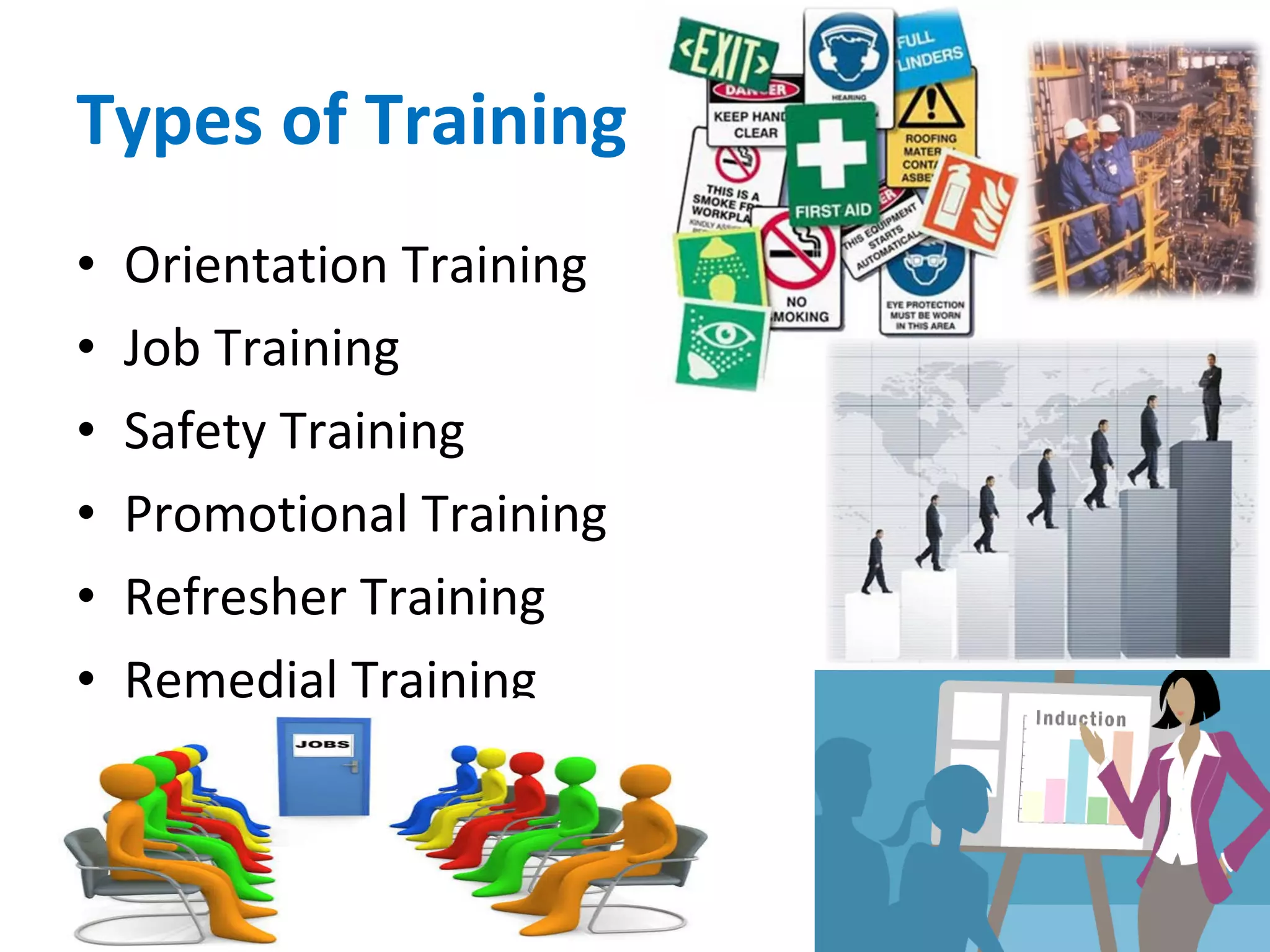
Types of Training Orientation Training Job Training Safety Training Promotional Training Refresher Training Remedial Training
TRAINING TECHNIQUES ON THE JOB TECHNIQUES OFF  THE  JOB
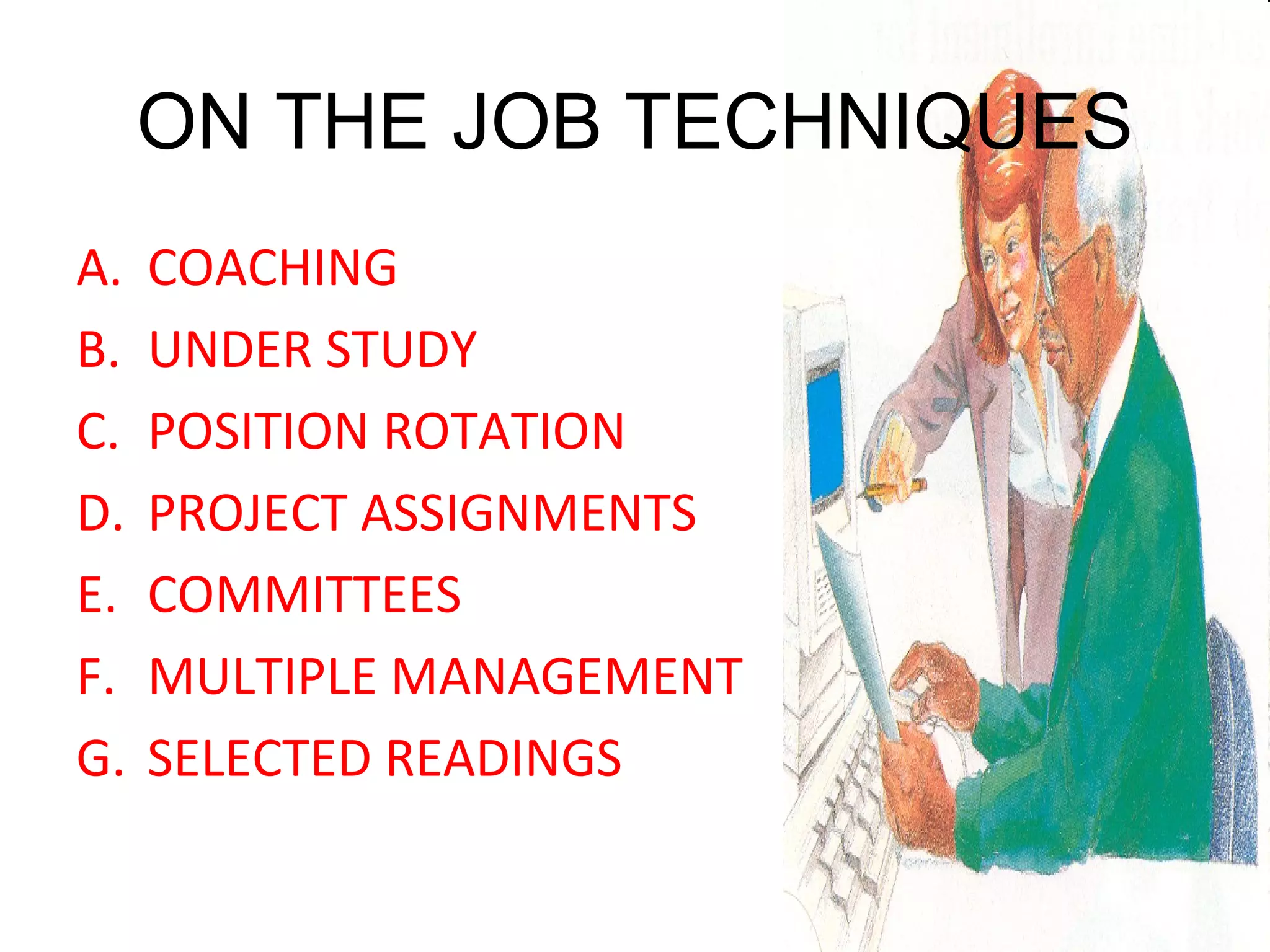
ON THE JOB TECHNIQUES COACHING UNDER STUDY POSITION ROTATION PROJECT ASSIGNMENTS COMMITTEES MULTIPLE MANAGEMENT SELECTED READINGS
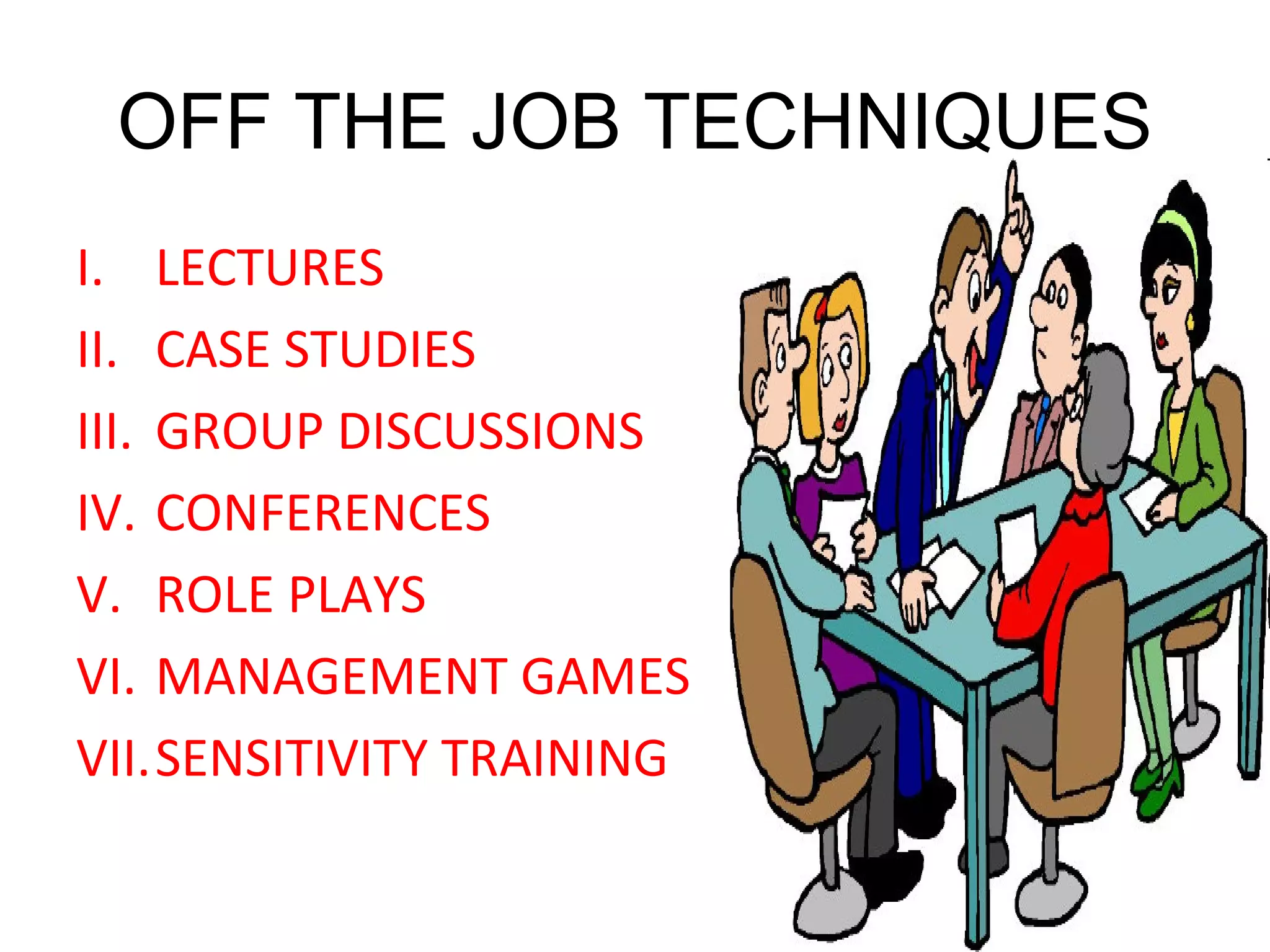
OFF THE JOB TECHNIQUES LECTURES CASE STUDIES GROUP DISCUSSIONS CONFERENCES ROLE PLAYS MANAGEMENT GAMES SENSITIVITY TRAINING
Training Evaluation
TRAINING EVALUATION Should not be a one time activity Systematic process to analyse feedback Helps and strengthen future postion and consolidate present learning
Aspects Relevance of training objectives The accomplishment of objective The appropriateness of training methodology The impact of learning
When to evaluate During training After completion At specified intervals
Who will evaluate Participants Staff Outside evaluators
After evaluation what? Results not adequately utilized Should not be a ritual
CASE STUDY
TRAINING INITIATIVES  AT GODREJ
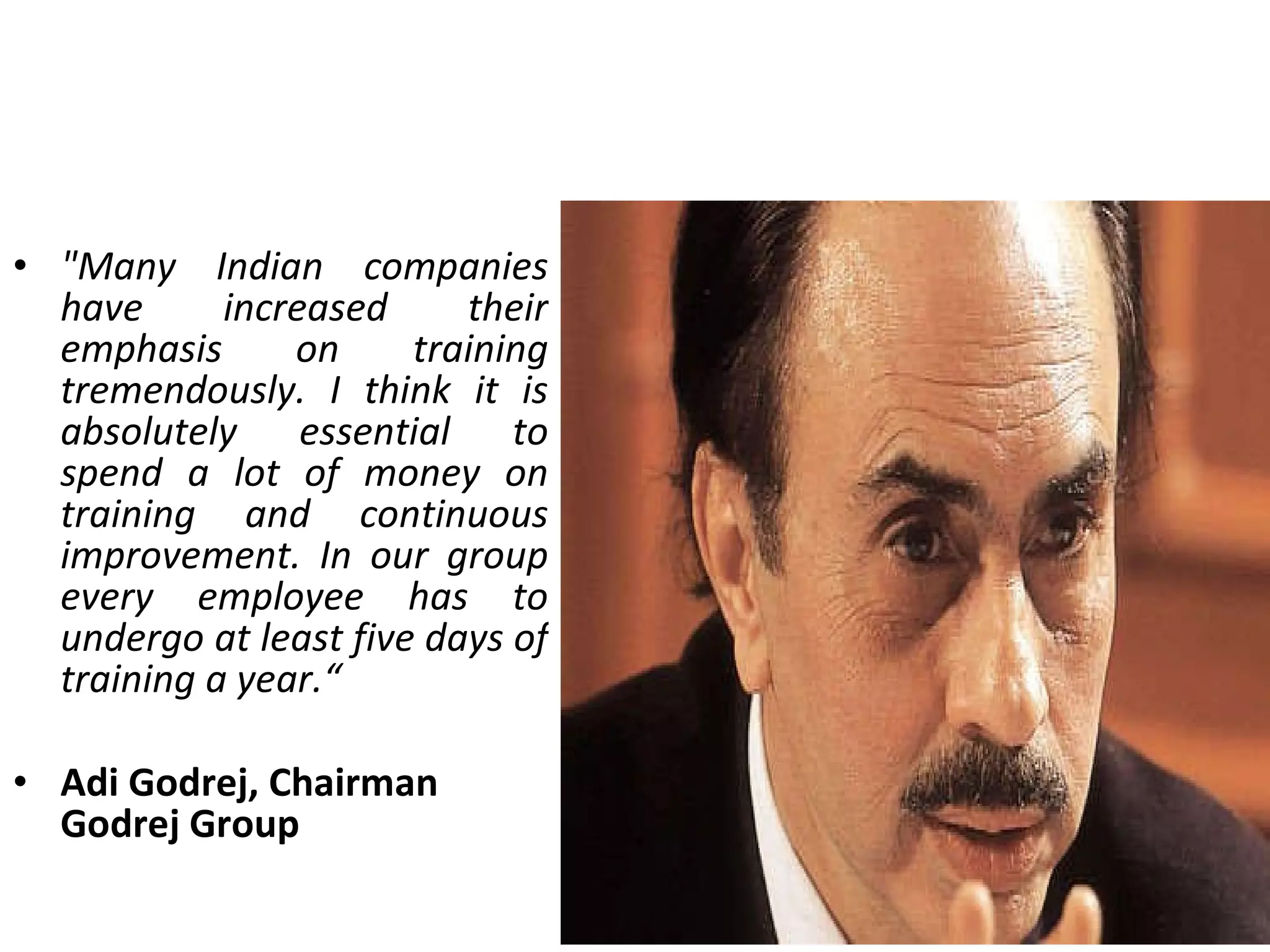
"Many Indian companies have increased their emphasis on training tremendously. I think it is absolutely essential to spend a lot of money on training and continuous improvement. In our group every employee has to undergo at least five days of training a year.“ Adi Godrej, Chairman Godrej Group
NEED FOR CHANGE Entire distribution of Godrej transferred to P&G 1995-Break-up of the joint venture between Godrej & P&G Post breakup Godrej devoid of distribution system Rebuilding exercise 1995-TQM
CHANGE Switch from a family-run business to a professionally managed company  Changed the earlier model of management hierarchy  Adopted a participative management model team spirit  employee improvement programmes.
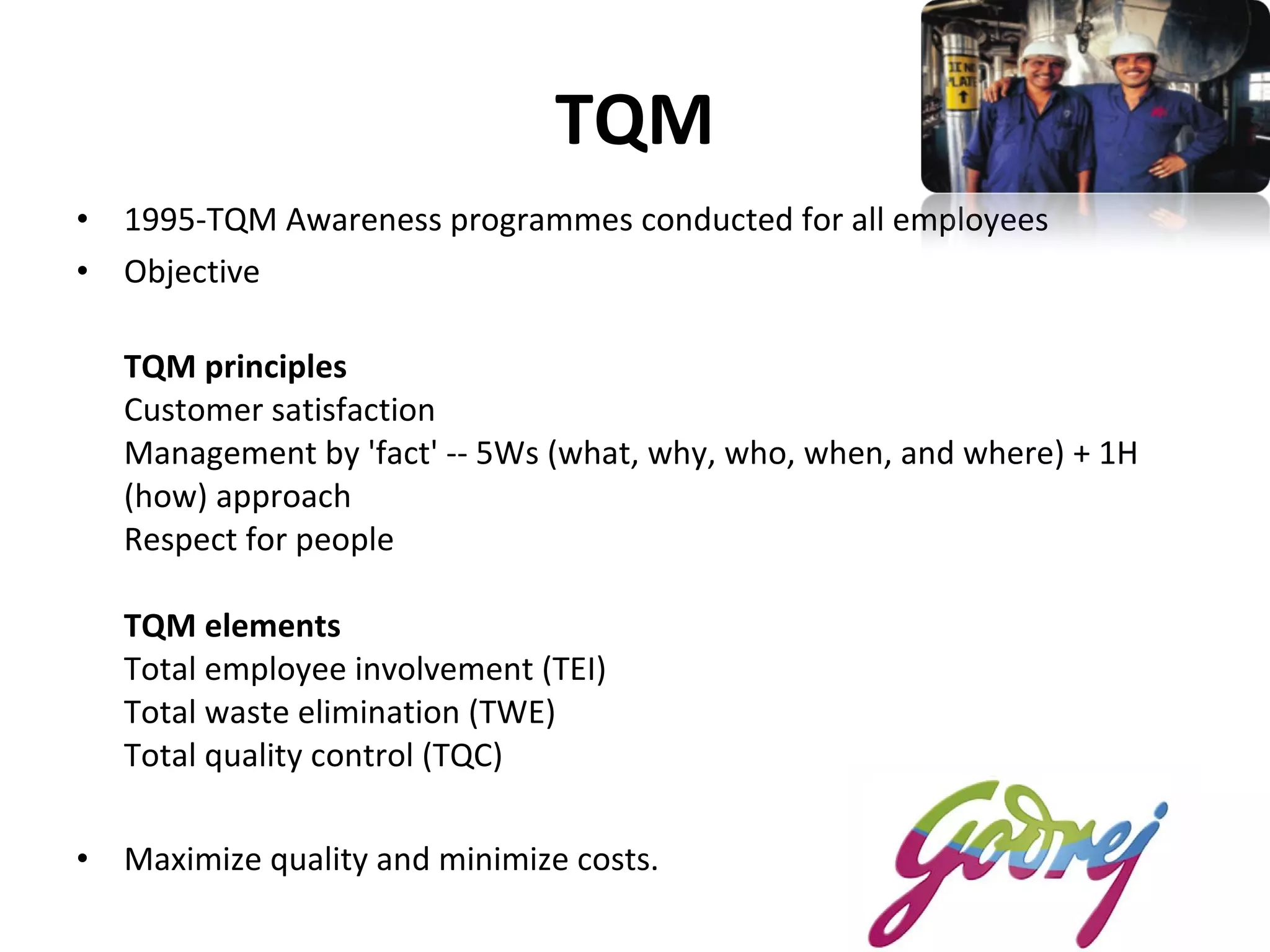
TQM 1995-TQM Awareness programmes conducted for all employees  Objective TQM principles Customer satisfaction  Management by 'fact' -- 5Ws (what, why, who, when, and where) + 1H (how) approach  Respect for people TQM elements Total employee involvement (TEI) Total waste elimination (TWE) Total quality control (TQC)   Maximize quality and minimize costs.
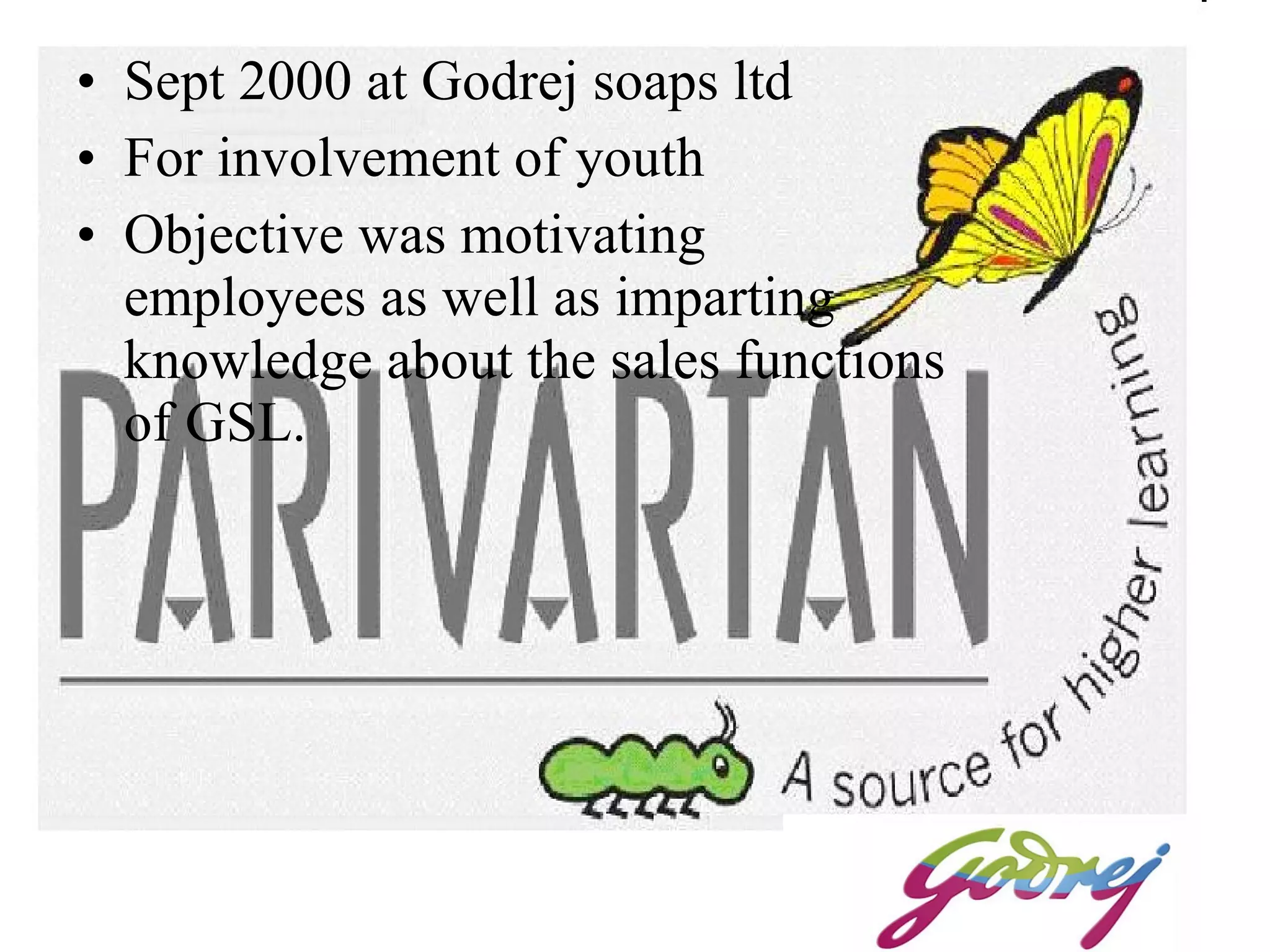
Sept 2000 at Godrej soaps ltd For involvement of youth Objective was motivating employees as well as imparting knowledge about the sales functions of GSL.
GALLOP- Godrej Accelerated Learning Leadership and Orientation Programme  2002 -structured and organised induction-training programme  Objective –to nurture the new recruits into leaders and dynamic performers The trainees were rotated in four departments other than their primary department including a compulsory sales stint.  Mandatory rotation helped the trainees to get a hands-on experience to understand the market
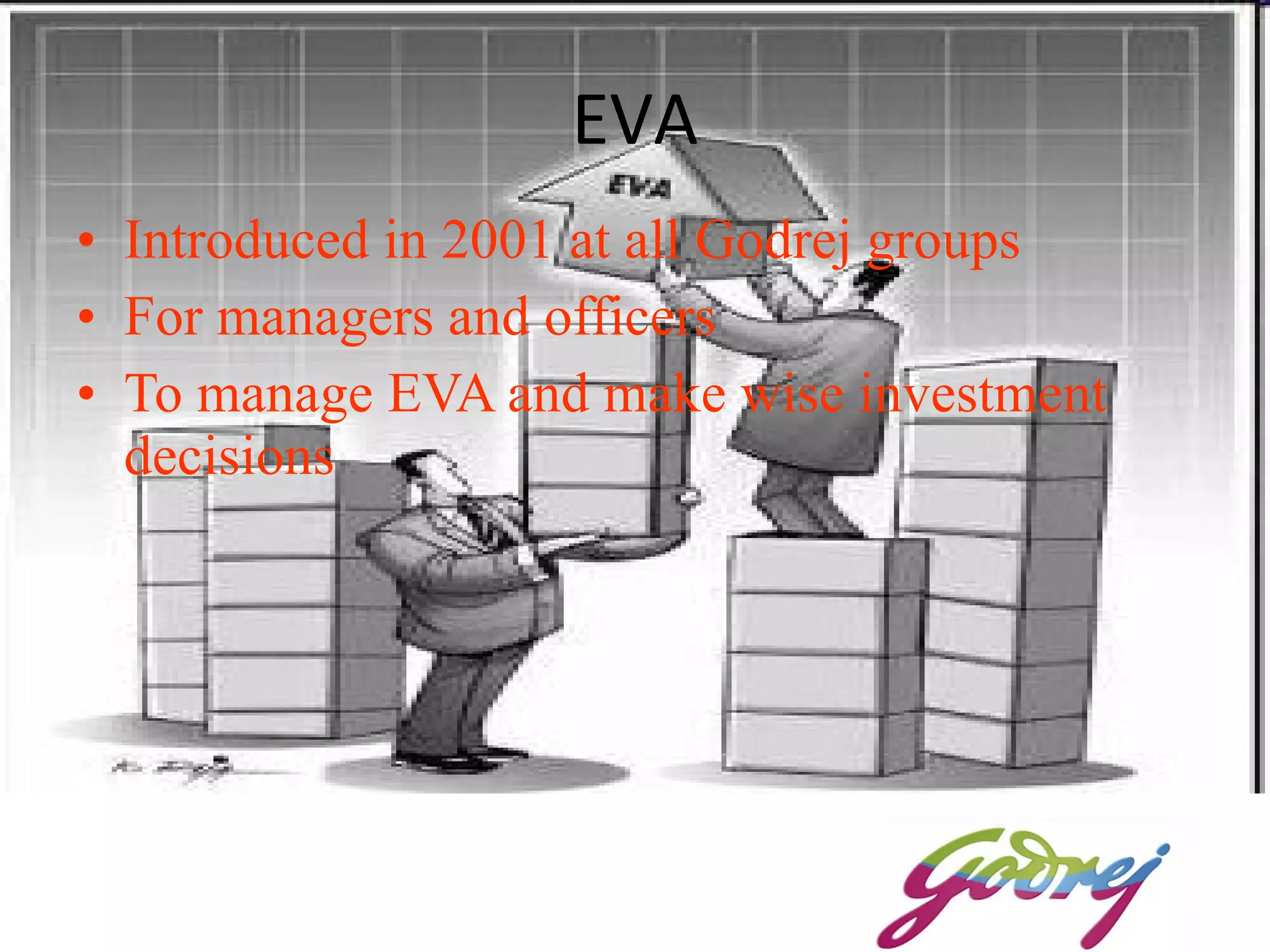
EVA Introduced in 2001 at all Godrej groups For managers and officers To manage EVA and make wise investment decisions
E-Gyan 2002 -E-Gyan was the e-learning initiative  Transform traditional training methods of workshops and sharpen the intellect of the employees by self- learning initiatives
SPARK Sept 2002 at Godrej industries ltd Train the trainer For managers to become effective coaches
Bibliography & Webliography Essentials of Training & Development by Dr. Anjali Ghanekar Human Resource Management by Dr. Anjali Ghanekar Human Resource Management by C.B Gupta www.icmrindia.com www.godrejinds.com

Final Training

  • 1.
    Training, Coaching &Mentoring Subject : Organization Development MMS II, Sem III Date : 26/09/09 Submitted to : Mr. Kuldeep Singh
  • 2.
    Group Members :Gauri Mahalle C-20 Rupali Mehta C-22 Jayashree Prabhu C-43 Devika Shinde P-34
  • 3.
    Training Training isthe process of increasing the knowledge and skills for doing a particular job.
  • 4.
    “ Personally,I am always ready to learn, although I do not always like being taught.” -Winston Churchill
  • 5.
    Need of TrainingJob Requirements Technological Changes Organizational Viability Internal Mobility
  • 6.
    Evaluation Criteria FeedbackSystematic Approach for Training
  • 7.
    Training Need Analysis
  • 8.
    Training Need Assessmentrefers to the process used to determine whether training is necessary. To determine whether or not training is the solution to the problem.
  • 9.
    What is NeedsAssessment? Training need is a need for human performance improvement that can best be met by training of some kind. Training needs identification is the process required to detect & specify training needs at individual or organizational levels. Analysis of training needs is the process of examining training needs to determine how best they might actually be met.
  • 10.
    Training Needs Assessment Training Needs Assessment is an ongoing process of gathering data to determine what training needs exist so that training can be developed to help the organization accomplish its objectives. The purpose: Current level of target group Required level to be achieved Assess the gap
  • 11.
    Causes & Outcomesof Needs Assessment Reasons for pressure points Lack of basic skills Poor performance Customer requests New Product New Jobs High performance standards Task Analysis Person Analysis Organizational Analysis Outcomes What Trainees need to learn Who receives training Type of Training Frequency of Training How training should be evaluated
  • 12.
    Concerns of Managers& Trainers in TNA Upper Level Managers Middle Level Managers Trainers Organizational Analysis Is training important to achieve our business objectives? How does training support our business strategy? Do I want to spend money on training? How much? Do I have the budget to buy training services? Will managers support training? Person Analysis What functions or business units need training? Who should be trained? Managers? Professionals? Core employees? How will I identify which employees need training? Task Analysis Does the organization have the people with the knowledge, skills, and ability need to compete? For what jobs can training make the biggest difference in product quality or customer service? What tasks should be trained? What knowledge, skills, ability, or other characteristics are necessary?
  • 13.
    Methods of TrainingNeeds Assessment Records & Reports / Documentation Observation Survey / Questionnaire Performance Appraisals Tests Interviews Assessment Centres Combination Method
  • 14.
  • 15.
    Training Design Definepurpose of the training and target audience Determine Participants’ Need Methods:  written survey  random sample of registrants by phone  evaluation & feedback  current roles & responsibilities
  • 16.
    Training Design DefineTraining Goals and Objectives 4. Outline Training Content Introduction Learning Component Wrap-up & Evaluation segment Develop Instructional Activities Prepare the Written Training Design
  • 17.
    Training Design 7. Prepare Participant Evaluation Forms Issues:  Did participants acquire knowledge & skills that the training was supposed to provide?  Were the trainers knowledgeable about the training content?  Were the activities interesting & effective enough?  Was the training format appropriate? 8. Determine Follow-up activities for the event
  • 18.
    Types of TrainingOrientation Training Job Training Safety Training Promotional Training Refresher Training Remedial Training
  • 19.
    TRAINING TECHNIQUES ONTHE JOB TECHNIQUES OFF THE JOB
  • 20.
    ON THE JOBTECHNIQUES COACHING UNDER STUDY POSITION ROTATION PROJECT ASSIGNMENTS COMMITTEES MULTIPLE MANAGEMENT SELECTED READINGS
  • 21.
    OFF THE JOBTECHNIQUES LECTURES CASE STUDIES GROUP DISCUSSIONS CONFERENCES ROLE PLAYS MANAGEMENT GAMES SENSITIVITY TRAINING
  • 22.
  • 23.
    TRAINING EVALUATION Shouldnot be a one time activity Systematic process to analyse feedback Helps and strengthen future postion and consolidate present learning
  • 24.
    Aspects Relevance oftraining objectives The accomplishment of objective The appropriateness of training methodology The impact of learning
  • 25.
    When to evaluateDuring training After completion At specified intervals
  • 26.
    Who will evaluateParticipants Staff Outside evaluators
  • 27.
    After evaluation what?Results not adequately utilized Should not be a ritual
  • 28.
  • 29.
  • 30.
    "Many Indian companieshave increased their emphasis on training tremendously. I think it is absolutely essential to spend a lot of money on training and continuous improvement. In our group every employee has to undergo at least five days of training a year.“ Adi Godrej, Chairman Godrej Group
  • 31.
    NEED FOR CHANGEEntire distribution of Godrej transferred to P&G 1995-Break-up of the joint venture between Godrej & P&G Post breakup Godrej devoid of distribution system Rebuilding exercise 1995-TQM
  • 32.
    CHANGE Switch froma family-run business to a professionally managed company Changed the earlier model of management hierarchy Adopted a participative management model team spirit employee improvement programmes.
  • 33.
    TQM 1995-TQM Awarenessprogrammes conducted for all employees Objective TQM principles Customer satisfaction Management by 'fact' -- 5Ws (what, why, who, when, and where) + 1H (how) approach Respect for people TQM elements Total employee involvement (TEI) Total waste elimination (TWE) Total quality control (TQC)   Maximize quality and minimize costs.
  • 34.
    Sept 2000 atGodrej soaps ltd For involvement of youth Objective was motivating employees as well as imparting knowledge about the sales functions of GSL.
  • 35.
    GALLOP- Godrej AcceleratedLearning Leadership and Orientation Programme 2002 -structured and organised induction-training programme Objective –to nurture the new recruits into leaders and dynamic performers The trainees were rotated in four departments other than their primary department including a compulsory sales stint. Mandatory rotation helped the trainees to get a hands-on experience to understand the market
  • 36.
    EVA Introduced in2001 at all Godrej groups For managers and officers To manage EVA and make wise investment decisions
  • 37.
    E-Gyan 2002 -E-Gyanwas the e-learning initiative Transform traditional training methods of workshops and sharpen the intellect of the employees by self- learning initiatives
  • 38.
    SPARK Sept 2002at Godrej industries ltd Train the trainer For managers to become effective coaches
  • 39.
    Bibliography & WebliographyEssentials of Training & Development by Dr. Anjali Ghanekar Human Resource Management by Dr. Anjali Ghanekar Human Resource Management by C.B Gupta www.icmrindia.com www.godrejinds.com