
1 
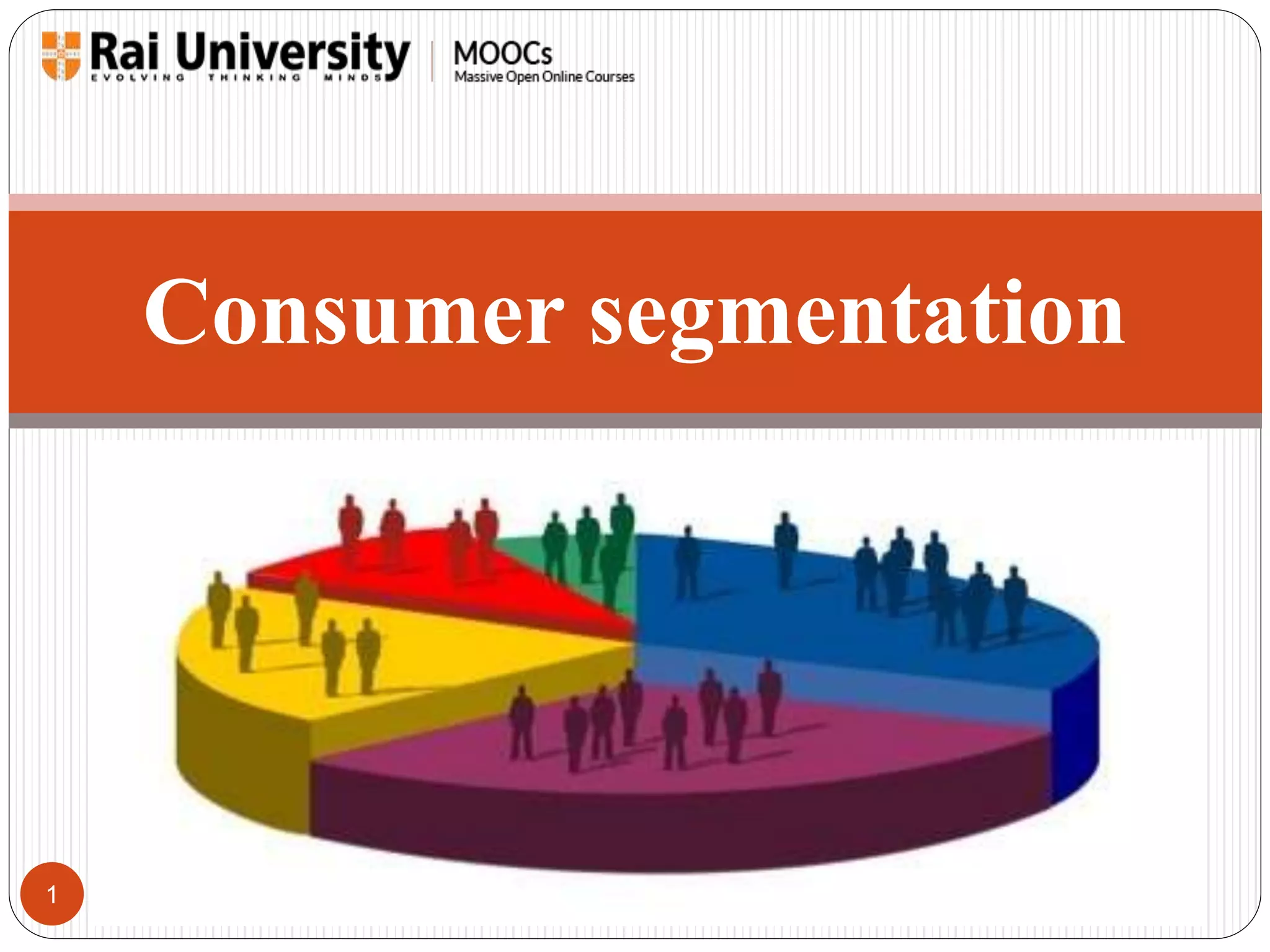
Consumer segmentation
Meaning 
2 
 Customer segmentation(also known as market segmentation) is the practice 
of dividing a customer base into groups of individuals that are similar in 
specific ways relevant to marketing, such as age, gender, interests, spending 
habits, and so on. 
 Customer Segmentation is the subdivision of a market into discrete customer 
groups that share similar characteristics. 
 Customer Segmentation can be a powerful means to identify unmet customer 
needs. 
 Customer Segmentation is most effective when a company tailors offerings to 
segments that are the most profitable and serves them with distinct 
competitive advantages.
3 
 This prioritization can help companies develop marketing campaigns and 
pricing strategies to extract maximum value from both high- and low profit 
customers. 
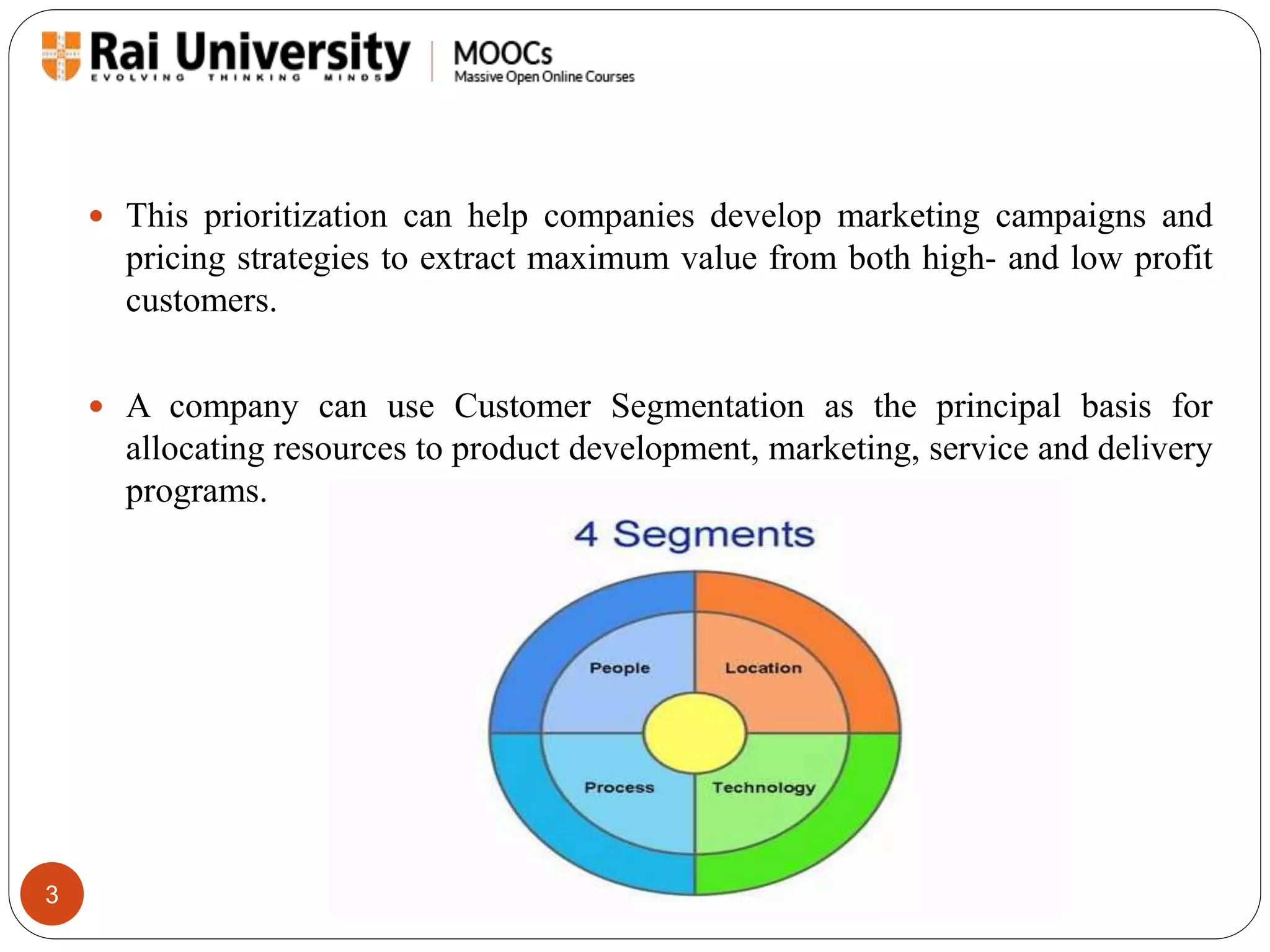
 A company can use Customer Segmentation as the principal basis for 
allocating resources to product development, marketing, service and delivery 
programs.
Objectives 
4 
 To identify profit and market share maximizing strategy for each need based 
customer segment to minimize : 
 Over satisfying some customer segment needs (excess financial cost) 
 Under satisfying others (market share cost)
How Customer Segmentation works: 
5 
 Customer Segmentation requires managers to: 
 Divide the market into meaningful and measurable segments according to 
customers' needs 
 Determine the profit potential of each segment by analyize the revenue and 
cost impacts of serving each segment 
 Target segments according to their profit potential and the company's ability to 
serve them in a proprietary way 
 Measure performance of each segment and adjust the segmentation approach 
over time as market conditions change decision making throughout the 
organization
Companies use Customer Segmentation 
 Prioritize new product development efforts 
 Develop customized marketing programs 
 Choose specific product features 
 Establish appropriate service options 
 Design an optimal distribution strategy 
 Determine appropriate product pricing 
6
Approaches to Consumer segmentation: 
7 
 A priori segmentation : it is the simplest approach, uses a classification 
scheme based on publicly available characteristics such as industry and 
company size to create distinct groups of customers within a market. 
 It may not always be valid, since companies in the same industry and of the 
same size may have very different needs. 
 Needs-based segmentation : it is based on differentiated, validated drivers 
(needs) that customers express for a specific product or service being 
offered. 
 The needs are discovered and verified through primary market research, and 
segments are demarcated based on different needs rather than characteristics 
such as industry or company size.
8 
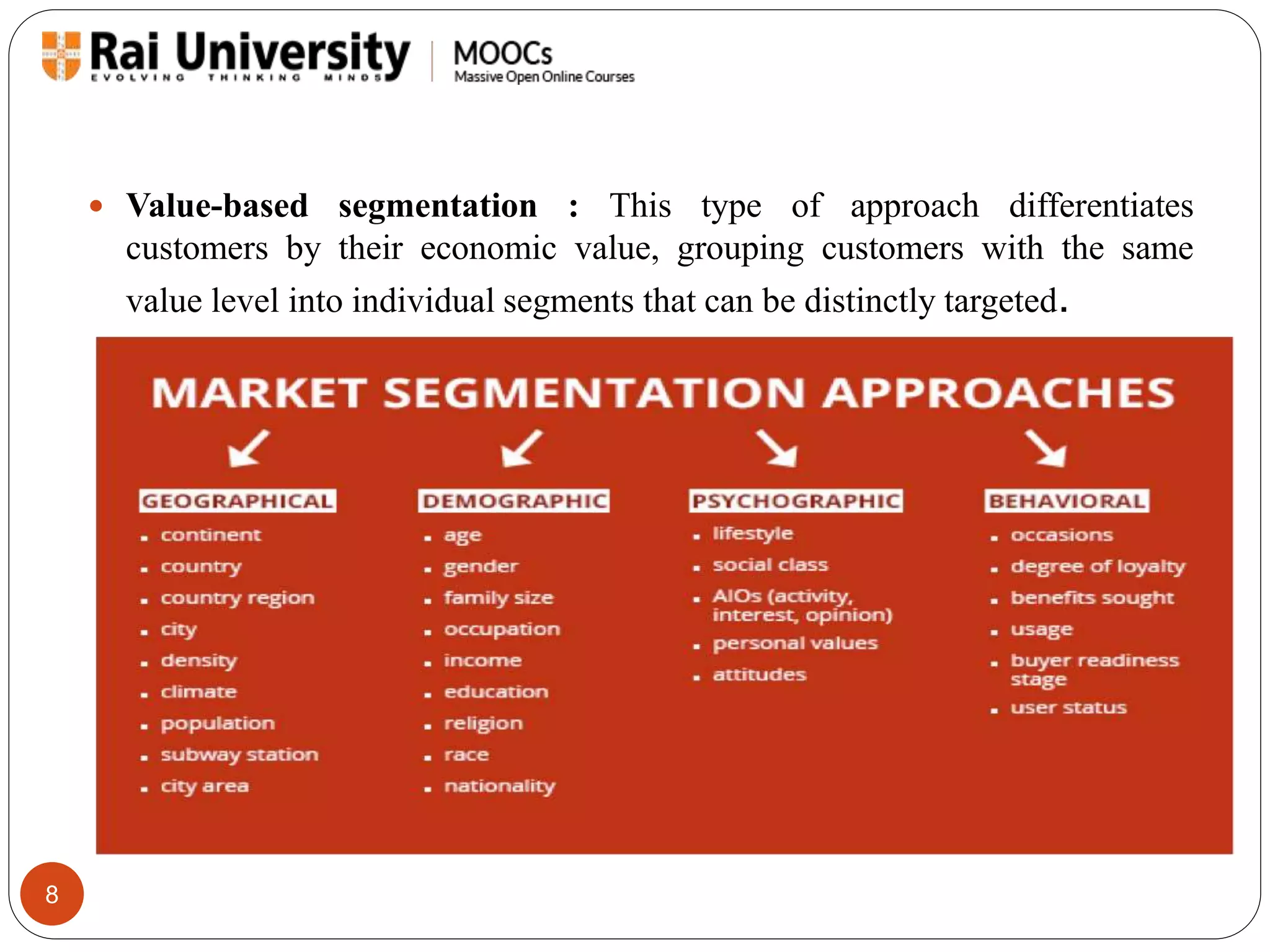
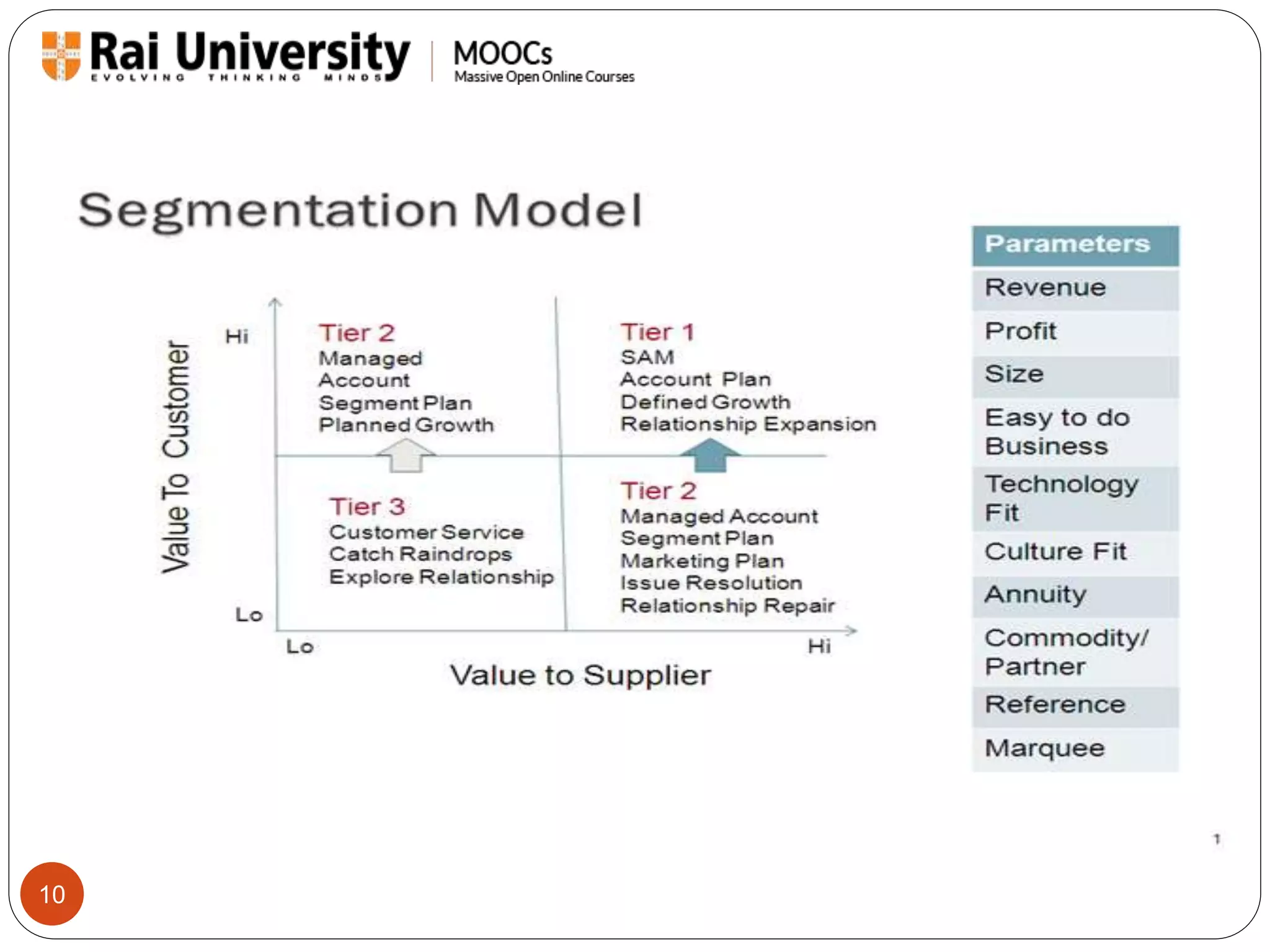
 Value-based segmentation : This type of approach differentiates 
customers by their economic value, grouping customers with the same 
value level into individual segments that can be distinctly targeted.
Limitations 
9 
 We have not been able to provide a quantitative validation to our finding 
because of non-availability of sales figures 
 The changes in the brand equity as measured by us capture only a relative 
measure and not an absolute score. 
 Further, for the purpose of our study, we have categorised consumers into 
three age categories namely <15,15-30 and >30 only. 
 However we believe that the model is only a generalised framework and the 
brand manager’s need to adapt it to the parameters as thought relevant by 
them.
10
11 
Thank you

Consumer Segmentation - Introduction to Branding

  • 1.
  • 2.
    Meaning 2 Customer segmentation(also known as market segmentation) is the practice of dividing a customer base into groups of individuals that are similar in specific ways relevant to marketing, such as age, gender, interests, spending habits, and so on.  Customer Segmentation is the subdivision of a market into discrete customer groups that share similar characteristics.  Customer Segmentation can be a powerful means to identify unmet customer needs.  Customer Segmentation is most effective when a company tailors offerings to segments that are the most profitable and serves them with distinct competitive advantages.
  • 3.
    3  Thisprioritization can help companies develop marketing campaigns and pricing strategies to extract maximum value from both high- and low profit customers.  A company can use Customer Segmentation as the principal basis for allocating resources to product development, marketing, service and delivery programs.
  • 4.
    Objectives 4 To identify profit and market share maximizing strategy for each need based customer segment to minimize :  Over satisfying some customer segment needs (excess financial cost)  Under satisfying others (market share cost)
  • 5.
    How Customer Segmentationworks: 5  Customer Segmentation requires managers to:  Divide the market into meaningful and measurable segments according to customers' needs  Determine the profit potential of each segment by analyize the revenue and cost impacts of serving each segment  Target segments according to their profit potential and the company's ability to serve them in a proprietary way  Measure performance of each segment and adjust the segmentation approach over time as market conditions change decision making throughout the organization
  • 6.
    Companies use CustomerSegmentation  Prioritize new product development efforts  Develop customized marketing programs  Choose specific product features  Establish appropriate service options  Design an optimal distribution strategy  Determine appropriate product pricing 6
  • 7.
    Approaches to Consumersegmentation: 7  A priori segmentation : it is the simplest approach, uses a classification scheme based on publicly available characteristics such as industry and company size to create distinct groups of customers within a market.  It may not always be valid, since companies in the same industry and of the same size may have very different needs.  Needs-based segmentation : it is based on differentiated, validated drivers (needs) that customers express for a specific product or service being offered.  The needs are discovered and verified through primary market research, and segments are demarcated based on different needs rather than characteristics such as industry or company size.
  • 8.
    8  Value-basedsegmentation : This type of approach differentiates customers by their economic value, grouping customers with the same value level into individual segments that can be distinctly targeted.
  • 9.
    Limitations 9 We have not been able to provide a quantitative validation to our finding because of non-availability of sales figures  The changes in the brand equity as measured by us capture only a relative measure and not an absolute score.  Further, for the purpose of our study, we have categorised consumers into three age categories namely <15,15-30 and >30 only.  However we believe that the model is only a generalised framework and the brand manager’s need to adapt it to the parameters as thought relevant by them.
  • 10.
  • 11.