DATA ANALYSIS:
Our achieved data can be analyzed from different point of view and purpose. Like previously
mentioned-Planning, Modeling, Designing. For these application several parameters are need
to be determined from this type of study. Like
ADT,AADT,VECHILE COMPOSITION,FLOW RATE,FLOW VARIATION
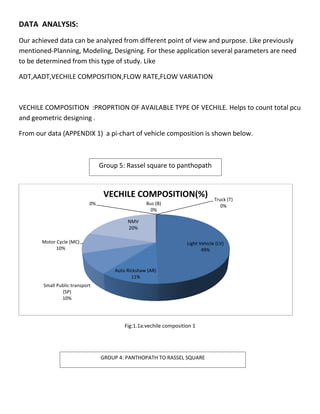
VECHILE COMPOSITION :PROPRTION OF AVAILABLE TYPE OF VECHILE. Helps to count total pcu
and geometric designing .
From our data (APPENDIX 1) a pi-chart of vehicle composition is shown below.
Fig:1.1a:vechile composition 1
Bus (B)
0%
Truck (T)
0%
Light Vehicle (LV)
49%
Auto Rickshaw (AR)
11%
Small Public-transport
(SP)
10%
Motor Cycle (MC)
10%
NMV
20%
0%
VECHILE COMPOSITION(%)
Group 5: Rassel square to panthopath
GROUP 4: PANTHOPATH TO RASSEL SQUARE
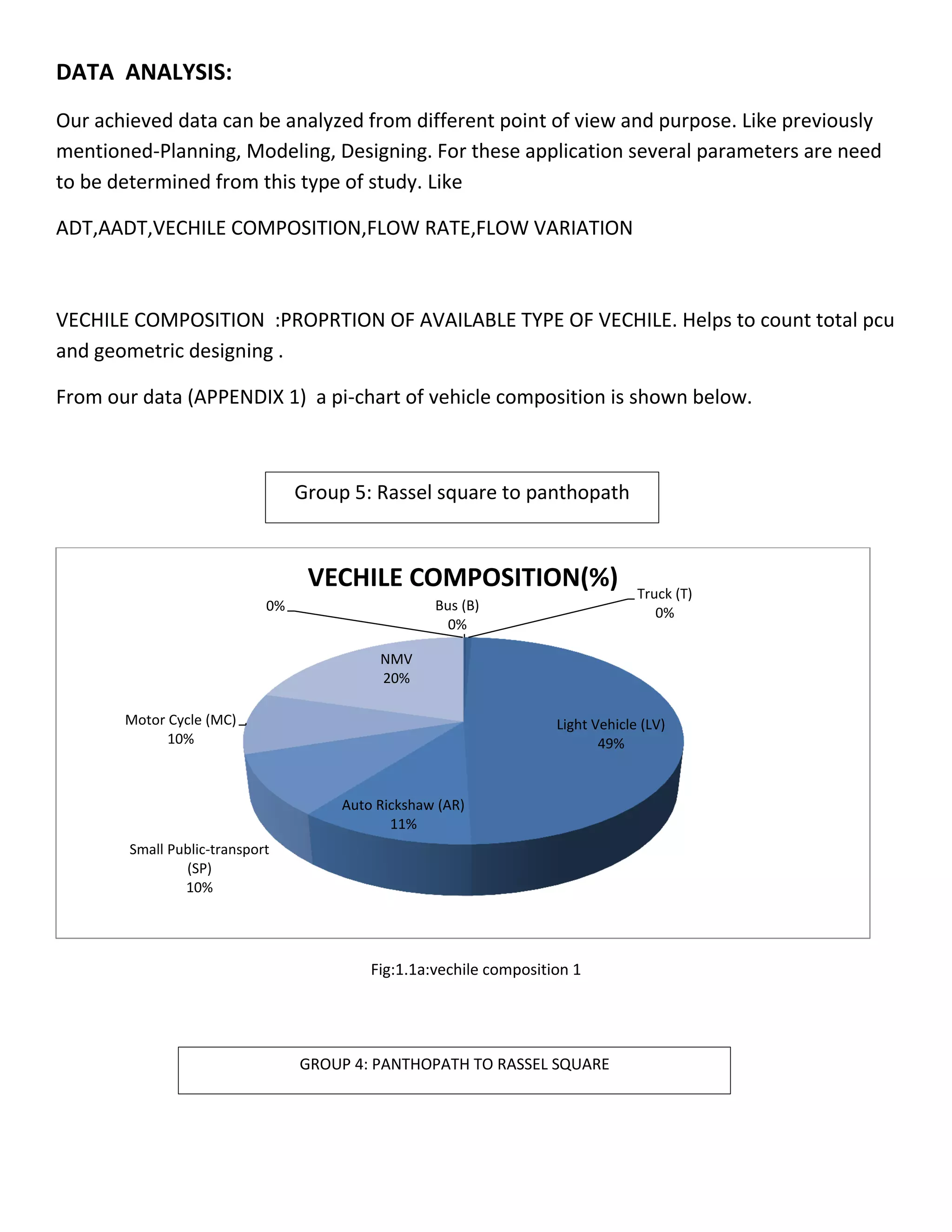
Fig:1.1b:vechile composition 2
So,we can say light vehicle is predominate here.
Directional Distribution:
Distribution of traffic vechile is varied according with their demand.It varies with time also
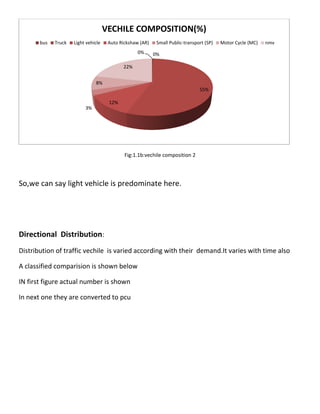
A classified comparision is shown below
IN first figure actual number is shown
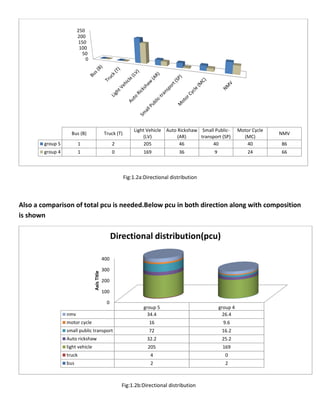
In next one they are converted to pcu
0% 0%
55%
12%
3%
8%
22%
VECHILE COMPOSITION(%)
bus Truck Light vehicle Auto Rickshaw (AR) Small Public-transport (SP) Motor Cycle (MC) nmv
Fig:1.2a:Directional distribution
Also a comparison of total pcu is needed.Below pcu in both direction along with composition
is shown
Fig:1.2b:Directional distribution
0
50
100
150
200
250
Bus (B) Truck (T)
Light Vehicle
(LV)
Auto Rickshaw
(AR)
Small Public-
transport (SP)
Motor Cycle
(MC)
NMV
group 5 1 2 205 46 40 40 86
group 4 1 0 169 36 9 24 66
0
100
200
300
400
group 5 group 4
nmv 34.4 26.4
motor cycle 16 9.6
small public transport 72 16.2
Auto rickshaw 32.2 25.2
light vehicle 205 169
truck 4 0
bus 2 2
AxisTitle
Directional distribution(pcu)
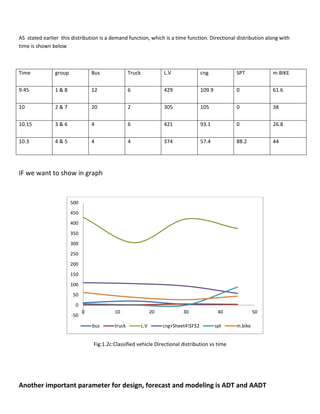
AS stated earlier this distribution is a demand function, which is a time function. Directional distribution along with
time is shown below
Time group Bus Truck L.V cng SPT m.BIKE
9.45 1 & 8 12 6 429 109.9 0 61.6
10 2 & 7 20 2 305 105 0 38
10.15 3 & 6 4 6 421 93.1 0 26.8
10.3 4 & 5 4 4 374 57.4 88.2 44
IF we want to show in graph
Fig:1.2c:Classified vehicle Directional distribution vs time
Another important parameter for design, forecast and modeling is ADT and AADT
-50
0
50
100
150
200
250
300
350
400
450
500
0 10 20 30 40 50
bus truck L.V cng+Sheet4!$F$2 spt m.bike
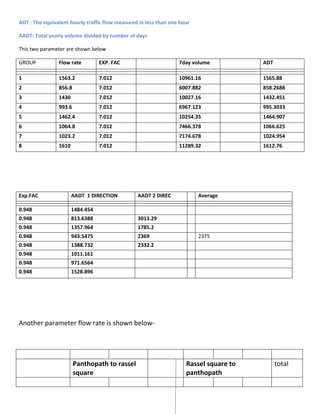
ADT : The equivalent hourly traffic flow measured in less than one hour
AADT: Total yearly volume divided by number of days
This two parameter are shown below
GROUP Flow rate EXP. FAC 7day volume ADT
1 1563.2 7.012 10961.16 1565.88
2 856.8 7.012 6007.882 858.2688
3 1430 7.012 10027.16 1432.451
4 993.6 7.012 6967.123 995.3033
5 1462.4 7.012 10254.35 1464.907
6 1064.8 7.012 7466.378 1066.625
7 1023.2 7.012 7174.678 1024.954
8 1610 7.012 11289.32 1612.76
Exp.FAC AADT 1 DIRECTION AADT 2 DIREC Average
0.948 1484.454
0.948 813.6388 3013.29
0.948 1357.964 1785.2
0.948 943.5475 2369 2375
0.948 1388.732 2332.2
0.948 1011.161
0.948 971.6564
0.948 1528.896
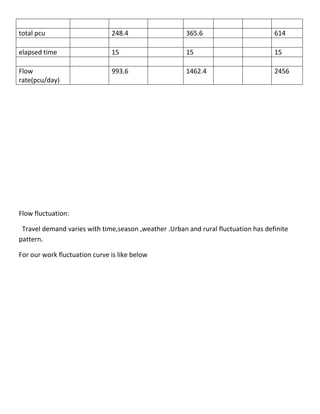
Another parameter flow rate is shown below-
Panthopath to rassel
square
Rassel square to
panthopath
total
total pcu 248.4 365.6 614
elapsed time 15 15 15
Flow
rate(pcu/day)
993.6 1462.4 2456
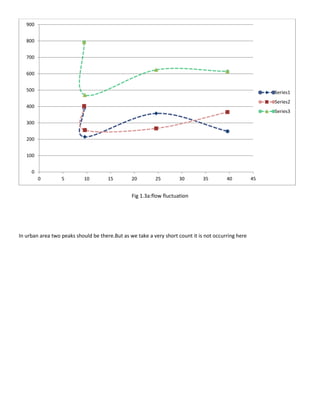
Flow fluctuation:
Travel demand varies with time,season ,weather .Urban and rural fluctuation has definite
pattern.
For our work fluctuation curve is like below
Fig 1.3a:flow fluctuation
In urban area two peaks should be there.But as we take a very short count it is not occurring here
0
100
200
300
400
500
600
700
800
900
0 5 10 15 20 25 30 35 40 45
Series1
Series2
Series3

traffic volume study Data analysis

  • 1.
    DATA ANALYSIS: Our achieveddata can be analyzed from different point of view and purpose. Like previously mentioned-Planning, Modeling, Designing. For these application several parameters are need to be determined from this type of study. Like ADT,AADT,VECHILE COMPOSITION,FLOW RATE,FLOW VARIATION VECHILE COMPOSITION :PROPRTION OF AVAILABLE TYPE OF VECHILE. Helps to count total pcu and geometric designing . From our data (APPENDIX 1) a pi-chart of vehicle composition is shown below. Fig:1.1a:vechile composition 1 Bus (B) 0% Truck (T) 0% Light Vehicle (LV) 49% Auto Rickshaw (AR) 11% Small Public-transport (SP) 10% Motor Cycle (MC) 10% NMV 20% 0% VECHILE COMPOSITION(%) Group 5: Rassel square to panthopath GROUP 4: PANTHOPATH TO RASSEL SQUARE
  • 2.
    Fig:1.1b:vechile composition 2 So,wecan say light vehicle is predominate here. Directional Distribution: Distribution of traffic vechile is varied according with their demand.It varies with time also A classified comparision is shown below IN first figure actual number is shown In next one they are converted to pcu 0% 0% 55% 12% 3% 8% 22% VECHILE COMPOSITION(%) bus Truck Light vehicle Auto Rickshaw (AR) Small Public-transport (SP) Motor Cycle (MC) nmv
  • 3.
    Fig:1.2a:Directional distribution Also acomparison of total pcu is needed.Below pcu in both direction along with composition is shown Fig:1.2b:Directional distribution 0 50 100 150 200 250 Bus (B) Truck (T) Light Vehicle (LV) Auto Rickshaw (AR) Small Public- transport (SP) Motor Cycle (MC) NMV group 5 1 2 205 46 40 40 86 group 4 1 0 169 36 9 24 66 0 100 200 300 400 group 5 group 4 nmv 34.4 26.4 motor cycle 16 9.6 small public transport 72 16.2 Auto rickshaw 32.2 25.2 light vehicle 205 169 truck 4 0 bus 2 2 AxisTitle Directional distribution(pcu)
  • 4.
    AS stated earlierthis distribution is a demand function, which is a time function. Directional distribution along with time is shown below Time group Bus Truck L.V cng SPT m.BIKE 9.45 1 & 8 12 6 429 109.9 0 61.6 10 2 & 7 20 2 305 105 0 38 10.15 3 & 6 4 6 421 93.1 0 26.8 10.3 4 & 5 4 4 374 57.4 88.2 44 IF we want to show in graph Fig:1.2c:Classified vehicle Directional distribution vs time Another important parameter for design, forecast and modeling is ADT and AADT -50 0 50 100 150 200 250 300 350 400 450 500 0 10 20 30 40 50 bus truck L.V cng+Sheet4!$F$2 spt m.bike
  • 5.
    ADT : Theequivalent hourly traffic flow measured in less than one hour AADT: Total yearly volume divided by number of days This two parameter are shown below GROUP Flow rate EXP. FAC 7day volume ADT 1 1563.2 7.012 10961.16 1565.88 2 856.8 7.012 6007.882 858.2688 3 1430 7.012 10027.16 1432.451 4 993.6 7.012 6967.123 995.3033 5 1462.4 7.012 10254.35 1464.907 6 1064.8 7.012 7466.378 1066.625 7 1023.2 7.012 7174.678 1024.954 8 1610 7.012 11289.32 1612.76 Exp.FAC AADT 1 DIRECTION AADT 2 DIREC Average 0.948 1484.454 0.948 813.6388 3013.29 0.948 1357.964 1785.2 0.948 943.5475 2369 2375 0.948 1388.732 2332.2 0.948 1011.161 0.948 971.6564 0.948 1528.896 Another parameter flow rate is shown below- Panthopath to rassel square Rassel square to panthopath total
  • 6.
    total pcu 248.4365.6 614 elapsed time 15 15 15 Flow rate(pcu/day) 993.6 1462.4 2456 Flow fluctuation: Travel demand varies with time,season ,weather .Urban and rural fluctuation has definite pattern. For our work fluctuation curve is like below
  • 7.
    Fig 1.3a:flow fluctuation Inurban area two peaks should be there.But as we take a very short count it is not occurring here 0 100 200 300 400 500 600 700 800 900 0 5 10 15 20 25 30 35 40 45 Series1 Series2 Series3