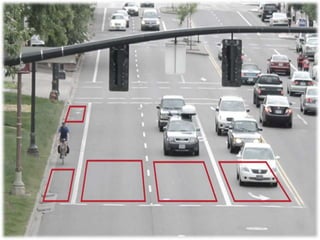
Traffic Engineering
Topic: Traffic volume study
Bhavin Pindoriya - 116210306746
Keyur Sorathiya - 106210306824
Krishn Sorathiya - 136210306100
Jayesh Sorathiya - 136210306103
Methods of traffic volume study
1. Manual counts.
2. Mechanical counters.
3. Combination of manual and mechanical
methods.
4. Moving car method.
Manual counts
• A manual classified count (MCC) involves counting all the
vehicles passing a selected location on a road for a pre-
determined period of time. The count can be for any
duration, but is usually conducted for 16 or 24 hours in a
day, and for three or four days consecutively.
• The count is conducted by persons standing at the
roadside and recording passing vehicles on a form, hence
the term “manual traffic count”. This distinguishes it from
counts by machines that can record passing vehicles
automatically, which are know as “automatic traffic
counts”.
• The count records individual vehicles by categories (i.e. a
truck or car) and the direction they are travelling in. This is
the reason it is called a ‘classified count’.
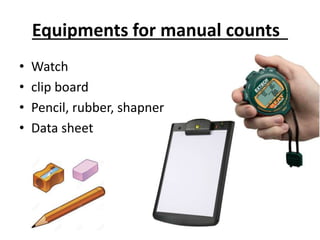
Equipments for manual counts
• Watch
• clip board
• Pencil, rubber, shapner
• Data sheet
Manual Count Recording Methods
• Tally Sheets
• Mechanical Counting Boards
• Electronic Counting Boards
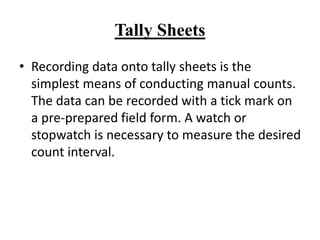
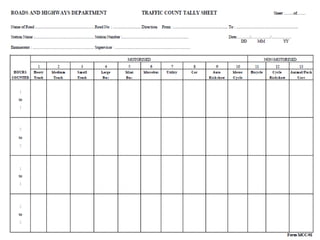
Tally Sheets
• Recording data onto tally sheets is the
simplest means of conducting manual counts.
The data can be recorded with a tick mark on
a pre-prepared field form. A watch or
stopwatch is necessary to measure the desired
count interval.
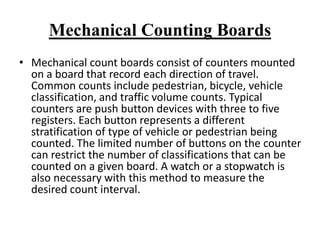
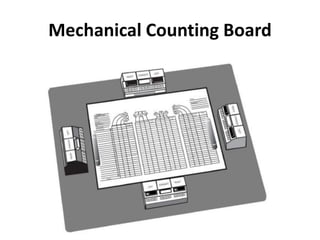
Mechanical Counting Boards
• Mechanical count boards consist of counters mounted
on a board that record each direction of travel.
Common counts include pedestrian, bicycle, vehicle
classification, and traffic volume counts. Typical
counters are push button devices with three to five
registers. Each button represents a different
stratification of type of vehicle or pedestrian being
counted. The limited number of buttons on the counter
can restrict the number of classifications that can be
counted on a given board. A watch or a stopwatch is
also necessary with this method to measure the
desired count interval.
Mechanical Counting Board
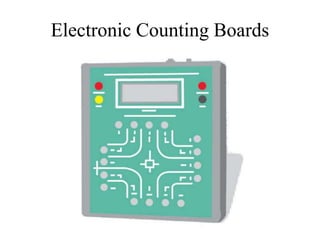
Electronic Counting Boards
Electronic counting boards are battery-operated,
hand-held devices used in collecting traffic count
data. They are similar to mechanical counting
boards, but with some important differences.
Electronic counting boards are lighter, more
compact, and easier to handle. They have an
internal clock that automatically separates the
data by time interval. Special functions include
automatic data reduction and summary. The data
can also be downloaded to a computer, which
saves time.
Electronic Counting Boards
Automatic Counts
• The automatic count method provides a means
for gathering large amounts of traffic data.
Automatic counts are usually taken in 1-hour
intervals for each 24-hour period. The counts may
extend for a week, month, or year. When the
counts are recorded for each 24-hour time
period, the peak flow period can be identified.
Automatic Count Recording
Methods
• Pneumatic tubes.
• Inductive loops.
• Weigh-in-Motion Sensor types.
1. Bending Plates
2. Capacitive Strip
3. Capacitive Mat
4. Piezo-electric Cable
• Micro-millimetre wave Radar detectors.
• Video Camera.
Pneumatic tubes.
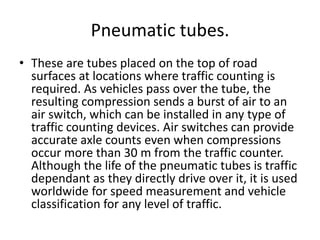
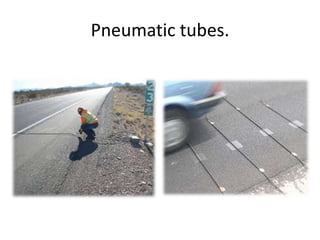
• These are tubes placed on the top of road
surfaces at locations where traffic counting is
required. As vehicles pass over the tube, the
resulting compression sends a burst of air to an
air switch, which can be installed in any type of
traffic counting devices. Air switches can provide
accurate axle counts even when compressions
occur more than 30 m from the traffic counter.
Although the life of the pneumatic tubes is traffic
dependant as they directly drive over it, it is used
worldwide for speed measurement and vehicle
classification for any level of traffic.
Pneumatic tubes.
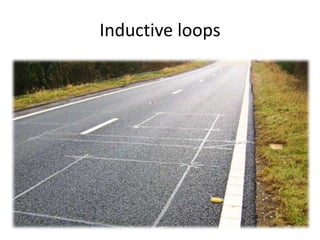
Inductive loops
Inductive loop detector consists of embedded
turned wire from which it gets its name. It
includes an oscillator, and a cable, which
allows signals to pass from the loop to the
traffic counting device. The counting device is
activated by the change in the magnetic field
when a vehicle passes over the loop
Inductive loops
Weigh-in-Motion Sensor
Weigh-in-Motion Sensor types. A variety of
traffic sensors and loops are used world-wide
to count, weigh and classify vehicles while in
motion, and these are collectively known as
Weigh In Motion (WIM) sensor systems.
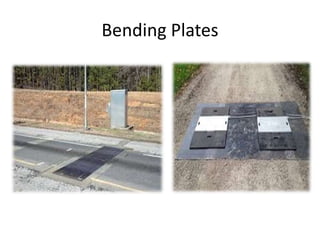
Bending Plates
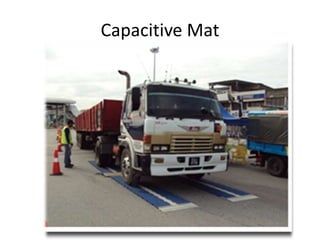
Capacitive Mat
Micro-millimetre wave Radar
detectors.
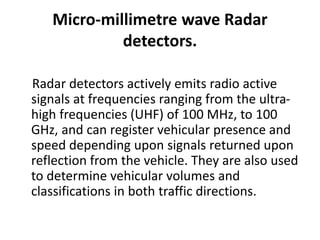
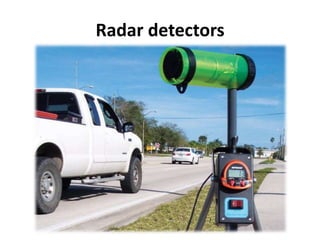
Radar detectors actively emits radio active
signals at frequencies ranging from the ultra-
high frequencies (UHF) of 100 MHz, to 100
GHz, and can register vehicular presence and
speed depending upon signals returned upon
reflection from the vehicle. They are also used
to determine vehicular volumes and
classifications in both traffic directions.
Radar detectors
Video Camera
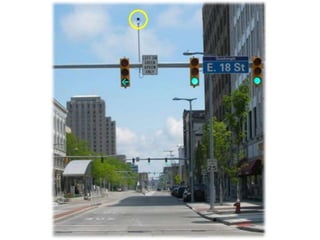
A video camera was set on the road at some
pole and recording is been and data is been
send to computer and be saved for further
analysis.
THANK YOU

Traffic engineering

  • 1.
    Traffic Engineering Topic: Trafficvolume study Bhavin Pindoriya - 116210306746 Keyur Sorathiya - 106210306824 Krishn Sorathiya - 136210306100 Jayesh Sorathiya - 136210306103
  • 2.
    Methods of trafficvolume study 1. Manual counts. 2. Mechanical counters. 3. Combination of manual and mechanical methods. 4. Moving car method.
  • 3.
    Manual counts • Amanual classified count (MCC) involves counting all the vehicles passing a selected location on a road for a pre- determined period of time. The count can be for any duration, but is usually conducted for 16 or 24 hours in a day, and for three or four days consecutively. • The count is conducted by persons standing at the roadside and recording passing vehicles on a form, hence the term “manual traffic count”. This distinguishes it from counts by machines that can record passing vehicles automatically, which are know as “automatic traffic counts”. • The count records individual vehicles by categories (i.e. a truck or car) and the direction they are travelling in. This is the reason it is called a ‘classified count’.
  • 4.
    Equipments for manualcounts • Watch • clip board • Pencil, rubber, shapner • Data sheet
  • 5.
    Manual Count RecordingMethods • Tally Sheets • Mechanical Counting Boards • Electronic Counting Boards
  • 6.
    Tally Sheets • Recordingdata onto tally sheets is the simplest means of conducting manual counts. The data can be recorded with a tick mark on a pre-prepared field form. A watch or stopwatch is necessary to measure the desired count interval.
  • 8.
    Mechanical Counting Boards •Mechanical count boards consist of counters mounted on a board that record each direction of travel. Common counts include pedestrian, bicycle, vehicle classification, and traffic volume counts. Typical counters are push button devices with three to five registers. Each button represents a different stratification of type of vehicle or pedestrian being counted. The limited number of buttons on the counter can restrict the number of classifications that can be counted on a given board. A watch or a stopwatch is also necessary with this method to measure the desired count interval.
  • 9.
  • 10.
    Electronic Counting Boards Electroniccounting boards are battery-operated, hand-held devices used in collecting traffic count data. They are similar to mechanical counting boards, but with some important differences. Electronic counting boards are lighter, more compact, and easier to handle. They have an internal clock that automatically separates the data by time interval. Special functions include automatic data reduction and summary. The data can also be downloaded to a computer, which saves time.
  • 11.
  • 12.
    Automatic Counts • Theautomatic count method provides a means for gathering large amounts of traffic data. Automatic counts are usually taken in 1-hour intervals for each 24-hour period. The counts may extend for a week, month, or year. When the counts are recorded for each 24-hour time period, the peak flow period can be identified.
  • 13.
    Automatic Count Recording Methods •Pneumatic tubes. • Inductive loops. • Weigh-in-Motion Sensor types. 1. Bending Plates 2. Capacitive Strip 3. Capacitive Mat 4. Piezo-electric Cable • Micro-millimetre wave Radar detectors. • Video Camera.
  • 14.
    Pneumatic tubes. • Theseare tubes placed on the top of road surfaces at locations where traffic counting is required. As vehicles pass over the tube, the resulting compression sends a burst of air to an air switch, which can be installed in any type of traffic counting devices. Air switches can provide accurate axle counts even when compressions occur more than 30 m from the traffic counter. Although the life of the pneumatic tubes is traffic dependant as they directly drive over it, it is used worldwide for speed measurement and vehicle classification for any level of traffic.
  • 15.
  • 16.
    Inductive loops Inductive loopdetector consists of embedded turned wire from which it gets its name. It includes an oscillator, and a cable, which allows signals to pass from the loop to the traffic counting device. The counting device is activated by the change in the magnetic field when a vehicle passes over the loop
  • 17.
  • 18.
    Weigh-in-Motion Sensor Weigh-in-Motion Sensortypes. A variety of traffic sensors and loops are used world-wide to count, weigh and classify vehicles while in motion, and these are collectively known as Weigh In Motion (WIM) sensor systems.
  • 19.
  • 20.
  • 21.
    Micro-millimetre wave Radar detectors. Radardetectors actively emits radio active signals at frequencies ranging from the ultra- high frequencies (UHF) of 100 MHz, to 100 GHz, and can register vehicular presence and speed depending upon signals returned upon reflection from the vehicle. They are also used to determine vehicular volumes and classifications in both traffic directions.
  • 22.
  • 23.
    Video Camera A videocamera was set on the road at some pole and recording is been and data is been send to computer and be saved for further analysis.
  • 26.