TRADITIONAL
METHOD
Karen Grace M. Alvaro, LPT
Master in Arts Education- General Education
Divine Word College of Laoag
VYGOTSKY’S SOCIO-
CULTURAL THEORY
ACTUAL
LEVEL
POTENTIAL
LEVEL
SCAFFOLDING
LEARNING
ZONE OF
PROXIMODISTAL
DEVELOPMENT
Karen Grace M. Alvaro, LPT
REVIEW LESSON
Karen Grace M. Alvaro, LPT
Review Lesson
• to renew study of the same subject matter
• to recall what has been taken up in the
past and view this again from a different
perspective or point of view
• new associations, new relationships, new
interpretations may be discovered
Karen Grace M. Alvaro, LPT
Purpose of Review
• Retention of the material learned.
• Organization of materials and experiences
into large wholes.
• Development of ability to evaluate
material.
• Supplementation of materials and
experiences.
• Foundation for further learning.
Karen Grace M. Alvaro, LPT
Purpose of Review
• Diagnosis of weakness.
• Development of interest in old materials.
• Stimulation of original thinking and
creativeness.
• Tracing the core or main thought
throughout a unit.
• Reorganization of previously organized
information into a new pattern.
Karen Grace M. Alvaro, LPT
Types of Review
• The short pre-lesson daily review
• The post-lesson unit review
• Extensive large unit review
• Oral or written reports
• Topical outlines
• Problem review
• Cooperative review
Karen Grace M. Alvaro, LPT
Techniques of Review
• Time of Review
• Length of the Review
• Preparation of Review
Karen Grace M. Alvaro, LPT
Principles of Review
• The review must be of value to the learner.
• The review should be interesting.
• The review should follow the psychological
principles of learning.
Karen Grace M. Alvaro, LPT
Conditions for Good Review
• Previous lessons must have been studied
• Too much should not be covered in one
lesson
• The teacher should have thorough
mastery of the subject and organize it as a
whole
Karen Grace M. Alvaro, LPT
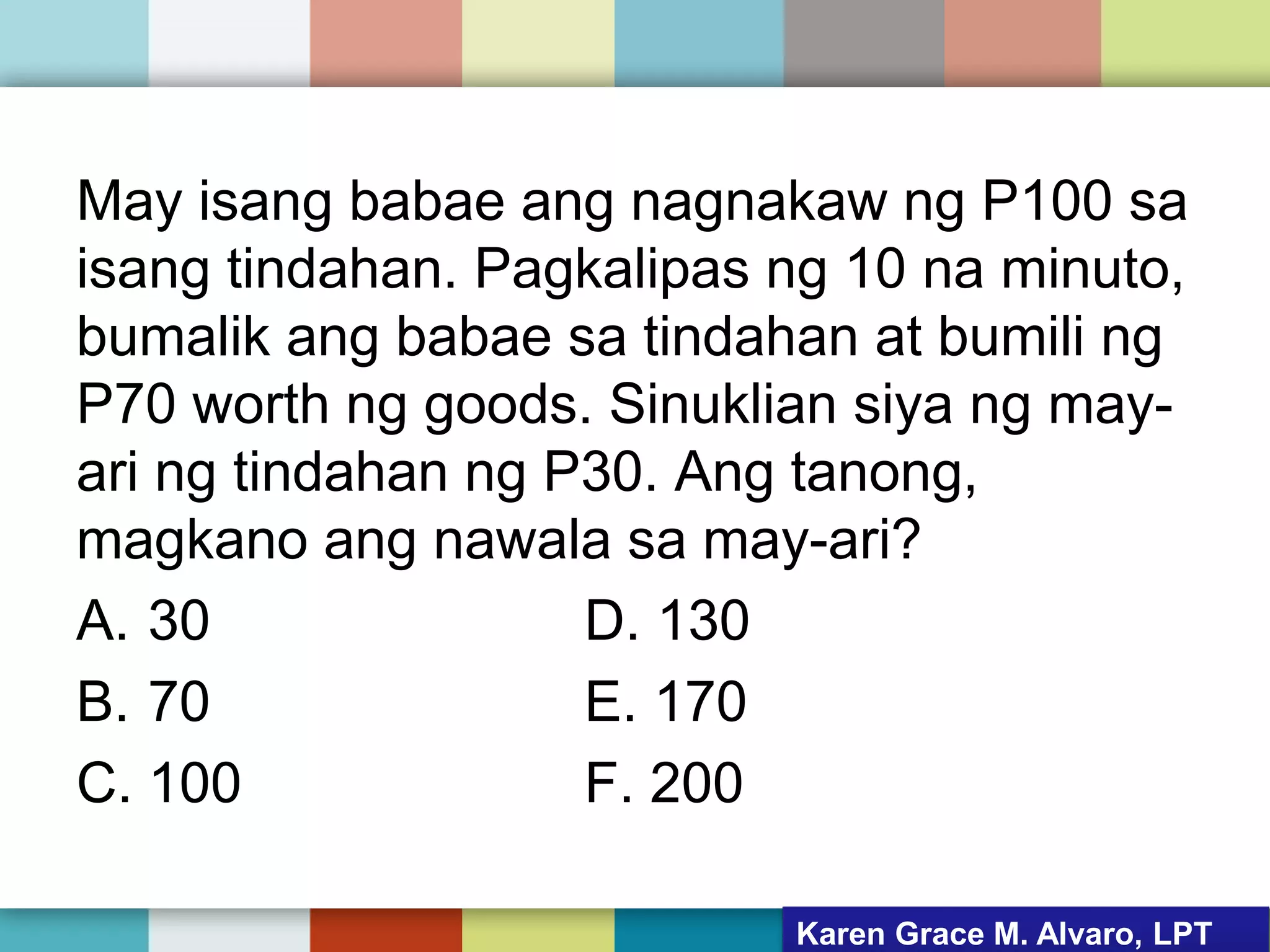
May isang babae ang nagnakaw ng P100 sa
isang tindahan. Pagkalipas ng 10 na minuto,
bumalik ang babae sa tindahan at bumili ng
P70 worth ng goods. Sinuklian siya ng may-
ari ng tindahan ng P30. Ang tanong,
magkano ang nawala sa may-ari?
A. 30 D. 130
B. 70 E. 170
C. 100 F. 200
Karen Grace M. Alvaro, LPT
PROBLEM METHOD
Karen Grace M. Alvaro, LPT
Nature
• It is the purposeful activity that will remove
a difficulty or perplexity through a process
of reasoning.
• Problem solving is both a learning and
teaching procedure.
Karen Grace M. Alvaro, LPT
• Reflective thinking is utilized in problem
solving; it consists of two phases:
(1)statement of the perplexity or difficulty
which gives rise to thinking, and
(2) the act of searching, or inquiry to find the
material that will solve or dispose of the
perplexity.
Karen Grace M. Alvaro, LPT
Types
• Mental.
• Symbolic.
• Real.
Karen Grace M. Alvaro, LPT
Functions
• To discover a new process
• To improve judgement
• To create a new idea
• To improve knowledge
• To entertain others
• To help another solve a problem
• To satisfy curiosity
Karen Grace M. Alvaro, LPT
Characteristics of a Good
Problem
• A difficulty exists which demands solution.
It is thought provoking.
• The problem is clear, definite, suitable to
the level of the learners and of practical
value.
• It is real, interesting and worthwhile to the
class.
Karen Grace M. Alvaro, LPT
Advantages
• It gives direction to a discussion and
prevents wandering off from the topic
• It contributes to the development of
personality
• It builds proper attitudes.
• The learners attitude toward schoolwork is
improved
Karen Grace M. Alvaro, LPT
Disadvantages
• Superficial thought
• Over rationalization
• Forming hasty conclusions
• Losing sight of the main thought
Karen Grace M. Alvaro, LPT
PROJECT METHOD
Karen Grace M. Alvaro, LPT
Characteristics
• Problematic in nature
• The activity should work toward a definite
attainable goal
• The activity should be purposeful, natural,
lifelike, and significant
• The pupil should plan, direct, and execute
the activities
Karen Grace M. Alvaro, LPT
Types of Problem Method
• Physical or Material Projects.
• Learning projects.
• Intellectual or Problem Projects.
Karen Grace M. Alvaro, LPT
Values
• It trains learners to be responsible and to
develop initiative.
• It trains learners to solve problems in
practical life situations.
• It develops the spirit of cooperation.
• It gives training in perseverance.
• It develops judgement.
• It encourages creative activity.
Karen Grace M. Alvaro, LPT
Advantages
• It emphasizes the practical in learning.
• It increases interest as it is practical and
tangible.
• It gives experience in making plans and in
selecting tools and materials.
• It encourages independent research in
applying criteria in a series of related
activities.
Karen Grace M. Alvaro, LPT
Disadvantages
• It is a slow way of learning and it is time
consuming
• It is expensive
• It is a failure in the hands of poor teachers
Karen Grace M. Alvaro, LPT
APPRECIATION
LESSON
Karen Grace M. Alvaro, LPT
Nature
• It is one that is designed to lead the class
to understand and enjoy something.
• One cannot fully appreciate what one does
not understand and enjoy something.
• Appreciation then is a combination of
understanding and enjoyment, or
intelligent enjoyment of something.
• It is also possible to learn to enjoy
something that is not for one’s good
Karen Grace M. Alvaro, LPT
Sources
• Literature
• Music
• Nature
• Arts
• Religion
• Culture
• Environment
Karen Grace M. Alvaro, LPT
Purposes
• is intelligent enjoyment of what is
worthwhile
• providing them with ways of spending
leisure hours in a wholesome and
profitable manner
• the activity of most values becomes an
interest and later, this may become a
hobby
Karen Grace M. Alvaro, LPT
Types of Appreciation
• Aesthetic appreciation.
• Ethical-social appreciation.
• Technical or intellectual appreciation
Karen Grace M. Alvaro, LPT
Procedure
• There is no single road to enjoyment and
therefore no hard-and-fast rule for
arousing appreciation.
Karen Grace M. Alvaro, LPT
Conditions for an Effective
Appreciation Lesson
• Knowledge on the part of the teacher of
what is to be appreciated
• Appreciation of the piece by the professor
himself
• Stimulation of the learners to appreciation
the piece
• Encouragement of the learners to discuss
the parts worth appreciating without the
teacher dictating or requiring it
Karen Grace M. Alvaro, LPT
REFERENCES
• Lardizabal, A. & et. Al. 2000. Principles
and methods of teaching. Phoenix
Publishing House, Inc. Phoenix Press,
Inc. 927 Quezon Avenue, Quezon City.
• Salandanan, G. & Corpuz B. 2007.
Principles of Teaching 1. Lorimar
Publishing, Inc. 176. Aurora Blvd., cor.
Boston St., Cubao, Quezon City, Metro
Manila
Karen Grace M. Alvaro, LPT
THANK YOU FOR
LISTENING!
Karen Grace M. Alvaro, LPT

Traditional Method of Teaching

  • 1.
    TRADITIONAL METHOD Karen Grace M.Alvaro, LPT Master in Arts Education- General Education Divine Word College of Laoag
  • 2.
  • 3.
  • 4.
    Review Lesson • torenew study of the same subject matter • to recall what has been taken up in the past and view this again from a different perspective or point of view • new associations, new relationships, new interpretations may be discovered Karen Grace M. Alvaro, LPT
  • 5.
    Purpose of Review •Retention of the material learned. • Organization of materials and experiences into large wholes. • Development of ability to evaluate material. • Supplementation of materials and experiences. • Foundation for further learning. Karen Grace M. Alvaro, LPT
  • 6.
    Purpose of Review •Diagnosis of weakness. • Development of interest in old materials. • Stimulation of original thinking and creativeness. • Tracing the core or main thought throughout a unit. • Reorganization of previously organized information into a new pattern. Karen Grace M. Alvaro, LPT
  • 7.
    Types of Review •The short pre-lesson daily review • The post-lesson unit review • Extensive large unit review • Oral or written reports • Topical outlines • Problem review • Cooperative review Karen Grace M. Alvaro, LPT
  • 8.
    Techniques of Review •Time of Review • Length of the Review • Preparation of Review Karen Grace M. Alvaro, LPT
  • 9.
    Principles of Review •The review must be of value to the learner. • The review should be interesting. • The review should follow the psychological principles of learning. Karen Grace M. Alvaro, LPT
  • 10.
    Conditions for GoodReview • Previous lessons must have been studied • Too much should not be covered in one lesson • The teacher should have thorough mastery of the subject and organize it as a whole Karen Grace M. Alvaro, LPT
  • 11.
    Karen Grace M.Alvaro, LPT
  • 12.
    May isang babaeang nagnakaw ng P100 sa isang tindahan. Pagkalipas ng 10 na minuto, bumalik ang babae sa tindahan at bumili ng P70 worth ng goods. Sinuklian siya ng may- ari ng tindahan ng P30. Ang tanong, magkano ang nawala sa may-ari? A. 30 D. 130 B. 70 E. 170 C. 100 F. 200 Karen Grace M. Alvaro, LPT
  • 13.
  • 14.
    Nature • It isthe purposeful activity that will remove a difficulty or perplexity through a process of reasoning. • Problem solving is both a learning and teaching procedure. Karen Grace M. Alvaro, LPT
  • 15.
    • Reflective thinkingis utilized in problem solving; it consists of two phases: (1)statement of the perplexity or difficulty which gives rise to thinking, and (2) the act of searching, or inquiry to find the material that will solve or dispose of the perplexity. Karen Grace M. Alvaro, LPT
  • 16.
    Types • Mental. • Symbolic. •Real. Karen Grace M. Alvaro, LPT
  • 17.
    Functions • To discovera new process • To improve judgement • To create a new idea • To improve knowledge • To entertain others • To help another solve a problem • To satisfy curiosity Karen Grace M. Alvaro, LPT
  • 18.
    Characteristics of aGood Problem • A difficulty exists which demands solution. It is thought provoking. • The problem is clear, definite, suitable to the level of the learners and of practical value. • It is real, interesting and worthwhile to the class. Karen Grace M. Alvaro, LPT
  • 19.
    Advantages • It givesdirection to a discussion and prevents wandering off from the topic • It contributes to the development of personality • It builds proper attitudes. • The learners attitude toward schoolwork is improved Karen Grace M. Alvaro, LPT
  • 20.
    Disadvantages • Superficial thought •Over rationalization • Forming hasty conclusions • Losing sight of the main thought Karen Grace M. Alvaro, LPT
  • 21.
  • 22.
    Characteristics • Problematic innature • The activity should work toward a definite attainable goal • The activity should be purposeful, natural, lifelike, and significant • The pupil should plan, direct, and execute the activities Karen Grace M. Alvaro, LPT
  • 23.
    Types of ProblemMethod • Physical or Material Projects. • Learning projects. • Intellectual or Problem Projects. Karen Grace M. Alvaro, LPT
  • 24.
    Values • It trainslearners to be responsible and to develop initiative. • It trains learners to solve problems in practical life situations. • It develops the spirit of cooperation. • It gives training in perseverance. • It develops judgement. • It encourages creative activity. Karen Grace M. Alvaro, LPT
  • 25.
    Advantages • It emphasizesthe practical in learning. • It increases interest as it is practical and tangible. • It gives experience in making plans and in selecting tools and materials. • It encourages independent research in applying criteria in a series of related activities. Karen Grace M. Alvaro, LPT
  • 26.
    Disadvantages • It isa slow way of learning and it is time consuming • It is expensive • It is a failure in the hands of poor teachers Karen Grace M. Alvaro, LPT
  • 27.
  • 28.
    Nature • It isone that is designed to lead the class to understand and enjoy something. • One cannot fully appreciate what one does not understand and enjoy something. • Appreciation then is a combination of understanding and enjoyment, or intelligent enjoyment of something. • It is also possible to learn to enjoy something that is not for one’s good Karen Grace M. Alvaro, LPT
  • 29.
    Sources • Literature • Music •Nature • Arts • Religion • Culture • Environment Karen Grace M. Alvaro, LPT
  • 30.
    Purposes • is intelligentenjoyment of what is worthwhile • providing them with ways of spending leisure hours in a wholesome and profitable manner • the activity of most values becomes an interest and later, this may become a hobby Karen Grace M. Alvaro, LPT
  • 31.
    Types of Appreciation •Aesthetic appreciation. • Ethical-social appreciation. • Technical or intellectual appreciation Karen Grace M. Alvaro, LPT
  • 32.
    Procedure • There isno single road to enjoyment and therefore no hard-and-fast rule for arousing appreciation. Karen Grace M. Alvaro, LPT
  • 33.
    Conditions for anEffective Appreciation Lesson • Knowledge on the part of the teacher of what is to be appreciated • Appreciation of the piece by the professor himself • Stimulation of the learners to appreciation the piece • Encouragement of the learners to discuss the parts worth appreciating without the teacher dictating or requiring it Karen Grace M. Alvaro, LPT
  • 34.
    REFERENCES • Lardizabal, A.& et. Al. 2000. Principles and methods of teaching. Phoenix Publishing House, Inc. Phoenix Press, Inc. 927 Quezon Avenue, Quezon City. • Salandanan, G. & Corpuz B. 2007. Principles of Teaching 1. Lorimar Publishing, Inc. 176. Aurora Blvd., cor. Boston St., Cubao, Quezon City, Metro Manila Karen Grace M. Alvaro, LPT
  • 35.
    THANK YOU FOR LISTENING! KarenGrace M. Alvaro, LPT