Teaching Strategies to
Develop Critical and
Creative Thinking as well as
Other Higher Thinking Skills
GRACE D. DILAO
SPEAKER
ACTIVITY
Reflect on your knowledge , skills and teaching
strategies to develop the learners’ critical, creative, and
other higher-order thinking skills
As a Proficient Teacher, I know…
As a Proficient Teacher, I do…
As a Proficient Teacher, I feel…
In this topic we will focus
on:
STRAND: Strategies for
developing critical and
creative thinking, as well
as other higher order
thinking skills
Key
Concepts Teaching Strategies
Creative Thinking Skills
Critical Thinking Skills
Higher-Order Thinking Skills
TEACHING STRATEGIES
These refer to the structure, system,
methods, techniques, procedures and
processes that a teacher uses during
instruction. These are strategies the
teacher employs to assist student
learning.
These are high level thinking skills such as
analysis, evaluation, interpretation, or
synthesis of information and application of
creative thought to form an argument,
solve a problem, or reach a conclusion.
CRITICAL THINKING SKILLS
HIGHER-ORDER THINKING SKILLS
 These are complex thinking
processes which include analysis,
evaluation, synthesis, reflection
and creativity.
Critical thinking is a higher-
order thinking skill.
Higher-order thinking skills go
beyond basic observation of facts
and memorization. They are what
we are talking about when we want
our students to be evaluative,
creative and innovative.
Higher-order thinking, known as higher
order thinking skills (HOTS), is a
concept of education reform based
on learning taxonomies (such as
Bloom's taxonomy).
Using Bloom’s Taxonomy of Thinking
Skills, the goal is to move students
 from lower- to higher-order thinking
 from knowledge (information gathering)
 to comprehension (confirming)
 to application (making use of knowledge)
 to analysis (taking information apart)
 to evaluation (judging the outcome)
 to synthesis (putting information together)
and creative generation
Development through Problem-
Based Strategies
Problem-based learning can be implemented by
considering these steps (Duch, Groh, and Allen,2001)
1. Choose a learning goal for the learners to attain
at the end of the instruction.
2. Think of a real-world context for the
understanding of the content. Build realistic
applications of the concept being taught.
3. Identify the teaching contexts where the
problem may be introduced.
4. Evaluate the learner’s performance using
appropriate tool/s and provide feedback. Make
and deliver activities/exercises aligned with the
lesson objectives.
Practices of teachers using problem-based learning
 Mila, an elementary Science teacher, facilitates the teaching process that will enable her learners to
decide the effects of a typhoon on the community.
 To allow her learners to demonstrate profound understanding of this competency, she engages her
class to work on a problem-based task as presented below.
Application: Your community is prone to destructive typhoons. In groups of 5, think of a possible
structure of a typhoon-proof house. Explain the reasons behind its structure.
Practices of teachers using problem-based learning
 Maritess, an elementary Araling Panlipunan teacher, enables her learners to patronize locally made
products. (AP6TDK-Ivgh-7: Naiuugnay ang kahalagahan ng pagtangkilik sa sariling produkto sa pag-
unlad at pagsulong ng bansa.)
 To facilitate understanding of the topic, she employs a group activity.
 Pangkatang Gawain: Bilang empleyado ng isang advertising company, naatasan kayong ipromote
ang local na produckto ng inyong bayan. Gumawa ng isang as campaign para rito.
Development
through Effective
Questioning
Strategies
Development through Effective
Questioning Strategies
 Effective questioning can be used as an
important classroom tool to develop
critical, creative and higher-order
thinking skills.
 According to McComas and Rossier
(2005), if you want your students to recall
and remember certain knowledge, ask
them low-level; convergent questions;
however, if you want to see if students
understand and are able to transfer
knowledge, ask them divergent questions.
To develop critical thinking among
your learners, your questions should
encourage them to analyze, evaluate
and create with sample tasks as
presented in the table.
Development
through
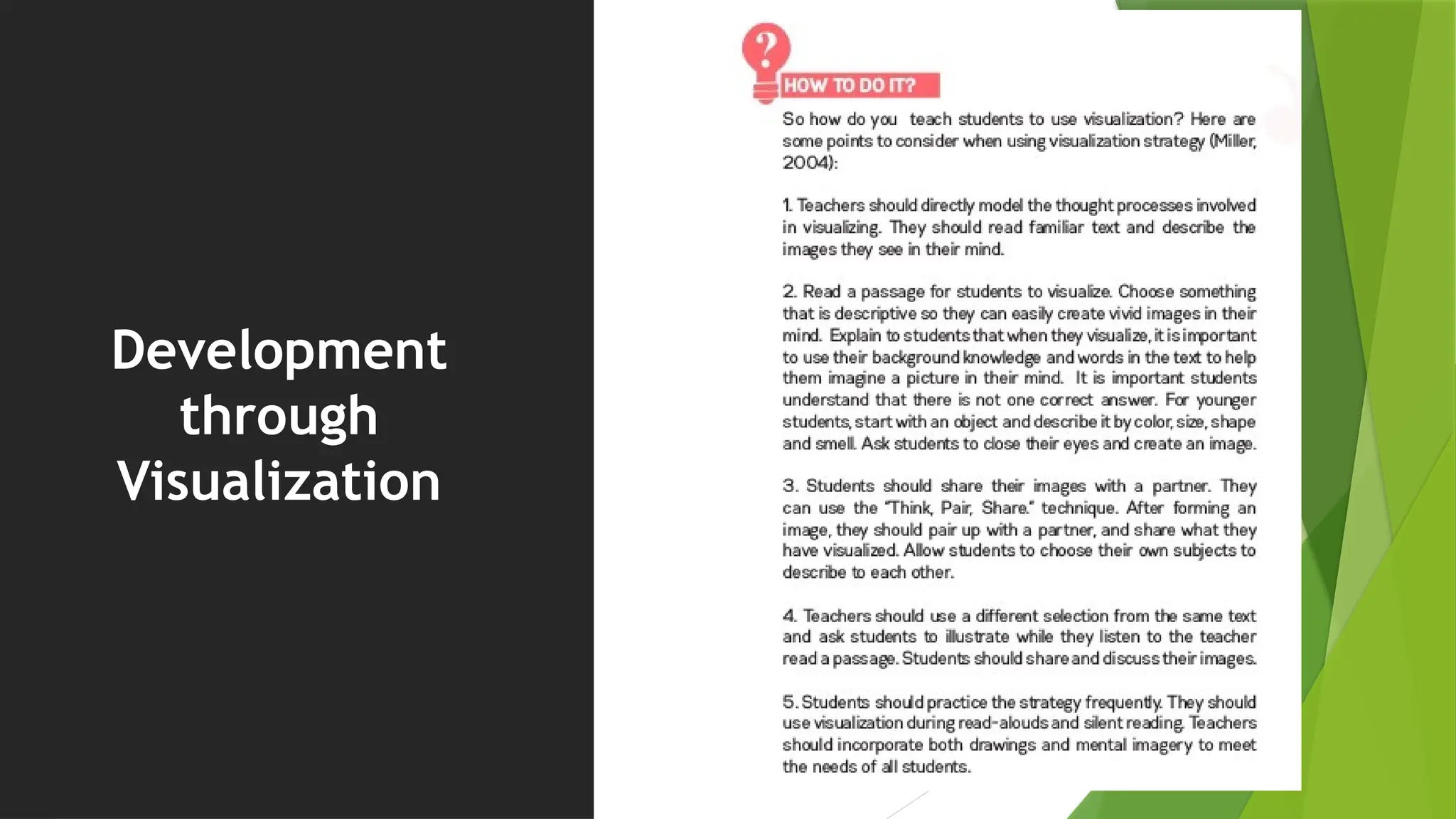
Visualization
Practices of teachers using
visualization
 Teacher Mhawi read an excerpt from
the story The Centipede by Rony V.
Diaz. As he read this to his students,
he instructed them to visualize the
text in their mind.
 Visualization is a creative strategy
which promotes insight, enhances
creativity, expands imagination, and
strengthens problem-solving skills.
Development through
Plus, Minus, Interesting
(PMI) Strategy
•Teacher Mandy prepared her
learners to facilitate
discussion in their carpentry
class. Their class is working
on the following competency:
formulate safety nets to
control hazards and risks in
the workplace.
(TLE_JACP7/8ID-Oi2)
How to do
the PMI?
The following might help you in using PMIs:
 Step 1. Consider the Plus Points
 Step 2. Consider the Minus Points
 Step 3. Consider the Interesting Points of the
Situation
 Step 4. Make your conclusion
Development through Role, Audience, Format
and Topic (RAFT) Strategy
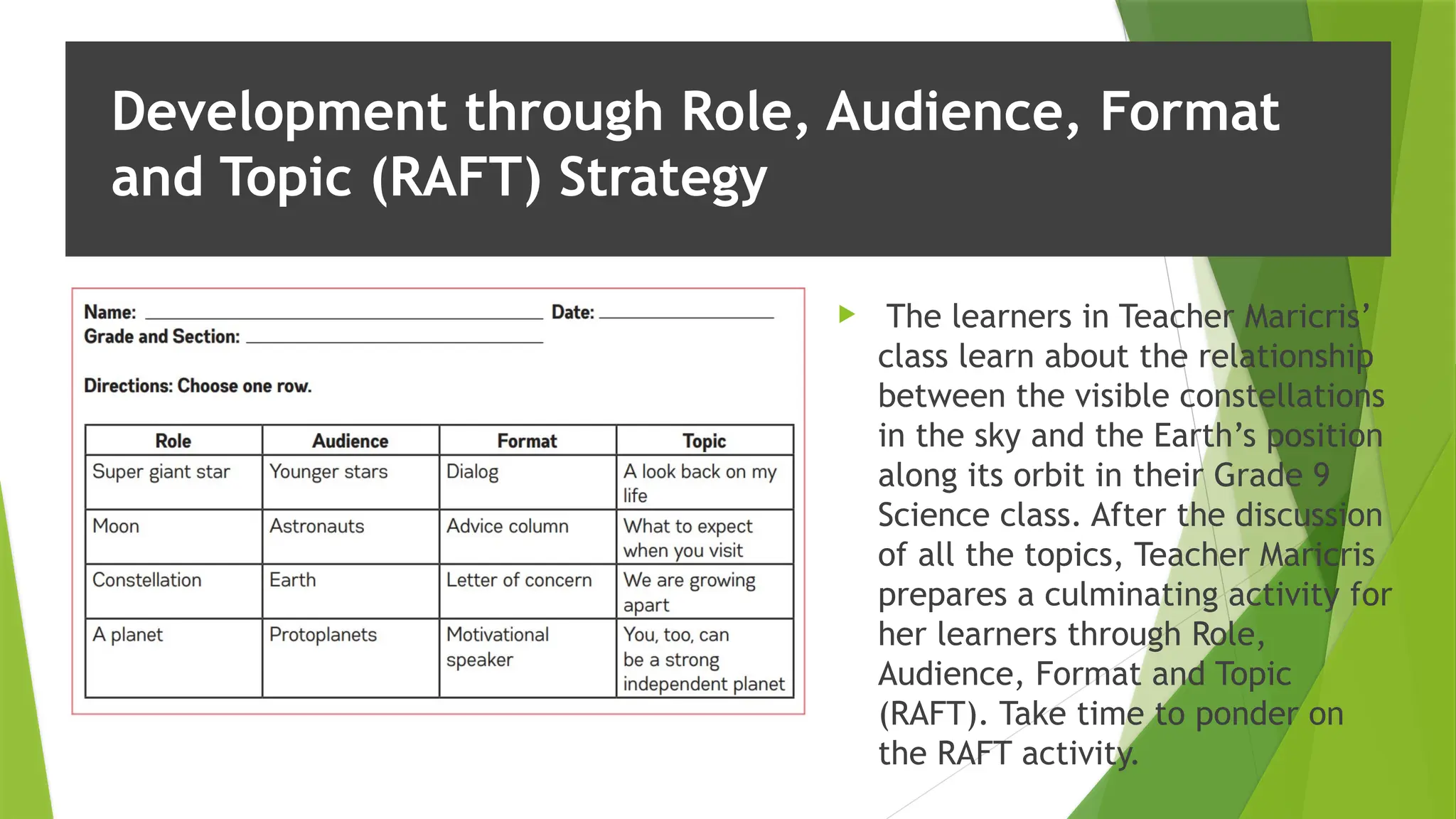
 The learners in Teacher Maricris’
class learn about the relationship
between the visible constellations
in the sky and the Earth’s position
along its orbit in their Grade 9
Science class. After the discussion
of all the topics, Teacher Maricris
prepares a culminating activity for
her learners through Role,
Audience, Format and Topic
(RAFT). Take time to ponder on
the RAFT activity.
Development through
Role, Audience, Format
and Topic (RAFT) Strategy
 It can be noted that Teacher Maricris does
not only focus on the content subject area
but also develops the critical and creative
thinking skills of the learners through the
use of RAFT strategy.
 According to Buehl (2009), RAFT is a writing
strategy that helps learners understand
their role as a writer and they can
communicate their ideas effectively. It also
helps the learners focus on their writing
task and discover ideas from writing. By
using this strategy, the teacher can
encourage the learners to write creatively
and effectively.
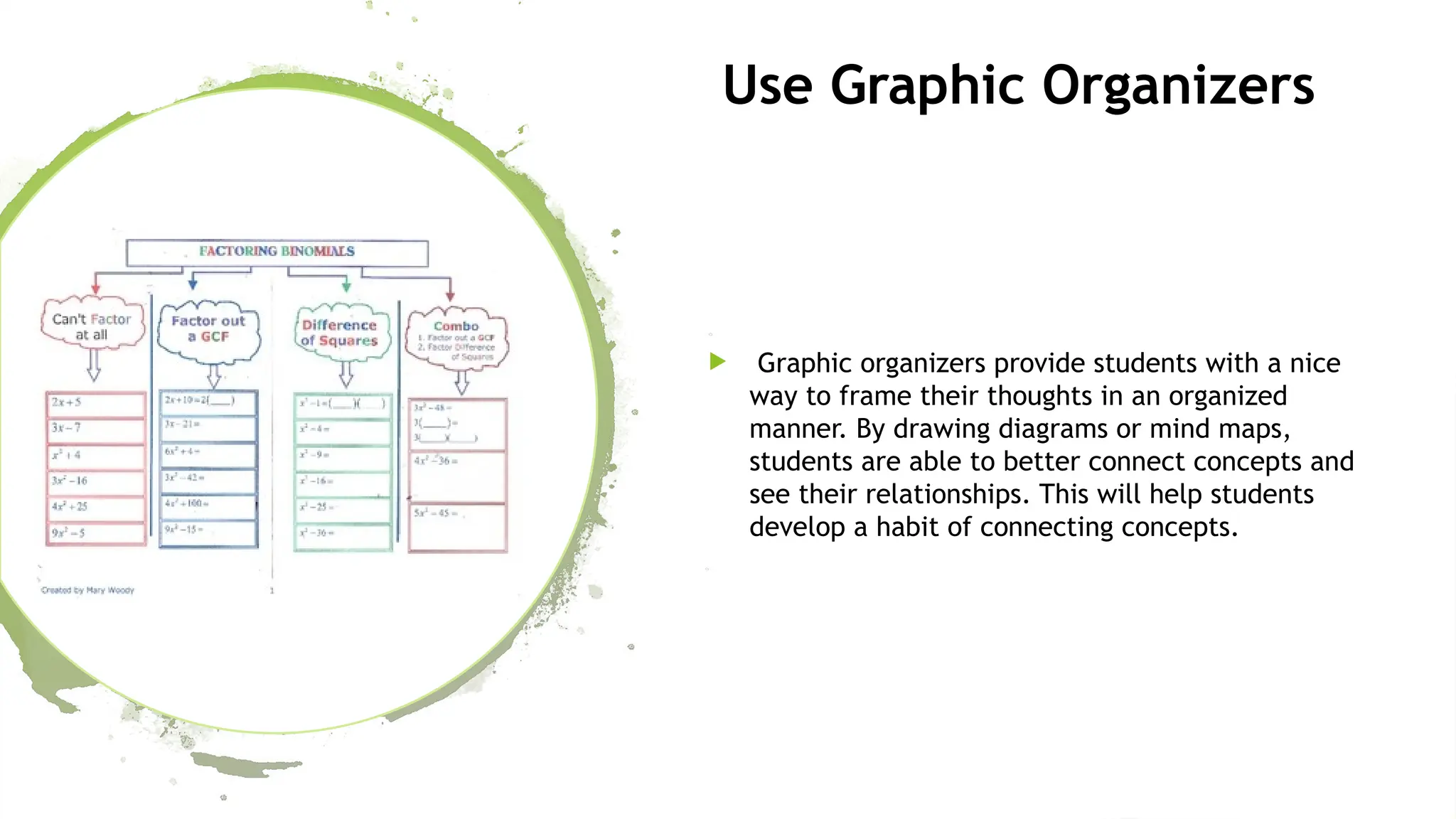
Use Graphic Organizers
 Graphic organizers provide students with a nice
way to frame their thoughts in an organized
manner. By drawing diagrams or mind maps,
students are able to better connect concepts and
see their relationships. This will help students
develop a habit of connecting concepts.
Different Types of
Graphic Organizers
 Concept Map
 Flow Diagram or Sequence Chart
 Compare/Contrast or Venn
Diagram
 Cause-and-Effect Diagram
 Main Idea and Details Chart
Other
illustratio
ns
practices
CRITICAL THINKING
• The teacher asks directive and purposeful questions to exercise learners’ problem
solving and decision-making skills.
• The teacher encourages learners to ask questions not just to provide answers but
to nurture their problem-solving skills.
• The teacher allows time for learners to ponder on questions, issues or problems.
• The teacher gives learners a variety of experiences that prompt learners to
formulate, infer, make decisions, consider possibilities, make judgements and solve
complex problems
Other
illustratio
ns
practices
CREATIVE THINKING
• The teacher employs divergent thinking strategies which encourages learners
to think “out of the box” by asking them to define a problem, provide solutions
and explain implications of the solution. Learners think of many different and
unusual ideas and points of view, then adds details to improve those ideas.
• The teacher uses instruction that is designed to aid learners in finding meaning
in an academic material and keep it by connecting it to their daily lives
Other
illustratio
ns
practices
CREATIVE THINKING
• The teacher uses visualization strategies where learners are tasked to create
mental images of something that cannot be seen or that does not exist.
• The teacher employs Creative Dramatics where learners explore ideas through
physical activities (e.g., pantomime, mirrors, debriefing).
• The teacher uses analogy where learners compare similar objects or abstract
processes (direct) or write about something in another’s perspective
(personal).
Other
illustratio
ns
practices
OTHER HIGHER-ORDER THINKING
• The teacher gives learners opportunities to assess their own work based on the learning
goals and make necessary adjustments
• The teacher teaches learners how to think aloud through modelling (e.g., Thinking
Hats).
• The teacher engages learners to think aloud about engaging themselves on a problem.
• Pupils are paired where one is the problem solver and the other is the listener. The pair
shares experience with the group (i.e. thinking aloud through collaborative inquiry).
Learners
extend the
discussion by
inviting
comments
from their
classmates and
challenging
one another’s
thinking
CRITICAL THINKING
• The teacher creates an environment where teacher and learners can freely communicate with
each other, express ideas and exchange views that others may not necessarily agree with.
CREATIVE THINKING
• The teacher asks learners to offer multiple varied solutions to
complex problems through brainstorming.
OTHER HIGHER-ORDER THINKING
• The teacher adopts activities that allow learners to monitor their
learning
Learners
themselves
ensure that
all voices are
heard in the
discussion.
CRITICAL THINKING
• The teacher ensures that questions are within the learners’ level of
ability or within the context of their experiences.
CREATIVE THINKING
• The teacher generates creative ideas from learners by providing a “big picture”
of what they are learning for them to have something to think flexibly about.
OTHER HIGHER-ORDER THINKING
• The teacher uses cooperative group work where learners are tasked to discuss
understanding, evaluate their own work and other’s work, and reflect on learning.
Sample Practices
 Two Grade 5 Science teachers teach the
same competency in Science: S5MTIc-d-2
Investigate changes that happen in
materials under the following conditions:
2.2 application of heat.
 Teacher A delivers a lecture on the changes
that happen to certain materials under the
application of heat. In her discussion, she
asks her learners questions, such as “What
happens to paper when it is burned?” To
evaluate their learning, she provides them
with a worksheet that contains questions
about the topic.
Sample Practices
 Two Grade 5 Science teachers teach the
same competency in Science: S5MTIc-d-2
Investigate changes that happen in
materials under the following conditions:
2.2 application of heat.
 Teacher B at the beginning of the lesson asks “What
will our lives be without heat?” Then, she poses the
question “What will happen to the different
materials when they are subjected to heat?” She
then elicits answers from the class and writes them
on the board. After, she guides the learners to
conduct experiments on the effect of heat on
various materials. She then allows them to present
and explain their findings. As an enrichment
activity, she asks them to think of a new device
that produces heat and to identify its function.
Let’s talk about it
 What can you say about their instructional
practice?
 In what way(s) do the teachers’ practice differ?
 Which teacher practice is more engaging for the
learners? Why?
 Which teacher practice will create more
meaningful learning experience for the learners?
Why?
Effective questioning strategies by
focusing on the set of questions
 a. Who were the characters in the story?
 b. Why was the mouse so eager to go to the
seashore?
 c. Why were his parents alarmed by his
decision?
 d. What challenges did he encounter on his
way to the seashore?
 e. What do you think did the parents mean
when they say “the world is full of terror” Do
you agree with what they said? Why or why not?
 f. What could be another way for the mouse to
pursue his dream?
 g. If you were to pursue your own dream, how
would you do it?
10 Teaching Strategies that
Enhance Higher-Order Thinking
1. Help Determine What Higher-Order Thinking is. Help
students understand what higher-order thinking is. ...
2.Encourage Questioning. ...
3.Connect Concepts. ...
4.Teach Students to Infer. ...
5.Use Graphic Organizers. ...
6.Teach Problem-Solving Strategies. ...
7.Encourage Creative Thinking. ...
8.Use Mind Movies.
9.Teach student to elaborate their answers
10.Teach QARs .( Question and Answer relationships)
Help students understand what higher-order
thinking is. ...
Explain to them what it is and why they need
it. Help them understand their own strengths
and challenges.
Encourage Questioning. ...
 A classroom where students feel free to ask
questions without any negative reactions
from their peers or their teachers is a
classroom where students feel free to be
creative.
Connect Concepts. ...
Lead students through the process of how to
connect one concept to another. By doing this
you are teaching them to connect what they
already know with what they are learning. This
level of thinking will help students learn to
make connections whenever it is possible, which
will help them gain even more understanding
Teach Students to Infer
 Teach students to make inferences by giving
them “Real-world” examples. You can start
by giving students a picture of a people
standing in line at a soup kitchen. Ask them
to look at the picture and focus on the
details. Then, ask them to make inferences
based on what they see in the picture.
Use Graphic Organizers
 Graphic organizers provide students with a
nice way to frame their thoughts in an
organized manner.
Teach Problem-Solving Strategies
 Teach students to use a step-by-step
method for solving problems. This way of
higher order thinking will help them solve
problems faster and easier.
Encourage Creative Thinking
 Creative thinking is when students invent,
imagine, and design what they are thinking.
Using your creative senses help students
process and understand information better.
Teach Students to Elaborate Their
Answers
 Higher-order thinking requires students to
really understand a concept not repeat it or
memorize it. Encourage students to
elaborate their answers and talk about
what they are learning.
Teach QARs
 Question-Answer-Relationships, or QARs, teach
students to label the type of question that is
being asked, then use that information to help
them formulate an answer. Students must
decipher if the answer can be found in a text
or on the Internet, or if they must rely on their
own prior knowledge to answer it.
Use Mind Movies
 When concepts that are being learned are
hard, encourage students to create a movie
in their mind. Teach them to close their eyes
and picture it like a movie playing. This way
of higher order thinking will truly help them
understand in a powerful, unique way.
References
 https://www.slideshare.net/knowellton/module3ppst152
 https://2.bp.blogspot.com/-udupyVjyNVM/XCtIhScVAJI/AAAAAAAIETQ/XMsZ-6
z-NrkonPghuPdq4LDRrpZqFHQgACLcBGAs/s1600/AW2856425_00.gif
 https://media1.giphy.com/media/uWzYKSRpgkWKfoSbmX/giphy.gif

https://www.teachhub.com/teaching-strategies/2019/10/teaching-strategies
-that-enhance-higher-order-thinking/
 https://education.wm.edu/centers/ttac/documents/articles/graphic_organiz
ers.pdf

Teaching-Strategies-to-Develop-Critical-and-Creative-Thinking_GRACE DILAO.pptx

  • 1.
    Teaching Strategies to DevelopCritical and Creative Thinking as well as Other Higher Thinking Skills GRACE D. DILAO SPEAKER
  • 3.
    ACTIVITY Reflect on yourknowledge , skills and teaching strategies to develop the learners’ critical, creative, and other higher-order thinking skills As a Proficient Teacher, I know… As a Proficient Teacher, I do… As a Proficient Teacher, I feel…
  • 4.
    In this topicwe will focus on: STRAND: Strategies for developing critical and creative thinking, as well as other higher order thinking skills
  • 5.
    Key Concepts Teaching Strategies CreativeThinking Skills Critical Thinking Skills Higher-Order Thinking Skills
  • 6.
    TEACHING STRATEGIES These referto the structure, system, methods, techniques, procedures and processes that a teacher uses during instruction. These are strategies the teacher employs to assist student learning.
  • 7.
    These are highlevel thinking skills such as analysis, evaluation, interpretation, or synthesis of information and application of creative thought to form an argument, solve a problem, or reach a conclusion. CRITICAL THINKING SKILLS
  • 8.
    HIGHER-ORDER THINKING SKILLS These are complex thinking processes which include analysis, evaluation, synthesis, reflection and creativity.
  • 9.
    Critical thinking isa higher- order thinking skill.
  • 10.
    Higher-order thinking skillsgo beyond basic observation of facts and memorization. They are what we are talking about when we want our students to be evaluative, creative and innovative.
  • 11.
    Higher-order thinking, knownas higher order thinking skills (HOTS), is a concept of education reform based on learning taxonomies (such as Bloom's taxonomy).
  • 12.
    Using Bloom’s Taxonomyof Thinking Skills, the goal is to move students  from lower- to higher-order thinking  from knowledge (information gathering)  to comprehension (confirming)  to application (making use of knowledge)  to analysis (taking information apart)  to evaluation (judging the outcome)  to synthesis (putting information together) and creative generation
  • 13.
    Development through Problem- BasedStrategies Problem-based learning can be implemented by considering these steps (Duch, Groh, and Allen,2001) 1. Choose a learning goal for the learners to attain at the end of the instruction. 2. Think of a real-world context for the understanding of the content. Build realistic applications of the concept being taught. 3. Identify the teaching contexts where the problem may be introduced. 4. Evaluate the learner’s performance using appropriate tool/s and provide feedback. Make and deliver activities/exercises aligned with the lesson objectives.
  • 14.
    Practices of teachersusing problem-based learning  Mila, an elementary Science teacher, facilitates the teaching process that will enable her learners to decide the effects of a typhoon on the community.  To allow her learners to demonstrate profound understanding of this competency, she engages her class to work on a problem-based task as presented below. Application: Your community is prone to destructive typhoons. In groups of 5, think of a possible structure of a typhoon-proof house. Explain the reasons behind its structure.
  • 15.
    Practices of teachersusing problem-based learning  Maritess, an elementary Araling Panlipunan teacher, enables her learners to patronize locally made products. (AP6TDK-Ivgh-7: Naiuugnay ang kahalagahan ng pagtangkilik sa sariling produkto sa pag- unlad at pagsulong ng bansa.)  To facilitate understanding of the topic, she employs a group activity.  Pangkatang Gawain: Bilang empleyado ng isang advertising company, naatasan kayong ipromote ang local na produckto ng inyong bayan. Gumawa ng isang as campaign para rito.
  • 16.
  • 17.
    Development through Effective QuestioningStrategies  Effective questioning can be used as an important classroom tool to develop critical, creative and higher-order thinking skills.  According to McComas and Rossier (2005), if you want your students to recall and remember certain knowledge, ask them low-level; convergent questions; however, if you want to see if students understand and are able to transfer knowledge, ask them divergent questions.
  • 18.
    To develop criticalthinking among your learners, your questions should encourage them to analyze, evaluate and create with sample tasks as presented in the table.
  • 19.
  • 20.
    Practices of teachersusing visualization  Teacher Mhawi read an excerpt from the story The Centipede by Rony V. Diaz. As he read this to his students, he instructed them to visualize the text in their mind.  Visualization is a creative strategy which promotes insight, enhances creativity, expands imagination, and strengthens problem-solving skills.
  • 21.
    Development through Plus, Minus,Interesting (PMI) Strategy •Teacher Mandy prepared her learners to facilitate discussion in their carpentry class. Their class is working on the following competency: formulate safety nets to control hazards and risks in the workplace. (TLE_JACP7/8ID-Oi2)
  • 23.
    How to do thePMI? The following might help you in using PMIs:  Step 1. Consider the Plus Points  Step 2. Consider the Minus Points  Step 3. Consider the Interesting Points of the Situation  Step 4. Make your conclusion
  • 24.
    Development through Role,Audience, Format and Topic (RAFT) Strategy  The learners in Teacher Maricris’ class learn about the relationship between the visible constellations in the sky and the Earth’s position along its orbit in their Grade 9 Science class. After the discussion of all the topics, Teacher Maricris prepares a culminating activity for her learners through Role, Audience, Format and Topic (RAFT). Take time to ponder on the RAFT activity.
  • 25.
    Development through Role, Audience,Format and Topic (RAFT) Strategy  It can be noted that Teacher Maricris does not only focus on the content subject area but also develops the critical and creative thinking skills of the learners through the use of RAFT strategy.  According to Buehl (2009), RAFT is a writing strategy that helps learners understand their role as a writer and they can communicate their ideas effectively. It also helps the learners focus on their writing task and discover ideas from writing. By using this strategy, the teacher can encourage the learners to write creatively and effectively.
  • 26.
    Use Graphic Organizers Graphic organizers provide students with a nice way to frame their thoughts in an organized manner. By drawing diagrams or mind maps, students are able to better connect concepts and see their relationships. This will help students develop a habit of connecting concepts.
  • 27.
    Different Types of GraphicOrganizers  Concept Map  Flow Diagram or Sequence Chart  Compare/Contrast or Venn Diagram  Cause-and-Effect Diagram  Main Idea and Details Chart
  • 28.
    Other illustratio ns practices CRITICAL THINKING • Theteacher asks directive and purposeful questions to exercise learners’ problem solving and decision-making skills. • The teacher encourages learners to ask questions not just to provide answers but to nurture their problem-solving skills. • The teacher allows time for learners to ponder on questions, issues or problems. • The teacher gives learners a variety of experiences that prompt learners to formulate, infer, make decisions, consider possibilities, make judgements and solve complex problems
  • 29.
    Other illustratio ns practices CREATIVE THINKING • Theteacher employs divergent thinking strategies which encourages learners to think “out of the box” by asking them to define a problem, provide solutions and explain implications of the solution. Learners think of many different and unusual ideas and points of view, then adds details to improve those ideas. • The teacher uses instruction that is designed to aid learners in finding meaning in an academic material and keep it by connecting it to their daily lives
  • 30.
    Other illustratio ns practices CREATIVE THINKING • Theteacher uses visualization strategies where learners are tasked to create mental images of something that cannot be seen or that does not exist. • The teacher employs Creative Dramatics where learners explore ideas through physical activities (e.g., pantomime, mirrors, debriefing). • The teacher uses analogy where learners compare similar objects or abstract processes (direct) or write about something in another’s perspective (personal).
  • 31.
    Other illustratio ns practices OTHER HIGHER-ORDER THINKING •The teacher gives learners opportunities to assess their own work based on the learning goals and make necessary adjustments • The teacher teaches learners how to think aloud through modelling (e.g., Thinking Hats). • The teacher engages learners to think aloud about engaging themselves on a problem. • Pupils are paired where one is the problem solver and the other is the listener. The pair shares experience with the group (i.e. thinking aloud through collaborative inquiry).
  • 32.
    Learners extend the discussion by inviting comments fromtheir classmates and challenging one another’s thinking CRITICAL THINKING • The teacher creates an environment where teacher and learners can freely communicate with each other, express ideas and exchange views that others may not necessarily agree with. CREATIVE THINKING • The teacher asks learners to offer multiple varied solutions to complex problems through brainstorming. OTHER HIGHER-ORDER THINKING • The teacher adopts activities that allow learners to monitor their learning
  • 33.
    Learners themselves ensure that all voicesare heard in the discussion. CRITICAL THINKING • The teacher ensures that questions are within the learners’ level of ability or within the context of their experiences. CREATIVE THINKING • The teacher generates creative ideas from learners by providing a “big picture” of what they are learning for them to have something to think flexibly about. OTHER HIGHER-ORDER THINKING • The teacher uses cooperative group work where learners are tasked to discuss understanding, evaluate their own work and other’s work, and reflect on learning.
  • 34.
    Sample Practices  TwoGrade 5 Science teachers teach the same competency in Science: S5MTIc-d-2 Investigate changes that happen in materials under the following conditions: 2.2 application of heat.
  • 35.
     Teacher Adelivers a lecture on the changes that happen to certain materials under the application of heat. In her discussion, she asks her learners questions, such as “What happens to paper when it is burned?” To evaluate their learning, she provides them with a worksheet that contains questions about the topic.
  • 36.
    Sample Practices  TwoGrade 5 Science teachers teach the same competency in Science: S5MTIc-d-2 Investigate changes that happen in materials under the following conditions: 2.2 application of heat.
  • 37.
     Teacher Bat the beginning of the lesson asks “What will our lives be without heat?” Then, she poses the question “What will happen to the different materials when they are subjected to heat?” She then elicits answers from the class and writes them on the board. After, she guides the learners to conduct experiments on the effect of heat on various materials. She then allows them to present and explain their findings. As an enrichment activity, she asks them to think of a new device that produces heat and to identify its function.
  • 38.
    Let’s talk aboutit  What can you say about their instructional practice?  In what way(s) do the teachers’ practice differ?  Which teacher practice is more engaging for the learners? Why?  Which teacher practice will create more meaningful learning experience for the learners? Why?
  • 39.
    Effective questioning strategiesby focusing on the set of questions  a. Who were the characters in the story?  b. Why was the mouse so eager to go to the seashore?  c. Why were his parents alarmed by his decision?  d. What challenges did he encounter on his way to the seashore?
  • 40.
     e. Whatdo you think did the parents mean when they say “the world is full of terror” Do you agree with what they said? Why or why not?  f. What could be another way for the mouse to pursue his dream?  g. If you were to pursue your own dream, how would you do it?
  • 41.
    10 Teaching Strategiesthat Enhance Higher-Order Thinking 1. Help Determine What Higher-Order Thinking is. Help students understand what higher-order thinking is. ... 2.Encourage Questioning. ... 3.Connect Concepts. ... 4.Teach Students to Infer. ... 5.Use Graphic Organizers. ... 6.Teach Problem-Solving Strategies. ... 7.Encourage Creative Thinking. ... 8.Use Mind Movies. 9.Teach student to elaborate their answers 10.Teach QARs .( Question and Answer relationships)
  • 42.
    Help students understandwhat higher-order thinking is. ... Explain to them what it is and why they need it. Help them understand their own strengths and challenges.
  • 43.
    Encourage Questioning. ... A classroom where students feel free to ask questions without any negative reactions from their peers or their teachers is a classroom where students feel free to be creative.
  • 44.
    Connect Concepts. ... Leadstudents through the process of how to connect one concept to another. By doing this you are teaching them to connect what they already know with what they are learning. This level of thinking will help students learn to make connections whenever it is possible, which will help them gain even more understanding
  • 45.
    Teach Students toInfer  Teach students to make inferences by giving them “Real-world” examples. You can start by giving students a picture of a people standing in line at a soup kitchen. Ask them to look at the picture and focus on the details. Then, ask them to make inferences based on what they see in the picture.
  • 46.
    Use Graphic Organizers Graphic organizers provide students with a nice way to frame their thoughts in an organized manner.
  • 47.
    Teach Problem-Solving Strategies Teach students to use a step-by-step method for solving problems. This way of higher order thinking will help them solve problems faster and easier.
  • 48.
    Encourage Creative Thinking Creative thinking is when students invent, imagine, and design what they are thinking. Using your creative senses help students process and understand information better.
  • 49.
    Teach Students toElaborate Their Answers  Higher-order thinking requires students to really understand a concept not repeat it or memorize it. Encourage students to elaborate their answers and talk about what they are learning.
  • 50.
    Teach QARs  Question-Answer-Relationships,or QARs, teach students to label the type of question that is being asked, then use that information to help them formulate an answer. Students must decipher if the answer can be found in a text or on the Internet, or if they must rely on their own prior knowledge to answer it.
  • 51.
    Use Mind Movies When concepts that are being learned are hard, encourage students to create a movie in their mind. Teach them to close their eyes and picture it like a movie playing. This way of higher order thinking will truly help them understand in a powerful, unique way.
  • 55.
    References  https://www.slideshare.net/knowellton/module3ppst152  https://2.bp.blogspot.com/-udupyVjyNVM/XCtIhScVAJI/AAAAAAAIETQ/XMsZ-6 z-NrkonPghuPdq4LDRrpZqFHQgACLcBGAs/s1600/AW2856425_00.gif https://media1.giphy.com/media/uWzYKSRpgkWKfoSbmX/giphy.gif  https://www.teachhub.com/teaching-strategies/2019/10/teaching-strategies -that-enhance-higher-order-thinking/  https://education.wm.edu/centers/ttac/documents/articles/graphic_organiz ers.pdf

Editor's Notes

  • #2 How’s the teacher in the illustration? Is She really facilitating critical thinking among his students? As Proficient teachers, we come to class every day with a hope that we will make learning for every learner meaningful. Equipped with sufficient knowledge and skills, we embrace the world of diverse learners. One of the challenges we face is how to engage them into classroom activities that foster critical, creative and higher-order thinking skills. More than making our learners remember what we teach, we also want them to use the knowledge they learn to analyze problems, evaluate options and create solutions. This can only be possible when learners are provided with classroom environments that develop and nurture their thinking skills.
  • #11 The idea is that some types of learning require more cognitive processing than others, but also have more generalized benefits.
  • #23 The following might help you in using PMIs: Step 1. Consider the Plus Points In this step, simply enumerate all of the positive things you can think of. Don’t critique yourself along the way; simply spill out all the positive points that you can think of. Step 2. Consider the Minus Points In this step, enumerate all of the negative things you can think of. Again, don’t critique yourself. Simply spill out all the negative points you can think of. Step 3. Consider the Interesting Points of the Situation In this step, enumerate all the interesting points that you can think of. Rather than positive or negative, they are simply points of interest that you should direct your attention to. Step 4. Make your conclusion In this step, you make your judgement because you’ve scanned and organized three important aspects: the positives, the negatives, and the interesting.
  • #38 Teacher A’s traditional lecture method centers on the role of teachers as transmitters and sources of knowledge. Consequently, learners are viewed as passive receivers of information. On the other hand, Teacher B demonstrates guided inquiry in instruction. She engages the learners through problem-based activities. She encourages them to experiment, to test their hypotheses, and to communicate their findings. As post-teaching activity, she asks them to create as an extension and application of what the learners learn in the class. These strategies stimulate them to infer, make decisions, formulate ideas and solve complex problems. We need to remember that our instruction should apply a range of strategies to develop creative, critical and higher-order thinking skills. Our learners are thinking and creative individuals. Our role then is to unleash the creativity in each of our learners.
  • #39 As you note, these questions require the learners to recall information from the text read. These call for low-order thinking skills like remembering. These questions, answered by single responses, are called convergent questions.
  • #40 On the other hand, these questions require learners to answer by analyzing, synthesizing, and evaluating. These are divergent, open-ended questions and may have multiple answers.
  • #42 Help students understand what higher-order thinking is. You can do this by showing them how they can ask themselves good questions.
  • #43 Encourage students to ask questions, and if for some reason you can’t get to their question during class time, then show them how they can answer it themselves, or have them save the question until the following day.
  • #44  let’s say that the concept they are learning is “Chinese New Year.” An even broader concept would be “Holidays,” and if you take it one step further it can be “Celebrations.” Each small concept can be connected to a bigger, broader concept.
  • #45 Another way to teach young students about how to infer is to teach an easy concept like weather. Ask students to put on their raincoat and boots, then ask them to infer what they think the weather looks like outside.
  • #46 By drawing diagrams or mind maps, students are able to better connect concepts and see their relationships. This will help students develop a habit of connecting concepts.
  • #47 Encourage students to use alternative methods to solve problems as well as offer them different problem-solving methods.
  • #48 Research shows that when students utilize creative higher order thinking skills, it indeed increases their understanding. Encourage students to think “Outside of the box.”
  • #49 Ask parents to reinforce this at home, as well by asking the right questions that make students explain their answers in more detail, or to answer their child’s question with a more detailed response.
  • #50 This strategy has been found to be effective for higher-order thinking because students become more aware of the relationship between the information in a text and their prior knowledge, which helps them decipher which strategy to use when they need to seek an answer.