TRADITIONAL LITERATURE “ Once Upon A Time,  in a Land Far Away…” ELE 620  Children’s Literature Cambridge College
BACKGROUND Definition: “Stories born of the oral tradition” Origins:  Stories handed down from generation to generation by word of mouth They come from any country, any culture Similarities can be found in tales from one country to another No identifiable author Recognizable literary patterns in all types
CATEGORIES Folktales Fables Myths Epics and Legends
FOLKTALES Types of folktales: Cumulative tales Pourquoi tales Beast tales Wonder tales Realistic tales
CUMULATIVE TALES Increased repetition of details building to a quick climax Can be found in all cultures Examples: Gingerbread Boy, Henny Penny, Old Woman and Her Pig
POURQUOI TALES “Why” stories that explain certain animal traits or characteristics or human customs Found in many African and Native American cultures Example:  “How the Animals Got Their Tales” “How Chipmunk Got His Stripes”
BEAST TALES Animals act and talk like humans Often appear as “tricksters” – weak outsmarts strong Common animal characters: Fish (Scandanavian, English, German) Bears, Wolves (Russian) Spiders, Rabbits, Monkeys, Tortoises, Crocodiles, Lions (African) Rabbits, Badgers, Monkeys, Bees (Japanese)
WONDER TALES Also called “Fairy Tales” Contain magic and supernatural Usually have fairies, or other magical characters such as witches, ogres, trolls, demons Often contain a quest, romance and adventure “ Once Upon a Time,” “Happily Ever After” Truth, love, kindness will prevail Wickedness, hate, evil will be punished
REALISTIC TALES Stories that involve no magic Could really have happened, some actually may have happened Begins with a real person but is embellished from many retellings Examples: Zlateh the Goat The Boy of the Three-Year Nap
TALL TALES Most common in American folklore Superlatives – biggest, highest, strongest… Mixture of humor, bravado, and pioneer spirit Examples: Paul Bunyan, Pecos Bill, John Henry, Johnny Appleseed
FOLK TALE CHARACTERISTICS  What are the common characteristics in all folktales? Plot Structure Characterization Style Themes Motifs
PLOT STRUCTURE Short, simple, fast moving Humorous, happy endings Good rewarded, evil punished Wishes come true, but a task must be accomplished Youngest child usually succeeds, oldest defeated Repetition, responses and chants Number 3 is significant Quick establishment of time and place, although indefinite
CHARACTERIZATION Flat dimensions (completely good or completely evil) Examples: Beautiful girl who is virtuous, humble, patient Stepmothers who are ugly, cross, mean Poor are long-suffering, kind, generous Rich are hardhearted, conniving and dishonest
STYLE Offer opportunities for children to hear rich qualitative language and language patterns Should maintain the “flavor” of the culture but still understood by a wide audience Figurative language but not much description Often imitate sounds of the story Written as though a storyteller is speaking directly to the reader Maintains atmosphere of the culture of origin
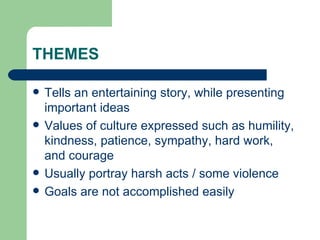
THEMES Tells an entertaining story, while presenting important ideas Values of culture expressed such as humility, kindness, patience, sympathy, hard work, and courage Usually portray harsh acts / some violence Goals are not accomplished easily
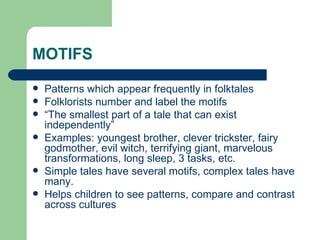
MOTIFS Patterns which appear frequently in folktales Folklorists number and label the motifs  “ The smallest part of a tale that can exist independently” Examples: youngest brother, clever trickster, fairy godmother, evil witch, terrifying giant, marvelous transformations, long sleep, 3 tasks, etc. Simple tales have several motifs, complex tales have many. Helps children to see patterns, compare and contrast across cultures
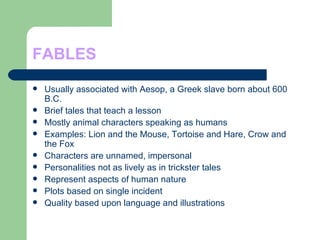
FABLES Usually associated with Aesop, a Greek slave born about 600 B.C.  Brief tales that teach a lesson Mostly animal characters speaking as humans Examples: Lion and the Mouse, Tortoise and Hare, Crow and the Fox Characters are unnamed, impersonal Personalities not as lively as in trickster tales Represent aspects of human nature Plots based on single incident Quality based upon language and illustrations
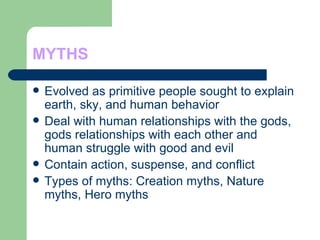
MYTHS Evolved as primitive people sought to explain earth, sky, and human behavior Deal with human relationships with the gods, gods relationships with each other and human struggle with good and evil Contain action, suspense, and conflict Types of myths: Creation myths, Nature myths, Hero myths
EPICS AND LEGENDS A long narrative clustering around a single hero A story form that grew out of myths with gods intervening in some stories but mostly involve human heroes Heroes embodying all ideal characteristics of the time, highest morals of society Robin Hood (justice and freedom) King Arthur (chivalry) Knowledge of epics gives children understanding of different cultures, and models of greatness through the ages
ALL AROUND THE WORLD Every culture has produced folklore. The study of these tales can provide insights into the beliefs of these people, their values, their jokes, their lifestyles, histories. A cross-cultural study of folktales can provide children with an opportunity to discover the universal qualities of humankind.

Traditional Literature

  • 1.
    TRADITIONAL LITERATURE “Once Upon A Time, in a Land Far Away…” ELE 620 Children’s Literature Cambridge College
  • 2.
    BACKGROUND Definition: “Storiesborn of the oral tradition” Origins: Stories handed down from generation to generation by word of mouth They come from any country, any culture Similarities can be found in tales from one country to another No identifiable author Recognizable literary patterns in all types
  • 3.
    CATEGORIES Folktales FablesMyths Epics and Legends
  • 4.
    FOLKTALES Types offolktales: Cumulative tales Pourquoi tales Beast tales Wonder tales Realistic tales
  • 5.
    CUMULATIVE TALES Increasedrepetition of details building to a quick climax Can be found in all cultures Examples: Gingerbread Boy, Henny Penny, Old Woman and Her Pig
  • 6.
    POURQUOI TALES “Why”stories that explain certain animal traits or characteristics or human customs Found in many African and Native American cultures Example: “How the Animals Got Their Tales” “How Chipmunk Got His Stripes”
  • 7.
    BEAST TALES Animalsact and talk like humans Often appear as “tricksters” – weak outsmarts strong Common animal characters: Fish (Scandanavian, English, German) Bears, Wolves (Russian) Spiders, Rabbits, Monkeys, Tortoises, Crocodiles, Lions (African) Rabbits, Badgers, Monkeys, Bees (Japanese)
  • 8.
    WONDER TALES Alsocalled “Fairy Tales” Contain magic and supernatural Usually have fairies, or other magical characters such as witches, ogres, trolls, demons Often contain a quest, romance and adventure “ Once Upon a Time,” “Happily Ever After” Truth, love, kindness will prevail Wickedness, hate, evil will be punished
  • 9.
    REALISTIC TALES Storiesthat involve no magic Could really have happened, some actually may have happened Begins with a real person but is embellished from many retellings Examples: Zlateh the Goat The Boy of the Three-Year Nap
  • 10.
    TALL TALES Mostcommon in American folklore Superlatives – biggest, highest, strongest… Mixture of humor, bravado, and pioneer spirit Examples: Paul Bunyan, Pecos Bill, John Henry, Johnny Appleseed
  • 11.
    FOLK TALE CHARACTERISTICS What are the common characteristics in all folktales? Plot Structure Characterization Style Themes Motifs
  • 12.
    PLOT STRUCTURE Short,simple, fast moving Humorous, happy endings Good rewarded, evil punished Wishes come true, but a task must be accomplished Youngest child usually succeeds, oldest defeated Repetition, responses and chants Number 3 is significant Quick establishment of time and place, although indefinite
  • 13.
    CHARACTERIZATION Flat dimensions(completely good or completely evil) Examples: Beautiful girl who is virtuous, humble, patient Stepmothers who are ugly, cross, mean Poor are long-suffering, kind, generous Rich are hardhearted, conniving and dishonest
  • 14.
    STYLE Offer opportunitiesfor children to hear rich qualitative language and language patterns Should maintain the “flavor” of the culture but still understood by a wide audience Figurative language but not much description Often imitate sounds of the story Written as though a storyteller is speaking directly to the reader Maintains atmosphere of the culture of origin
  • 15.
    THEMES Tells anentertaining story, while presenting important ideas Values of culture expressed such as humility, kindness, patience, sympathy, hard work, and courage Usually portray harsh acts / some violence Goals are not accomplished easily
  • 16.
    MOTIFS Patterns whichappear frequently in folktales Folklorists number and label the motifs “ The smallest part of a tale that can exist independently” Examples: youngest brother, clever trickster, fairy godmother, evil witch, terrifying giant, marvelous transformations, long sleep, 3 tasks, etc. Simple tales have several motifs, complex tales have many. Helps children to see patterns, compare and contrast across cultures
  • 17.
    FABLES Usually associatedwith Aesop, a Greek slave born about 600 B.C. Brief tales that teach a lesson Mostly animal characters speaking as humans Examples: Lion and the Mouse, Tortoise and Hare, Crow and the Fox Characters are unnamed, impersonal Personalities not as lively as in trickster tales Represent aspects of human nature Plots based on single incident Quality based upon language and illustrations
  • 18.
    MYTHS Evolved asprimitive people sought to explain earth, sky, and human behavior Deal with human relationships with the gods, gods relationships with each other and human struggle with good and evil Contain action, suspense, and conflict Types of myths: Creation myths, Nature myths, Hero myths
  • 19.
    EPICS AND LEGENDSA long narrative clustering around a single hero A story form that grew out of myths with gods intervening in some stories but mostly involve human heroes Heroes embodying all ideal characteristics of the time, highest morals of society Robin Hood (justice and freedom) King Arthur (chivalry) Knowledge of epics gives children understanding of different cultures, and models of greatness through the ages
  • 20.
    ALL AROUND THEWORLD Every culture has produced folklore. The study of these tales can provide insights into the beliefs of these people, their values, their jokes, their lifestyles, histories. A cross-cultural study of folktales can provide children with an opportunity to discover the universal qualities of humankind.