African American Literature  1970 - Present Lit 325 Cambridge College Christina J. Brownell Senior Instructor
The Second Awakening Impact of African American artistic production on world culture had never been greater Work in film and television, music, and painting made African American artists household names Never before had so much distinguished writing been produced by black Americans
Film and Television  James Earl Jones Eddie Murphy Denzel Washington Whoopi Goldberg Spike Lee Will Smith
Recording artists Michael Jackson Ray Charles Stevie Wonder Whitney Houston Marvin Gaye Tina Turner
Artists and Painters Romare Beardon Jacob Lawrence Faith Ringgold
Writers Maya Angelou Toni Morrison Ernest J. Gaines Alice Walker Octavia Butler Jamaica Kincaid Toni Cade Bambera Rita Dove Walter Mosley Edwidge Danticat
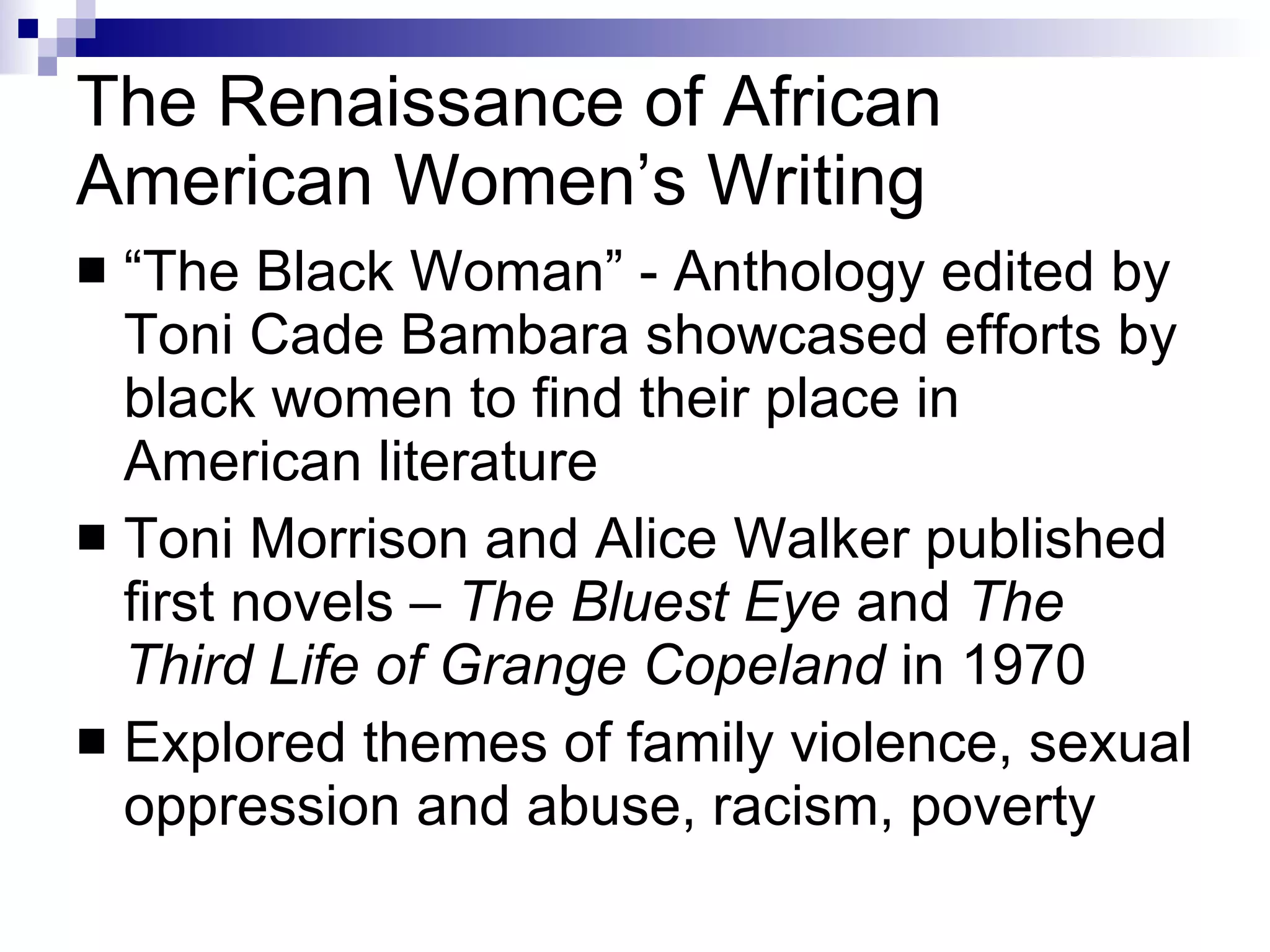
The Renaissance of African American Women’s Writing “The Black Woman” - Anthology edited by Toni Cade Bambara showcased efforts by black women to find their place in American literature Toni Morrison and Alice Walker published first novels –  The Bluest Eye  and  The Third Life of Grange Copeland  in 1970 Explored themes of family violence, sexual oppression and abuse, racism, poverty
Private vs. Public Trauma Writings such as Maya Angelou’s autobiographical description of childhood rape,  I Know Why the Caged Bird Sings,  did not focus on traumatic encounters between blacks and whites, but on violent intimate relationships Black women writers were accused of bashing black men,  and being disloyal to race
Maya Angelou (1928 - ) Poet, educator, historian, best-selling author, actress, playwright, civil-rights activist, producer and director Born in St. Louis, Missouri,  and raised in St. Louis and Stamps, Arkansas  With the guidance of her friend, James Baldwin, she wrote  I Know Why the Caged Bird Sings,  in 1970 President Clinton requested that she compose a poem to read at his inauguration in 1993, and her reading of  "On the Pulse of the Morning"  was broadcast live around the world.
Alice Walker (1944 - ) Poet, short story writer, novelist, essayist, anthologist, teacher, editor, publisher, and activist Born in Georgia, a self-described “daughter of the rural peasantry”  Won the Pulitzer Prize in 1983 for  The Color Purple
“ What did it mean for a black woman to be an artist in our grandmother’s day?” Alice Walker explored this theme in her essay, “In Search of Our Mother’s Gardens” Generations of black women artists released their creativity in song, quilt- making, baking, and gardening
The creative will of African American women  “ Walker wants readers to consider how the will to artistically create is linked to the will to survive, especially for those in society who have historically been denied any and all expressions of freedom, including creativity.  It is within this link between survival and creativity that Walker opens up a new way in which to think about artistry, specifically the artistry of African American women, by considering the smallest efforts at preserving momentary “beauties” as herculean efforts at maintaining humanity.  Under her perspective, survival itself becomes an act of artistry.” ~Barbara Smith “Toward a Black Feminist Criticism
Haunting Memoirs, Powerful Poetry This period saw the resurgence of memoir as a prominent genre, reminiscent of traditional African American storytelling Poetry “slams” became popular in clubs, campuses, and television Performance poetry – meant to be heard rather than read
“ Oprah’s Book Club” In 1996, Oprah Winfrey established a book club for television audiences, featuring fiction by  Toni Morrison ,  Pearl  Cleage ,  Terry McMillan  and other emerging writers  These books sold in the millions, and the number of novels published by African Americans increased immensely Across the nation, readers organized book clubs to discuss what they were reading
“ Black Texts Talk to other Black Texts” Contemporary writers acknowledge the influence of traditional writing in their own work Patterns of shared themes reflected in use of established texts “repeated with a black difference”
Identity and Literature Traditional African American literary study has always been interdisciplinary- combining art, music, film, religion, history, and folklore  Today’s black popular culture is strongly influenced through interaction with film, video, and mass produced music  African American literary and cultural scholarship is now firmly grounded in the merging of these two influences
“ I would hurl words into this darkness and wait for an echo, and if an echo sounded, no matter how faintly, I would send other words to tell, to march, to fight, to create a sense of hunger for life that gnaws in us all” ~ Richard Wright

African American Literature

  • 1.
    African American Literature 1970 - Present Lit 325 Cambridge College Christina J. Brownell Senior Instructor
  • 2.
    The Second AwakeningImpact of African American artistic production on world culture had never been greater Work in film and television, music, and painting made African American artists household names Never before had so much distinguished writing been produced by black Americans
  • 3.
    Film and Television James Earl Jones Eddie Murphy Denzel Washington Whoopi Goldberg Spike Lee Will Smith
  • 4.
    Recording artists MichaelJackson Ray Charles Stevie Wonder Whitney Houston Marvin Gaye Tina Turner
  • 5.
    Artists and PaintersRomare Beardon Jacob Lawrence Faith Ringgold
  • 6.
    Writers Maya AngelouToni Morrison Ernest J. Gaines Alice Walker Octavia Butler Jamaica Kincaid Toni Cade Bambera Rita Dove Walter Mosley Edwidge Danticat
  • 7.
    The Renaissance ofAfrican American Women’s Writing “The Black Woman” - Anthology edited by Toni Cade Bambara showcased efforts by black women to find their place in American literature Toni Morrison and Alice Walker published first novels – The Bluest Eye and The Third Life of Grange Copeland in 1970 Explored themes of family violence, sexual oppression and abuse, racism, poverty
  • 8.
    Private vs. PublicTrauma Writings such as Maya Angelou’s autobiographical description of childhood rape, I Know Why the Caged Bird Sings, did not focus on traumatic encounters between blacks and whites, but on violent intimate relationships Black women writers were accused of bashing black men, and being disloyal to race
  • 9.
    Maya Angelou (1928- ) Poet, educator, historian, best-selling author, actress, playwright, civil-rights activist, producer and director Born in St. Louis, Missouri, and raised in St. Louis and Stamps, Arkansas With the guidance of her friend, James Baldwin, she wrote I Know Why the Caged Bird Sings, in 1970 President Clinton requested that she compose a poem to read at his inauguration in 1993, and her reading of "On the Pulse of the Morning" was broadcast live around the world.
  • 10.
    Alice Walker (1944- ) Poet, short story writer, novelist, essayist, anthologist, teacher, editor, publisher, and activist Born in Georgia, a self-described “daughter of the rural peasantry” Won the Pulitzer Prize in 1983 for The Color Purple
  • 11.
    “ What didit mean for a black woman to be an artist in our grandmother’s day?” Alice Walker explored this theme in her essay, “In Search of Our Mother’s Gardens” Generations of black women artists released their creativity in song, quilt- making, baking, and gardening
  • 12.
    The creative willof African American women “ Walker wants readers to consider how the will to artistically create is linked to the will to survive, especially for those in society who have historically been denied any and all expressions of freedom, including creativity.  It is within this link between survival and creativity that Walker opens up a new way in which to think about artistry, specifically the artistry of African American women, by considering the smallest efforts at preserving momentary “beauties” as herculean efforts at maintaining humanity.  Under her perspective, survival itself becomes an act of artistry.” ~Barbara Smith “Toward a Black Feminist Criticism
  • 13.
    Haunting Memoirs, PowerfulPoetry This period saw the resurgence of memoir as a prominent genre, reminiscent of traditional African American storytelling Poetry “slams” became popular in clubs, campuses, and television Performance poetry – meant to be heard rather than read
  • 14.
    “ Oprah’s BookClub” In 1996, Oprah Winfrey established a book club for television audiences, featuring fiction by Toni Morrison , Pearl Cleage , Terry McMillan and other emerging writers These books sold in the millions, and the number of novels published by African Americans increased immensely Across the nation, readers organized book clubs to discuss what they were reading
  • 15.
    “ Black TextsTalk to other Black Texts” Contemporary writers acknowledge the influence of traditional writing in their own work Patterns of shared themes reflected in use of established texts “repeated with a black difference”
  • 16.
    Identity and LiteratureTraditional African American literary study has always been interdisciplinary- combining art, music, film, religion, history, and folklore Today’s black popular culture is strongly influenced through interaction with film, video, and mass produced music African American literary and cultural scholarship is now firmly grounded in the merging of these two influences
  • 17.
    “ I wouldhurl words into this darkness and wait for an echo, and if an echo sounded, no matter how faintly, I would send other words to tell, to march, to fight, to create a sense of hunger for life that gnaws in us all” ~ Richard Wright