Traditional Literature
Folktales, Fables, Fairytales, Myths
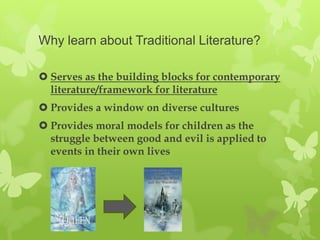
Why learn about Traditional Literature?

 Serves as the building blocks for contemporary
  literature/framework for literature
 Provides a window on diverse cultures
 Provides moral models for children as the
  struggle between good and evil is applied to
  events in their own lives
Folktale

A story told by word of
 mouth to teach a lesson
Passed down from
 generation to generation
Folk tale
 Folktales feature common people, such as
  peasants, and commonplace events.
 Characters representing human frailty (being
  fragile).
 Characters represent human qualities
   Good
   Evil
   Wisdom
   Foolishness
   Laziness
   Etc.
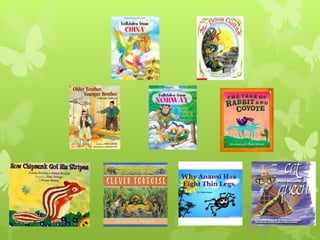
Folktales

The conflict of the story is clear.
The resolution usually has happy endings
Good is rewarded and evil is punished
Elements of magic or magical characters
 may be incorporated, but logic rules so
 the supernatural must make sense in the
 story.
Fables
 Short stories that teach a moral (lesson)
   Plot is very brief, with one event.
 Animal characters with human characteristics
   Characters are flat, and stand for one human
    trait.
 Themes: cooperation, understanding,
  acceptance, etc.
   Morals sometimes are inferred.
   May be expressed in a proverb.
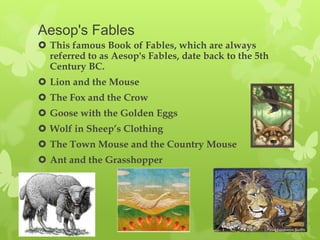
Aesop's Fables
 This famous Book of Fables, which are always
  referred to as Aesop's Fables, date back to the 5th
  Century BC.
 Lion and the Mouse
 The Fox and the Crow
 Goose with the Golden Eggs
 Wolf in Sheep’s Clothing
 The Town Mouse and the Country Mouse
 Ant and the Grasshopper
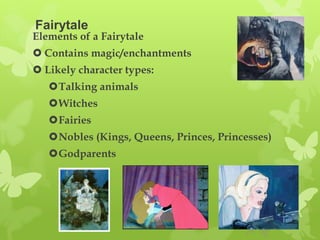
Fairytale
Elements of a Fairytale
 Contains magic/enchantments
 Likely character types:
   Talking animals
   Witches
   Fairies
   Nobles (Kings, Queens, Princes, Princesses)
   Godparents
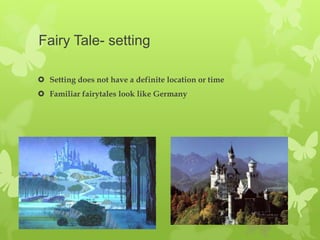
Fairy Tale- setting

 Setting does not have a definite location or time
 Familiar fairytales look like Germany
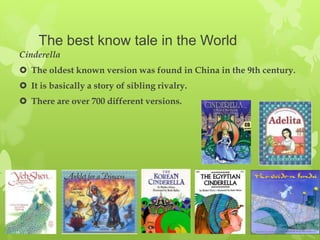
The best know tale in the World
Cinderella
 The oldest known version was found in China in the 9th century.
 It is basically a story of sibling rivalry.
 There are over 700 different versions.
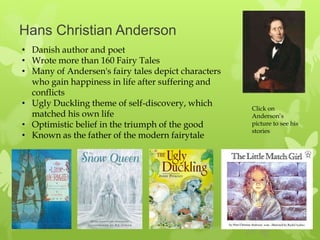
Hans Christian Anderson
• Danish author and poet
• Wrote more than 160 Fairy Tales
• Many of Andersen's fairy tales depict characters
  who gain happiness in life after suffering and
  conflicts
• Ugly Duckling theme of self-discovery, which
                                                     Click on
  matched his own life                               Anderson’s
• Optimistic belief in the triumph of the good       picture to see his
                                                     stories
• Known as the father of the modern fairytale
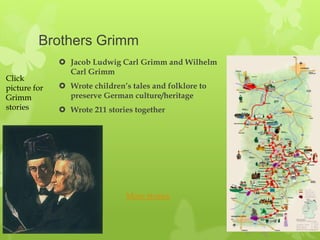
Brothers Grimm
               Jacob Ludwig Carl Grimm and Wilhelm
                Carl Grimm
Click
picture for    Wrote children’s tales and folklore to
Grimm           preserve German culture/heritage
stories        Wrote 211 stories together


                                More stories
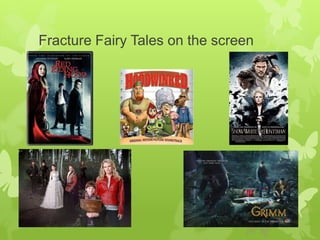
Fractured Fairy tale
 When authors modernize or change one or more of
  the elements of the story, the story is called a
  fractured fairy tale.


 Plot (conflict, rising action, climax, falling action,
  resolution)
 Setting (time and/or place)
 Character (name, character traits)
 Point of View
 Theme
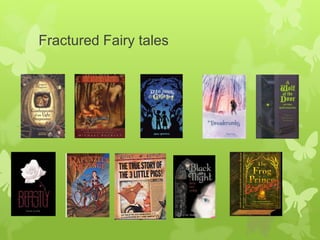
Fractured Fairy tales
Fracture Fairy Tales on the screen
Myths

 A mythology is a related body of stories which
  make up the official beliefs or explanations of
  a religious system.
 Myths attempt to explain the beginning of the
  world, natural phenomena, the relationships
  between the gods and humans, and the origins
  of civilization.
 Myths, like legends, are stories told as though
  they were true.
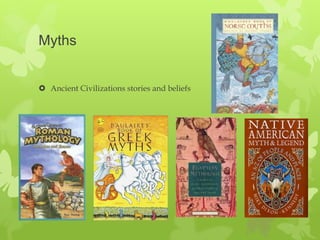
Myths


 Ancient Civilizations stories and beliefs

Traditional literature powerpoint

  • 1.
  • 2.
    Why learn aboutTraditional Literature?  Serves as the building blocks for contemporary literature/framework for literature  Provides a window on diverse cultures  Provides moral models for children as the struggle between good and evil is applied to events in their own lives
  • 3.
    Folktale A story toldby word of mouth to teach a lesson Passed down from generation to generation
  • 4.
    Folk tale  Folktalesfeature common people, such as peasants, and commonplace events.  Characters representing human frailty (being fragile).  Characters represent human qualities Good Evil Wisdom Foolishness Laziness Etc.
  • 5.
    Folktales The conflict ofthe story is clear. The resolution usually has happy endings Good is rewarded and evil is punished Elements of magic or magical characters may be incorporated, but logic rules so the supernatural must make sense in the story.
  • 7.
    Fables  Short storiesthat teach a moral (lesson) Plot is very brief, with one event.  Animal characters with human characteristics Characters are flat, and stand for one human trait.  Themes: cooperation, understanding, acceptance, etc. Morals sometimes are inferred. May be expressed in a proverb.
  • 8.
    Aesop's Fables  Thisfamous Book of Fables, which are always referred to as Aesop's Fables, date back to the 5th Century BC.  Lion and the Mouse  The Fox and the Crow  Goose with the Golden Eggs  Wolf in Sheep’s Clothing  The Town Mouse and the Country Mouse  Ant and the Grasshopper
  • 9.
    Fairytale Elements of aFairytale  Contains magic/enchantments  Likely character types: Talking animals Witches Fairies Nobles (Kings, Queens, Princes, Princesses) Godparents
  • 10.
    Fairy Tale- setting Setting does not have a definite location or time  Familiar fairytales look like Germany
  • 11.
    The best knowtale in the World Cinderella  The oldest known version was found in China in the 9th century.  It is basically a story of sibling rivalry.  There are over 700 different versions.
  • 12.
    Hans Christian Anderson •Danish author and poet • Wrote more than 160 Fairy Tales • Many of Andersen's fairy tales depict characters who gain happiness in life after suffering and conflicts • Ugly Duckling theme of self-discovery, which Click on matched his own life Anderson’s • Optimistic belief in the triumph of the good picture to see his stories • Known as the father of the modern fairytale
  • 13.
    Brothers Grimm  Jacob Ludwig Carl Grimm and Wilhelm Carl Grimm Click picture for  Wrote children’s tales and folklore to Grimm preserve German culture/heritage stories  Wrote 211 stories together More stories
  • 14.
    Fractured Fairy tale When authors modernize or change one or more of the elements of the story, the story is called a fractured fairy tale.  Plot (conflict, rising action, climax, falling action, resolution)  Setting (time and/or place)  Character (name, character traits)  Point of View  Theme
  • 15.
  • 16.
    Fracture Fairy Taleson the screen
  • 17.
    Myths  A mythologyis a related body of stories which make up the official beliefs or explanations of a religious system.  Myths attempt to explain the beginning of the world, natural phenomena, the relationships between the gods and humans, and the origins of civilization.  Myths, like legends, are stories told as though they were true.
  • 18.