WEEK 2 LECTURE:
MYTHS & LEGENDS
HWST 104
MYTHOLOGY
• Mythology is the study of myth.
• The term “myth” is often used to
refer to a false story. However, the
academic use of the term does not
pass judgment on truth or falsity.
MYTHOLOGY
• Mythology is a collection of traditional
stories that express the beliefs or values of
a group of people
• It is the basis for the understanding of our
own existence
– All cultures have some type of myths
(ie: Greeks, Romans, Native Americans, Maori, etc.)
– The same myths can often be found in different parts
of the world. For example, creation stories related to
plants, animals, and people are common among
many cultures.
MYTHS
• Myths are poetic stories that express a world
view and embodies the ideals, beliefs, and
dreams of a society. In fact, if a dream is the
unconscious expression of an individual reality,
then a myth is the collective consciousness of
society's dreams
• Myths help groups of people identify
themselves and define their values. It helps
validate social order and provides a moral
code by which to live.
MYTHS
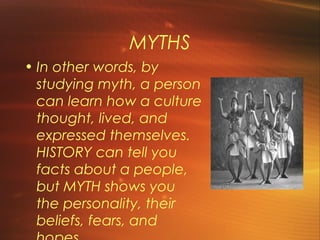
• In other words, by
studying myth, a person
can learn how a culture
thought, lived, and
expressed themselves. 
HISTORY can tell you
facts about a people,
but MYTH shows you
the personality, their
beliefs, fears, and
MYTHS
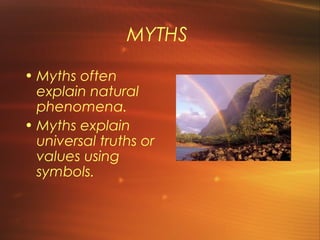
• Myths often
explain natural
phenomena.
• Myths explain
universal truths or
values using
symbols.
MYTHS
• Myths are spiritual
in nature and are
meant to
instruct/teach the
spirit and resonate
something within
you. They are
clues to the
spiritual potential
of the human life.
MYTHS
• Myths inform
people in the
ways of living
successfully in
a given
geography
CHARACTERISTICS OF A MYTH
• Sacred stories concerning the distant past
• Often uses the supernatural to interpret
natural events and to explain the basic
questions of human existence such as the
nature of the universe and humanity
• Conveys how to live: assumptions, values,
core meanings of individuals, families,
communities, and cultures
• Often incorporates characters that are
non-human such as gods, goddesses,
demigods, and supernatural beings.
MYTHS
• You may encounter different versions of
stories. No one can say that one version
of a story is “right” and the others
“wrong.”
• To understand myths, one must look
beyond the literal translation. Instead,
you should study the symbols and
ideas.
MYTHS
• Characters and
symbols in myths can
mean different
things to different
people.
• In fact, they can
even mean different
things to the same
person at different
EXAMPLES OF MYTHS
• Classic Myths
– Pandora’s Box
– Homer’s Iliad
– Pele & Hi’iaka
• Modern-day myths have many components of
ancient/classic myths, as in the following:
– Star Wars
– Lord of the Rings
– Whale Rider
– Superman
– Finding Nemo
– Monsters Inc.
MYTHOLOGY IN
MODERN DAY SOCIETY
• Mythology is everywhere! Many
companies/groups/corporations take
their name, logo or theme from ancient
mythology. Below are just a few:
– Ajax: Greek warrior in the Trojan war who “cleaned up”
in battle (household cleaner)
– Apollo: God of music (Apollo Theater)
– Nike: Winged goddess of victory who can run and fly
at great speeds (shoes/apparel)
– Olympus: Home of the Olympian gods (camera
company)
MYTHOLOGY IN
MODERN DAY SOCIETY
• There are many words/expressions that are
derived from ancient myths
– Achilles’ heel
• Achilles: Greek hero of the Trojan War who was said to
be invulnerable on all his body except for his heel. It is
said that he was killed in battle by an arrow to his heel
– Midas touch
• Midas: King with the golden touch who transformed all
he touched into gold
– Herculean strength
• Hercules: Roman name for Heracles, the greatest Greek
hero
LEGENDS
• Legends are stories handed down
through generations that are about the
more recent past
• Does not incorporate all essential
elements of a myth
– Often blends facts with improbable elements
– Legends may contain references to the gods
or accounts of extraordinary or miraculous
events , however it generally includes or is
based on historical events
• Main characters are usually human. The
main character is generally a hero who
serves as an exemplar or model of
behavior for people within a society
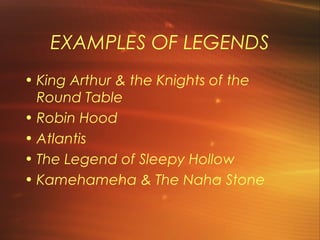
EXAMPLES OF LEGENDS
• King Arthur & the Knights of the
Round Table
• Robin Hood
• Atlantis
• The Legend of Sleepy Hollow
• Kamehameha & The Naha Stone
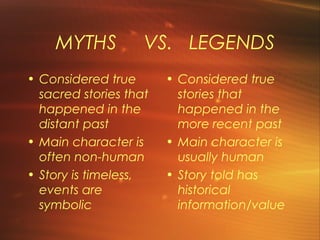
MYTHS VS. LEGENDS
• Considered true
sacred stories that
happened in the
distant past
• Main character is
often non-human
• Story is timeless,
events are
symbolic
• Considered true
stories that
happened in the
more recent past
• Main character is
usually human
• Story told has
historical
information/value
“Myths are clues to the
spiritual potentialities of the
human life.”
-Joseph Campbell
“All of these symbols in myths
refer to YOU.”
-Joseph Campbell
“If all of these symbols in myth
refer to YOU, what could it
mean?”
-Kaipo Frias
“Follow your bliss. When you
do, . . . doors will open where
you would not have thought
there would be doors; and
where there wouldn't be
a door for anyone else.”
-Joseph Campbell

Basic mythology

  • 1.
    WEEK 2 LECTURE: MYTHS& LEGENDS HWST 104
  • 2.
    MYTHOLOGY • Mythology isthe study of myth. • The term “myth” is often used to refer to a false story. However, the academic use of the term does not pass judgment on truth or falsity.
  • 3.
    MYTHOLOGY • Mythology isa collection of traditional stories that express the beliefs or values of a group of people • It is the basis for the understanding of our own existence – All cultures have some type of myths (ie: Greeks, Romans, Native Americans, Maori, etc.) – The same myths can often be found in different parts of the world. For example, creation stories related to plants, animals, and people are common among many cultures.
  • 4.
    MYTHS • Myths arepoetic stories that express a world view and embodies the ideals, beliefs, and dreams of a society. In fact, if a dream is the unconscious expression of an individual reality, then a myth is the collective consciousness of society's dreams • Myths help groups of people identify themselves and define their values. It helps validate social order and provides a moral code by which to live.
  • 5.
    MYTHS • In otherwords, by studying myth, a person can learn how a culture thought, lived, and expressed themselves.  HISTORY can tell you facts about a people, but MYTH shows you the personality, their beliefs, fears, and
  • 6.
    MYTHS • Myths often explainnatural phenomena. • Myths explain universal truths or values using symbols.
  • 7.
    MYTHS • Myths arespiritual in nature and are meant to instruct/teach the spirit and resonate something within you. They are clues to the spiritual potential of the human life.
  • 8.
    MYTHS • Myths inform peoplein the ways of living successfully in a given geography
  • 9.
    CHARACTERISTICS OF AMYTH • Sacred stories concerning the distant past • Often uses the supernatural to interpret natural events and to explain the basic questions of human existence such as the nature of the universe and humanity • Conveys how to live: assumptions, values, core meanings of individuals, families, communities, and cultures • Often incorporates characters that are non-human such as gods, goddesses, demigods, and supernatural beings.
  • 10.
    MYTHS • You mayencounter different versions of stories. No one can say that one version of a story is “right” and the others “wrong.” • To understand myths, one must look beyond the literal translation. Instead, you should study the symbols and ideas.
  • 11.
    MYTHS • Characters and symbolsin myths can mean different things to different people. • In fact, they can even mean different things to the same person at different
  • 12.
    EXAMPLES OF MYTHS •Classic Myths – Pandora’s Box – Homer’s Iliad – Pele & Hi’iaka • Modern-day myths have many components of ancient/classic myths, as in the following: – Star Wars – Lord of the Rings – Whale Rider – Superman – Finding Nemo – Monsters Inc.
  • 13.
    MYTHOLOGY IN MODERN DAYSOCIETY • Mythology is everywhere! Many companies/groups/corporations take their name, logo or theme from ancient mythology. Below are just a few: – Ajax: Greek warrior in the Trojan war who “cleaned up” in battle (household cleaner) – Apollo: God of music (Apollo Theater) – Nike: Winged goddess of victory who can run and fly at great speeds (shoes/apparel) – Olympus: Home of the Olympian gods (camera company)
  • 14.
    MYTHOLOGY IN MODERN DAYSOCIETY • There are many words/expressions that are derived from ancient myths – Achilles’ heel • Achilles: Greek hero of the Trojan War who was said to be invulnerable on all his body except for his heel. It is said that he was killed in battle by an arrow to his heel – Midas touch • Midas: King with the golden touch who transformed all he touched into gold – Herculean strength • Hercules: Roman name for Heracles, the greatest Greek hero
  • 15.
    LEGENDS • Legends arestories handed down through generations that are about the more recent past • Does not incorporate all essential elements of a myth – Often blends facts with improbable elements – Legends may contain references to the gods or accounts of extraordinary or miraculous events , however it generally includes or is based on historical events • Main characters are usually human. The main character is generally a hero who serves as an exemplar or model of behavior for people within a society
  • 16.
    EXAMPLES OF LEGENDS •King Arthur & the Knights of the Round Table • Robin Hood • Atlantis • The Legend of Sleepy Hollow • Kamehameha & The Naha Stone
  • 17.
    MYTHS VS. LEGENDS •Considered true sacred stories that happened in the distant past • Main character is often non-human • Story is timeless, events are symbolic • Considered true stories that happened in the more recent past • Main character is usually human • Story told has historical information/value
  • 18.
    “Myths are cluesto the spiritual potentialities of the human life.” -Joseph Campbell
  • 19.
    “All of thesesymbols in myths refer to YOU.” -Joseph Campbell “If all of these symbols in myth refer to YOU, what could it mean?” -Kaipo Frias
  • 20.
    “Follow your bliss.When you do, . . . doors will open where you would not have thought there would be doors; and where there wouldn't be a door for anyone else.” -Joseph Campbell