TRADITIONAL TALES
Patterns and variables
DEFINITION OF
TRADITIONAL
TALES
TRADITIONAL TALES
-also known as FOLKTALES
-They are stories that
came from oral tradition
of our ancestors.
-They were passed to
different lands by the
migration people.
TWO THEORIES ABOUT FOLKTALES
1.MONOGENESIS TEORY-they
believe that every folktales could be
traced to the pre-historic group called
ARYANS, also known as the Indo-
Europeans.
2.POLYGENESIS THEORY-
this means that traditional tales have
come from multiples sources.
CLASSIFICATIONS OF FOLTALES
-ACCORDING TO STACY CARNEY
1.CUMMULATIVE TALES-
these have little plot and lots of rhythm.
-events follow a logical order in a pattern
of repetition. Also called chain tales
EXAMPLE: "The Death of the Little
Hen"
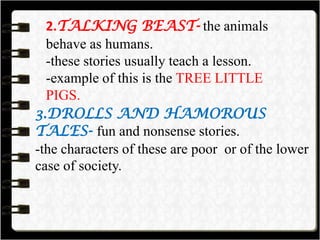
2.TALKING BEAST- the animals
behave as humans.
-these stories usually teach a lesson.
-example of this is the TREE LITTLE
PIGS.
3.DROLLS AND HAMOROUS
TALES- fun and nonsense stories.
-the characters of these are poor or of the lower
case of society.
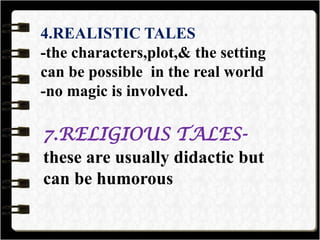
4.REALISTIC TALES
-the characters,plot,& the setting
can be possible in the real world
-no magic is involved.
7.RELIGIOUS TALES-
these are usually didactic but
can be humorous
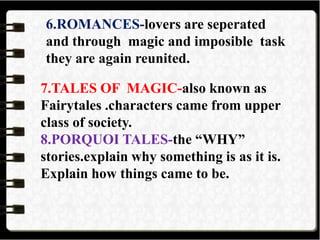
6.ROMANCES-lovers are seperated
and through magic and imposible task
they are again reunited.
7.TALES OF MAGIC-also known as
Fairytales .characters came from upper
class of society.
8.PORQUOI TALES-the “WHY”
stories.explain why something is as it is.
Explain how things came to be.
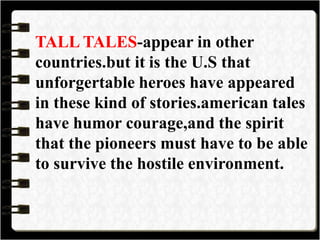
TALL TALES-appear in other
countries.but it is the U.S that
unforgertable heroes have appeared
in these kind of stories.american tales
have humor courage,and the spirit
that the pioneers must have to be able
to survive the hostile environment.
DIFFRERENCE BETWEEN
FOLKTALES AND TALLTALES
-A tall tale is a folktale about a
larger-than-life hero solving an
over-the-top problem in a
humorous or outrageous way.
-typically feature highly
exaggerated, improbable details
-The main character of a tall tale, the
hero, must possess some kind of
unbelievable skill or trait
- All tall tales contain extreme
exaggeration and humor. The characters,
the speech and even the details are
exaggerated.
EXAMPLES OF TALL TAlTALES
1.Paul Bunyan-was a lumber jack whose strength,
speed, and skills outmatched those of a noramal
human being.He had a Blue Ox called Babethat
accompanied him in his adventures.
2.PECOS BILL-a cowboy taised by the
coyote.This cowboy rode a mountain lion and
not a horse in mostt cases.When he rode a
horse, he was Widow Maketr,a very very wild
horse.
3.JOHNY HENRY-African-american
hero.he born as a giant.A over 8 ft.tall
and had enormous stregth.He
dedicated himself to working on a
railroad until he died.He died after
after winning a competition against a
steel-driving machine.
CHARACTERISTICS OF
FOLKTALES
1.STRUCTURE OF PLOT-it includes the
setting, characters and their actions,the
repititoion or the chants,riddles or poems
that presented in the plot.The conflict,the
climax,and conclussion of the story.
2.CHARACTERIZATION-the
characters of folktales are flat.
3.STYLE-folktales of different
countries have their own unique
way of presenting their stories.
-figurative language and
imaginary are also in many
folktales.
THEMES-subject of the story.
4.MOTIFS-the patterns that
are present in the story.
a. The characters seen in the
folktale: wicked stepmothers,
abused children, tricksters,
and the younger brother.
b. Supernatural beings, fairies,
witches, giants.
c. Magical object-tablecloths that
give food, mirror that speaks.
d. Enchantments- prince turn into
frog, long sleep for over hundred
years.
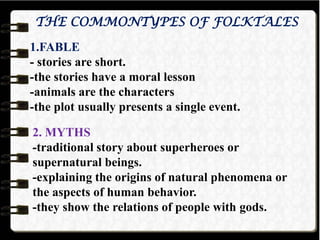
THE COMMONTYPES OF FOLKTALES
1.FABLE
- stories are short.
-the stories have a moral lesson
-animals are the characters
-the plot usually presents a single event.
2. MYTHS
-traditional story about superheroes or
supernatural beings.
-explaining the origins of natural phenomena or
the aspects of human behavior.
-they show the relations of people with gods.
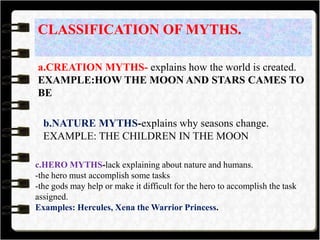
CLASSIFICATION OF MYTHS.
a.CREATION MYTHS- explains how the world is created.
EXAMPLE:HOW THE MOON AND STARS CAMES TO
BE
b.NATURE MYTHS-explains why seasons change.
EXAMPLE: THE CHILDREN IN THE MOON
c.HERO MYTHS-lack explaining about nature and humans.
-the hero must accomplish some tasks
-the gods may help or make it difficult for the hero to accomplish the task
assigned.
Examples: Hercules, Xena the Warrior Princess.
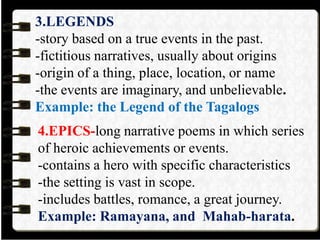
3.LEGENDS
-story based on a true events in the past.
-fictitious narratives, usually about origins
-origin of a thing, place, location, or name
-the events are imaginary, and unbelievable.
Example: the Legend of the Tagalogs
4.EPICS-long narrative poems in which series
of heroic achievements or events.
-contains a hero with specific characteristics
-the setting is vast in scope.
-includes battles, romance, a great journey.
Example: Ramayana, and Mahab-harata.
THANKYOU FOR LISTENING:
DEVELOPMENTAL READING I (MSE)
TRADITIONAL TALES:PATTERNS & VARIABLES
REPORTED BY:
BALUYUT, REINALYN V.
GROUP 2 FIRST REPORTER
COMMISION ON HIGHER EDUCATION (CHED)
INSTITUTE OF PROFFESIONAL EDUCATION
BACHELOR OF ELEMENTARY EDUCATION
OUR LADY OF PILLAR
MRS.EDNA R. BANGCOLENG
Instructress
DATE: AUGUST 17,2013
TRADITIONAL TALES:PATTERNS AND VARIABLES
All Rights Reserved: 2013 HE!HE!HE!
NEXT REPORTER:
RIZA
GROUP 2 BEED I-PILLAR
MODERN SHORT S TORIES
And it’s Elements
Rein cloud14

Rein cloud14

  • 4.
  • 5.
  • 6.
    TRADITIONAL TALES -also knownas FOLKTALES -They are stories that came from oral tradition of our ancestors. -They were passed to different lands by the migration people.
  • 7.
    TWO THEORIES ABOUTFOLKTALES 1.MONOGENESIS TEORY-they believe that every folktales could be traced to the pre-historic group called ARYANS, also known as the Indo- Europeans. 2.POLYGENESIS THEORY- this means that traditional tales have come from multiples sources.
  • 8.
    CLASSIFICATIONS OF FOLTALES -ACCORDINGTO STACY CARNEY 1.CUMMULATIVE TALES- these have little plot and lots of rhythm. -events follow a logical order in a pattern of repetition. Also called chain tales EXAMPLE: "The Death of the Little Hen"
  • 9.
    2.TALKING BEAST- theanimals behave as humans. -these stories usually teach a lesson. -example of this is the TREE LITTLE PIGS. 3.DROLLS AND HAMOROUS TALES- fun and nonsense stories. -the characters of these are poor or of the lower case of society.
  • 10.
    4.REALISTIC TALES -the characters,plot,&the setting can be possible in the real world -no magic is involved. 7.RELIGIOUS TALES- these are usually didactic but can be humorous
  • 11.
    6.ROMANCES-lovers are seperated andthrough magic and imposible task they are again reunited. 7.TALES OF MAGIC-also known as Fairytales .characters came from upper class of society. 8.PORQUOI TALES-the “WHY” stories.explain why something is as it is. Explain how things came to be.
  • 12.
    TALL TALES-appear inother countries.but it is the U.S that unforgertable heroes have appeared in these kind of stories.american tales have humor courage,and the spirit that the pioneers must have to be able to survive the hostile environment.
  • 13.
    DIFFRERENCE BETWEEN FOLKTALES ANDTALLTALES -A tall tale is a folktale about a larger-than-life hero solving an over-the-top problem in a humorous or outrageous way. -typically feature highly exaggerated, improbable details
  • 14.
    -The main characterof a tall tale, the hero, must possess some kind of unbelievable skill or trait - All tall tales contain extreme exaggeration and humor. The characters, the speech and even the details are exaggerated.
  • 15.
    EXAMPLES OF TALLTAlTALES 1.Paul Bunyan-was a lumber jack whose strength, speed, and skills outmatched those of a noramal human being.He had a Blue Ox called Babethat accompanied him in his adventures. 2.PECOS BILL-a cowboy taised by the coyote.This cowboy rode a mountain lion and not a horse in mostt cases.When he rode a horse, he was Widow Maketr,a very very wild horse.
  • 16.
    3.JOHNY HENRY-African-american hero.he bornas a giant.A over 8 ft.tall and had enormous stregth.He dedicated himself to working on a railroad until he died.He died after after winning a competition against a steel-driving machine.
  • 17.
    CHARACTERISTICS OF FOLKTALES 1.STRUCTURE OFPLOT-it includes the setting, characters and their actions,the repititoion or the chants,riddles or poems that presented in the plot.The conflict,the climax,and conclussion of the story. 2.CHARACTERIZATION-the characters of folktales are flat.
  • 18.
    3.STYLE-folktales of different countrieshave their own unique way of presenting their stories. -figurative language and imaginary are also in many folktales. THEMES-subject of the story.
  • 19.
    4.MOTIFS-the patterns that arepresent in the story. a. The characters seen in the folktale: wicked stepmothers, abused children, tricksters, and the younger brother.
  • 20.
    b. Supernatural beings,fairies, witches, giants. c. Magical object-tablecloths that give food, mirror that speaks. d. Enchantments- prince turn into frog, long sleep for over hundred years.
  • 21.
    THE COMMONTYPES OFFOLKTALES 1.FABLE - stories are short. -the stories have a moral lesson -animals are the characters -the plot usually presents a single event. 2. MYTHS -traditional story about superheroes or supernatural beings. -explaining the origins of natural phenomena or the aspects of human behavior. -they show the relations of people with gods.
  • 22.
    CLASSIFICATION OF MYTHS. a.CREATIONMYTHS- explains how the world is created. EXAMPLE:HOW THE MOON AND STARS CAMES TO BE b.NATURE MYTHS-explains why seasons change. EXAMPLE: THE CHILDREN IN THE MOON c.HERO MYTHS-lack explaining about nature and humans. -the hero must accomplish some tasks -the gods may help or make it difficult for the hero to accomplish the task assigned. Examples: Hercules, Xena the Warrior Princess.
  • 23.
    3.LEGENDS -story based ona true events in the past. -fictitious narratives, usually about origins -origin of a thing, place, location, or name -the events are imaginary, and unbelievable. Example: the Legend of the Tagalogs 4.EPICS-long narrative poems in which series of heroic achievements or events. -contains a hero with specific characteristics -the setting is vast in scope. -includes battles, romance, a great journey. Example: Ramayana, and Mahab-harata.
  • 24.
    THANKYOU FOR LISTENING: DEVELOPMENTALREADING I (MSE) TRADITIONAL TALES:PATTERNS & VARIABLES REPORTED BY: BALUYUT, REINALYN V. GROUP 2 FIRST REPORTER COMMISION ON HIGHER EDUCATION (CHED) INSTITUTE OF PROFFESIONAL EDUCATION BACHELOR OF ELEMENTARY EDUCATION OUR LADY OF PILLAR MRS.EDNA R. BANGCOLENG Instructress DATE: AUGUST 17,2013 TRADITIONAL TALES:PATTERNS AND VARIABLES All Rights Reserved: 2013 HE!HE!HE!
  • 25.
    NEXT REPORTER: RIZA GROUP 2BEED I-PILLAR MODERN SHORT S TORIES And it’s Elements