Track Performance of  Advanced High-Strength Rail Steels   Norbert Frank, Technical Customer Service Railways and Harbours Conference Cape Town, 06 th  March 2009
Content of this Presentation  Research & Development Targets Advanced Head Hardened Rail Steels Track Testing – Wear  Track Testing – Rolling Contact Fatigue Economical Impacts and Cost Savings Summary and Future Work
Typical Cost Structure of the Infrastructure longest possible service life highest reliability and lowest maintenance down time maintainability source: ÖBB Strategy Track
Research & Development Targets The longest possible lifetime – conserve the rail head profile by high wear resistance little material removal by grinding  consistent rail-wheel-contact to reduce forces The highest possible reliability – reduce inspection requirements ultra-clean rail steel – avoid internal defects The lowest requirement for maintenance – reduce costs increase rolling contact fatigue (RCF) resistance – at initiation stage reduce crack growth speed – when RCF cracks are present Improve safety and reliability
Content of this Presentation  Research & Development Targets Advanced Head Hardened Rail Steels Track Testing – Wear  Track Testing – Rolling Contact Fatigue Economical Impacts and Cost Savings Summary and Future Work
HH-Rails – History Non heat-treated steels: alloying is limited to max. 370 BHN ->  today the most expensive rail steels! 1980 – Starting point for head-hardened HSH ® -rails : standard Carbon (900A) chemistry and a smart heat treatment of the rail head in a polymer liquid Next steps add alloying elements (C, Cr) to increase hardness Today´s State-of-the-Art: hardness limit for pearlite greater than 440 BHN  Hyper-Eutectoide steels (C  ~ 1,0%) show the best track performance
Advanced HSH ® -Rail Steels today highest wear resistance best choice for heavy haul transport according to VA-spec. hypereutectoid rail steel with  up to 1 % Carbon ~  420 BHN 400UHC up to 100 % higher wear and RCF resistance compared to R350HT  increasing application for heavy loaded tracks  according to VA-specification HSH ® -rail with Cr ~ 0,50 % ~  390 BHN 370LHT wear rate approx. 1/3 of R260 for all fields of application in railways  and urban transport  according to EN13674-1 traditional HSH ® -rail ~  370 BHN R350HT increased wear and crack resistance for all fields of application in railways well established heavy haul grade of the 90s according to EN13674-1 HSH ® -rail with Cr ~ 0,25 % ~  380 BHN R350LHT properties and application features grade
voestalpine‘s  Track Tests Wear  RCF Head Checks Spalling Wear negligible Corrugations  Squats
voestalpine‘s  Track Tests Wear  RCF Head Checks Spalling Wear negligible Corrugations  Squats R260 R350HT 370LHT 400UHC Dobain430 TTCI 4 UP 4 RWE 2,5 Ofotb 2,3 ÖBB 3 tests 1, 2, 5 DB Körle 1,2 DB Mülmisch 1,2 Pilb Rail 4 DB 2-5 NBS; 1 DB Mering I + II 1-5 DB Kerzell 1-5 SNCF, Prorail; 2,3 UP 4
Content of this Presentation  Research & Development Targets Advanced Head Hardened Rail Steels Track Testing – Wear  Track Testing – Rolling Contact Fatigue Economical Impacts and Cost Savings Summary and Future Work
Track Testing at the Ofotban an /Norway Iron ore line – LKAB  50 % curves with R < 500 m  40 %  declanation with 20 ‰ Axle load 25/30 tons 30 Mio t/a
Ofotbanan – Test Conditions  status 1997 – Micro-alloyed S1200 best solution  Test with head hardened rail steels: R350HT – 370 BHN 370LHT – 390 BHN Critical topic:  aluminothermic welds  traffic direction AT-joint
Ofotbanan – Wear Measurements  R 350HT 4 years S1200 2 years 370LHT 4 years
Ofotbanan – RCF Performance  R350HT  – 370 BHN head checks  medium spalling one  year of service 370LHT  – 390 BHN head checks little spalling two years  of service
Ofotbanan – Weld Performance  HPW  weld: Less battering No spalling next to weld Approved! Z90HC  weld: Some battering Spalling next to weld
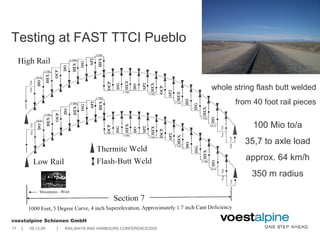
Testing at  FAST TTCI Pueblo  100 Mio to/a 35,7 to axle load approx. 64 km/h 350 m radius whole string flash butt welded from 40 foot rail pieces
TTCI Phase V: 3 rd  Test voestalpine since 2005 Absolute wear data at 350 Mio to RMSM VAS AM US JFE
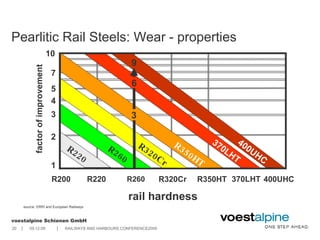
Wear – Higher Rail Hardness  Higher hardness – less wear Head hardened – maximum hardness
Pearlitic Rail Steels: Wear - properties 10 7 5 4 3 2 1 factor of improvement source: ERRI and European Railways R220 R260 R350HT R320Cr 400UHC R200 370LHT rail hardness  R320Cr R220 R260 400UHC  370LHT  R350HT 3 6 9
Content of this Presentation  Research & Development Targets Advanced Head Hardened Rail Steels Track Testing – Wear  Track Testing – Rolling Contact Fatigue Economical Impacts and Cost Savings Summary and Future Work
RCF Study with DB AG Comprehensive track testing at medium and high speed lines In tangents, wide, medium and tight curves Mixed traffic up to 22,5 to axle load 90.000 to/day – highest daily loads available at DB Monitoring, documentation and conclusions by the  R & D Organisation of DB AG – DB Systemtechnik (FTZ)
Track Testing – Typical Layout
Wear and Corrugation Measurements cross-sectional profiles: Miniprof longitudinal profile: RM1200
RCF – Crack Characterization Magnetic particle inspection In-Track Eddy current testing  Metallography of cut samples
Mering/DB – Surface of the Old 900A Rails  after 9 years or 300 Mio to of total load Severe head checks 5 mm deep (!) Rail was never ground Had to be replaced
Track Testing of 3 Grades with different Hardness:  RCF Results after 100 Mio to
Dimensions of the  Head Check ed Area R220 R260 R350HT R350HT R260 R220 grade 15 1,2 12 0,8 18 b [mm] 1,7 a [mm] a b
Crack Depth – Grinding Requirements 2,3 mm 1,3 mm 0,4 mm R220 240 BHN 0,0 0,5 1,0 1,5 2,0 2,5 3,0 [mm] R260 280 BHN R350HT 360 BHN Metallographic  Eddy Curren t
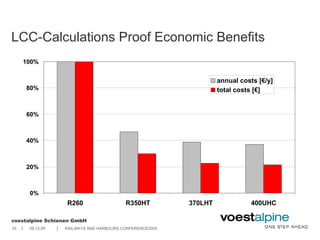
Conclusion on the Rail Service Performance Wear resistance of R350HT 3 x better than R260 But wear is not a life-limiting factor in medium radius curves Maintenance requirements – double/triple the time between grinding  Stretch the technical rail life from 13 (R260) to 34 years by R350HT Economic analysis by Life-Cycle-Cost Calculations
Content of this Presentation  Research & Development Targets Advanced Head Hardened Rail Steels Track Testing – Wear  Track Testing – Rolling Contact Fatigue Economical Impacts and Cost Savings Summary and Future Work
LCC-Calculations Proof Economic Benefits Evaluate the Whole Life Cycle maintenance activities – mainly grinding to remove Head Checks replacement of worn rails R260 Life Cylce HSH ®  head hardened rail steels Life Cylce
LCC-Calculations Proof Economic Benefits
Content of this Presentation  Research & Development Targets Advanced Head Hardened Rail Steels Track Testing – Wear  Track Testing – Rolling Contact Fatigue Economical Impacts and Cost Savings Summary and Future Work
voestalpine‘s  Track Tests Wear  RCF Head Checks Spalling Wear negligible Corrugations  Squats R260 R350HT 370LHT 400UHC Dobain430 TTCI 4 UP 4 RWE 2,5 Ofotb 2,3 ÖBB 3 tests 1, 2, 5 DB Körle 1,2 DB Mülmisch 1,2   Pilb Rail 4 DB 2-5 NBS; 1 DB Mering I + II 1-5 DB Kerzell 1-5 SNCF, Prorail; 2,3 UP 4 The Hardest Rail you can get Hard Rail and Grinding Current  Investigations
We Define New Development Targets No risk of unexpected failures Reliability R No corrective maintenance required Availability A No maintenance required Maintainability M No dangerous failures Safety S Longest possible service life   low Life-Cycle-Costs LCC Lowest total Costs

Track Performance

  • 1.
    Track Performance of Advanced High-Strength Rail Steels Norbert Frank, Technical Customer Service Railways and Harbours Conference Cape Town, 06 th March 2009
  • 2.
    Content of thisPresentation Research & Development Targets Advanced Head Hardened Rail Steels Track Testing – Wear Track Testing – Rolling Contact Fatigue Economical Impacts and Cost Savings Summary and Future Work
  • 3.
    Content of thisPresentation Research & Development Targets Advanced Head Hardened Rail Steels Track Testing – Wear Track Testing – Rolling Contact Fatigue Economical Impacts and Cost Savings Summary and Future Work
  • 4.
    Typical Cost Structureof the Infrastructure longest possible service life highest reliability and lowest maintenance down time maintainability source: ÖBB Strategy Track
  • 5.
    Research & DevelopmentTargets The longest possible lifetime – conserve the rail head profile by high wear resistance little material removal by grinding consistent rail-wheel-contact to reduce forces The highest possible reliability – reduce inspection requirements ultra-clean rail steel – avoid internal defects The lowest requirement for maintenance – reduce costs increase rolling contact fatigue (RCF) resistance – at initiation stage reduce crack growth speed – when RCF cracks are present Improve safety and reliability
  • 6.
    Content of thisPresentation Research & Development Targets Advanced Head Hardened Rail Steels Track Testing – Wear Track Testing – Rolling Contact Fatigue Economical Impacts and Cost Savings Summary and Future Work
  • 7.
    HH-Rails – HistoryNon heat-treated steels: alloying is limited to max. 370 BHN -> today the most expensive rail steels! 1980 – Starting point for head-hardened HSH ® -rails : standard Carbon (900A) chemistry and a smart heat treatment of the rail head in a polymer liquid Next steps add alloying elements (C, Cr) to increase hardness Today´s State-of-the-Art: hardness limit for pearlite greater than 440 BHN Hyper-Eutectoide steels (C ~ 1,0%) show the best track performance
  • 8.
    Advanced HSH ®-Rail Steels today highest wear resistance best choice for heavy haul transport according to VA-spec. hypereutectoid rail steel with up to 1 % Carbon ~ 420 BHN 400UHC up to 100 % higher wear and RCF resistance compared to R350HT increasing application for heavy loaded tracks according to VA-specification HSH ® -rail with Cr ~ 0,50 % ~ 390 BHN 370LHT wear rate approx. 1/3 of R260 for all fields of application in railways and urban transport according to EN13674-1 traditional HSH ® -rail ~ 370 BHN R350HT increased wear and crack resistance for all fields of application in railways well established heavy haul grade of the 90s according to EN13674-1 HSH ® -rail with Cr ~ 0,25 % ~ 380 BHN R350LHT properties and application features grade
  • 9.
    voestalpine‘s TrackTests Wear RCF Head Checks Spalling Wear negligible Corrugations Squats
  • 10.
    voestalpine‘s TrackTests Wear RCF Head Checks Spalling Wear negligible Corrugations Squats R260 R350HT 370LHT 400UHC Dobain430 TTCI 4 UP 4 RWE 2,5 Ofotb 2,3 ÖBB 3 tests 1, 2, 5 DB Körle 1,2 DB Mülmisch 1,2 Pilb Rail 4 DB 2-5 NBS; 1 DB Mering I + II 1-5 DB Kerzell 1-5 SNCF, Prorail; 2,3 UP 4
  • 11.
    Content of thisPresentation Research & Development Targets Advanced Head Hardened Rail Steels Track Testing – Wear Track Testing – Rolling Contact Fatigue Economical Impacts and Cost Savings Summary and Future Work
  • 12.
    Track Testing atthe Ofotban an /Norway Iron ore line – LKAB 50 % curves with R < 500 m 40 % declanation with 20 ‰ Axle load 25/30 tons 30 Mio t/a
  • 13.
    Ofotbanan – TestConditions status 1997 – Micro-alloyed S1200 best solution Test with head hardened rail steels: R350HT – 370 BHN 370LHT – 390 BHN Critical topic: aluminothermic welds traffic direction AT-joint
  • 14.
    Ofotbanan – WearMeasurements R 350HT 4 years S1200 2 years 370LHT 4 years
  • 15.
    Ofotbanan – RCFPerformance R350HT – 370 BHN head checks medium spalling one year of service 370LHT – 390 BHN head checks little spalling two years of service
  • 16.
    Ofotbanan – WeldPerformance HPW weld: Less battering No spalling next to weld Approved! Z90HC weld: Some battering Spalling next to weld
  • 17.
    Testing at FAST TTCI Pueblo 100 Mio to/a 35,7 to axle load approx. 64 km/h 350 m radius whole string flash butt welded from 40 foot rail pieces
  • 18.
    TTCI Phase V:3 rd Test voestalpine since 2005 Absolute wear data at 350 Mio to RMSM VAS AM US JFE
  • 19.
    Wear – HigherRail Hardness Higher hardness – less wear Head hardened – maximum hardness
  • 20.
    Pearlitic Rail Steels:Wear - properties 10 7 5 4 3 2 1 factor of improvement source: ERRI and European Railways R220 R260 R350HT R320Cr 400UHC R200 370LHT rail hardness R320Cr R220 R260 400UHC 370LHT R350HT 3 6 9
  • 21.
    Content of thisPresentation Research & Development Targets Advanced Head Hardened Rail Steels Track Testing – Wear Track Testing – Rolling Contact Fatigue Economical Impacts and Cost Savings Summary and Future Work
  • 22.
    RCF Study withDB AG Comprehensive track testing at medium and high speed lines In tangents, wide, medium and tight curves Mixed traffic up to 22,5 to axle load 90.000 to/day – highest daily loads available at DB Monitoring, documentation and conclusions by the R & D Organisation of DB AG – DB Systemtechnik (FTZ)
  • 23.
    Track Testing –Typical Layout
  • 24.
    Wear and CorrugationMeasurements cross-sectional profiles: Miniprof longitudinal profile: RM1200
  • 25.
    RCF – CrackCharacterization Magnetic particle inspection In-Track Eddy current testing Metallography of cut samples
  • 26.
    Mering/DB – Surfaceof the Old 900A Rails after 9 years or 300 Mio to of total load Severe head checks 5 mm deep (!) Rail was never ground Had to be replaced
  • 27.
    Track Testing of3 Grades with different Hardness: RCF Results after 100 Mio to
  • 28.
    Dimensions of the Head Check ed Area R220 R260 R350HT R350HT R260 R220 grade 15 1,2 12 0,8 18 b [mm] 1,7 a [mm] a b
  • 29.
    Crack Depth –Grinding Requirements 2,3 mm 1,3 mm 0,4 mm R220 240 BHN 0,0 0,5 1,0 1,5 2,0 2,5 3,0 [mm] R260 280 BHN R350HT 360 BHN Metallographic Eddy Curren t
  • 30.
    Conclusion on theRail Service Performance Wear resistance of R350HT 3 x better than R260 But wear is not a life-limiting factor in medium radius curves Maintenance requirements – double/triple the time between grinding Stretch the technical rail life from 13 (R260) to 34 years by R350HT Economic analysis by Life-Cycle-Cost Calculations
  • 31.
    Content of thisPresentation Research & Development Targets Advanced Head Hardened Rail Steels Track Testing – Wear Track Testing – Rolling Contact Fatigue Economical Impacts and Cost Savings Summary and Future Work
  • 32.
    LCC-Calculations Proof EconomicBenefits Evaluate the Whole Life Cycle maintenance activities – mainly grinding to remove Head Checks replacement of worn rails R260 Life Cylce HSH ® head hardened rail steels Life Cylce
  • 33.
  • 34.
    Content of thisPresentation Research & Development Targets Advanced Head Hardened Rail Steels Track Testing – Wear Track Testing – Rolling Contact Fatigue Economical Impacts and Cost Savings Summary and Future Work
  • 35.
    voestalpine‘s TrackTests Wear RCF Head Checks Spalling Wear negligible Corrugations Squats R260 R350HT 370LHT 400UHC Dobain430 TTCI 4 UP 4 RWE 2,5 Ofotb 2,3 ÖBB 3 tests 1, 2, 5 DB Körle 1,2 DB Mülmisch 1,2 Pilb Rail 4 DB 2-5 NBS; 1 DB Mering I + II 1-5 DB Kerzell 1-5 SNCF, Prorail; 2,3 UP 4 The Hardest Rail you can get Hard Rail and Grinding Current Investigations
  • 36.
    We Define NewDevelopment Targets No risk of unexpected failures Reliability R No corrective maintenance required Availability A No maintenance required Maintainability M No dangerous failures Safety S Longest possible service life low Life-Cycle-Costs LCC Lowest total Costs