URBAN TRACK
Final Conference
Alternative to Floating Track Slab
High Attenuation Sleeper
Presented by Ian Robertson, ALSTOM
24 June 2010, Prague
Final Conference – 24 June 2010 2
Contents
Specific objectives of study
Chosen concept
Detailed design and laboratory test
Site test (ongoing)
Conclusions
Final Conference – 24 June 2010 3
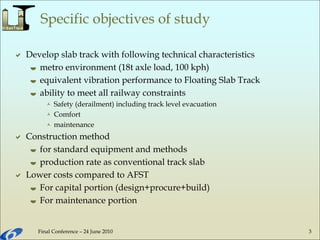
Specific objectives of study
 Develop slab track with following technical characteristics
 metro environment (18t axle load, 100 kph)
 equivalent vibration performance to Floating Slab Track
 ability to meet all railway constraints
 Safety (derailment) including track level evacuation
 Comfort
 maintenance
 Construction method
 for standard equipment and methods
 production rate as conventional track slab
 Lower costs compared to AFST
 For capital portion (design+procure+build)
 For maintenance portion
Final Conference – 24 June 2010 4
Chosen concept
Review of existing systems worldwide
Previous generation bi-block sleepers for CTRL
 Relatively low weight
 Tie bar overstressed with very soft pads
 Track gauge variations with very soft pads
Chosen concept = mono-block resilient sleeper
High attenuation due to
 High sleeper mass (350 – 400 kg)
 Very soft resilient inserts (8KN/mm/fastener)
Adapted to tracklaying gantries
Maintenance friendly
Final Conference – 24 June 2010 5
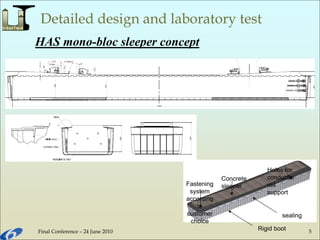
Detailed design and laboratory test
HAS mono-bloc sleeper concept
Rigid boot
Concrete
sleeperFastening
system
according
to
customer
choice
sealing
Holes for
conductor
rail
support
Final Conference – 24 June 2010 6
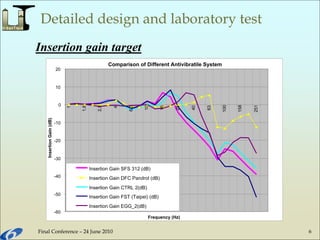
Detailed design and laboratory test
Comparison of Different Antivibratile System
-60
-50
-40
-30
-20
-10
0
10
20 1
1,6
2,5
4
6,3
10
16
25
40
63
100
158
251
Frequency (Hz)
InsertionGain(dB)
Insertion Gain SFS 312 (dB)
Insertion Gain DFC Pandrol (dB)
Insertion Gain CTRL 2(dB)
Insertion Gain FST (Taipei) (dB)
Insertion Gain EGG_2(dB)
Insertion gain target
Final Conference – 24 June 2010 7
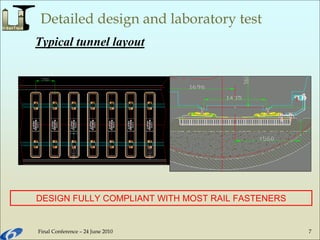
Detailed design and laboratory test
DESIGN FULLY COMPLIANT WITH MOST RAIL FASTENERS
Typical tunnel layout
Final Conference – 24 June 2010 8
Detailed design and laboratory test
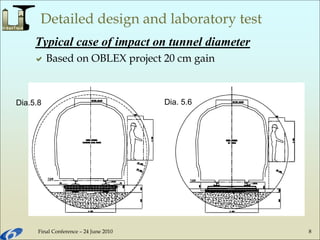
Based on OBLEX project 20 cm gain
Dia.5.8 Dia. 5.6
Typical case of impact on tunnel diameter
Final Conference – 24 June 2010 9
Detailed design and laboratory test
Time
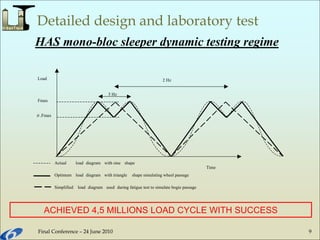
Load 2 Hz
5 Hz
Fmax
.Fmax
Actual load diagram with sine shape
Optimum load diagram with triangle shape simulating wheel passage
Simplified load diagram used during fatigue test to simulate bogie passage
ACHIEVED 4,5 MILLIONS LOAD CYCLE WITH SUCCESS
HAS mono-bloc sleeper dynamic testing regime
Final Conference – 24 June 2010 10
Detailed design and laboratory test
Mechanical test carried out
 Fatigue test with inclined loads according to the
following phases :
 1M Cycles @ low frequency (3 Hz) applied load between 10kN et
75kN, centred, inclined at 38°
 0.5MCycles @ moderate frequency (5 Hz) applied load between
30/40kN et 75kN centred , inclined at 38°
 2M Cycles @ low frequency (3 Hz) applied load between 10kN et
75kN, inclined at 10° and 38°
 1 M Cycles @ moderate frequency (5 Hz) applied load between
30/40kN et 75kN, inclined at 10° and 38°
NO PAD WEARING & NO VERTICAL STIFFNESS LOSS AFTER 4.5M
CYCLES
(EN13230: 2M CYCLES)
Final Conference – 24 June 2010 11
Detailed design and laboratory test
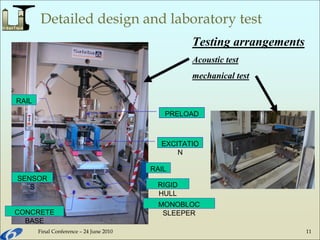
EXCITATIO
N
MONOBLOC
SLEEPER
RAIL
RIGID
HULL
RAIL
PRELOAD
CONCRETE
BASE
SENSOR
S
Testing arrangements
Acoustic test
mechanical test
Final Conference – 24 June 2010 12
Detailed design and laboratory test
0
2
4
6
8
10
12
MN/m
0 32 40 50 64
kN
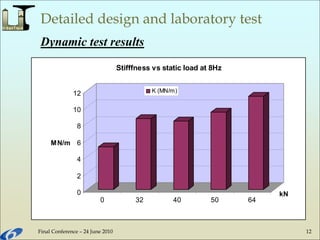
Stifffness vs static load at 8Hz
K (MN/m)
Dynamic test results
Final Conference – 24 June 2010 13
Site test (ongoing)
Several possibilities reviewed notably
 SINGAPORE Circle Line
 CEF test site (Valenciennes)
CEF chosen
 Easier logistics
 To respect URBAN TRACK timing
Construction just completed June 11
Vibration tests scheduled July
Introduction
Final Conference – 24 June 2010 14
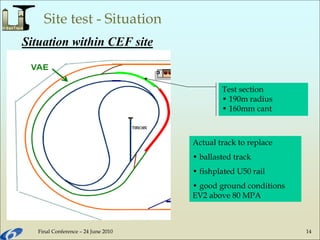
Site test - Situation
Test section
• 190m radius
• 160mm cant
Situation within CEF site
Actual track to replace
• ballasted track
• fishplated U50 rail
• good ground conditions
EV2 above 80 MPA
Final Conference – 24 June 2010 15
Site test
 50m of High Attenuation Track
 2 x 6.5m of transition slab with ballasted track
 Sleeper spacing 700mm
 Welded rail on high attenuation zone
 Fishplated joints allowing movement at each end of test
General Layout
Final Conference – 24 June 2010 16
Site test
Typical section
Final Conference – 24 June 2010 17
Site test
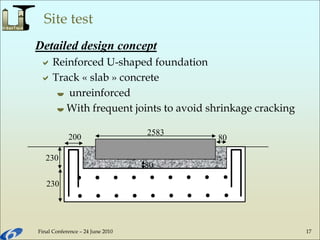
Detailed design concept
230
230
80
2583
80200
Reinforced U-shaped foundation
Track « slab » concrete
 unreinforced
 With frequent joints to avoid shrinkage cracking
Final Conference – 24 June 2010 18
Site test
After HAS vibration testing
 Axle load = 25 tonnes
 Total load = 280MGT
 HAS resilient inserts to replace by stiffer inserts
(30MN/M)
Structural design based on Eurocode 2
 Load Model 71
 Crack 0.2mm
Detailed design assumptions
Final Conference – 24 June 2010 19
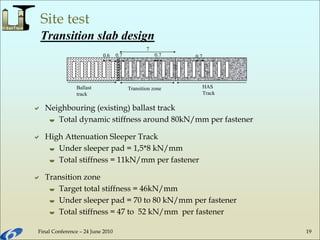
Site test
 Neighbouring (existing) ballast track
 Total dynamic stiffness around 80kN/mm per fastener
 High Attenuation Sleeper Track
 Under sleeper pad = 1,5*8 kN/mm
 Total stiffness = 11kN/mm per fastener
 Transition zone
 Target total stiffness = 46kN/mm
 Under sleeper pad = 70 to 80 kN/mm per fastener
 Total stiffness = 47 to 52 kN/mm per fastener
0.70.6 0.7
HAS
Track
Ballast
track
Transition zone
7
0.7
Transition slab design
Final Conference – 24 June 2010 20
Site test
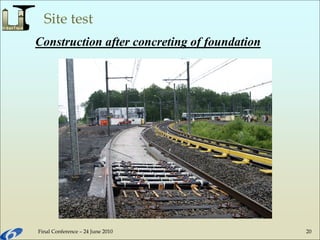
Construction after concreting of foundation
Final Conference – 24 June 2010 21
Site test
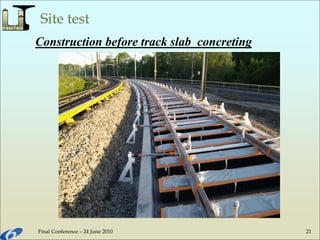
Construction before track slab concreting
Final Conference – 24 June 2010 22
Site test
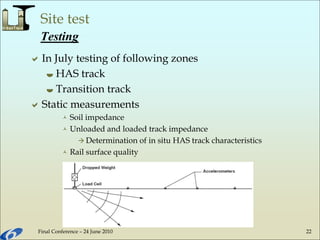
In July testing of following zones
 HAS track
 Transition track
Static measurements
 Soil impedance
 Unloaded and loaded track impedance
 Determination of in situ HAS track characteristics
 Rail surface quality
Testing
Final Conference – 24 June 2010 23
Site test
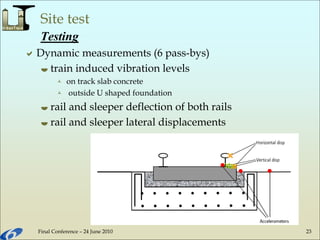
Dynamic measurements (6 pass-bys)
 train induced vibration levels
 on track slab concrete
 outside U shaped foundation
 rail and sleeper deflection of both rails
 rail and sleeper lateral displacements
Testing
Final Conference – 24 June 2010 24
Site test
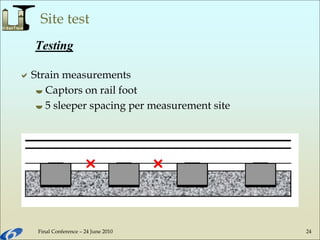
Strain measurements
 Captors on rail foot
 5 sleeper spacing per measurement site
Testing
Final Conference – 24 June 2010 25
Site test
Vibration simulation
 HAS track parameters measured
 PACT reference track parameters
 Measured roughness
 Rolling Stock data
 Insertion gain calculation in 1/3rd octave bands
Testing
Final Conference – 24 June 2010 26
Conclusions
 High performance alternative to floating track slab
 Ideal for underground metro applications
 Could absorb railway loads applied to sensitive bridges
 In high speed tunnel application
 Theoretically compared to “S3” high speed –4dB (halved the vibration level)
 Limiting operational criteria (mixed operations, speed, twist…) to determine
 Costing being completed but ballpark figures are
 Compared to typical metro floating track slab
 Design, procure and build cost HAS gives 10% saving
 Maintenance costs for HAS are much lower
 Potential to reduce tunnelling costs
 Further information
 final report will be ready after completion of CEF tests in August 2010
 See URBAN TRACK website http://www.urbantrack.eu/
 RGCF no 191 February 2010
 Railway Engineering 2009
High Attenuation Sleeper

Urban track singapore

  • 1.
    URBAN TRACK Final Conference Alternativeto Floating Track Slab High Attenuation Sleeper Presented by Ian Robertson, ALSTOM 24 June 2010, Prague
  • 2.
    Final Conference –24 June 2010 2 Contents Specific objectives of study Chosen concept Detailed design and laboratory test Site test (ongoing) Conclusions
  • 3.
    Final Conference –24 June 2010 3 Specific objectives of study  Develop slab track with following technical characteristics  metro environment (18t axle load, 100 kph)  equivalent vibration performance to Floating Slab Track  ability to meet all railway constraints  Safety (derailment) including track level evacuation  Comfort  maintenance  Construction method  for standard equipment and methods  production rate as conventional track slab  Lower costs compared to AFST  For capital portion (design+procure+build)  For maintenance portion
  • 4.
    Final Conference –24 June 2010 4 Chosen concept Review of existing systems worldwide Previous generation bi-block sleepers for CTRL  Relatively low weight  Tie bar overstressed with very soft pads  Track gauge variations with very soft pads Chosen concept = mono-block resilient sleeper High attenuation due to  High sleeper mass (350 – 400 kg)  Very soft resilient inserts (8KN/mm/fastener) Adapted to tracklaying gantries Maintenance friendly
  • 5.
    Final Conference –24 June 2010 5 Detailed design and laboratory test HAS mono-bloc sleeper concept Rigid boot Concrete sleeperFastening system according to customer choice sealing Holes for conductor rail support
  • 6.
    Final Conference –24 June 2010 6 Detailed design and laboratory test Comparison of Different Antivibratile System -60 -50 -40 -30 -20 -10 0 10 20 1 1,6 2,5 4 6,3 10 16 25 40 63 100 158 251 Frequency (Hz) InsertionGain(dB) Insertion Gain SFS 312 (dB) Insertion Gain DFC Pandrol (dB) Insertion Gain CTRL 2(dB) Insertion Gain FST (Taipei) (dB) Insertion Gain EGG_2(dB) Insertion gain target
  • 7.
    Final Conference –24 June 2010 7 Detailed design and laboratory test DESIGN FULLY COMPLIANT WITH MOST RAIL FASTENERS Typical tunnel layout
  • 8.
    Final Conference –24 June 2010 8 Detailed design and laboratory test Based on OBLEX project 20 cm gain Dia.5.8 Dia. 5.6 Typical case of impact on tunnel diameter
  • 9.
    Final Conference –24 June 2010 9 Detailed design and laboratory test Time Load 2 Hz 5 Hz Fmax .Fmax Actual load diagram with sine shape Optimum load diagram with triangle shape simulating wheel passage Simplified load diagram used during fatigue test to simulate bogie passage ACHIEVED 4,5 MILLIONS LOAD CYCLE WITH SUCCESS HAS mono-bloc sleeper dynamic testing regime
  • 10.
    Final Conference –24 June 2010 10 Detailed design and laboratory test Mechanical test carried out  Fatigue test with inclined loads according to the following phases :  1M Cycles @ low frequency (3 Hz) applied load between 10kN et 75kN, centred, inclined at 38°  0.5MCycles @ moderate frequency (5 Hz) applied load between 30/40kN et 75kN centred , inclined at 38°  2M Cycles @ low frequency (3 Hz) applied load between 10kN et 75kN, inclined at 10° and 38°  1 M Cycles @ moderate frequency (5 Hz) applied load between 30/40kN et 75kN, inclined at 10° and 38° NO PAD WEARING & NO VERTICAL STIFFNESS LOSS AFTER 4.5M CYCLES (EN13230: 2M CYCLES)
  • 11.
    Final Conference –24 June 2010 11 Detailed design and laboratory test EXCITATIO N MONOBLOC SLEEPER RAIL RIGID HULL RAIL PRELOAD CONCRETE BASE SENSOR S Testing arrangements Acoustic test mechanical test
  • 12.
    Final Conference –24 June 2010 12 Detailed design and laboratory test 0 2 4 6 8 10 12 MN/m 0 32 40 50 64 kN Stifffness vs static load at 8Hz K (MN/m) Dynamic test results
  • 13.
    Final Conference –24 June 2010 13 Site test (ongoing) Several possibilities reviewed notably  SINGAPORE Circle Line  CEF test site (Valenciennes) CEF chosen  Easier logistics  To respect URBAN TRACK timing Construction just completed June 11 Vibration tests scheduled July Introduction
  • 14.
    Final Conference –24 June 2010 14 Site test - Situation Test section • 190m radius • 160mm cant Situation within CEF site Actual track to replace • ballasted track • fishplated U50 rail • good ground conditions EV2 above 80 MPA
  • 15.
    Final Conference –24 June 2010 15 Site test  50m of High Attenuation Track  2 x 6.5m of transition slab with ballasted track  Sleeper spacing 700mm  Welded rail on high attenuation zone  Fishplated joints allowing movement at each end of test General Layout
  • 16.
    Final Conference –24 June 2010 16 Site test Typical section
  • 17.
    Final Conference –24 June 2010 17 Site test Detailed design concept 230 230 80 2583 80200 Reinforced U-shaped foundation Track « slab » concrete  unreinforced  With frequent joints to avoid shrinkage cracking
  • 18.
    Final Conference –24 June 2010 18 Site test After HAS vibration testing  Axle load = 25 tonnes  Total load = 280MGT  HAS resilient inserts to replace by stiffer inserts (30MN/M) Structural design based on Eurocode 2  Load Model 71  Crack 0.2mm Detailed design assumptions
  • 19.
    Final Conference –24 June 2010 19 Site test  Neighbouring (existing) ballast track  Total dynamic stiffness around 80kN/mm per fastener  High Attenuation Sleeper Track  Under sleeper pad = 1,5*8 kN/mm  Total stiffness = 11kN/mm per fastener  Transition zone  Target total stiffness = 46kN/mm  Under sleeper pad = 70 to 80 kN/mm per fastener  Total stiffness = 47 to 52 kN/mm per fastener 0.70.6 0.7 HAS Track Ballast track Transition zone 7 0.7 Transition slab design
  • 20.
    Final Conference –24 June 2010 20 Site test Construction after concreting of foundation
  • 21.
    Final Conference –24 June 2010 21 Site test Construction before track slab concreting
  • 22.
    Final Conference –24 June 2010 22 Site test In July testing of following zones  HAS track  Transition track Static measurements  Soil impedance  Unloaded and loaded track impedance  Determination of in situ HAS track characteristics  Rail surface quality Testing
  • 23.
    Final Conference –24 June 2010 23 Site test Dynamic measurements (6 pass-bys)  train induced vibration levels  on track slab concrete  outside U shaped foundation  rail and sleeper deflection of both rails  rail and sleeper lateral displacements Testing
  • 24.
    Final Conference –24 June 2010 24 Site test Strain measurements  Captors on rail foot  5 sleeper spacing per measurement site Testing
  • 25.
    Final Conference –24 June 2010 25 Site test Vibration simulation  HAS track parameters measured  PACT reference track parameters  Measured roughness  Rolling Stock data  Insertion gain calculation in 1/3rd octave bands Testing
  • 26.
    Final Conference –24 June 2010 26 Conclusions  High performance alternative to floating track slab  Ideal for underground metro applications  Could absorb railway loads applied to sensitive bridges  In high speed tunnel application  Theoretically compared to “S3” high speed –4dB (halved the vibration level)  Limiting operational criteria (mixed operations, speed, twist…) to determine  Costing being completed but ballpark figures are  Compared to typical metro floating track slab  Design, procure and build cost HAS gives 10% saving  Maintenance costs for HAS are much lower  Potential to reduce tunnelling costs  Further information  final report will be ready after completion of CEF tests in August 2010  See URBAN TRACK website http://www.urbantrack.eu/  RGCF no 191 February 2010  Railway Engineering 2009 High Attenuation Sleeper