Universal Mechanism 1
Universal Mechanism
Application of UM to optimize
wheel profiles on Russian Railways
D. Pogorelova, V. Simonova, V. Sakaloa, A. Sakaloa, R. Kovaleva, A. Rodikova,
S. Tomashevskiya, D. Kerentcevb, Iman Hazratic
aLaboratory of Computational Mechanics, Bryansk State Technical University, Bryansk, Russia
bVyksa Steel Works, Vyksa, Russia
CConcordia University, Montreal, Canada
www.universalmechanism.com um@universalmechanism.com
2nd annual ICRI Workshop on RCF and Wear August 1-3, 2017
University of British Columbia, Vancouver, Canada
Universal Mechanism 2
Simulation of TEM7 model in a tight S-curve
Model is developed by V. Bykov and A. Spirov from All-Russian Locomotive Institute, Kolomna, Russia
What is Universal Mechanism?
ICRI mini-conference, AUG 01, 2017
Universal Mechanism 3
Introduction
The objective of the research is optimization of the wheel profiles for three types
of cars:
1) (old design) freight car with three-piece bogies with axle load of 23.5 t;
2) (new design) freight car with three-piece bogies with axle load of 25 t;
3) conventional passenger car with maximum speed of 160 km/h.
Optimization criteria:
1) wear of wheel profiles;
2) rolling contact fatigue;
3) safety factors and lateral forces.
Customer is Vyksa Steel Works located in Vyksa, Russia. The company occupies
over 50% of the Russian market of railway wheels. Optimal profiles will make the
re-profiling interval longer and minimize the maintenance cost for railway
operators.
ICRI mini-conference, AUG 01, 2017
Universal Mechanism 4
Conventional three-piece bogie with axle load of 23.5 t
The model of a gondola car with axle load of 23.5 t
ICRI mini-conference, AUG 01, 2017
Universal Mechanism 5
Modern three-piece bogie with axle load of 25 t
The model of a gondola car with axle load of 25 t
ICRI mini-conference, AUG 01, 2017
Universal Mechanism 6
Conventional Passenger Car
Passenger car with maximum speed of 160 km/h
ICRI mini-conference, AUG 01, 2017
Universal Mechanism 7
Working conditions
Track / Weight Speed, km/h / Weight
Tangent / 80%
60 / 30%
100 / 50%
140 / 20%
Curve R = 650 m / 15%
60 / 30%
90 / 50%
120 / 20%
Curve R = 350 m / 5% 60 / 100%
Passenger car
Freight cars
Track / Weight Speed, km/h / Weight
Tangent / 80%
40 / 29%
60 / 54%
80 / 17%
Curve R = 650 m / 15%
40 / 29%
60 / 54%
80 / 17%
Curve R = 350 m / 5% 50 / 100%
ICRI mini-conference, AUG 01, 2017
Universal Mechanism 8
Contact Models for Wear Simulation in UM
O
z1
z2
y
x
O
y
yl yr
xl(y)
δ δ
z
w1
w2
fr
fw
fw deformed
fr deformed
interpenetration
area
contact
area
1
2
y
2) Pressures along the strip i are distributed
by semielliptical law :
,
1 2
2
0
li
i
x
z
p
p 

1) Interpenetration is defined by using
interpenetration factor KВ:
.
0 
 B
K

.
0
0
li
i
В
p
i
x
E
K
k
p


Recommended interpenetration factor: KВ = 0,53
,
073
,
0
294
,
0
146
,
0 2

 


p
k
The approximating dependence for determination
of the factor kp:
;
/ a
b


where
b and a are smaller and bigger semiaxis
of the contact ellipse.
Normal contact problem
Tangential contact rolling problem
The modified algorithm, based on the FASTSIM1 algorithm, is used for determinatino the tangential
forces distribution on the contact surface.
1. Kalker J.J. A Fast Algorithm for the Simplified Theory of Rolling Contact // Vehicle system dynamics. 1982. №11. P. 1…13.
where
ICRI mini-conference, AUG 01, 2017
Universal Mechanism 9
Wear Model and Parameters
Wear model
A
k
I V

I is the volume wear, m3;
kV is the factor of the volume wear, m3/J;
A is the work of friction, J
Research in the field conditions on the Gottard line [1]
km = (1.1-2.4)∙10-3 mg/Nm
Wear factor vs. hardness
km = 5.455·10-3 – 1.3·10-5 HB mg/Nm (1)
Steel grade 2 L T
Wear factor km, mg/Nm 1.83∙10-3 1.54∙10-3 1.24∙10-3
[1] O. Krettek, A. Szabo, E. Bekefi, I. Zobory. On identification of wear coefficient used in the
dissipated energy based wear hypothesis, in: Proc. of the 2nd mini conf. Contact mechanics and
wear of rail/wheel systems, Budapest, 1996, pp. 260-265.
[2] D.P. Markov, Increasing the hardness of railway wheels, Bull. All Russia Sci. Res. Inst. Railway
Transport 3 (1995) 10-17 (in Russian).
ICRI mini-conference, AUG 01, 2017
Universal Mechanism 10
Wear indicators
flange wear
rolling surface wear
Wear indicators: flange and rolling surface wear
70 mm
18 mm
ICRI mini-conference, AUG 01, 2017
Universal Mechanism 11
Typical Wheel Wear Simulation Results
The choice of object of research
The comparison of the rolling surface wear and flange wear of the
wheels of the 1st and 2nd wheelsets with GOST 10791 profiles
ICRI mini-conference, AUG 01, 2017
Universal Mechanism 12
Wheel wear simulation
Freight car with axle load of 23.5 t
GOST 10791 is the standard (initial) profile
P1..P9 are newly obtained (enhanced) profiles
ITM-73, VMZ 001 are patented third-party profiles
Initial profile
ICRI mini-conference, AUG 01, 2017
Universal Mechanism 13
Wheel wear simulation
Initial and worn P5 wheel profile
Flange wear vs. kilometrage
80+
Freight car with axle load of 23.5 t
ICRI mini-conference, AUG 01, 2017
Universal Mechanism 14
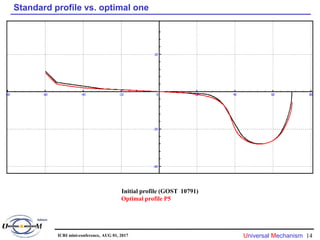
Standard profile vs. optimal one
Initial profile (GOST 10791)
Optimal profile P5
ICRI mini-conference, AUG 01, 2017
Universal Mechanism 15
Wheel wear simulation
Freight car with axle load of 25 t
ICRI mini-conference, AUG 01, 2017
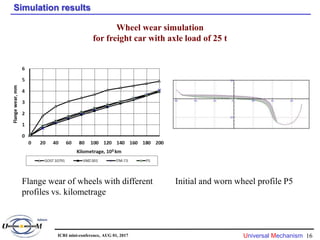
Universal Mechanism 16
Simulation results
Initial and worn wheel profile P5
Flange wear of wheels with different
profiles vs. kilometrage
Wheel wear simulation
for freight car with axle load of 25 t
ICRI mini-conference, AUG 01, 2017
Universal Mechanism 17
Wheel wear simulation
Passenger car
ICRI mini-conference, AUG 01, 2017
Universal Mechanism 18
Rolling Contact Fatigue
The RCF curves of the Weller's curves type
m
eq
C
N 
 
max

 
eq
The maximum shear stress criterion
Criterion of rolling contact fatigue damage
N
eq

N is the number of cycles to fatigue failure;
σeq is the selected criterion of the contact strength;
C, m are the material constants.



n
i i
N
Q
1
1
The accumulated damage in the node
(1)
(2)
(3)
ICRI mini-conference, AUG 01, 2017
Universal Mechanism 19
Rolling Contact Fatigue
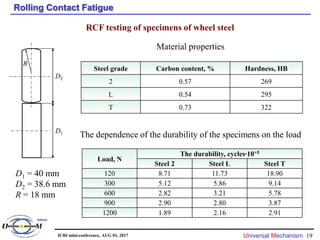
RCF testing of specimens of wheel steel
Steel grade Carbon content, % Hardness, HB
2 0.57 269
L 0.54 295
T 0.73 322
Load, N
The durability, cycles∙10+5
Steel 2 Steel L Steel T
120 8.71 11.73 18.90
300 5.12 5.86 9.14
600 2.82 3.21 5.78
900 2.90 2.80 3.87
1200 1.89 2.16 2.91
Material properties
The dependence of the durability of the specimens on the load
R
D1
D2
D1 = 40 mm
D2 = 38.6 mm
R = 18 mm
ICRI mini-conference, AUG 01, 2017
Universal Mechanism 20
Rolling Contact Fatigue
Processing the results of the RCF tests
FE models of the fragments of the wheel
steel specimen (1) and loading roller (2)
z
y
x
R 19.3
R 18
R 20
1
2
The approximated stress-strain
diagrams of the wheel steels
Steel 2
Steel L
Specimen:
E1 = 2.0∙1011 Pa
ν1 = 0.3
26 896 nodes
24 000 elements
Loading roller:
E2 = 5.9∙1011 Pa
ν2 = 0.202
11 767 nodes
9 600 elements
ICRI mini-conference, AUG 01, 2017
Universal Mechanism 21
Rolling Contact Fatigue
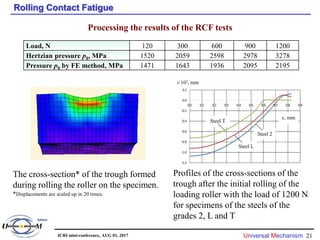
Processing the results of the RCF tests
The cross-section* of the trough formed
during rolling the roller on the specimen.
*Displacements are scaled up in 20 times.
v∙102, mm
x, mm
Steel L
Steel 2
Steel T
Profiles of the cross-sections of the
trough after the initial rolling of the
loading roller with the load of 1200 N
for specimens of the steels of the
grades 2, L and T
Load, N 120 300 600 900 1200
Hertzian pressure p0, MPa 1520 2059 2598 2978 3278
Pressure p0 by FE method, MPa 1471 1643 1936 2095 2195
ICRI mini-conference, AUG 01, 2017
Universal Mechanism 22
Rolling Contact Fatigue
Processing the results of the RCF tests
Directions of the residual stresses in the
dangerous point of the specimen
R
max

σ1
σ1
σ2 σ3
σ3
y
x
z
45º
45º
σ3
σ3
σ2 σ1
σ1
y
x
z
45º
45º
L
max

Directions of the principal stresses in
the dangerous point of the specimen
after re-rolling of the loading roller
σ3
σ3
σ1 σ2
σ2
y
x
z
45º
45º
L
23

Directions of the principal stresses in
the dangerous point at low loads
 
  2
/
max
max
max
L
R
a


 

 (1)
The amplitude value of τmax
is the residual maximum shear
stress;
is the maximum shear stress
caused by the loading under re-rolling
of the loading roller
R
max

L
max

ICRI mini-conference, AUG 01, 2017
Universal Mechanism 23
Rolling Contact Fatigue
Processing the results of the RCF tests
The function of the RCF curve
RCF life (cycles, x10+5)
τa
max, MPa
Steel 2
Steel L
Steel T
Grade of wheel steel C m
2 2.1·1010 1.9
L 4.6·1010 2.0
T 1.2·1012 2.5
  m
a
C
N

 max
 (1)
ICRI mini-conference, AUG 01, 2017
Universal Mechanism 24
Rolling Contact Fatigue
Operation of the UM RCF tool
ICRI mini-conference, AUG 01, 2017
Universal Mechanism 25
Rolling Contact Fatigue
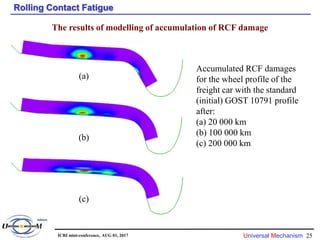
The results of modelling of accumulation of RCF damage
Accumulated RCF damages
for the wheel profile of the
freight car with the standard
(initial) GOST 10791 profile
after:
(a) 20 000 km
(b) 100 000 km
(c) 200 000 km
(a)
(b)
(c)
ICRI mini-conference, AUG 01, 2017
Universal Mechanism 26
Comparison of initial and optimal wheel profiles
The accumulated RCF damages, passenger car
Initial profile (GOST 10791) Optimal profile P9
20 000 km, 0.051
Kilometrage, relative
accumulated damage
60 000 km, 0.262
100 000 km, 0.530
160 000 km, 0.827
200 000 km, 1.000
20 000 km, 0.021
Kilometrage, relative
accumulated damage
60 000 km, 0.080
100 000 km, 0.165
160 000 km, 0.308
200 000 km, 0.404
ICRI mini-conference, AUG 01, 2017
Universal Mechanism 27
Comparison of initial and optimal wheel profiles
Initial profile (GOST 10791) Optimal profile P5
20 000 km, 0.125
Kilometrage, relative
accumulated damage
60 000 km, 0.358
100 000 km, 0.541
160 000 km, 0.780
200 000 km, 1.000
20 000 km, 0.048
Kilometrage, relative
accumulated damage
60 000 km, 0.162
100 000 km, 0.288
160 000 km, 0.513
200 000 km, 0.739
The accumulated RCF damages, freight car, 23.5 t/axle
ICRI mini-conference, AUG 01, 2017
Universal Mechanism 28
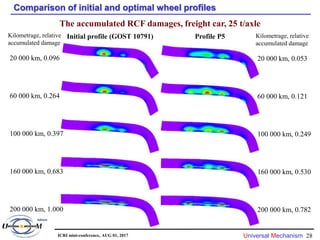
Comparison of initial and optimal wheel profiles
Initial profile (GOST 10791) Profile P5
20 000 km, 0.096
Kilometrage, relative
accumulated damage
60 000 km, 0.264
100 000 km, 0.397
160 000 km, 0.683
200 000 km, 1.000
20 000 km, 0.053
Kilometrage, relative
accumulated damage
60 000 km, 0.121
100 000 km, 0.249
160 000 km, 0.530
200 000 km, 0.782
The accumulated RCF damages, freight car, 25 t/axle
ICRI mini-conference, AUG 01, 2017
Universal Mechanism 29
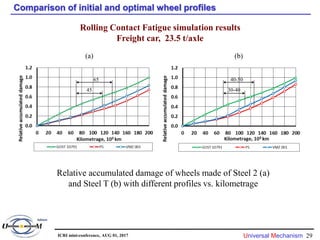
Comparison of initial and optimal wheel profiles
Rolling Contact Fatigue simulation results
Freight car, 23.5 t/axle
45
65
30-40
40-50
Relative accumulated damage of wheels made of Steel 2 (a)
and Steel T (b) with different profiles vs. kilometrage
(a) (b)
ICRI mini-conference, AUG 01, 2017
Universal Mechanism 30
Discussion of RCF Criteria
Criteria of RCF damage
1) The maximum Hertzian pressure
2) The amplitude of the maximum shear stress
3) The Dang Van criterion
4) The Sines criteria
5) The potential energy of deformation
2
/
)
( 3
1
max 

 

e
h
DV
a
DV t
t 



 

 )
(
)
(
is the shear stress “amplitude” ;
is the hydrostatic stress;
is the fatigue limit of material in pure shear;
is the Dang Van factor
)
(t
a

)
(t
h

e

DV

A
J
J
J
J P
R
M




 )
( 1
1
1
2 
 
)
(
6
)
(
)
(
)
(
3
1 2
2
2
2
2
2
2 zx
yz
xy
x
z
z
y
y
x T
T
T
S
S
S
S
S
S
J 









)]
(
2
[
2
1
1
3
3
2
2
1
2
3
2
2
2
1
0 








 





E
U
ICRI mini-conference, AUG 01, 2017
Universal Mechanism 31
Conclusions
1) The optimization of the wheel profiles for the three types of cars was made.
2) The predicted increase of service life of the wheels with innovative profiles in
comparison with the standard ones taking into accounts their steel grade was
estimated.
3) The software tool that allows taking into account the influence of the hardness
of wheel steel on the wear and RCF durability is developed.
ICRI mini-conference, AUG 01, 2017
Universal Mechanism 32
Thanks for your kind attention
2nd annual ICRI Workshop on RCF and Wear August 1-3, 2017
University of British Columbia, Vancouver, Canada
Application of UM to optimize
wheel profiles on Russian Railways
D. Pogorelova, V. Simonova, V. Sakaloa, A. Sakaloa, R. Kovaleva, A. Rodikova,
S. Tomashevskiya, D. Kerentcevb, Iman Hazratic
aLaboratory of Computational Mechanics, Bryansk, Russia
bVyksa Steel Works, Vyksa, Russia
CConcordia University, Montreal, Canada
www.universalmechanism.com um@universalmechanism.com
iran@universalmechanism.com
iman.hazrarti@concordia.ca

Wheel profile optimization icri-rcf.pptx

  • 1.
    Universal Mechanism 1 UniversalMechanism Application of UM to optimize wheel profiles on Russian Railways D. Pogorelova, V. Simonova, V. Sakaloa, A. Sakaloa, R. Kovaleva, A. Rodikova, S. Tomashevskiya, D. Kerentcevb, Iman Hazratic aLaboratory of Computational Mechanics, Bryansk State Technical University, Bryansk, Russia bVyksa Steel Works, Vyksa, Russia CConcordia University, Montreal, Canada www.universalmechanism.com um@universalmechanism.com 2nd annual ICRI Workshop on RCF and Wear August 1-3, 2017 University of British Columbia, Vancouver, Canada
  • 2.
    Universal Mechanism 2 Simulationof TEM7 model in a tight S-curve Model is developed by V. Bykov and A. Spirov from All-Russian Locomotive Institute, Kolomna, Russia What is Universal Mechanism? ICRI mini-conference, AUG 01, 2017
  • 3.
    Universal Mechanism 3 Introduction Theobjective of the research is optimization of the wheel profiles for three types of cars: 1) (old design) freight car with three-piece bogies with axle load of 23.5 t; 2) (new design) freight car with three-piece bogies with axle load of 25 t; 3) conventional passenger car with maximum speed of 160 km/h. Optimization criteria: 1) wear of wheel profiles; 2) rolling contact fatigue; 3) safety factors and lateral forces. Customer is Vyksa Steel Works located in Vyksa, Russia. The company occupies over 50% of the Russian market of railway wheels. Optimal profiles will make the re-profiling interval longer and minimize the maintenance cost for railway operators. ICRI mini-conference, AUG 01, 2017
  • 4.
    Universal Mechanism 4 Conventionalthree-piece bogie with axle load of 23.5 t The model of a gondola car with axle load of 23.5 t ICRI mini-conference, AUG 01, 2017
  • 5.
    Universal Mechanism 5 Modernthree-piece bogie with axle load of 25 t The model of a gondola car with axle load of 25 t ICRI mini-conference, AUG 01, 2017
  • 6.
    Universal Mechanism 6 ConventionalPassenger Car Passenger car with maximum speed of 160 km/h ICRI mini-conference, AUG 01, 2017
  • 7.
    Universal Mechanism 7 Workingconditions Track / Weight Speed, km/h / Weight Tangent / 80% 60 / 30% 100 / 50% 140 / 20% Curve R = 650 m / 15% 60 / 30% 90 / 50% 120 / 20% Curve R = 350 m / 5% 60 / 100% Passenger car Freight cars Track / Weight Speed, km/h / Weight Tangent / 80% 40 / 29% 60 / 54% 80 / 17% Curve R = 650 m / 15% 40 / 29% 60 / 54% 80 / 17% Curve R = 350 m / 5% 50 / 100% ICRI mini-conference, AUG 01, 2017
  • 8.
    Universal Mechanism 8 ContactModels for Wear Simulation in UM O z1 z2 y x O y yl yr xl(y) δ δ z w1 w2 fr fw fw deformed fr deformed interpenetration area contact area 1 2 y 2) Pressures along the strip i are distributed by semielliptical law : , 1 2 2 0 li i x z p p   1) Interpenetration is defined by using interpenetration factor KВ: . 0   B K  . 0 0 li i В p i x E K k p   Recommended interpenetration factor: KВ = 0,53 , 073 , 0 294 , 0 146 , 0 2      p k The approximating dependence for determination of the factor kp: ; / a b   where b and a are smaller and bigger semiaxis of the contact ellipse. Normal contact problem Tangential contact rolling problem The modified algorithm, based on the FASTSIM1 algorithm, is used for determinatino the tangential forces distribution on the contact surface. 1. Kalker J.J. A Fast Algorithm for the Simplified Theory of Rolling Contact // Vehicle system dynamics. 1982. №11. P. 1…13. where ICRI mini-conference, AUG 01, 2017
  • 9.
    Universal Mechanism 9 WearModel and Parameters Wear model A k I V  I is the volume wear, m3; kV is the factor of the volume wear, m3/J; A is the work of friction, J Research in the field conditions on the Gottard line [1] km = (1.1-2.4)∙10-3 mg/Nm Wear factor vs. hardness km = 5.455·10-3 – 1.3·10-5 HB mg/Nm (1) Steel grade 2 L T Wear factor km, mg/Nm 1.83∙10-3 1.54∙10-3 1.24∙10-3 [1] O. Krettek, A. Szabo, E. Bekefi, I. Zobory. On identification of wear coefficient used in the dissipated energy based wear hypothesis, in: Proc. of the 2nd mini conf. Contact mechanics and wear of rail/wheel systems, Budapest, 1996, pp. 260-265. [2] D.P. Markov, Increasing the hardness of railway wheels, Bull. All Russia Sci. Res. Inst. Railway Transport 3 (1995) 10-17 (in Russian). ICRI mini-conference, AUG 01, 2017
  • 10.
    Universal Mechanism 10 Wearindicators flange wear rolling surface wear Wear indicators: flange and rolling surface wear 70 mm 18 mm ICRI mini-conference, AUG 01, 2017
  • 11.
    Universal Mechanism 11 TypicalWheel Wear Simulation Results The choice of object of research The comparison of the rolling surface wear and flange wear of the wheels of the 1st and 2nd wheelsets with GOST 10791 profiles ICRI mini-conference, AUG 01, 2017
  • 12.
    Universal Mechanism 12 Wheelwear simulation Freight car with axle load of 23.5 t GOST 10791 is the standard (initial) profile P1..P9 are newly obtained (enhanced) profiles ITM-73, VMZ 001 are patented third-party profiles Initial profile ICRI mini-conference, AUG 01, 2017
  • 13.
    Universal Mechanism 13 Wheelwear simulation Initial and worn P5 wheel profile Flange wear vs. kilometrage 80+ Freight car with axle load of 23.5 t ICRI mini-conference, AUG 01, 2017
  • 14.
    Universal Mechanism 14 Standardprofile vs. optimal one Initial profile (GOST 10791) Optimal profile P5 ICRI mini-conference, AUG 01, 2017
  • 15.
    Universal Mechanism 15 Wheelwear simulation Freight car with axle load of 25 t ICRI mini-conference, AUG 01, 2017
  • 16.
    Universal Mechanism 16 Simulationresults Initial and worn wheel profile P5 Flange wear of wheels with different profiles vs. kilometrage Wheel wear simulation for freight car with axle load of 25 t ICRI mini-conference, AUG 01, 2017
  • 17.
    Universal Mechanism 17 Wheelwear simulation Passenger car ICRI mini-conference, AUG 01, 2017
  • 18.
    Universal Mechanism 18 RollingContact Fatigue The RCF curves of the Weller's curves type m eq C N    max    eq The maximum shear stress criterion Criterion of rolling contact fatigue damage N eq  N is the number of cycles to fatigue failure; σeq is the selected criterion of the contact strength; C, m are the material constants.    n i i N Q 1 1 The accumulated damage in the node (1) (2) (3) ICRI mini-conference, AUG 01, 2017
  • 19.
    Universal Mechanism 19 RollingContact Fatigue RCF testing of specimens of wheel steel Steel grade Carbon content, % Hardness, HB 2 0.57 269 L 0.54 295 T 0.73 322 Load, N The durability, cycles∙10+5 Steel 2 Steel L Steel T 120 8.71 11.73 18.90 300 5.12 5.86 9.14 600 2.82 3.21 5.78 900 2.90 2.80 3.87 1200 1.89 2.16 2.91 Material properties The dependence of the durability of the specimens on the load R D1 D2 D1 = 40 mm D2 = 38.6 mm R = 18 mm ICRI mini-conference, AUG 01, 2017
  • 20.
    Universal Mechanism 20 RollingContact Fatigue Processing the results of the RCF tests FE models of the fragments of the wheel steel specimen (1) and loading roller (2) z y x R 19.3 R 18 R 20 1 2 The approximated stress-strain diagrams of the wheel steels Steel 2 Steel L Specimen: E1 = 2.0∙1011 Pa ν1 = 0.3 26 896 nodes 24 000 elements Loading roller: E2 = 5.9∙1011 Pa ν2 = 0.202 11 767 nodes 9 600 elements ICRI mini-conference, AUG 01, 2017
  • 21.
    Universal Mechanism 21 RollingContact Fatigue Processing the results of the RCF tests The cross-section* of the trough formed during rolling the roller on the specimen. *Displacements are scaled up in 20 times. v∙102, mm x, mm Steel L Steel 2 Steel T Profiles of the cross-sections of the trough after the initial rolling of the loading roller with the load of 1200 N for specimens of the steels of the grades 2, L and T Load, N 120 300 600 900 1200 Hertzian pressure p0, MPa 1520 2059 2598 2978 3278 Pressure p0 by FE method, MPa 1471 1643 1936 2095 2195 ICRI mini-conference, AUG 01, 2017
  • 22.
    Universal Mechanism 22 RollingContact Fatigue Processing the results of the RCF tests Directions of the residual stresses in the dangerous point of the specimen R max  σ1 σ1 σ2 σ3 σ3 y x z 45º 45º σ3 σ3 σ2 σ1 σ1 y x z 45º 45º L max  Directions of the principal stresses in the dangerous point of the specimen after re-rolling of the loading roller σ3 σ3 σ1 σ2 σ2 y x z 45º 45º L 23  Directions of the principal stresses in the dangerous point at low loads     2 / max max max L R a       (1) The amplitude value of τmax is the residual maximum shear stress; is the maximum shear stress caused by the loading under re-rolling of the loading roller R max  L max  ICRI mini-conference, AUG 01, 2017
  • 23.
    Universal Mechanism 23 RollingContact Fatigue Processing the results of the RCF tests The function of the RCF curve RCF life (cycles, x10+5) τa max, MPa Steel 2 Steel L Steel T Grade of wheel steel C m 2 2.1·1010 1.9 L 4.6·1010 2.0 T 1.2·1012 2.5   m a C N   max  (1) ICRI mini-conference, AUG 01, 2017
  • 24.
    Universal Mechanism 24 RollingContact Fatigue Operation of the UM RCF tool ICRI mini-conference, AUG 01, 2017
  • 25.
    Universal Mechanism 25 RollingContact Fatigue The results of modelling of accumulation of RCF damage Accumulated RCF damages for the wheel profile of the freight car with the standard (initial) GOST 10791 profile after: (a) 20 000 km (b) 100 000 km (c) 200 000 km (a) (b) (c) ICRI mini-conference, AUG 01, 2017
  • 26.
    Universal Mechanism 26 Comparisonof initial and optimal wheel profiles The accumulated RCF damages, passenger car Initial profile (GOST 10791) Optimal profile P9 20 000 km, 0.051 Kilometrage, relative accumulated damage 60 000 km, 0.262 100 000 km, 0.530 160 000 km, 0.827 200 000 km, 1.000 20 000 km, 0.021 Kilometrage, relative accumulated damage 60 000 km, 0.080 100 000 km, 0.165 160 000 km, 0.308 200 000 km, 0.404 ICRI mini-conference, AUG 01, 2017
  • 27.
    Universal Mechanism 27 Comparisonof initial and optimal wheel profiles Initial profile (GOST 10791) Optimal profile P5 20 000 km, 0.125 Kilometrage, relative accumulated damage 60 000 km, 0.358 100 000 km, 0.541 160 000 km, 0.780 200 000 km, 1.000 20 000 km, 0.048 Kilometrage, relative accumulated damage 60 000 km, 0.162 100 000 km, 0.288 160 000 km, 0.513 200 000 km, 0.739 The accumulated RCF damages, freight car, 23.5 t/axle ICRI mini-conference, AUG 01, 2017
  • 28.
    Universal Mechanism 28 Comparisonof initial and optimal wheel profiles Initial profile (GOST 10791) Profile P5 20 000 km, 0.096 Kilometrage, relative accumulated damage 60 000 km, 0.264 100 000 km, 0.397 160 000 km, 0.683 200 000 km, 1.000 20 000 km, 0.053 Kilometrage, relative accumulated damage 60 000 km, 0.121 100 000 km, 0.249 160 000 km, 0.530 200 000 km, 0.782 The accumulated RCF damages, freight car, 25 t/axle ICRI mini-conference, AUG 01, 2017
  • 29.
    Universal Mechanism 29 Comparisonof initial and optimal wheel profiles Rolling Contact Fatigue simulation results Freight car, 23.5 t/axle 45 65 30-40 40-50 Relative accumulated damage of wheels made of Steel 2 (a) and Steel T (b) with different profiles vs. kilometrage (a) (b) ICRI mini-conference, AUG 01, 2017
  • 30.
    Universal Mechanism 30 Discussionof RCF Criteria Criteria of RCF damage 1) The maximum Hertzian pressure 2) The amplitude of the maximum shear stress 3) The Dang Van criterion 4) The Sines criteria 5) The potential energy of deformation 2 / ) ( 3 1 max      e h DV a DV t t         ) ( ) ( is the shear stress “amplitude” ; is the hydrostatic stress; is the fatigue limit of material in pure shear; is the Dang Van factor ) (t a  ) (t h  e  DV  A J J J J P R M      ) ( 1 1 1 2    ) ( 6 ) ( ) ( ) ( 3 1 2 2 2 2 2 2 2 zx yz xy x z z y y x T T T S S S S S S J           )] ( 2 [ 2 1 1 3 3 2 2 1 2 3 2 2 2 1 0                 E U ICRI mini-conference, AUG 01, 2017
  • 31.
    Universal Mechanism 31 Conclusions 1)The optimization of the wheel profiles for the three types of cars was made. 2) The predicted increase of service life of the wheels with innovative profiles in comparison with the standard ones taking into accounts their steel grade was estimated. 3) The software tool that allows taking into account the influence of the hardness of wheel steel on the wear and RCF durability is developed. ICRI mini-conference, AUG 01, 2017
  • 32.
    Universal Mechanism 32 Thanksfor your kind attention 2nd annual ICRI Workshop on RCF and Wear August 1-3, 2017 University of British Columbia, Vancouver, Canada Application of UM to optimize wheel profiles on Russian Railways D. Pogorelova, V. Simonova, V. Sakaloa, A. Sakaloa, R. Kovaleva, A. Rodikova, S. Tomashevskiya, D. Kerentcevb, Iman Hazratic aLaboratory of Computational Mechanics, Bryansk, Russia bVyksa Steel Works, Vyksa, Russia CConcordia University, Montreal, Canada www.universalmechanism.com um@universalmechanism.com iran@universalmechanism.com iman.hazrarti@concordia.ca

Editor's Notes

  • #3 Universal Mechanism is a multibody software simulation tool that has been developed in Bryansk, Russia, since 1989. The first commercial DOS-version was released in 1993. Now Universal Mechanism includes special built-in tools for simulation of rail and wheel wear and rolling contact fatigue. This presentation is devoted to the optimization of wheel profiles for both freight and passenger cars using Universal Mechanism software.
  • #4 This project was carried out by Laboratory of Computational Mechanics for the Vyksa Steel Works with using UM software.
  • #5 A model of conventional Russian three-piece bogie with axle load 23.5 t is shown here.
  • #6 The computer model of a modern Russian three-piece bogie with axle load 25 t is presented in this slide.
  • #7 The computer model of a conventional Russian passenger car with the maximum speed of 160 km/h is shown in this slide.
  • #8 The modes of modelling of movement of the cars are represented on this slide. These modes were developed based on the statistical data and standards of the Russian railways.
  • #10 A model known as Archard model was used in this project. It is based on the hypothesis of the linear dependence between the volume wear I and the work of creep forces A. The value of the wear factor of (1.1-2.4)∙10-3 mg/Nm was obtained for different wheel profile points as a result of research in the field conditions [1]. As is known, one of the factors most significantly influencing the wear resistance is the hardness of the material. In our investigation was needed to make the calculations for the steels of grades “2”, “L” and “T”. These are wheel steels of Russian grades according to GOST 10791-2011. Their hardness are in the range from 255 to 340 HB. The investigations done in Railway Research Institute (Russia) [2] is shown that the increase the hardness of the wheel steel per 1 HB increases the wear resistance by 1%. Based on these results to determine the wear factor in this range of the hardness the following relationship can be suggested (1). In accordance with (1) for steels 2, L and T the follow values of the wear factors were taken (see Table).
  • #11 Two following wheel wear indicators were used for comparison of the alternative wheel profiles: the rolling surface wear and flange wear. The rolling surface wear is measured on distance of 70 mm from inside surface of the wheel rim. The flange wear is measured on distance of 18 mm from top of the wheel flange. An analysis of alternative wheel profiles for three types of cars was carried out by modelling the evolution of profiles during operation until a kilometrage of 200 000 km. The rolling surface wear and flange wear were estimated every 20 000 km.
  • #12 The evolution of the wheel profiles was modeled from the new state which was the same for all wheelsets of the cars. During the modelling of wear the assumption about the symmetrical wear of the right and left wheels of each wheelset was used. Also the assumption about the identical wear of the wheels of the 1st and 4th axles, of the 2nd and 3rd axles was used. This actually means that the wheels experience on the average the same effect from the right and left rail tracks and the probability of the car driving in the forward and reverse directions is the same. Analysis of the wear distribution in the car axes shows that the wheels of the 1st and 4th axes to wear most intensively. Therefore the rolling surface wear and flange wear of the wheel profiles of the first wheelset in the direction of movement are taken as indicator of the wear. The difference in the indicators of the wear of the wheels of the 1st and 2nd wheelsets in the direction of movement for a freight car (23.5 t/axle) with standard conical wheels according GOST 10791 during the evolution process is shown in diagram here.
  • #13 As a result of preliminary heuristic and formal optimization procedures more than 20 wheel profiles (P1..P20) were suggested. They were promising for a more complete analysis with a view to making a final decision. In the subsequent stages of the analysis nine of them were selected. They were get the working names P1, P2, P3, ..., P9. Together with them the six well-known profiles were analyzed: GOST 10791, VMZ 001, ITM-73 and others. In this slide the results of wear modelling during the evolution of profiles selected as potentially promising in the previous stage are presented. After estimation the results at current stage some of the wheel profiles were excluded from consideration.
  • #14 In this slide the diagrams of the flange wear for innovative and standard profiles are shown. It can be seen from the diagrams that the resource by the kilometrage of innovative profiles is increased by the amount of about 80 thousand km in comparison with the standard conical wheel GOST 10791.
  • #16 In this slide the results of wear modelling during the evolution of profiles selected as potentially promising in the previous stage for the gondola car on the bogies of 18-9885 type are presented. Analysis of the results of the flange wear shows that all profiles alternative to the GOST 10791 profile have significant advantages over it. There is no significant difference in the rolling surface wear of the wheel profiles. However it should be noted that the profiles with the smallest flange wear have the biggest rolling surface wear.
  • #17 In this slide the diagrams of the flange wear for innovative and standard profiles are shown. It is seen from the diagrams that the resource by the kilometrage for the VMZ 001 and P5 profiles can be increased by an amount of about 80 thousand km.
  • #18 In this slide the results of wear simulation during the evolution of profiles selected as potentially promising in the previous stage for the passenger car are presented. From the diagrams of the flange wear it follows that the innovative profiles completely remove the problem of wear of the flanges for the passenger car, i.e. there are no restrictions on the resource for this indicator. From the diagrams of the rolling surface wear it is seen that the innovative profiles will at least not reduce the resource by the rolling surface wear in comparison with the standard conical profile.
  • #19 The rolling contact fatigue curves of the Weller's curves type are used for modelling of accumulation of the RCF damage. They are represented by equation (1). The maximum shear stress is used as the RCF criterion (2). The advisability of using it as a criterion is obvious with taking into account the dominant idea of the nature of fatigue failure: due to shifts of material on the planes of action of the maximum shear stresses the material is loosened, the microcracks are formed. Then the main crack is formed. The finite element meshes was used for accumulation of RCF damages. The number of cycles before the appearance of the RCF damage Ni was determined using the RCF curve. The value of the damage on the current step i was added to the damage accumulated on previous step i-1 according to theory of linear summation. The accumulated damage in the node was calculated by equation (3).
  • #20 For construction of the RCF curves the results of tests are needed. The results of the RCF tests of the specimens of the experimental castings were used in this project. The RCF tests were done at the Railway Research Institute (Russia). The experimental castings were conformed on the carbon content and hardness of material to the steels of grades 2, L and T respectively (see top Table). The test specimens were cut at a distance of 10 mm from the rolling surface of the wheel. The cylindrical specimens of diameter 40 mm were used. The toroidal roller of the diameter of 38.6 mm with a radius of the torus 18 mm made of hard alloy WC8 was used as the second roller. The alloy WC8 is the Russian steel grade which contains W 92%, Co 2% and to has hardness of 88 HRA. The speed of rotation of the specimen was 1500 rpm. The specimens were rolling without sliding. The oil I-20 was applied to the rolling surfaces. The tests were carried out on five load levels. From 1 to 5 samples were tested at one load level. The test results are shown in bottom Table.
  • #21 The stress-strain state of the specimens was analyzed by the finite element (FE) method. The FE meshes of the fragments of the wheel steel specimen and the loading roller are shown in left Figure. They had dimensions on the x and z axes of 3.15 mm, on the y axis of 1.5 mm. The finite elements with eight nodes and dimensions of the ribs along the x and z axes of 0.075 mm and 0.1 mm along the y axis were used. The rollers had dimensions: the radius of the specimen of the wheel steel is 20 mm, the radius of the loading roller is 19.3 mm and the radius of the torus is 18 mm. The loading roller material had following parameters: 5.9∙1011 Pa for the tensile modulus and 0.202 for the Poisson's ratio. The wheel steel specimens material had following parameters: 2.0∙1011 Pa for the tensile modulus and 0.3 for the Poisson's ratio. The FE model of the wheel steel specimen had 26896 nodes. The FE model of the loading roller had 11767 nodes. The number of the finite elements was 24000 and 9600 respectively. The rolling contact problem was solved in the elastoplastic formulation. The diagrams of deformation of the wheel steels of the grades 2, L and T are obtained for solution the contact problems in the elastoplastic formulation for the tested specimens. Tensile tests of the long cylindrical specimens with a diameter of 10 mm were done at the Vyksa Steel Works (Russia). The approximated diagrams of deformation are shown in right Figure. Rolling of the loading roller was modeled by sequential shift it at a step equal to the size of the finite element along the z axis. The 30 steps for each specimen were done that corresponds to the rolling along the distance of 2.25 mm. Such distance was sufficient to exclude the influence of edge effects on the stress state in the contact area. The contact problem had been solved for the each position of the loading roller. Solutions were made for the specimens of the steels of the grades 2, L and T for five load levels given in the RCF test conditions. The values of all the components of the residual stresses were obtained. The highest shear stress occurred at a point located on the y axis. Its position was easily determined by the isolines of τmax, which are called isochromatic lines in the photoelasticity. It was located at the depth of 0.1 mm at the load of 120 and 300 N and at the depth of 0.2 mm at the higher loads. The greatest stresses τmax occurred at the load of 1200 N. They were equal to 458, 466 and 593 MPa for steel 2, L and T, respectively.
  • #22 The trough was forming on the cylindrical surface of the wheel steel specimen due to rolling of the loading roller. Its cross-sectional shape is shown in Figures. The biggest depth of the trough was obtained for the steel 2 specimen. It amounted to 0.0107 mm at the load 1200 N. The radii of curvature of the troughs in cross-section were defined approximately. Their values of 24; 25.8; 27.5 mm were received for specimens of the steel 2, L and T, respectively. The loading roller was located in the middle of the length of the rolling track. The load, at which the residual stresses were obtained, was applied to the loading roller in the simulation of re-rolling. The solution was carried out in the elastoplastic formulation. It is customary the maximum Hertzian pressure is used at the construction of the RCF curves. In fact it is considerably less than the maximum Hertzian pressure due to the formation of the trough. For example, comparison of the values of the maximum Hertzian pressure and the pressure, calculated by the FE method, for the specimen of the steel L are shown in top Table. The maximum pressure under the load 1200 N with considering the curvature of the trough from the Hertz solution in the elastic formulation is equal to 2345 MPa. It is much less the conditional pressure.
  • #23 The planes of an infinitesimal parallelepiped located close of the dangerous point and perpendicular to the coordinate axes are the principal because the plane xy and yz are the planes of symmetry of the FE model. The principal stresses are acting on them. The directions of the residual stresses in the dangerous point of the wheel steel specimen are shown in Figure at top left corner. The directions of the stresses arising from the re-rolling of the loading roller are shown in Figure at bottom left corner. They are acting in the plane inclined at an angle 45 to the x and y axis in both cases but are directed oppositely. The amplitude value of τmax in this case is defined by equation (1). The directions of the principal stresses arising from the re-rolling of the loading roller at low loads are shown in Figure at top right corner. In this case theτL23 was introduced into the equation (1) instead of the τLmax .
  • #24 The RCF curves for steels 2, L and T were constructed by using the obtained values τamax and the corresponding durability of the specimens in the RCF tests. The curves were approximated by the functions (1). The values of the materials constants are presented in Table. Approximated RCF curves are shown in Figure.
  • #25 The simulation of the accumulation of the RCF damage in the left wheel of the first wheelset of the gondola car was done using the “UM Rolling Contact Fatigue” (UM RCF) tool of the UM software. On this slide you can see an example of the UM RCF tool operation. The radial cross-section of the wheel with accumulated damages is shown at the top of the graphical area of window. The radial cross-section of the wheel with equivalent stresses on the current step is shown at the bottom of the graphical area of window. Modelling is made in postprocessing mode when the simulation of movement of the gondola car in the UM software is completed. Information about forces in the contact of the wheel and rail is read from an array that is created by the UM Wheel/Rail Wear tool. These forces are calculated by the fast algorithm with taking into account the creeps and spin. The wear of the wheel is taken into account during the accumulation of the RCF damages modelling by change of the wheel profile and reconstruction of the FE mesh of the radial cross-section of the wheel. The wear of the rails were not considered. The calculation was done excluding residual stresses. Any non-zero stress was considered damaging.
  • #26 On this slide you can see the isochromatic lines of the accumulated RCF damages in the material of the wheel of the gondola car with the GOST 10791 profile after the kilometrage of 20 000, 100 000 and 200 000 km. We can see that the surface layers of the wheel material were removed due to wear. The RCF damages accumulated in these layers were also removed. For example in Figure (a) we can see the RCF damages accumulated on the surface of the wheel flange. But after kilometrage of 20 000 km (Figure (b) and (c)) they were disappeared. After change of the wheel profile the RCF damages accumulated in the nodes of FE mesh on previous kilometrage is calculated in the nodes of new FE mesh by approximation.
  • #27 Summation of the RCF damages continued to kilometrage of 200 000 km. Cumulative damage sum of the each wheel was divided on cumulative damage sum of the wheel with GOST 10791 profile. Thereby the comparative results against the GOST 10791 profile was considered. On this slide you can see the isochromatic lines of the accumulated RCF damages in the material of the passenger car wheel made of Steel 2 for two wheel profiles.
  • #28 On this slide you can see the isochromatic lines of the accumulated RCF damages for wheels of freight car, 23.5 t/axle, steel “2” for two wheel profiles.
  • #29 On this slide you can see the isochromatic lines of the accumulated RCF for wheels of freight car, 23.5 t/axle, steel “T” for two wheel profiles.
  • #30 In the case of use of Steel 2 (see Figure (a)) the increase of the wheel life by RCF durability is about 65 thousand km for the P5 profile and about 45 thousand km for the VMZ 001 profile. For Steel T (see Figure (b)) the resource increase for the P5 profile is about 40-50 thousand km and for the VMZ 001 profile about 30-40 thousand km.
  • #31 Different criteria can be used for RCF damage modelling. (1) The maximum Hertzian pressure. It is generally accepted to use this criterion for construction of the RCF curves. But there are several reasons why it cannot be used as a criterion for modelling of the processes of accumulation of the RCF damage. The first reason – this criterion does not take into account the creeps, spin and tangential forces distributed over the contact surface and arising from the rolling of the wheels in the condition of braking. These factors are significant influencing on the stress state. The second reason – the criterion cannot consider the residual stresses in the subcontact layer of the material. The third reason – the RCF tests are done under the high contact pressures up to 3500 MPa. In the subcontact layer the plastic deformations are arisen which leads to a change of geometry of the contact surfaces and, as a result, to the change of the contact pressure distribution. (2) The amplitude of the maximum shear stress. The criterion allows taking into account the stresses caused by normal and tangential forces in the contact, residual stresses, but not fully. The drawback of this criterion is that it does not take into account the hydrostatic pressure. The favorable conditions for the formation and development of cracks are created with the multiaxial tension in the material and loosening its formation under compression. The Dang Van (3) and Sines (4) criteria allows taking into account the hydrostatic pressure. It seems to us the most promising is the criterion of the potential energy of deformation (5). This criterion takes into account all stresses in the contact area and can be realized enough easily. The Dang Van's and maximum shear stress criteria were realized in UM RCF tool. It is planned to realize the Sines and potential energy of deformation criteria. For using these criteria the construction of the RCF curves is needed.