
Dr. Dinesh. M.G
Professor of Surgery
J.J.M.M.C.
Davangere
Tracheostomy
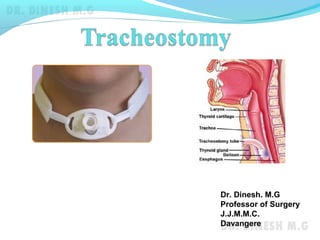
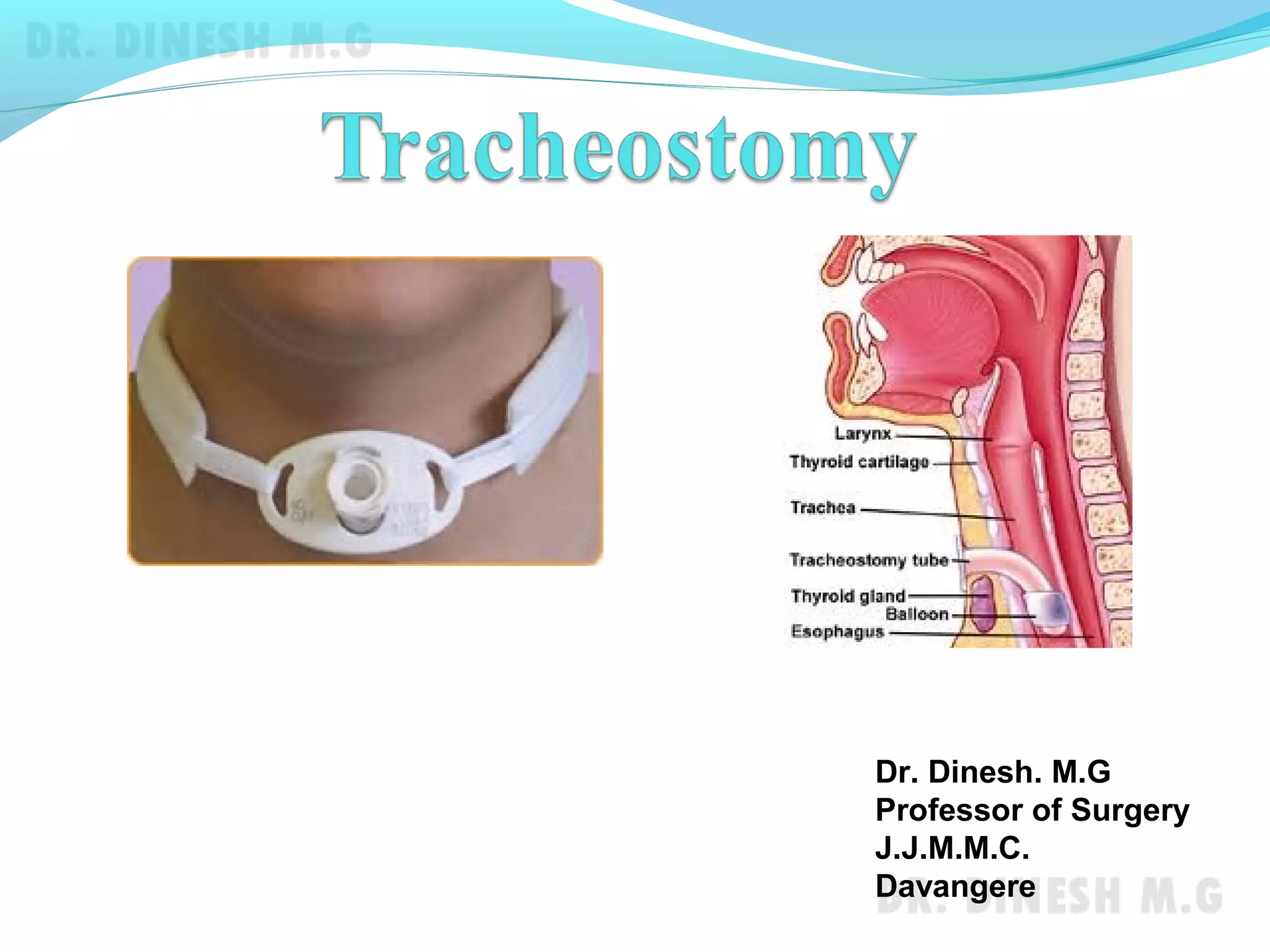
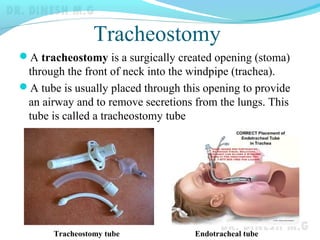
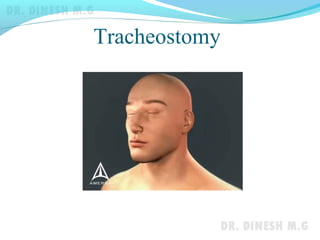
A tracheostomy is a surgically created opening (stoma)
through the front of neck into the windpipe (trachea).
A tube is usually placed through this opening to provide
an airway and to remove secretions from the lungs. This
tube is called a tracheostomy tube
Endotracheal tubeTracheostomy tube
Tracheostomy
Indications
1.Upper airway obstruction
 Foreign body
 Infection(Diphtheria, Ludwig’s angina)
 Oedema of glottis(head and neck burns)
 Bilateral vocal cord palsy
 Trauma(faciomaxillary, larynx, trachea)
 Tumour(carcinoma larynx)
 Congenital lesions(web, atresia)
 Chronic stenosis(TB)
Tracheostomy
Indications (cont’d)
2.Retained secretions
 Severe bronchopneumonia
 Chronic bronchitis
 Chest injury(flail chest)
2.Respiratory insufficiency
 Head injury
 Bulbar poliomyelitis
 Barbiturate poisoning
 Tetanus
Tracheostomy
Objectives of tracheostomy
To assist respiration
Relief from airway obstruction
Reduction of the anatomical dead space(150ml)
Access for tracheobronchial toileting
Cuffed tube prevents aspiration and allows positive pressure
ventilation
All these objectives can be met by endotracheal intubation
initially. But the need for prolonged endotracheal intubation
requires tracheostomy
Tracheostomy
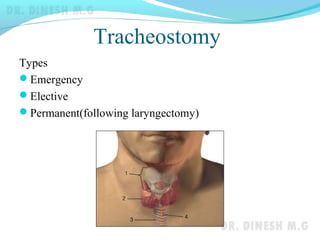
Types
Emergency
Elective
Permanent(following laryngectomy)
Tracheostomy
Steps of operation of emergency tracheostomy
1.Patient in supine position with neck extended
2.After local anaesthesia, 1.5” vertical skin incision is given
below cricoid in the midline
3.Skin, platysma,deep fascia and pretracheal fascia are
divided
4.Isthmus of thyroid is divided between ligatures
5.Cricoid hook is used to lift & stabilise trachea
6.The 2nd
, 3rd
& 4th
tracheal rings are divided with a knife
7.Tracheal wound is dilated with tracheal dilator
8.Tracheostomy tube is inserted and cuff inflated
9.The tube is fixed around neck with tapes
Tracheostomy
Tracheostomy
Elective tracheostomy
Transverse skin incision is placed
Inverted U shaped tracheal flap is raised and stitched to
skin incision
Aftercare of tracheostomy
Humidification
Intermittent suction of tracheobronchial secretions
Clearance of thick mucus by nebulisation and washing of
inner tube with sodabicarb and changing
Care of cuff with low pressure
Replacement of tube once in 3-4 days correctly
Tracheostomy
Complications of tracheostomy
Intraoperative
Haemorrhage
Recurrent laryngeal nerve injury
Injury to oesophagus
Postoperative
Surgical emphysema
Pneumothorax
Pneumomediastinum
Wound infection
Aspiration pneumonia
Tracheal stenosis
Tracheoesophageal fistula
Tracheo-innominate artery fistula
Parathyroid glands
Surgical anatomy
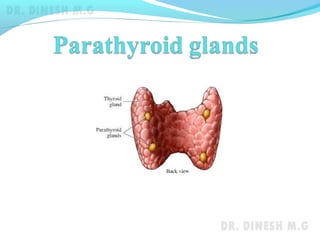
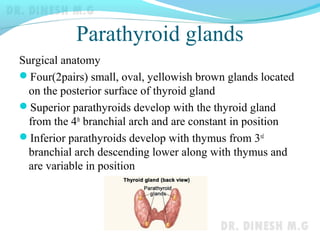
Four(2pairs) small, oval, yellowish brown glands located
on the posterior surface of thyroid gland
Superior parathyroids develop with the thyroid gland
from the 4th
branchial arch and are constant in position
Inferior parathyroids develop with thymus from 3rd
branchial arch descending lower along with thymus and
are variable in position
Parathyroid glands
Physiology
Chief cells of parathyroid produce parathormone(PTH)
PTH raises plasma calcium levels by
Increasing calcium absorption from intestine
Releasing calcium from bones by osteoclastic stimulation
Increasing the renal resorption of calcium
Calcitonin secreted by parafollicular cells of thyroid has
opposite action on calcium i.e. it lowers the serum calcium
levels.
Hypoparathyroidism
Usually due to damage to parathyroid gland during
thyroidectomy
Due to decreased PTH hypocalcemia develops leading to
tetany.
Clinical features
Circumoral tingling and numbness
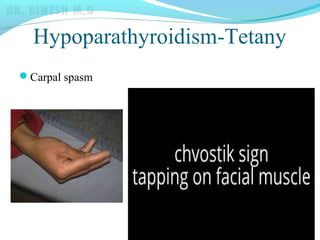
Chvostek’s sign
Trousseau’s sign
Carpopedal smasm
Laryngeal stridor
Hypoparathyroidism-Tetany
Carpal spasm
Hypoparathyroidism-Tetany
Diagnosis
Serum calcium levels below normal(9-11mg%)
Treatment
10 ml of intravenous calcium gluconate slowly in acute
cases
Oral calcium with Vit-D3 in permanent
hypoparathyroidism
Hyperparathyroidism
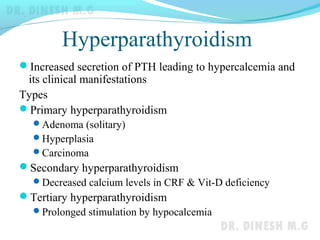
Increased secretion of PTH leading to hypercalcemia and
its clinical manifestations
Types
Primary hyperparathyroidism
Adenoma (solitary)
Hyperplasia
Carcinoma
Secondary hyperparathyroidism
Decreased calcium levels in CRF & Vit-D deficiency
Tertiary hyperparathyroidism
Prolonged stimulation by hypocalcemia
Hyperparathyroidism
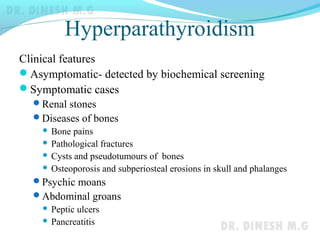
Clinical features
Asymptomatic- detected by biochemical screening
Symptomatic cases
Renal stones
Diseases of bones
 Bone pains
 Pathological fractures
 Cysts and pseudotumours of bones
 Osteoporosis and subperiosteal erosions in skull and phalanges
Psychic moans
Abdominal groans
 Peptic ulcers
 Pancreatitis
Hyperparathyroidism
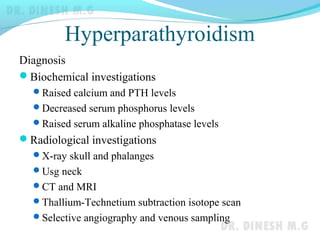
Diagnosis
Biochemical investigations
Raised calcium and PTH levels
Decreased serum phosphorus levels
Raised serum alkaline phosphatase levels
Radiological investigations
X-ray skull and phalanges
Usg neck
CT and MRI
Thallium-Technetium subtraction isotope scan
Selective angiography and venous sampling
Hyperparathyroidism
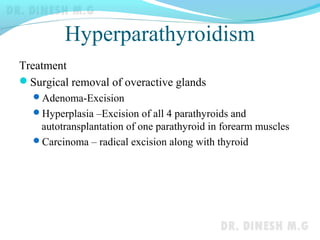
Treatment
Surgical removal of overactive glands
Adenoma-Excision
Hyperplasia –Excision of all 4 parathyroids and
autotransplantation of one parathyroid in forearm muscles
Carcinoma – radical excision along with thyroid
Thank you

Tracheostomy,Parathyroid and Pituitary

  • 1.
    Dr. Dinesh. M.G Professorof Surgery J.J.M.M.C. Davangere
  • 2.
    Tracheostomy A tracheostomy isa surgically created opening (stoma) through the front of neck into the windpipe (trachea). A tube is usually placed through this opening to provide an airway and to remove secretions from the lungs. This tube is called a tracheostomy tube Endotracheal tubeTracheostomy tube
  • 3.
    Tracheostomy Indications 1.Upper airway obstruction Foreign body  Infection(Diphtheria, Ludwig’s angina)  Oedema of glottis(head and neck burns)  Bilateral vocal cord palsy  Trauma(faciomaxillary, larynx, trachea)  Tumour(carcinoma larynx)  Congenital lesions(web, atresia)  Chronic stenosis(TB)
  • 4.
    Tracheostomy Indications (cont’d) 2.Retained secretions Severe bronchopneumonia  Chronic bronchitis  Chest injury(flail chest) 2.Respiratory insufficiency  Head injury  Bulbar poliomyelitis  Barbiturate poisoning  Tetanus
  • 5.
    Tracheostomy Objectives of tracheostomy Toassist respiration Relief from airway obstruction Reduction of the anatomical dead space(150ml) Access for tracheobronchial toileting Cuffed tube prevents aspiration and allows positive pressure ventilation All these objectives can be met by endotracheal intubation initially. But the need for prolonged endotracheal intubation requires tracheostomy
  • 6.
  • 7.
    Tracheostomy Steps of operationof emergency tracheostomy 1.Patient in supine position with neck extended 2.After local anaesthesia, 1.5” vertical skin incision is given below cricoid in the midline 3.Skin, platysma,deep fascia and pretracheal fascia are divided 4.Isthmus of thyroid is divided between ligatures 5.Cricoid hook is used to lift & stabilise trachea 6.The 2nd , 3rd & 4th tracheal rings are divided with a knife 7.Tracheal wound is dilated with tracheal dilator 8.Tracheostomy tube is inserted and cuff inflated 9.The tube is fixed around neck with tapes
  • 8.
  • 9.
    Tracheostomy Elective tracheostomy Transverse skinincision is placed Inverted U shaped tracheal flap is raised and stitched to skin incision Aftercare of tracheostomy Humidification Intermittent suction of tracheobronchial secretions Clearance of thick mucus by nebulisation and washing of inner tube with sodabicarb and changing Care of cuff with low pressure Replacement of tube once in 3-4 days correctly
  • 10.
    Tracheostomy Complications of tracheostomy Intraoperative Haemorrhage Recurrentlaryngeal nerve injury Injury to oesophagus Postoperative Surgical emphysema Pneumothorax Pneumomediastinum Wound infection Aspiration pneumonia Tracheal stenosis Tracheoesophageal fistula Tracheo-innominate artery fistula
  • 12.
    Parathyroid glands Surgical anatomy Four(2pairs)small, oval, yellowish brown glands located on the posterior surface of thyroid gland Superior parathyroids develop with the thyroid gland from the 4th branchial arch and are constant in position Inferior parathyroids develop with thymus from 3rd branchial arch descending lower along with thymus and are variable in position
  • 13.
    Parathyroid glands Physiology Chief cellsof parathyroid produce parathormone(PTH) PTH raises plasma calcium levels by Increasing calcium absorption from intestine Releasing calcium from bones by osteoclastic stimulation Increasing the renal resorption of calcium Calcitonin secreted by parafollicular cells of thyroid has opposite action on calcium i.e. it lowers the serum calcium levels.
  • 14.
    Hypoparathyroidism Usually due todamage to parathyroid gland during thyroidectomy Due to decreased PTH hypocalcemia develops leading to tetany. Clinical features Circumoral tingling and numbness Chvostek’s sign Trousseau’s sign Carpopedal smasm Laryngeal stridor
  • 15.
  • 16.
    Hypoparathyroidism-Tetany Diagnosis Serum calcium levelsbelow normal(9-11mg%) Treatment 10 ml of intravenous calcium gluconate slowly in acute cases Oral calcium with Vit-D3 in permanent hypoparathyroidism
  • 17.
    Hyperparathyroidism Increased secretion ofPTH leading to hypercalcemia and its clinical manifestations Types Primary hyperparathyroidism Adenoma (solitary) Hyperplasia Carcinoma Secondary hyperparathyroidism Decreased calcium levels in CRF & Vit-D deficiency Tertiary hyperparathyroidism Prolonged stimulation by hypocalcemia
  • 18.
    Hyperparathyroidism Clinical features Asymptomatic- detectedby biochemical screening Symptomatic cases Renal stones Diseases of bones  Bone pains  Pathological fractures  Cysts and pseudotumours of bones  Osteoporosis and subperiosteal erosions in skull and phalanges Psychic moans Abdominal groans  Peptic ulcers  Pancreatitis
  • 19.
    Hyperparathyroidism Diagnosis Biochemical investigations Raised calciumand PTH levels Decreased serum phosphorus levels Raised serum alkaline phosphatase levels Radiological investigations X-ray skull and phalanges Usg neck CT and MRI Thallium-Technetium subtraction isotope scan Selective angiography and venous sampling
  • 20.
    Hyperparathyroidism Treatment Surgical removal ofoveractive glands Adenoma-Excision Hyperplasia –Excision of all 4 parathyroids and autotransplantation of one parathyroid in forearm muscles Carcinoma – radical excision along with thyroid
  • 21.