Probiotics
Basic Introduction
Probiotics
What is Going on in the Gut?
› Animal gastrointestinal tracts are populated by hundreds of different species of
bacteria in mind-boggling numbers
› There are billions and billions of bacteria in any animals gut.
› Each of these types of bacteria competes for food and living space until all the
available food and living space in the gut are used up.
Cont. …
› The type and numbers of each bacteria:
– Varies from individual to individual
– Changes over time as the animal is exposed to new types of bacteria
Cont. …
› When it comes to numbers, most of the bacteria in an animals gut are not harmful.
› Seemingly healthy animals will have a some harmful bacteria such as E-coli, or
Salmonella in their guts but in small quantities can't cause any harmful effect.
› The population of these harmful bacteria are held in check by the good bacteria that
out-compete them for resources and keep their numbers so low where they can't
cause infection.
Probiotics
What are Probiotics?
› Probiotics are foods or dietary supplements that contain live bacteria with or without
yeast.
Probiotics
Functions of Probiotics
› Probiotics increase the population of the ‘good’ bacteria (micro flora), which are
needed in the intestinal tract in order to process food properly.
› They are given to animals (and people too) in order to add to, or replace, the
bacteria that normally exists in the animals gastrointestinal tract.
Cont. …
› The use of probiotics as a daily supplement has become a popular routine in the
commercial poultry industry, particularly following antibiotic treatment.
› One commonly known probiotic is called Lactobacillus Acidophilus, and is naturally
occurring in some food such as yogurt.
› But direct application through a liquid or powdered form mixed into drinking water is
the most effective route.
Probiotics
Mechanism of Action of Probiotics
› There are several postulated mechanisms by which probiotics exert their effect on
susceptibility to pathogens.
› However, for most probiotics known to be effective, the actual mechanism of action is
unknown.
› It is likely for most probiotics that combinations of factors are responsible for activity.
Competition for Receptors
› Probiotic bacteria compete with pathogens for:
1. Receptors on the surface of intestinal epithelial cells.
2. Binding sites, on mucus, extracellular matrix, food particles or other sites in the
gastrointestinal tract.
› Competition for receptors may be part of the basis for early expression of probiotic
effect, within 4 hours of administration, observed in some experiments.
Competition for Nutrients
› The stable intestinal microflora is a complex system in which essentially all available
nutrients are utilized.
› Effective competition for available nutrients is hypothesized to be a mechanism of
probiotic activity.
› However, direct proof of this mechanism of action in vivo is lacking.
Production of Antimicrobial Substances
› Probiotic microorganisms have been shown to produce a variety of potentially
antimicrobial substances such as:
1. Low molecular weight (LMW) substances such as;
1. Organic Acids
2. Alcohols, Hydrogen Peroxide
3. Ammonia
4. Methylhydantoin
5. Lipoteichoic Acid
6. Siderophores
7. Diacetyl
2. Bacteriocins which is thought to contribute to antimicrobial activity of some
probiotics.
Immune Enhancement
› Probiotics can have stimulatory effects on both antigen specific and non-specific
immune functions.
› Probiotic administration leads to:
1. Increasing macrophage numbers
2. Increasing phagocytic activity
3. Increasing production of cytokines, such as interferon-gamma and tumor
necrosis factor, which are involved in modulation of both specific and non-
specific immune responses.
4. Enhancing specific local and systemic IgA responses.
Probiotics
When to Use Probiotics?
Healthy Adult Chicken
› Healthy adult chicken has a gut composed primarily of good bacteria.
› If you give that chicken a probiotic that contains new strains of good bacteria, you
might alter the population balance between various good bacteria strains in its gut.
› This does not necessarily improve the chickens health.
› Basically, you would be just swapping in a new good bacteria for an old good
bacteria or increasing the level of one kind of good bacteria relative to other good
bacteria in the chickens gut.
› Therefore, it does not give much benefit in providing probiotics to healthy adult
chickens.
Cont. …
Day-old chicks
› Day-old chicks need time to build up strong populations of good bacteria.
› They are more susceptible to having harmful bacteria out-compete good bacteria if
they are exposed to a potent source of harmful bacteria such as contaminated food
or water dishes.
› It is recommended to provide probiotic to chicks for the first week of life.
Cont. …
Following Antibiotic Treatment
› When birds are treated with antibiotics, all bacteria are killed off, beneficial and
harmful.
› Treating with probiotics immediately after the use of antibiotics, help to repopulate
the gut with the good bacteria.
Cont. …
Everyday Treatment
› Probiotics, on daily basis, may;
1. Help birds ward off most illnesses they could become exposed to in that
environment.
2. Stimulate laying hens to drink more water.
3. Stimulate appetite.
4. Increasing good gut bacteria which compete against the bad bacteria, change
the pH environment, allow nutrient absorption, and prevent infection.
Probiotics
Selection of Probiotics
Genera proposed for use as probiotics in food animals
› Bacteria
– Lactobacillus
– Bifidobacterium
– Enterococcus
– Bacillus
– Escherichia
– Proteus
– Streptococcus
› Fungi
– Saccharomyces
– Aspergillus
Probiotics
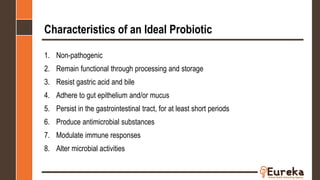
Characteristics of an Ideal Probiotic
1. Non-pathogenic
2. Remain functional through processing and storage
3. Resist gastric acid and bile
4. Adhere to gut epithelium and/or mucus
5. Persist in the gastrointestinal tract, for at least short periods
6. Produce antimicrobial substances
7. Modulate immune responses
8. Alter microbial activities
Probiotics
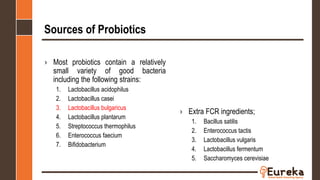
Sources of Probiotics
› Most probiotics contain a relatively
small variety of good bacteria
including the following strains:
1. Lactobacillus acidophilus
2. Lactobacillus casei
3. Lactobacillus bulgaricus
4. Lactobacillus plantarum
5. Streptococcus thermophilus
6. Enterococcus faecium
7. Bifidobacterium
› Extra FCR ingredients;
1. Bacillus satilis
2. Enterococcus tactis
3. Lactobacillus vulgaris
4. Lactobacillus fermentum
5. Saccharomyces cerevisiae
Probiotics
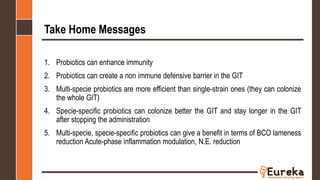
Take Home Messages
Take Home Messages
1. Probiotics can enhance immunity
2. Probiotics can create a non immune defensive barrier in the GIT
3. Multi-specie probiotics are more efficient than single-strain ones (they can colonize
the whole GIT)
4. Specie-specific probiotics can colonize better the GIT and stay longer in the GIT
after stopping the administration
5. Multi-specie, specie-specific probiotics can give a benefit in terms of BCO lameness
reduction Acute-phase inflammation modulation, N.E. reduction
Probiotics
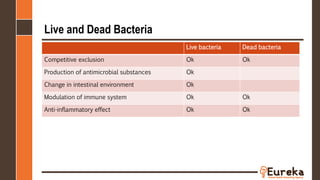
Live and Dead Bacteria
Live bacteria Dead bacteria
Competitive exclusion Ok Ok
Production of antimicrobial substances Ok
Change in intestinal environment Ok
Modulation of immune system Ok Ok
Anti-inflammatory effect Ok Ok
Contact us on;
ossama.motawae@eurekaeg.com
+201023985680

Probiotics Basic Introduction

  • 1.
  • 2.
  • 3.
    What is Goingon in the Gut? › Animal gastrointestinal tracts are populated by hundreds of different species of bacteria in mind-boggling numbers › There are billions and billions of bacteria in any animals gut. › Each of these types of bacteria competes for food and living space until all the available food and living space in the gut are used up.
  • 4.
    Cont. … › Thetype and numbers of each bacteria: – Varies from individual to individual – Changes over time as the animal is exposed to new types of bacteria
  • 5.
    Cont. … › Whenit comes to numbers, most of the bacteria in an animals gut are not harmful. › Seemingly healthy animals will have a some harmful bacteria such as E-coli, or Salmonella in their guts but in small quantities can't cause any harmful effect. › The population of these harmful bacteria are held in check by the good bacteria that out-compete them for resources and keep their numbers so low where they can't cause infection.
  • 6.
  • 7.
    What are Probiotics? ›Probiotics are foods or dietary supplements that contain live bacteria with or without yeast.
  • 8.
  • 9.
    Functions of Probiotics ›Probiotics increase the population of the ‘good’ bacteria (micro flora), which are needed in the intestinal tract in order to process food properly. › They are given to animals (and people too) in order to add to, or replace, the bacteria that normally exists in the animals gastrointestinal tract.
  • 10.
    Cont. … › Theuse of probiotics as a daily supplement has become a popular routine in the commercial poultry industry, particularly following antibiotic treatment. › One commonly known probiotic is called Lactobacillus Acidophilus, and is naturally occurring in some food such as yogurt. › But direct application through a liquid or powdered form mixed into drinking water is the most effective route.
  • 11.
  • 12.
    Mechanism of Actionof Probiotics › There are several postulated mechanisms by which probiotics exert their effect on susceptibility to pathogens. › However, for most probiotics known to be effective, the actual mechanism of action is unknown. › It is likely for most probiotics that combinations of factors are responsible for activity.
  • 13.
    Competition for Receptors ›Probiotic bacteria compete with pathogens for: 1. Receptors on the surface of intestinal epithelial cells. 2. Binding sites, on mucus, extracellular matrix, food particles or other sites in the gastrointestinal tract. › Competition for receptors may be part of the basis for early expression of probiotic effect, within 4 hours of administration, observed in some experiments.
  • 14.
    Competition for Nutrients ›The stable intestinal microflora is a complex system in which essentially all available nutrients are utilized. › Effective competition for available nutrients is hypothesized to be a mechanism of probiotic activity. › However, direct proof of this mechanism of action in vivo is lacking.
  • 15.
    Production of AntimicrobialSubstances › Probiotic microorganisms have been shown to produce a variety of potentially antimicrobial substances such as: 1. Low molecular weight (LMW) substances such as; 1. Organic Acids 2. Alcohols, Hydrogen Peroxide 3. Ammonia 4. Methylhydantoin 5. Lipoteichoic Acid 6. Siderophores 7. Diacetyl 2. Bacteriocins which is thought to contribute to antimicrobial activity of some probiotics.
  • 16.
    Immune Enhancement › Probioticscan have stimulatory effects on both antigen specific and non-specific immune functions. › Probiotic administration leads to: 1. Increasing macrophage numbers 2. Increasing phagocytic activity 3. Increasing production of cytokines, such as interferon-gamma and tumor necrosis factor, which are involved in modulation of both specific and non- specific immune responses. 4. Enhancing specific local and systemic IgA responses.
  • 17.
  • 18.
    When to UseProbiotics? Healthy Adult Chicken › Healthy adult chicken has a gut composed primarily of good bacteria. › If you give that chicken a probiotic that contains new strains of good bacteria, you might alter the population balance between various good bacteria strains in its gut. › This does not necessarily improve the chickens health. › Basically, you would be just swapping in a new good bacteria for an old good bacteria or increasing the level of one kind of good bacteria relative to other good bacteria in the chickens gut. › Therefore, it does not give much benefit in providing probiotics to healthy adult chickens.
  • 19.
    Cont. … Day-old chicks ›Day-old chicks need time to build up strong populations of good bacteria. › They are more susceptible to having harmful bacteria out-compete good bacteria if they are exposed to a potent source of harmful bacteria such as contaminated food or water dishes. › It is recommended to provide probiotic to chicks for the first week of life.
  • 20.
    Cont. … Following AntibioticTreatment › When birds are treated with antibiotics, all bacteria are killed off, beneficial and harmful. › Treating with probiotics immediately after the use of antibiotics, help to repopulate the gut with the good bacteria.
  • 21.
    Cont. … Everyday Treatment ›Probiotics, on daily basis, may; 1. Help birds ward off most illnesses they could become exposed to in that environment. 2. Stimulate laying hens to drink more water. 3. Stimulate appetite. 4. Increasing good gut bacteria which compete against the bad bacteria, change the pH environment, allow nutrient absorption, and prevent infection.
  • 22.
  • 23.
    Selection of Probiotics Generaproposed for use as probiotics in food animals › Bacteria – Lactobacillus – Bifidobacterium – Enterococcus – Bacillus – Escherichia – Proteus – Streptococcus › Fungi – Saccharomyces – Aspergillus
  • 24.
  • 25.
    Characteristics of anIdeal Probiotic 1. Non-pathogenic 2. Remain functional through processing and storage 3. Resist gastric acid and bile 4. Adhere to gut epithelium and/or mucus 5. Persist in the gastrointestinal tract, for at least short periods 6. Produce antimicrobial substances 7. Modulate immune responses 8. Alter microbial activities
  • 26.
  • 27.
    Sources of Probiotics ›Most probiotics contain a relatively small variety of good bacteria including the following strains: 1. Lactobacillus acidophilus 2. Lactobacillus casei 3. Lactobacillus bulgaricus 4. Lactobacillus plantarum 5. Streptococcus thermophilus 6. Enterococcus faecium 7. Bifidobacterium › Extra FCR ingredients; 1. Bacillus satilis 2. Enterococcus tactis 3. Lactobacillus vulgaris 4. Lactobacillus fermentum 5. Saccharomyces cerevisiae
  • 28.
  • 29.
    Take Home Messages 1.Probiotics can enhance immunity 2. Probiotics can create a non immune defensive barrier in the GIT 3. Multi-specie probiotics are more efficient than single-strain ones (they can colonize the whole GIT) 4. Specie-specific probiotics can colonize better the GIT and stay longer in the GIT after stopping the administration 5. Multi-specie, specie-specific probiotics can give a benefit in terms of BCO lameness reduction Acute-phase inflammation modulation, N.E. reduction
  • 30.
  • 31.
    Live and DeadBacteria Live bacteria Dead bacteria Competitive exclusion Ok Ok Production of antimicrobial substances Ok Change in intestinal environment Ok Modulation of immune system Ok Ok Anti-inflammatory effect Ok Ok
  • 32.

Editor's Notes

  • #8 Probiotics are said to provide health benefits but these benefits are generally not well explained or understood.
  • #16 Bacteriocins are proteinaceous or peptidic toxins produced by bacteria to inhibit the growth of similar or closely related bacterial strain