Factors influencing feedFactors influencing feed
consumption in chickensconsumption in chickens
Presented by :Presented by :
Dr .M.G.Nikam (RVD/12-16)Dr .M.G.Nikam (RVD/12-16)
PhD ScholarPhD Scholar
Department of Poultry ScienceDepartment of Poultry Science
C.V.Sc R’nagarC.V.Sc R’nagar
HyderabadHyderabad
POULTRY FEEDINGPOULTRY FEEDING
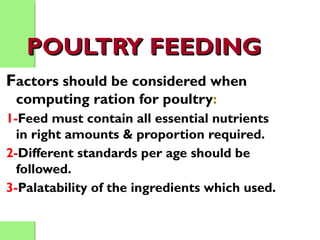
Factors should be considered when
computing ration for poultry:
1-Feed must contain all essential nutrients
in right amounts & proportion required.
2-Different standards per age should be
followed.
3-Palatability of the ingredients which used.
POULTRY FEEDINGPOULTRY FEEDING
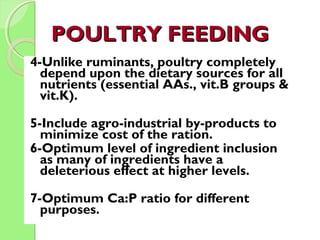
4-Unlike ruminants, poultry completely
depend upon the dietary sources for all
nutrients (essential AAs., vit.B groups &
vit.K).
5-Include agro-industrial by-products to
minimize cost of the ration.
6-Optimum level of ingredient inclusion
as many of ingredients have a
deleterious effect at higher levels.
7-Optimum Ca:P ratio for different
purposes.
Factors affecting feed intakeFactors affecting feed intake::
 Type of Bird
 Age of Bird
 Growth / production rate
 Energy Content of Feed
 Particle Size of Feed
Factors affecting feed intakeFactors affecting feed intake::
• Water Availability to Birds
• Health Status of Birds/Diseases
• Ambient temperature
• Stress
• Fiber content of the feed
TYPE OF BIRDTYPE OF BIRD
• Meat producing birds
• Egg producing birds
• Dual type birds
• Hybrids-Breed cross or strain crosses
• Fancy or ornamental birds
Age of BirdAge of Bird
Nutrient requirements are related to
both body weight and the stage of
maturity as Chick stage feed consumption
is less .
However later phages feed intake will
increase gradually because bird requires
feed for maintenance and production
purposes and bird has to overcome the
stress of egg/meat production
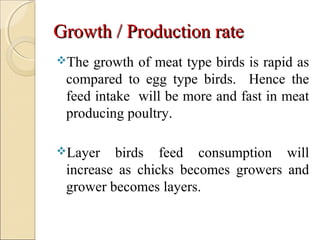
Growth / Production rateGrowth / Production rate
The growth of meat type birds is rapid as
compared to egg type birds. Hence the
feed intake will be more and fast in meat
producing poultry.
Layer birds feed consumption will
increase as chicks becomes growers and
grower becomes layers.
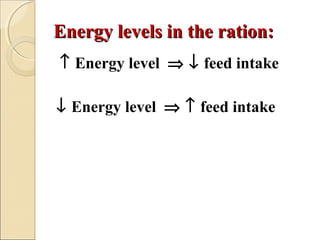
Energy levels in the ration:Energy levels in the ration:
↑ Energy level ⇒ ↓ feed intake
↓ Energy level ⇒ ↑ feed intake
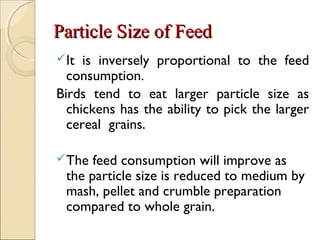
Particle Size of FeedParticle Size of Feed
It is inversely proportional to the feed
consumption.
Birds tend to eat larger particle size as
chickens has the ability to pick the larger
cereal grains.
The feed consumption will improve as
the particle size is reduced to medium by
mash, pellet and crumble preparation
compared to whole grain.
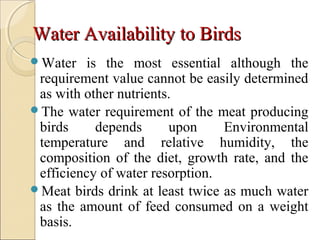
Water Availability to BirdsWater Availability to Birds
Water is the most essential although the
requirement value cannot be easily determined
as with other nutrients.
The water requirement of the meat producing
birds depends upon Environmental
temperature and relative humidity, the
composition of the diet, growth rate, and the
efficiency of water resorption.
Meat birds drink at least twice as much water
as the amount of feed consumed on a weight
basis.
Cont…Cont…
 Actual water consumption relative to feed intake
varies depending environmental temperature and
dietary factors. Increasing dietary crude protein
increases water intake and : feed ratios (Marks and
Pesti, 1984)
 Crumbled or pelleted feed increases both water and
feed intake relative to mash diets, but water: feed
ratios stay relatively the same (Marks and Pesti,
1984)
 Increasing dietary salt and other osmotically active
Minerals increase water intake (Marks, 1987)
Health Status of Birds/DiseasesHealth Status of Birds/Diseases
Birds experiencing a disease challenge may
benefit from an increase in the intake of
some nutrients but not feed as a whole
Healthy birds --------- Normal feed
consumption
Sick birds ---------------feed consumption
will be less
Ambient temperatureAmbient temperature
Poultry have increased energy requirements to
maintain normal body temperature in cold
ambient temperatures and the opposite in hot
ambient temperatures.
The process of digestion of food produces body
heat and the amount of heat produced will vary
according to the nutrient composition of the diet.
This is called the heat increment of the diet.
In cold temperatures it may be desirable to
formulate a diet with a higher heat increment
and the opposite in hot temperatures
StressStress
Stress has adverse effects on reduced feed intake.
 Elevation of the stress mounting an immune
response is compromised by hormones associated
with the stress response causes reduced absorption
of specific nutrients.
For example, body reserves to be mobilized to
fuel the “fight or flight” response .
ContCont……
Nutrient absorption and gut motility reduced
substantially during the stress response .
Acute stress may cause a momentary
decrease in feed intake with minimal impact
on performance, chronic stress will have a
marked and persistently detrimental effect on
nutrient absorption and utilization .
ContCont....
Chronic stress can be influenced by three
environmental stressors:
Heat stress.
 Poor air quality.
 Poor litter quality.
Heat stressHeat stress
Heat is removed from the body by insensible
heat loss .
The degree of heat stress endured by a bird
is dependent upon several factors, including
the body size and growth rate of the bird,
Ambient temperature and the amount of
convective heat loss influenced by air speed
the temperature must be 10-20* C ideal
15*C Panting at 29.4* C.
Poor air qualityPoor air quality
Adequate ventilation reduces air
moisture, dust, ammonia, and carbon
dioxide and brings in more oxygen.
High air moisture decreases evaporative
cooling and thus adversely affects feed
intake in sensitive heat load.
Excess air dust causes Inflammation of
the pulmonary system, which depresses
feed intake.
Cont..Cont..
Excess ammonia not only irritates
pulmonary tissues.
 but it also is a metabolic stressor that
causes depressed feed intake high levels
of carbon dioxide or low oxygen levels in
the is air results in depressed metabolic
rate that ultimately causes depressed feed
intake.
Poor litter qualityPoor litter quality
Poor litter quality is also a medium
of many of pathogens that challenge
the health status of the flock.
Fiber content of the feedFiber content of the feed
Presence of large quantity of higher
polysaccharides like cellulose and lignin in
chicken diet increases bulk in feed. Lignin
and Cellulose cannot be digested by
chicken
The efforts to convert the
polysaccharides in to mono or
disaccharides will result in tremendous
increase in food energy for chicken
ReferencesReferences
• Marks, H.L., 1987. Water and feed intake, feed
efficiency, and abdominal fat levels of dwarf and normal
chickens selected under different water: feed ratio
environments .Poult. Sci., 66: 1895-900.
• Marks, H.L. and G.M. Pesti, 1984. The role of protein
and diet form in water consumption and abdominal
deposition in broilers. Poult. Sci., 63: 1617-25
• Commercial chicken and Egg production fifth edition
by - Donald Bell And William Weaver
Factors afecting feed consumption in chicken

Factors afecting feed consumption in chicken

  • 1.
    Factors influencing feedFactorsinfluencing feed consumption in chickensconsumption in chickens Presented by :Presented by : Dr .M.G.Nikam (RVD/12-16)Dr .M.G.Nikam (RVD/12-16) PhD ScholarPhD Scholar Department of Poultry ScienceDepartment of Poultry Science C.V.Sc R’nagarC.V.Sc R’nagar HyderabadHyderabad
  • 2.
    POULTRY FEEDINGPOULTRY FEEDING Factorsshould be considered when computing ration for poultry: 1-Feed must contain all essential nutrients in right amounts & proportion required. 2-Different standards per age should be followed. 3-Palatability of the ingredients which used.
  • 3.
    POULTRY FEEDINGPOULTRY FEEDING 4-Unlikeruminants, poultry completely depend upon the dietary sources for all nutrients (essential AAs., vit.B groups & vit.K). 5-Include agro-industrial by-products to minimize cost of the ration. 6-Optimum level of ingredient inclusion as many of ingredients have a deleterious effect at higher levels. 7-Optimum Ca:P ratio for different purposes.
  • 4.
    Factors affecting feedintakeFactors affecting feed intake::  Type of Bird  Age of Bird  Growth / production rate  Energy Content of Feed  Particle Size of Feed
  • 5.
    Factors affecting feedintakeFactors affecting feed intake:: • Water Availability to Birds • Health Status of Birds/Diseases • Ambient temperature • Stress • Fiber content of the feed
  • 6.
    TYPE OF BIRDTYPEOF BIRD • Meat producing birds • Egg producing birds • Dual type birds • Hybrids-Breed cross or strain crosses • Fancy or ornamental birds
  • 7.
    Age of BirdAgeof Bird Nutrient requirements are related to both body weight and the stage of maturity as Chick stage feed consumption is less . However later phages feed intake will increase gradually because bird requires feed for maintenance and production purposes and bird has to overcome the stress of egg/meat production
  • 8.
    Growth / ProductionrateGrowth / Production rate The growth of meat type birds is rapid as compared to egg type birds. Hence the feed intake will be more and fast in meat producing poultry. Layer birds feed consumption will increase as chicks becomes growers and grower becomes layers.
  • 9.
    Energy levels inthe ration:Energy levels in the ration: ↑ Energy level ⇒ ↓ feed intake ↓ Energy level ⇒ ↑ feed intake
  • 10.
    Particle Size ofFeedParticle Size of Feed It is inversely proportional to the feed consumption. Birds tend to eat larger particle size as chickens has the ability to pick the larger cereal grains. The feed consumption will improve as the particle size is reduced to medium by mash, pellet and crumble preparation compared to whole grain.
  • 11.
    Water Availability toBirdsWater Availability to Birds Water is the most essential although the requirement value cannot be easily determined as with other nutrients. The water requirement of the meat producing birds depends upon Environmental temperature and relative humidity, the composition of the diet, growth rate, and the efficiency of water resorption. Meat birds drink at least twice as much water as the amount of feed consumed on a weight basis.
  • 12.
    Cont…Cont…  Actual waterconsumption relative to feed intake varies depending environmental temperature and dietary factors. Increasing dietary crude protein increases water intake and : feed ratios (Marks and Pesti, 1984)  Crumbled or pelleted feed increases both water and feed intake relative to mash diets, but water: feed ratios stay relatively the same (Marks and Pesti, 1984)  Increasing dietary salt and other osmotically active Minerals increase water intake (Marks, 1987)
  • 13.
    Health Status ofBirds/DiseasesHealth Status of Birds/Diseases Birds experiencing a disease challenge may benefit from an increase in the intake of some nutrients but not feed as a whole Healthy birds --------- Normal feed consumption Sick birds ---------------feed consumption will be less
  • 14.
    Ambient temperatureAmbient temperature Poultryhave increased energy requirements to maintain normal body temperature in cold ambient temperatures and the opposite in hot ambient temperatures. The process of digestion of food produces body heat and the amount of heat produced will vary according to the nutrient composition of the diet. This is called the heat increment of the diet. In cold temperatures it may be desirable to formulate a diet with a higher heat increment and the opposite in hot temperatures
  • 15.
    StressStress Stress has adverseeffects on reduced feed intake.  Elevation of the stress mounting an immune response is compromised by hormones associated with the stress response causes reduced absorption of specific nutrients. For example, body reserves to be mobilized to fuel the “fight or flight” response .
  • 16.
    ContCont…… Nutrient absorption andgut motility reduced substantially during the stress response . Acute stress may cause a momentary decrease in feed intake with minimal impact on performance, chronic stress will have a marked and persistently detrimental effect on nutrient absorption and utilization .
  • 17.
    ContCont.... Chronic stress canbe influenced by three environmental stressors: Heat stress.  Poor air quality.  Poor litter quality.
  • 18.
    Heat stressHeat stress Heatis removed from the body by insensible heat loss . The degree of heat stress endured by a bird is dependent upon several factors, including the body size and growth rate of the bird, Ambient temperature and the amount of convective heat loss influenced by air speed the temperature must be 10-20* C ideal 15*C Panting at 29.4* C.
  • 19.
    Poor air qualityPoorair quality Adequate ventilation reduces air moisture, dust, ammonia, and carbon dioxide and brings in more oxygen. High air moisture decreases evaporative cooling and thus adversely affects feed intake in sensitive heat load. Excess air dust causes Inflammation of the pulmonary system, which depresses feed intake.
  • 20.
    Cont..Cont.. Excess ammonia notonly irritates pulmonary tissues.  but it also is a metabolic stressor that causes depressed feed intake high levels of carbon dioxide or low oxygen levels in the is air results in depressed metabolic rate that ultimately causes depressed feed intake.
  • 21.
    Poor litter qualityPoorlitter quality Poor litter quality is also a medium of many of pathogens that challenge the health status of the flock.
  • 22.
    Fiber content ofthe feedFiber content of the feed Presence of large quantity of higher polysaccharides like cellulose and lignin in chicken diet increases bulk in feed. Lignin and Cellulose cannot be digested by chicken The efforts to convert the polysaccharides in to mono or disaccharides will result in tremendous increase in food energy for chicken
  • 23.
    ReferencesReferences • Marks, H.L.,1987. Water and feed intake, feed efficiency, and abdominal fat levels of dwarf and normal chickens selected under different water: feed ratio environments .Poult. Sci., 66: 1895-900. • Marks, H.L. and G.M. Pesti, 1984. The role of protein and diet form in water consumption and abdominal deposition in broilers. Poult. Sci., 63: 1617-25 • Commercial chicken and Egg production fifth edition by - Donald Bell And William Weaver