
Preparing the Organization for Growth
Patterns of Entrepreneurship
Chapter 9
Building the Management Team
Chief Executive Officer
Setting Up the Board of Directors
• Control over management
• Select and compensate (and fire, if required) the
Chief Executive Officer
• Approve selection, replacement and compensation
of senior management
• Nominate directors
• Advance stockholder’s rights
• Review financial performance in detail and keep
stockholders informed
Board of Directors-Duties and
Responsibilities
• Participate in preparation and reappraisal
of strategic plan
• Validate major investments, acquisitions
and asset sales
• Confirm major policy changes
• Approve legal activities
• Closely monitor legal, ethical and
environmental compliance
• Authorize borrowing and new stock issues
Setting Up a Board of Advisors
Usually consultants, peers, retired executives, or key
investors that provide advice and support to the venture.
The Board of Advisors differs from the Board of Directors
in that it is informal, not an official part of the governance
structure and assumes no legal liability.
A sense of reality is important in locating advisors.
They will act as a sounding board for developing partners,
networking, product ideas, and are normally compensated
in the form of stock options..
The Entrepreneurial Stages
Stages
Generate
Idea
Confirm
Viability Exit
Main focus Secure vision Confirm dream Leave cleanly
Elapsed time ----- 2–6 months 1 month
Cumulative time ----- Month 6 Month 8
Participants You Friends and
founders
Founder and
lawyer
Main risks Lacks realism Leaks Counter-offers or
live on savings
The Entrepreneurial Stages
Stages
Prepare
Business Plan
Hire Mgmt.
Team Seed Capital
Main focus Write plan Attract talent Money from lead
VC
Elapsed time 2-6 months 2-9 months 2-12 months
Cumulative time Month 14 Month 18 Month 27
Participants Team leaders Friends, media,
etc.
VC, founders
Main risks Not worth
funding
Leaks; money Can’t attract
capital
Stages Start Up
Additional
Capital Required Launch Product
Main focus Hire staff; build
product
Raise more
money
Secure first
customers
Elapsed time 6-18 months 2-6 months per
round
1-2 years from
start
Cumulative time Month 30 Years 2-4 24-36 months
Major costs Burn rate; money
per month
Time of top
management
Marketing; cash
Main risks Stiff competition;
money issues
Lack of focus;
run out of money
Poor market
accept; counter
by competitor
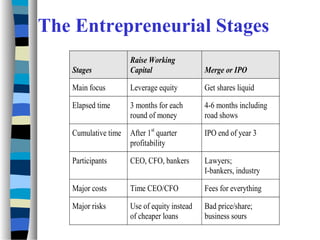
The Entrepreneurial Stages
Stages
Raise Working
Capital Merge or IPO
Main focus Leverage equity Get shares liquid
Elapsed time 3 months for each
round of money
4-6 months including
road shows
Cumulative time After 1st
quarter
profitability
IPO end of year 3
Participants CEO, CFO, bankers Lawyers;
I-bankers, industry
Major costs Time CEO/CFO Fees for everything
Major risks Use of equity instead
of cheaper loans
Bad price/share;
business sours

Entrepreneurship Chap 9

  • 1.
    Preparing the Organizationfor Growth Patterns of Entrepreneurship Chapter 9
  • 2.
    Building the ManagementTeam Chief Executive Officer Setting Up the Board of Directors • Control over management • Select and compensate (and fire, if required) the Chief Executive Officer • Approve selection, replacement and compensation of senior management • Nominate directors • Advance stockholder’s rights • Review financial performance in detail and keep stockholders informed
  • 3.
    Board of Directors-Dutiesand Responsibilities • Participate in preparation and reappraisal of strategic plan • Validate major investments, acquisitions and asset sales • Confirm major policy changes • Approve legal activities • Closely monitor legal, ethical and environmental compliance • Authorize borrowing and new stock issues
  • 4.
    Setting Up aBoard of Advisors Usually consultants, peers, retired executives, or key investors that provide advice and support to the venture. The Board of Advisors differs from the Board of Directors in that it is informal, not an official part of the governance structure and assumes no legal liability. A sense of reality is important in locating advisors. They will act as a sounding board for developing partners, networking, product ideas, and are normally compensated in the form of stock options..
  • 5.
    The Entrepreneurial Stages Stages Generate Idea Confirm ViabilityExit Main focus Secure vision Confirm dream Leave cleanly Elapsed time ----- 2–6 months 1 month Cumulative time ----- Month 6 Month 8 Participants You Friends and founders Founder and lawyer Main risks Lacks realism Leaks Counter-offers or live on savings
  • 6.
    The Entrepreneurial Stages Stages Prepare BusinessPlan Hire Mgmt. Team Seed Capital Main focus Write plan Attract talent Money from lead VC Elapsed time 2-6 months 2-9 months 2-12 months Cumulative time Month 14 Month 18 Month 27 Participants Team leaders Friends, media, etc. VC, founders Main risks Not worth funding Leaks; money Can’t attract capital
  • 7.
    Stages Start Up Additional CapitalRequired Launch Product Main focus Hire staff; build product Raise more money Secure first customers Elapsed time 6-18 months 2-6 months per round 1-2 years from start Cumulative time Month 30 Years 2-4 24-36 months Major costs Burn rate; money per month Time of top management Marketing; cash Main risks Stiff competition; money issues Lack of focus; run out of money Poor market accept; counter by competitor The Entrepreneurial Stages
  • 8.
    The Entrepreneurial Stages Stages RaiseWorking Capital Merge or IPO Main focus Leverage equity Get shares liquid Elapsed time 3 months for each round of money 4-6 months including road shows Cumulative time After 1st quarter profitability IPO end of year 3 Participants CEO, CFO, bankers Lawyers; I-bankers, industry Major costs Time CEO/CFO Fees for everything Major risks Use of equity instead of cheaper loans Bad price/share; business sours