UNDER THE GUIDANCE OF
    SADAF MA’AM .
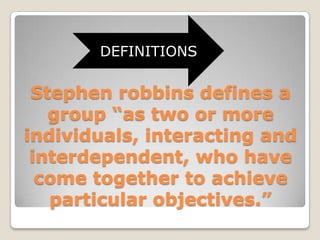
DEFINITIONS

 Stephen robbins defines a
   group “as two or more
individuals, interacting and
 interdependent, who have
  come together to achieve
   particular objectives.”
TYPES OF GROUPS
Most individuals belong to various types of groups. These
different groups can be broadly classified in two types.
• {1} FORMAL GROUPS: these groups are consciously
  created to serve an organizational objective. The crew of
  an airline flight is an example of a formal group.
• Formal groups can be further divided into different types.
• [a] Command group: It is a group determine by the
  connection between individual who are a formal part of
  the organization. For eg, the marketing department
  comprising of the general manager and the other
  marketing staff.
• [b] Task group: A task group is created by the
  management to accomplish certain organizational goals.
  It is specifically created to solve the problem or preform a
  defined task.
[2] INFORMAL GROUPS: Informal groups are groups that
develop naturally among people, without any direction from
the organization within they operate. They are formed
spontaneously and are based on personal relationships or
specific interests.

The different types of informal groups are:

[a] Interest groups: Interest groups consist of person who
share common interests. They may be job related interest, or
such as sports, national politics or religion.

[b] Friendship groups: friendship group consist of individual
who come together because they share one or more common
characteristics. They consist of people with natural affinities for
one another.
STAGES OF GROUP DEVELOPMENT
   Every group passes through different stages in its life
cycle. According to a popular model, every group passes
through five distinct stages of group development.

(1) Forming: In the forming stages the members share
personal information and try to know more about the
tasks to be preformed.

(2) Storming: the members compete for positions of status
and control. This is a period of high emotionality and
tension among group members. The storming stage is
completed when the intra group conflicts are resolved and
the group’s leadership is accepted.
(3) Norming: In this stage the group really begins to come
together as a co-ordinated unit. Members start co-operating
with each other and place their competing interest in the
background.
(4) Performing: This stage is sometimes called as total
integration. During this stage, the group members work
effectively and efficiently towards achieving the group
objectives.
(5) Adjourning: In this stage the group prepares for
disbandment. The group’s focus is now on wrapping up
activities rather than achieving high task performance.
WHY DO PEOPLE JOIN GROUPS

people join groups for a variety of different reason. Most people
belong to several groups because different groups provide
different benefits. The following are the benefits:
(1) Security.
(2) Self-esteem.
(3) Status.
(4) Affiliation.
(5) Power.
(6) Goal achievement.
(7) Satisfaction of needs.
(8) Shared interest and goals.
GROUPS DYNAMICS- FACTORS
            INFLUENCING WORKING OF GROUPS


 Each group has its own unique personality. This is because
several factors affect the working of groups. The different
factors that influence group dynamics can be classified in to:

    (1) EXTERNAL FACTORS
    (2) GROUP RESOURCES
    (3) GROUP STRUCTURE
    (4) GROUP PROCESS
    (5) GROUP TASKS
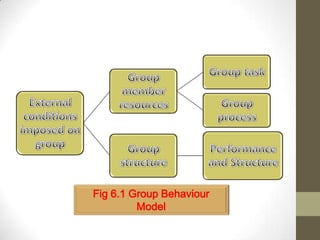
Fig 6.1 Group Behaviour
         Model
EXTERNAL
                       CONDITIONS
  work groups don’t exists in isolation. They are a part of the
larger organization. They are as follows.

(1) organization strategy.
(2) authority structures.
(3) formal regulations.
(4) organizational resources.
(5) human resources selection process.
(6) performance evaluation and reward system.
(7) organizational culture.
(8) physical work setting.
GROUP MEMBER RESOURCES

To succeed a group must have members with the right skills and
competencies. The resources that individual members bring to the
group have a strong influence on its performance. Abilities and
personality characteristics of group members are two important
resources.

(1) Abilities: What group members can do it has a strong bearing
on group performance. Intellectual and task relevant ability of
group members affects overall group performance.
(2) Personality characteristics: The personality traits of individual
group members strongly influence how they interact with other
group members. Characteristics such as authoritarianism and
dominance have a negative impact on groups.
GROUP STRUCTURE

 Group structure refers to the pattern of interrelationships
between the individuals constituting a group. The different
aspects or variables of group structure are:

(1) Formal leadership
(2) Roles
(3) Norms
(4) Status
(5) Size
(6) Cohesiveness
(7) Composition
GROUP PROCESS

 Group process includes the communication patterns used by
members for information exchange, group decision processes,
leader behavior, conflicts and the like. One group process that
has generated considerable interest among researchers is the
social facilitation effect. Psychologists have given different
explanations for the social facilitation effect. Some of the
prominent explanations are:

(1) Drive theory.
(2) Evaluation apprehension.
(3) Distraction-conflict model.
GROUP TASK

  Task may be simple, routine and standardized or they be
complex, non routine, and novel. The nature of the task
moderates the group process and effect group performance
and member satisfaction. For certain kind of tasks, large groups
are more suitable while for some tasks smaller groups are
desirable. Greater interaction among group members is
required when there is a high degree of interdependence
among the tasks that group members must perform.
THE END

  MADE BY :


HARISH        05

Groups in Organisations and Group Dynamics.

  • 2.
    UNDER THE GUIDANCEOF SADAF MA’AM .
  • 4.
    DEFINITIONS Stephen robbinsdefines a group “as two or more individuals, interacting and interdependent, who have come together to achieve particular objectives.”
  • 5.
    TYPES OF GROUPS Mostindividuals belong to various types of groups. These different groups can be broadly classified in two types. • {1} FORMAL GROUPS: these groups are consciously created to serve an organizational objective. The crew of an airline flight is an example of a formal group. • Formal groups can be further divided into different types. • [a] Command group: It is a group determine by the connection between individual who are a formal part of the organization. For eg, the marketing department comprising of the general manager and the other marketing staff. • [b] Task group: A task group is created by the management to accomplish certain organizational goals. It is specifically created to solve the problem or preform a defined task.
  • 6.
    [2] INFORMAL GROUPS:Informal groups are groups that develop naturally among people, without any direction from the organization within they operate. They are formed spontaneously and are based on personal relationships or specific interests. The different types of informal groups are: [a] Interest groups: Interest groups consist of person who share common interests. They may be job related interest, or such as sports, national politics or religion. [b] Friendship groups: friendship group consist of individual who come together because they share one or more common characteristics. They consist of people with natural affinities for one another.
  • 7.
    STAGES OF GROUPDEVELOPMENT Every group passes through different stages in its life cycle. According to a popular model, every group passes through five distinct stages of group development. (1) Forming: In the forming stages the members share personal information and try to know more about the tasks to be preformed. (2) Storming: the members compete for positions of status and control. This is a period of high emotionality and tension among group members. The storming stage is completed when the intra group conflicts are resolved and the group’s leadership is accepted.
  • 8.
    (3) Norming: Inthis stage the group really begins to come together as a co-ordinated unit. Members start co-operating with each other and place their competing interest in the background. (4) Performing: This stage is sometimes called as total integration. During this stage, the group members work effectively and efficiently towards achieving the group objectives. (5) Adjourning: In this stage the group prepares for disbandment. The group’s focus is now on wrapping up activities rather than achieving high task performance.
  • 9.
    WHY DO PEOPLEJOIN GROUPS people join groups for a variety of different reason. Most people belong to several groups because different groups provide different benefits. The following are the benefits: (1) Security. (2) Self-esteem. (3) Status. (4) Affiliation. (5) Power. (6) Goal achievement. (7) Satisfaction of needs. (8) Shared interest and goals.
  • 10.
    GROUPS DYNAMICS- FACTORS INFLUENCING WORKING OF GROUPS Each group has its own unique personality. This is because several factors affect the working of groups. The different factors that influence group dynamics can be classified in to: (1) EXTERNAL FACTORS (2) GROUP RESOURCES (3) GROUP STRUCTURE (4) GROUP PROCESS (5) GROUP TASKS
  • 11.
    Fig 6.1 GroupBehaviour Model
  • 12.
    EXTERNAL CONDITIONS work groups don’t exists in isolation. They are a part of the larger organization. They are as follows. (1) organization strategy. (2) authority structures. (3) formal regulations. (4) organizational resources. (5) human resources selection process. (6) performance evaluation and reward system. (7) organizational culture. (8) physical work setting.
  • 13.
    GROUP MEMBER RESOURCES Tosucceed a group must have members with the right skills and competencies. The resources that individual members bring to the group have a strong influence on its performance. Abilities and personality characteristics of group members are two important resources. (1) Abilities: What group members can do it has a strong bearing on group performance. Intellectual and task relevant ability of group members affects overall group performance. (2) Personality characteristics: The personality traits of individual group members strongly influence how they interact with other group members. Characteristics such as authoritarianism and dominance have a negative impact on groups.
  • 14.
    GROUP STRUCTURE Groupstructure refers to the pattern of interrelationships between the individuals constituting a group. The different aspects or variables of group structure are: (1) Formal leadership (2) Roles (3) Norms (4) Status (5) Size (6) Cohesiveness (7) Composition
  • 15.
    GROUP PROCESS Groupprocess includes the communication patterns used by members for information exchange, group decision processes, leader behavior, conflicts and the like. One group process that has generated considerable interest among researchers is the social facilitation effect. Psychologists have given different explanations for the social facilitation effect. Some of the prominent explanations are: (1) Drive theory. (2) Evaluation apprehension. (3) Distraction-conflict model.
  • 16.
    GROUP TASK Task may be simple, routine and standardized or they be complex, non routine, and novel. The nature of the task moderates the group process and effect group performance and member satisfaction. For certain kind of tasks, large groups are more suitable while for some tasks smaller groups are desirable. Greater interaction among group members is required when there is a high degree of interdependence among the tasks that group members must perform.
  • 17.
    THE END MADE BY : HARISH 05