1THE MANAGEMENT AND CONTROL OF QUALITY, 5e, © 2002 South-Western/Thomson LearningTM
Chapter 1
Introduction to Quality
2THE MANAGEMENT AND CONTROL OF QUALITY, 5e, © 2002 South-Western/Thomson LearningTM
Modern Importance of Quality
“The first job we have is to turn out quality
merchandise that consumers will buy and keep
on buying. If we produce it efficiently and
economically, we will earn a profit, in which
you will share.”
- William Cooper Procter
3THE MANAGEMENT AND CONTROL OF QUALITY, 5e, © 2002 South-Western/Thomson LearningTM
Quality Assurance
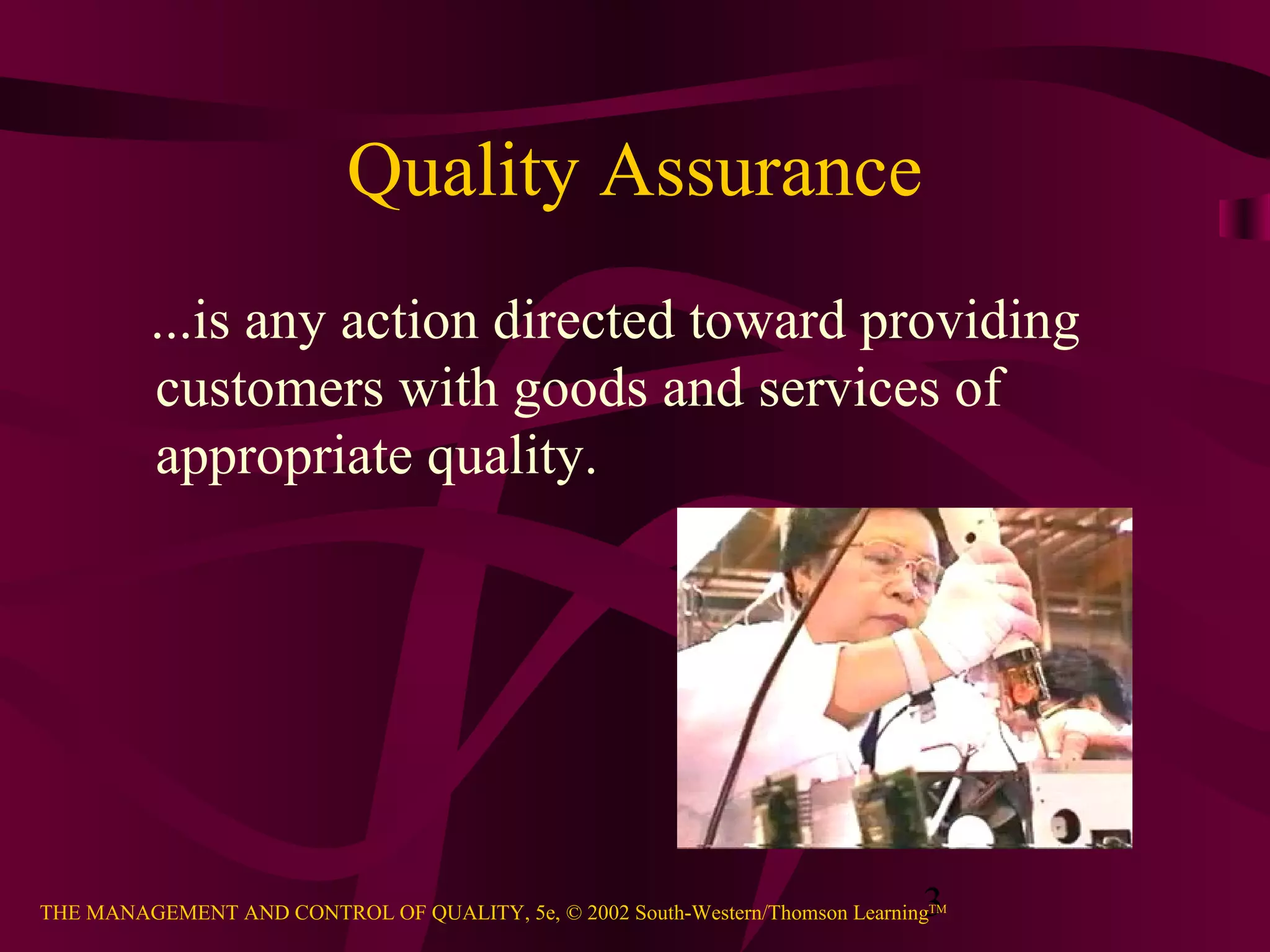
...is any action directed toward providing
customers with goods and services of
appropriate quality.
4THE MANAGEMENT AND CONTROL OF QUALITY, 5e, © 2002 South-Western/Thomson LearningTM
History of Quality Assurance (1 of 2)
• Skilled craftsmanship during Middle Ages
• Industrial Revolution: rise of inspection and
separate quality departments
• Statistical methods at Bell System
• Quality control during World War II
• Quality management in Japan
5THE MANAGEMENT AND CONTROL OF QUALITY, 5e, © 2002 South-Western/Thomson LearningTM
History of Quality Assurance (2 of 2)
• Quality awareness in U.S. manufacturing
industry during 1980s: “Total Quality
Management”
• Malcolm Baldrige National Quality Award
(1987)
• Quality in service industries, government,
health care, and education
• Current and future challenge: keep progress in
quality management alive
6THE MANAGEMENT AND CONTROL OF QUALITY, 5e, © 2002 South-Western/Thomson LearningTM
Contemporary Influences on
Quality
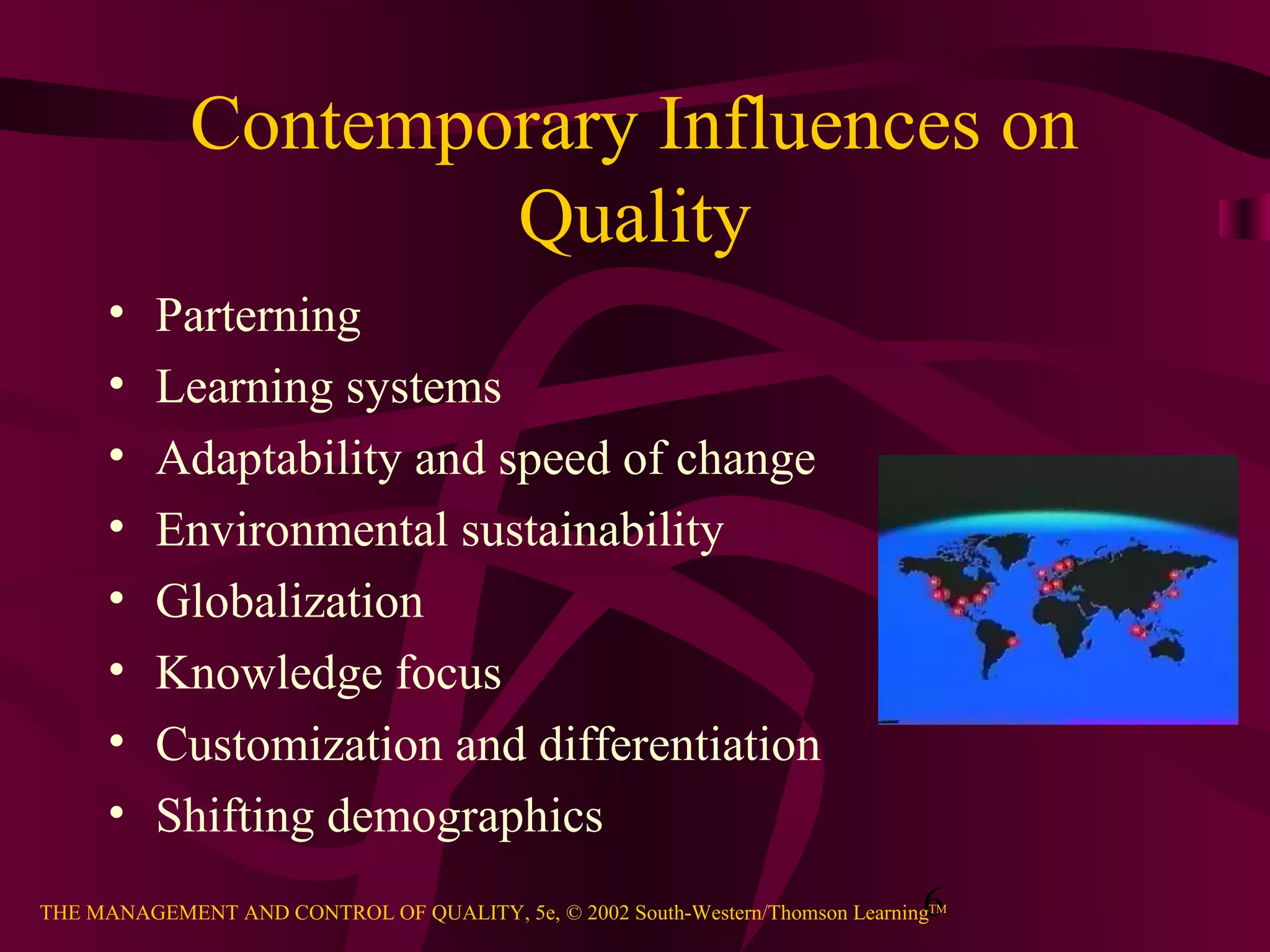
• Parterning
• Learning systems
• Adaptability and speed of change
• Environmental sustainability
• Globalization
• Knowledge focus
• Customization and differentiation
• Shifting demographics
7THE MANAGEMENT AND CONTROL OF QUALITY, 5e, © 2002 South-Western/Thomson LearningTM
Definitions of Quality
• Transcendent definition: excellence
• Product-based definition: quantities of
product attributes
• User-based definition: fitness for intended
use
• Value-based definition: quality vs. price
• Manufacturing-based definition:
conformance to specifications
8THE MANAGEMENT AND CONTROL OF QUALITY, 5e, © 2002 South-Western/Thomson LearningTM
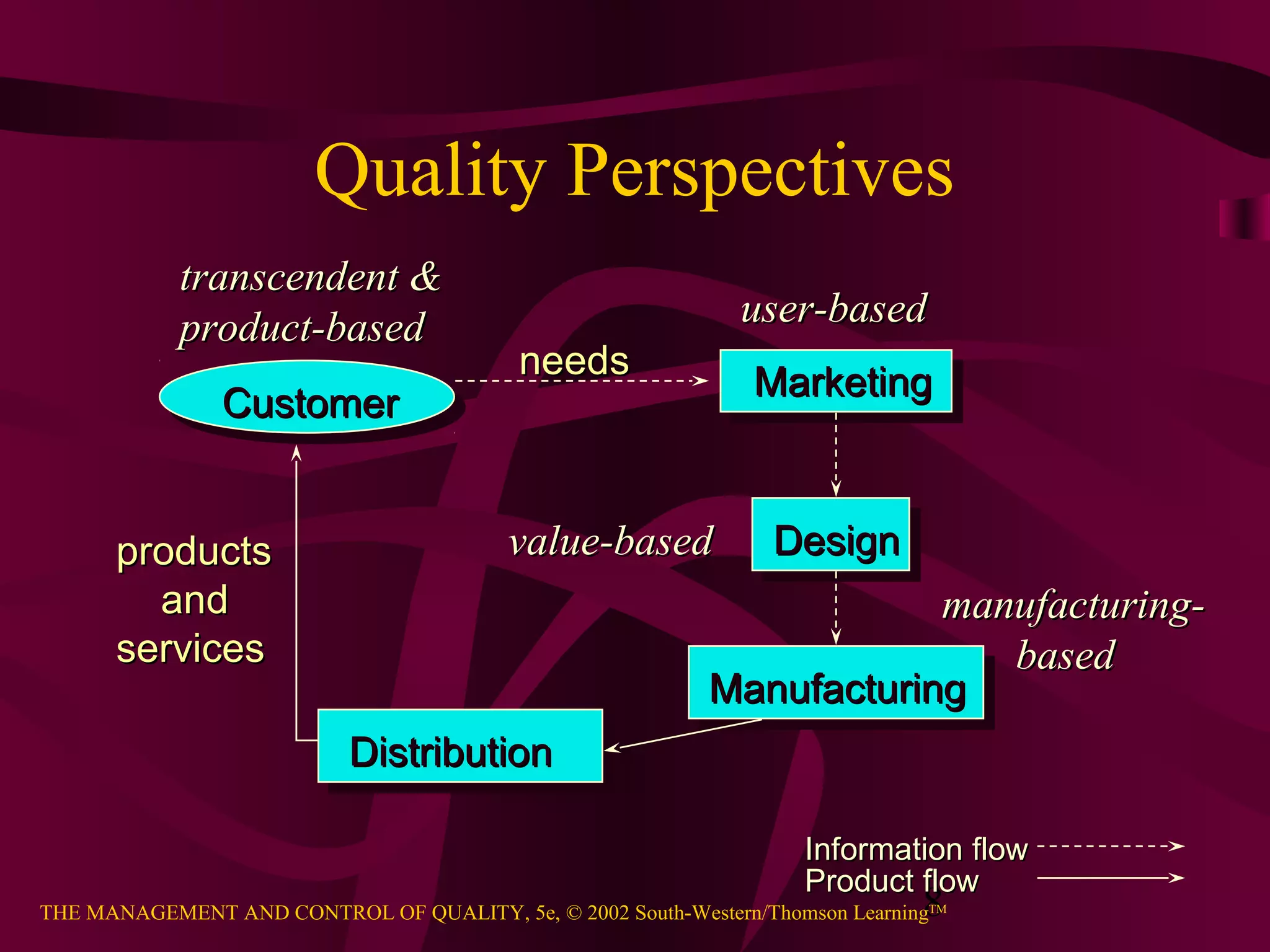
Quality Perspectives
CustomerCustomer
DistributionDistribution
productsproducts
andand
servicesservices
needsneeds
transcendent &transcendent &
product-basedproduct-based user-baseduser-based
manufacturing-manufacturing-
basedbased
value-basedvalue-based
MarketingMarketing
DesignDesign
ManufacturingManufacturing
Information flowInformation flow
Product flowProduct flow
9THE MANAGEMENT AND CONTROL OF QUALITY, 5e, © 2002 South-Western/Thomson LearningTM
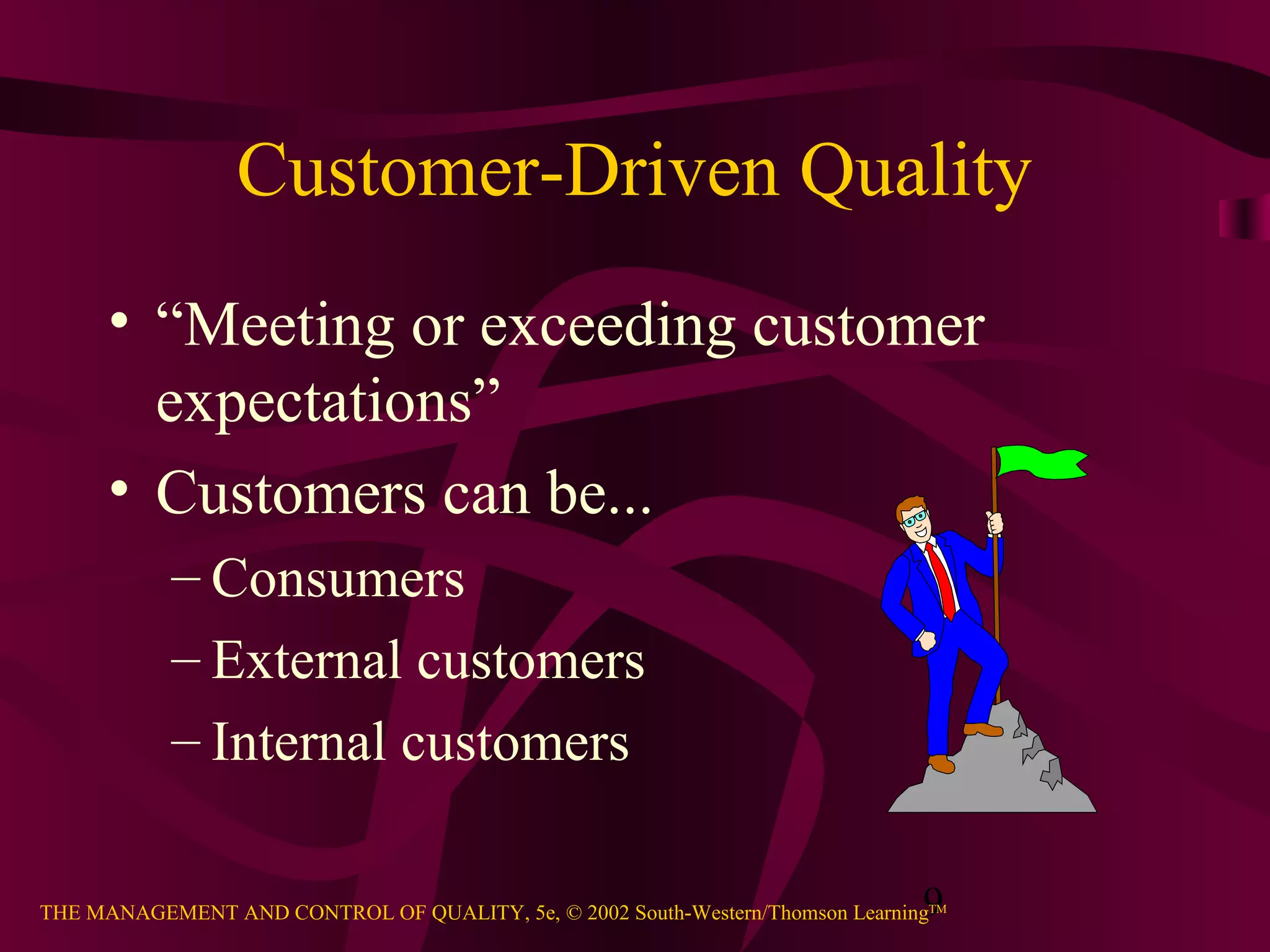
Customer-Driven Quality
• “Meeting or exceeding customer
expectations”
• Customers can be...
– Consumers
– External customers
– Internal customers
10THE MANAGEMENT AND CONTROL OF QUALITY, 5e, © 2002 South-Western/Thomson LearningTM
Total Quality
• People-focused management system
• Focus on increasing customer satisfaction
and reducing costs
• A systems approach that integrates
organizational functions and the entire
supply chain
• Stresses learning and adaptation to change
• Based on the scientific method
11THE MANAGEMENT AND CONTROL OF QUALITY, 5e, © 2002 South-Western/Thomson LearningTM
Principles of Total Quality
• Customer and stakeholder focus
• Participation and teamwork
• Process focus and continuous
improvement
...supported by an integrated organizational
infrastructure, a set of management practices,
and a set of tools and techniques
12THE MANAGEMENT AND CONTROL OF QUALITY, 5e, © 2002 South-Western/Thomson LearningTM
Customer and Stakeholder Focus
• Customer is principal judge of quality
• Organizations must first understand
customers’ needs and expectations in order
to meet and exceed them
• Organizations must build relationships with
customers
• Customers include employees and society at
large
13THE MANAGEMENT AND CONTROL OF QUALITY, 5e, © 2002 South-Western/Thomson LearningTM
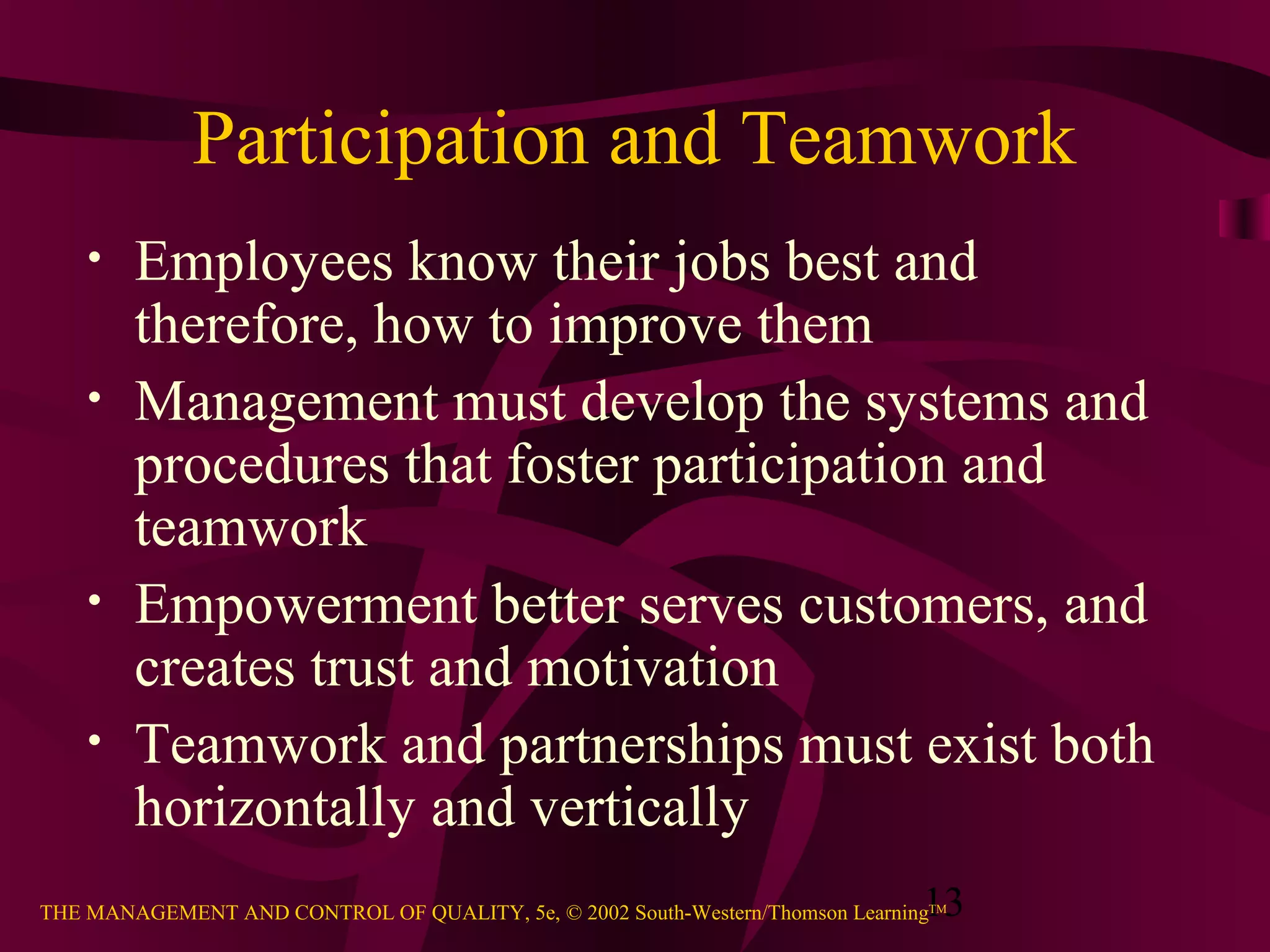
Participation and Teamwork
• Employees know their jobs best and
therefore, how to improve them
• Management must develop the systems and
procedures that foster participation and
teamwork
• Empowerment better serves customers, and
creates trust and motivation
• Teamwork and partnerships must exist both
horizontally and vertically
14THE MANAGEMENT AND CONTROL OF QUALITY, 5e, © 2002 South-Western/Thomson LearningTM
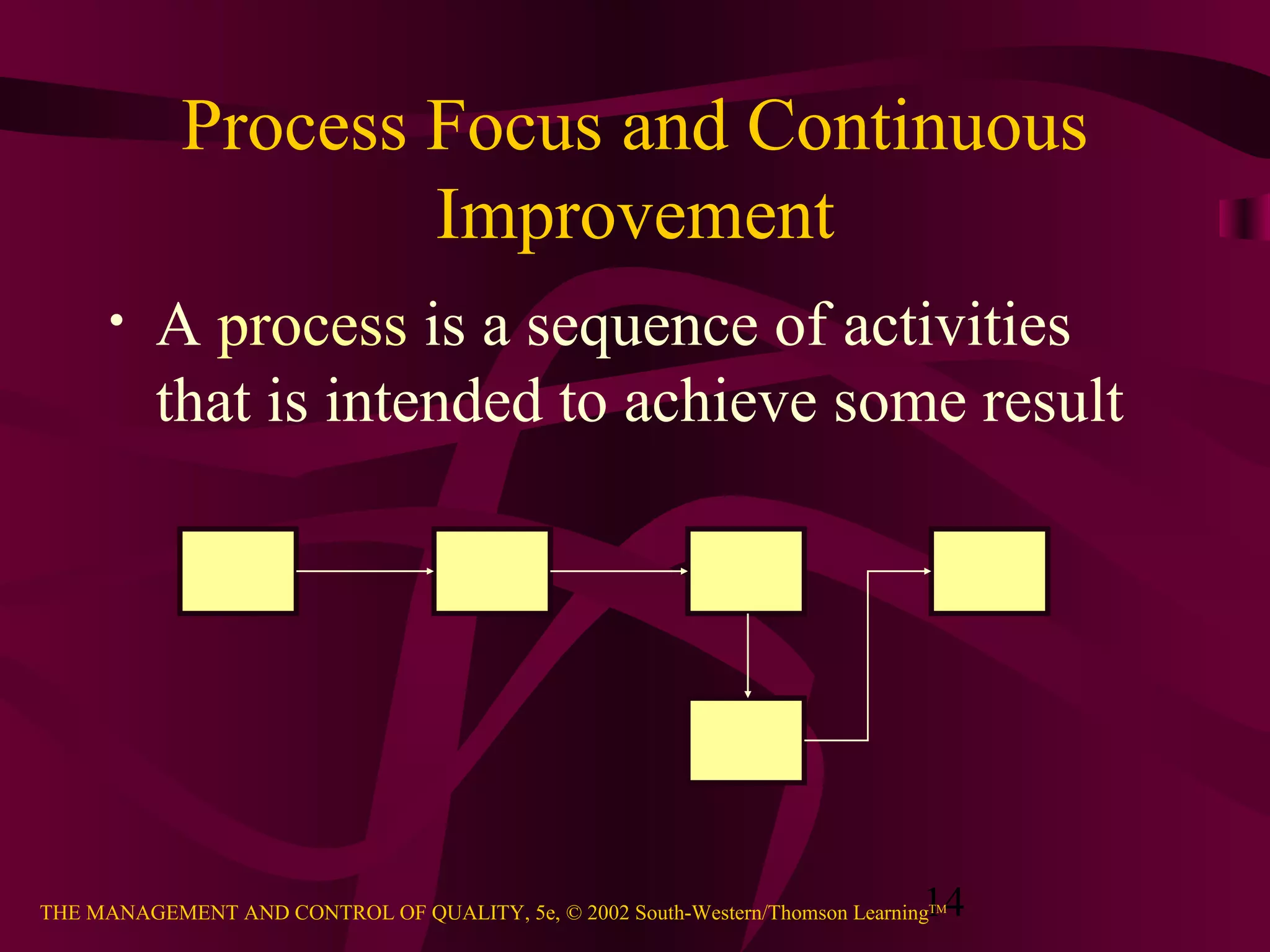
Process Focus and Continuous
Improvement
• A process is a sequence of activities
that is intended to achieve some result
15THE MANAGEMENT AND CONTROL OF QUALITY, 5e, © 2002 South-Western/Thomson LearningTM
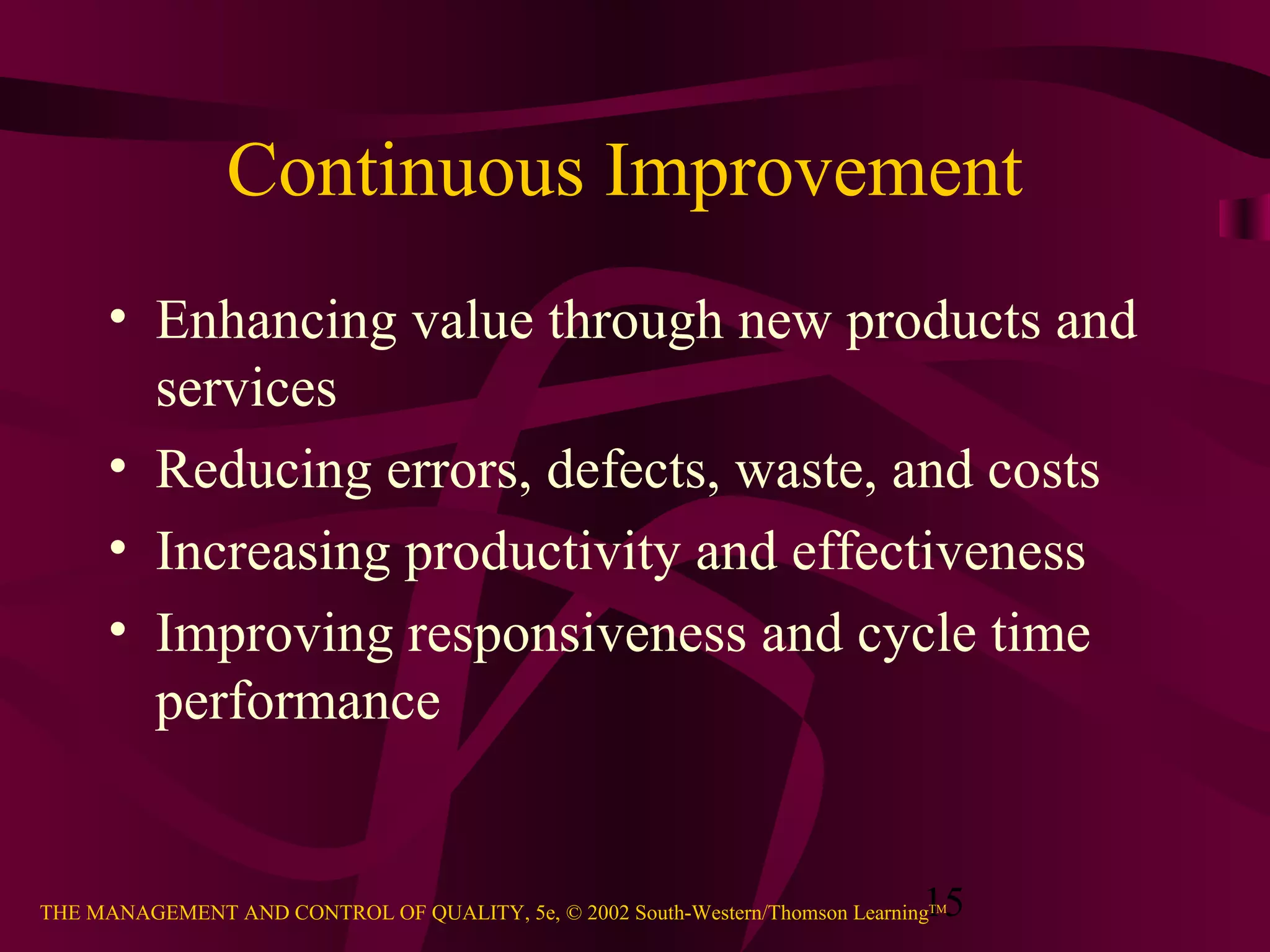
Continuous Improvement
• Enhancing value through new products and
services
• Reducing errors, defects, waste, and costs
• Increasing productivity and effectiveness
• Improving responsiveness and cycle time
performance
16THE MANAGEMENT AND CONTROL OF QUALITY, 5e, © 2002 South-Western/Thomson LearningTM
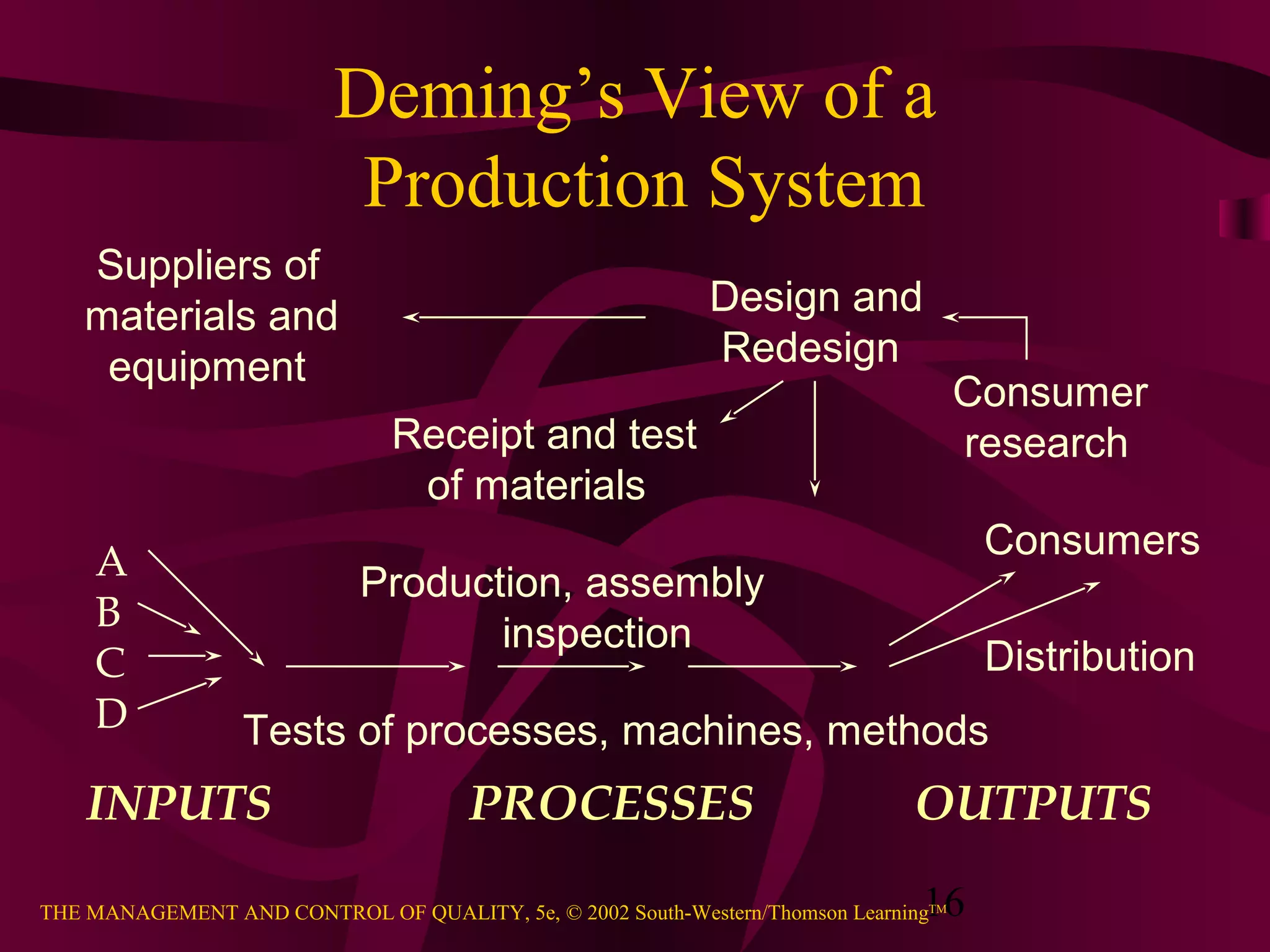
Deming’s View of a
Production System
Suppliers of
materials and
equipment
Receipt and test
of materials
Design and
Redesign
Consumer
research
A
B
C
D
Production, assembly
inspection
Tests of processes, machines, methods
Distribution
Consumers
INPUTS PROCESSES OUTPUTS
17THE MANAGEMENT AND CONTROL OF QUALITY, 5e, © 2002 South-Western/Thomson LearningTM
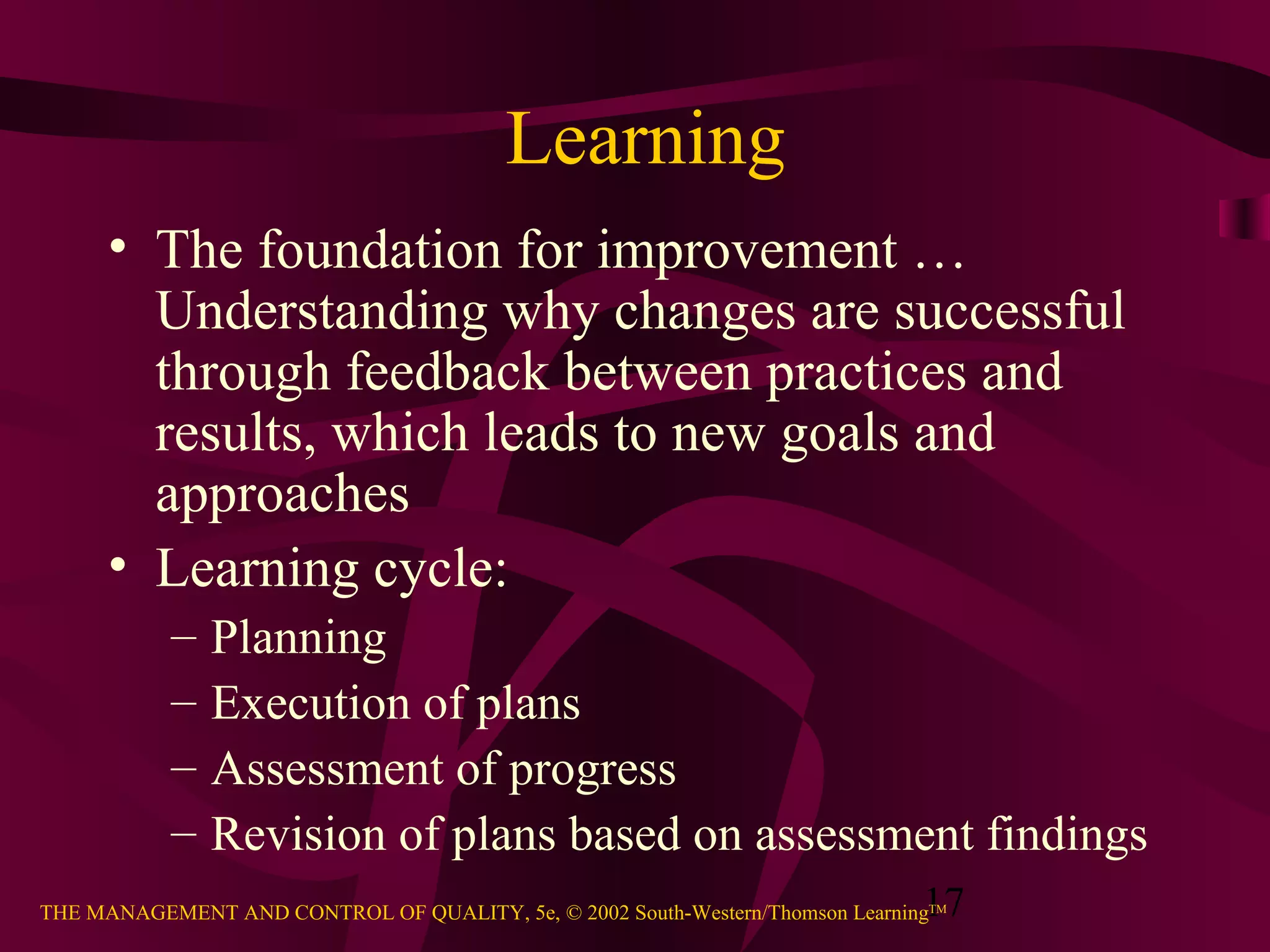
Learning
• The foundation for improvement …
Understanding why changes are successful
through feedback between practices and
results, which leads to new goals and
approaches
• Learning cycle:
– Planning
– Execution of plans
– Assessment of progress
– Revision of plans based on assessment findings
18THE MANAGEMENT AND CONTROL OF QUALITY, 5e, © 2002 South-Western/Thomson LearningTM
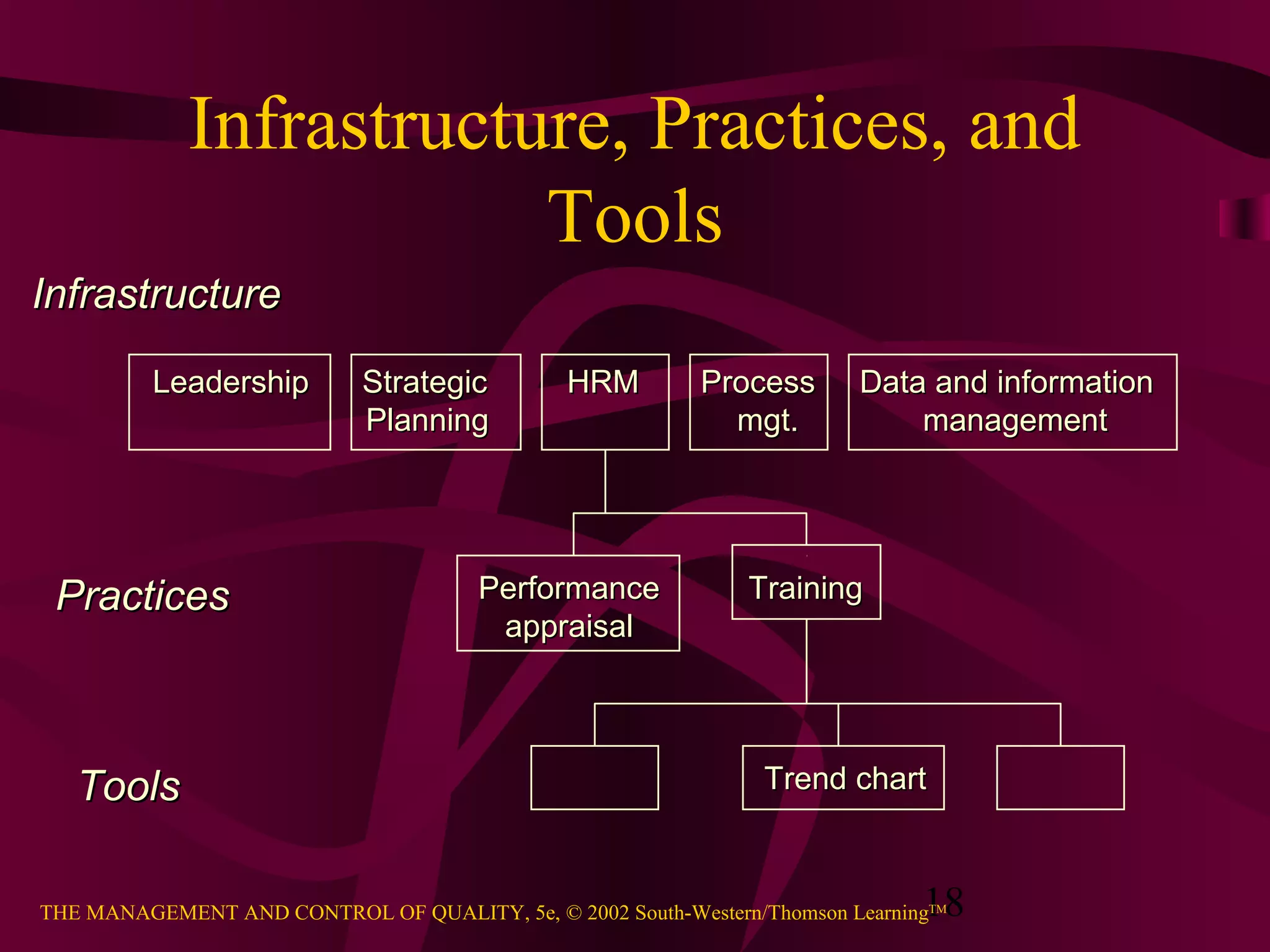
Infrastructure, Practices, and
Tools
Leadership Strategic HRM Process Data and informationLeadership Strategic HRM Process Data and information
Planning mgt. managementPlanning mgt. management
Performance TrainingPerformance Training
appraisalappraisal
Trend chartTrend chartToolsTools
PracticesPractices
InfrastructureInfrastructure
19THE MANAGEMENT AND CONTROL OF QUALITY, 5e, © 2002 South-Western/Thomson LearningTM
TQ Infrastructure
• Customer relationship management
• Leadership and strategic planning
• Human resources management
• Process management
• Data and information management
20THE MANAGEMENT AND CONTROL OF QUALITY, 5e, © 2002 South-Western/Thomson LearningTM
Competitive Advantage
• Is driven by customer wants and needs
• Makes significant contribution to business
success
• Matches organization’s unique resources with
opportunities
• Is durable and lasting
• Provides basis for further improvement
• Provides direction and motivation
Quality supports each of these characteristics
21THE MANAGEMENT AND CONTROL OF QUALITY, 5e, © 2002 South-Western/Thomson LearningTM
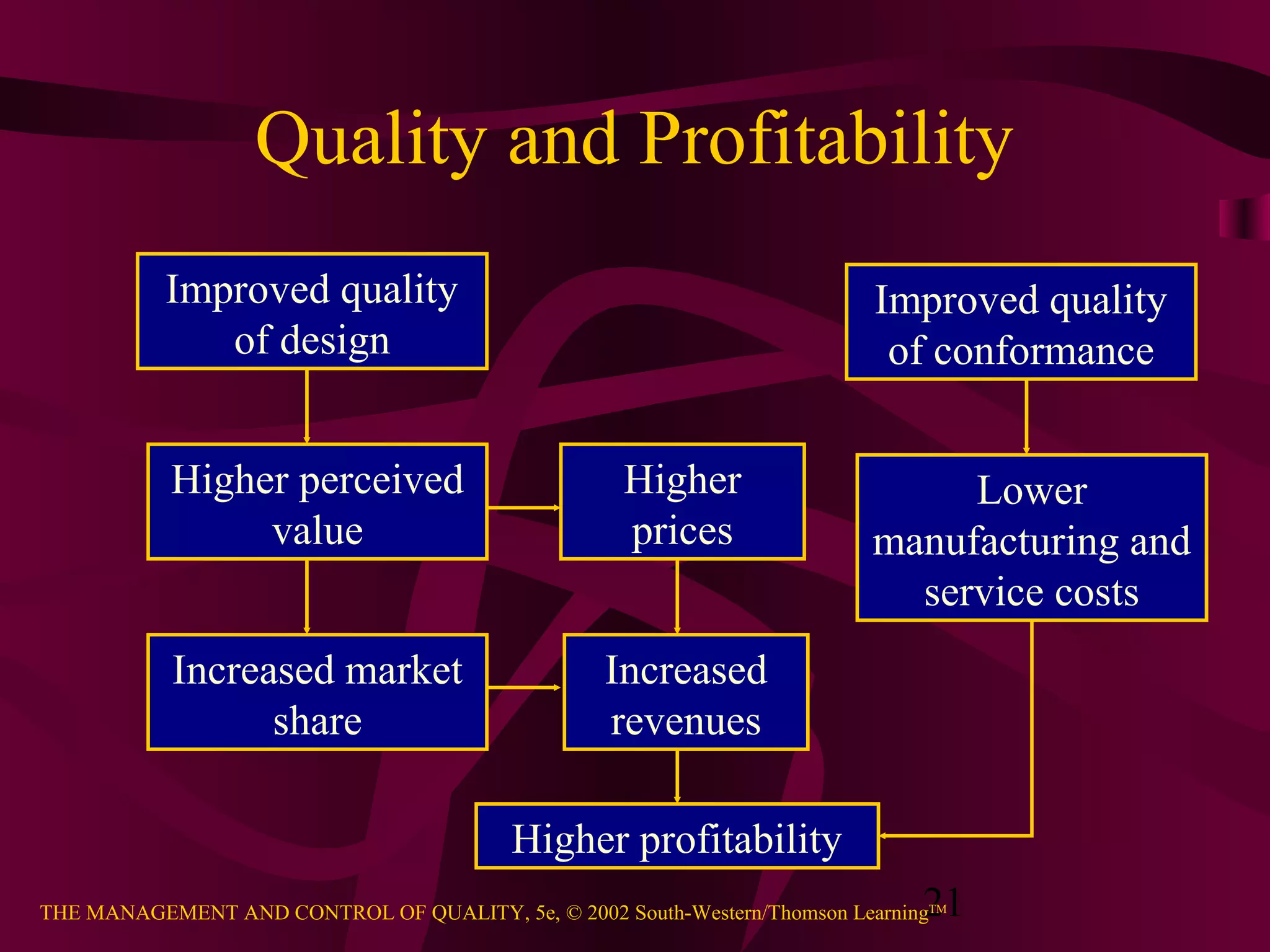
Quality and Profitability
Improved quality
of design
Higher perceived
value
Increased market
share
Higher
prices
Increased
revenues
Improved quality
of conformance
Lower
manufacturing and
service costs
Higher profitability
22THE MANAGEMENT AND CONTROL OF QUALITY, 5e, © 2002 South-Western/Thomson LearningTM
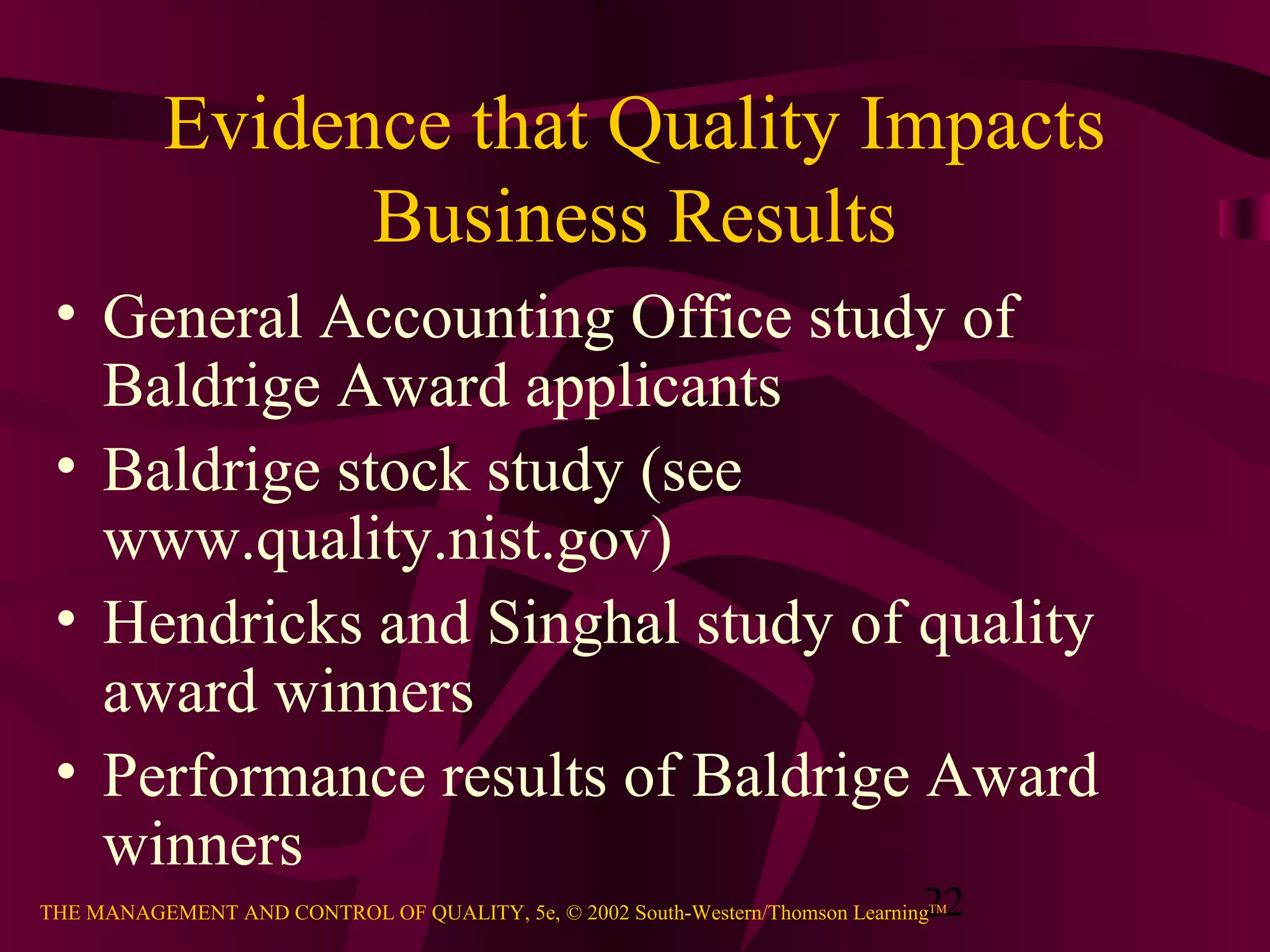
Evidence that Quality Impacts
Business Results
• General Accounting Office study of
Baldrige Award applicants
• Baldrige stock study (see
www.quality.nist.gov)
• Hendricks and Singhal study of quality
award winners
• Performance results of Baldrige Award
winners
23THE MANAGEMENT AND CONTROL OF QUALITY, 5e, © 2002 South-Western/Thomson LearningTM
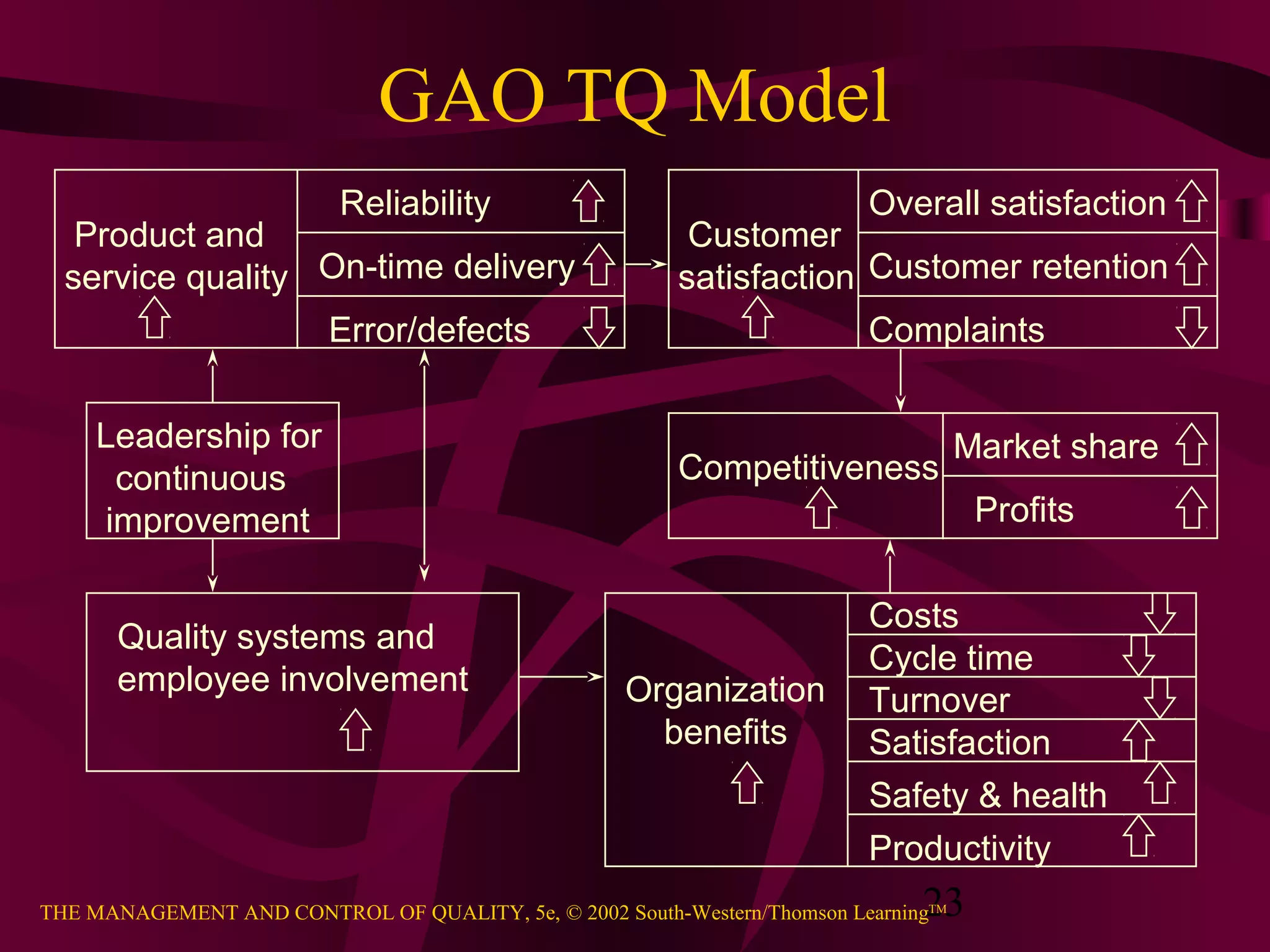
GAO TQ Model
Product and
service quality
Customer
satisfaction
Leadership for
continuous
improvement
Quality systems and
employee involvement
Competitiveness
Organization
benefits
Reliability
On-time delivery
Error/defects
Overall satisfaction
Customer retention
Complaints
Costs
Cycle time
Turnover
Satisfaction
Safety & health
Productivity
Market share
Profits
24THE MANAGEMENT AND CONTROL OF QUALITY, 5e, © 2002 South-Western/Thomson LearningTM
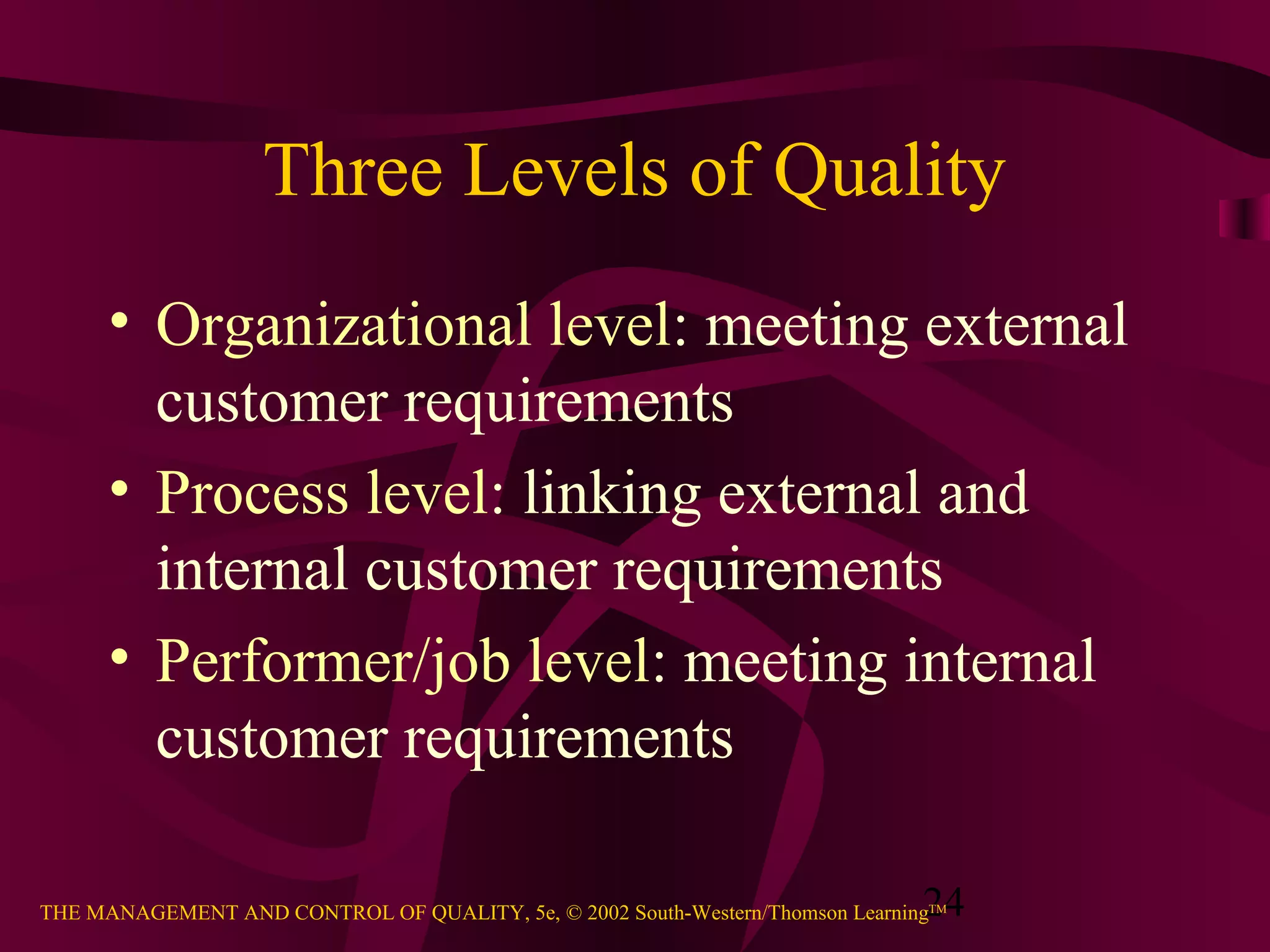
Three Levels of Quality
• Organizational level: meeting external
customer requirements
• Process level: linking external and
internal customer requirements
• Performer/job level: meeting internal
customer requirements
25THE MANAGEMENT AND CONTROL OF QUALITY, 5e, © 2002 South-Western/Thomson LearningTM
Quality and Personal Values
• Personal initiative has a positive impact
on business success
• Quality begins with personal attitudes
• Quality-focused individuals often exceed
customer expectations
• Attitudes can be changed through
awareness and effort (e.g., personal
quality checklists)

Ch01

  • 1.
    1THE MANAGEMENT ANDCONTROL OF QUALITY, 5e, © 2002 South-Western/Thomson LearningTM Chapter 1 Introduction to Quality
  • 2.
    2THE MANAGEMENT ANDCONTROL OF QUALITY, 5e, © 2002 South-Western/Thomson LearningTM Modern Importance of Quality “The first job we have is to turn out quality merchandise that consumers will buy and keep on buying. If we produce it efficiently and economically, we will earn a profit, in which you will share.” - William Cooper Procter
  • 3.
    3THE MANAGEMENT ANDCONTROL OF QUALITY, 5e, © 2002 South-Western/Thomson LearningTM Quality Assurance ...is any action directed toward providing customers with goods and services of appropriate quality.
  • 4.
    4THE MANAGEMENT ANDCONTROL OF QUALITY, 5e, © 2002 South-Western/Thomson LearningTM History of Quality Assurance (1 of 2) • Skilled craftsmanship during Middle Ages • Industrial Revolution: rise of inspection and separate quality departments • Statistical methods at Bell System • Quality control during World War II • Quality management in Japan
  • 5.
    5THE MANAGEMENT ANDCONTROL OF QUALITY, 5e, © 2002 South-Western/Thomson LearningTM History of Quality Assurance (2 of 2) • Quality awareness in U.S. manufacturing industry during 1980s: “Total Quality Management” • Malcolm Baldrige National Quality Award (1987) • Quality in service industries, government, health care, and education • Current and future challenge: keep progress in quality management alive
  • 6.
    6THE MANAGEMENT ANDCONTROL OF QUALITY, 5e, © 2002 South-Western/Thomson LearningTM Contemporary Influences on Quality • Parterning • Learning systems • Adaptability and speed of change • Environmental sustainability • Globalization • Knowledge focus • Customization and differentiation • Shifting demographics
  • 7.
    7THE MANAGEMENT ANDCONTROL OF QUALITY, 5e, © 2002 South-Western/Thomson LearningTM Definitions of Quality • Transcendent definition: excellence • Product-based definition: quantities of product attributes • User-based definition: fitness for intended use • Value-based definition: quality vs. price • Manufacturing-based definition: conformance to specifications
  • 8.
    8THE MANAGEMENT ANDCONTROL OF QUALITY, 5e, © 2002 South-Western/Thomson LearningTM Quality Perspectives CustomerCustomer DistributionDistribution productsproducts andand servicesservices needsneeds transcendent &transcendent & product-basedproduct-based user-baseduser-based manufacturing-manufacturing- basedbased value-basedvalue-based MarketingMarketing DesignDesign ManufacturingManufacturing Information flowInformation flow Product flowProduct flow
  • 9.
    9THE MANAGEMENT ANDCONTROL OF QUALITY, 5e, © 2002 South-Western/Thomson LearningTM Customer-Driven Quality • “Meeting or exceeding customer expectations” • Customers can be... – Consumers – External customers – Internal customers
  • 10.
    10THE MANAGEMENT ANDCONTROL OF QUALITY, 5e, © 2002 South-Western/Thomson LearningTM Total Quality • People-focused management system • Focus on increasing customer satisfaction and reducing costs • A systems approach that integrates organizational functions and the entire supply chain • Stresses learning and adaptation to change • Based on the scientific method
  • 11.
    11THE MANAGEMENT ANDCONTROL OF QUALITY, 5e, © 2002 South-Western/Thomson LearningTM Principles of Total Quality • Customer and stakeholder focus • Participation and teamwork • Process focus and continuous improvement ...supported by an integrated organizational infrastructure, a set of management practices, and a set of tools and techniques
  • 12.
    12THE MANAGEMENT ANDCONTROL OF QUALITY, 5e, © 2002 South-Western/Thomson LearningTM Customer and Stakeholder Focus • Customer is principal judge of quality • Organizations must first understand customers’ needs and expectations in order to meet and exceed them • Organizations must build relationships with customers • Customers include employees and society at large
  • 13.
    13THE MANAGEMENT ANDCONTROL OF QUALITY, 5e, © 2002 South-Western/Thomson LearningTM Participation and Teamwork • Employees know their jobs best and therefore, how to improve them • Management must develop the systems and procedures that foster participation and teamwork • Empowerment better serves customers, and creates trust and motivation • Teamwork and partnerships must exist both horizontally and vertically
  • 14.
    14THE MANAGEMENT ANDCONTROL OF QUALITY, 5e, © 2002 South-Western/Thomson LearningTM Process Focus and Continuous Improvement • A process is a sequence of activities that is intended to achieve some result
  • 15.
    15THE MANAGEMENT ANDCONTROL OF QUALITY, 5e, © 2002 South-Western/Thomson LearningTM Continuous Improvement • Enhancing value through new products and services • Reducing errors, defects, waste, and costs • Increasing productivity and effectiveness • Improving responsiveness and cycle time performance
  • 16.
    16THE MANAGEMENT ANDCONTROL OF QUALITY, 5e, © 2002 South-Western/Thomson LearningTM Deming’s View of a Production System Suppliers of materials and equipment Receipt and test of materials Design and Redesign Consumer research A B C D Production, assembly inspection Tests of processes, machines, methods Distribution Consumers INPUTS PROCESSES OUTPUTS
  • 17.
    17THE MANAGEMENT ANDCONTROL OF QUALITY, 5e, © 2002 South-Western/Thomson LearningTM Learning • The foundation for improvement … Understanding why changes are successful through feedback between practices and results, which leads to new goals and approaches • Learning cycle: – Planning – Execution of plans – Assessment of progress – Revision of plans based on assessment findings
  • 18.
    18THE MANAGEMENT ANDCONTROL OF QUALITY, 5e, © 2002 South-Western/Thomson LearningTM Infrastructure, Practices, and Tools Leadership Strategic HRM Process Data and informationLeadership Strategic HRM Process Data and information Planning mgt. managementPlanning mgt. management Performance TrainingPerformance Training appraisalappraisal Trend chartTrend chartToolsTools PracticesPractices InfrastructureInfrastructure
  • 19.
    19THE MANAGEMENT ANDCONTROL OF QUALITY, 5e, © 2002 South-Western/Thomson LearningTM TQ Infrastructure • Customer relationship management • Leadership and strategic planning • Human resources management • Process management • Data and information management
  • 20.
    20THE MANAGEMENT ANDCONTROL OF QUALITY, 5e, © 2002 South-Western/Thomson LearningTM Competitive Advantage • Is driven by customer wants and needs • Makes significant contribution to business success • Matches organization’s unique resources with opportunities • Is durable and lasting • Provides basis for further improvement • Provides direction and motivation Quality supports each of these characteristics
  • 21.
    21THE MANAGEMENT ANDCONTROL OF QUALITY, 5e, © 2002 South-Western/Thomson LearningTM Quality and Profitability Improved quality of design Higher perceived value Increased market share Higher prices Increased revenues Improved quality of conformance Lower manufacturing and service costs Higher profitability
  • 22.
    22THE MANAGEMENT ANDCONTROL OF QUALITY, 5e, © 2002 South-Western/Thomson LearningTM Evidence that Quality Impacts Business Results • General Accounting Office study of Baldrige Award applicants • Baldrige stock study (see www.quality.nist.gov) • Hendricks and Singhal study of quality award winners • Performance results of Baldrige Award winners
  • 23.
    23THE MANAGEMENT ANDCONTROL OF QUALITY, 5e, © 2002 South-Western/Thomson LearningTM GAO TQ Model Product and service quality Customer satisfaction Leadership for continuous improvement Quality systems and employee involvement Competitiveness Organization benefits Reliability On-time delivery Error/defects Overall satisfaction Customer retention Complaints Costs Cycle time Turnover Satisfaction Safety & health Productivity Market share Profits
  • 24.
    24THE MANAGEMENT ANDCONTROL OF QUALITY, 5e, © 2002 South-Western/Thomson LearningTM Three Levels of Quality • Organizational level: meeting external customer requirements • Process level: linking external and internal customer requirements • Performer/job level: meeting internal customer requirements
  • 25.
    25THE MANAGEMENT ANDCONTROL OF QUALITY, 5e, © 2002 South-Western/Thomson LearningTM Quality and Personal Values • Personal initiative has a positive impact on business success • Quality begins with personal attitudes • Quality-focused individuals often exceed customer expectations • Attitudes can be changed through awareness and effort (e.g., personal quality checklists)