INTRODUCTION
A particular picture in every AMUL
office prominently displays that
“never forget your primary customer…
if you don’t, success is certain !!!”
The birth of amul inspired the white
revolution and heralded the operation
flood…
HISTORY
‘AMUL’ has been derived from the word
‘amulya’ which in ‘sanskrit’ means
‘priceless’…
‘AMUL’ was primarily the vision of Dr.
Verghese Kurien, who in the ’50s gave
himself permission to re-invent the milk
industry…
STRATEGIC DECISIONS
• Continuous and regular demand for milk
• Targeting an untouched industry
• Complete technical know-how
• Extensively availability of land in villages
• Cheap and surplus labour
• Wholesale depots, Retailers & Direct consumer base
• Use of ICT(Information Communication Technology)
OPERATING DECISIONS
•Every morning 20 lakh women across 1000 villages
brought milk worth Rs 5crore
•Along with men, women dairy workers are available
•Creation of co-operative societies
•Providing training and skill development to workers
•Easy procurement, processing and distribution
function
•Expansion of product in the form of butter, ghee,
cheese etc.
CONTROL DECISIONS
• Professional management
• Effective co-ordination
• Benefits from recent initiatives
• Assured buy in from the unions
SWOT ANALYSIS
STRENGTHS WEAKNESSES
OPPORTUNITIES THREATS
Highly diverse product mix
High quality and low prices
Robust distribution network
Unique Advertisement
techniques
Unable to capture chocolate
market.
Strong dependency on weak
infrastructure.
Risk of highly complex supply
chain.
Potential to expand to
smaller towns and other
geographies.
 Expand product portfolio to
enter new product categories.
Strong present competitors-
Britannia, nestle, mother dairy,
Cadbury.
New MNC’s entering the
market.
Food inflation
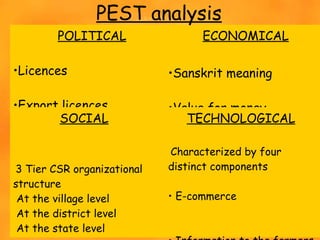
POLITICAL
•Licences
•Export licences
ECONOMICAL
•Sanskrit meaning
•Value for money
SOCIAL
3 Tier CSR organizational
structure
At the village level
At the district level
At the state level
TECHNOLOGICAL
Characterized by four
distinct components
• E-commerce
PEST analysis
THE
PRODUCTION SYSTEM
MODEL …
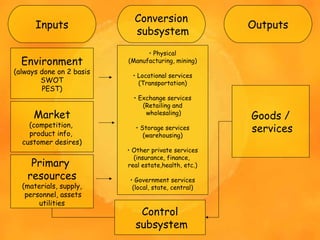
Inputs
Conversion
subsystem
Outputs
Environment
(always done on 2 basis
SWOT
PEST)
Market
(competition,
product info,
customer desires)
Primary
resources
(materials, supply,
personnel, assets
utilities
• Physical
(Manufacturing, mining)
• Locational services
(Transportation)
• Exchange services
(Retailing and
wholesaling)
• Storage services
(warehousing)
• Other private services
(insurance, finance,
real estate,health, etc.)
• Government services
(local, state, central)
Goods /
services
Control
subsystem
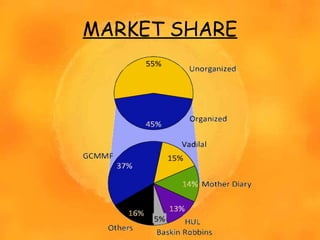
MARKET SHARE
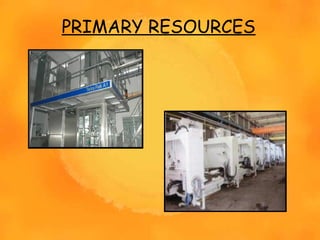
PRIMARY RESOURCES
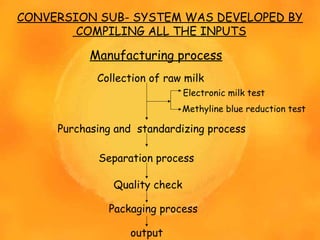
Collection of raw milk
Electronic milk test
Methyline blue reduction test
Purchasing and standardizing process
Separation process
Quality check
Packaging process
output
Manufacturing process
CONVERSION SUB- SYSTEM WAS DEVELOPED BY
COMPILING ALL THE INPUTS
NEEDS
IDENTIFICATION
ADVANCE
PRODUCT
PLANNING
ADVANCE
DESIGN
DETAILED DESIGN
ENGINEERING
PROMOTION
,DESIGN AND
DEVELOPMENT
PRODUCT
EVALUATION
PRODUCT USE
AND
SUPPORT
Analysis of relevant ratios:
Interest coverage ratio
Dupont analysis
FINANCIAL MANAGEMENT
Sales
CE
PBDIT
Sales
X
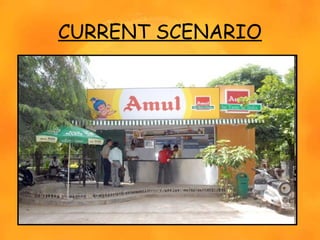
CURRENT SCENARIO
• Expansion of processing and packaging capacities to meet growing
demands.
• Setting up of additional processing facilities in Delhi and Mumbai.
• Sold its milk brands on the internet
• Launched the product Amul calci a fortified milk brand
• Long term strategy includes foray into South India.
• Plans to scale its outlets to 10000 by 2010
• Extending its new retail initiative ice-cream parlors
from 60 to 200 across the country.
• Cooperation has hired NID people to design its outlets.
• Joined hands with the milk co-operative union in
Puducherry to manufacture ice-creams there.
• The 13 district cooperative milk producers' union today
prides to have 2.79 million members handling 11.22
million litres of milk per day.
• The total milk production in 2008-2009 was 3.05
PRESENTED BY :-
NAMES
SAKINA BHARMAL
BINDIYA CHOTRANI
AKASH HINDUJA
SURBHI JOSHI
MANISHA MELWANI
NIKHIL NAGPAL
MANIK SINGAL
NAMRATA VALECHA
ROLL NOS.
09
13
20
24
40
47
57
58

Amul final ppt

  • 2.
    INTRODUCTION A particular picturein every AMUL office prominently displays that “never forget your primary customer… if you don’t, success is certain !!!” The birth of amul inspired the white revolution and heralded the operation flood…
  • 3.
    HISTORY ‘AMUL’ has beenderived from the word ‘amulya’ which in ‘sanskrit’ means ‘priceless’… ‘AMUL’ was primarily the vision of Dr. Verghese Kurien, who in the ’50s gave himself permission to re-invent the milk industry…
  • 4.
    STRATEGIC DECISIONS • Continuousand regular demand for milk • Targeting an untouched industry • Complete technical know-how • Extensively availability of land in villages • Cheap and surplus labour • Wholesale depots, Retailers & Direct consumer base • Use of ICT(Information Communication Technology)
  • 5.
    OPERATING DECISIONS •Every morning20 lakh women across 1000 villages brought milk worth Rs 5crore •Along with men, women dairy workers are available •Creation of co-operative societies •Providing training and skill development to workers •Easy procurement, processing and distribution function •Expansion of product in the form of butter, ghee, cheese etc.
  • 6.
    CONTROL DECISIONS • Professionalmanagement • Effective co-ordination • Benefits from recent initiatives • Assured buy in from the unions
  • 7.
    SWOT ANALYSIS STRENGTHS WEAKNESSES OPPORTUNITIESTHREATS Highly diverse product mix High quality and low prices Robust distribution network Unique Advertisement techniques Unable to capture chocolate market. Strong dependency on weak infrastructure. Risk of highly complex supply chain. Potential to expand to smaller towns and other geographies.  Expand product portfolio to enter new product categories. Strong present competitors- Britannia, nestle, mother dairy, Cadbury. New MNC’s entering the market. Food inflation
  • 8.
    POLITICAL •Licences •Export licences ECONOMICAL •Sanskrit meaning •Valuefor money SOCIAL 3 Tier CSR organizational structure At the village level At the district level At the state level TECHNOLOGICAL Characterized by four distinct components • E-commerce PEST analysis
  • 9.
  • 10.
    Inputs Conversion subsystem Outputs Environment (always done on2 basis SWOT PEST) Market (competition, product info, customer desires) Primary resources (materials, supply, personnel, assets utilities • Physical (Manufacturing, mining) • Locational services (Transportation) • Exchange services (Retailing and wholesaling) • Storage services (warehousing) • Other private services (insurance, finance, real estate,health, etc.) • Government services (local, state, central) Goods / services Control subsystem
  • 11.
  • 12.
  • 13.
    Collection of rawmilk Electronic milk test Methyline blue reduction test Purchasing and standardizing process Separation process Quality check Packaging process output Manufacturing process CONVERSION SUB- SYSTEM WAS DEVELOPED BY COMPILING ALL THE INPUTS
  • 14.
  • 15.
    Analysis of relevantratios: Interest coverage ratio Dupont analysis FINANCIAL MANAGEMENT
  • 16.
  • 17.
  • 18.
    • Expansion ofprocessing and packaging capacities to meet growing demands. • Setting up of additional processing facilities in Delhi and Mumbai. • Sold its milk brands on the internet • Launched the product Amul calci a fortified milk brand • Long term strategy includes foray into South India.
  • 19.
    • Plans toscale its outlets to 10000 by 2010 • Extending its new retail initiative ice-cream parlors from 60 to 200 across the country. • Cooperation has hired NID people to design its outlets. • Joined hands with the milk co-operative union in Puducherry to manufacture ice-creams there. • The 13 district cooperative milk producers' union today prides to have 2.79 million members handling 11.22 million litres of milk per day. • The total milk production in 2008-2009 was 3.05
  • 20.
    PRESENTED BY :- NAMES SAKINABHARMAL BINDIYA CHOTRANI AKASH HINDUJA SURBHI JOSHI MANISHA MELWANI NIKHIL NAGPAL MANIK SINGAL NAMRATA VALECHA ROLL NOS. 09 13 20 24 40 47 57 58