Tourism 
• Tourism refers to the temporary movement 
of people primarily for leisure and 
recreational purposes 
• It is characterised by the interaction(s) 
between tourists and tourism destinations
Tourist 
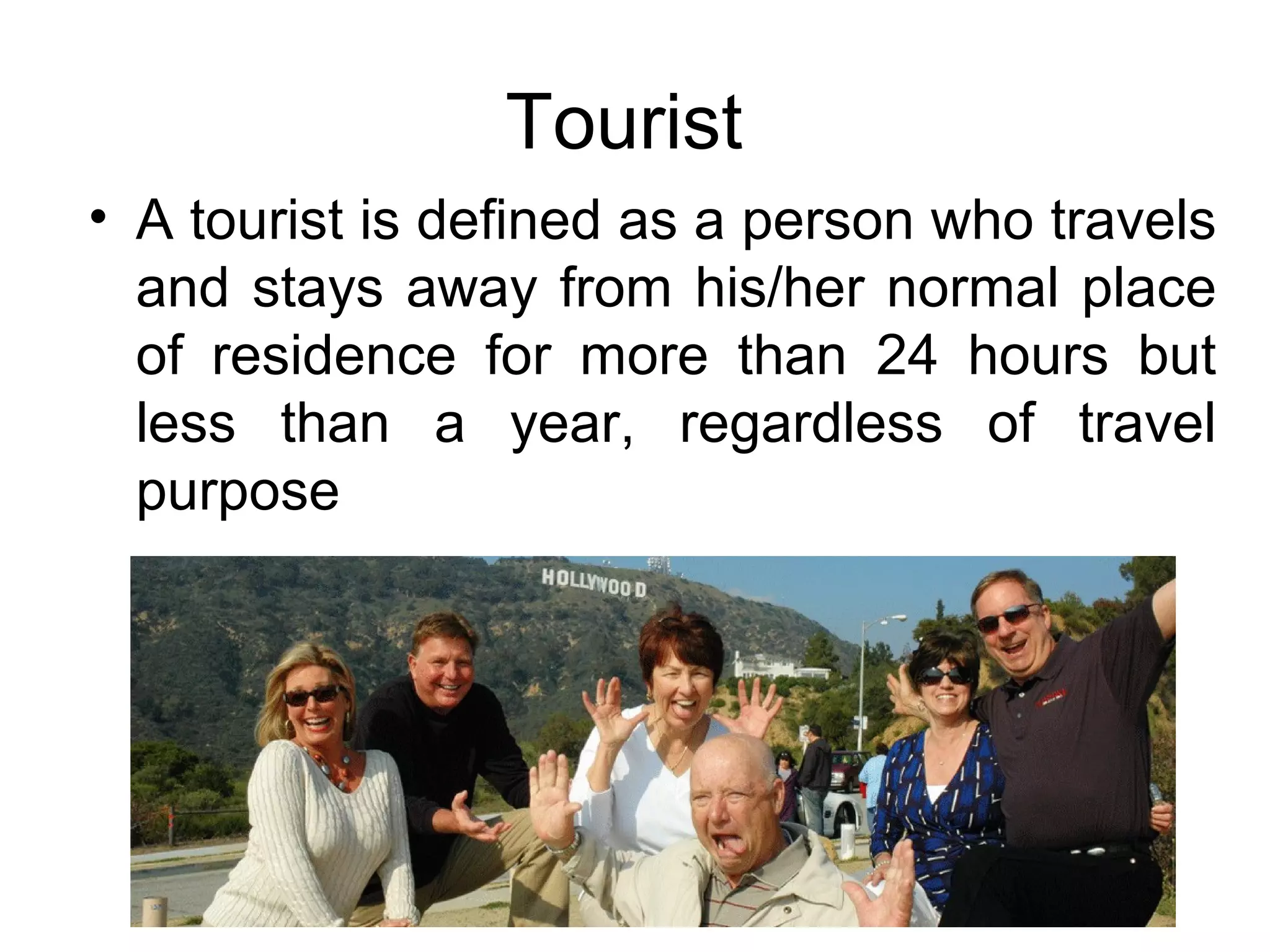
• A tourist is defined as a person who travels 
and stays away from his/her normal place 
of residence for more than 24 hours but 
less than a year, regardless of travel 
purpose
Tourism Types 
• Tourism is place-specific, tourists travel to 
a specific physical location 
• Different spaces/environments (both 
physical and human) in tourism 
destinations create diverse tourism 
activities 
• There are therefore the presence of 
different tourism types
Honeypot Tourism 
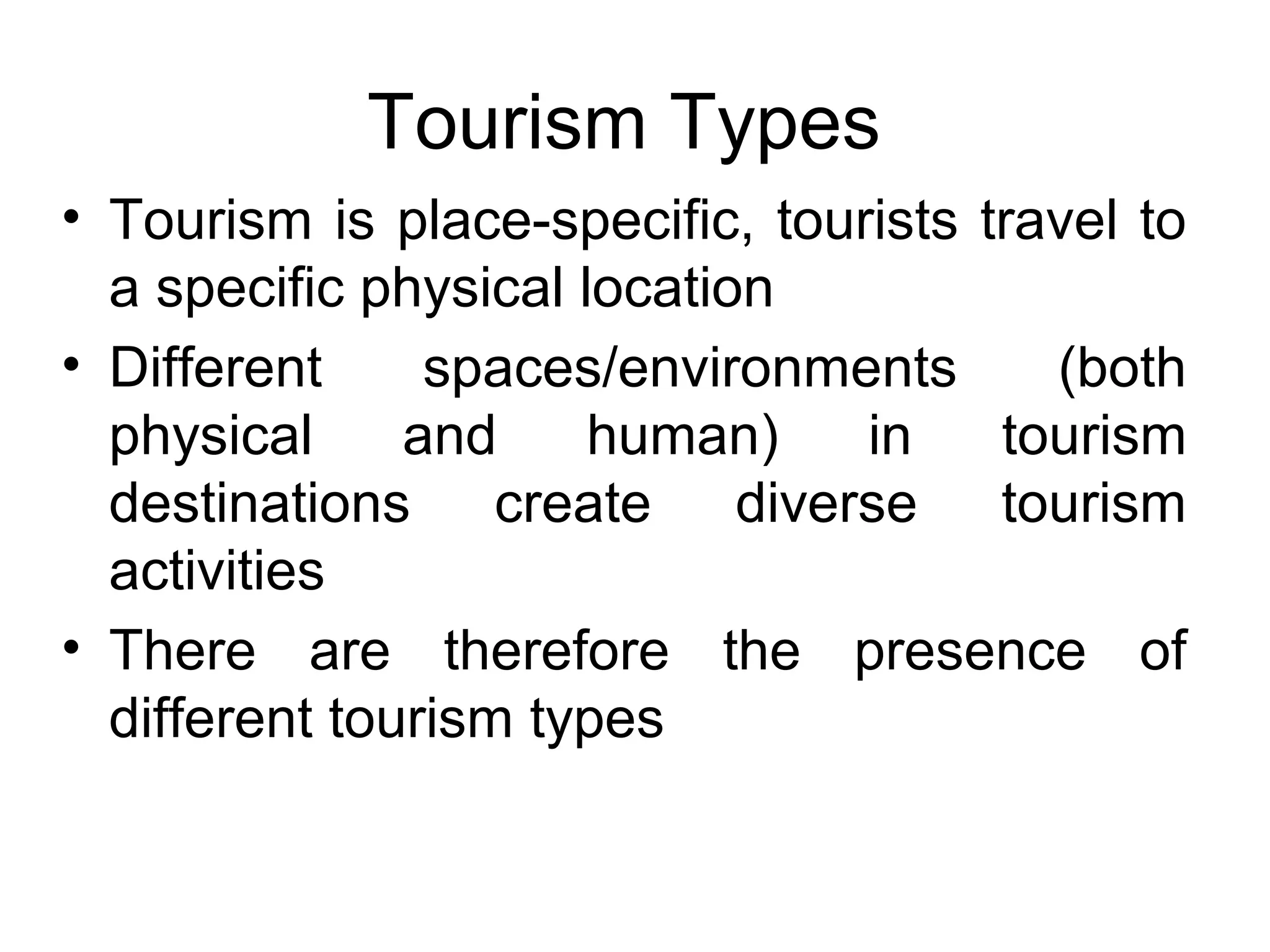
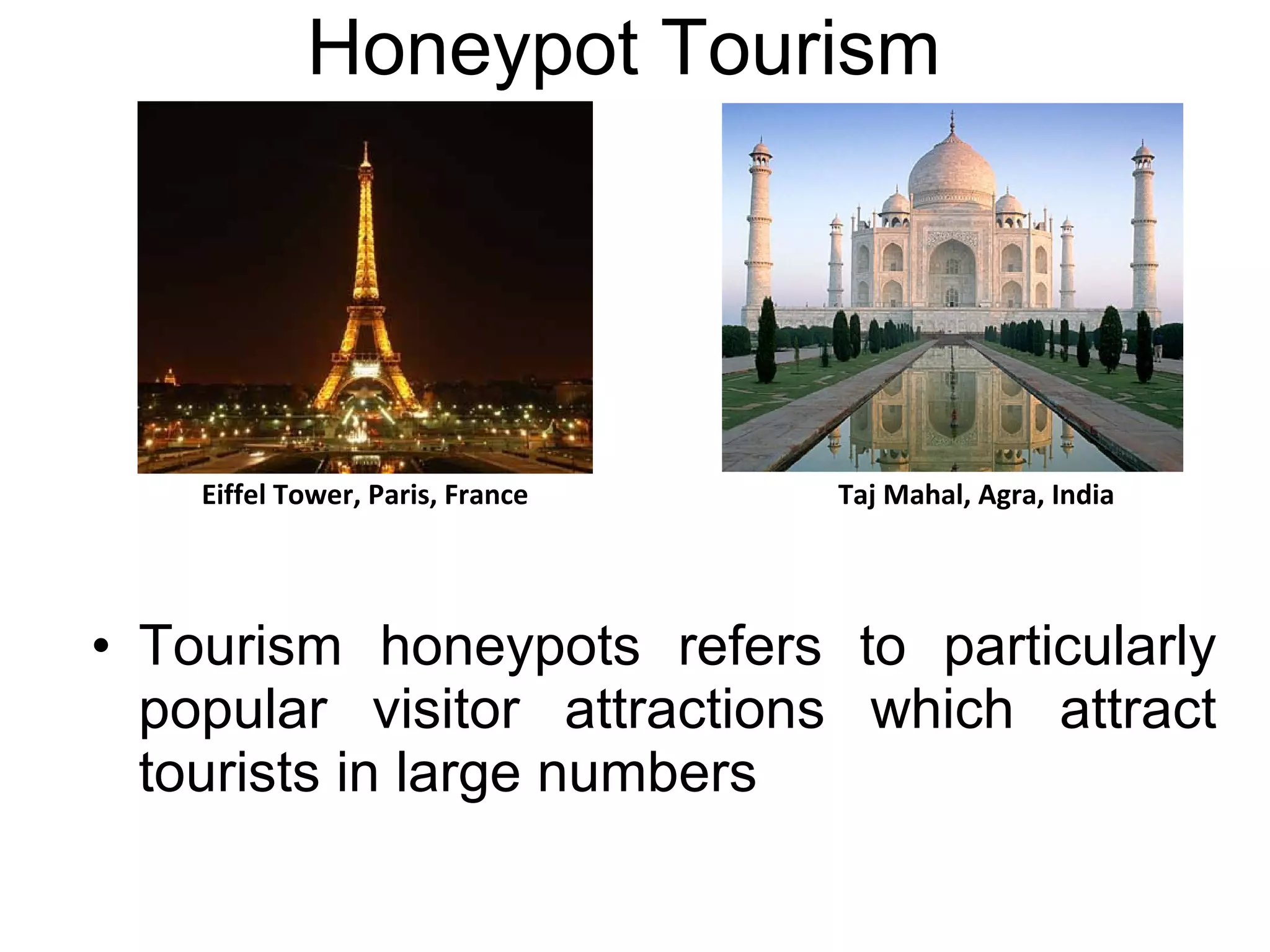
Eiffel Tower, Paris, France Taj Mahal, Agra, India 
• Tourism honeypots refers to particularly 
popular visitor attractions which attract 
tourists in large numbers
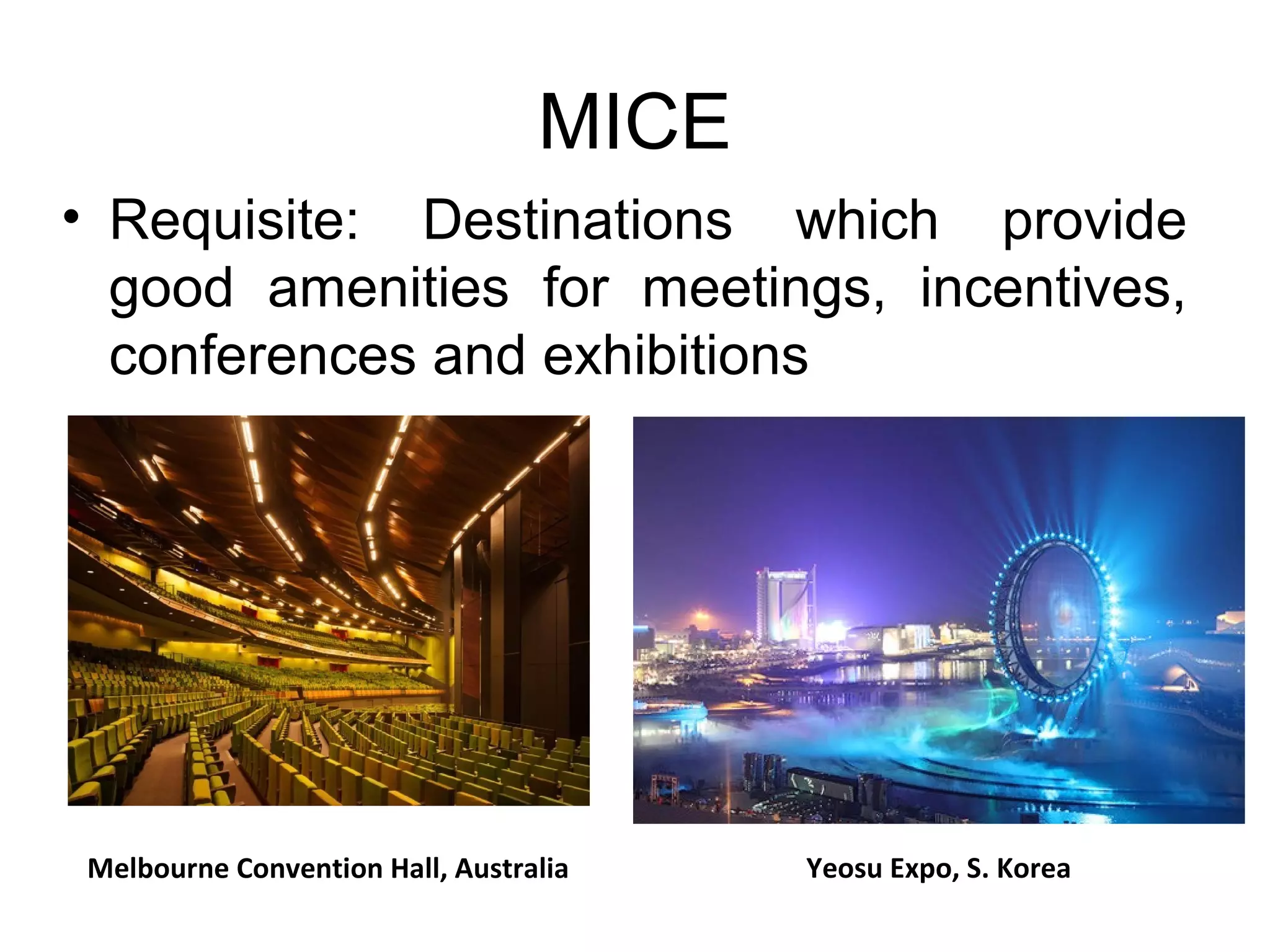
MICE 
• Requisite: Destinations which provide 
good amenities for meetings, incentives, 
conferences and exhibitions 
Melbourne Convention Hall, Australia Yeosu Expo, S. Korea
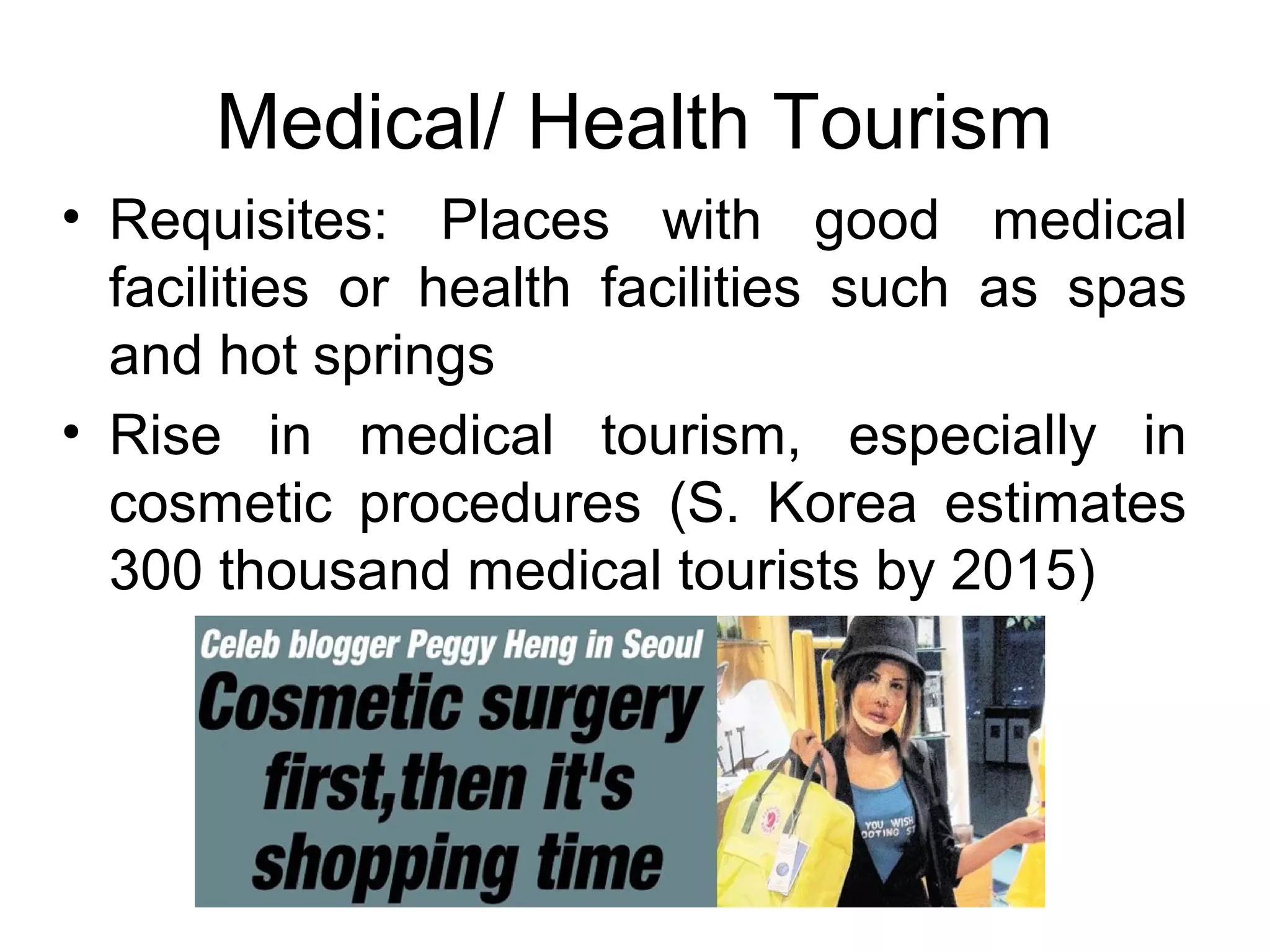
Medical/ Health Tourism 
• Requisites: Places with good medical 
facilities or health facilities such as spas 
and hot springs 
• Rise in medical tourism, especially in 
cosmetic procedures (S. Korea estimates 
300 thousand medical tourists by 2015)
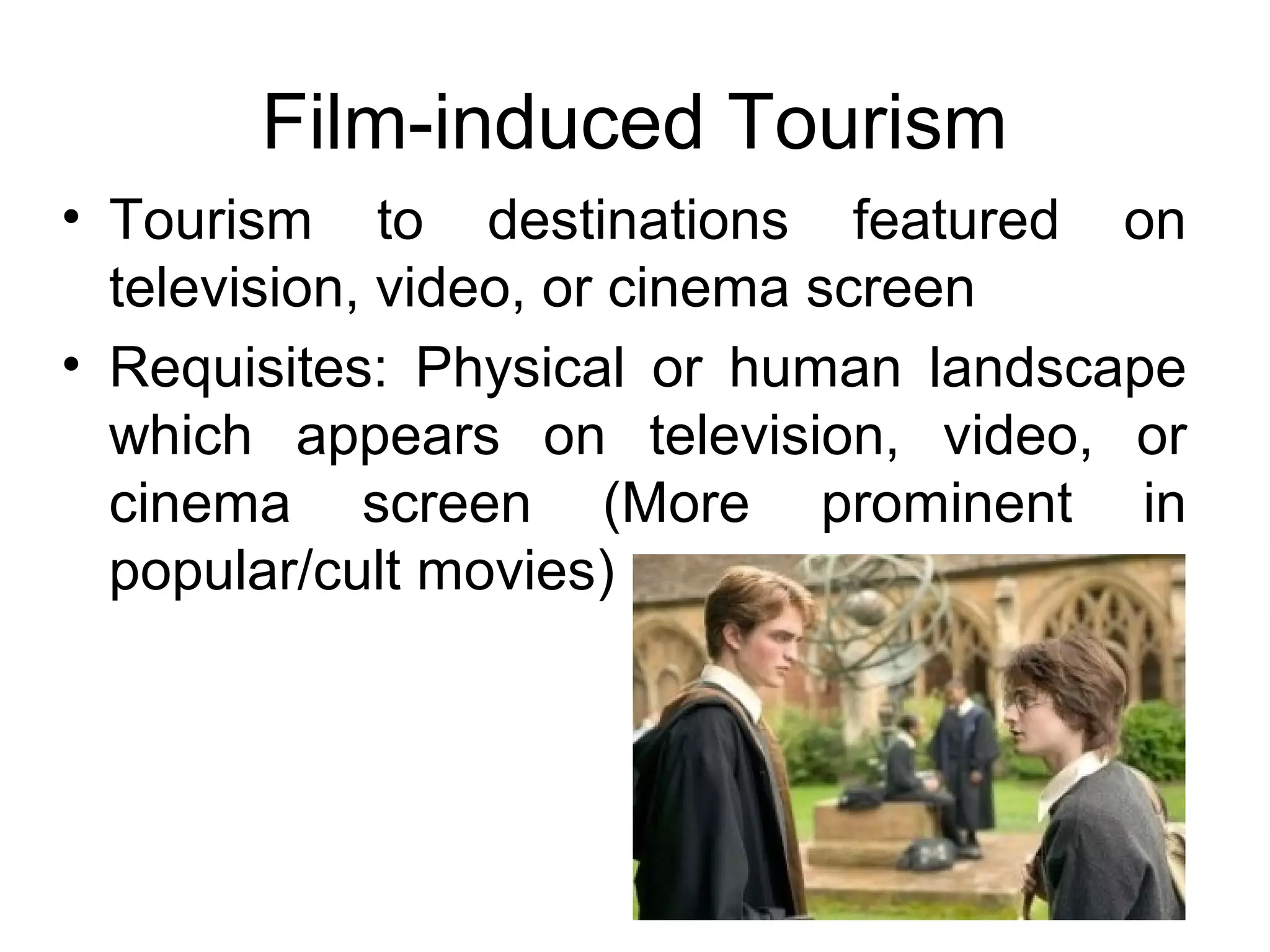
Film-induced Tourism 
• Tourism to destinations featured on 
television, video, or cinema screen 
• Requisites: Physical or human landscape 
which appears on television, video, or 
cinema screen (More prominent in 
popular/cult movies)
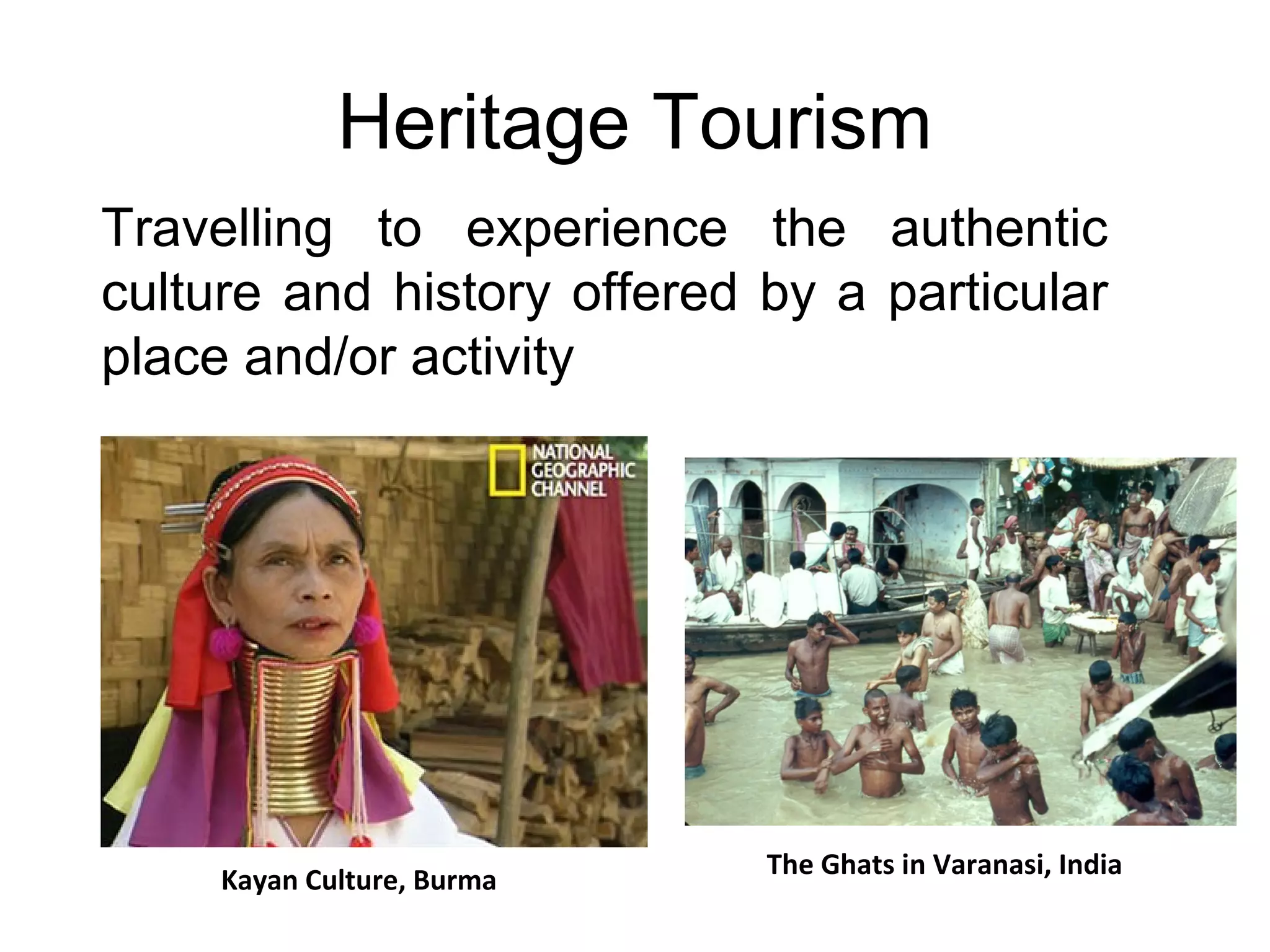
Heritage Tourism 
Travelling to experience the authentic 
culture and history offered by a particular 
place and/or activity 
The Kayan Culture, Burma Ghats in Varanasi, India
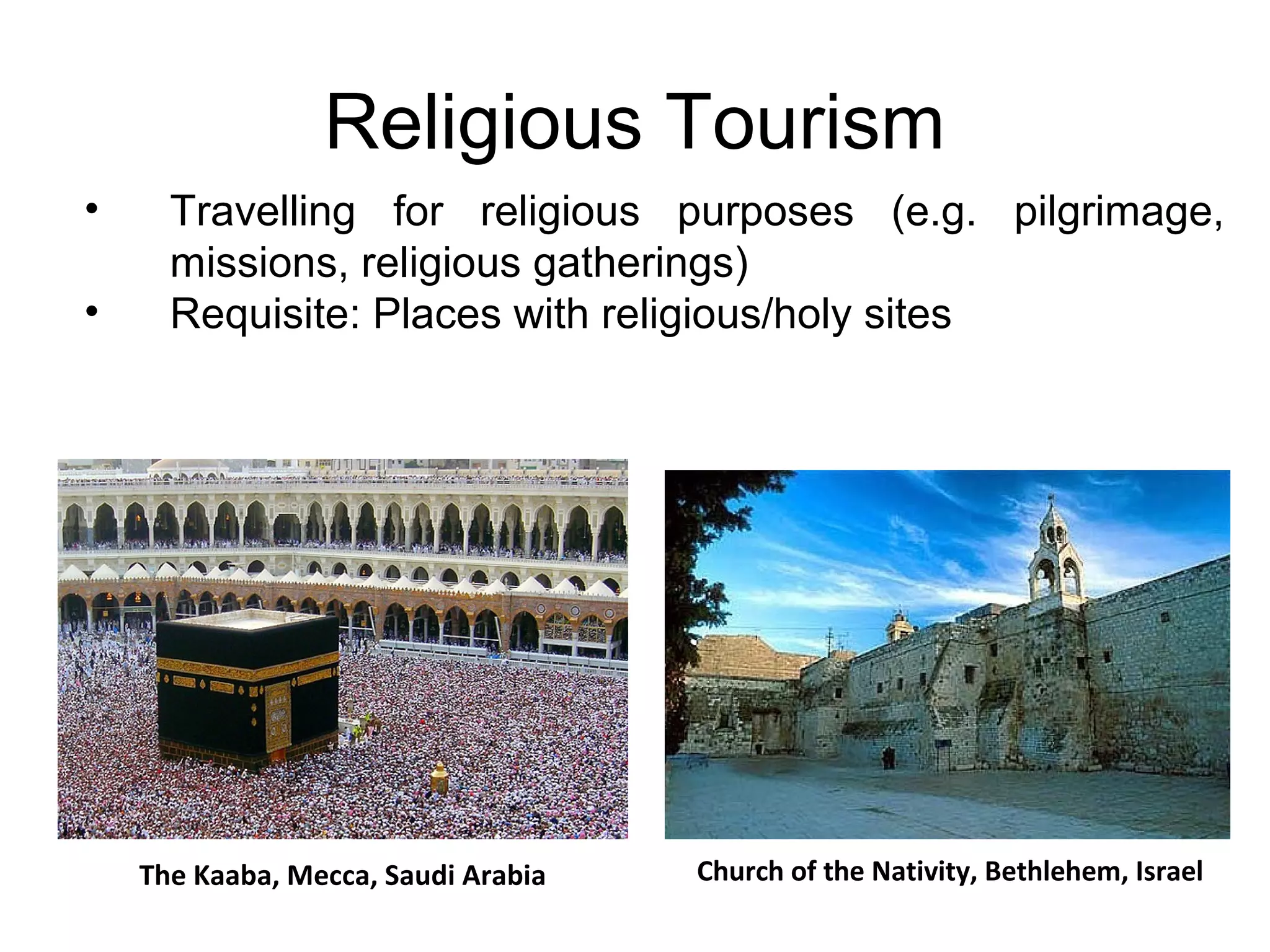
Religious Tourism 
• Travelling for religious purposes (e.g. pilgrimage, 
missions, religious gatherings) 
• Requisite: Places with religious/holy sites 
The Kaaba, Mecca, Saudi Arabia Church of the Nativity, Bethlehem, Israel
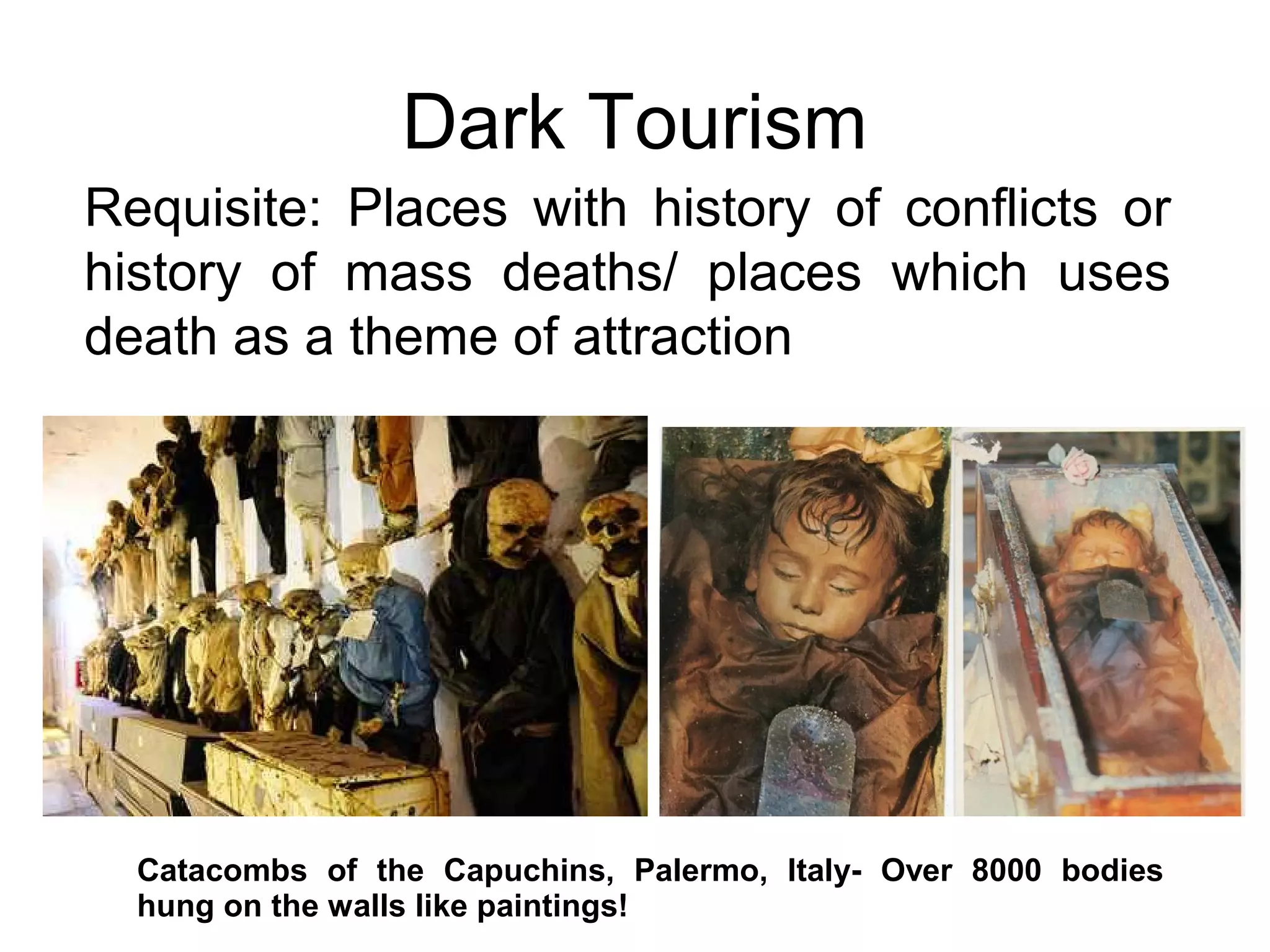
Dark Tourism 
Requisite: Places with history of conflicts or 
history of mass deaths/ places which uses 
death as a theme of attraction 
Catacombs of the Capuchins, Palermo, Italy- Over 8000 bodies 
hung on the walls like paintings!
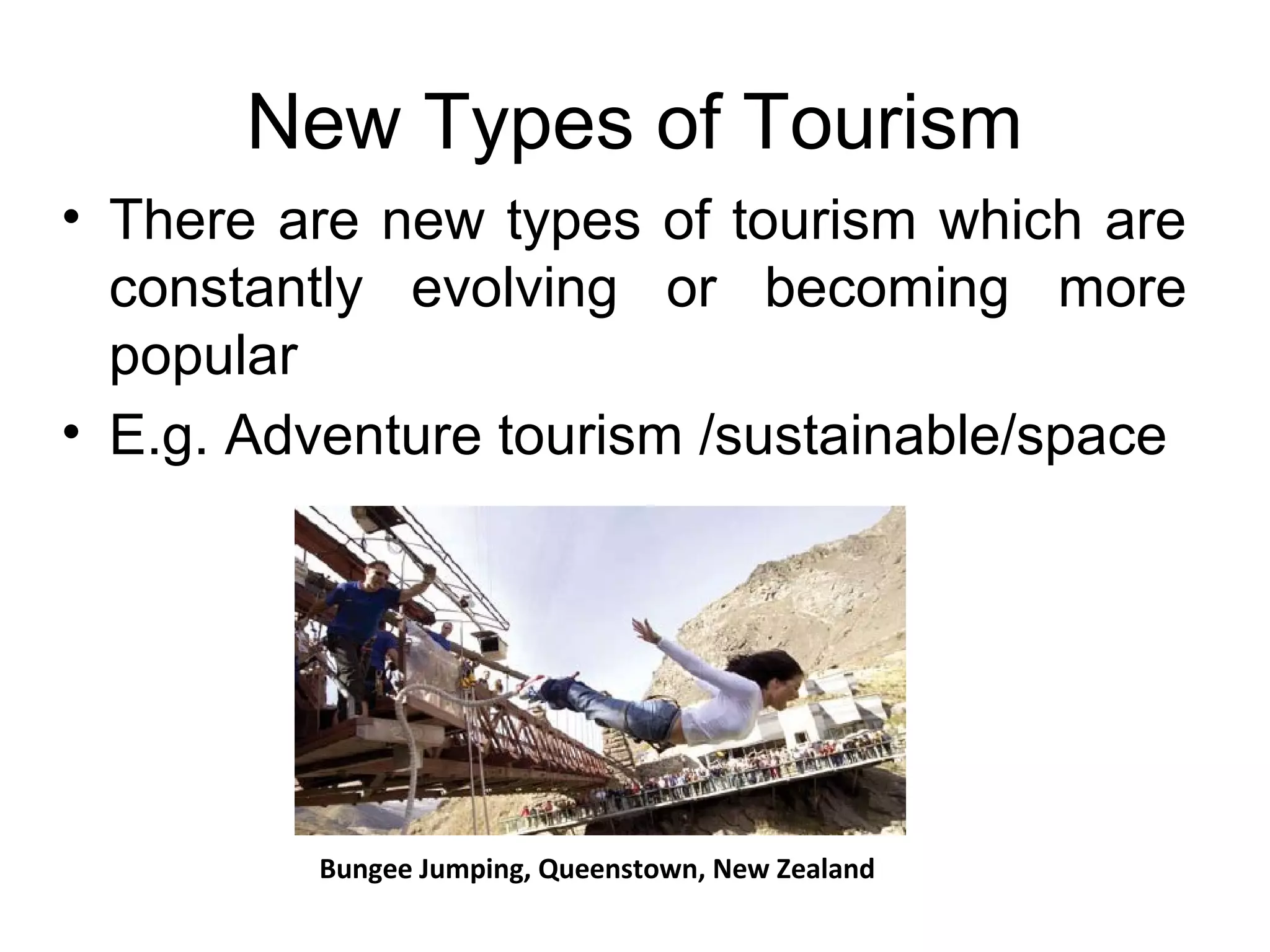
New Types of Tourism 
• There are new types of tourism which are 
constantly evolving or becoming more 
popular 
• E.g. Adventure tourism /sustainable/space 
Bungee Jumping, Queenstown, New Zealand
Learning Points 
• Tourism is place-specific 
• Different environments (both physical and 
human) in tourism destinations create 
diverse opportunities for tourist activities 
• Presence of requisites for each type of 
tourism
Definition 
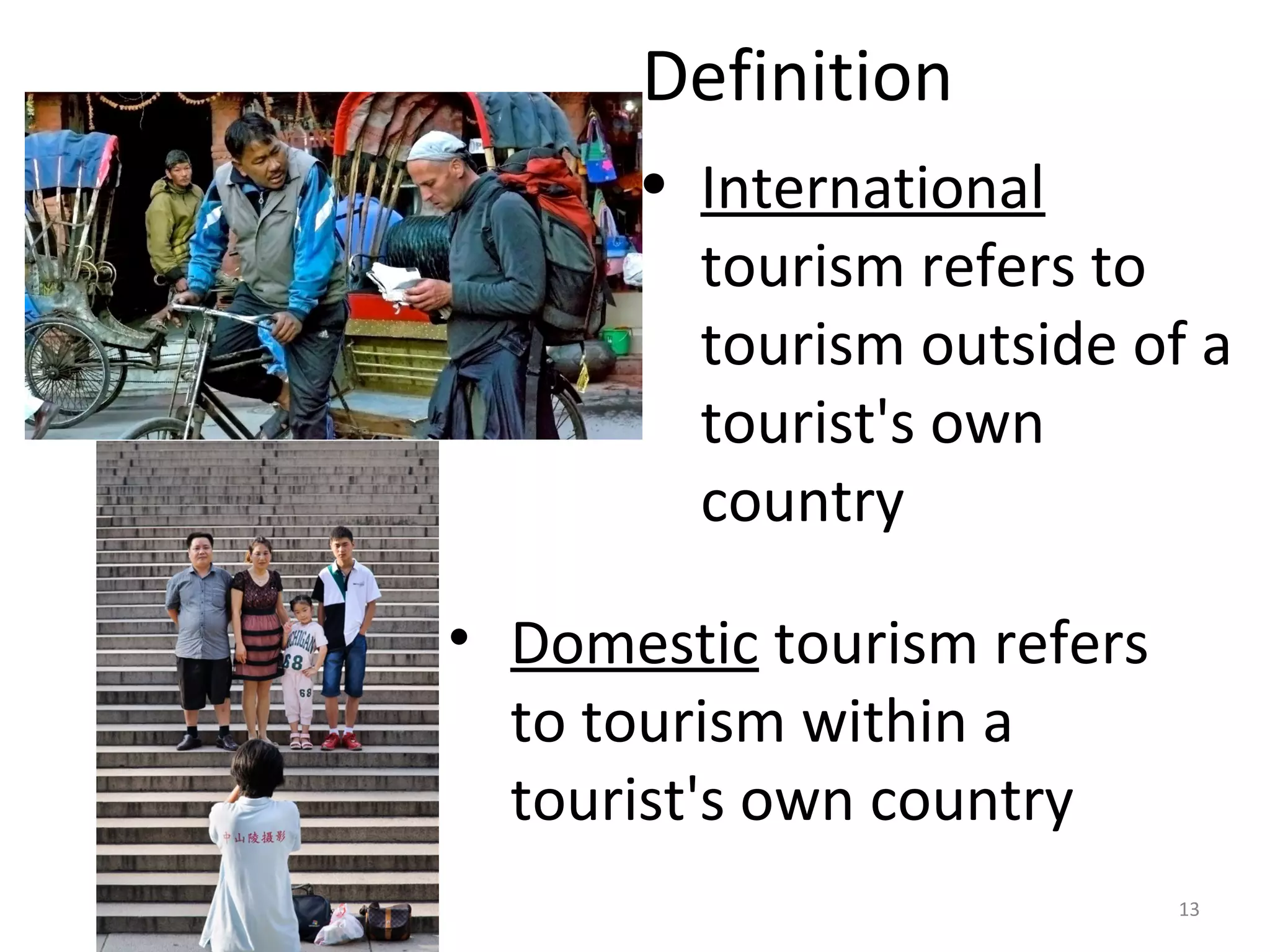
• International 
tourism refers to 
tourism outside of a 
tourist's own 
country 
13 
• Domestic tourism refers 
to tourism within a 
tourist's own country
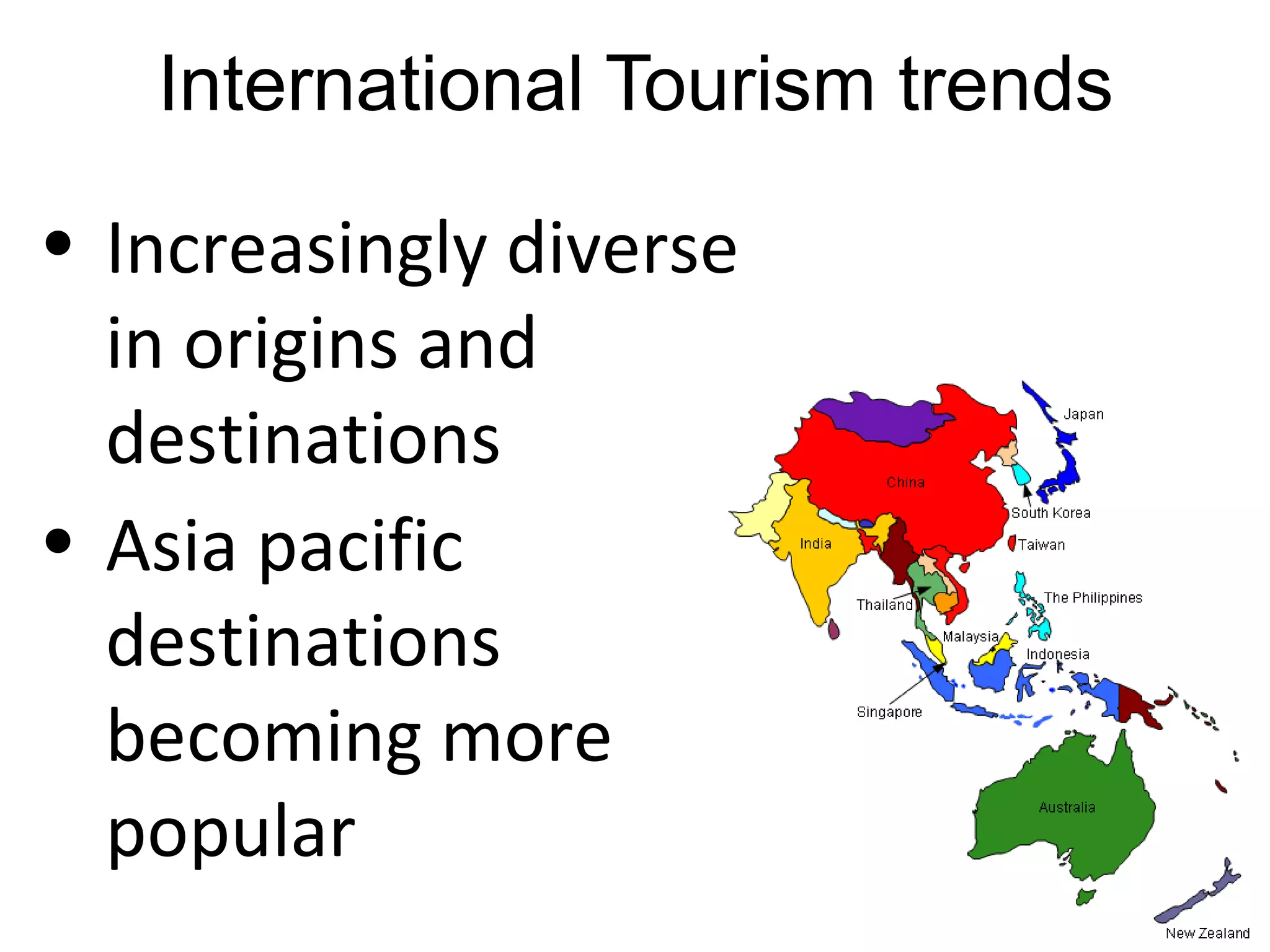
International Tourism trends 
• Increasingly diverse 
in origins and 
destinations 
• Asia pacific 
destinations 
becoming more 
popular
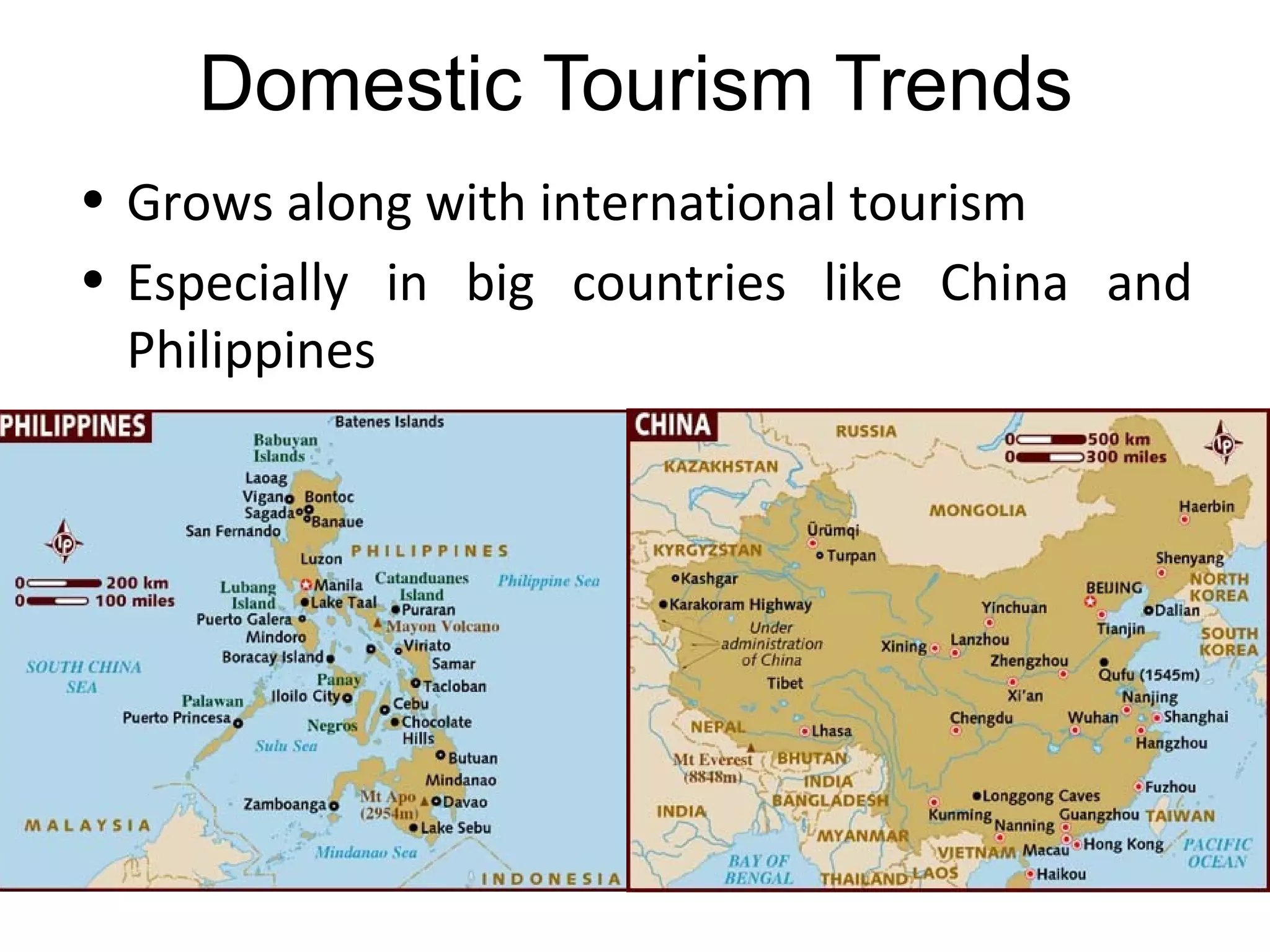
Domestic Tourism Trends 
• Grows along with international tourism 
• Especially in big countries like China and 
Philippines
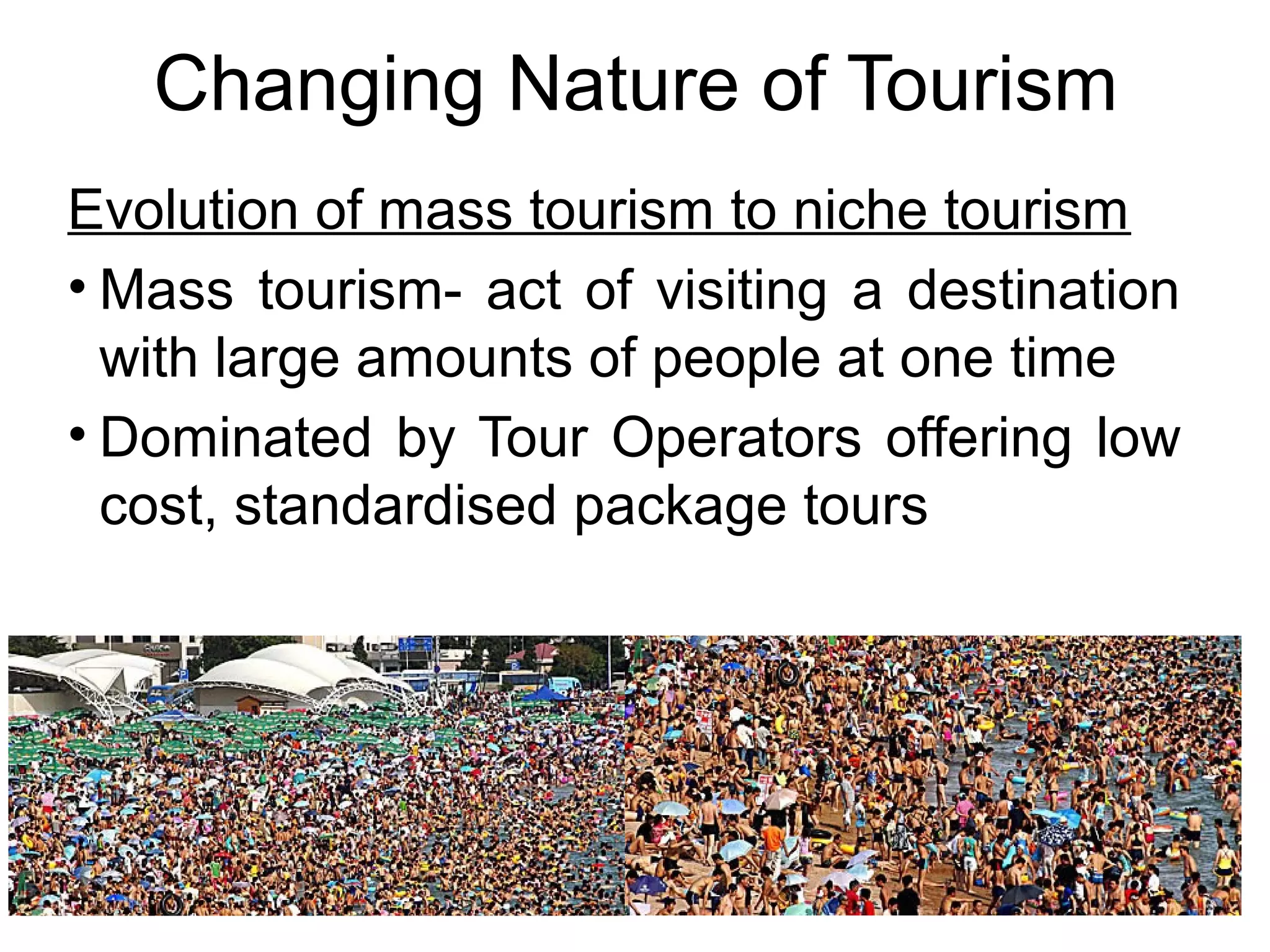
Changing Nature of Tourism 
Evolution of mass tourism to niche tourism 
• Mass tourism- act of visiting a destination 
with large amounts of people at one time 
• Dominated by Tour Operators offering low 
cost, standardised package tours
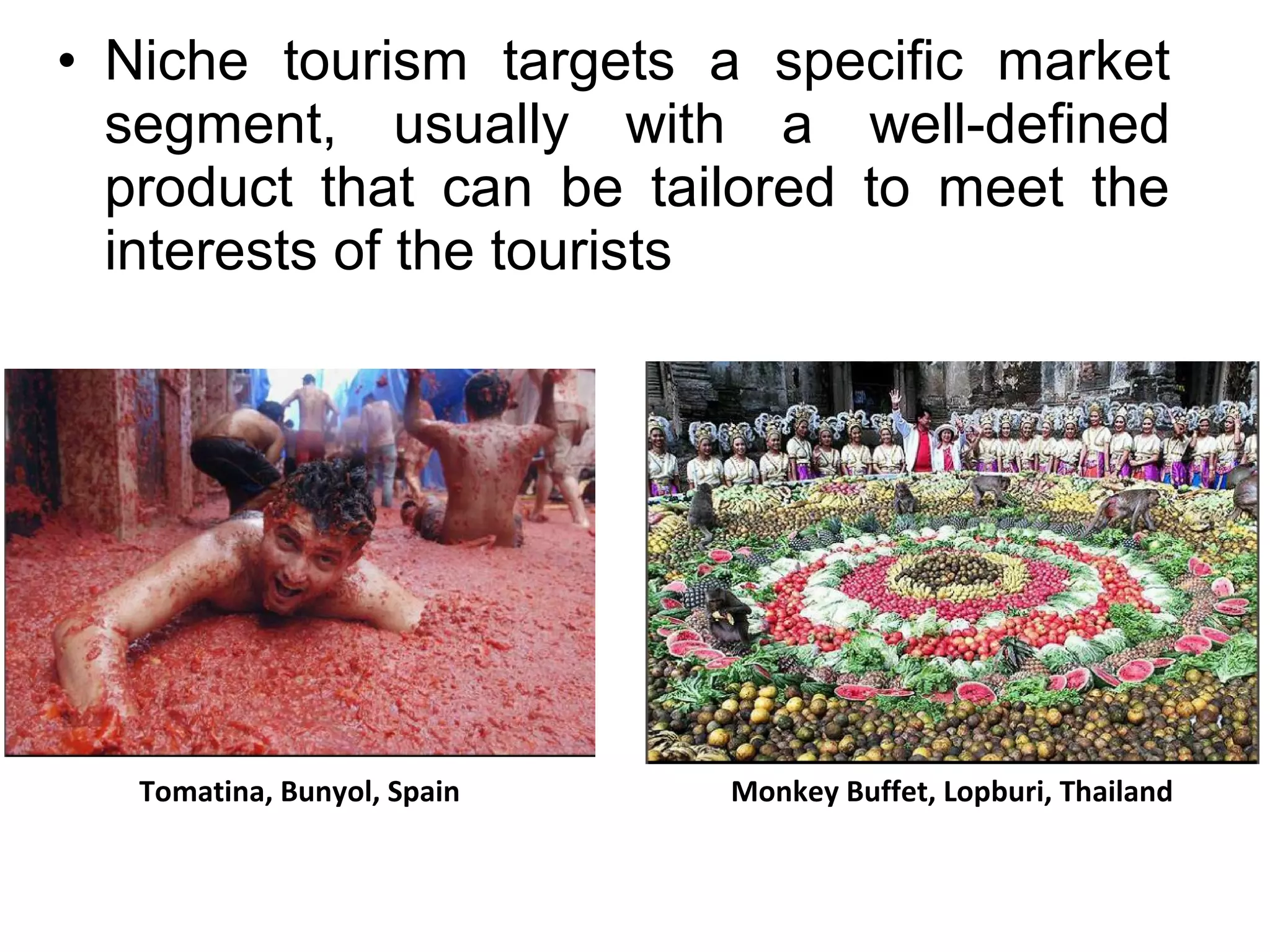
• Niche tourism targets a specific market 
segment, usually with a well-defined 
product that can be tailored to meet the 
interests of the tourists 
Tomatina, Bunyol, Spain Monkey Buffet, Lopburi, Thailand
Changing Nature of Tourism 
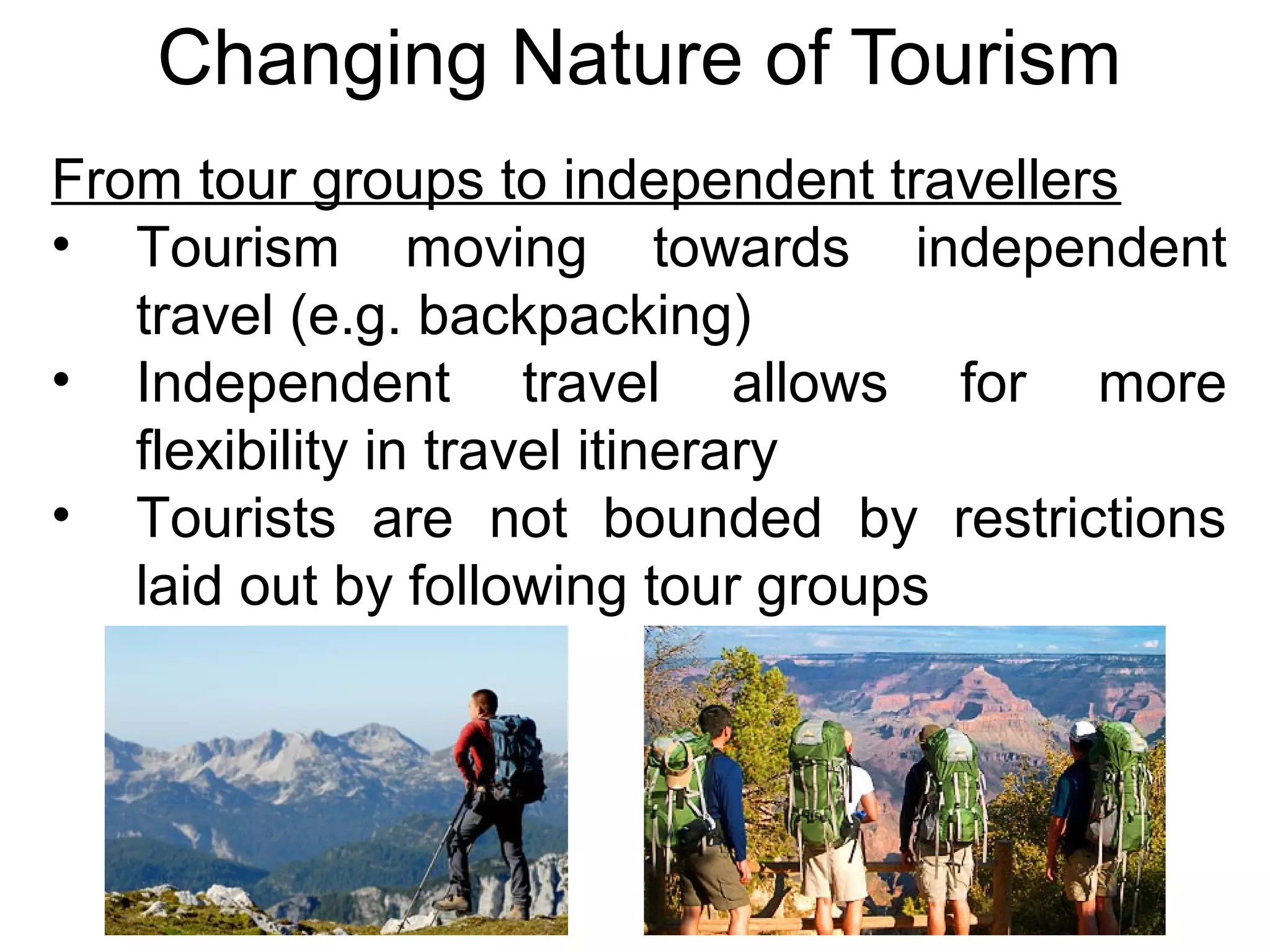
From tour groups to independent travellers 
• Tourism moving towards independent 
travel (e.g. backpacking) 
• Independent travel allows for more 
flexibility in travel itinerary 
• Tourists are not bounded by restrictions 
laid out by following tour groups
Changing Nature of Tourism 
Growth of long haul destinations 
• No standard definition of what is 
considered long or short haul destinations 
• Some consider long haul destinations to 
be more than 5 hours away by flight 
• Tourists moving away from regional 
destinations to those which are further 
away (e.g. Singapore to Brazil/ USA)
Changing Nature of Tourism 
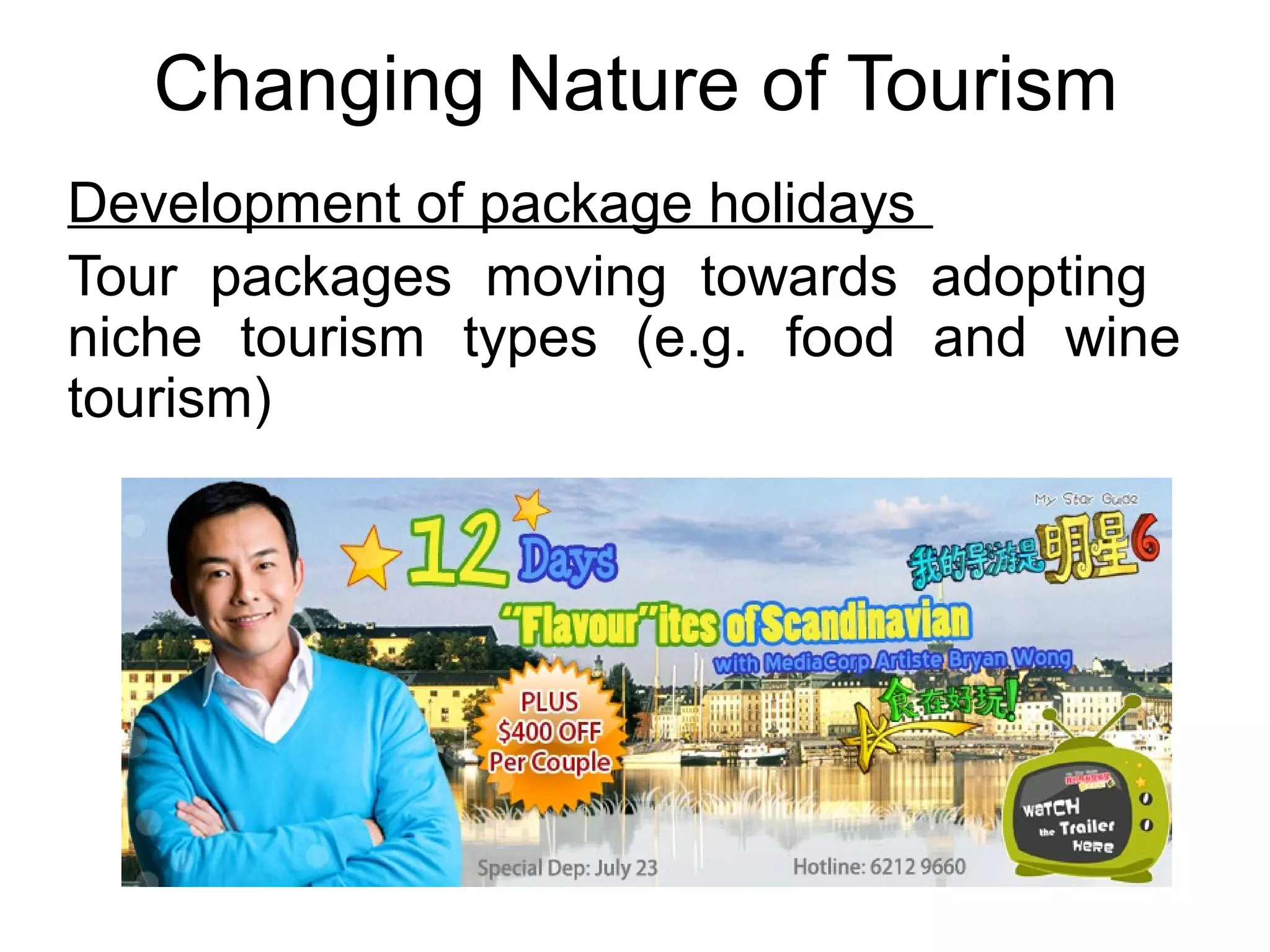
Development of package holidays 
Tour packages moving towards adopting 
niche tourism types (e.g. food and wine 
tourism)
Changing Nature of Tourism 
Development of short haul destinations 
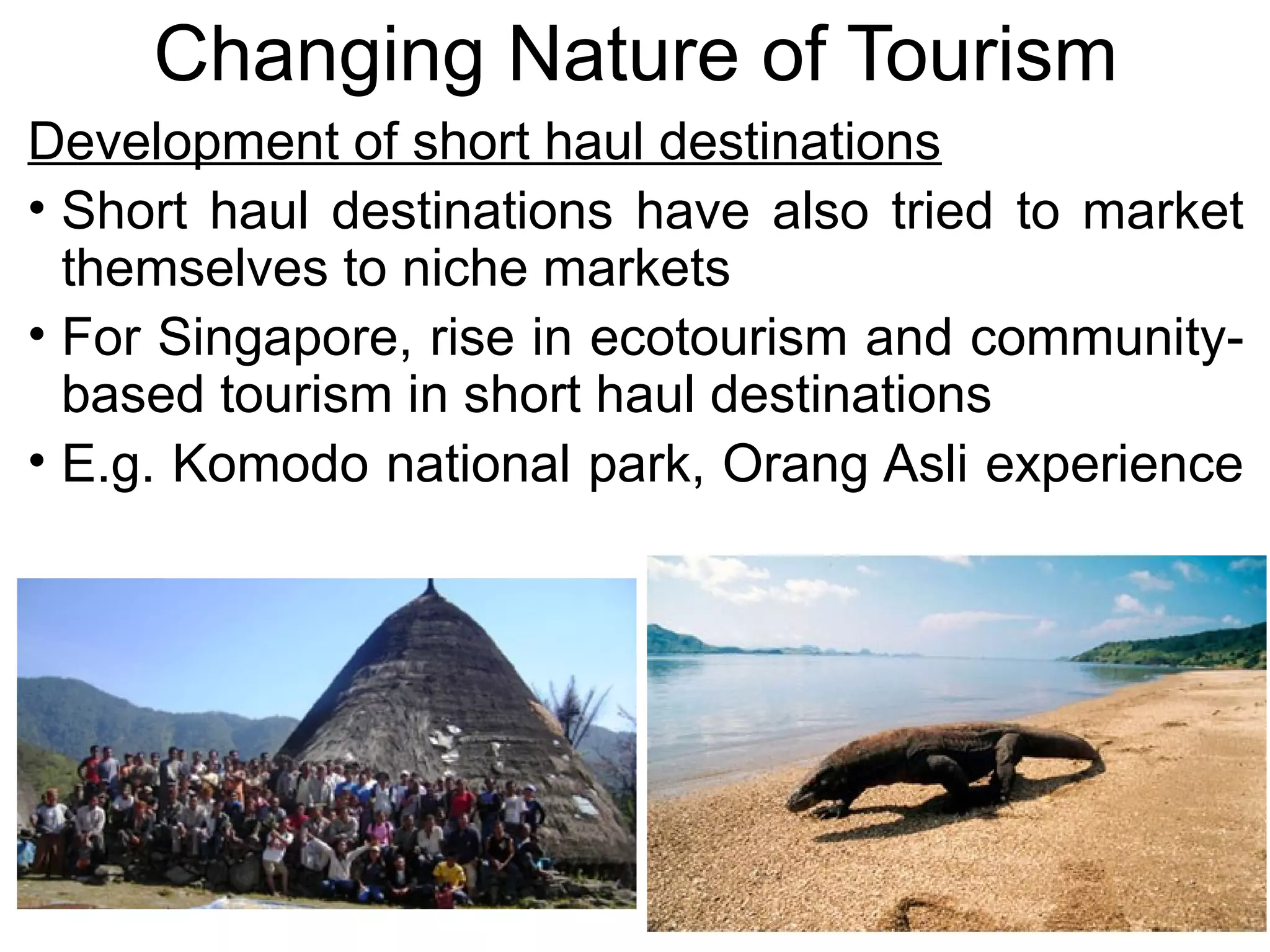
• Short haul destinations have also tried to market 
themselves to niche markets 
• For Singapore, rise in ecotourism and community-based 
tourism in short haul destinations 
• E.g. Komodo national park, Orang Asli experience
Learning Points 
• The trend of global tourism is positive 
seen from both rising tourist arrivals and 
tourism receipts 
• Niche tourism types and independent 
travelling have become popular 
• Package tours are adopting elements of 
niche tourism to attract the diverse market 
• Tourism is the way to go because of the 
economic benefits it brings
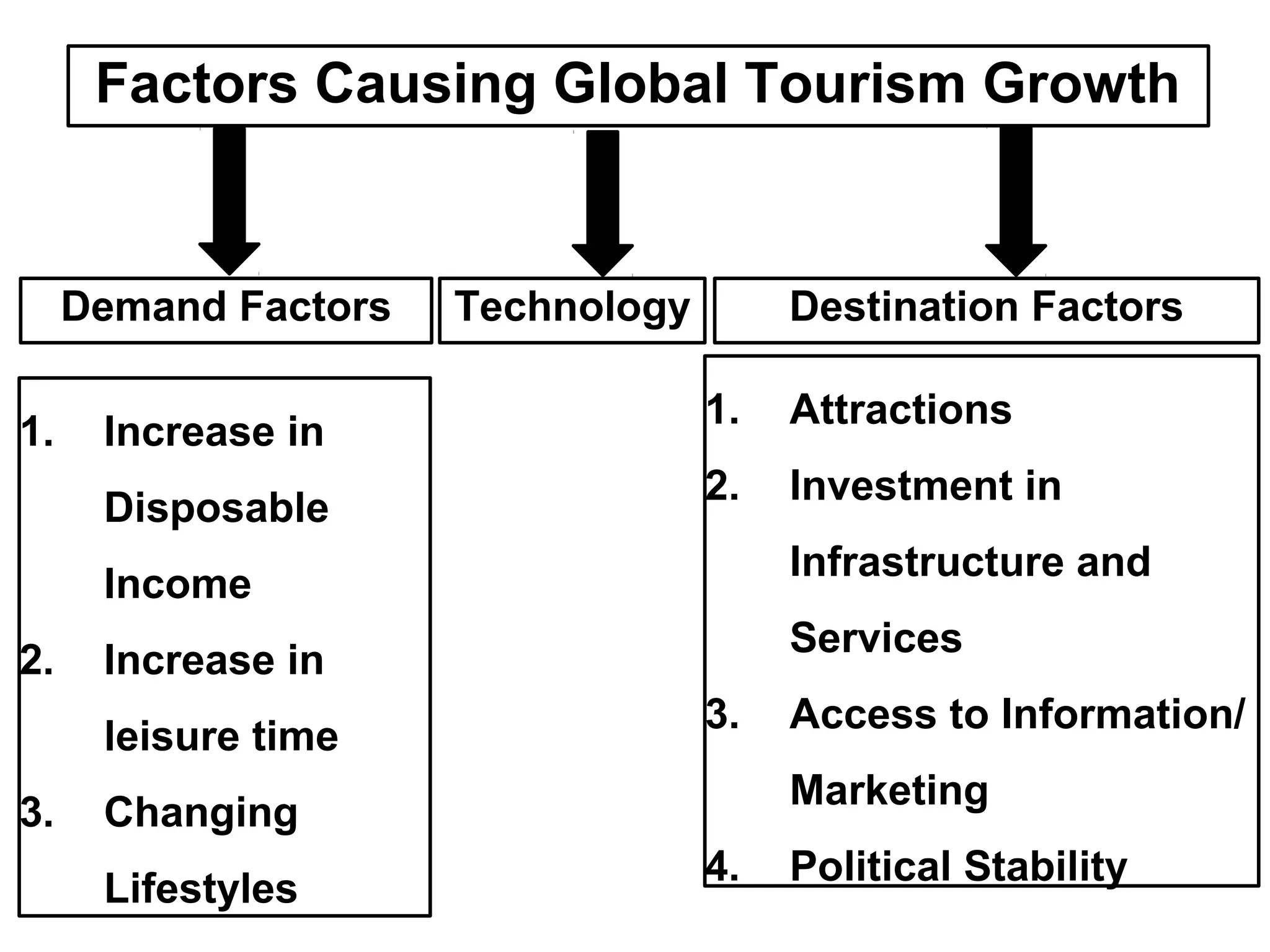
Factors Causing Global Tourism Growth 
Demand Factors Destination Factors 
1. Increase in 
Disposable 
Income 
2. Increase in 
leisure time 
3. Changing 
Lifestyles 
1. Attractions 
2. Investment in 
Infrastructure and 
Services 
3. Access to Information/ 
Marketing 
4. Political Stability 
Technology
Demand Factors 
Factors that influence 
people’s desire and 
capability to travel and 
purchase tourism 
related goods and 
services
Demand Factors 
Disposable Income 
• Refers to the amount 
of money left for an 
individual to spend, or 
to be set aside as 
savings, after taxes
Demand Factors 
Disposable Income 
• Increase in disposable income enables 
people to spend more on goods and 
activities which would improve their 
quality of life 
• Accounts for growth in tourism as people 
can afford to travel more frequently and to 
more expensive destinations
Demand Factors 
Leisure Time 
• Refers to time available outside of the 
demands of work or duty 
• Increasing trend where people enjoy a 
minimum of three weeks of paid annual 
leave 
• Increase in leisure time allows people to 
travel more
Demand Factors 
Changing Lifestyles 
• Refers to the way a person lives which 
includes patterns of social relations, 
consumption and entertainment 
• Higher education levels propels people 
to travel to know more about the world 
• Education has also developed varied 
interests in people resulting in people 
attracted to various tourist destinations 
(e.g. nature lovers to ecotourism)
Demand Factors 
Changing Lifestyles 
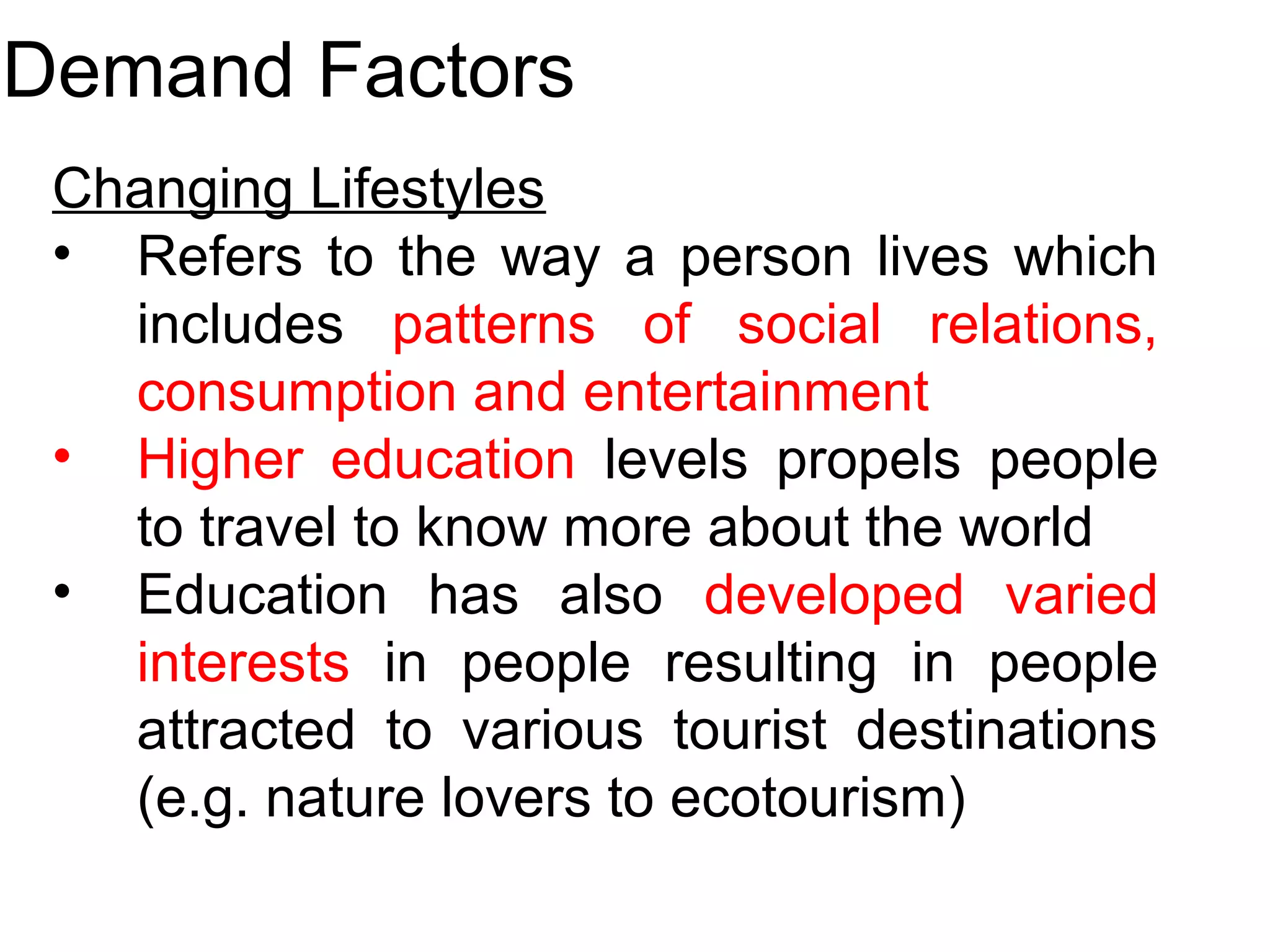
• Travelling also acts as a stress-reliever 
for people who want respite from urban/ 
working life 
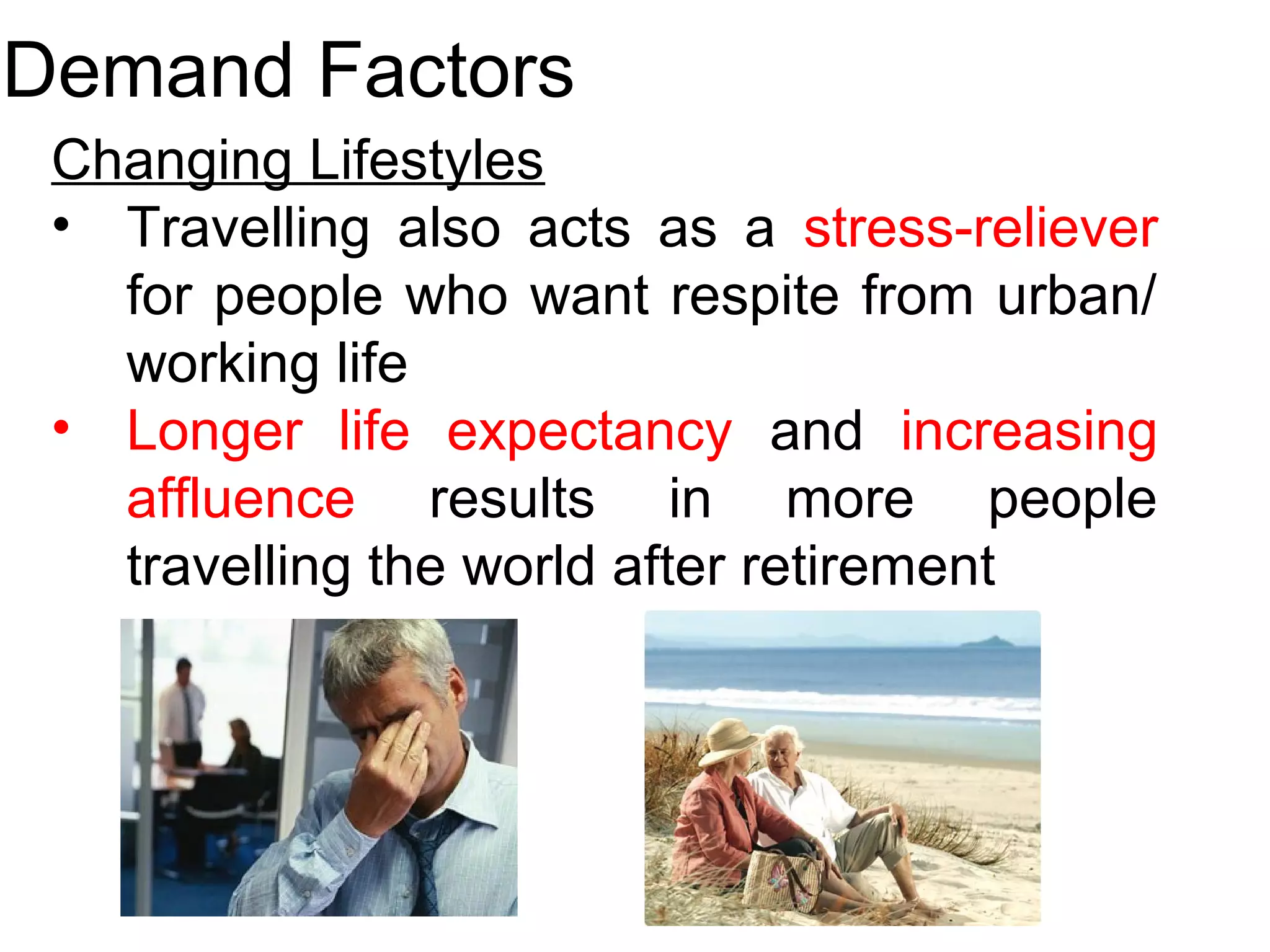
• Longer life expectancy and increasing 
affluence results in more people 
travelling the world after retirement
Destination Factors 
Destination Factors 
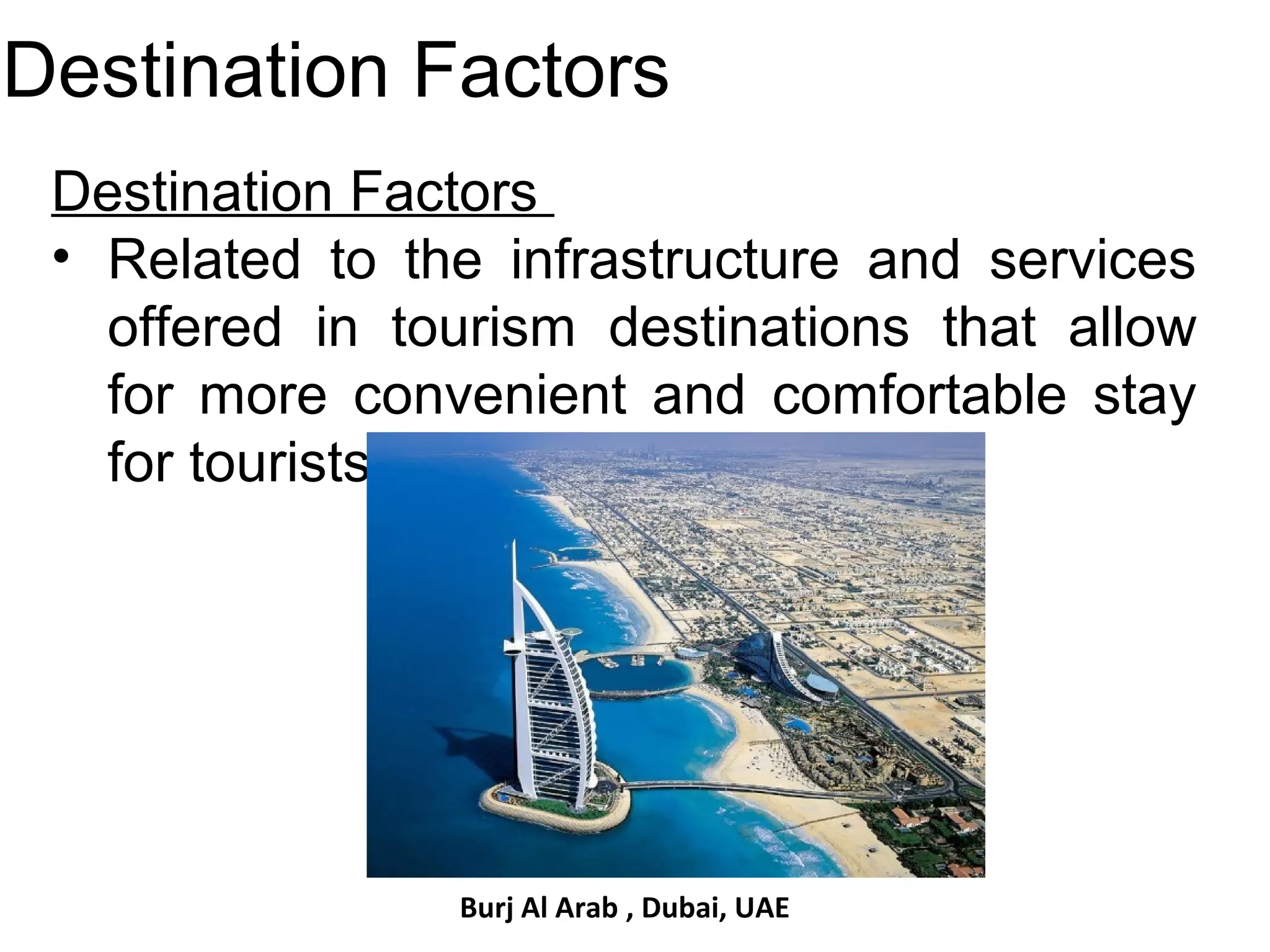
• Related to the infrastructure and services 
offered in tourism destinations that allow 
for more convenient and comfortable stay 
for tourists 
Burj Al Arab , Dubai, UAE
Destination Factors 
Attractions 
• Refers to the range of attractions in a 
tourist location 
• Presence of attractions which are varied 
in type would encourage tourists to visit 
the destination 
• Has Singapore been successful in this 
area?
Destination Factors 
Investment in Infrastructure and Services 
• Refers to the presence of a range of 
large-scale public systems, services, and 
facilities 
• Includes tourist accommodation, medical 
facilities, transport infrastructure, 
recreational and entertainment facilities 
• Destination with more investments in 
infrastructure and services likely to attract 
more tourists
Destination Factors 
Access to Information 
• Refers to the ease in which tourists are 
able to obtain information of the 
destination 
• This could be in the form of internet or 
print sources (e.g. Lonely Planet 
Guidebooks) 
• Tourists more inclined to visit destinations 
that has more information available
Destination Factors 
Marketing 
• Potential visitors get access to information 
through the marketing of the destination 
by their respective countries 
• Prevalent use of the mass media to 
advertise on certain marketable traits of 
destinations 
• Destination more likely to attract visitors if 
marketing is done well
Destination Factors 
Political Stability 
• Countries which are in the midst of 
conflicts or wars are deemed to be unsafe 
for tourists 
• E.g. Syria and Iraq are not visited currently 
despite having attractions 
Ruins of Palmyra, Syria Great Ziggurat of Ur, Iraq
Technology 
• The advent of technology and various Web 
tools makes travelling to another country 
much easier 
• Can you think of technology available now 
which aids in increasing tourism that was 
not available in the past?
Learning Points 
• The growth of tourism is due to a 
combination of demand and destination 
factors 
• The growth of tourism is also propelled by 
the rise of technology which allows 
tourists to access information, plan their 
travel itinerary and book for 
accommodation and transport
Fluctuations in Tourism 
Tourism numbers decline because 
of .... 
- Terrorism 
- Recession 
- Diseases 
- Disasters
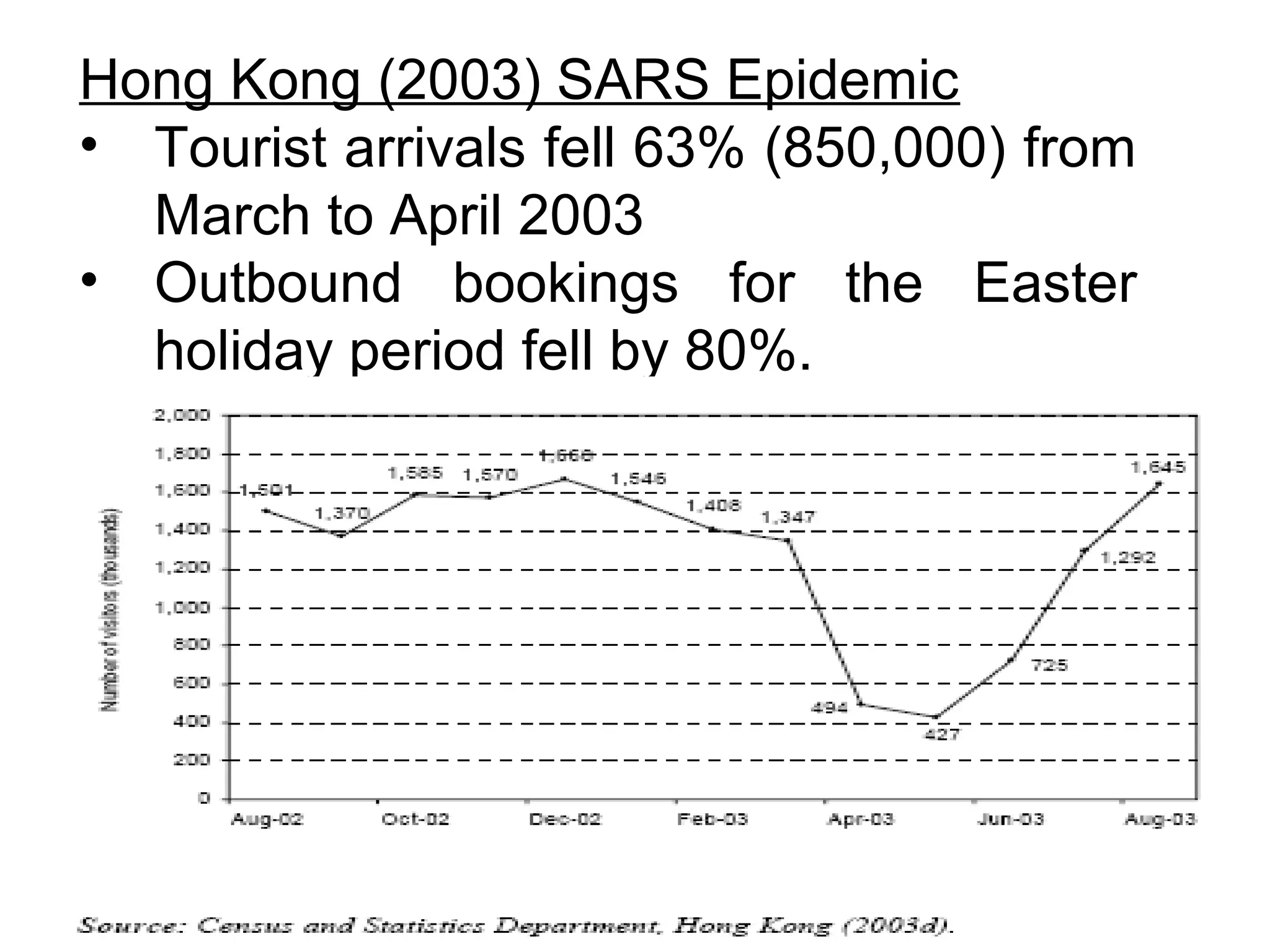
Hong Kong (2003) SARS Epidemic 
• Tourist arrivals fell 63% (850,000) from 
March to April 2003 
• Outbound bookings for the Easter 
holiday period fell by 80%.
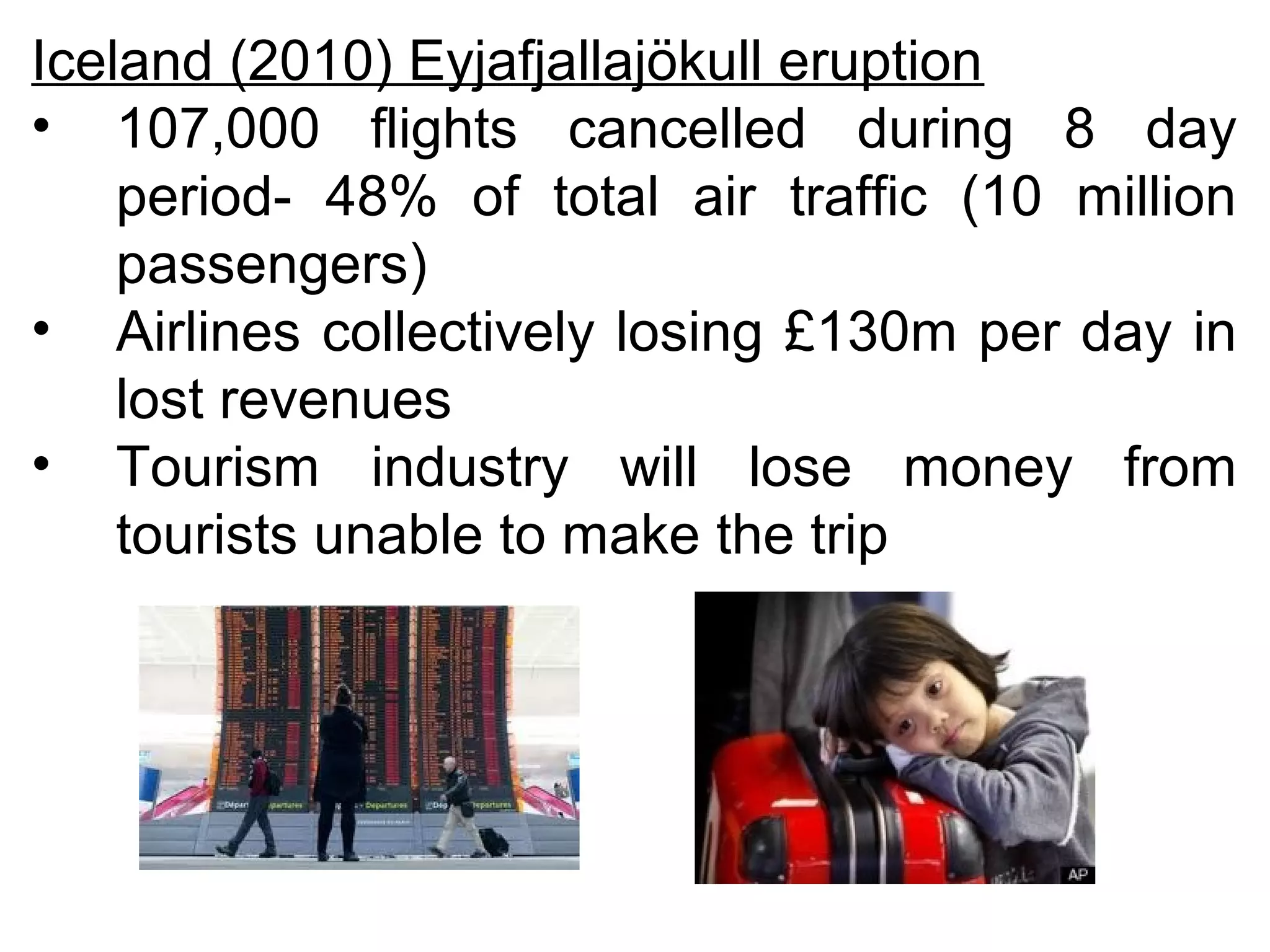
Iceland (2010) Eyjafjallajökull eruption 
• 107,000 flights cancelled during 8 day 
period- 48% of total air traffic (10 million 
passengers) 
• Airlines collectively losing £130m per day in 
lost revenues 
• Tourism industry will lose money from 
tourists unable to make the trip
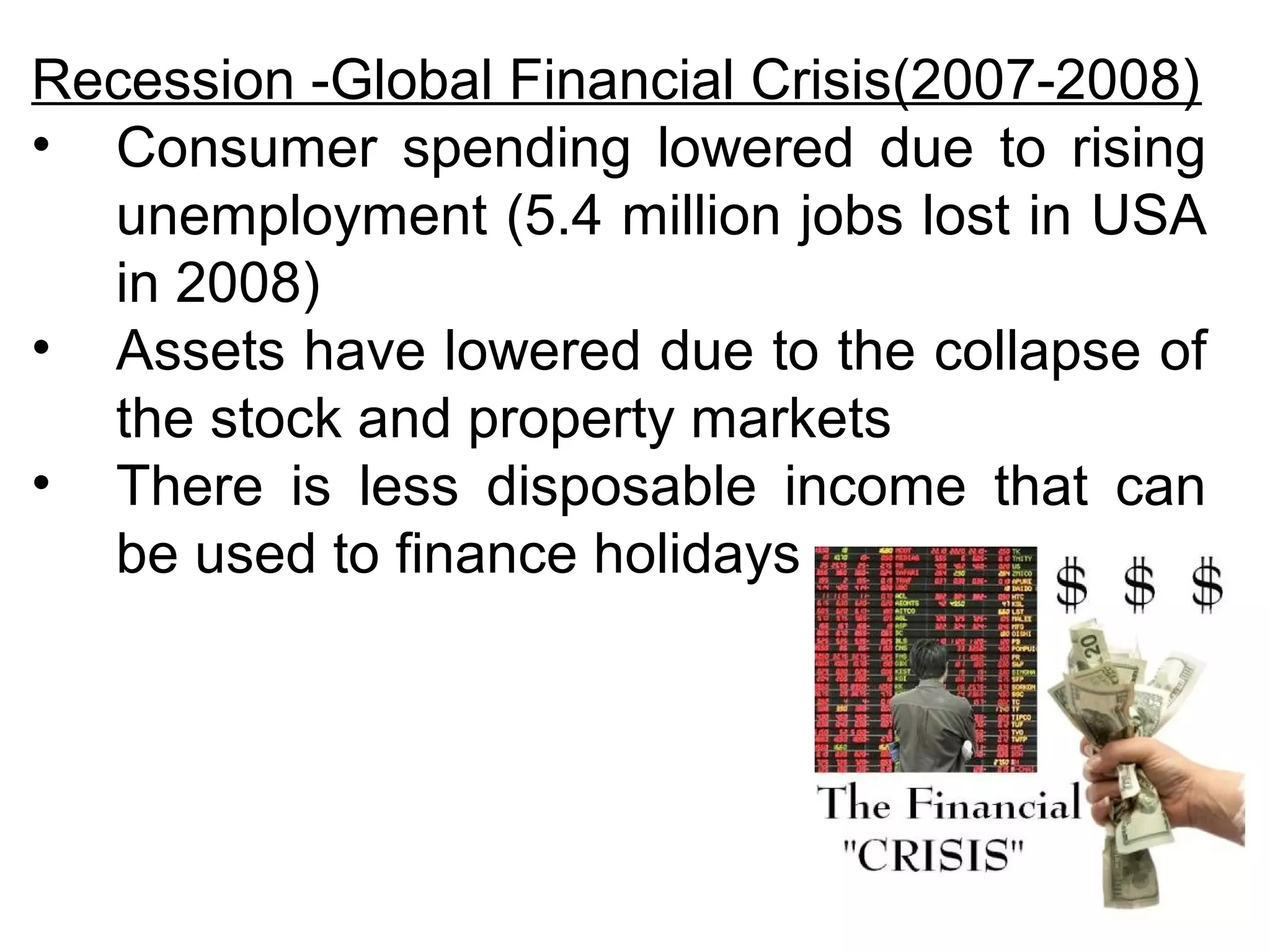
Recession -Global Financial Crisis(2007-2008) 
• Consumer spending lowered due to rising 
unemployment (5.4 million jobs lost in USA 
in 2008) 
• Assets have lowered due to the collapse of 
the stock and property markets 
• There is less disposable income that can 
be used to finance holidays
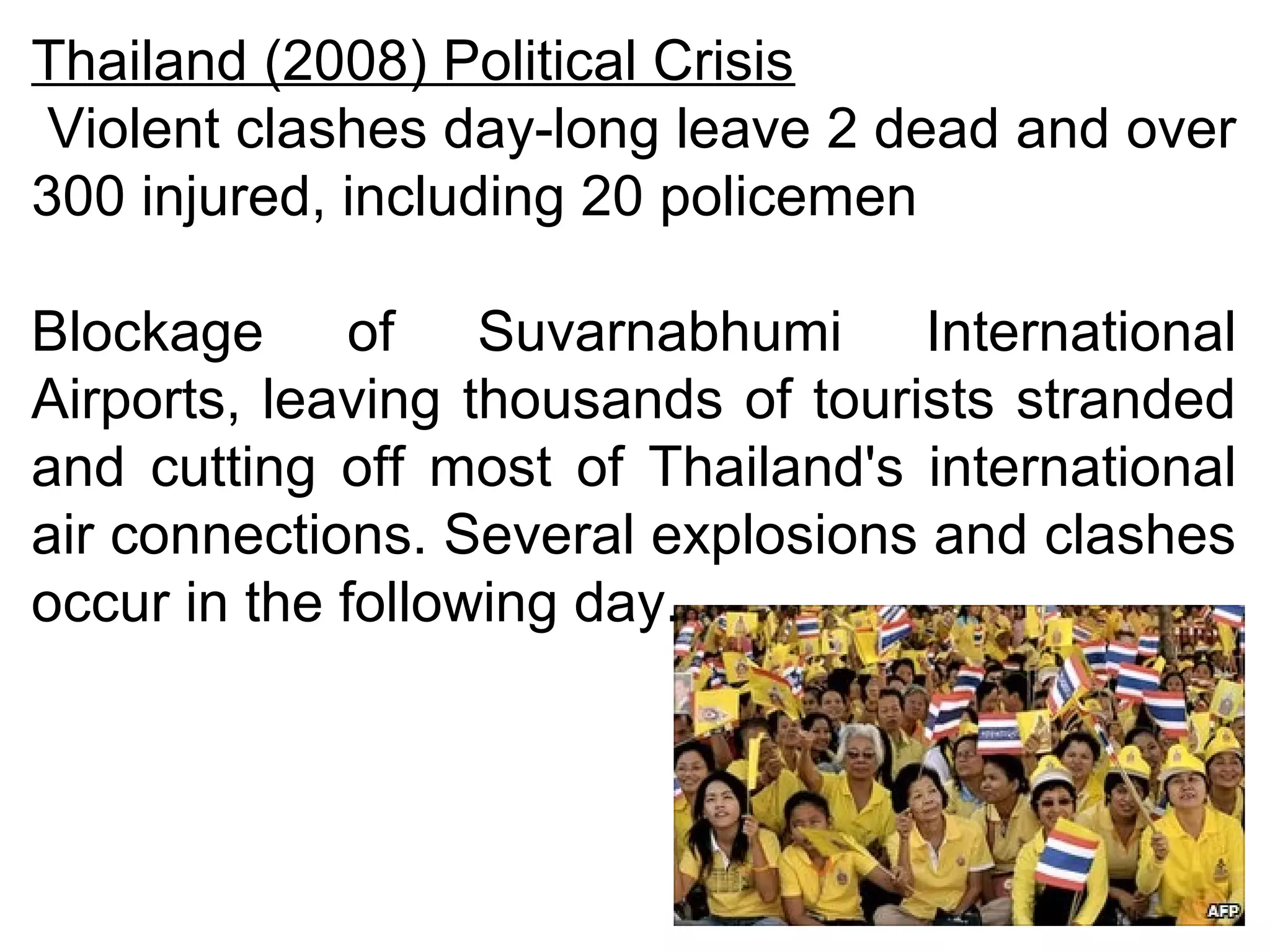
Thailand (2008) Political Crisis 
Violent clashes day-long leave 2 dead and over 
300 injured, including 20 policemen 
Blockage of Suvarnabhumi International 
Airports, leaving thousands of tourists stranded 
and cutting off most of Thailand's international 
air connections. Several explosions and clashes 
occur in the following day.
Tourism impacts 
Developing tourism at what cost?
44
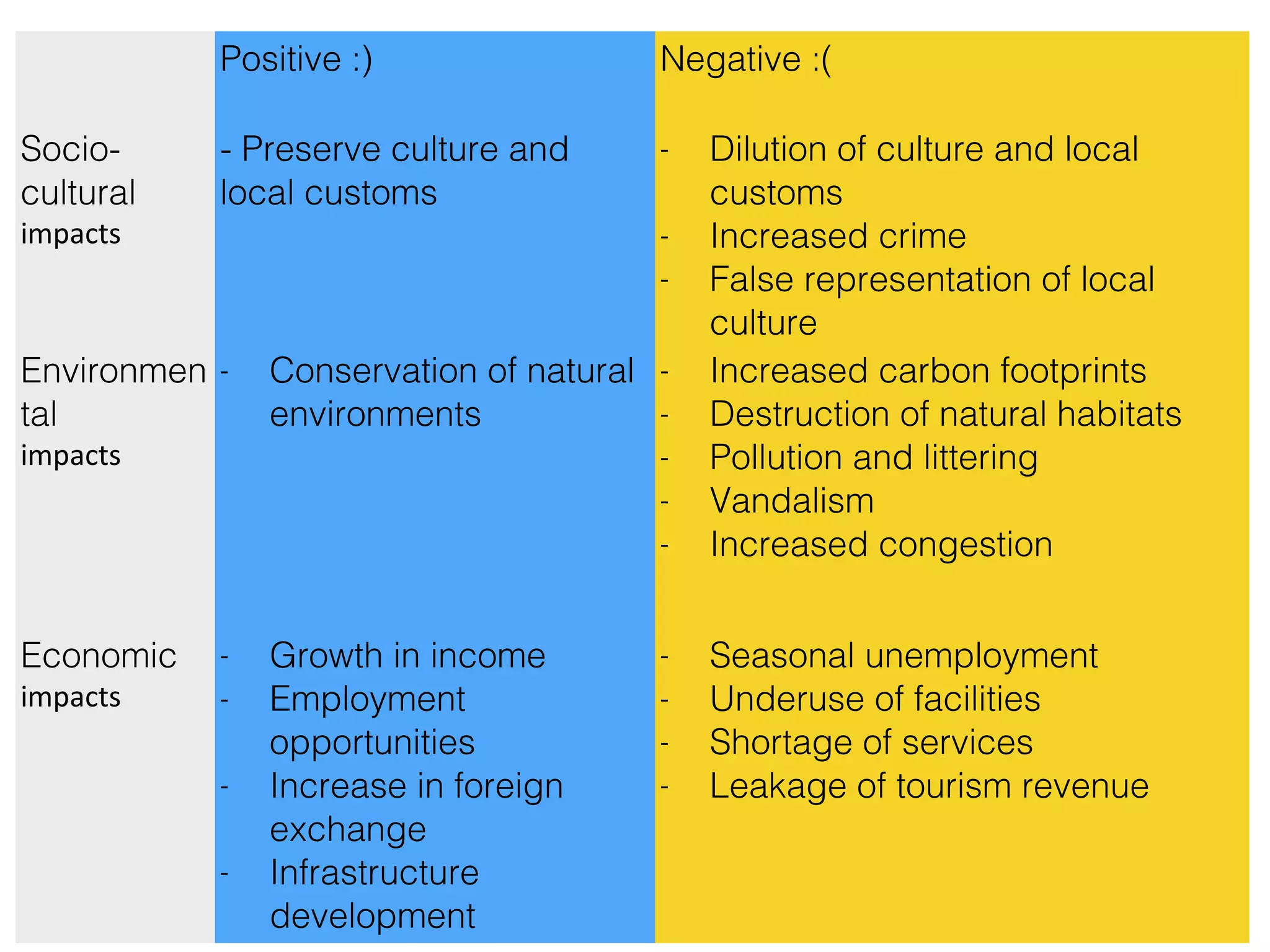
Positive :) Negative :( 
Socio-cultural 
impacts 
- Preserve culture and 
local customs 
- Dilution of culture and local 
customs 
- Increased crime 
- False representation of local 
culture 
Environmen 
tal 
impacts 
- Conservation of natural 
environments 
- Increased carbon footprints 
- Destruction of natural habitats 
- Pollution and littering 
- Vandalism 
- Increased congestion 
Economic 
impacts 
- Growth in income 
- Employment 
opportunities 
- Increase in foreign 
exchange 
- Infrastructure 
development 
- Seasonal unemployment 
- Underuse of facilities 
- Shortage of services 
- Leakage of tourism revenue
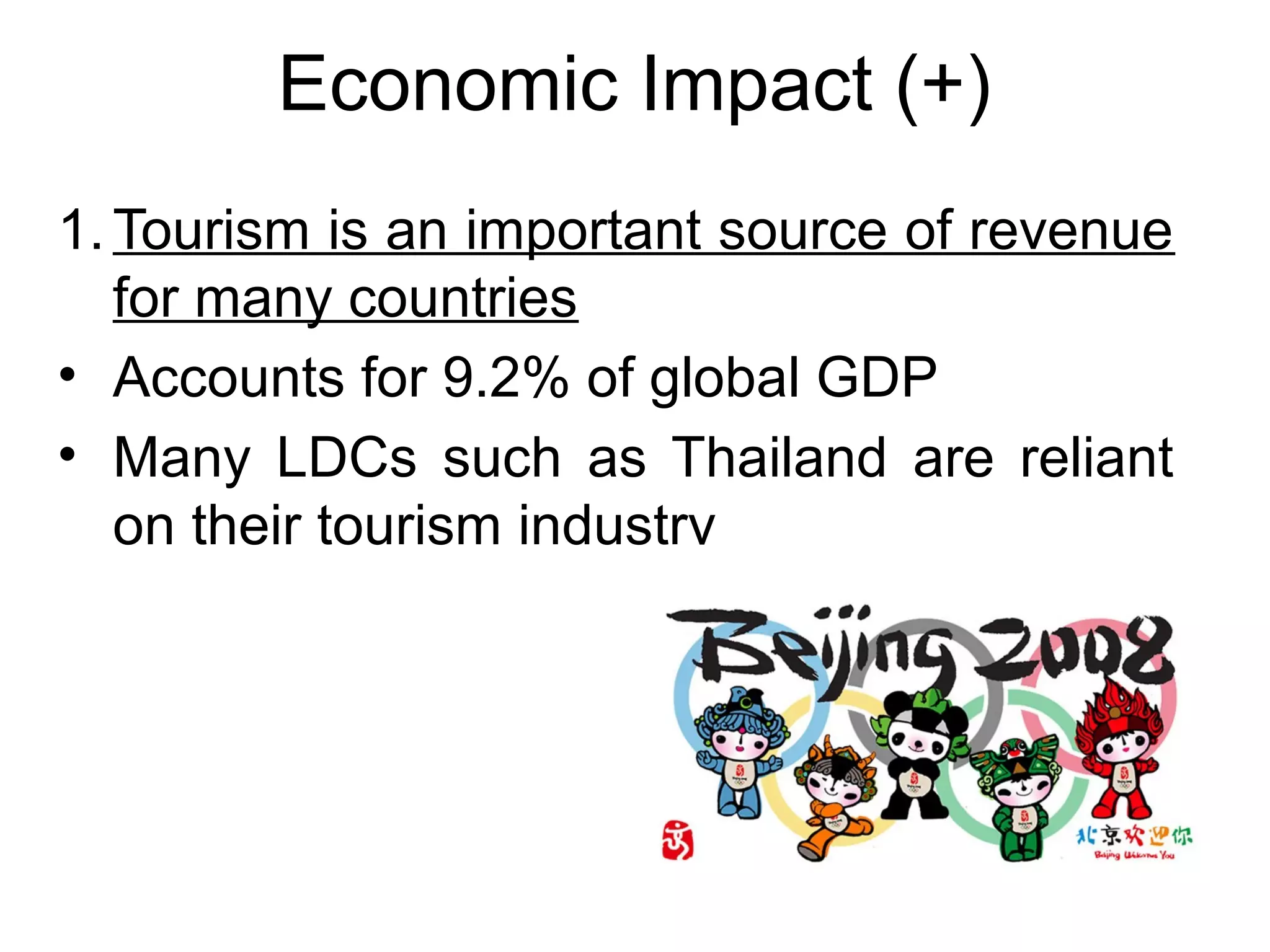
Economic Impact (+) 
1.Tourism is an important source of revenue 
for many countries 
• Accounts for 9.2% of global GDP 
• Many LDCs such as Thailand are reliant 
on their tourism industry
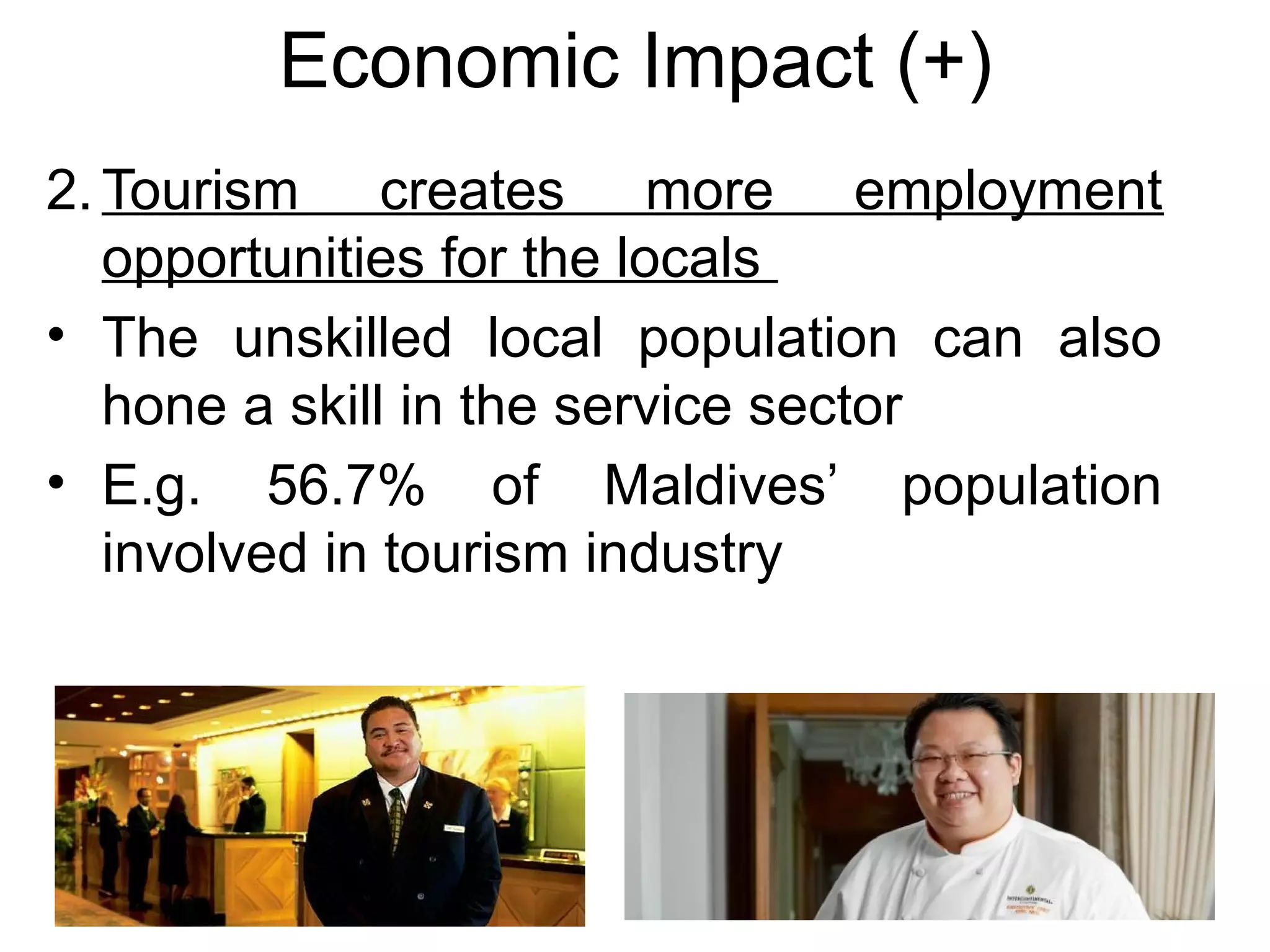
Economic Impact (+) 
2.Tourism creates more employment 
opportunities for the locals 
• The unskilled local population can also 
hone a skill in the service sector 
• E.g. 56.7% of Maldives’ population 
involved in tourism industry
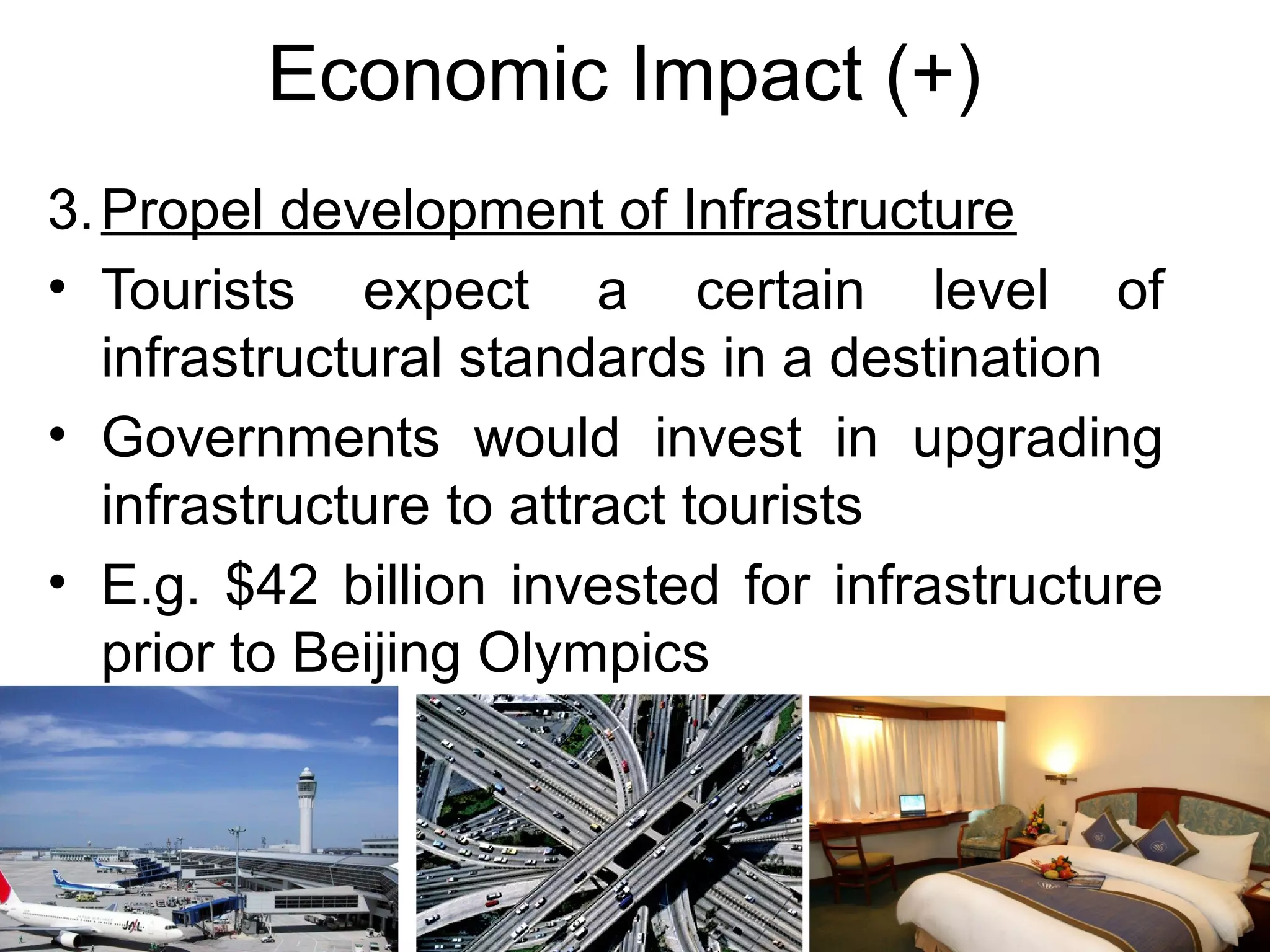
Economic Impact (+) 
3.Propel development of Infrastructure 
• Tourists expect a certain level of 
infrastructural standards in a destination 
• Governments would invest in upgrading 
infrastructure to attract tourists 
• E.g. $42 billion invested for infrastructure 
prior to Beijing Olympics
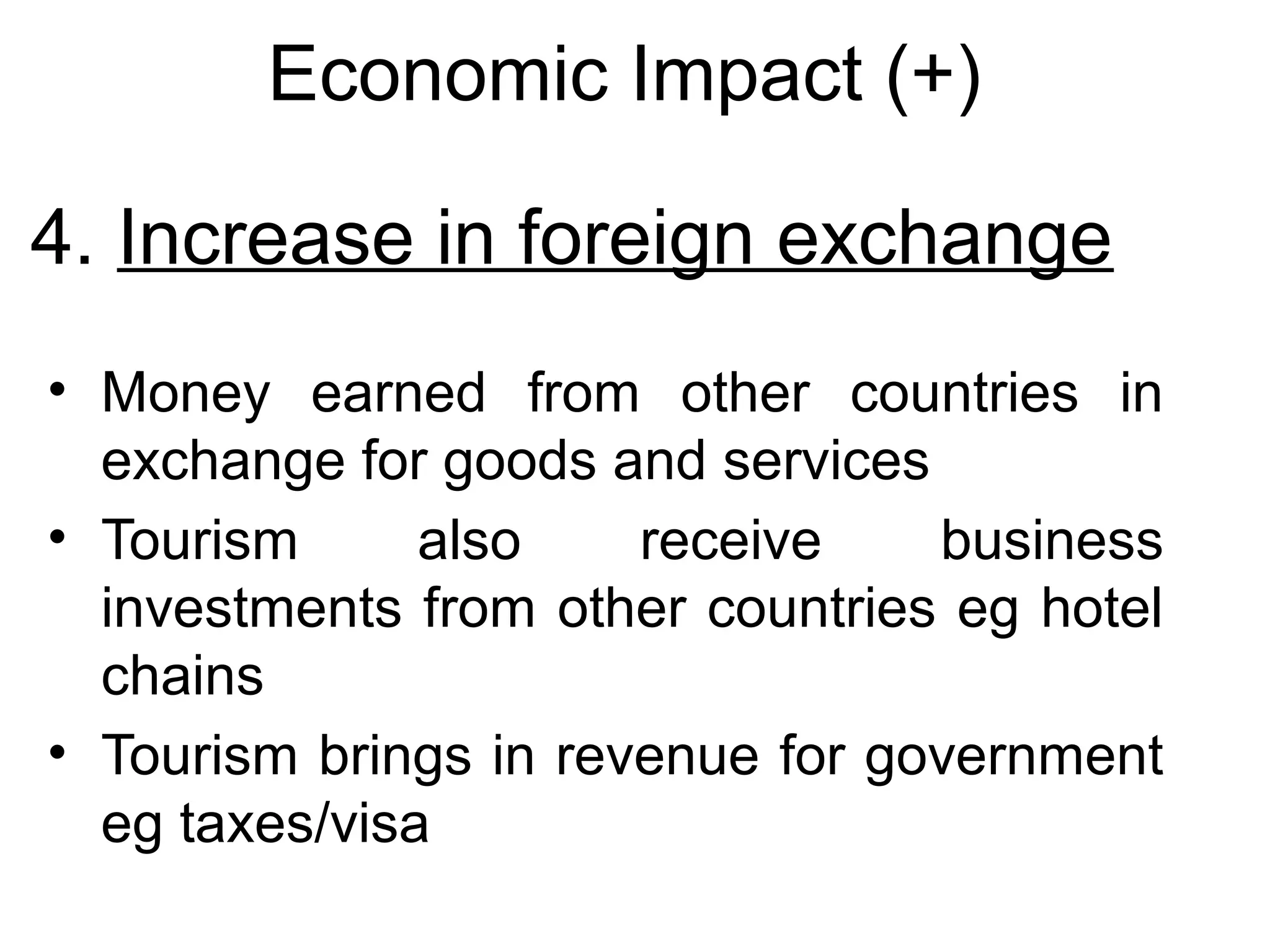
Economic Impact (+) 
4. Increase in foreign exchange 
• Money earned from other countries in 
exchange for goods and services 
• Tourism also receive business 
investments from other countries eg hotel 
chains 
• Tourism brings in revenue for government 
eg taxes/visa
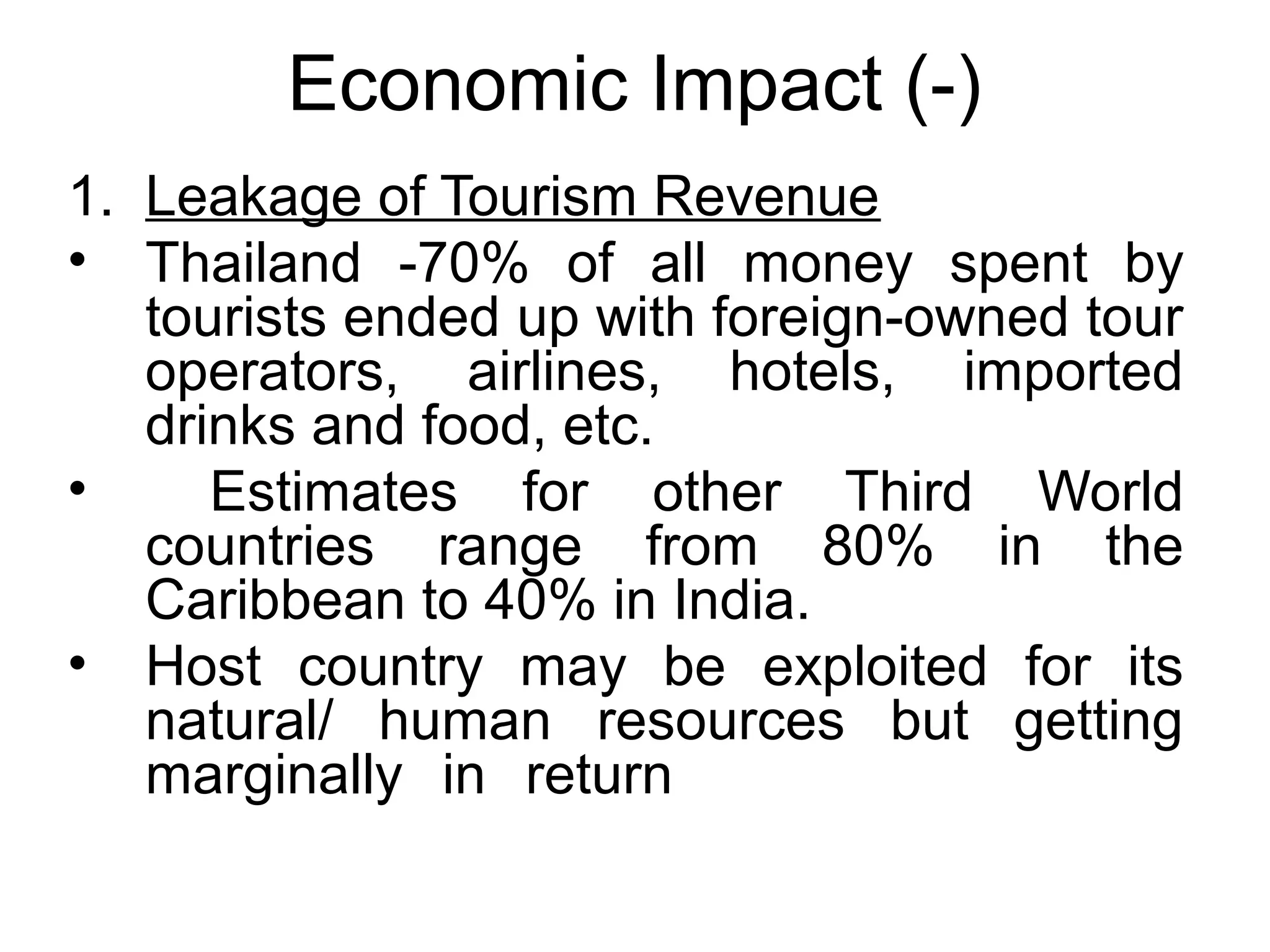
Economic Impact (-) 
1. Leakage of Tourism Revenue 
• Thailand -70% of all money spent by 
tourists ended up with foreign-owned tour 
operators, airlines, hotels, imported 
drinks and food, etc. 
• Estimates for other Third World 
countries range from 80% in the 
Caribbean to 40% in India. 
• Host country may be exploited for its 
natural/ human resources but getting 
marginally in return
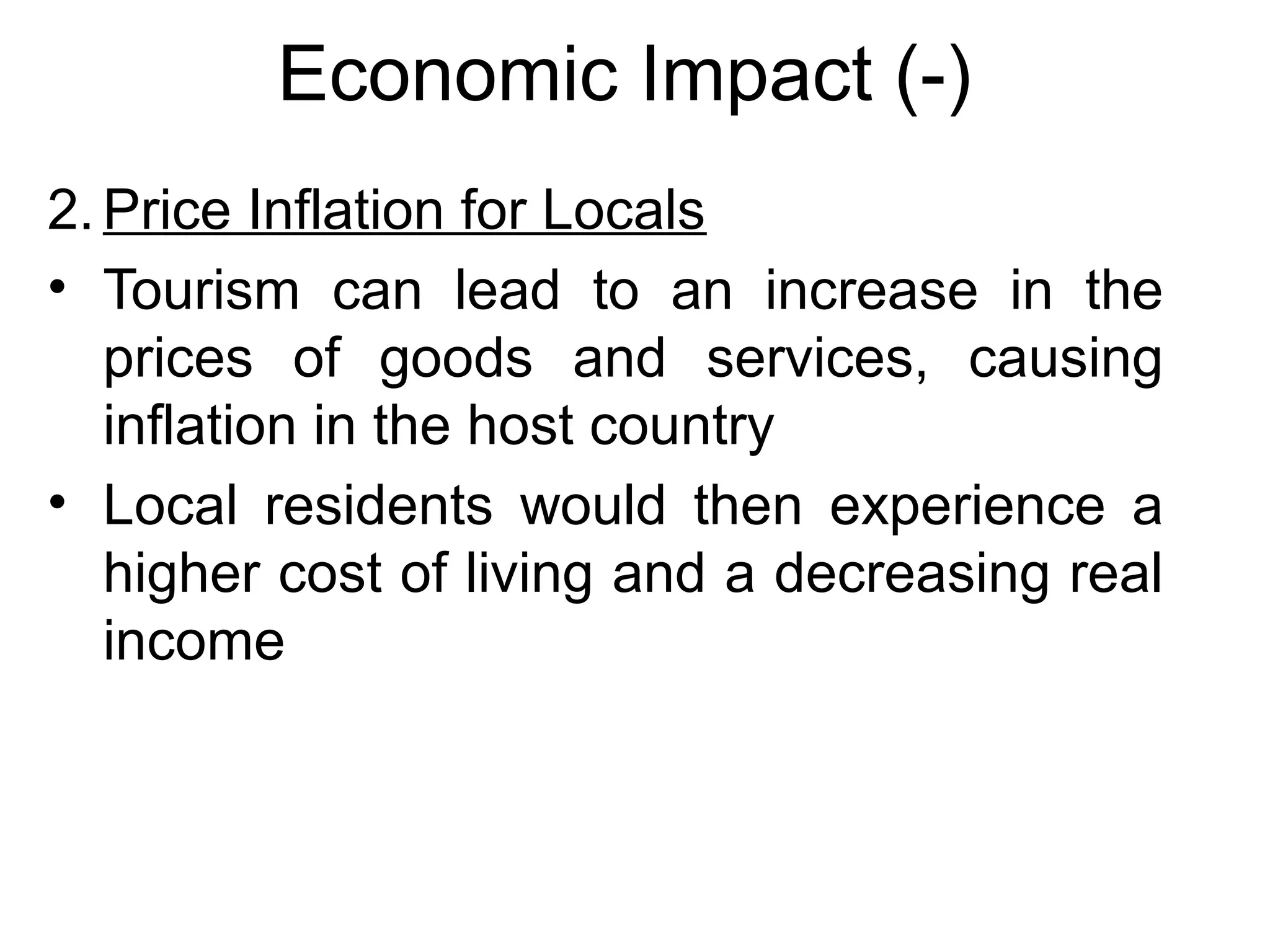
Economic Impact (-) 
2.Price Inflation for Locals 
• Tourism can lead to an increase in the 
prices of goods and services, causing 
inflation in the host country 
• Local residents would then experience a 
higher cost of living and a decreasing real 
income
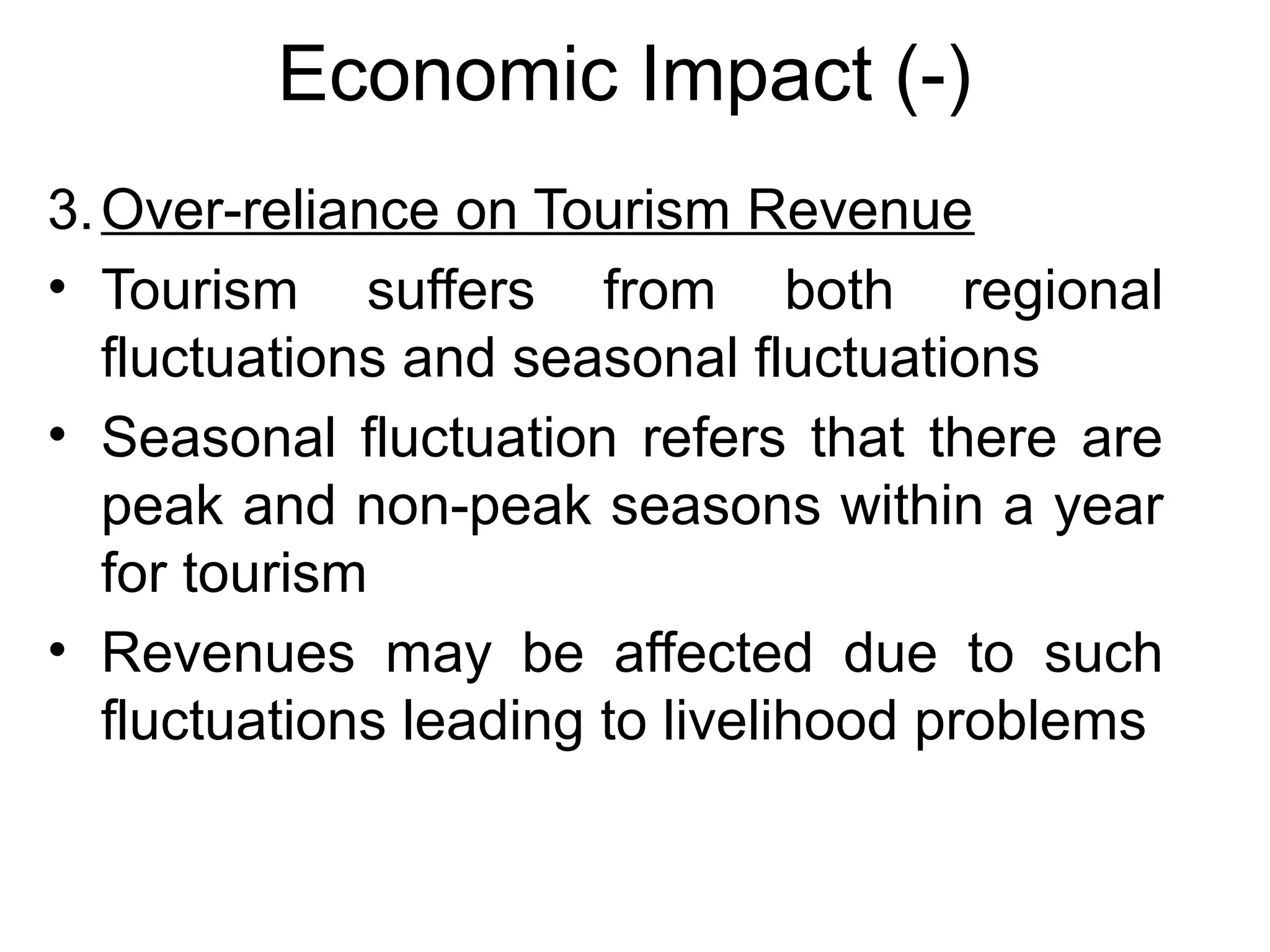
Economic Impact (-) 
3.Over-reliance on Tourism Revenue 
• Tourism suffers from both regional 
fluctuations and seasonal fluctuations 
• Seasonal fluctuation refers that there are 
peak and non-peak seasons within a year 
for tourism 
• Revenues may be affected due to such 
fluctuations leading to livelihood problems
Socio-Cultural Impact (+) 
1.Preservation and 
Promotion of Local 
Culture and Heritage 
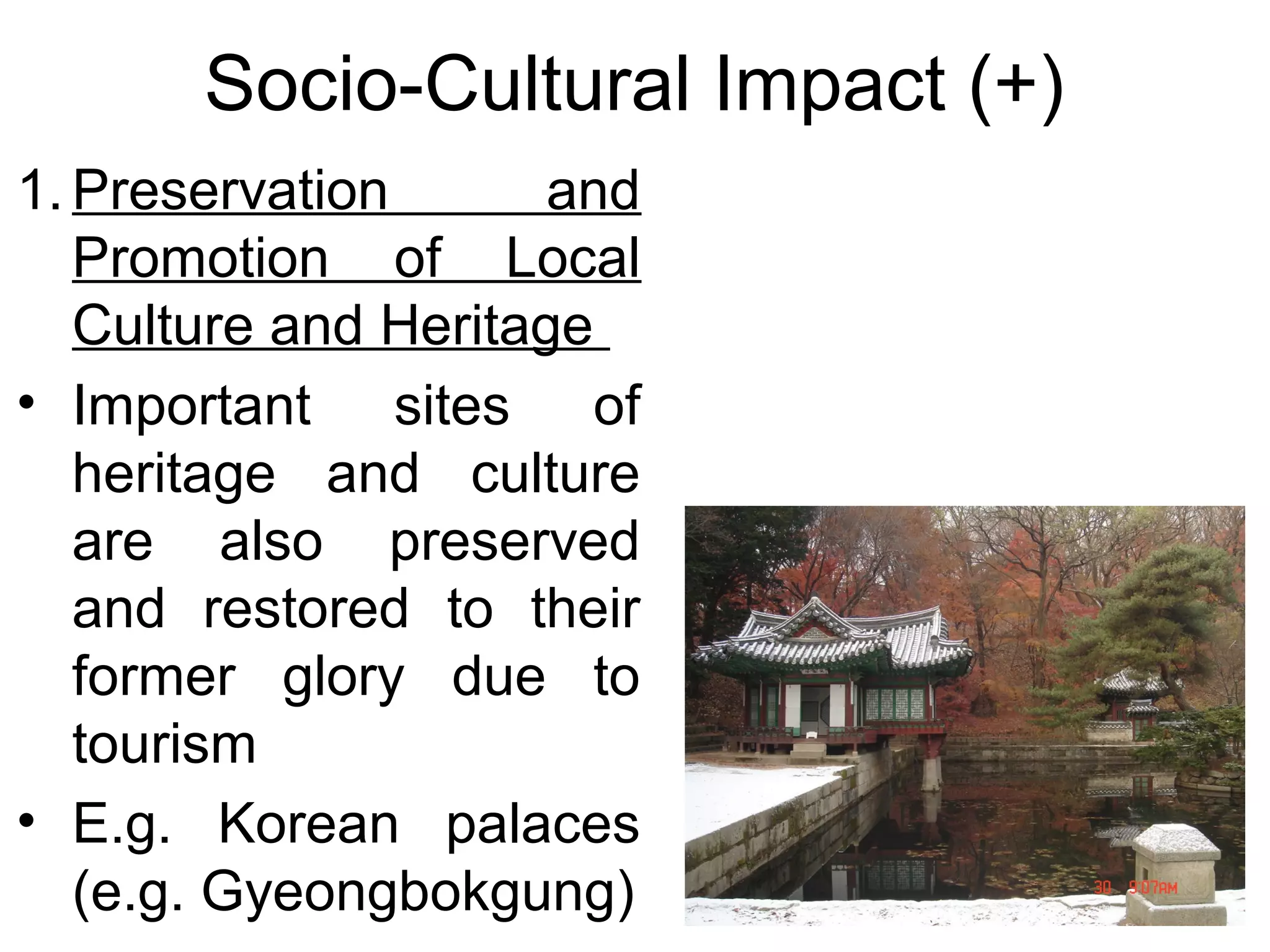
• Important sites of 
heritage and culture 
are also preserved 
and restored to their 
former glory due to 
tourism 
• E.g. Korean palaces 
(e.g. Gyeongbokgung)
Socio-Cultural Impact (+) 
2.Positive Exchanges and Interaction 
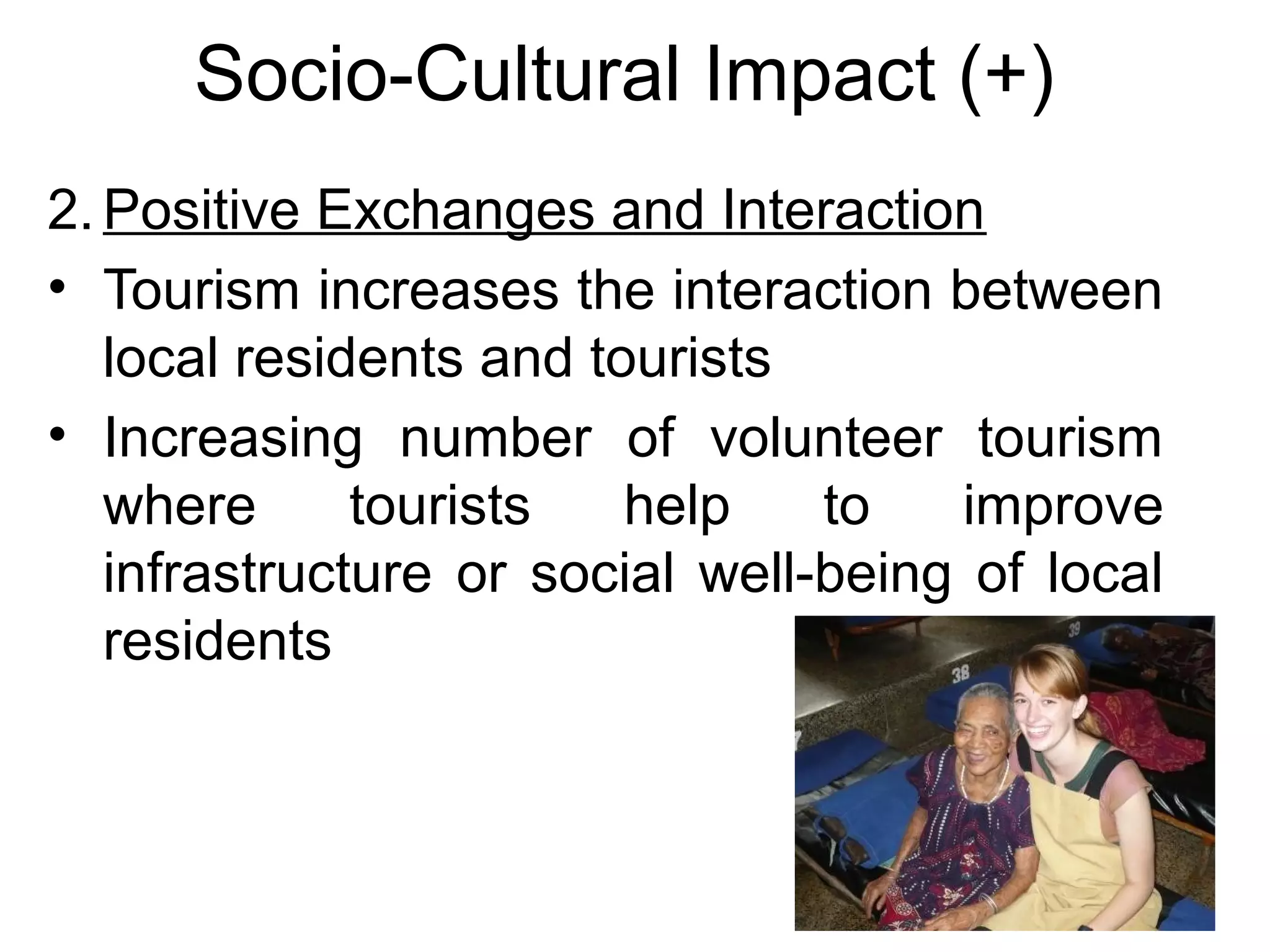
• Tourism increases the interaction between 
local residents and tourists 
• Increasing number of volunteer tourism 
where tourists help to improve 
infrastructure or social well-being of local 
residents
Socio-Cultural Impact (-) 
1. Dilution/ False Representation of Local 
Culture 
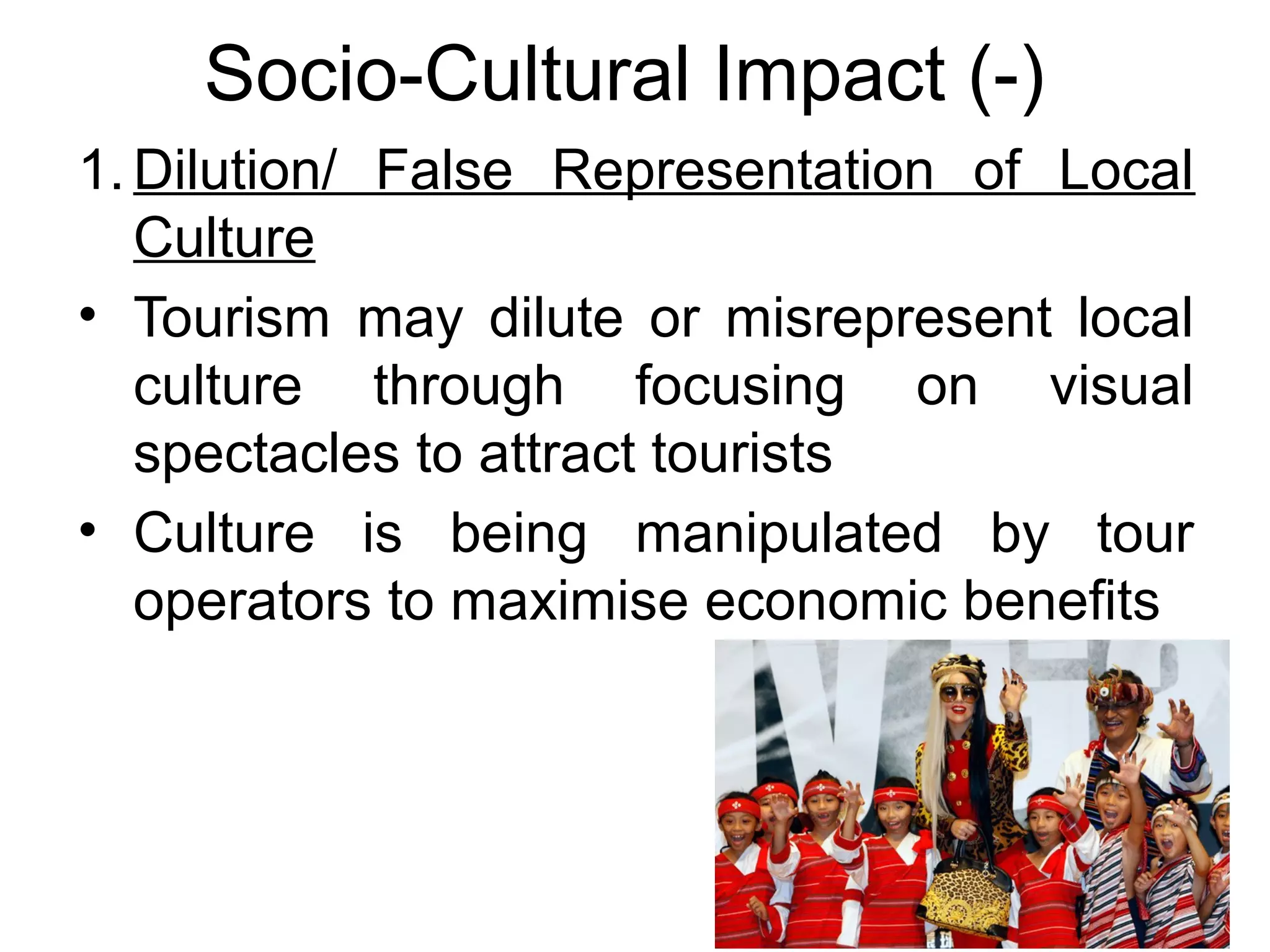
• Tourism may dilute or misrepresent local 
culture through focusing on visual 
spectacles to attract tourists 
• Culture is being manipulated by tour 
operators to maximise economic benefits
Socio-Cultural Impact (-) 
2.Disrespect of local cultures 
and customs 
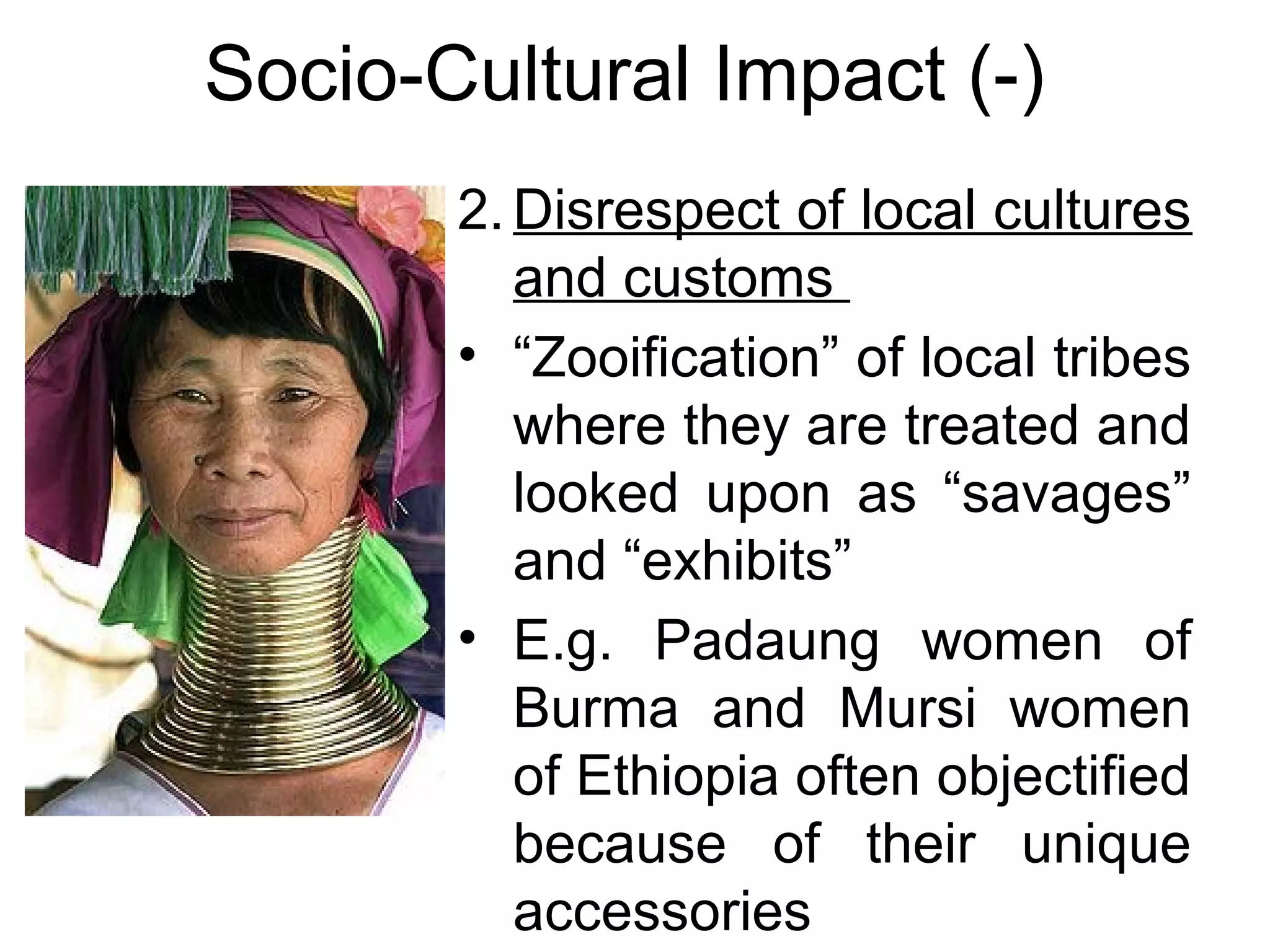
• “Zooification” of local tribes 
where they are treated and 
looked upon as “savages” 
and “exhibits” 
• E.g. Padaung women of 
Burma and Mursi women 
of Ethiopia often objectified 
because of their unique 
accessories
Socio-Cultural Impact (-) 
3. Increased Crime and Social Problems 
• The influx of wealthy travelers may 
increase instances of petty crime 
• Criminals often see tourists as an easy 
target because they: 
– typically carry large sums of money and other 
valuables 
– Are more likely to be relaxed and off guard while 
on vacation 
– Are less likely to report crimes or to testify against 
suspects, wishing to avoid problems
Environmental Impact (+) 
1. Increased Awareness on Environmental 
Protection 
• More emphasis has been put into 
conserving natural areas and lowering 
carbon footprint 
• Carbon footprint refers to the total 
Greenhouse Gas emissions caused by an 
organization, event, product or person
Environmental Impact (-) 
1.Destruction of Natural Habitat 
• Pristine environments are destroyed by 
human development to build tourism 
facilities 
• E.g. Tourists visiting the Galapagos 
Islands have unknowingly brought with 
them invasive species which threaten to 
destroy native species
Environmental 
Impact (-) 
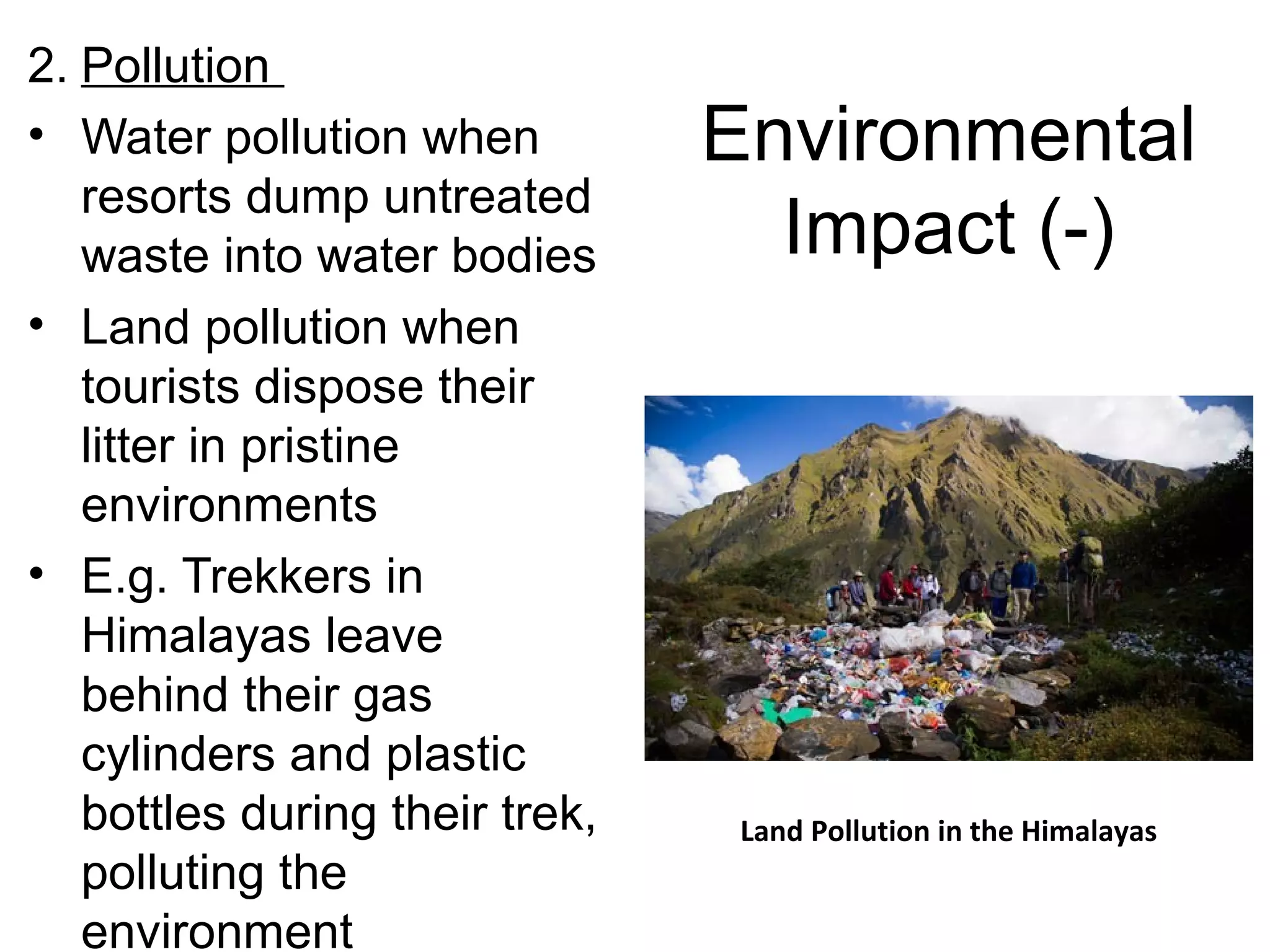
2. Pollution 
• Water pollution when 
resorts dump untreated 
waste into water bodies 
• Land pollution when 
tourists dispose their 
litter in pristine 
environments 
• E.g. Trekkers in 
Himalayas leave 
behind their gas 
cylinders and plastic 
bottles during their trek, 
polluting the 
environment 
Land Pollution in the Himalayas
Stakeholders 
• Individuals or groups with multiple stakes 
or interests in an organisation or decision 
• Any group or individual who can affect or is 
affected by the achievement of an 
organisation’s objectives
Stakeholders in Tourism
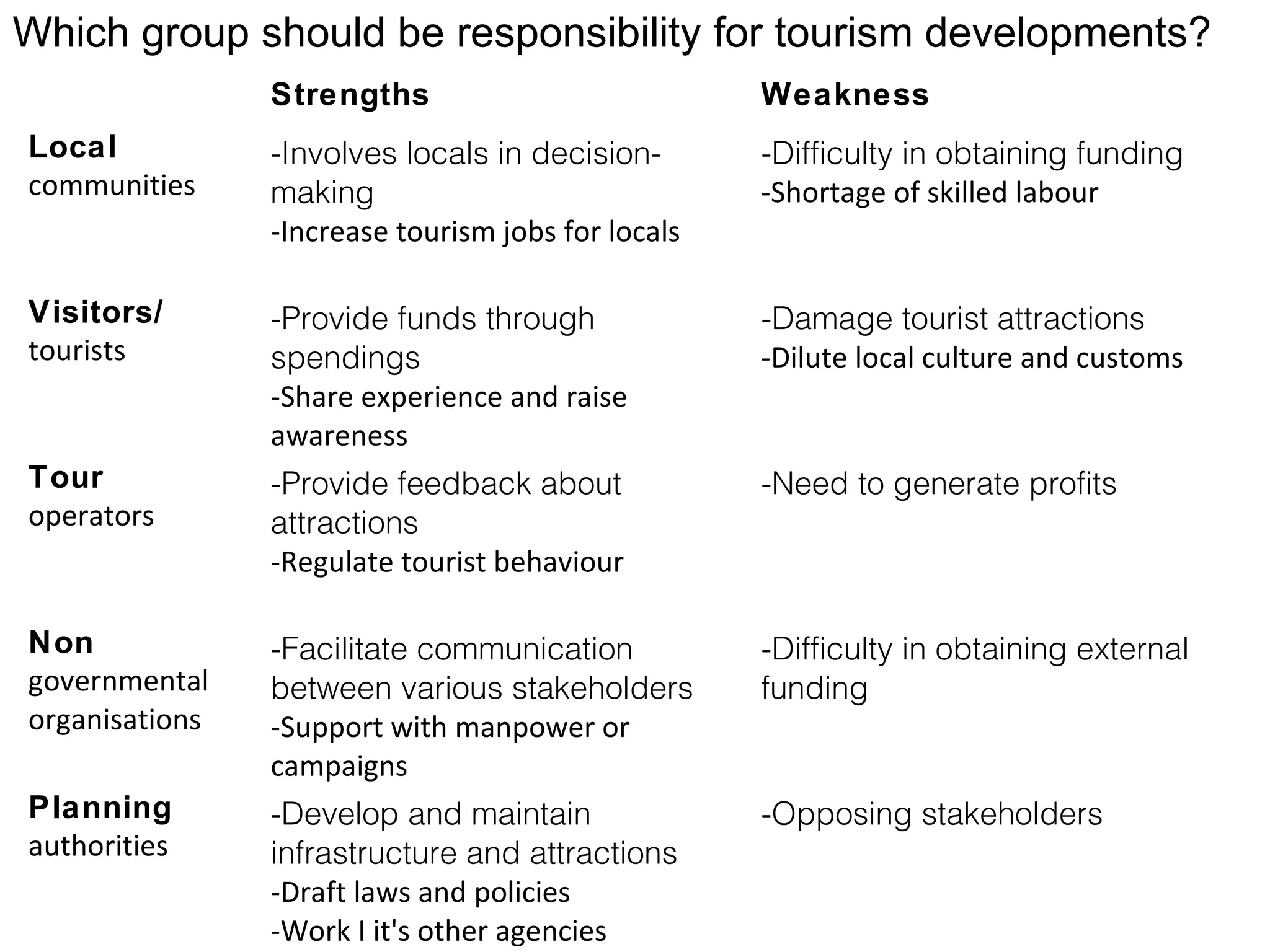
Which group should be responsibility for tourism developments? 
Strengths Weakness 
Local 
communities 
-Involves locals in decision-making 
-Increase tourism jobs for locals 
-Difficulty in obtaining funding 
-Shortage of skilled labour 
Visitors/ 
tourists 
-Provide funds through 
spendings 
-Share experience and raise 
awareness 
-Damage tourist attractions 
-Dilute local culture and customs 
Tour 
operators 
-Provide feedback about 
attractions 
-Regulate tourist behaviour 
-Need to generate profits 
Non 
governmental 
organisations 
-Facilitate communication 
between various stakeholders 
-Support with manpower or 
campaigns 
-Difficulty in obtaining external 
funding 
Planning 
authorities 
-Develop and maintain 
infrastructure and attractions 
-Draft laws and policies 
-Work I it's other agencies 
-Opposing stakeholders
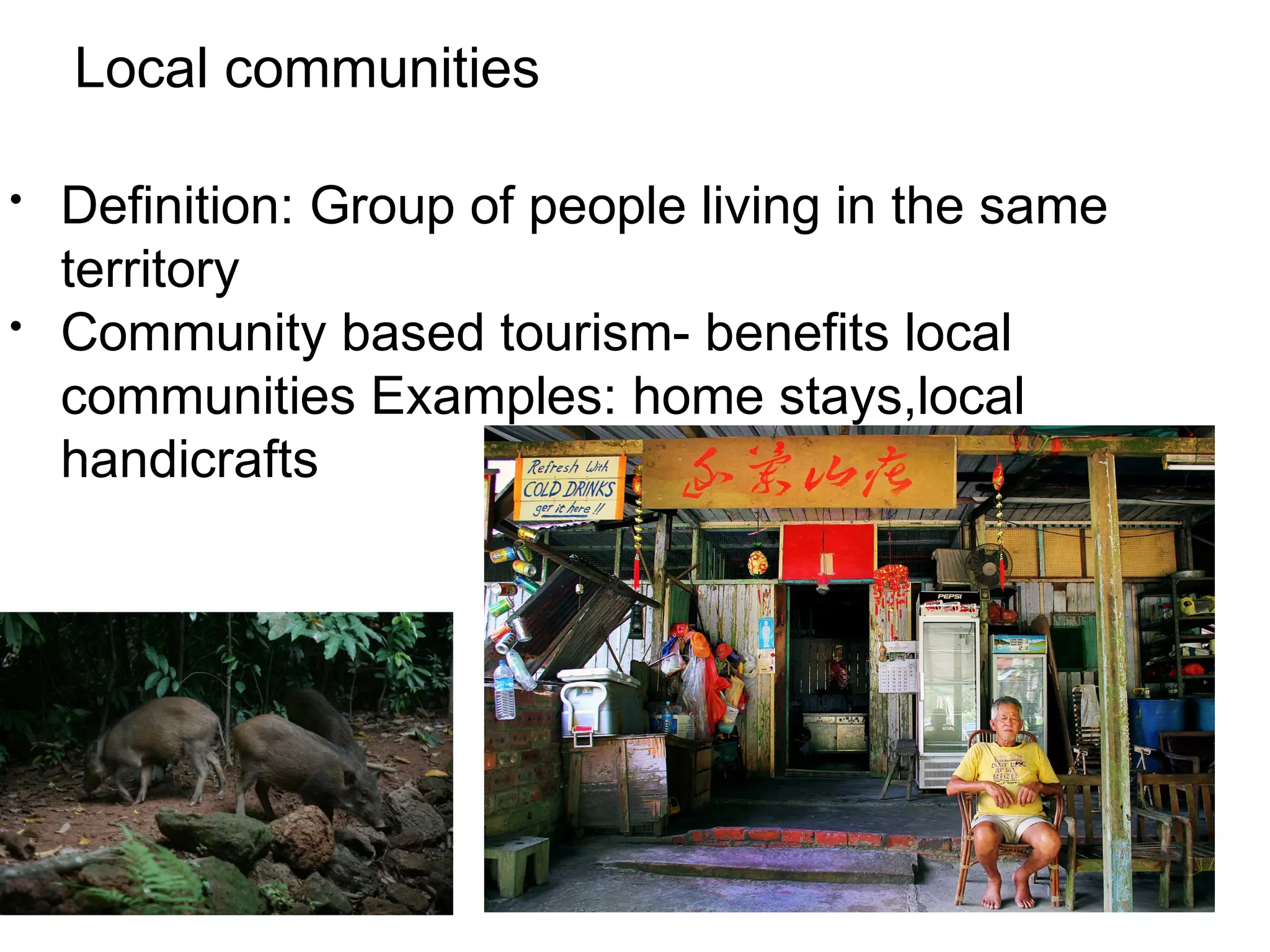
Local communities 
• Definition: Group of people living in the same 
territory 
• Community based tourism- benefits local 
communities Examples: home stays,local 
handicrafts
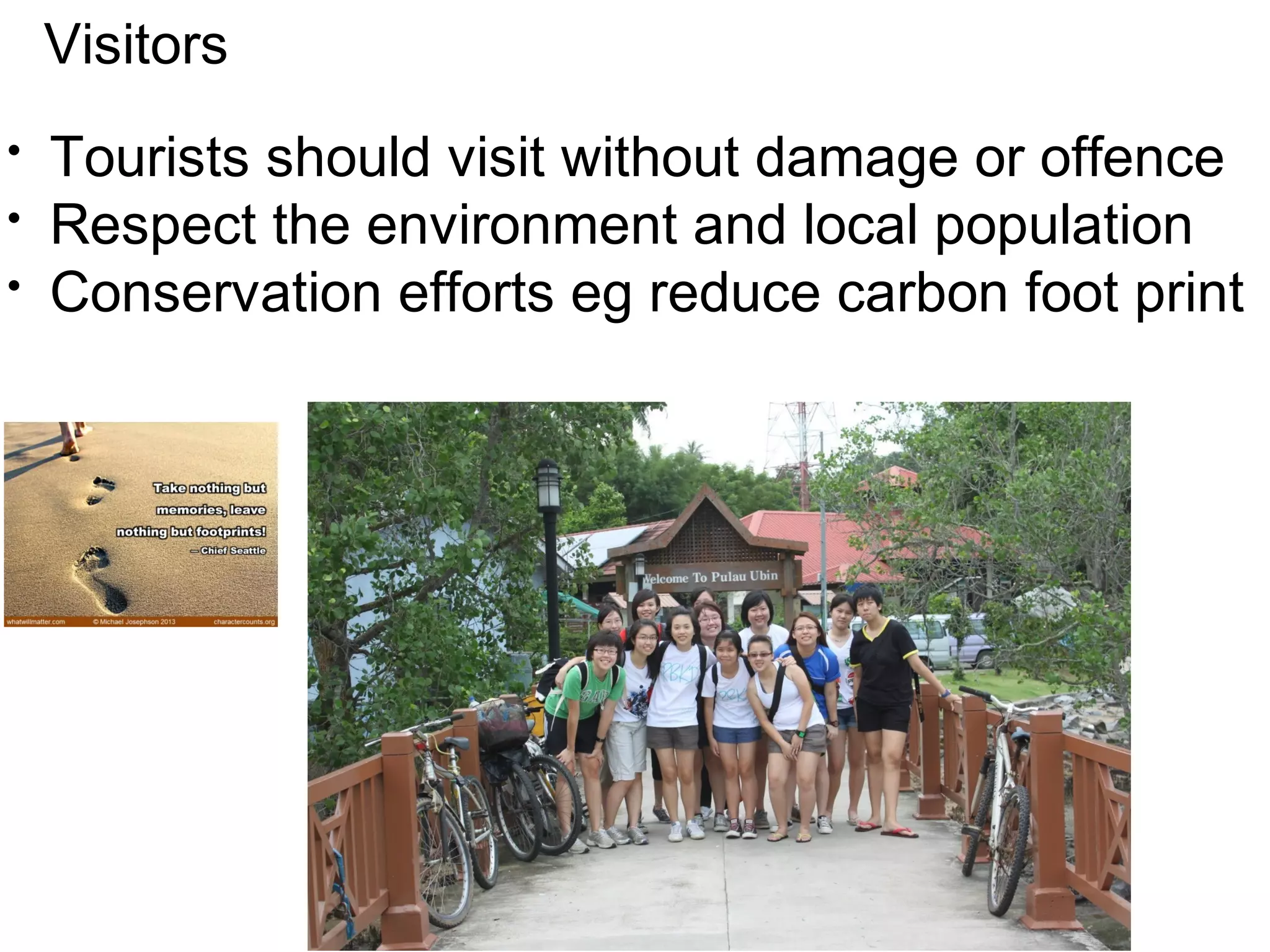
Visitors 
• Tourists should visit without damage or offence 
• Respect the environment and local population 
• Conservation efforts eg reduce carbon foot print
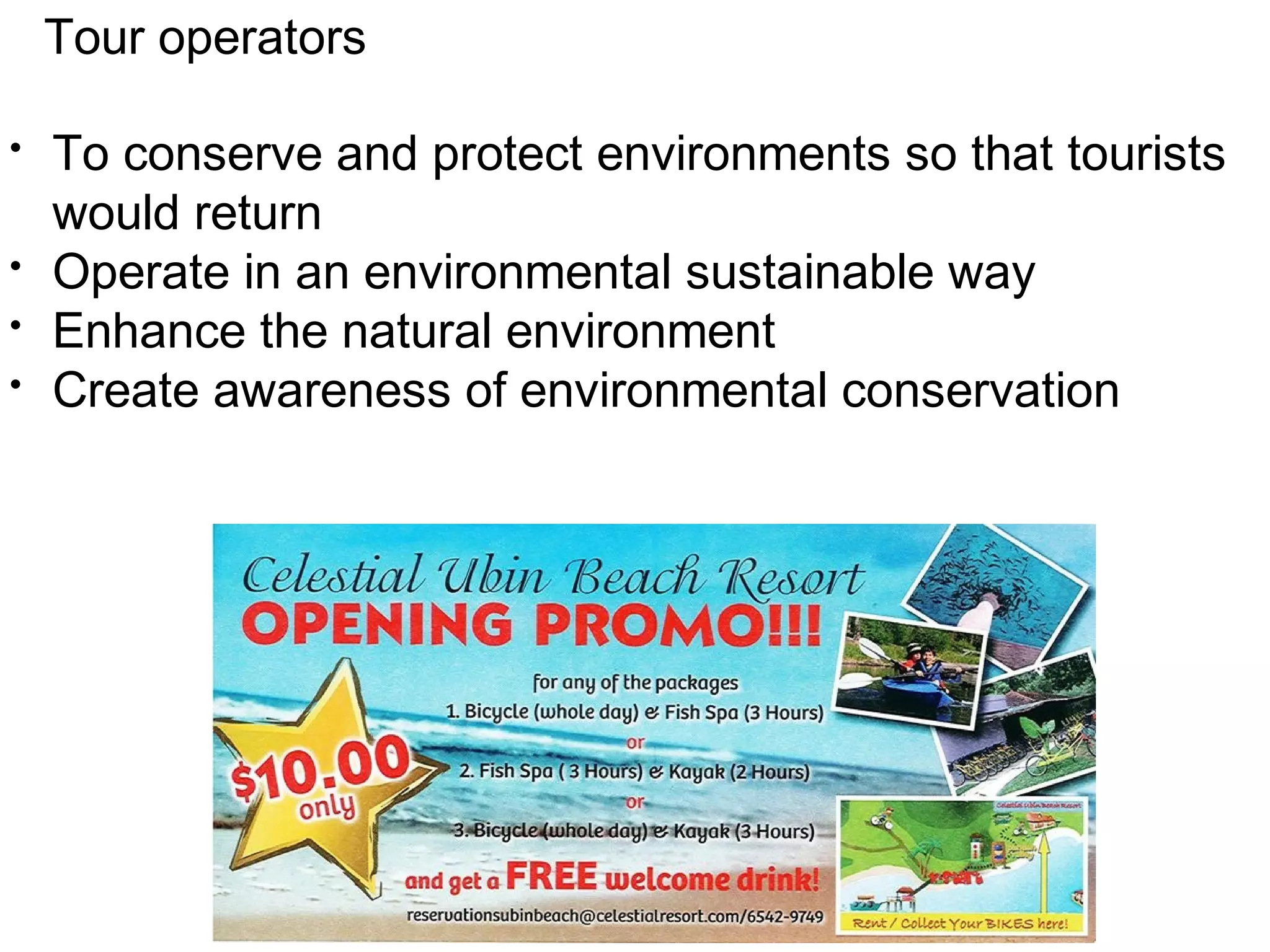
Tour operators 
• To conserve and protect environments so that tourists 
would return 
• Operate in an environmental sustainable way 
• Enhance the natural environment 
• Create awareness of environmental conservation
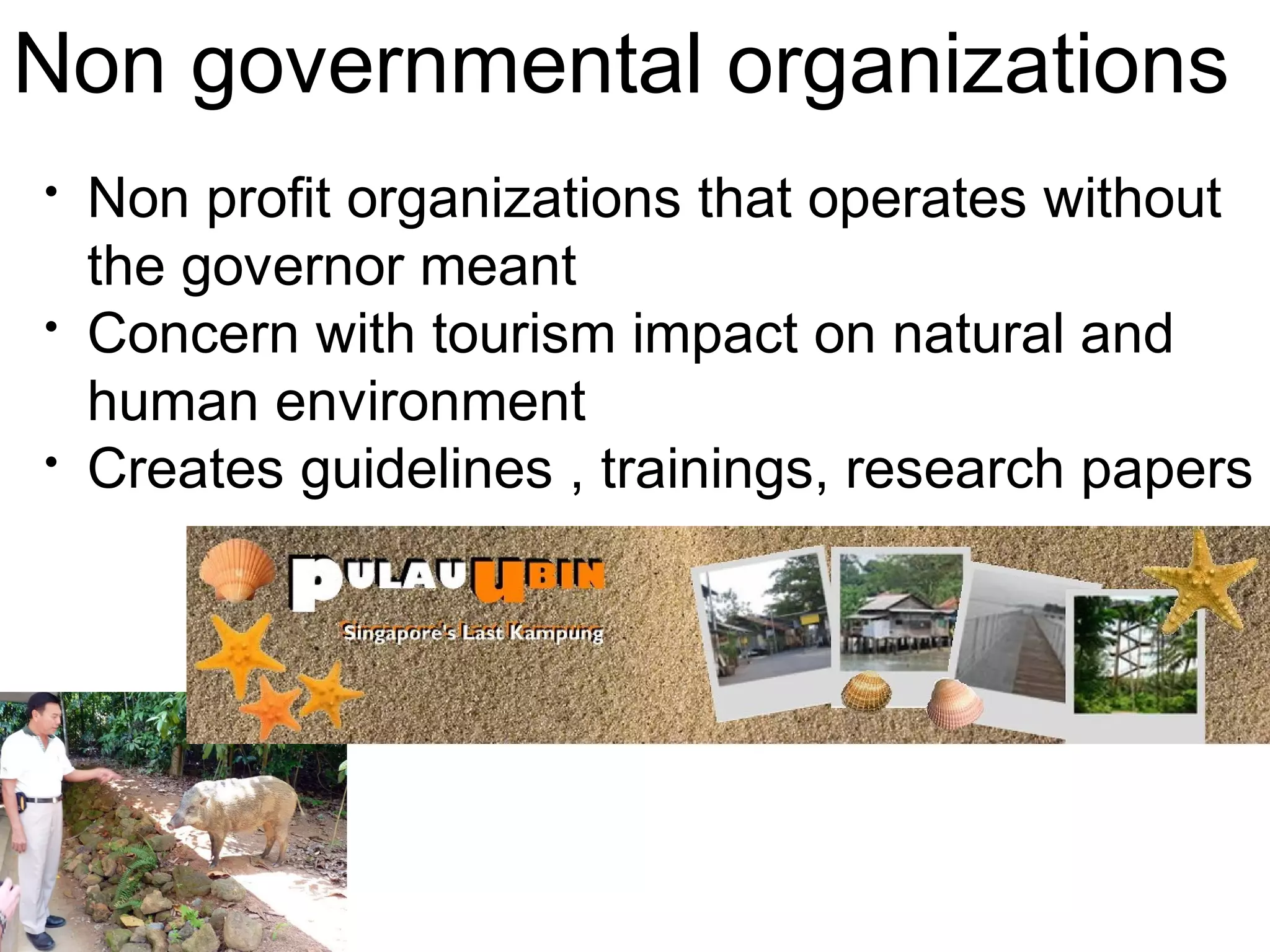
Non governmental organizations 
• Non profit organizations that operates without 
the governor meant 
• Concern with tourism impact on natural and 
human environment 
• Creates guidelines , trainings, research papers
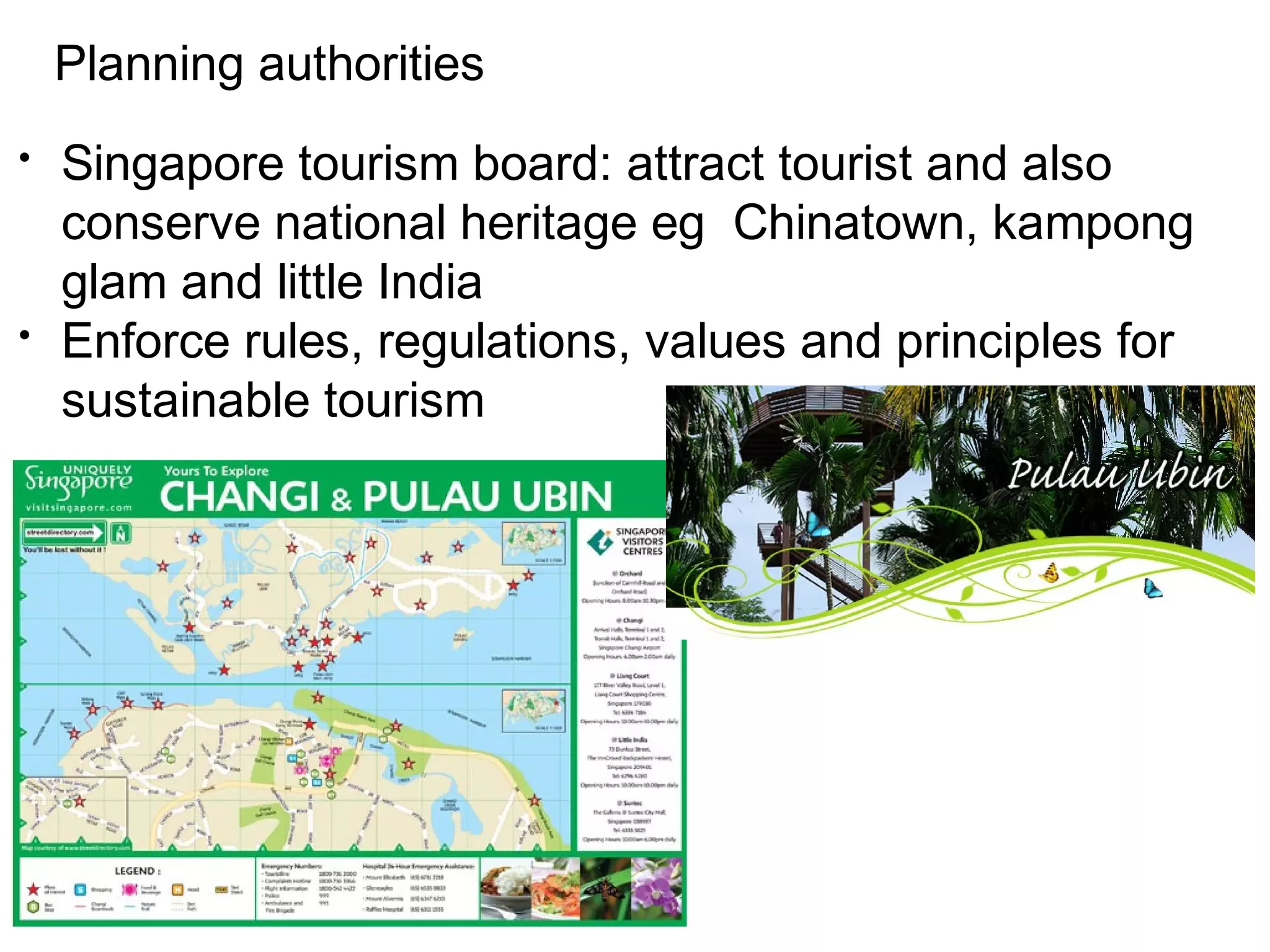
Planning authorities 
• Singapore tourism board: attract tourist and also 
conserve national heritage eg Chinatown, kampong 
glam and little India 
• Enforce rules, regulations, values and principles for 
sustainable tourism
Sustainable Tourism 
• It refers to : 
– Tourism that respects both local people and 
the traveller, cultural heritage and the 
environment. (UNESCO) 
– tourism activity that can be maintained over 
the long term because it results in a net 
benefit for the social, economic, natural and 
cultural environments of the area in which it 
takes place.
Establish Laws and Regulations 
• Refers to the setting up of guidelines or 
restrictions by planning authorities 
• This is to deter tourists from irresponsible 
behaviour 
• Environmental damage would be 
minimised and local cultures and traditions 
would be respected through such law 
enforcements
Establish Laws and Regulations 
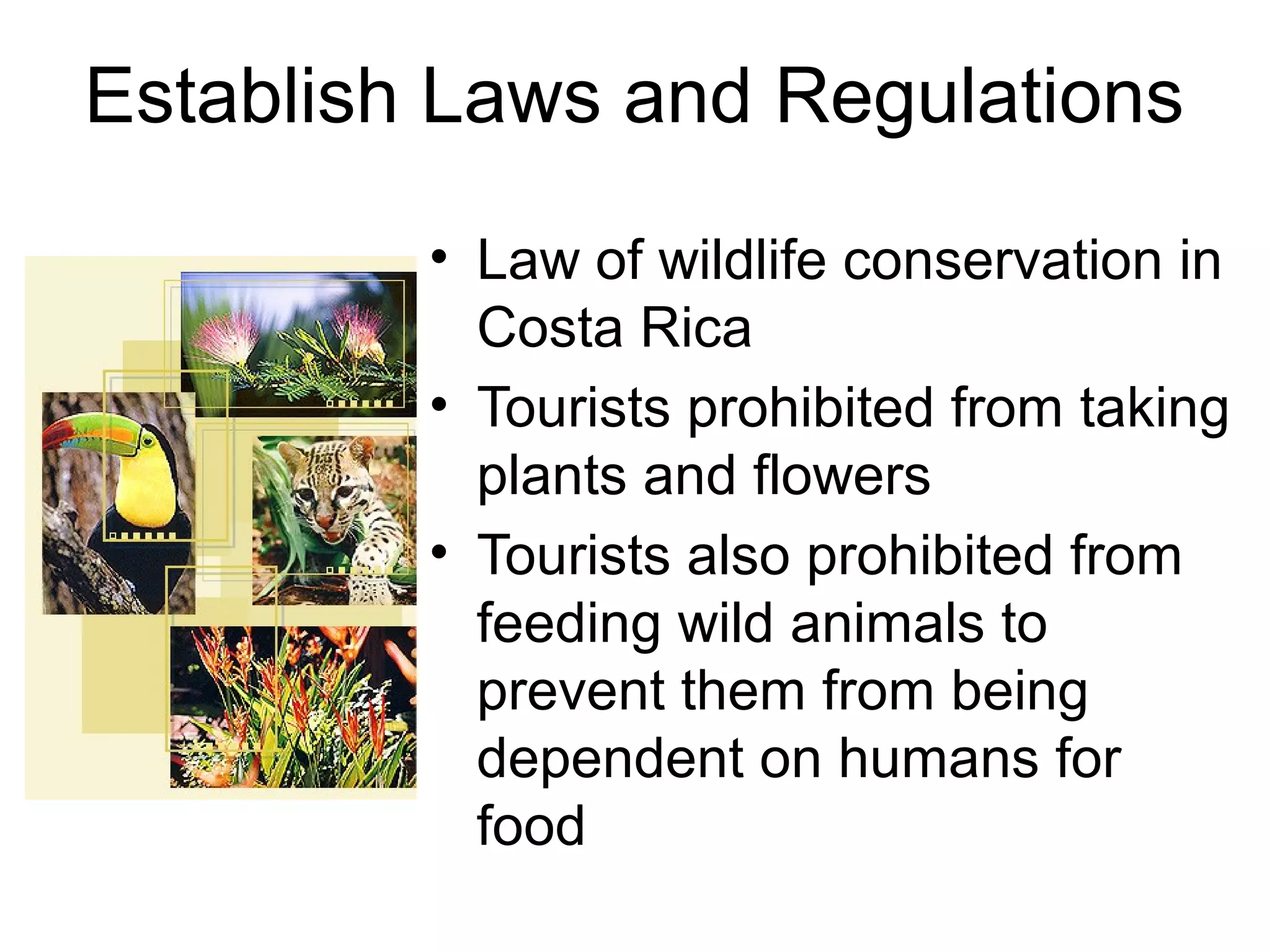
• Law of wildlife conservation in 
Costa Rica 
• Tourists prohibited from taking 
plants and flowers 
• Tourists also prohibited from 
feeding wild animals to 
prevent them from being 
dependent on humans for 
food
Establish Laws and Regulations 
Problems 
• Not all tourists conform to the 
environmentally-friendly guidelines as 
many feel the use or overuse of resources 
is justifiable with payment 
• Tourists may also feel self-important and 
show little respect for local cultures and 
traditions, hence creating disharmony 
among the local society
Promoting Ecotourism 
• Ecotourism refers to environmentally 
responsible travel to relatively undisturbed 
natural areas that promotes conservation 
and improves the well-being of locals 
• Practicing ecotourism will allow tourists to 
enjoy the experience of being in natural 
environments, promote conservation and 
ensure that the locals benefit economically
Promoting Ecotourism 
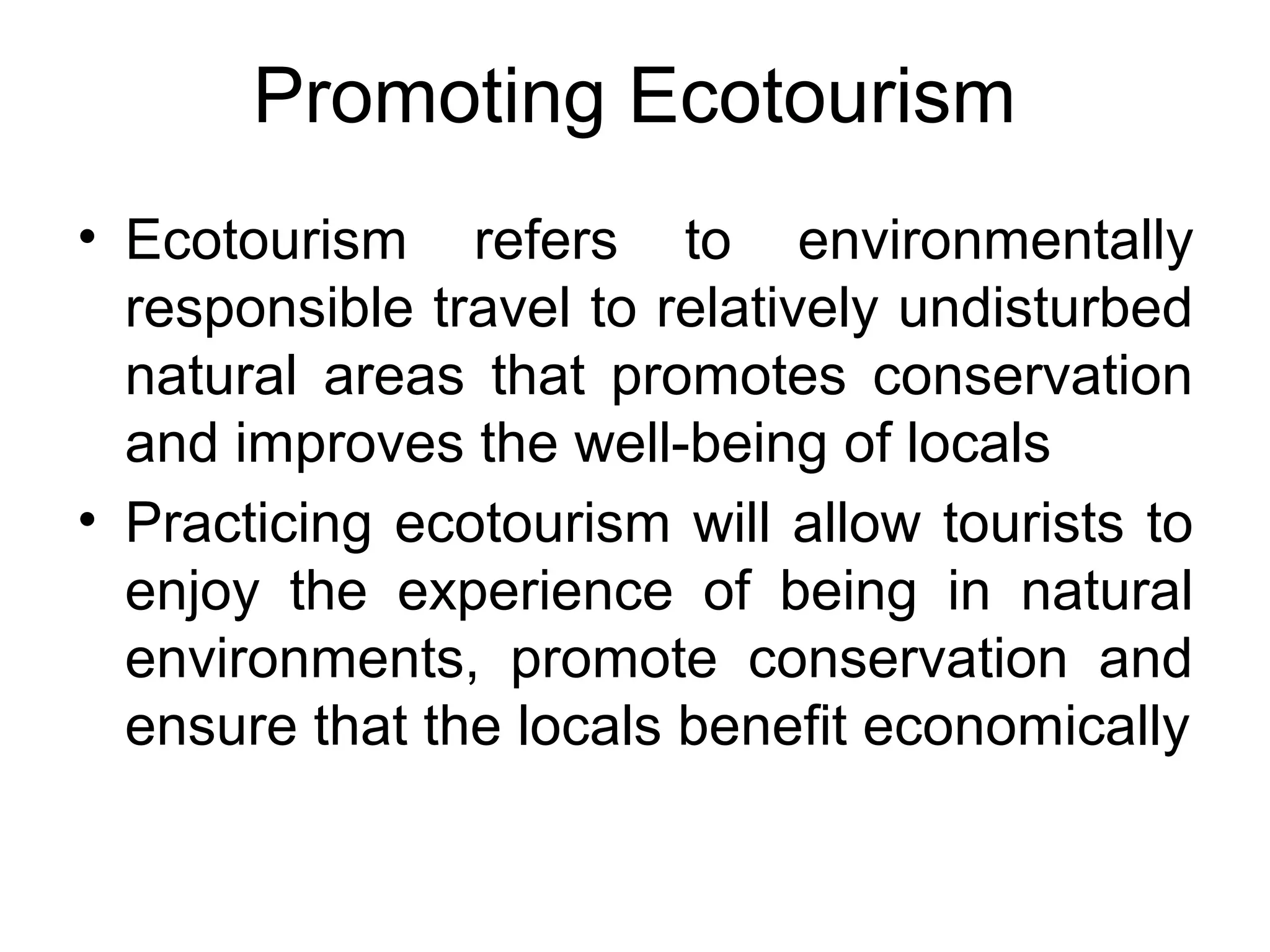
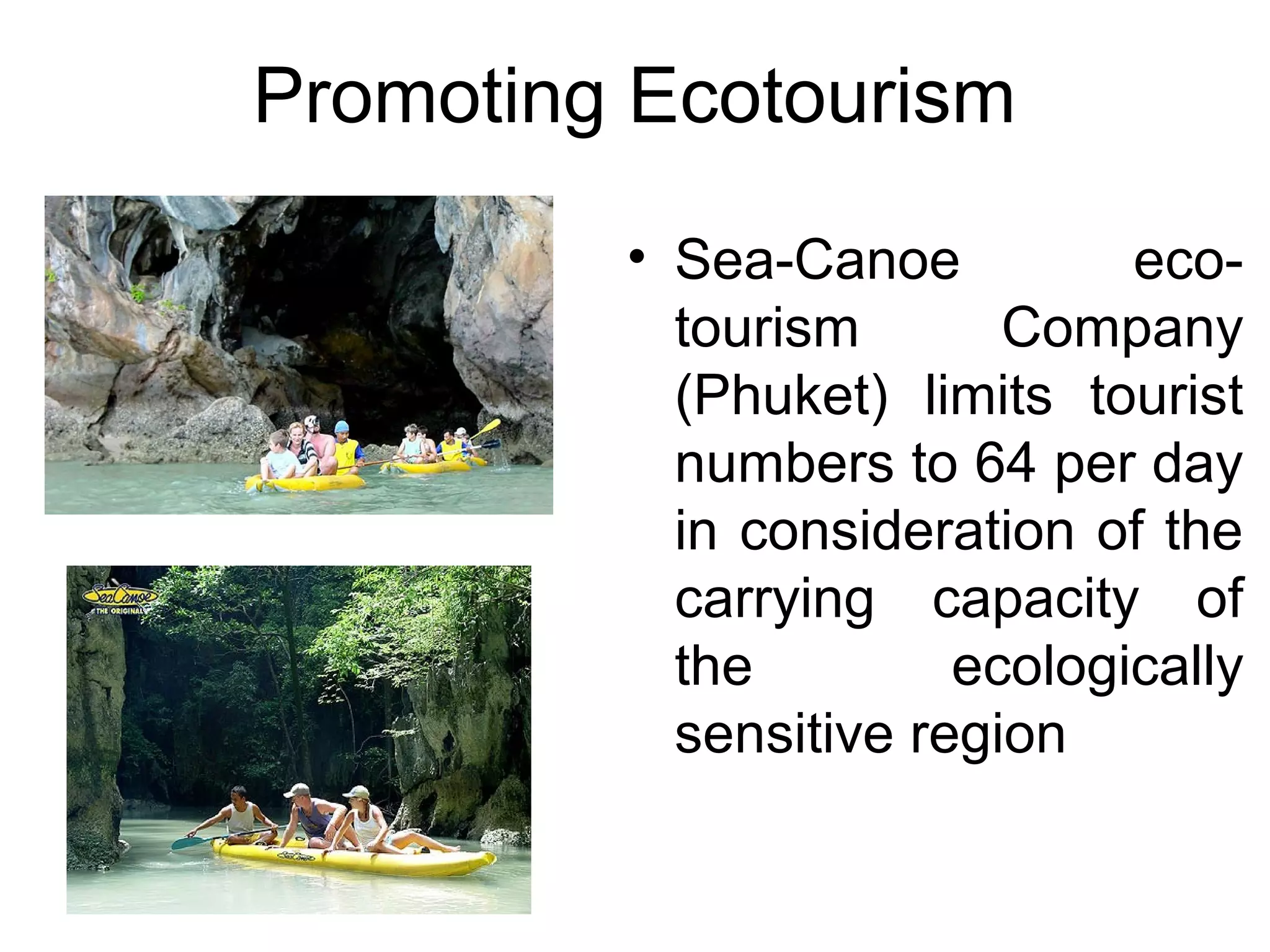
• Sea-Canoe eco-tourism 
Company 
(Phuket) limits tourist 
numbers to 64 per day 
in consideration of the 
carrying capacity of 
the ecologically 
sensitive region
Promoting Ecotourism 
Problems 
•Tour operators driven by profits may fail to 
conduct tourist activities following 
ecotourism guidelines hence end up 
degrading the environment
Promoting Community Based Tourism 
• Refers to the development and management 
of tourism that includes, consults and benefits 
the local community, especially in the context 
of rural villages and indigenous people 
• Giving the locals control over tourist activities 
will allow the local community to contribute 
their intimate knowledge of the local 
environment to tourism projects and help 
manage the negative impact of tourism
Promoting Community Based Tourism 
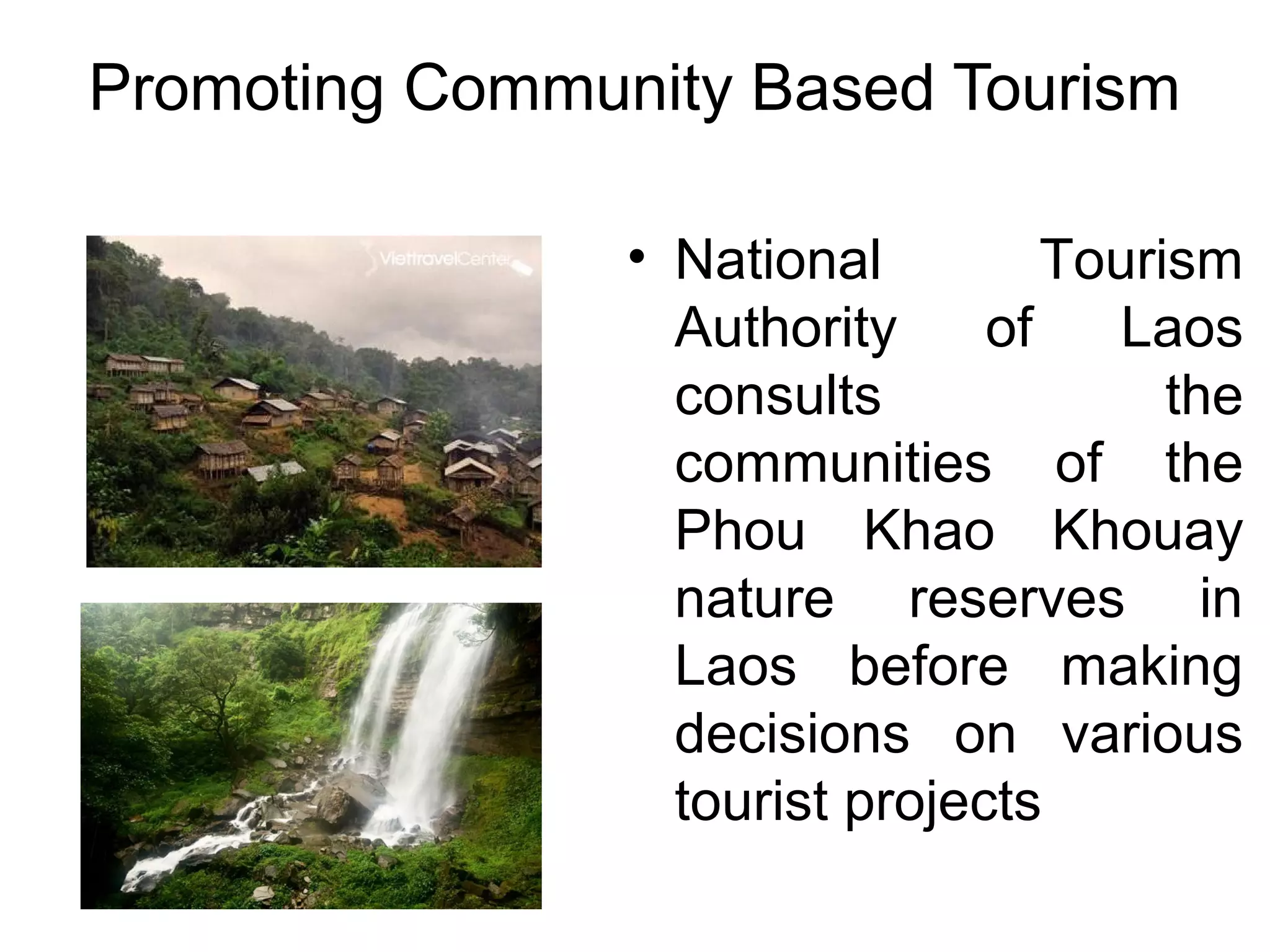
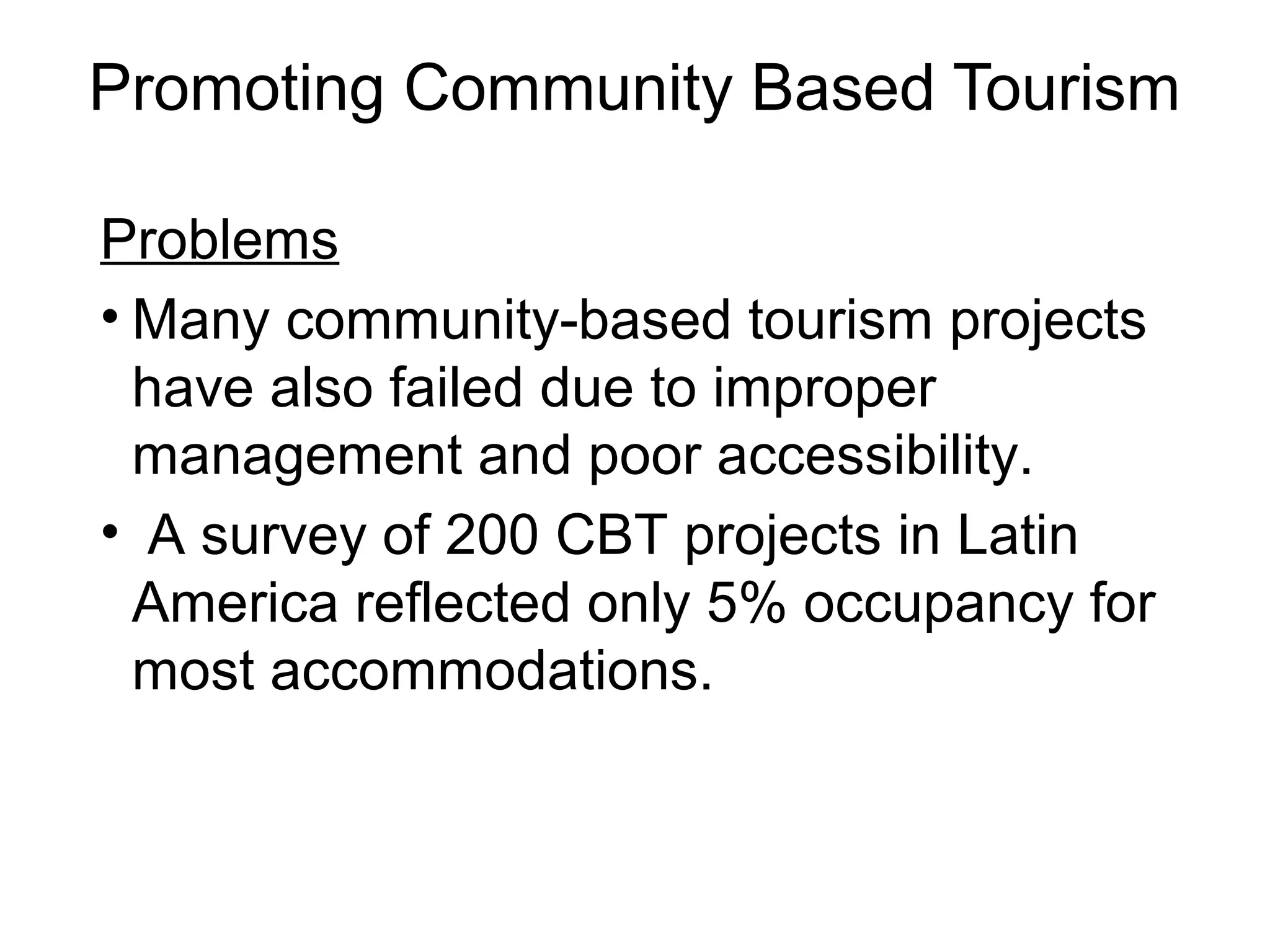
• National Tourism 
Authority of Laos 
consults the 
communities of the 
Phou Khao Khouay 
nature reserves in 
Laos before making 
decisions on various 
tourist projects
Promoting Community Based Tourism 
Problems 
• Many community-based tourism projects 
have also failed due to improper 
management and poor accessibility. 
• A survey of 200 CBT projects in Latin 
America reflected only 5% occupancy for 
most accommodations.

Tourism slides combined for students

  • 1.
    Tourism • Tourismrefers to the temporary movement of people primarily for leisure and recreational purposes • It is characterised by the interaction(s) between tourists and tourism destinations
  • 2.
    Tourist • Atourist is defined as a person who travels and stays away from his/her normal place of residence for more than 24 hours but less than a year, regardless of travel purpose
  • 3.
    Tourism Types •Tourism is place-specific, tourists travel to a specific physical location • Different spaces/environments (both physical and human) in tourism destinations create diverse tourism activities • There are therefore the presence of different tourism types
  • 4.
    Honeypot Tourism EiffelTower, Paris, France Taj Mahal, Agra, India • Tourism honeypots refers to particularly popular visitor attractions which attract tourists in large numbers
  • 5.
    MICE • Requisite:Destinations which provide good amenities for meetings, incentives, conferences and exhibitions Melbourne Convention Hall, Australia Yeosu Expo, S. Korea
  • 6.
    Medical/ Health Tourism • Requisites: Places with good medical facilities or health facilities such as spas and hot springs • Rise in medical tourism, especially in cosmetic procedures (S. Korea estimates 300 thousand medical tourists by 2015)
  • 7.
    Film-induced Tourism •Tourism to destinations featured on television, video, or cinema screen • Requisites: Physical or human landscape which appears on television, video, or cinema screen (More prominent in popular/cult movies)
  • 8.
    Heritage Tourism Travellingto experience the authentic culture and history offered by a particular place and/or activity The Kayan Culture, Burma Ghats in Varanasi, India
  • 9.
    Religious Tourism •Travelling for religious purposes (e.g. pilgrimage, missions, religious gatherings) • Requisite: Places with religious/holy sites The Kaaba, Mecca, Saudi Arabia Church of the Nativity, Bethlehem, Israel
  • 10.
    Dark Tourism Requisite:Places with history of conflicts or history of mass deaths/ places which uses death as a theme of attraction Catacombs of the Capuchins, Palermo, Italy- Over 8000 bodies hung on the walls like paintings!
  • 11.
    New Types ofTourism • There are new types of tourism which are constantly evolving or becoming more popular • E.g. Adventure tourism /sustainable/space Bungee Jumping, Queenstown, New Zealand
  • 12.
    Learning Points •Tourism is place-specific • Different environments (both physical and human) in tourism destinations create diverse opportunities for tourist activities • Presence of requisites for each type of tourism
  • 13.
    Definition • International tourism refers to tourism outside of a tourist's own country 13 • Domestic tourism refers to tourism within a tourist's own country
  • 14.
    International Tourism trends • Increasingly diverse in origins and destinations • Asia pacific destinations becoming more popular
  • 15.
    Domestic Tourism Trends • Grows along with international tourism • Especially in big countries like China and Philippines
  • 16.
    Changing Nature ofTourism Evolution of mass tourism to niche tourism • Mass tourism- act of visiting a destination with large amounts of people at one time • Dominated by Tour Operators offering low cost, standardised package tours
  • 17.
    • Niche tourismtargets a specific market segment, usually with a well-defined product that can be tailored to meet the interests of the tourists Tomatina, Bunyol, Spain Monkey Buffet, Lopburi, Thailand
  • 18.
    Changing Nature ofTourism From tour groups to independent travellers • Tourism moving towards independent travel (e.g. backpacking) • Independent travel allows for more flexibility in travel itinerary • Tourists are not bounded by restrictions laid out by following tour groups
  • 19.
    Changing Nature ofTourism Growth of long haul destinations • No standard definition of what is considered long or short haul destinations • Some consider long haul destinations to be more than 5 hours away by flight • Tourists moving away from regional destinations to those which are further away (e.g. Singapore to Brazil/ USA)
  • 20.
    Changing Nature ofTourism Development of package holidays Tour packages moving towards adopting niche tourism types (e.g. food and wine tourism)
  • 21.
    Changing Nature ofTourism Development of short haul destinations • Short haul destinations have also tried to market themselves to niche markets • For Singapore, rise in ecotourism and community-based tourism in short haul destinations • E.g. Komodo national park, Orang Asli experience
  • 22.
    Learning Points •The trend of global tourism is positive seen from both rising tourist arrivals and tourism receipts • Niche tourism types and independent travelling have become popular • Package tours are adopting elements of niche tourism to attract the diverse market • Tourism is the way to go because of the economic benefits it brings
  • 23.
    Factors Causing GlobalTourism Growth Demand Factors Destination Factors 1. Increase in Disposable Income 2. Increase in leisure time 3. Changing Lifestyles 1. Attractions 2. Investment in Infrastructure and Services 3. Access to Information/ Marketing 4. Political Stability Technology
  • 24.
    Demand Factors Factorsthat influence people’s desire and capability to travel and purchase tourism related goods and services
  • 25.
    Demand Factors DisposableIncome • Refers to the amount of money left for an individual to spend, or to be set aside as savings, after taxes
  • 26.
    Demand Factors DisposableIncome • Increase in disposable income enables people to spend more on goods and activities which would improve their quality of life • Accounts for growth in tourism as people can afford to travel more frequently and to more expensive destinations
  • 27.
    Demand Factors LeisureTime • Refers to time available outside of the demands of work or duty • Increasing trend where people enjoy a minimum of three weeks of paid annual leave • Increase in leisure time allows people to travel more
  • 28.
    Demand Factors ChangingLifestyles • Refers to the way a person lives which includes patterns of social relations, consumption and entertainment • Higher education levels propels people to travel to know more about the world • Education has also developed varied interests in people resulting in people attracted to various tourist destinations (e.g. nature lovers to ecotourism)
  • 29.
    Demand Factors ChangingLifestyles • Travelling also acts as a stress-reliever for people who want respite from urban/ working life • Longer life expectancy and increasing affluence results in more people travelling the world after retirement
  • 30.
    Destination Factors DestinationFactors • Related to the infrastructure and services offered in tourism destinations that allow for more convenient and comfortable stay for tourists Burj Al Arab , Dubai, UAE
  • 31.
    Destination Factors Attractions • Refers to the range of attractions in a tourist location • Presence of attractions which are varied in type would encourage tourists to visit the destination • Has Singapore been successful in this area?
  • 32.
    Destination Factors Investmentin Infrastructure and Services • Refers to the presence of a range of large-scale public systems, services, and facilities • Includes tourist accommodation, medical facilities, transport infrastructure, recreational and entertainment facilities • Destination with more investments in infrastructure and services likely to attract more tourists
  • 33.
    Destination Factors Accessto Information • Refers to the ease in which tourists are able to obtain information of the destination • This could be in the form of internet or print sources (e.g. Lonely Planet Guidebooks) • Tourists more inclined to visit destinations that has more information available
  • 34.
    Destination Factors Marketing • Potential visitors get access to information through the marketing of the destination by their respective countries • Prevalent use of the mass media to advertise on certain marketable traits of destinations • Destination more likely to attract visitors if marketing is done well
  • 35.
    Destination Factors PoliticalStability • Countries which are in the midst of conflicts or wars are deemed to be unsafe for tourists • E.g. Syria and Iraq are not visited currently despite having attractions Ruins of Palmyra, Syria Great Ziggurat of Ur, Iraq
  • 36.
    Technology • Theadvent of technology and various Web tools makes travelling to another country much easier • Can you think of technology available now which aids in increasing tourism that was not available in the past?
  • 37.
    Learning Points •The growth of tourism is due to a combination of demand and destination factors • The growth of tourism is also propelled by the rise of technology which allows tourists to access information, plan their travel itinerary and book for accommodation and transport
  • 38.
    Fluctuations in Tourism Tourism numbers decline because of .... - Terrorism - Recession - Diseases - Disasters
  • 39.
    Hong Kong (2003)SARS Epidemic • Tourist arrivals fell 63% (850,000) from March to April 2003 • Outbound bookings for the Easter holiday period fell by 80%.
  • 40.
    Iceland (2010) Eyjafjallajökulleruption • 107,000 flights cancelled during 8 day period- 48% of total air traffic (10 million passengers) • Airlines collectively losing £130m per day in lost revenues • Tourism industry will lose money from tourists unable to make the trip
  • 41.
    Recession -Global FinancialCrisis(2007-2008) • Consumer spending lowered due to rising unemployment (5.4 million jobs lost in USA in 2008) • Assets have lowered due to the collapse of the stock and property markets • There is less disposable income that can be used to finance holidays
  • 42.
    Thailand (2008) PoliticalCrisis Violent clashes day-long leave 2 dead and over 300 injured, including 20 policemen Blockage of Suvarnabhumi International Airports, leaving thousands of tourists stranded and cutting off most of Thailand's international air connections. Several explosions and clashes occur in the following day.
  • 43.
    Tourism impacts Developingtourism at what cost?
  • 44.
  • 45.
    Positive :) Negative:( Socio-cultural impacts - Preserve culture and local customs - Dilution of culture and local customs - Increased crime - False representation of local culture Environmen tal impacts - Conservation of natural environments - Increased carbon footprints - Destruction of natural habitats - Pollution and littering - Vandalism - Increased congestion Economic impacts - Growth in income - Employment opportunities - Increase in foreign exchange - Infrastructure development - Seasonal unemployment - Underuse of facilities - Shortage of services - Leakage of tourism revenue
  • 46.
    Economic Impact (+) 1.Tourism is an important source of revenue for many countries • Accounts for 9.2% of global GDP • Many LDCs such as Thailand are reliant on their tourism industry
  • 47.
    Economic Impact (+) 2.Tourism creates more employment opportunities for the locals • The unskilled local population can also hone a skill in the service sector • E.g. 56.7% of Maldives’ population involved in tourism industry
  • 48.
    Economic Impact (+) 3.Propel development of Infrastructure • Tourists expect a certain level of infrastructural standards in a destination • Governments would invest in upgrading infrastructure to attract tourists • E.g. $42 billion invested for infrastructure prior to Beijing Olympics
  • 49.
    Economic Impact (+) 4. Increase in foreign exchange • Money earned from other countries in exchange for goods and services • Tourism also receive business investments from other countries eg hotel chains • Tourism brings in revenue for government eg taxes/visa
  • 50.
    Economic Impact (-) 1. Leakage of Tourism Revenue • Thailand -70% of all money spent by tourists ended up with foreign-owned tour operators, airlines, hotels, imported drinks and food, etc. • Estimates for other Third World countries range from 80% in the Caribbean to 40% in India. • Host country may be exploited for its natural/ human resources but getting marginally in return
  • 51.
    Economic Impact (-) 2.Price Inflation for Locals • Tourism can lead to an increase in the prices of goods and services, causing inflation in the host country • Local residents would then experience a higher cost of living and a decreasing real income
  • 52.
    Economic Impact (-) 3.Over-reliance on Tourism Revenue • Tourism suffers from both regional fluctuations and seasonal fluctuations • Seasonal fluctuation refers that there are peak and non-peak seasons within a year for tourism • Revenues may be affected due to such fluctuations leading to livelihood problems
  • 53.
    Socio-Cultural Impact (+) 1.Preservation and Promotion of Local Culture and Heritage • Important sites of heritage and culture are also preserved and restored to their former glory due to tourism • E.g. Korean palaces (e.g. Gyeongbokgung)
  • 54.
    Socio-Cultural Impact (+) 2.Positive Exchanges and Interaction • Tourism increases the interaction between local residents and tourists • Increasing number of volunteer tourism where tourists help to improve infrastructure or social well-being of local residents
  • 55.
    Socio-Cultural Impact (-) 1. Dilution/ False Representation of Local Culture • Tourism may dilute or misrepresent local culture through focusing on visual spectacles to attract tourists • Culture is being manipulated by tour operators to maximise economic benefits
  • 56.
    Socio-Cultural Impact (-) 2.Disrespect of local cultures and customs • “Zooification” of local tribes where they are treated and looked upon as “savages” and “exhibits” • E.g. Padaung women of Burma and Mursi women of Ethiopia often objectified because of their unique accessories
  • 57.
    Socio-Cultural Impact (-) 3. Increased Crime and Social Problems • The influx of wealthy travelers may increase instances of petty crime • Criminals often see tourists as an easy target because they: – typically carry large sums of money and other valuables – Are more likely to be relaxed and off guard while on vacation – Are less likely to report crimes or to testify against suspects, wishing to avoid problems
  • 58.
    Environmental Impact (+) 1. Increased Awareness on Environmental Protection • More emphasis has been put into conserving natural areas and lowering carbon footprint • Carbon footprint refers to the total Greenhouse Gas emissions caused by an organization, event, product or person
  • 59.
    Environmental Impact (-) 1.Destruction of Natural Habitat • Pristine environments are destroyed by human development to build tourism facilities • E.g. Tourists visiting the Galapagos Islands have unknowingly brought with them invasive species which threaten to destroy native species
  • 60.
    Environmental Impact (-) 2. Pollution • Water pollution when resorts dump untreated waste into water bodies • Land pollution when tourists dispose their litter in pristine environments • E.g. Trekkers in Himalayas leave behind their gas cylinders and plastic bottles during their trek, polluting the environment Land Pollution in the Himalayas
  • 61.
    Stakeholders • Individualsor groups with multiple stakes or interests in an organisation or decision • Any group or individual who can affect or is affected by the achievement of an organisation’s objectives
  • 62.
  • 63.
    Which group shouldbe responsibility for tourism developments? Strengths Weakness Local communities -Involves locals in decision-making -Increase tourism jobs for locals -Difficulty in obtaining funding -Shortage of skilled labour Visitors/ tourists -Provide funds through spendings -Share experience and raise awareness -Damage tourist attractions -Dilute local culture and customs Tour operators -Provide feedback about attractions -Regulate tourist behaviour -Need to generate profits Non governmental organisations -Facilitate communication between various stakeholders -Support with manpower or campaigns -Difficulty in obtaining external funding Planning authorities -Develop and maintain infrastructure and attractions -Draft laws and policies -Work I it's other agencies -Opposing stakeholders
  • 64.
    Local communities •Definition: Group of people living in the same territory • Community based tourism- benefits local communities Examples: home stays,local handicrafts
  • 65.
    Visitors • Touristsshould visit without damage or offence • Respect the environment and local population • Conservation efforts eg reduce carbon foot print
  • 66.
    Tour operators •To conserve and protect environments so that tourists would return • Operate in an environmental sustainable way • Enhance the natural environment • Create awareness of environmental conservation
  • 67.
    Non governmental organizations • Non profit organizations that operates without the governor meant • Concern with tourism impact on natural and human environment • Creates guidelines , trainings, research papers
  • 68.
    Planning authorities •Singapore tourism board: attract tourist and also conserve national heritage eg Chinatown, kampong glam and little India • Enforce rules, regulations, values and principles for sustainable tourism
  • 69.
    Sustainable Tourism •It refers to : – Tourism that respects both local people and the traveller, cultural heritage and the environment. (UNESCO) – tourism activity that can be maintained over the long term because it results in a net benefit for the social, economic, natural and cultural environments of the area in which it takes place.
  • 70.
    Establish Laws andRegulations • Refers to the setting up of guidelines or restrictions by planning authorities • This is to deter tourists from irresponsible behaviour • Environmental damage would be minimised and local cultures and traditions would be respected through such law enforcements
  • 71.
    Establish Laws andRegulations • Law of wildlife conservation in Costa Rica • Tourists prohibited from taking plants and flowers • Tourists also prohibited from feeding wild animals to prevent them from being dependent on humans for food
  • 72.
    Establish Laws andRegulations Problems • Not all tourists conform to the environmentally-friendly guidelines as many feel the use or overuse of resources is justifiable with payment • Tourists may also feel self-important and show little respect for local cultures and traditions, hence creating disharmony among the local society
  • 73.
    Promoting Ecotourism •Ecotourism refers to environmentally responsible travel to relatively undisturbed natural areas that promotes conservation and improves the well-being of locals • Practicing ecotourism will allow tourists to enjoy the experience of being in natural environments, promote conservation and ensure that the locals benefit economically
  • 74.
    Promoting Ecotourism •Sea-Canoe eco-tourism Company (Phuket) limits tourist numbers to 64 per day in consideration of the carrying capacity of the ecologically sensitive region
  • 75.
    Promoting Ecotourism Problems •Tour operators driven by profits may fail to conduct tourist activities following ecotourism guidelines hence end up degrading the environment
  • 76.
    Promoting Community BasedTourism • Refers to the development and management of tourism that includes, consults and benefits the local community, especially in the context of rural villages and indigenous people • Giving the locals control over tourist activities will allow the local community to contribute their intimate knowledge of the local environment to tourism projects and help manage the negative impact of tourism
  • 77.
    Promoting Community BasedTourism • National Tourism Authority of Laos consults the communities of the Phou Khao Khouay nature reserves in Laos before making decisions on various tourist projects
  • 78.
    Promoting Community BasedTourism Problems • Many community-based tourism projects have also failed due to improper management and poor accessibility. • A survey of 200 CBT projects in Latin America reflected only 5% occupancy for most accommodations.
Editor's Notes

  • #41 http://www.youtube.com/watch?v=LXkggxxAqd4