Tourism’s positive impacts in society and at the destination
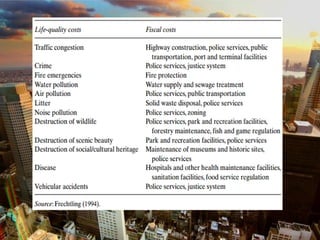
Tourism’s negative impacts at the destination
The economic impact
of tourism
The economic impact
of tourism
The dimension of tourism worldwide
has an economical, social, cultural
and environmental influence on
tourism destinations (Mathieson and
Wall, 1982), and the influence can be
positive and/or negative
■ Income
generation
■ Employment
generation
■ Tax revenue
generation
■ Balance of payment effects
■ Economic disadvantages
■ Improvement of the
economic structure
of a region
■ Encouragement of
entrepreneurial
activity
Six major factors govern
the magnitude of the
economic impact:
■ The volume and intensity of
expenditure
■ The level of economic
development in the
destination
■ The size of the economic
base of the destination
■ The degree to which
tourist expenditures
recirculate within the
destination
■ The degree to which the destination
has adjusted to the seasonality of
tourist demand (Mathieson and
Wall, 1982).
■ The nature of the main facility and its
attrac-tiveness
Comparative advantages
of tourism
1. Natural resources, culture and cultural heritage
2. Human resources
3. Capital and infrastructure resources.
■ The types of suppliers and producers with which the industry’s demands are linked
■ The ability of local suppliers to meet these demands
■ The historical development of tourism in the destination area
■ The type of tourist development.
economic
Disadvantages
Cost inflation is a consequence of a number of factors:
■ Peak management
■ High taxes on some tourist
■ products and services.
Tourism and inflation
■ Seasonal demand
■ Inelastic supply
■ An insufficient market reaction (certain resorts or firms profit from an eco-
nomic rent)
■ Imported inflation due to international arrivals (impact of hard currencies and
increase of the money mass).
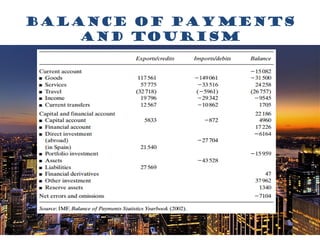
Balance of payments
and tourism
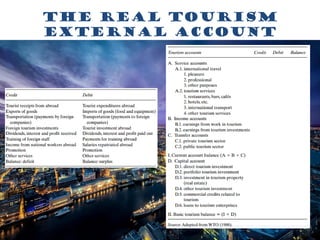
The real tourism
external account
The magic tourism
multiplier
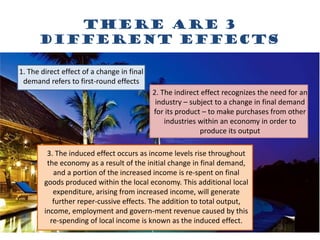
There are 3
different effects
1. The direct effect of a change in final
demand refers to first-round effects
2. The indirect effect recognizes the need for an
industry – subject to a change in final demand
for its product – to make purchases from other
industries within an economy in order to
produce its output
3. The induced effect occurs as income levels rise throughout
the economy as a result of the initial change in final demand,
and a portion of the increased income is re-spent on final
goods produced within the local economy. This additional local
expenditure, arising from increased income, will generate
further reper-cussive effects. The addition to total output,
income, employment and govern-ment revenue caused by this
re-spending of local income is known as the induced effect.
Determining factors
1. The saving quota of the population of the destination
2. The import quota, or the share of tourism expenditure that is spent to imported products
3. The tax quota, or the share going to the public sector.
4. A fourth possible factor is the supply constraints in the economy
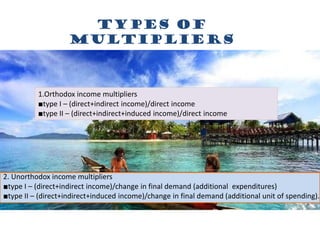
Types of
multipliers
1.Orthodox income multipliers
■type I – (direct+indirect income)/direct income
■type II – (direct+indirect+induced income)/direct income
2. Unorthodox income multipliers
■type I – (direct+indirect income)/change in final demand (additional expenditures)
■type II – (direct+indirect+induced income)/change in final demand (additional unit of spending).
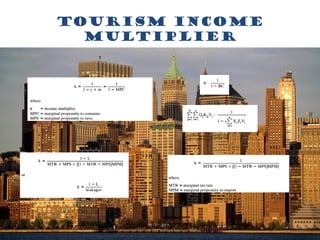
Tourism Income
Multiplier
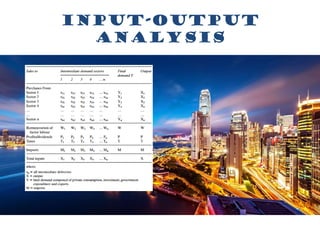
Input-output
analysis
The Tourism
Satellite Account
approach
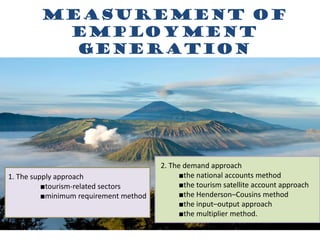
measurement of
employment
generation
1. The supply approach
■tourism-related sectors
■minimum requirement method
2. The demand approach
■the national accounts method
■the tourism satellite account approach
■the Henderson–Cousins method
■the input–output approach
■the multiplier method.
The input–output
approach
The multiplier
method
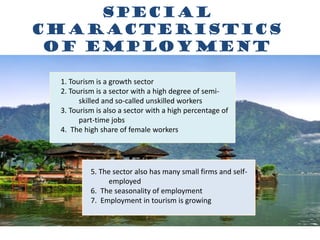
Special
characteristics
of employment
1. Tourism is a growth sector
2. Tourism is a sector with a high degree of semi-
skilled and so-called unskilled workers
3. Tourism is also a sector with a high percentage of
part-time jobs
4. The high share of female workers
5. The sector also has many small firms and self-
employed
6. The seasonality of employment
7. Employment in tourism is growing
Cost–benefit analysis
Cost–benefit analysis takes these crowding-out
effects into account through the application of
the ‘with and without’ and not the ‘before and
after’ principle (Vanhove, 1976).
Crowding-out’ effects
Major events always involve ‘crowding-out’
effects, expenditure switching and retained
expenditure. Big events are very often confronted
with crowding-out effects, when traditional
visitors prefer not to visit the region where the
event takes place for reasons of over occupation,
higher prices, etc. (Scherly and Breiter, 2002)
The impact of
events

Tourism Impact

  • 2.
    Tourism’s positive impactsin society and at the destination
  • 3.
    Tourism’s negative impactsat the destination
  • 4.
  • 5.
    The economic impact oftourism The dimension of tourism worldwide has an economical, social, cultural and environmental influence on tourism destinations (Mathieson and Wall, 1982), and the influence can be positive and/or negative ■ Income generation ■ Employment generation ■ Tax revenue generation ■ Balance of payment effects ■ Economic disadvantages ■ Improvement of the economic structure of a region ■ Encouragement of entrepreneurial activity
  • 6.
    Six major factorsgovern the magnitude of the economic impact: ■ The volume and intensity of expenditure ■ The level of economic development in the destination ■ The size of the economic base of the destination ■ The degree to which tourist expenditures recirculate within the destination ■ The degree to which the destination has adjusted to the seasonality of tourist demand (Mathieson and Wall, 1982). ■ The nature of the main facility and its attrac-tiveness
  • 7.
    Comparative advantages of tourism 1.Natural resources, culture and cultural heritage 2. Human resources 3. Capital and infrastructure resources. ■ The types of suppliers and producers with which the industry’s demands are linked ■ The ability of local suppliers to meet these demands ■ The historical development of tourism in the destination area ■ The type of tourist development.
  • 8.
    economic Disadvantages Cost inflation isa consequence of a number of factors: ■ Peak management ■ High taxes on some tourist ■ products and services. Tourism and inflation ■ Seasonal demand ■ Inelastic supply ■ An insufficient market reaction (certain resorts or firms profit from an eco- nomic rent) ■ Imported inflation due to international arrivals (impact of hard currencies and increase of the money mass).
  • 10.
  • 11.
  • 12.
  • 13.
    There are 3 differenteffects 1. The direct effect of a change in final demand refers to first-round effects 2. The indirect effect recognizes the need for an industry – subject to a change in final demand for its product – to make purchases from other industries within an economy in order to produce its output 3. The induced effect occurs as income levels rise throughout the economy as a result of the initial change in final demand, and a portion of the increased income is re-spent on final goods produced within the local economy. This additional local expenditure, arising from increased income, will generate further reper-cussive effects. The addition to total output, income, employment and govern-ment revenue caused by this re-spending of local income is known as the induced effect.
  • 14.
    Determining factors 1. Thesaving quota of the population of the destination 2. The import quota, or the share of tourism expenditure that is spent to imported products 3. The tax quota, or the share going to the public sector. 4. A fourth possible factor is the supply constraints in the economy
  • 15.
    Types of multipliers 1.Orthodox incomemultipliers ■type I – (direct+indirect income)/direct income ■type II – (direct+indirect+induced income)/direct income 2. Unorthodox income multipliers ■type I – (direct+indirect income)/change in final demand (additional expenditures) ■type II – (direct+indirect+induced income)/change in final demand (additional unit of spending).
  • 16.
  • 17.
  • 19.
  • 20.
    measurement of employment generation 1. Thesupply approach ■tourism-related sectors ■minimum requirement method 2. The demand approach ■the national accounts method ■the tourism satellite account approach ■the Henderson–Cousins method ■the input–output approach ■the multiplier method.
  • 21.
  • 22.
  • 23.
    Special characteristics of employment 1. Tourismis a growth sector 2. Tourism is a sector with a high degree of semi- skilled and so-called unskilled workers 3. Tourism is also a sector with a high percentage of part-time jobs 4. The high share of female workers 5. The sector also has many small firms and self- employed 6. The seasonality of employment 7. Employment in tourism is growing
  • 24.
    Cost–benefit analysis Cost–benefit analysistakes these crowding-out effects into account through the application of the ‘with and without’ and not the ‘before and after’ principle (Vanhove, 1976). Crowding-out’ effects Major events always involve ‘crowding-out’ effects, expenditure switching and retained expenditure. Big events are very often confronted with crowding-out effects, when traditional visitors prefer not to visit the region where the event takes place for reasons of over occupation, higher prices, etc. (Scherly and Breiter, 2002) The impact of events