TOTAL QUALITY MANAGEMENT -A Road Map to Corporate Excellence
What is TQM Total Quality Management (TQM) is an integrated organizational approach in delighting customers (both internal and external) by meeting their expectations all the time through everyone involved within the organization working on continuous improvement improvement in all products/services/processes along with structured methodology.
In TQM, Total  involvement of all levels in the organization Quality  conformance to agreed upon requirements Management  best use of available resources to achieve total quality
Advantages of TQM Helps to focus clearly on the needs of the market Facilitate to aspire for top quality performer Channelises the procedures necessary to achieve quality performance Helps examine critically and continuously all processes to remove non-productive activities and waste Gears organization to fully understand the competition and develop an effective combating strategy Helps develop good procedures for communication  Helps revive the process needed to develop the strategy of never ending improvement
TANGIBLE GAINS Better product quality Productivity improvement Reduced quality costs Increased market Increased profitability Reduced employee grievances INTANGIBILE GAINS Effective team work Enhancement of job interest Improvement in human relations and work area morale Participative culture Customer satisfaction Improved communication Enhanced problem-solving capacity Improved corporate health and character of company Better company image
TQM focuses on:- Customer satisfaction Leadership Quality policy Organizational structure Training for TQM Quality cost Supplier selection and development Employee involvement Quality Circles Recognition and reward
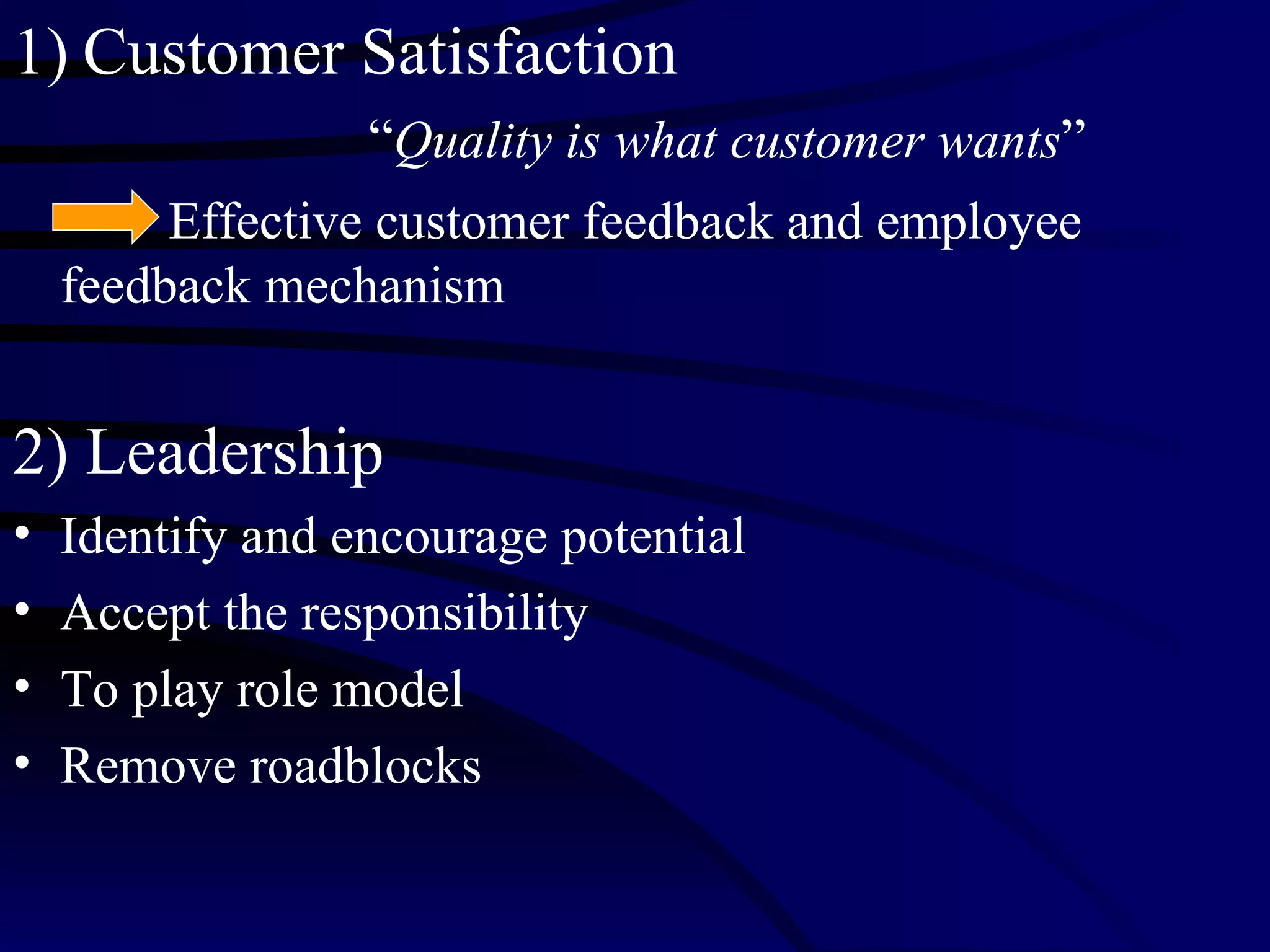
1)   Customer Satisfaction “ Quality is what customer wants ” Effective customer feedback and employee feedback mechanism 2) Leadership Identify and encourage potential Accept the responsibility To play role model Remove roadblocks
3) Quality Policy and Mission Statement Should be definite, clear and easily understood by the whole organization Should be well written and documented Should provide rallying point, uniting people towards achievement of total quality Should be communicated properly to one and all in the organization
4) Organizational Structure   FACILITATOR   OR TQM PROMOTION  CORRECTIVE COMMITTEE  ACTION TEAMS  QUALITY STEERING COMITEE QUALITY IMPROVEMENT TEAMS
5) Training For TQM Fundamentals of TQM taught from top to bottom 6) Cost Of Quality 7) Supplier Selection And Development Quality depends on quality of purchased product 8) Employee Involvement Participation and Teamwork
9) Quality Circles Conceived by Dr. Kaoru Ishikawa in 1961 Optimum size of 7-8 members Membership strictly voluntary Problem identification, selection, analysis, solution formation, management presentation and approval 10) Recognition and Reward
ISO 9000 Beginning of journey towards TQM  ISO 9001, 9002 & 9003 Tools For TQM Business Process Re-Engineering (BPR) Benchmarking Empowerment
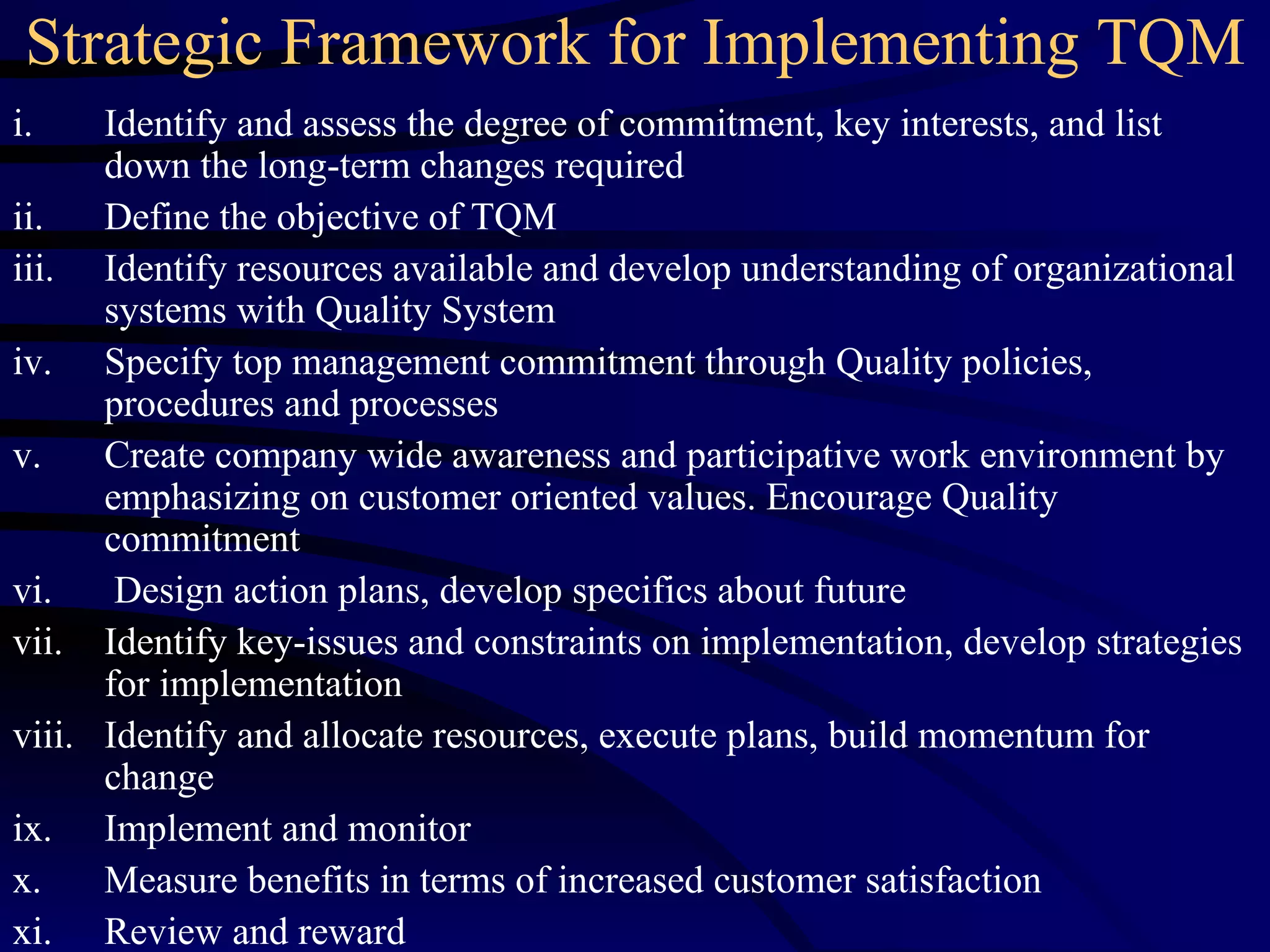
Strategic Framework for Implementing TQM Identify and assess the degree of commitment, key interests, and list down the long-term changes required Define the objective of TQM Identify resources available and develop understanding of organizational systems with Quality System Specify top management commitment through Quality policies, procedures and processes Create company wide awareness and participative work environment by emphasizing on customer oriented values. Encourage Quality commitment Design action plans, develop specifics about future Identify key-issues and constraints on implementation, develop strategies for implementation  Identify and allocate resources, execute plans, build momentum for change  Implement and monitor  Measure benefits in terms of increased customer satisfaction Review and reward
Conclusion In a nutshell,  TQM will increase productivity, will eliminate wastes, reduce non-conformances, optimize costs, increase the profitability , will enrich the employees life and will help the industry to meet it’s societal obligation. Total Quality Management is a marathon and not a sprint

Total Quality Management-A Road Map to Corporate Excellence

  • 1.
    TOTAL QUALITY MANAGEMENT-A Road Map to Corporate Excellence
  • 2.
    What is TQMTotal Quality Management (TQM) is an integrated organizational approach in delighting customers (both internal and external) by meeting their expectations all the time through everyone involved within the organization working on continuous improvement improvement in all products/services/processes along with structured methodology.
  • 3.
    In TQM, Total involvement of all levels in the organization Quality conformance to agreed upon requirements Management best use of available resources to achieve total quality
  • 4.
    Advantages of TQMHelps to focus clearly on the needs of the market Facilitate to aspire for top quality performer Channelises the procedures necessary to achieve quality performance Helps examine critically and continuously all processes to remove non-productive activities and waste Gears organization to fully understand the competition and develop an effective combating strategy Helps develop good procedures for communication Helps revive the process needed to develop the strategy of never ending improvement
  • 5.
    TANGIBLE GAINS Betterproduct quality Productivity improvement Reduced quality costs Increased market Increased profitability Reduced employee grievances INTANGIBILE GAINS Effective team work Enhancement of job interest Improvement in human relations and work area morale Participative culture Customer satisfaction Improved communication Enhanced problem-solving capacity Improved corporate health and character of company Better company image
  • 6.
    TQM focuses on:-Customer satisfaction Leadership Quality policy Organizational structure Training for TQM Quality cost Supplier selection and development Employee involvement Quality Circles Recognition and reward
  • 7.
    1) Customer Satisfaction “ Quality is what customer wants ” Effective customer feedback and employee feedback mechanism 2) Leadership Identify and encourage potential Accept the responsibility To play role model Remove roadblocks
  • 8.
    3) Quality Policyand Mission Statement Should be definite, clear and easily understood by the whole organization Should be well written and documented Should provide rallying point, uniting people towards achievement of total quality Should be communicated properly to one and all in the organization
  • 9.
    4) Organizational Structure FACILITATOR OR TQM PROMOTION CORRECTIVE COMMITTEE ACTION TEAMS QUALITY STEERING COMITEE QUALITY IMPROVEMENT TEAMS
  • 10.
    5) Training ForTQM Fundamentals of TQM taught from top to bottom 6) Cost Of Quality 7) Supplier Selection And Development Quality depends on quality of purchased product 8) Employee Involvement Participation and Teamwork
  • 11.
    9) Quality CirclesConceived by Dr. Kaoru Ishikawa in 1961 Optimum size of 7-8 members Membership strictly voluntary Problem identification, selection, analysis, solution formation, management presentation and approval 10) Recognition and Reward
  • 12.
    ISO 9000 Beginningof journey towards TQM ISO 9001, 9002 & 9003 Tools For TQM Business Process Re-Engineering (BPR) Benchmarking Empowerment
  • 13.
    Strategic Framework forImplementing TQM Identify and assess the degree of commitment, key interests, and list down the long-term changes required Define the objective of TQM Identify resources available and develop understanding of organizational systems with Quality System Specify top management commitment through Quality policies, procedures and processes Create company wide awareness and participative work environment by emphasizing on customer oriented values. Encourage Quality commitment Design action plans, develop specifics about future Identify key-issues and constraints on implementation, develop strategies for implementation Identify and allocate resources, execute plans, build momentum for change Implement and monitor Measure benefits in terms of increased customer satisfaction Review and reward
  • 14.
    Conclusion In anutshell, TQM will increase productivity, will eliminate wastes, reduce non-conformances, optimize costs, increase the profitability , will enrich the employees life and will help the industry to meet it’s societal obligation. Total Quality Management is a marathon and not a sprint