“STEPS TO IMPLEMENT TQM IN AN
ORGANIZATION – A CASE STUDY”
Submitted By
RAJASEKHARA MUDDANA
ADM NO: HPGD/JL15/4477
SPECILIZATION: OPERATIONS MANAGEMENT
PRIN. L. N. WELINGKAR INSTITUTE OF MANAGEMENT DEVELOPMENT &
RESEARCH
JUNE-2017
Introduction:
Competition is getting harder and becoming global. Companies now have to
be more responsive, offer a better product and keep improving. Total quality
management (TQM) increases customer satisfaction by boosting quality.
It does this by motivating the workforce and improving the way the company
operates. In an increasingly competitive market, firms with a continuous
improvement culture and external focus are more likely to survive and prosper.
TQM is considered an important catalyst in this context.
What is Total Quality Management:
 TQM is an approach to improving the effectiveness and flexibilities of
business as a whole.
 It is essentially a way of organizing and involving the whole organization,
every department, every activity and every single person at every level.
 TQM ensures that the management adopts a strategic overview of the
quality and focuses on prevention rather than inspection.
History:
From holistic historical review quality revolution, we can deduce that Quality
can be classified into four evolutionary phases:
 Inspection
 Quality control
 Quality assurance
 TOTAL QUALITY MANAGEMENT
History of Total Quality Management:
TQM involves methodology for continually improving the quality of all
processes, it draws on a knowledge of the principles & practices of:
 The Behavioral Sciences
 The Analysis of Quantitative & Non-Quantitative Data
 Economics Theories
 Process Analysis
Objectives of TQM:
 Meeting the customer's requirements is the primary objective and the key to
organizational survival and growth.
 The second objective of TQM is continuous improvement of quality. The
management should stimulate the employees in becoming increasingly
competent and creative.
 Third, TQM aims at developing the relationship of openness and trust
among the employees at all levels in the organization.
Significance of TQM:
The importance of TQM lies in the fact that it encourages innovation, makes
the organization adaptable to change, motivates people for better quality, and
integrates the business arising out of a common purpose and all these provide
the organization with a valuable and distinctive competitive edge.
Benefits of TQM:
 Improve Quality
 Employee Participation & Satisfaction
 Teamwork & Working Relationships
 Profitability & Market Share
 Productivity
 Communication
Classification of TQM Tools:
Qualitative Tools: Consist mainly of subjective inputs, which often do not intend to
measure something of a numerical nature.
Quantitative Tools: Involve either the extension of historical data or the analysis of
objective data, which usually avoid personal biases that sometimes contaminate
qualitative tools.
Categories of TQM Tools:
Qualitative tools:
• Flow Charts
• Cause-and-effect Diagrams
• Multi-voting
• Affinity Diagram
• Process Action Teams
• Brainstorming
• Election Grids
• Task Lists.
Qualitative tools:
• Shewart cycle (PDCA)
• Control charts
• Scatter diagrams
• Pareto charts
• Sampling
• Run charts
• Histograms.
TQM Tools As Primary Area Of Implementation:
1) Customer-based
2) Management-based
3) Employee-based
4) Supplier-based
5) Process-based
6) Product-based.
Customer
based
Management
based
Employee
based
Supplier
Based
Process
Based
Product
based
Customer
survey
Communicati
on
Empowerme
nt
Supplier training Just in time Bench
marking
Customer
need analysis
leadership circles
Quality
Supplier
documentation
Quality
improveme
t
Design of
experiments
Quality
function
deployment
Cross-
training
Supplier
certification
Lead time
reduction
Concurrent
engineering
Quality Bench
marking
Product flow
analysis
Brainstormin
g
Nominal
group
technique
Steps in Implementing TQM:
 OBTAIN CEO COMMITMENT
 EDUCATE UPPER-LEVEL MGT
 CREATE STEERING COMMITTEE
 OUTLINE THE VISION STATEMENT, MISSION STATEMENT & GUIDING PRINCIPLES
 PREPARE A FLOW DIAGRAM OF COMPANY PROCESSES
 FOCUS ON THE OWNER/CUSTOMER & SURVEYS
 CONSIDER THE EMPLOYEE AS AN INTERNAL OWNER/CUSTOMER
 PROVIDE A QUALITY TRAINING PROGRAM
 ESTABLISH QUALITY IMPROVEMENT TEAMS
 IMPLEMENT PROCESS IMPROVEMENTS
 USE THE TOOLS OF TQM
 KNOW THE BENEFITS OF TQM
Implementation Tips for Winning Organizations
According to Tom Peters, the following are the requirements of winning organization:
1. Total Quality Management
2. Reengineering
3. Leveraging knowledge (sharing information rather than hoarding it)
4. Curious cannibalistic corporation (adventurous and bold)
5. Virtual organization
6. Empowerment
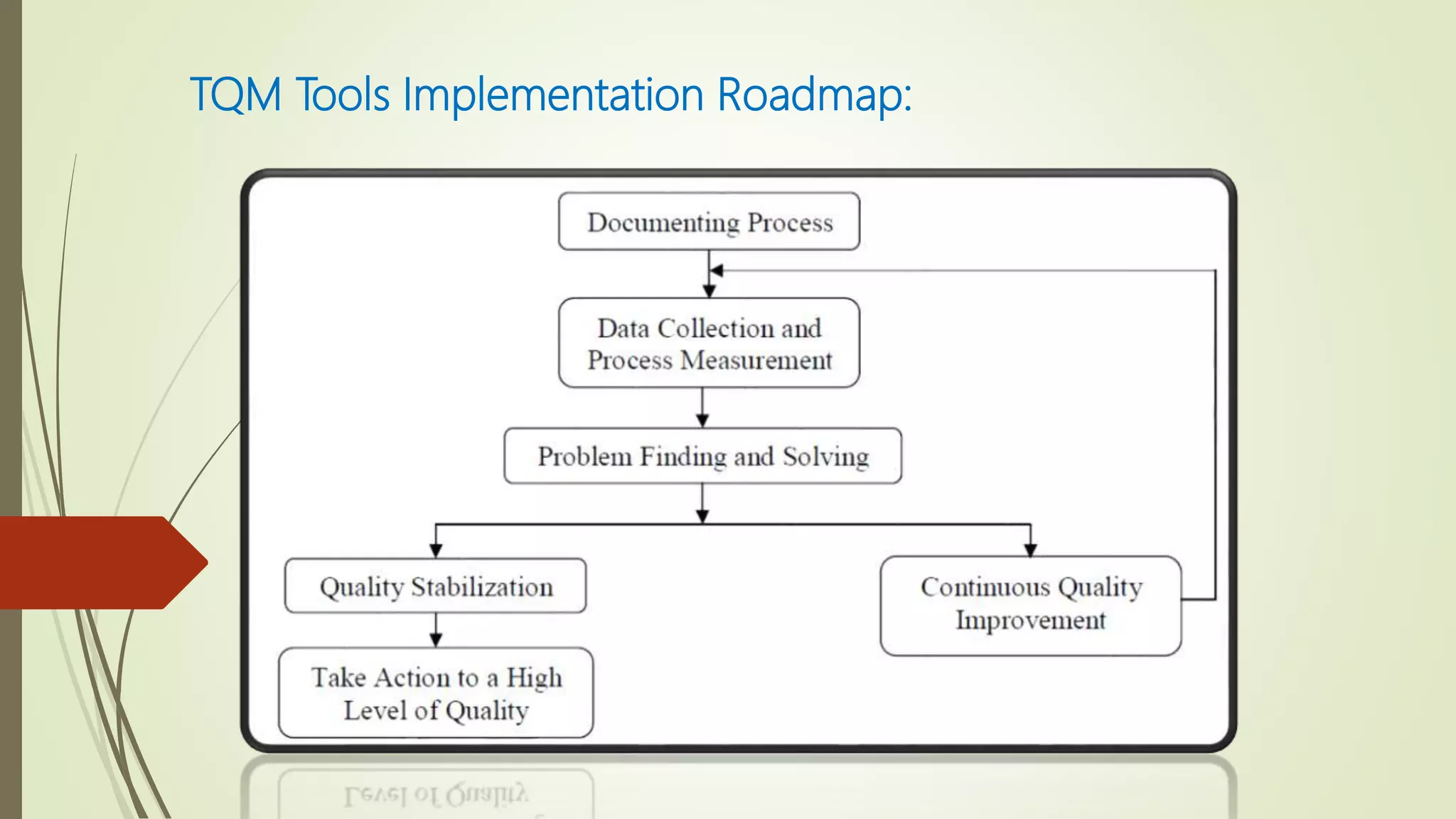
TQM Tools Implementation Roadmap:
Table 4.3 Total Quality Management: It indicates what TQM is and what is not.
Table 4.4 TQM Company Vs Others: The differences between organization practicing
TQM and others.
Implementation Of TQM (PDCA Way)
CHECK
5. Observe results
6. Analyze Results
ACT
7. Prevent undesired effects
8. Measure for improvements
PLAN
1. Policies and objectives
2. Methods to achieve objectives
DO
3.Education and Training
4. Implementation of Change
Steps in TQM Process
Elements of TQM:
 Be customer focused
It requires the company to check customers' attitudes regularly and includes the idea of
internal customers as well as external ones.
 Do it right the first time
This means avoiding rework, i.e., cutting the amount of defective work.
 Constantly improve
Continuous improvement allows the company gradually to get better.
 Quality is an attitude
Every one has to be committed to quality. That means changing the attitude of the entire
workforce, and altering the way the company operates.
 Telling staff what is going on
This involves improved communication. Typically, it includes team briefing.
 Educate and train people
An unskilled workforce makes mistakes. Giving more skills to workers means they can do a
wider range of jobs, and do them better. It also means educating staff in the principles of
TQM, which is a whole new style of working.
 Measure the work.
Measurement allows the company to make decisions based on facts, not opinion. It helps to
maintain standards and keep processes within the agreed tolerances.
 Top management must be involved
If senior management is not involved, the programme will fail.
 Make it a good place to work
Many companies are full of fear. Staffs are afraid of the sack, their boss and making
There is no point in running a TQM program unless the company drives out fear.
 Introduce team work
Team work boosts employees' morale. It reduces conflict and solves problem by hitting
with a wider range of skills. It pushes authority and responsibility downwards and provides
better, more balanced solutions.
 Organize by process, not by function
This element of TQM seeks to reduce the barriers that exist between different departments,
and concentrates on getting the product to the customer.
Reasons for FAILURE:
TQM fails because:
 Top management sees no reason for change.
 Top management is not concerned for its staff.
 Top management is not committed to the TQM programme.
 The company loses interest in the programme after six months.
 The workforce and the management do not agree on what needs to happen.
 Urgent problems intervene.
 TQM is imposed on the workforce, which does not inwardly accept it.
 No performance measure or targets are set, so progress cannot be measured.
 Processes are not analyzed, systems are weak and procedures are not written down.
Conclusion
The correct selection and use of tools and techniques is a vital component of any
successful TQM implementation plan. The TQM tools and techniques can be divided
into simple tools for solving a special problem and complex one that cover all
functions within the company.
Thank You!

STEPS TO IMPLEMENT TQM IN AN ORGANIZATION – A CASE STUDY

  • 1.
    “STEPS TO IMPLEMENTTQM IN AN ORGANIZATION – A CASE STUDY” Submitted By RAJASEKHARA MUDDANA ADM NO: HPGD/JL15/4477 SPECILIZATION: OPERATIONS MANAGEMENT PRIN. L. N. WELINGKAR INSTITUTE OF MANAGEMENT DEVELOPMENT & RESEARCH JUNE-2017
  • 2.
    Introduction: Competition is gettingharder and becoming global. Companies now have to be more responsive, offer a better product and keep improving. Total quality management (TQM) increases customer satisfaction by boosting quality. It does this by motivating the workforce and improving the way the company operates. In an increasingly competitive market, firms with a continuous improvement culture and external focus are more likely to survive and prosper. TQM is considered an important catalyst in this context.
  • 3.
    What is TotalQuality Management:  TQM is an approach to improving the effectiveness and flexibilities of business as a whole.  It is essentially a way of organizing and involving the whole organization, every department, every activity and every single person at every level.  TQM ensures that the management adopts a strategic overview of the quality and focuses on prevention rather than inspection.
  • 4.
    History: From holistic historicalreview quality revolution, we can deduce that Quality can be classified into four evolutionary phases:  Inspection  Quality control  Quality assurance  TOTAL QUALITY MANAGEMENT
  • 5.
    History of TotalQuality Management: TQM involves methodology for continually improving the quality of all processes, it draws on a knowledge of the principles & practices of:  The Behavioral Sciences  The Analysis of Quantitative & Non-Quantitative Data  Economics Theories  Process Analysis
  • 6.
    Objectives of TQM: Meeting the customer's requirements is the primary objective and the key to organizational survival and growth.  The second objective of TQM is continuous improvement of quality. The management should stimulate the employees in becoming increasingly competent and creative.  Third, TQM aims at developing the relationship of openness and trust among the employees at all levels in the organization.
  • 7.
    Significance of TQM: Theimportance of TQM lies in the fact that it encourages innovation, makes the organization adaptable to change, motivates people for better quality, and integrates the business arising out of a common purpose and all these provide the organization with a valuable and distinctive competitive edge.
  • 8.
    Benefits of TQM: Improve Quality  Employee Participation & Satisfaction  Teamwork & Working Relationships  Profitability & Market Share  Productivity  Communication
  • 9.
    Classification of TQMTools: Qualitative Tools: Consist mainly of subjective inputs, which often do not intend to measure something of a numerical nature. Quantitative Tools: Involve either the extension of historical data or the analysis of objective data, which usually avoid personal biases that sometimes contaminate qualitative tools. Categories of TQM Tools: Qualitative tools: • Flow Charts • Cause-and-effect Diagrams • Multi-voting • Affinity Diagram • Process Action Teams • Brainstorming • Election Grids • Task Lists. Qualitative tools: • Shewart cycle (PDCA) • Control charts • Scatter diagrams • Pareto charts • Sampling • Run charts • Histograms.
  • 10.
    TQM Tools AsPrimary Area Of Implementation: 1) Customer-based 2) Management-based 3) Employee-based 4) Supplier-based 5) Process-based 6) Product-based. Customer based Management based Employee based Supplier Based Process Based Product based Customer survey Communicati on Empowerme nt Supplier training Just in time Bench marking Customer need analysis leadership circles Quality Supplier documentation Quality improveme t Design of experiments Quality function deployment Cross- training Supplier certification Lead time reduction Concurrent engineering Quality Bench marking Product flow analysis Brainstormin g Nominal group technique
  • 11.
    Steps in ImplementingTQM:  OBTAIN CEO COMMITMENT  EDUCATE UPPER-LEVEL MGT  CREATE STEERING COMMITTEE  OUTLINE THE VISION STATEMENT, MISSION STATEMENT & GUIDING PRINCIPLES  PREPARE A FLOW DIAGRAM OF COMPANY PROCESSES  FOCUS ON THE OWNER/CUSTOMER & SURVEYS  CONSIDER THE EMPLOYEE AS AN INTERNAL OWNER/CUSTOMER  PROVIDE A QUALITY TRAINING PROGRAM  ESTABLISH QUALITY IMPROVEMENT TEAMS  IMPLEMENT PROCESS IMPROVEMENTS  USE THE TOOLS OF TQM  KNOW THE BENEFITS OF TQM
  • 12.
    Implementation Tips forWinning Organizations According to Tom Peters, the following are the requirements of winning organization: 1. Total Quality Management 2. Reengineering 3. Leveraging knowledge (sharing information rather than hoarding it) 4. Curious cannibalistic corporation (adventurous and bold) 5. Virtual organization 6. Empowerment
  • 13.
  • 14.
    Table 4.3 TotalQuality Management: It indicates what TQM is and what is not. Table 4.4 TQM Company Vs Others: The differences between organization practicing TQM and others.
  • 15.
    Implementation Of TQM(PDCA Way) CHECK 5. Observe results 6. Analyze Results ACT 7. Prevent undesired effects 8. Measure for improvements PLAN 1. Policies and objectives 2. Methods to achieve objectives DO 3.Education and Training 4. Implementation of Change Steps in TQM Process
  • 16.
    Elements of TQM: Be customer focused It requires the company to check customers' attitudes regularly and includes the idea of internal customers as well as external ones.  Do it right the first time This means avoiding rework, i.e., cutting the amount of defective work.  Constantly improve Continuous improvement allows the company gradually to get better.  Quality is an attitude Every one has to be committed to quality. That means changing the attitude of the entire workforce, and altering the way the company operates.
  • 17.
     Telling staffwhat is going on This involves improved communication. Typically, it includes team briefing.  Educate and train people An unskilled workforce makes mistakes. Giving more skills to workers means they can do a wider range of jobs, and do them better. It also means educating staff in the principles of TQM, which is a whole new style of working.  Measure the work. Measurement allows the company to make decisions based on facts, not opinion. It helps to maintain standards and keep processes within the agreed tolerances.  Top management must be involved If senior management is not involved, the programme will fail.
  • 18.
     Make ita good place to work Many companies are full of fear. Staffs are afraid of the sack, their boss and making There is no point in running a TQM program unless the company drives out fear.  Introduce team work Team work boosts employees' morale. It reduces conflict and solves problem by hitting with a wider range of skills. It pushes authority and responsibility downwards and provides better, more balanced solutions.  Organize by process, not by function This element of TQM seeks to reduce the barriers that exist between different departments, and concentrates on getting the product to the customer.
  • 19.
    Reasons for FAILURE: TQMfails because:  Top management sees no reason for change.  Top management is not concerned for its staff.  Top management is not committed to the TQM programme.  The company loses interest in the programme after six months.  The workforce and the management do not agree on what needs to happen.  Urgent problems intervene.  TQM is imposed on the workforce, which does not inwardly accept it.  No performance measure or targets are set, so progress cannot be measured.  Processes are not analyzed, systems are weak and procedures are not written down.
  • 20.
    Conclusion The correct selectionand use of tools and techniques is a vital component of any successful TQM implementation plan. The TQM tools and techniques can be divided into simple tools for solving a special problem and complex one that cover all functions within the company.
  • 21.