The TPM Guide
Total Productive Maintenance
1. TPM definition (1)
• A company-wide team-based effort to build quality into
equipment and to improve overall equipment
effectiveness
• Total
• all employees are involved
• it aims to eliminate all accidents, defects and breakdowns
• Productive
• actions are performed while production goes on
• troubles for production are minimized
• Maintenance
• keep in good condition
• repair, clean, lubricate
1. TPM definition (2)
• TPM combines the traditionally American
practice of preventive maintenance with
Total Quality Control and Total Employee
Involvement, to create a culture where
operators develop ownership of their
equipment, and become full partners with
Maintenance, Engineering and Management
to assure equipment operates properly
everyday.
2. Origins of TPM
• Dr. Deming introduced statistical analysis and used
the resulting data to control quality during
manufacturing (TQM)
• Some general concepts of TQM did not work well in
the maintenance environment
• The need to go further than preventive maintenance
was quickly recognized by those companies who
were committed to TQM
• Maintenance became an integral part of TQM in the
early 90’s
3. TPM principles
• Increase Overall Equipment Effectiveness
(OEE)
• Improve existing planned maintenance
systems
• The operator is the best condition monitor
• Provide training to upgrade operations and
maintenance skills
• Involve everyone and utilize cross-functional
teamwork
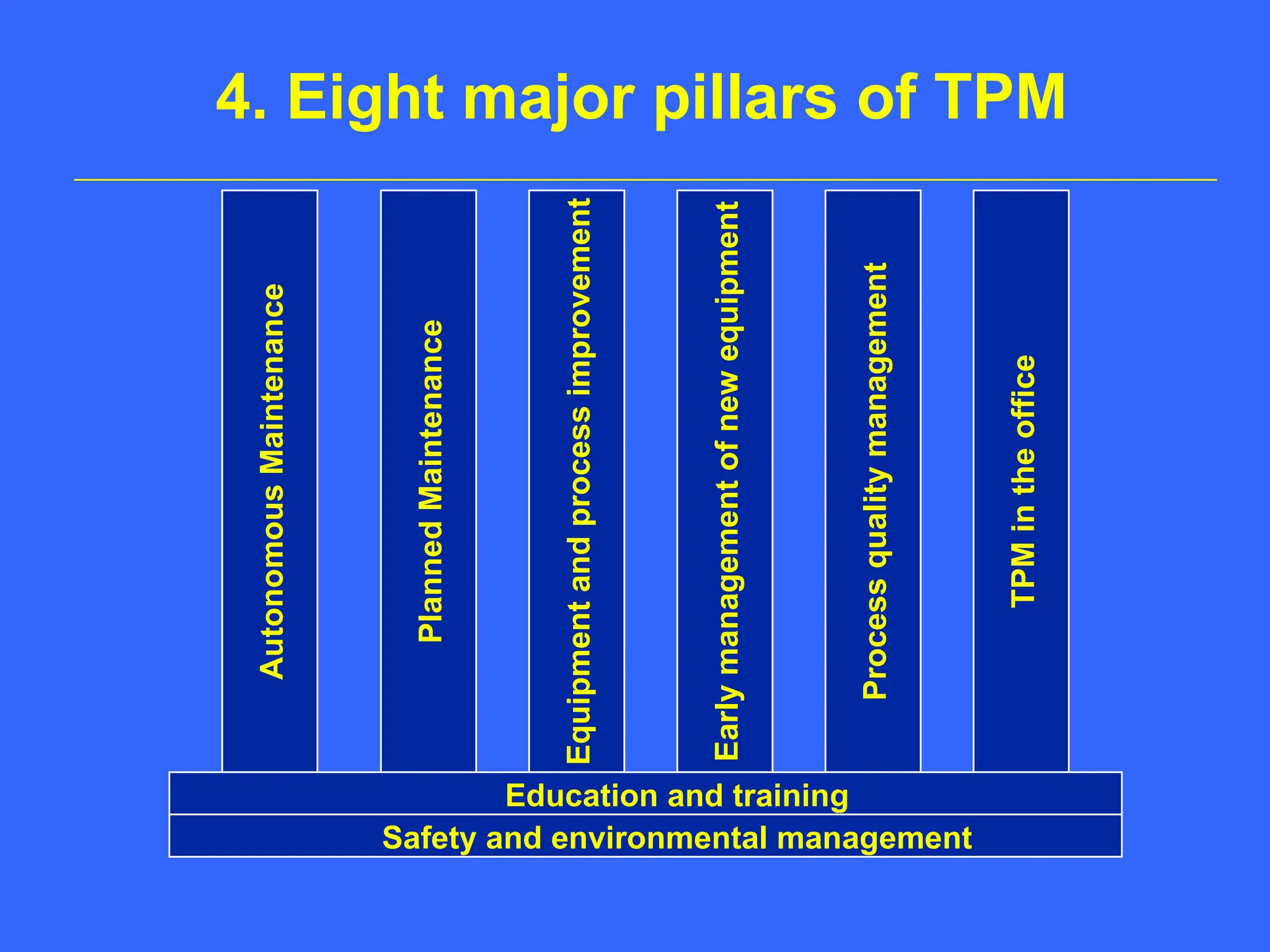
4. Eight major pillars of TPM
Autonomous
Maintenance
Planned
Maintenance
Equipment
and
process
improvement
Early
management
of
new
equipment
Process
quality
management
TPM
in
the
office
Education and training
Safety and environmental management
4. Eight major pillars of TPM
4.1. Autonomous Maintenance (1)
• Train the operators to close the gap
between them and the maintenance staff,
making it easier for both to work as one
team
• Change the equipment so the operator
can identify any abnormal conditions and
measure deterioration before it affects the
process or leads to a failure
4. Eight major pillars of TPM
4.1. Autonomous Maintenance (2)
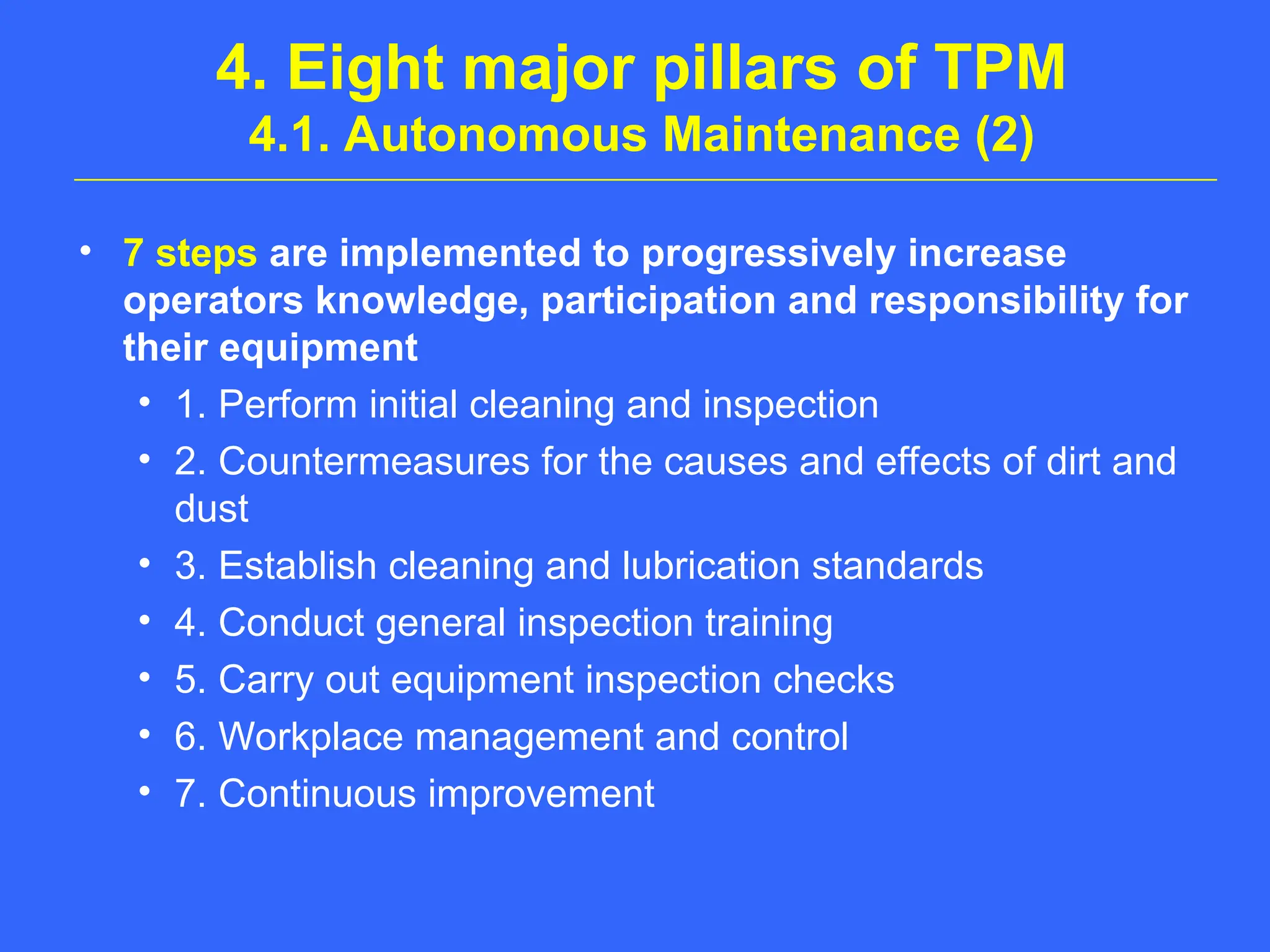
• 7 steps are implemented to progressively increase
operators knowledge, participation and responsibility for
their equipment
• 1. Perform initial cleaning and inspection
• 2. Countermeasures for the causes and effects of dirt and
dust
• 3. Establish cleaning and lubrication standards
• 4. Conduct general inspection training
• 5. Carry out equipment inspection checks
• 6. Workplace management and control
• 7. Continuous improvement
4. Eight major pillars of TPM
4.2. Equipment and process improvement
• Objective: maximize efficiency by eliminating
waste and manufacturing losses
• Manufacturing losses are categorized into 13 big
losses:
• Equipment losses (6)
• Manpower losses (4)
• Material losses (3)
4. Eight major pillars of TPM
4.2. Equipment and process improvement
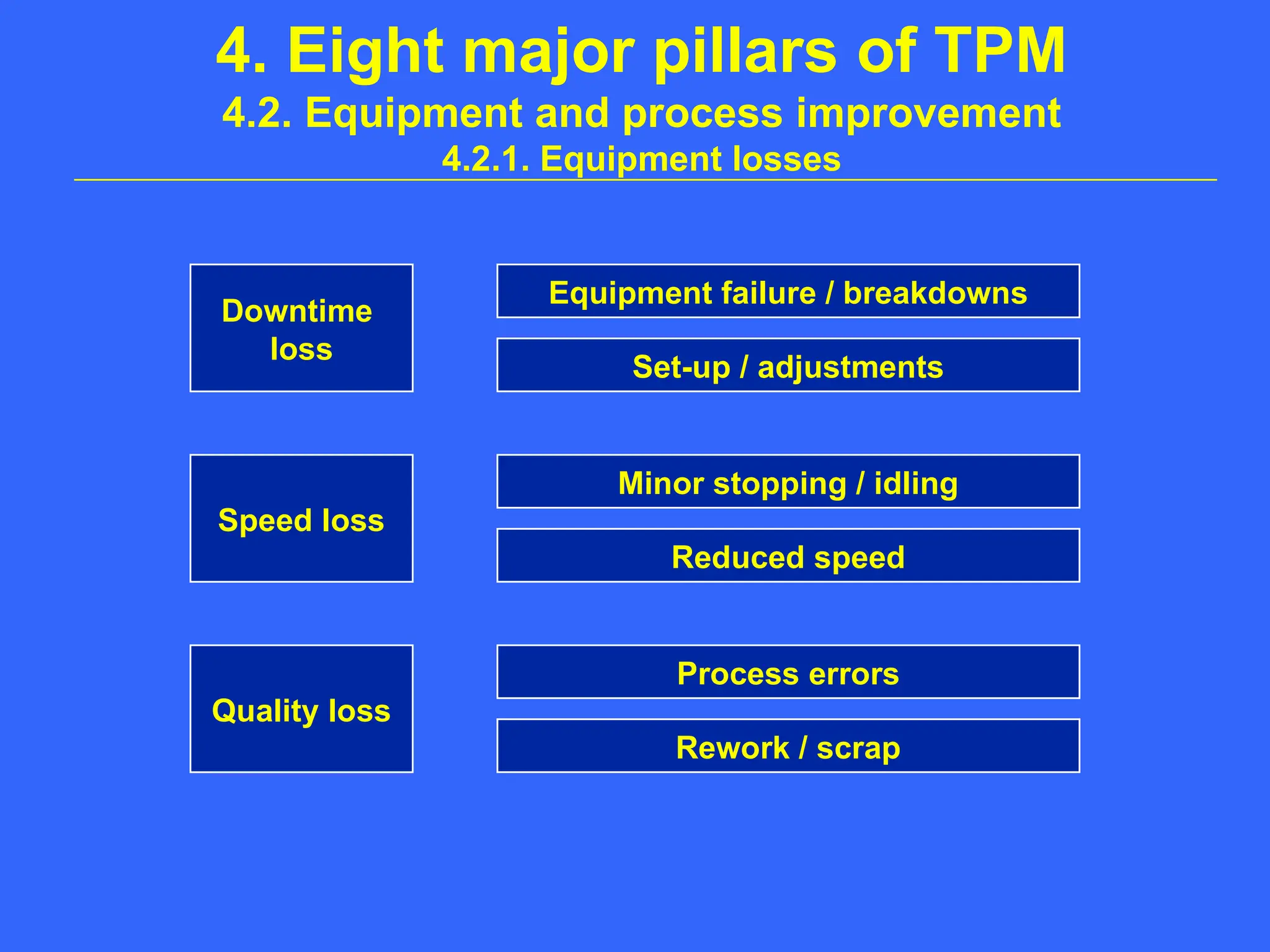
4.2.1. Equipment losses
Downtime
loss
Speed loss
Quality loss
Equipment failure / breakdowns
Set-up / adjustments
Minor stopping / idling
Reduced speed
Process errors
Rework / scrap
4. Eight major pillars of TPM
4.2. Equipment and process improvement
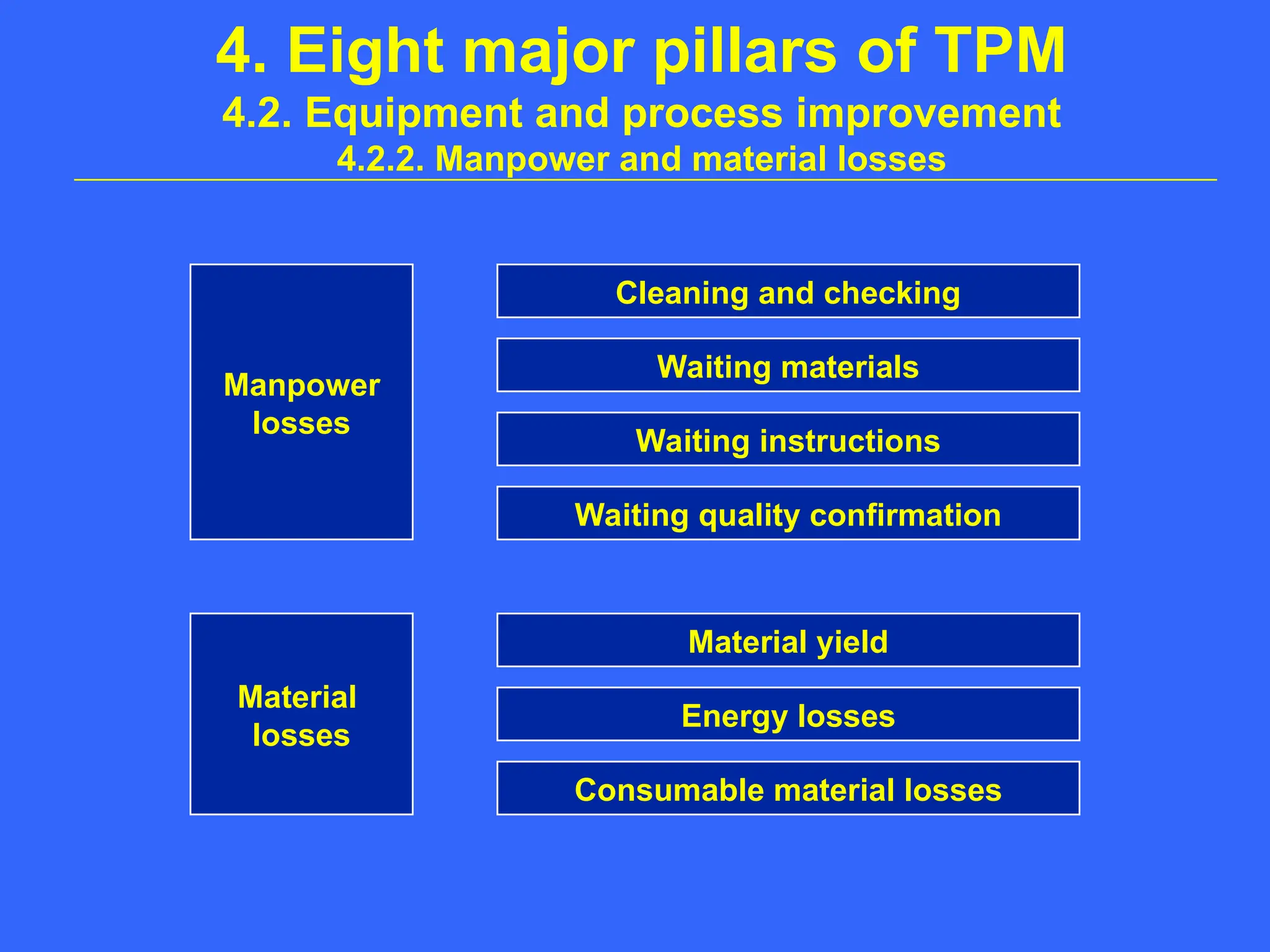
4.2.2. Manpower and material losses
Manpower
losses
Material
losses
Cleaning and checking
Waiting instructions
Waiting quality confirmation
Material yield
Energy losses
Waiting materials
Consumable material losses
4. Eight major pillars of TPM
4.2. Equipment and process improvement
4.2.3 Overall Equipment Effectiveness (OEE)
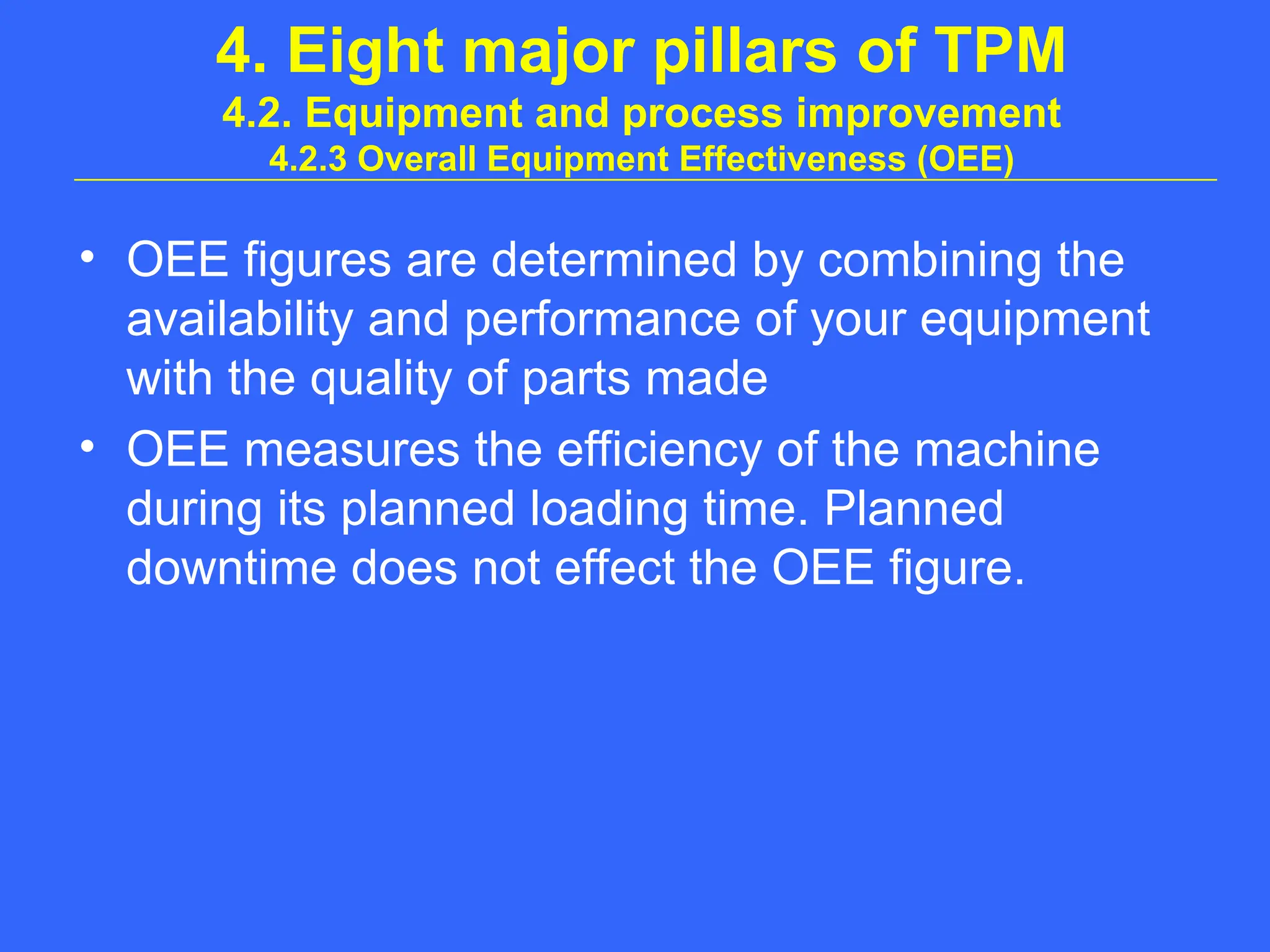
• OEE figures are determined by combining the
availability and performance of your equipment
with the quality of parts made
• OEE measures the efficiency of the machine
during its planned loading time. Planned
downtime does not effect the OEE figure.
4. Eight major pillars of TPM
4.2. Equipment and process improvement
4.2.3 Overall Equipment Effectiveness (OEE)
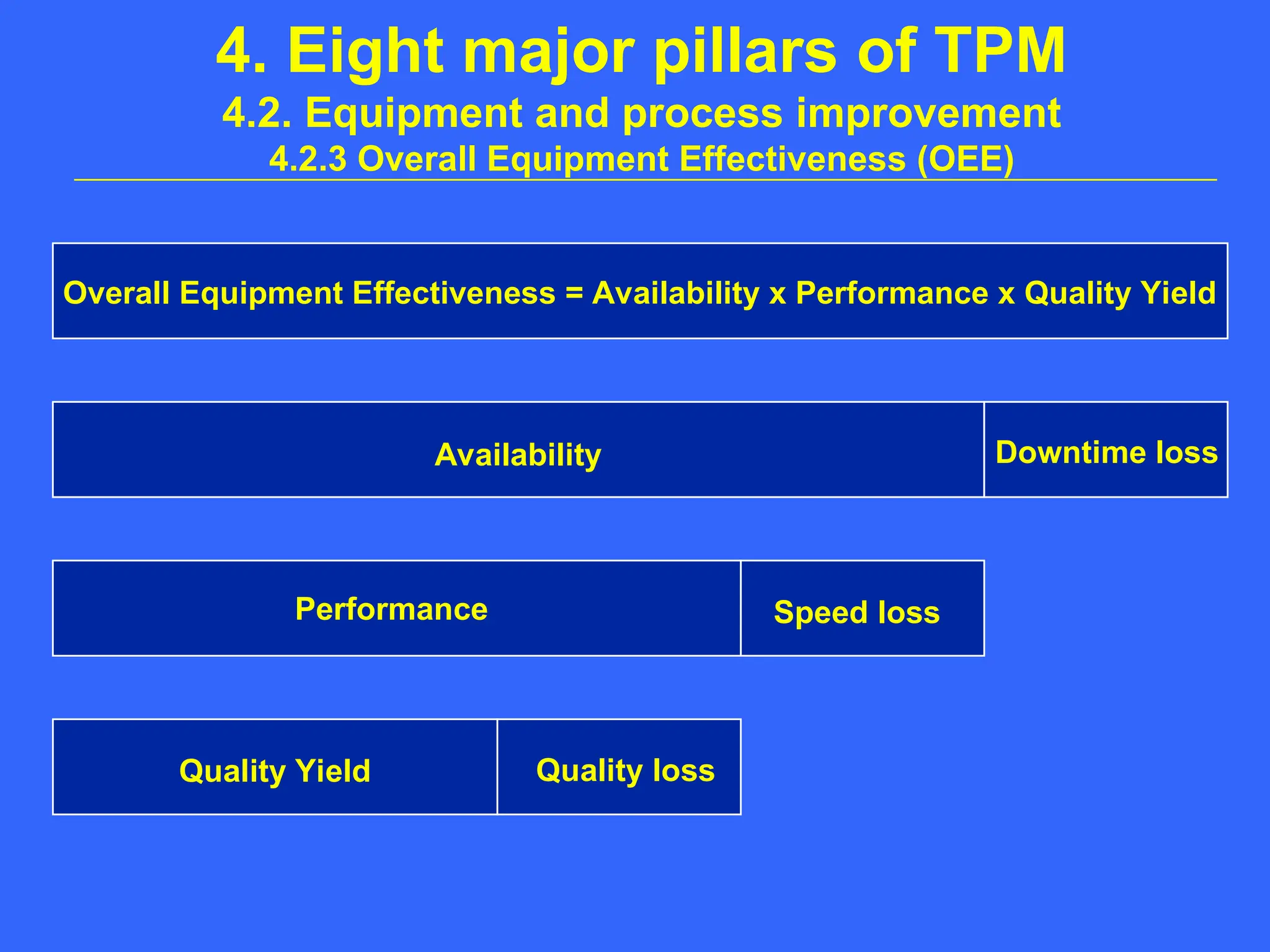
Overall Equipment Effectiveness = Availability x Performance x Quality Yield
Availability Downtime loss
Speed loss
Performance
Quality Yield Quality loss
4. Eight major pillars of TPM
4.2. Equipment and process improvement
4.2.3 Overall Equipment Effectiveness (OEE)
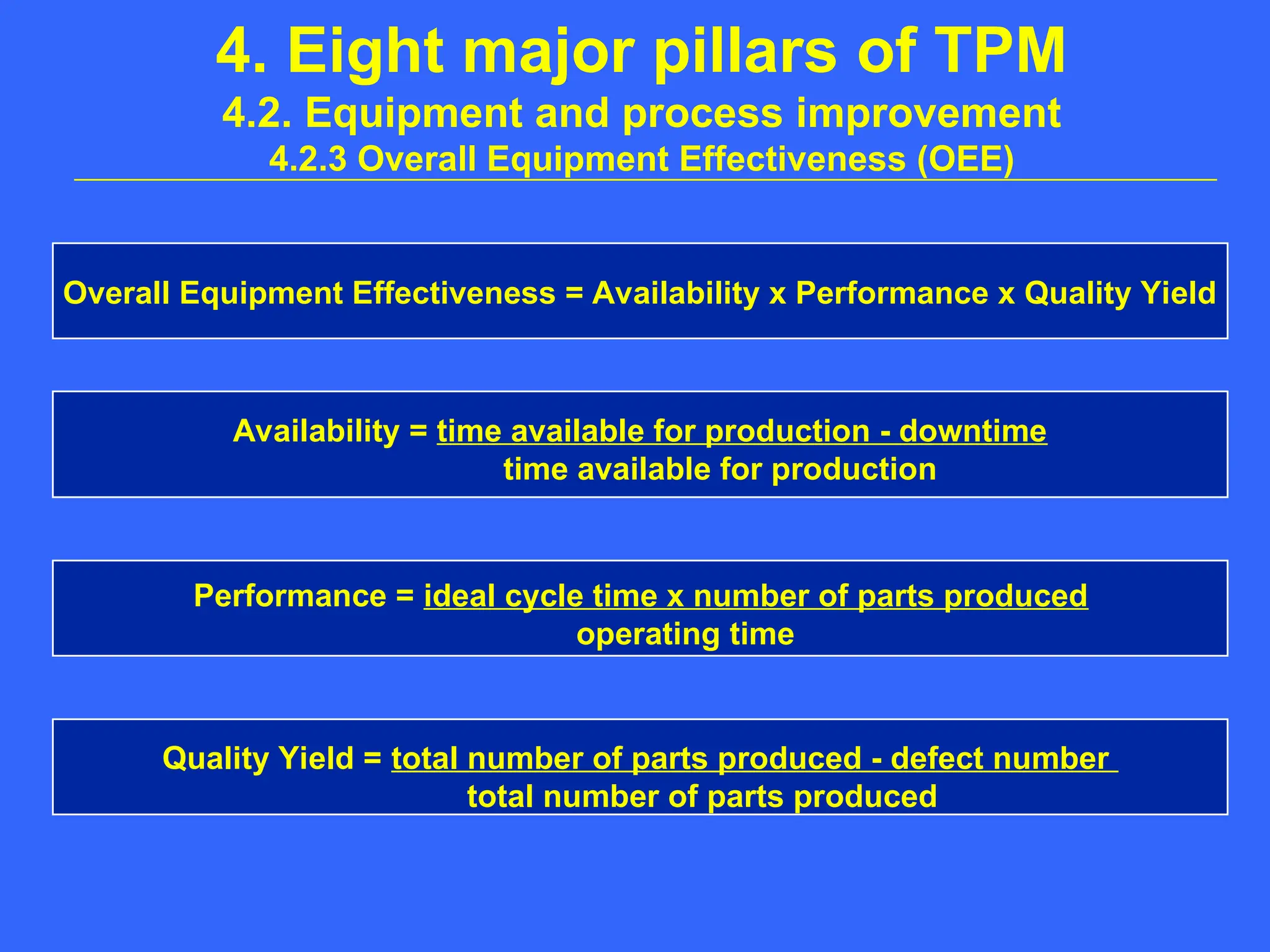
Overall Equipment Effectiveness = Availability x Performance x Quality Yield
Availability = time available for production - downtime
time available for production
Performance = ideal cycle time x number of parts produced
operating time
Quality Yield = total number of parts produced - defect number
total number of parts produced
4. Eight major pillars of TPM
4.3. Planned maintenance
• Objective: establish Preventative and Predictive
Maintenance systems for equipment and tooling
• Natural life cycle of individual machine elements
must be achieved
• Correct operation
• Correct set-up
• Cleaning
• Lubrication
• Retightening
• Feedback and repair of minor defects
• Quality spare parts
4. Eight major pillars of TPM
4.4. Early Management of new equipment
• Objective: establish systems to shorten
• new product or equipment development
• start-up, commissioning and stabilization time for
quality and efficiency
• New equipment needs to be:
• easy to operate
• easy to clean
• easy to maintain and reliable
• have quick set-up times
• operate at the lowest life cycle cost
4. Eight major pillars of TPM
4.5. Process Quality Management
• Definition: a process for controlling the condition of
equipment components that affect variability in
product quality
• Objective: to set and maintain conditions to
accomplish zero defects
• Quality rate has a direct correlation with
• material conditions
• equipment precision
• production methods
• process parameters
4. Eight major pillars of TPM
4.6. TPM in administrative and support departments
• Administrative and support departments can be
seen as process plants whose principal tasks
are to collect, process, and distribute information
• Process analysis should be applied to
streamline information flow
4. Eight major pillars of TPM
4.7. Education and training
• TPM is a continuous learning process.
• 2 major components
• soft skills training: how to work as teams,
diversity training and communication skills
• technical training: upgrading problem-solving
and equipment- related skills
4. Eight major pillars of TPM
4.8. Safety and environmental management
• Assuring safety and preventing adverse
environmental impacts are important priorities in
any TPM effort
5. TPM implementation
3 requirements for fundamental improvement
• Increasing motivation: changing peoples
attitudes
• Increasing competency and peoples skills
• Improving the work environment, so that it
supports the establishment of a program for
implementing TPM
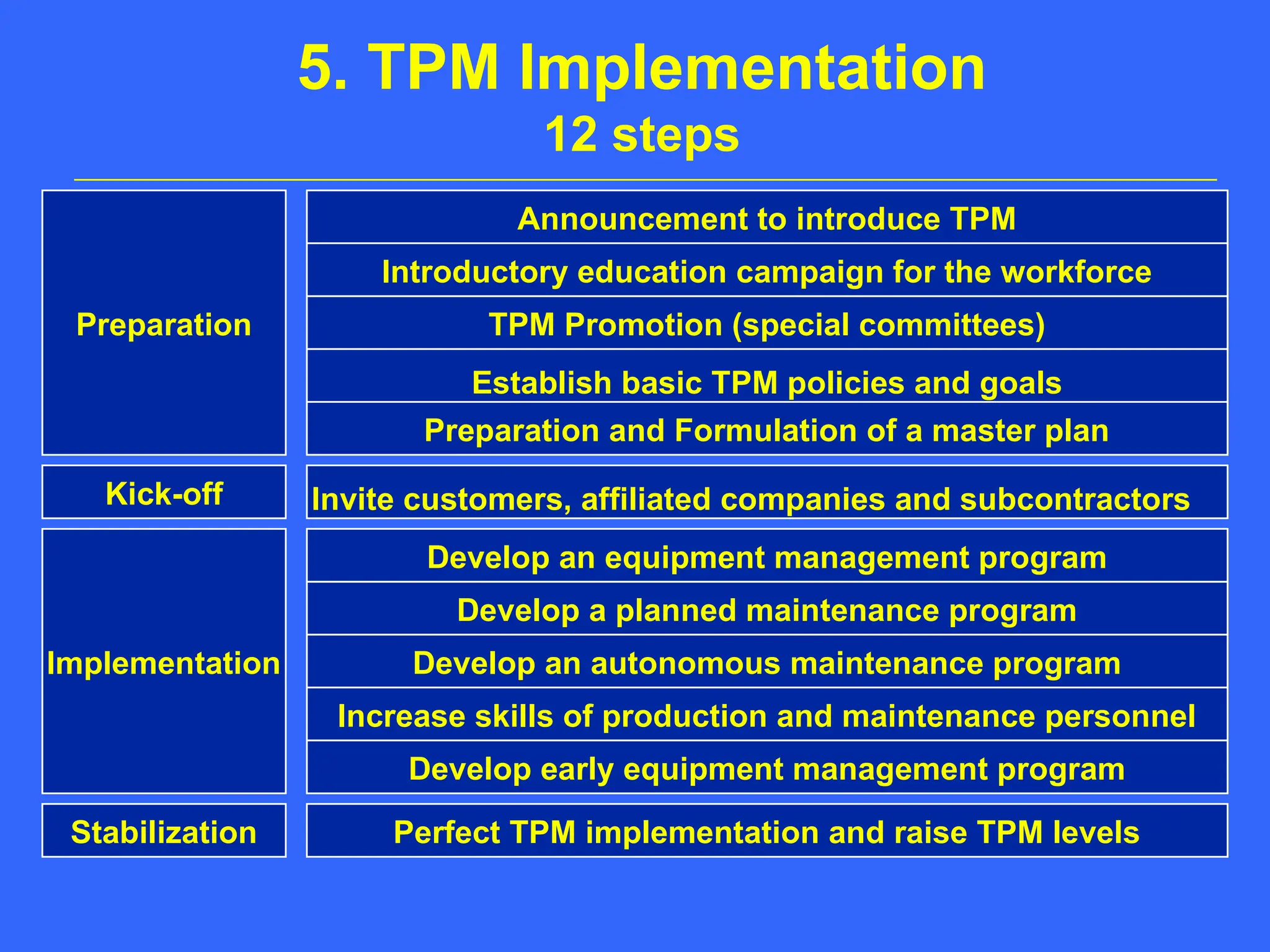
5. TPM Implementation
12 steps
Preparation
Kick-off
Implementation
Announcement to introduce TPM
Introductory education campaign for the workforce
TPM Promotion (special committees)
Establish basic TPM policies and goals
Preparation and Formulation of a master plan
Develop an equipment management program
Develop a planned maintenance program
Develop an autonomous maintenance program
Increase skills of production and maintenance personnel
Perfect TPM implementation and raise TPM levels
Stabilization
Develop early equipment management program
Invite customers, affiliated companies and subcontractors
5. TPM Implementation
5.1. Announce top management’s decision to
introduce TPM
• State TPM objectives in a company
newsletter
• Place articles on TPM in the company
newspaper
5. TPM Implementation
5.2. Introductory education campaign
• Seminars for managers
• Slide presentations for all employees
5. TPM Implementation
5.3. TPM Promotion
• Special committees at every level to promote
TPM
• Newsletters
• Articles
• Videos
• Posters
5. TPM Implementation
5.4. Establish basic TPM policies and goals
• Analyze existing conditions
• Set goals
• Predict results
5. TPM Implementation
5.5. Preparation and Formulation of a master plan
• A master plan lays out your goals, what you
will do to achieve them and when you will
achieve them
• Detailed plans for each pillar have to be
prepared
5. TPM Implementation
5.6. TPM kick-off
• The main kick-off to TPM should take the
form of a formal presentation with all the
employees attending
• This opportunity can be used to gain the full
support of the employees
• Invite external customers, affiliated and
subcontracting companies
5. TPM Implementation
5.7. Develop an equipment management program (1)
• The tools of Total Quality Management and
Continuous Improvement are applied to the
management and improvement of equipment
• Form project teams
• Select model equipment
• identify equipment problems
• analyze equipment problems
• develop solutions and proposals for improvement
5. TPM Implementation
5.7. Develop an equipment management program (2)
• Typical membership of a team
• five to seven operators
• a maintenance person
• a technical expert
• Tools
• Pareto
• Cause & effect
• Root cause
• Methods Analysis
5. TPM Implementation
5.8. Develop a planned maintenance program
• Set up plans and schedules to carry out work
on equipment before it breaks down, in order
to extend the life of the equipment
• Include periodic and predictive maintenance
• Include management of spare parts and tools
5. TPM Implementation
5.8. Develop a autonomous maintenance program
• A handing-over of maintenance tasks from
specialized maintenance personnel to
production operators
• Promote the seven steps
• Tasks to hand over
• cleaning
• lubricating
• inspecting
• set-up and adjustment
5. TPM Implementation
5.10. Increase skills of production and maintenance
personnel
• The training sessions must be planned
shortly after the kick-off presentation.
• 2 major components
• soft skills training
• technical training
• Train leaders together
• Have leaders share information with group
members
5. TPM Implementation
5.11. Develop early equipment management
program(1)
• The principle of designing for maintenance
prevention can be applied to new products,
and to new and existing machines.
• New products must be designed so that they
can be easily produced on new or existing
machines
• New machines must be designed for easier
operations, changeover and maintenance
5. TPM Implementation
5.11. Develop early equipment management
program(2)
• Existing machines:
• analyze historical records for
• trends of types of failures
• frequency of component failures
• root causes of failures
• determine how to eliminate the problem and
reduce maintenance through an equipment
design change or by changing the process
5. TPM Implementation
5.12. Perfect TPM implementation and raise TPM levels
• Evaluate for the PM Award: The Japanese
Institute for Productive Maintenance runs the
annual PM Excellence Award. They provide a
checklist for companies applying for the
award.
• Set higher goals
6. TPM Benefits
• Increased equipment productivity
• Reduced equipment downtime
• Increased plant capacity
• Lower maintenance and production costs
• Approaching zero equipment-caused defects
• Enhanced job satisfaction
• Increased Return On Investment
The TPM Guide
Total Productive Maintenance

TPM implementation throughout company.ppt

  • 1.
    The TPM Guide TotalProductive Maintenance
  • 2.
    1. TPM definition(1) • A company-wide team-based effort to build quality into equipment and to improve overall equipment effectiveness • Total • all employees are involved • it aims to eliminate all accidents, defects and breakdowns • Productive • actions are performed while production goes on • troubles for production are minimized • Maintenance • keep in good condition • repair, clean, lubricate
  • 3.
    1. TPM definition(2) • TPM combines the traditionally American practice of preventive maintenance with Total Quality Control and Total Employee Involvement, to create a culture where operators develop ownership of their equipment, and become full partners with Maintenance, Engineering and Management to assure equipment operates properly everyday.
  • 4.
    2. Origins ofTPM • Dr. Deming introduced statistical analysis and used the resulting data to control quality during manufacturing (TQM) • Some general concepts of TQM did not work well in the maintenance environment • The need to go further than preventive maintenance was quickly recognized by those companies who were committed to TQM • Maintenance became an integral part of TQM in the early 90’s
  • 5.
    3. TPM principles •Increase Overall Equipment Effectiveness (OEE) • Improve existing planned maintenance systems • The operator is the best condition monitor • Provide training to upgrade operations and maintenance skills • Involve everyone and utilize cross-functional teamwork
  • 6.
    4. Eight majorpillars of TPM Autonomous Maintenance Planned Maintenance Equipment and process improvement Early management of new equipment Process quality management TPM in the office Education and training Safety and environmental management
  • 7.
    4. Eight majorpillars of TPM 4.1. Autonomous Maintenance (1) • Train the operators to close the gap between them and the maintenance staff, making it easier for both to work as one team • Change the equipment so the operator can identify any abnormal conditions and measure deterioration before it affects the process or leads to a failure
  • 8.
    4. Eight majorpillars of TPM 4.1. Autonomous Maintenance (2) • 7 steps are implemented to progressively increase operators knowledge, participation and responsibility for their equipment • 1. Perform initial cleaning and inspection • 2. Countermeasures for the causes and effects of dirt and dust • 3. Establish cleaning and lubrication standards • 4. Conduct general inspection training • 5. Carry out equipment inspection checks • 6. Workplace management and control • 7. Continuous improvement
  • 9.
    4. Eight majorpillars of TPM 4.2. Equipment and process improvement • Objective: maximize efficiency by eliminating waste and manufacturing losses • Manufacturing losses are categorized into 13 big losses: • Equipment losses (6) • Manpower losses (4) • Material losses (3)
  • 10.
    4. Eight majorpillars of TPM 4.2. Equipment and process improvement 4.2.1. Equipment losses Downtime loss Speed loss Quality loss Equipment failure / breakdowns Set-up / adjustments Minor stopping / idling Reduced speed Process errors Rework / scrap
  • 11.
    4. Eight majorpillars of TPM 4.2. Equipment and process improvement 4.2.2. Manpower and material losses Manpower losses Material losses Cleaning and checking Waiting instructions Waiting quality confirmation Material yield Energy losses Waiting materials Consumable material losses
  • 12.
    4. Eight majorpillars of TPM 4.2. Equipment and process improvement 4.2.3 Overall Equipment Effectiveness (OEE) • OEE figures are determined by combining the availability and performance of your equipment with the quality of parts made • OEE measures the efficiency of the machine during its planned loading time. Planned downtime does not effect the OEE figure.
  • 13.
    4. Eight majorpillars of TPM 4.2. Equipment and process improvement 4.2.3 Overall Equipment Effectiveness (OEE) Overall Equipment Effectiveness = Availability x Performance x Quality Yield Availability Downtime loss Speed loss Performance Quality Yield Quality loss
  • 14.
    4. Eight majorpillars of TPM 4.2. Equipment and process improvement 4.2.3 Overall Equipment Effectiveness (OEE) Overall Equipment Effectiveness = Availability x Performance x Quality Yield Availability = time available for production - downtime time available for production Performance = ideal cycle time x number of parts produced operating time Quality Yield = total number of parts produced - defect number total number of parts produced
  • 15.
    4. Eight majorpillars of TPM 4.3. Planned maintenance • Objective: establish Preventative and Predictive Maintenance systems for equipment and tooling • Natural life cycle of individual machine elements must be achieved • Correct operation • Correct set-up • Cleaning • Lubrication • Retightening • Feedback and repair of minor defects • Quality spare parts
  • 16.
    4. Eight majorpillars of TPM 4.4. Early Management of new equipment • Objective: establish systems to shorten • new product or equipment development • start-up, commissioning and stabilization time for quality and efficiency • New equipment needs to be: • easy to operate • easy to clean • easy to maintain and reliable • have quick set-up times • operate at the lowest life cycle cost
  • 17.
    4. Eight majorpillars of TPM 4.5. Process Quality Management • Definition: a process for controlling the condition of equipment components that affect variability in product quality • Objective: to set and maintain conditions to accomplish zero defects • Quality rate has a direct correlation with • material conditions • equipment precision • production methods • process parameters
  • 18.
    4. Eight majorpillars of TPM 4.6. TPM in administrative and support departments • Administrative and support departments can be seen as process plants whose principal tasks are to collect, process, and distribute information • Process analysis should be applied to streamline information flow
  • 19.
    4. Eight majorpillars of TPM 4.7. Education and training • TPM is a continuous learning process. • 2 major components • soft skills training: how to work as teams, diversity training and communication skills • technical training: upgrading problem-solving and equipment- related skills
  • 20.
    4. Eight majorpillars of TPM 4.8. Safety and environmental management • Assuring safety and preventing adverse environmental impacts are important priorities in any TPM effort
  • 21.
    5. TPM implementation 3requirements for fundamental improvement • Increasing motivation: changing peoples attitudes • Increasing competency and peoples skills • Improving the work environment, so that it supports the establishment of a program for implementing TPM
  • 22.
    5. TPM Implementation 12steps Preparation Kick-off Implementation Announcement to introduce TPM Introductory education campaign for the workforce TPM Promotion (special committees) Establish basic TPM policies and goals Preparation and Formulation of a master plan Develop an equipment management program Develop a planned maintenance program Develop an autonomous maintenance program Increase skills of production and maintenance personnel Perfect TPM implementation and raise TPM levels Stabilization Develop early equipment management program Invite customers, affiliated companies and subcontractors
  • 23.
    5. TPM Implementation 5.1.Announce top management’s decision to introduce TPM • State TPM objectives in a company newsletter • Place articles on TPM in the company newspaper
  • 24.
    5. TPM Implementation 5.2.Introductory education campaign • Seminars for managers • Slide presentations for all employees
  • 25.
    5. TPM Implementation 5.3.TPM Promotion • Special committees at every level to promote TPM • Newsletters • Articles • Videos • Posters
  • 26.
    5. TPM Implementation 5.4.Establish basic TPM policies and goals • Analyze existing conditions • Set goals • Predict results
  • 27.
    5. TPM Implementation 5.5.Preparation and Formulation of a master plan • A master plan lays out your goals, what you will do to achieve them and when you will achieve them • Detailed plans for each pillar have to be prepared
  • 28.
    5. TPM Implementation 5.6.TPM kick-off • The main kick-off to TPM should take the form of a formal presentation with all the employees attending • This opportunity can be used to gain the full support of the employees • Invite external customers, affiliated and subcontracting companies
  • 29.
    5. TPM Implementation 5.7.Develop an equipment management program (1) • The tools of Total Quality Management and Continuous Improvement are applied to the management and improvement of equipment • Form project teams • Select model equipment • identify equipment problems • analyze equipment problems • develop solutions and proposals for improvement
  • 30.
    5. TPM Implementation 5.7.Develop an equipment management program (2) • Typical membership of a team • five to seven operators • a maintenance person • a technical expert • Tools • Pareto • Cause & effect • Root cause • Methods Analysis
  • 31.
    5. TPM Implementation 5.8.Develop a planned maintenance program • Set up plans and schedules to carry out work on equipment before it breaks down, in order to extend the life of the equipment • Include periodic and predictive maintenance • Include management of spare parts and tools
  • 32.
    5. TPM Implementation 5.8.Develop a autonomous maintenance program • A handing-over of maintenance tasks from specialized maintenance personnel to production operators • Promote the seven steps • Tasks to hand over • cleaning • lubricating • inspecting • set-up and adjustment
  • 33.
    5. TPM Implementation 5.10.Increase skills of production and maintenance personnel • The training sessions must be planned shortly after the kick-off presentation. • 2 major components • soft skills training • technical training • Train leaders together • Have leaders share information with group members
  • 34.
    5. TPM Implementation 5.11.Develop early equipment management program(1) • The principle of designing for maintenance prevention can be applied to new products, and to new and existing machines. • New products must be designed so that they can be easily produced on new or existing machines • New machines must be designed for easier operations, changeover and maintenance
  • 35.
    5. TPM Implementation 5.11.Develop early equipment management program(2) • Existing machines: • analyze historical records for • trends of types of failures • frequency of component failures • root causes of failures • determine how to eliminate the problem and reduce maintenance through an equipment design change or by changing the process
  • 36.
    5. TPM Implementation 5.12.Perfect TPM implementation and raise TPM levels • Evaluate for the PM Award: The Japanese Institute for Productive Maintenance runs the annual PM Excellence Award. They provide a checklist for companies applying for the award. • Set higher goals
  • 37.
    6. TPM Benefits •Increased equipment productivity • Reduced equipment downtime • Increased plant capacity • Lower maintenance and production costs • Approaching zero equipment-caused defects • Enhanced job satisfaction • Increased Return On Investment
  • 38.
    The TPM Guide TotalProductive Maintenance