
Anonymizing Network
Technologies
Outline
 Problem
 Tor
 Questions/Comments
Problem
 Internet surveillance like traffic analysis
reveals users privacy.
 Encryption does not work, since packet
headers still reveal a great deal about users.
 End-to-end anonymity is needed.
 Solution: a distributed, anonymous network
What is Tor
 Tor is a distributed anonymous communication
service using an overlay network that allows people
and groups to improve their privacy and security on
the Internet.
 Individuals use Tor to keep websites from tracking
them, or to connect to those internet services
blocked by their local Internet providers.
 Tor's hidden services let users publish web sites
and other services without needing to reveal the
location of the site.
Design
 Overlay network on the user level
 Onion Routers (OR) route traffic
 Onion Proxy (OP) fetches directories and
creates virtual circuits on the network on
behalf of users.
 Uses TCP with TLS
 All data is sent in fixed size (bytes) cells
Xinwen Fu@UMass Lowell 6/41
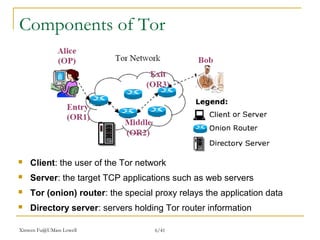
Components of Tor
 Client: the user of the Tor network
 Server: the target TCP applications such as web servers
 Tor (onion) router: the special proxy relays the application data
 Directory server: servers holding Tor router information
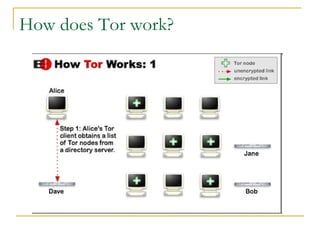
How does Tor work?
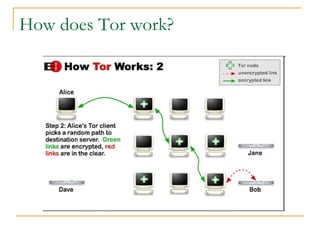
How does Tor work?
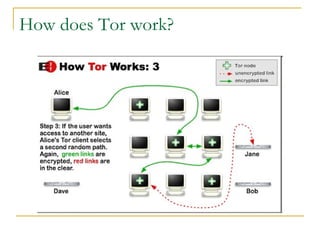
How does Tor work?
Xinwen Fu@UMass Lowell 10/41
How Tor Works? --- Onion Routing
Alice Bob
OR2
OR1
M
√M
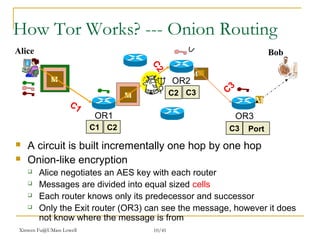
 A circuit is built incrementally one hop by one hop
 Onion-like encryption
 Alice negotiates an AES key with each router
 Messages are divided into equal sized cells
 Each router knows only its predecessor and successor
 Only the Exit router (OR3) can see the message, however it does
not know where the message is from
M
OR3
M
C1
C2
C3
C1 C2
C2 C3
C3 Port
Cells
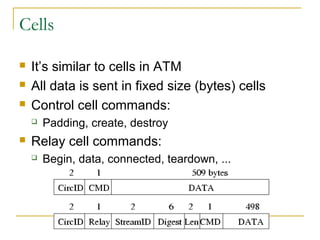
 It’s similar to cells in ATM
 All data is sent in fixed size (bytes) cells
 Control cell commands:
 Padding, create, destroy
 Relay cell commands:
 Begin, data, connected, teardown, ...
Additional functionality
 Integrity checking
 Only done at the edges of a stream
 SHA-1 digest of data sent and received
 First 4 bytes of digest are sent with each message
for verification
Congestion Control
 OR-to-OR congestion might happen if too many
users choose the same OR-to-OR connection.
 Circuit Level throttling
 2 windows keep track of relay data to be transmitted to
other ORs (packaging window) and data transmitted out of
the network (delivery window)
 Windows are decremented after forwarding packets and
increments on a relay sendme message towards OP with
streamID zero.
 When a window reaches 0, no messages are forwarded
Hidden Service and Rendezvous Points
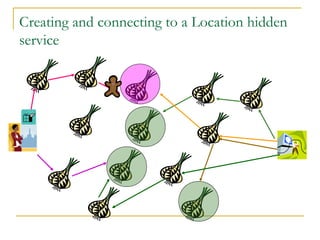
 Location-hidden services allow Bob to offer a TCP
service without revealing his IP address.
 Tor accommodates receiver anonymity by allowing
location hidden services
 Design goals for location hidden services
 Access Control: filtering incoming requests
 Robustness: maintain a long-term pseudonymous identity
 Smear-resistance: against socially disapproved acts
 Application transparency
 Location hidden service leverage rendezvous points
Creating and connecting to a Location hidden
service
Questions about Tor?

Tor

  • 1.
  • 2.
  • 3.
    Problem  Internet surveillancelike traffic analysis reveals users privacy.  Encryption does not work, since packet headers still reveal a great deal about users.  End-to-end anonymity is needed.  Solution: a distributed, anonymous network
  • 4.
    What is Tor Tor is a distributed anonymous communication service using an overlay network that allows people and groups to improve their privacy and security on the Internet.  Individuals use Tor to keep websites from tracking them, or to connect to those internet services blocked by their local Internet providers.  Tor's hidden services let users publish web sites and other services without needing to reveal the location of the site.
  • 5.
    Design  Overlay networkon the user level  Onion Routers (OR) route traffic  Onion Proxy (OP) fetches directories and creates virtual circuits on the network on behalf of users.  Uses TCP with TLS  All data is sent in fixed size (bytes) cells
  • 6.
    Xinwen Fu@UMass Lowell6/41 Components of Tor  Client: the user of the Tor network  Server: the target TCP applications such as web servers  Tor (onion) router: the special proxy relays the application data  Directory server: servers holding Tor router information
  • 7.
  • 8.
  • 9.
  • 10.
    Xinwen Fu@UMass Lowell10/41 How Tor Works? --- Onion Routing Alice Bob OR2 OR1 M √M  A circuit is built incrementally one hop by one hop  Onion-like encryption  Alice negotiates an AES key with each router  Messages are divided into equal sized cells  Each router knows only its predecessor and successor  Only the Exit router (OR3) can see the message, however it does not know where the message is from M OR3 M C1 C2 C3 C1 C2 C2 C3 C3 Port
  • 11.
    Cells  It’s similarto cells in ATM  All data is sent in fixed size (bytes) cells  Control cell commands:  Padding, create, destroy  Relay cell commands:  Begin, data, connected, teardown, ...
  • 12.
    Additional functionality  Integritychecking  Only done at the edges of a stream  SHA-1 digest of data sent and received  First 4 bytes of digest are sent with each message for verification
  • 13.
    Congestion Control  OR-to-ORcongestion might happen if too many users choose the same OR-to-OR connection.  Circuit Level throttling  2 windows keep track of relay data to be transmitted to other ORs (packaging window) and data transmitted out of the network (delivery window)  Windows are decremented after forwarding packets and increments on a relay sendme message towards OP with streamID zero.  When a window reaches 0, no messages are forwarded
  • 14.
    Hidden Service andRendezvous Points  Location-hidden services allow Bob to offer a TCP service without revealing his IP address.  Tor accommodates receiver anonymity by allowing location hidden services  Design goals for location hidden services  Access Control: filtering incoming requests  Robustness: maintain a long-term pseudonymous identity  Smear-resistance: against socially disapproved acts  Application transparency  Location hidden service leverage rendezvous points
  • 15.
    Creating and connectingto a Location hidden service
  • 16.