Overview
 Anonymity    systems
 Review of how Tor works
 Tor Project Inc.
 Helper tools and accessories
 Advanced Tor control
 Attack Vectors
Anonymity Systems
 JAP
 I2P
 Freenet
 Xerobank
 Botnets
Freenet
 Storage   network p2p based
 Shares files on your system to other nodes
 Plausabile Deniability
I2P
   Opposing design of Tor
   UDP based
   Darknet design
   Java, Python, and C API’s
   Mixed routing based on packets
   Splits tunneling between upstream and
    downstream
   “Garlic Routing” – mix streams together to
    prevent traffic analysis
   Variable latency design
Tor
 Tor(not TOR) – previously stood for The
  Onion Router
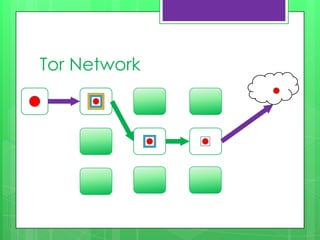
 Provides a method of anonymity by
  passing data between proxies
Tor Network
Terminology
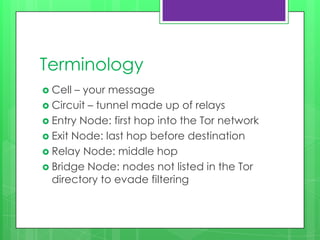
 Cell – your message
 Circuit – tunnel made up of relays
 Entry Node: first hop into the Tor network
 Exit Node: last hop before destination
 Relay Node: middle hop
 Bridge Node: nodes not listed in the Tor
  directory to evade filtering
Who’s Using Tor?
 Whistleblowers
     Wikileaks – runs hidden service
 Militaries
     field ops
     command and control using hidden
      services
 Chinese      journalists and dissidents
Tor Project
 501(c)(3) NFP
 Freely available
 Full spec and full documentation
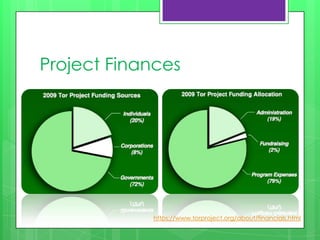
Project Finances


            https://www.torproject.org/about/financials.html
Current Project Sponsors
   Federal Grant:
       International Program to Support Democracy Human
        Rights and Labor
       $632,189
   International Broadcasting Bureau
       Voice of America, Radio Free Europe/Radio
        Liberty, Radio and TV Martí, Radio Free Asia, Radio
        Sawa/Alhurra TV
       $270,000
   Stichting.Net
       Association of NFP’s in the Netherlands
       $38,279
   Google: $29,083
   ITT: $27,000
   Other: $9,997
                               https://www.torproject.org/about/sponsors.html.en
Past Funders
 DARPA   and Naval Research Labratory
  2001-2006
 EFF – 2004-2005
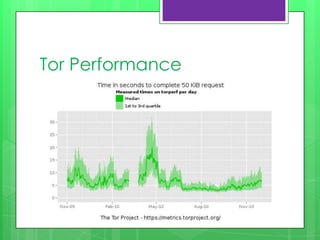
Tor Performance
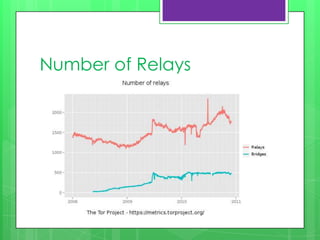
Number of Relays
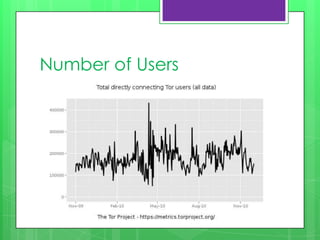
Number of Users
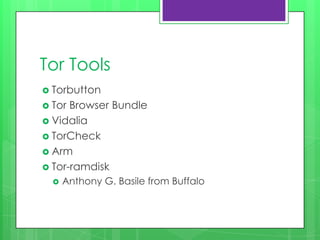
Tor Tools
 Torbutton
 Tor Browser Bundle
 Vidalia
 TorCheck
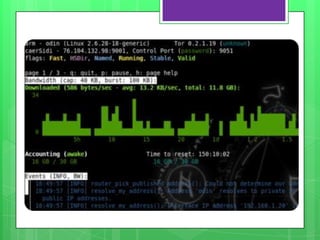
 Arm
 Tor-ramdisk
     Anthony G. Basile from Buffalo
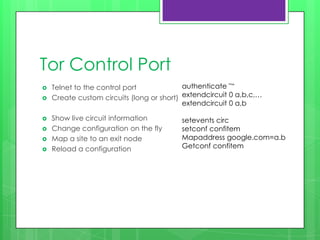
Tor Control Port
   Telnet to the control port             authenticate "“
   Create custom circuits (long or short) extendcircuit 0 a,b,c,…
                                           extendcircuit 0 a,b

   Show live circuit information         setevents circ
   Change configuration on the fly       setconf confitem
   Map a site to an exit node            Mapaddress google.com=a.b
   Reload a configuration                Getconf confitem
Attacks
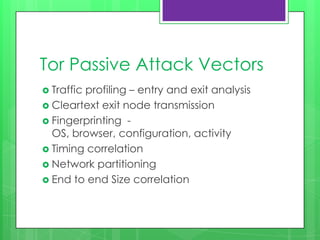
Tor Passive Attack Vectors
 Traffic
        profiling – entry and exit analysis
 Cleartext exit node transmission
 Fingerprinting -
  OS, browser, configuration, activity
 Timing correlation
 Network partitioning
 End to end Size correlation
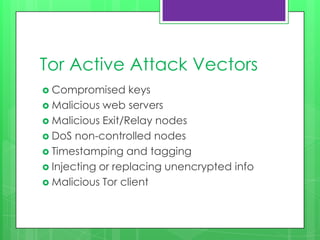
Tor Active Attack Vectors
 Compromised     keys
 Malicious web servers
 Malicious Exit/Relay nodes
 DoS non-controlled nodes
 Timestamping and tagging
 Injecting or replacing unencrypted info
 Malicious Tor client
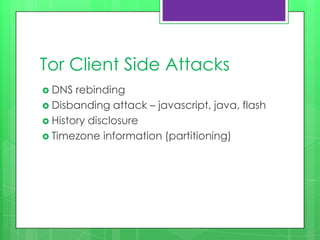
Tor Client Side Attacks
 DNS  rebinding
 Disbanding attack – javascript, java, flash
 History disclosure
 Timezone information (partitioning)
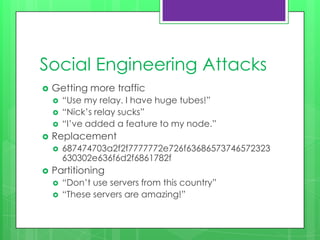
Social Engineering Attacks
   Getting more traffic
       “Use my relay. I have huge tubes!”
       “Nick’s relay sucks”
       “I’ve added a feature to my node.”
   Replacement
       687474703a2f2f7777772e726f63686573746572323
        630302e636f6d2f6861782f
   Partitioning
       “Don’t use servers from this country”
       “These servers are amazing!”
More Info
 www.torproject.org
 Metrics.torproject.org
 Blog.torproject.org
 Check.torproject.org
 @torproject

Tor

  • 2.
    Overview  Anonymity systems  Review of how Tor works  Tor Project Inc.  Helper tools and accessories  Advanced Tor control  Attack Vectors
  • 3.
    Anonymity Systems  JAP I2P  Freenet  Xerobank  Botnets
  • 4.
    Freenet  Storage network p2p based  Shares files on your system to other nodes  Plausabile Deniability
  • 5.
    I2P  Opposing design of Tor  UDP based  Darknet design  Java, Python, and C API’s  Mixed routing based on packets  Splits tunneling between upstream and downstream  “Garlic Routing” – mix streams together to prevent traffic analysis  Variable latency design
  • 6.
    Tor  Tor(not TOR)– previously stood for The Onion Router  Provides a method of anonymity by passing data between proxies
  • 7.
  • 8.
    Terminology  Cell –your message  Circuit – tunnel made up of relays  Entry Node: first hop into the Tor network  Exit Node: last hop before destination  Relay Node: middle hop  Bridge Node: nodes not listed in the Tor directory to evade filtering
  • 9.
    Who’s Using Tor? Whistleblowers  Wikileaks – runs hidden service  Militaries  field ops  command and control using hidden services  Chinese journalists and dissidents
  • 10.
    Tor Project  501(c)(3)NFP  Freely available  Full spec and full documentation
  • 11.
    Project Finances https://www.torproject.org/about/financials.html
  • 12.
    Current Project Sponsors  Federal Grant:  International Program to Support Democracy Human Rights and Labor  $632,189  International Broadcasting Bureau  Voice of America, Radio Free Europe/Radio Liberty, Radio and TV Martí, Radio Free Asia, Radio Sawa/Alhurra TV  $270,000  Stichting.Net  Association of NFP’s in the Netherlands  $38,279  Google: $29,083  ITT: $27,000  Other: $9,997 https://www.torproject.org/about/sponsors.html.en
  • 13.
    Past Funders  DARPA and Naval Research Labratory 2001-2006  EFF – 2004-2005
  • 14.
  • 15.
  • 16.
  • 17.
    Tor Tools  Torbutton Tor Browser Bundle  Vidalia  TorCheck  Arm  Tor-ramdisk  Anthony G. Basile from Buffalo
  • 19.
    Tor Control Port  Telnet to the control port authenticate "“  Create custom circuits (long or short) extendcircuit 0 a,b,c,… extendcircuit 0 a,b  Show live circuit information setevents circ  Change configuration on the fly setconf confitem  Map a site to an exit node Mapaddress google.com=a.b  Reload a configuration Getconf confitem
  • 20.
  • 21.
    Tor Passive AttackVectors  Traffic profiling – entry and exit analysis  Cleartext exit node transmission  Fingerprinting - OS, browser, configuration, activity  Timing correlation  Network partitioning  End to end Size correlation
  • 22.
    Tor Active AttackVectors  Compromised keys  Malicious web servers  Malicious Exit/Relay nodes  DoS non-controlled nodes  Timestamping and tagging  Injecting or replacing unencrypted info  Malicious Tor client
  • 23.
    Tor Client SideAttacks  DNS rebinding  Disbanding attack – javascript, java, flash  History disclosure  Timezone information (partitioning)
  • 24.
    Social Engineering Attacks  Getting more traffic  “Use my relay. I have huge tubes!”  “Nick’s relay sucks”  “I’ve added a feature to my node.”  Replacement  687474703a2f2f7777772e726f63686573746572323 630302e636f6d2f6861782f  Partitioning  “Don’t use servers from this country”  “These servers are amazing!”
  • 25.
    More Info  www.torproject.org Metrics.torproject.org  Blog.torproject.org  Check.torproject.org  @torproject