Liberte vs Tails
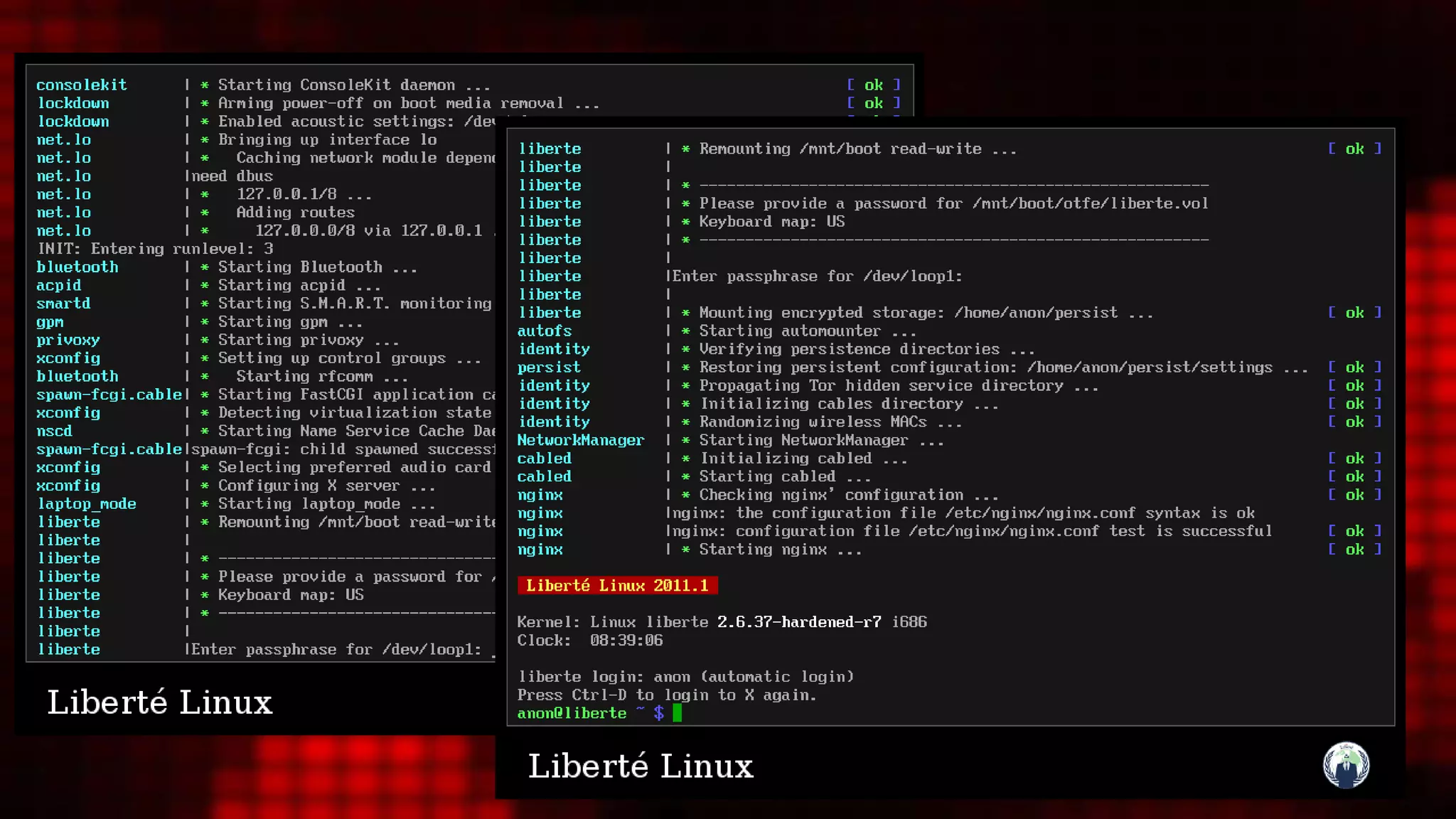
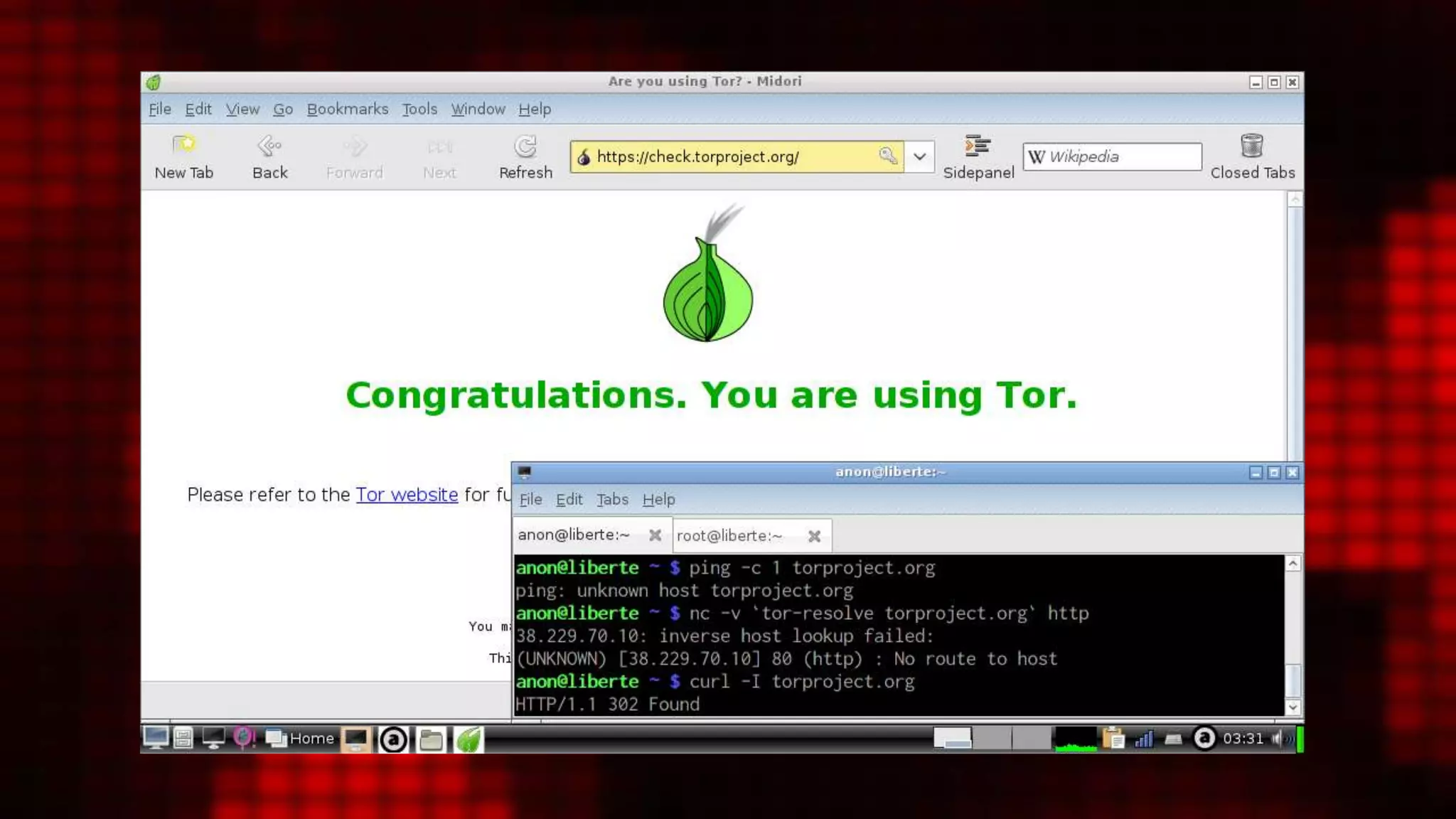
Liberté Linux
• Hardened, Gentoo-based, LiveUSB/CD, Linux
distro
• Fully(ish) anonymized
• Similar in goal to TAILS
• Designed for Anon specifically
• Run by Maxim Kammerer (he is Crazy)
• Uses Tor AND I2P
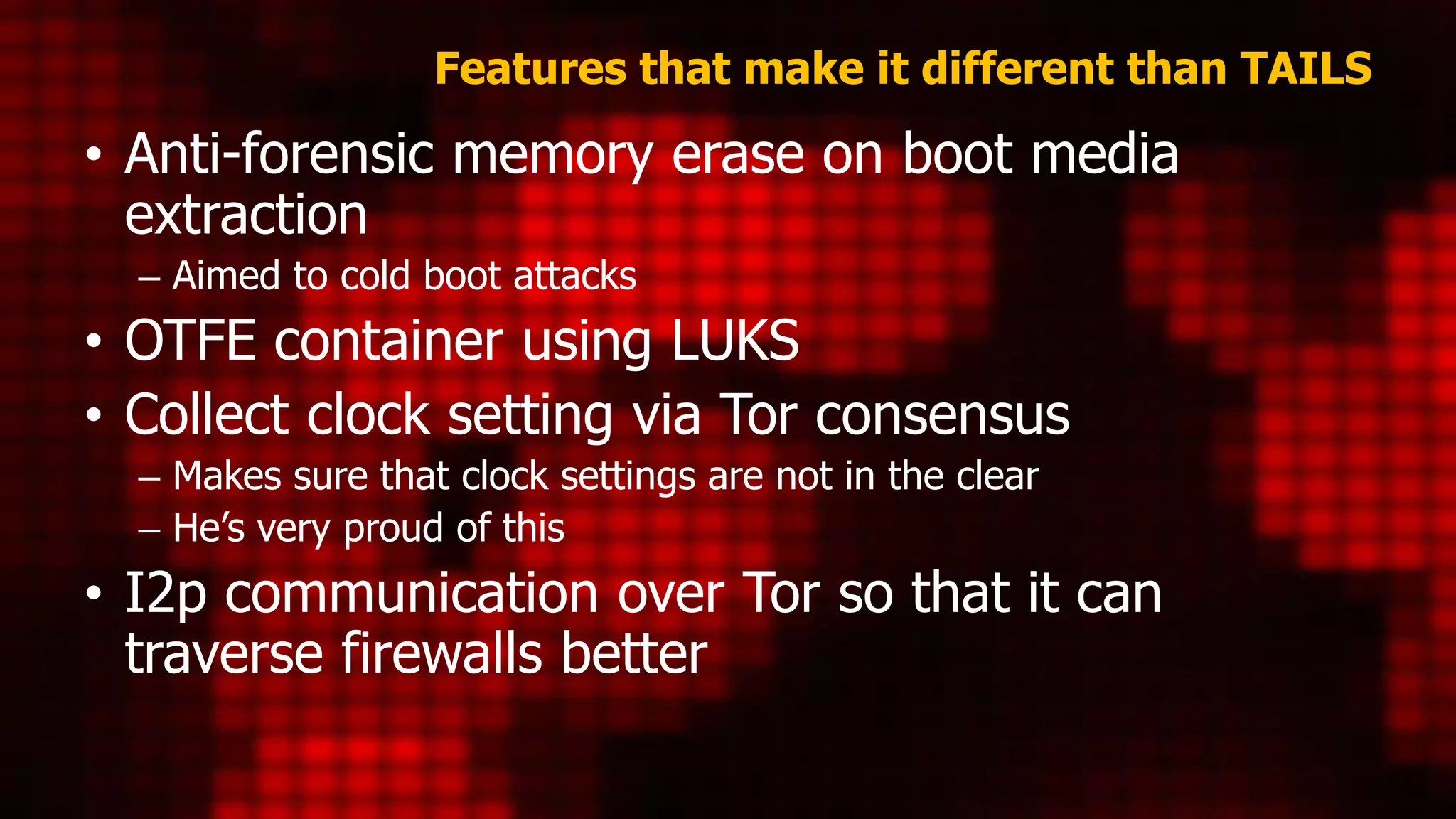
Features that make it different than TAILS
• Anti-forensic memory erase on boot media
extraction
– Aimed to cold boot attacks
• OTFE container using LUKS
• Collect clock setting via Tor consensus
– Makes sure that clock settings are not in the clear
– He’s very proud of this
• I2p communication over Tor so that it can
traverse firewalls better
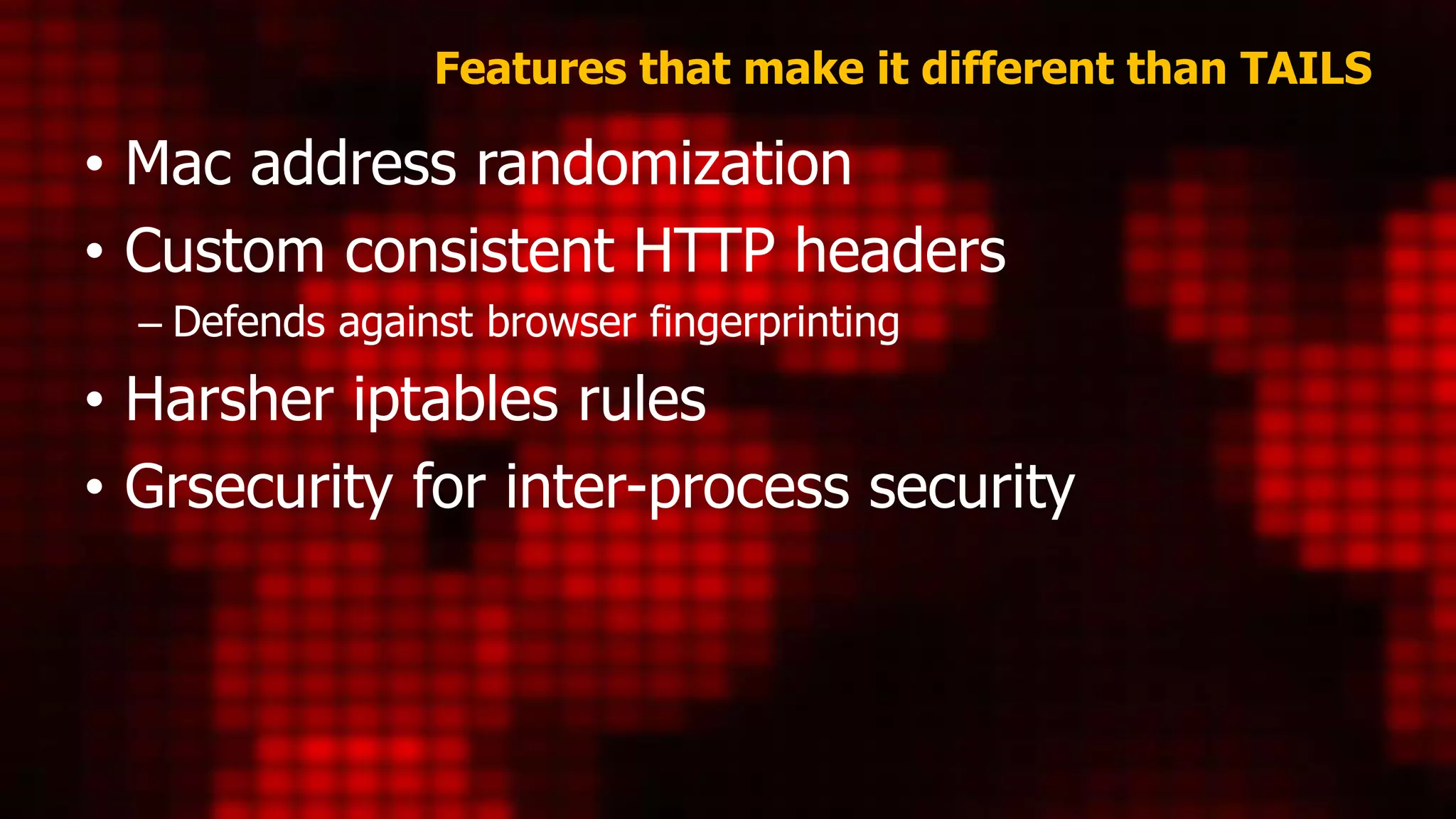
Features that make it different than TAILS
• Mac address randomization
• Custom consistent HTTP headers
– Defends against browser fingerprinting
• Harsher iptables rules
• Grsecurity for inter-process security
The Big Features
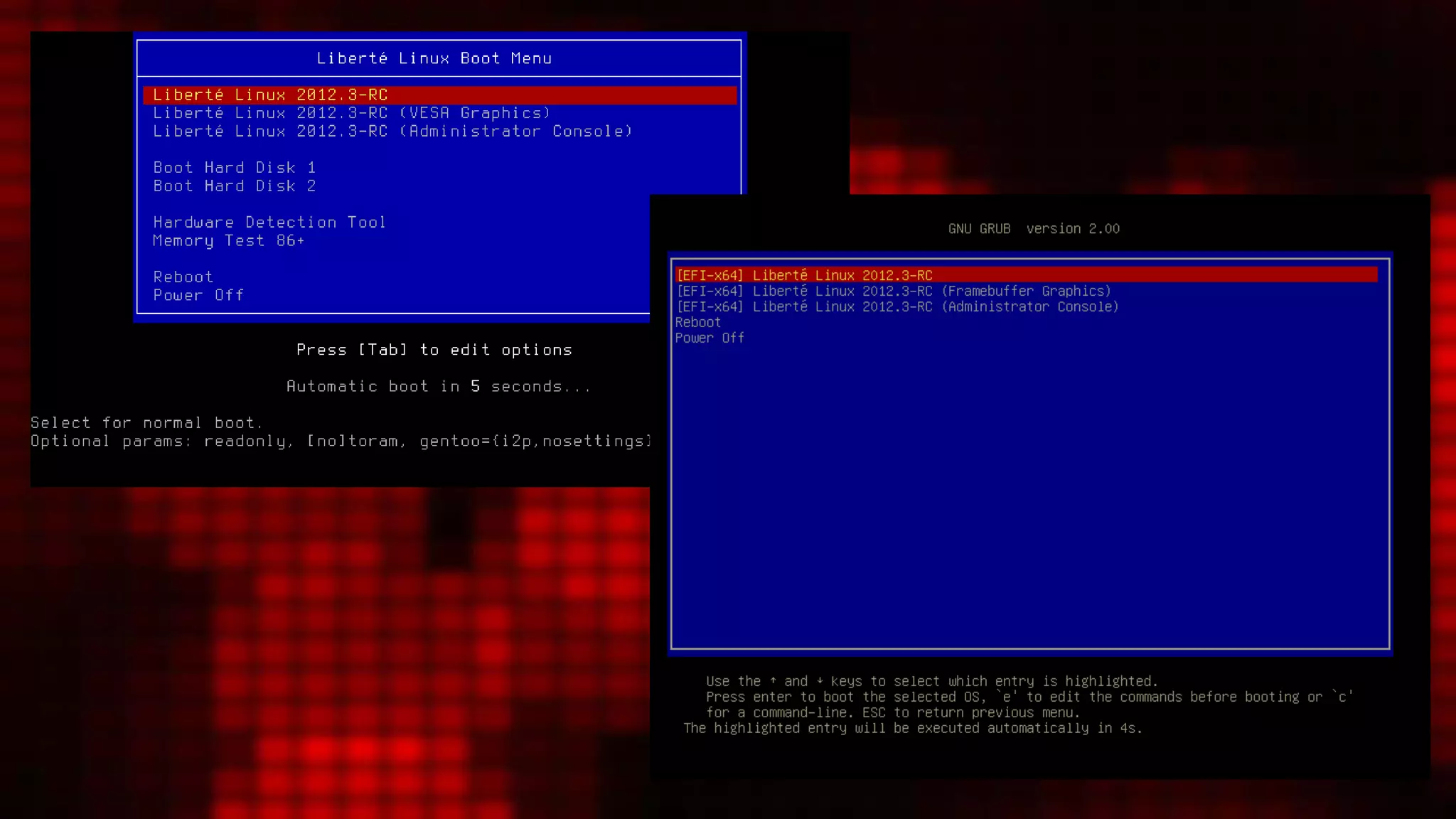
• The first Linux distro that uses UEFI
– Secure boot
– Hardware based verification of the operating system
– If something new is on the system (malware) it won’t boot
• Does not allow you to install ANY software
• Forces a specific resolution
• Cables Communication
– Custom written P2P message exchange
TAILS
TAILS Linux
• Debian based, LiveUSB/CD, Linux distro
• Fully(ish) anonymized
• Similar in goal to Liberte
• Designed for the everyman
• Run by Baum with the support of the Tor
Project
• Uses just Tor for anonymity (but has i2p
installed)
Features that Make It Different Than Liberte
• Regular updates
– New versions are put out due to security issues or active
development at least once a month
– You can apt-get upgrade whenever you want
• Uses standard LUKS for persistence and
supports TrueCrypt
• Contains a meta-data stripping tool – MAT
• Uses Iceweasel (eventually TorBrowser)
instead of janky Epiphany
The Big Features
• Documentation and Support
– Unlike liberte that hasn’t been updated since 2012
– New releases every month
– Monetarily supported by Tor Project
– Has a roadmap!
– Has complete, up to date documentation, in many languages
• Can temporarily install any software
– Or manually build from source and install your own software
Tails “Quirks”
• No lock screen, no screen saver
– Even if you install a screensaver, there are other tty terminals
that let you just log in
• Persistent Media is only USB
– That means virtualization products won’t be able to make a
consistent partion
Cables: TL;DR
• A secure, peer-to-peer based message
exchange
• Aims to be a decentralized eMail replacement
• Not really good as instant messaging (See
bitmessage)
Antitree presents:
A Mouthful of Crypto
An animated explanation of the Cables Address generation
process
OR
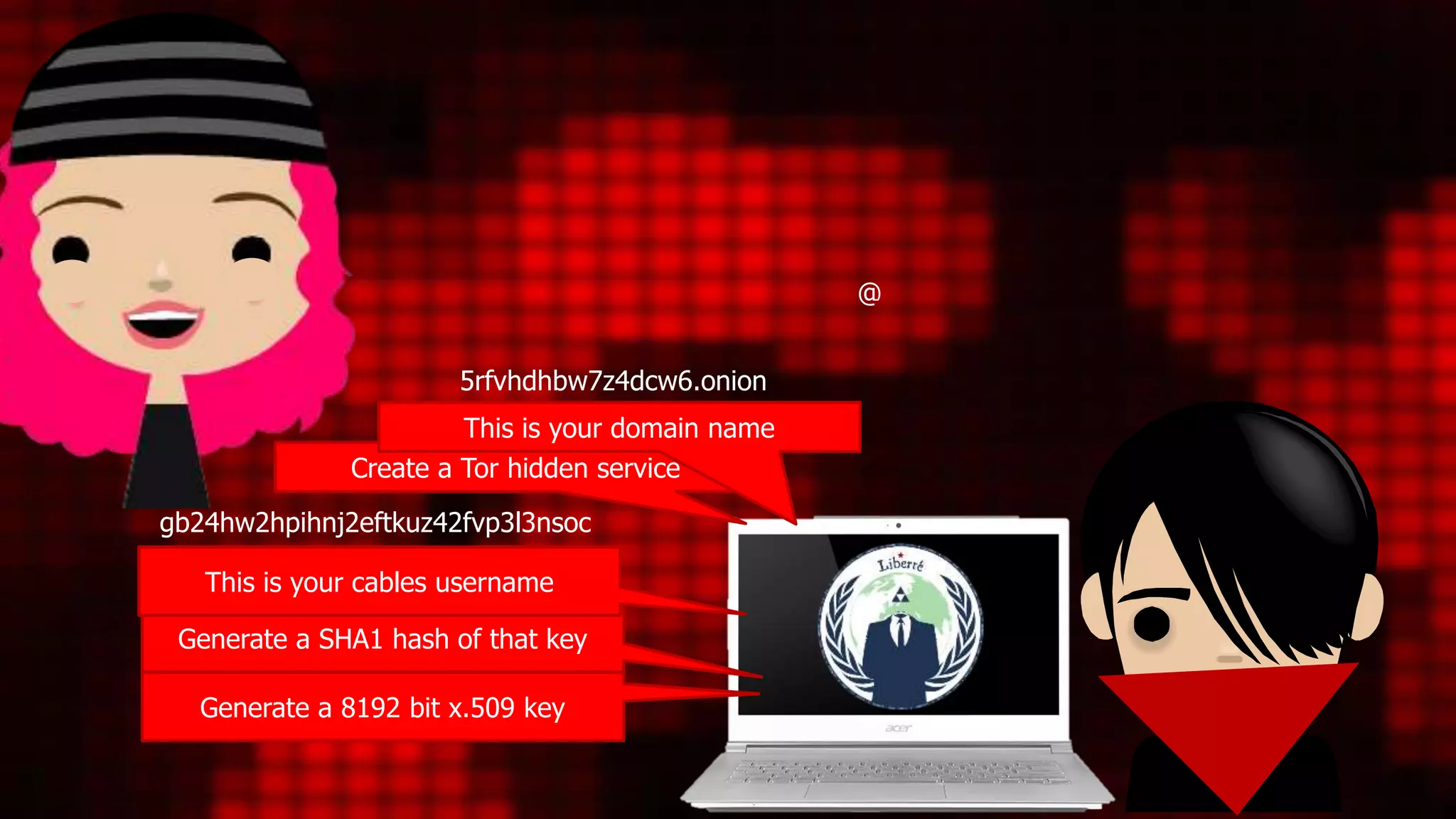
Generate a 8192 bit x.509 key
Generate a SHA1 hash of that key
This is your cables username
gb24hw2hpihnj2eftkuz42fvp3l3nsoc
Create a Tor hidden service
5rfvhdhbw7z4dcw6.onion
This is your domain name
@
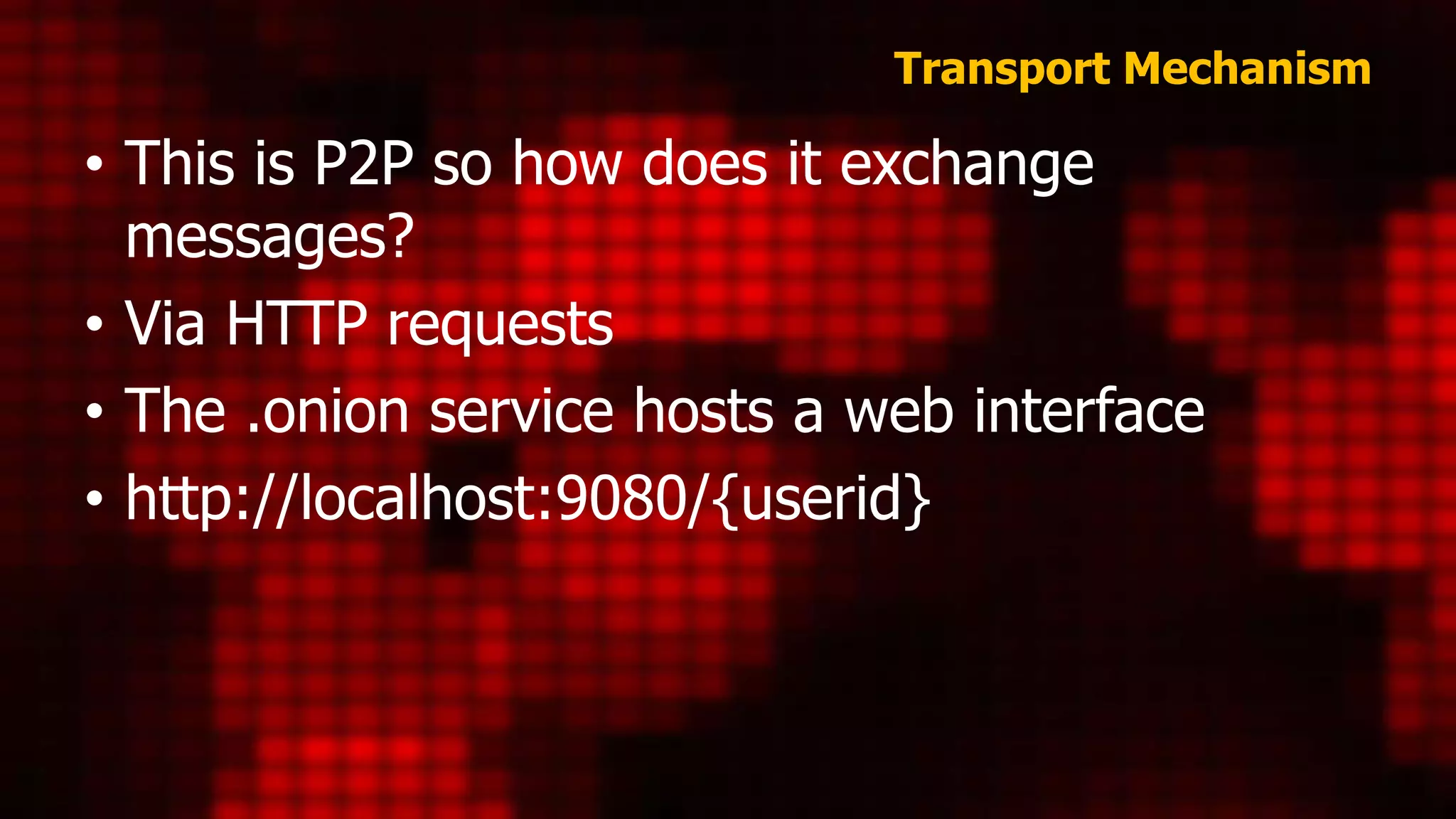
Transport Mechanism
• This is P2P so how does it exchange
messages?
• Via HTTP requests
• The .onion service hosts a web interface
• http://localhost:9080/{userid}
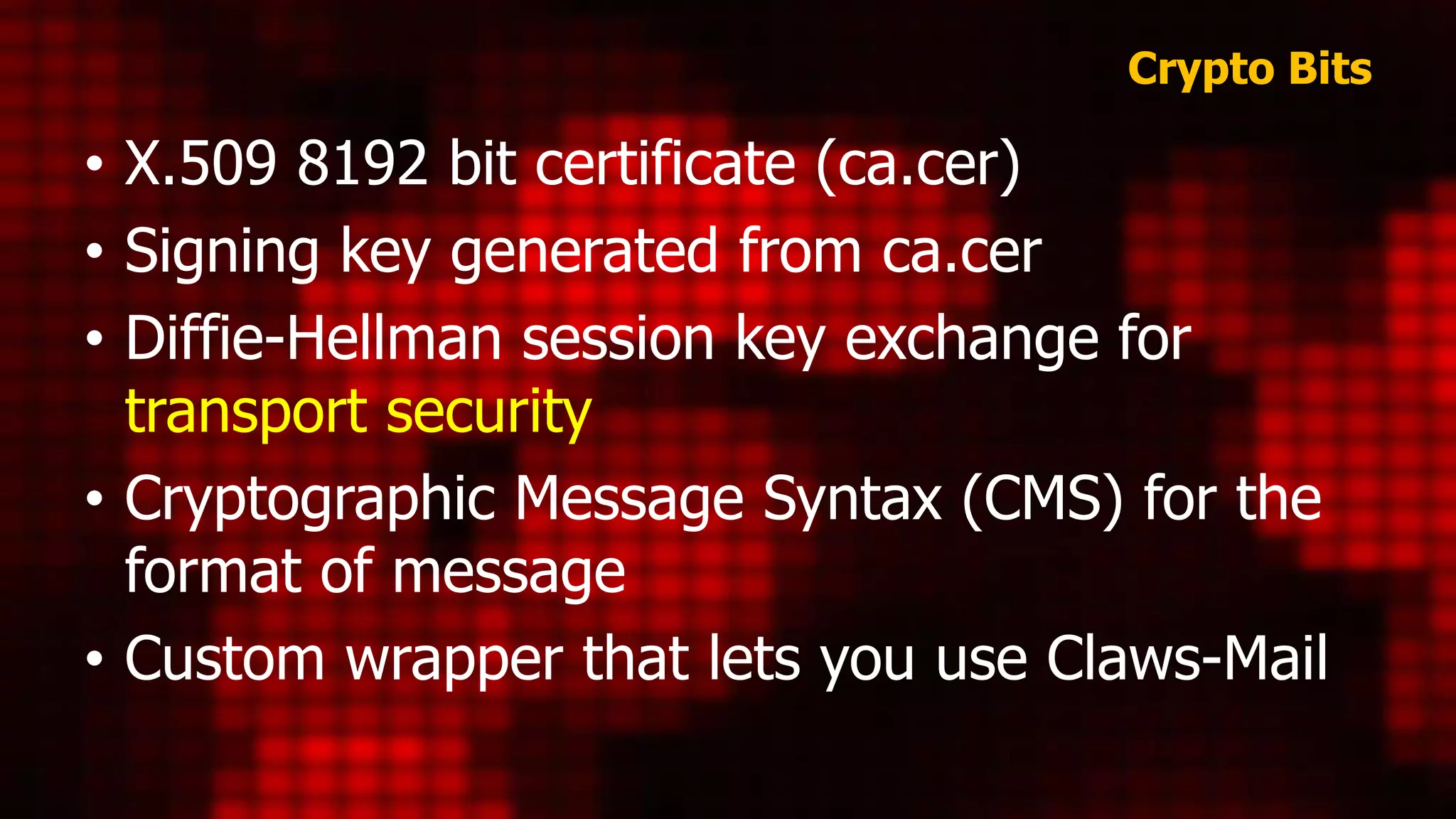
Crypto Bits
• X.509 8192 bit certificate (ca.cer)
• Signing key generated from ca.cer
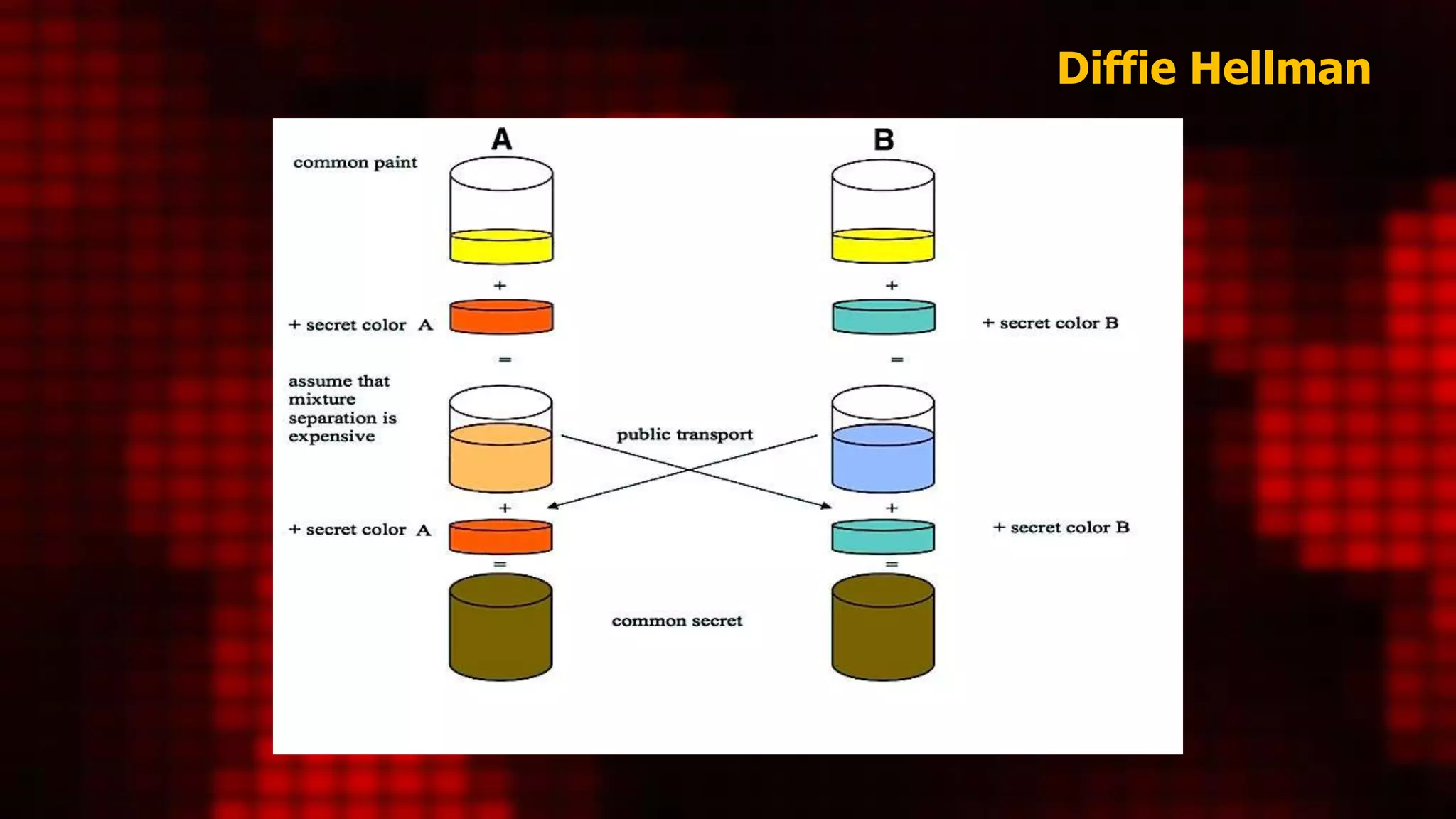
• Diffie-Hellman session key exchange for
transport security
• Cryptographic Message Syntax (CMS) for the
format of message
• Custom wrapper that lets you use Claws-Mail
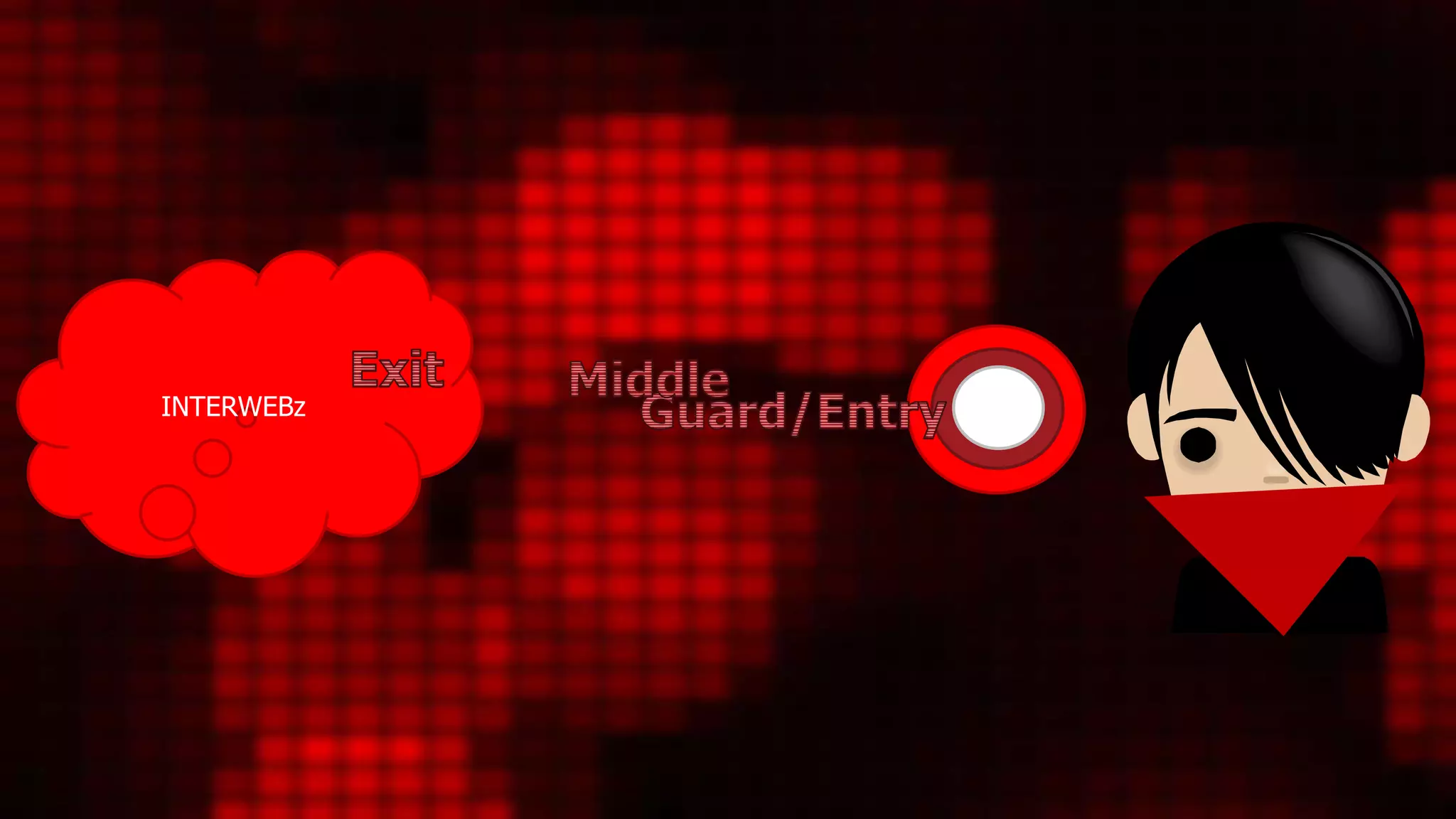
INTERWEBz
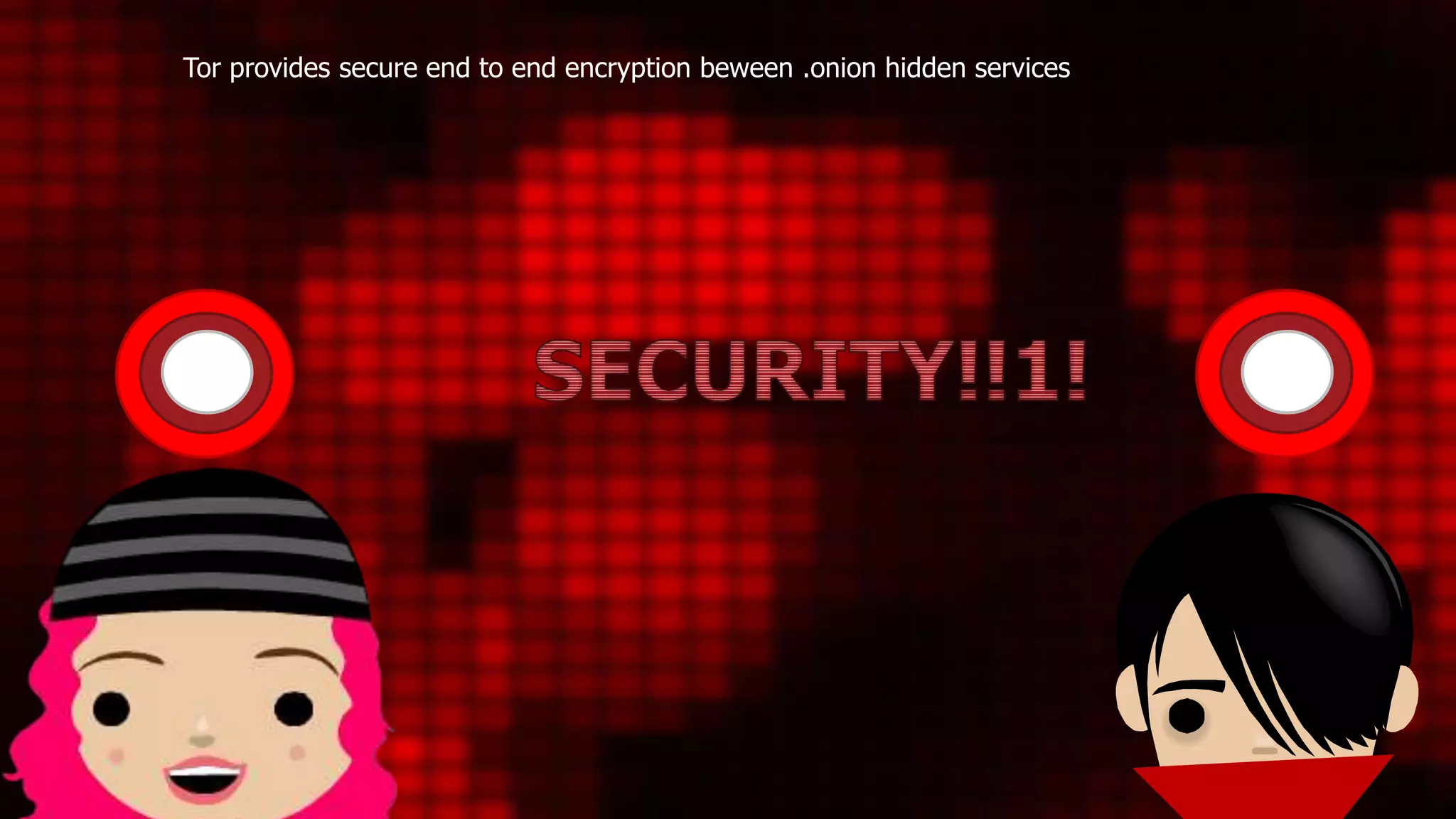
Tor provides secure end to end encryption beween .onion hidden services
Wait
• Diffie-Helman is a secure temporal key
exchange
• Used in this case to provide transport security
• It provides a key exchange ON TOP of the
hidden service transport mechanism
Diffie Hellman
BUT WHY??
• Why is Maxim adding a transport security
mechanism on top of Tor?
• Answer: Because he didn’t think Tor hidden
services had enough crypto
– SHA1 – deprecated
– AES128 – deprecated
– RSA-1024 – deprecated
• Tor’s hidden services are not secure enough
Review
• RSA 8192 x509 based secure message
exchange
• Uses HTTP requests over onion services to
connect
• Security on top of your security
• Janky web service
Popularity
• No one uses this
• I think one of the reasons is the awkwardness
of the name “Cables”
• Although it’s inherently more anonymous than
BitMessage, who cares because no one uses it
Bitmessage (actual logo)
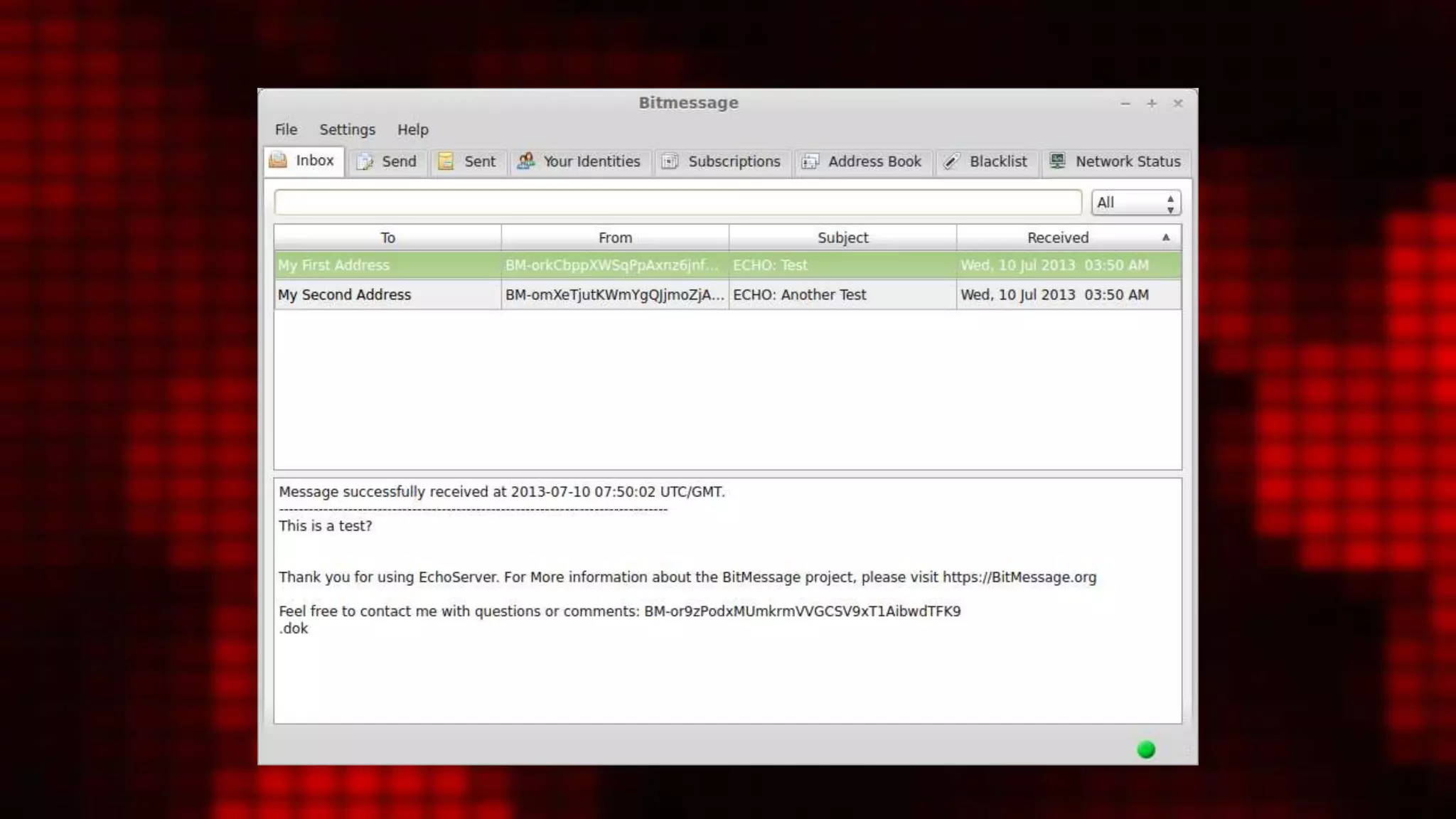
Bitmessage
• Secure, P2P based messaging
• Similar to mixmaster style anonymity
model(plausible deniability)
• If bitcoin had a baby with email it would be
Bitmessage
• You can only decrypt messages sent to your
public key
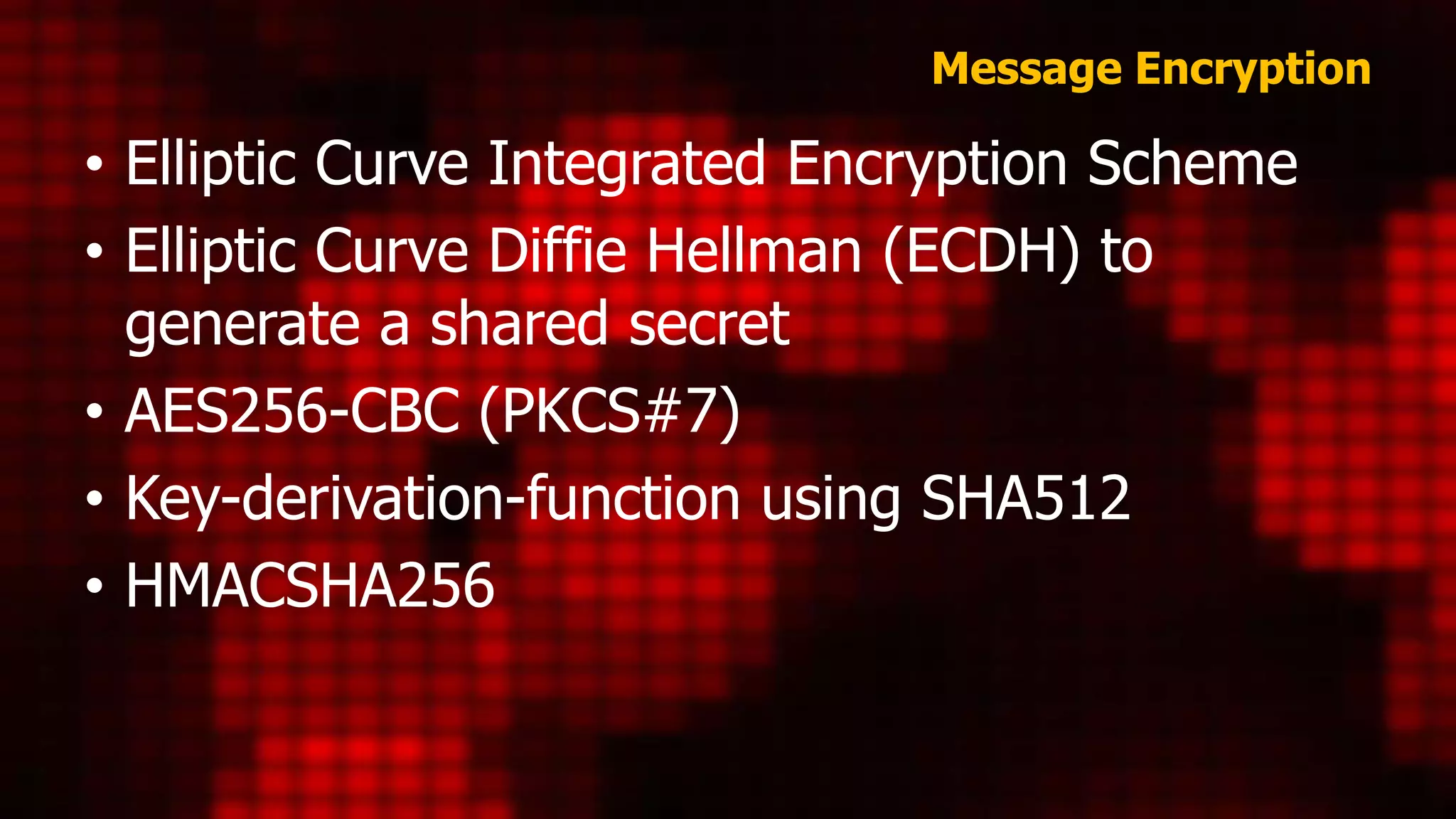
Message Encryption
• Elliptic Curve Integrated Encryption Scheme
• Elliptic Curve Diffie Hellman (ECDH) to
generate a shared secret
• AES256-CBC (PKCS#7)
• Key-derivation-function using SHA512
• HMACSHA256
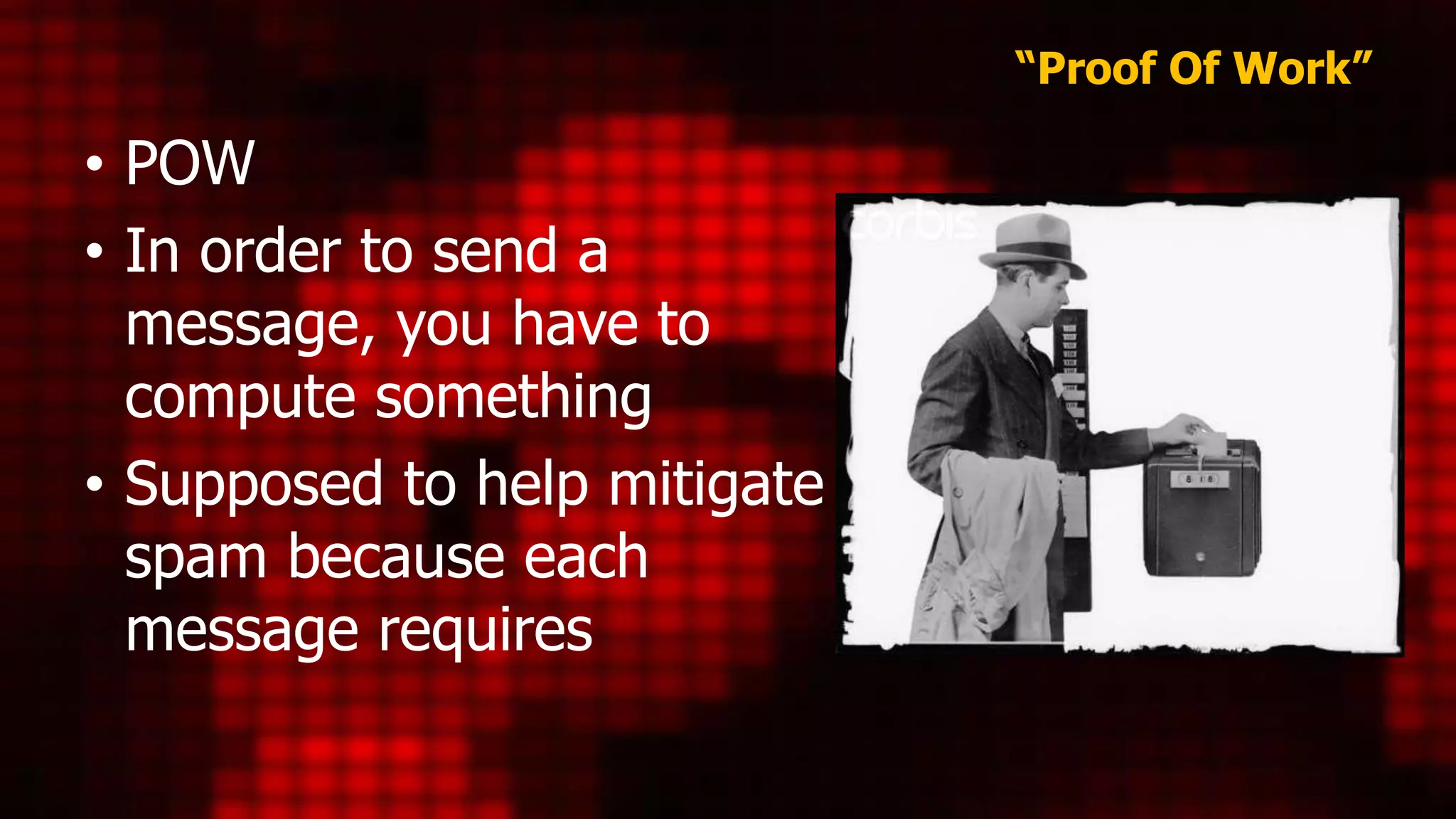
“Proof Of Work”
• POW
• In order to send a
message, you have to
compute something
• Supposed to help mitigate
spam because each
message requires
Crypto
• payload = time + streamnumber + encrypted
• target = 2^64 / ((length of the payload in bytes +
payloadLengthExtraBytes + 8) *
averageProofOfWorkNonceTrialsPerByte)
• initialHash = sha512(payload)
• while trialValue > target:
nonce = nonce + 1
resultHash = sha512(sha512( nonce + initialHash))
trialValue = int(resulthash[:8])
• Output: trialValue
Verification
• The client receives the message and verifies that
it has done enough work to send it to you
• The goal is that for each person you send to, you
have to send a POW
• When you send to 100 people, it may take 3
hours
• You can adjust the required POW to send to you
Protocol Encryption
• It’s like some crazy bitcoin
P2P network
• Seems really complicated
• I just don’t fucking know
• https://bitmessage.org/wiki/
Protocol_specification
Bit Message Popularity
• BitMessage is the most popular messaging
exchange by far
• Deepweb users like this as their favorite
• Remember they are all using the same exact
client and software and network to do this
exchange
• www.reddit.com/r/bitmessage
Summary
• Liberte: Cutting edge but full of the jank
• TAILS: Annoying but the best
• Cables: Why are we even talking about it?
• BitMessage: The most popular one, so it
doesn’t matter how secure it is

Reinventing anon email

  • 2.
  • 4.
    Liberté Linux • Hardened,Gentoo-based, LiveUSB/CD, Linux distro • Fully(ish) anonymized • Similar in goal to TAILS • Designed for Anon specifically • Run by Maxim Kammerer (he is Crazy) • Uses Tor AND I2P
  • 8.
    Features that makeit different than TAILS • Anti-forensic memory erase on boot media extraction – Aimed to cold boot attacks • OTFE container using LUKS • Collect clock setting via Tor consensus – Makes sure that clock settings are not in the clear – He’s very proud of this • I2p communication over Tor so that it can traverse firewalls better
  • 9.
    Features that makeit different than TAILS • Mac address randomization • Custom consistent HTTP headers – Defends against browser fingerprinting • Harsher iptables rules • Grsecurity for inter-process security
  • 10.
    The Big Features •The first Linux distro that uses UEFI – Secure boot – Hardware based verification of the operating system – If something new is on the system (malware) it won’t boot • Does not allow you to install ANY software • Forces a specific resolution • Cables Communication – Custom written P2P message exchange
  • 11.
  • 12.
    TAILS Linux • Debianbased, LiveUSB/CD, Linux distro • Fully(ish) anonymized • Similar in goal to Liberte • Designed for the everyman • Run by Baum with the support of the Tor Project • Uses just Tor for anonymity (but has i2p installed)
  • 14.
    Features that MakeIt Different Than Liberte • Regular updates – New versions are put out due to security issues or active development at least once a month – You can apt-get upgrade whenever you want • Uses standard LUKS for persistence and supports TrueCrypt • Contains a meta-data stripping tool – MAT • Uses Iceweasel (eventually TorBrowser) instead of janky Epiphany
  • 15.
    The Big Features •Documentation and Support – Unlike liberte that hasn’t been updated since 2012 – New releases every month – Monetarily supported by Tor Project – Has a roadmap! – Has complete, up to date documentation, in many languages • Can temporarily install any software – Or manually build from source and install your own software
  • 16.
    Tails “Quirks” • Nolock screen, no screen saver – Even if you install a screensaver, there are other tty terminals that let you just log in • Persistent Media is only USB – That means virtualization products won’t be able to make a consistent partion
  • 17.
    Cables: TL;DR • Asecure, peer-to-peer based message exchange • Aims to be a decentralized eMail replacement • Not really good as instant messaging (See bitmessage)
  • 18.
    Antitree presents: A Mouthfulof Crypto An animated explanation of the Cables Address generation process OR
  • 19.
    Generate a 8192bit x.509 key Generate a SHA1 hash of that key This is your cables username gb24hw2hpihnj2eftkuz42fvp3l3nsoc Create a Tor hidden service 5rfvhdhbw7z4dcw6.onion This is your domain name @
  • 20.
    Transport Mechanism • Thisis P2P so how does it exchange messages? • Via HTTP requests • The .onion service hosts a web interface • http://localhost:9080/{userid}
  • 21.
    Crypto Bits • X.5098192 bit certificate (ca.cer) • Signing key generated from ca.cer • Diffie-Hellman session key exchange for transport security • Cryptographic Message Syntax (CMS) for the format of message • Custom wrapper that lets you use Claws-Mail
  • 22.
  • 23.
    Tor provides secureend to end encryption beween .onion hidden services
  • 24.
    Wait • Diffie-Helman isa secure temporal key exchange • Used in this case to provide transport security • It provides a key exchange ON TOP of the hidden service transport mechanism
  • 25.
  • 26.
    BUT WHY?? • Whyis Maxim adding a transport security mechanism on top of Tor? • Answer: Because he didn’t think Tor hidden services had enough crypto – SHA1 – deprecated – AES128 – deprecated – RSA-1024 – deprecated • Tor’s hidden services are not secure enough
  • 27.
    Review • RSA 8192x509 based secure message exchange • Uses HTTP requests over onion services to connect • Security on top of your security • Janky web service
  • 28.
    Popularity • No oneuses this • I think one of the reasons is the awkwardness of the name “Cables” • Although it’s inherently more anonymous than BitMessage, who cares because no one uses it
  • 29.
  • 30.
    Bitmessage • Secure, P2Pbased messaging • Similar to mixmaster style anonymity model(plausible deniability) • If bitcoin had a baby with email it would be Bitmessage • You can only decrypt messages sent to your public key
  • 34.
    Message Encryption • EllipticCurve Integrated Encryption Scheme • Elliptic Curve Diffie Hellman (ECDH) to generate a shared secret • AES256-CBC (PKCS#7) • Key-derivation-function using SHA512 • HMACSHA256
  • 35.
    “Proof Of Work” •POW • In order to send a message, you have to compute something • Supposed to help mitigate spam because each message requires
  • 36.
    Crypto • payload =time + streamnumber + encrypted • target = 2^64 / ((length of the payload in bytes + payloadLengthExtraBytes + 8) * averageProofOfWorkNonceTrialsPerByte) • initialHash = sha512(payload) • while trialValue > target: nonce = nonce + 1 resultHash = sha512(sha512( nonce + initialHash)) trialValue = int(resulthash[:8]) • Output: trialValue
  • 37.
    Verification • The clientreceives the message and verifies that it has done enough work to send it to you • The goal is that for each person you send to, you have to send a POW • When you send to 100 people, it may take 3 hours • You can adjust the required POW to send to you
  • 38.
    Protocol Encryption • It’slike some crazy bitcoin P2P network • Seems really complicated • I just don’t fucking know • https://bitmessage.org/wiki/ Protocol_specification
  • 39.
    Bit Message Popularity •BitMessage is the most popular messaging exchange by far • Deepweb users like this as their favorite • Remember they are all using the same exact client and software and network to do this exchange • www.reddit.com/r/bitmessage
  • 40.
    Summary • Liberte: Cuttingedge but full of the jank • TAILS: Annoying but the best • Cables: Why are we even talking about it? • BitMessage: The most popular one, so it doesn’t matter how secure it is