T O P O L O G Y O F T H E
NETWORK
NETWORK
NETWORK
Information technology Holiday Homework
Presentation by:
Presentation by:
Anushka Tripathi
Anushka Tripathi
VIII-A
VIII-A
ROll no. 6
ROll no. 6
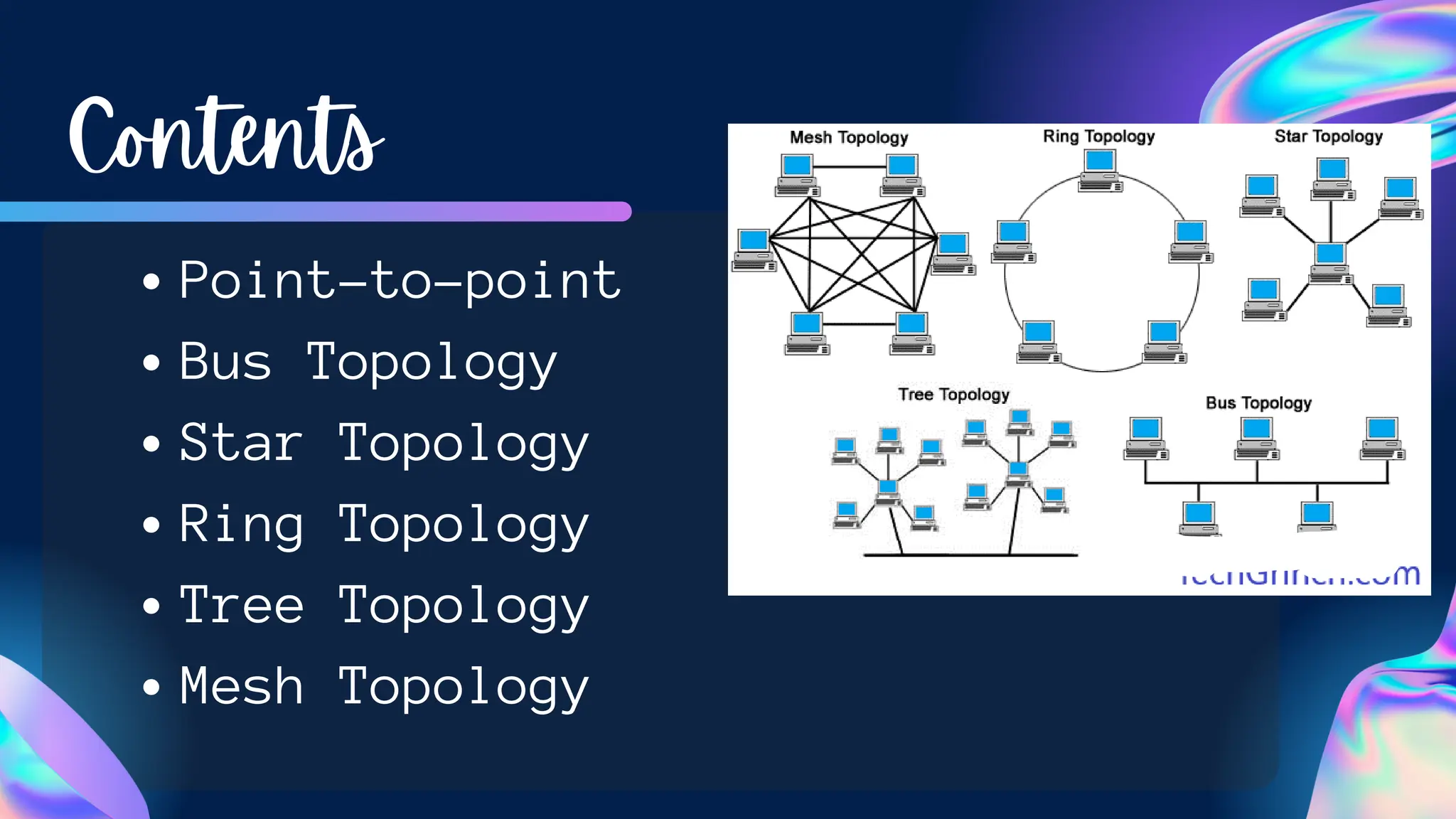
Point-to-point
Bus Topology
Star Topology
Ring Topology
Tree Topology
Mesh Topology
Contents
04
What are Network Topologies
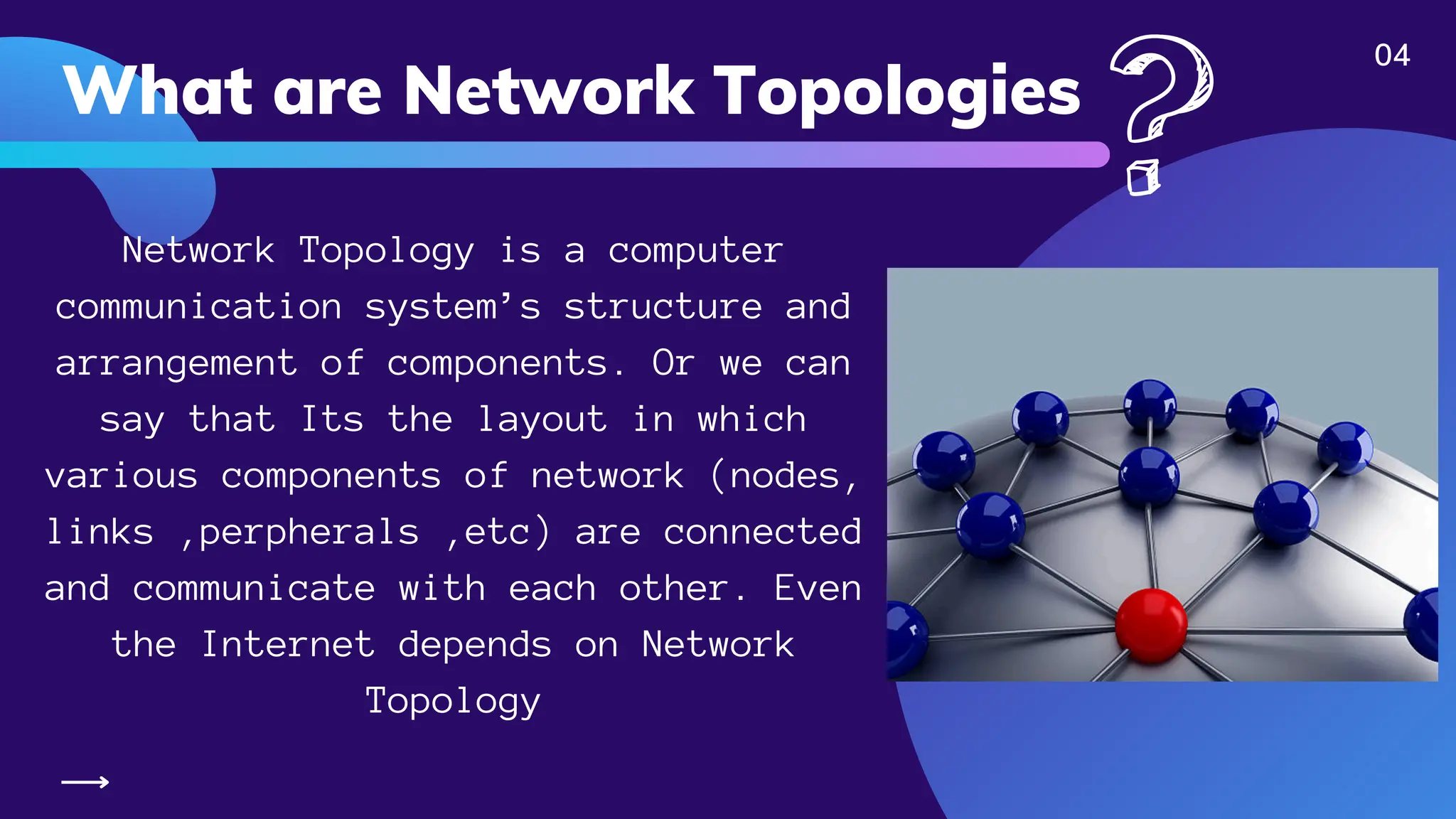
Network Topology is a computer
communication system’s structure and
arrangement of components. Or we can
say that Its the layout in which
various components of network (nodes,
links ,perpherals ,etc) are connected
and communicate with each other. Even
the Internet depends on Network
Topology
05
Social Media
Specialist
Digital
Marketing
Website
Developer
Graphic
Design
Expertise Expertise Expertise
It is made from two words, Network and Topology.
Network: A network is an arrangement where two or more
computers ( also referred to as nodes ) communicate with each
other. These computers or participant nodes actively contribute to
the process of communication.
Topology: Topology is simply an arrangement of how these nodes will
interact. It is a topology that governs data flow between
respective nodes.
07
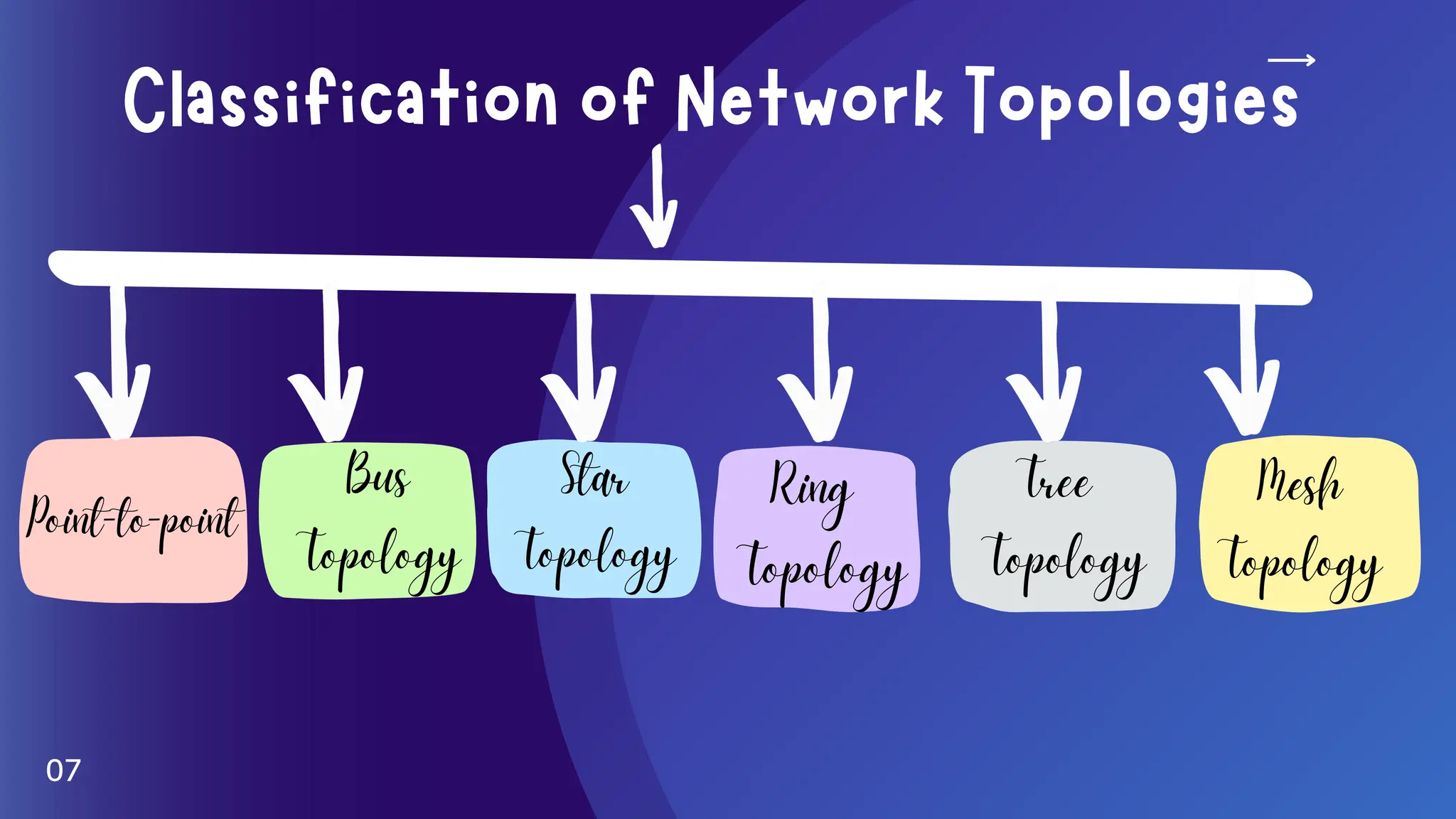
Classification of Network Topologies
Point-to-point
Bus
Topology
Star
Topology
Ring
Topology
Tree
Topology
Mesh
Topology
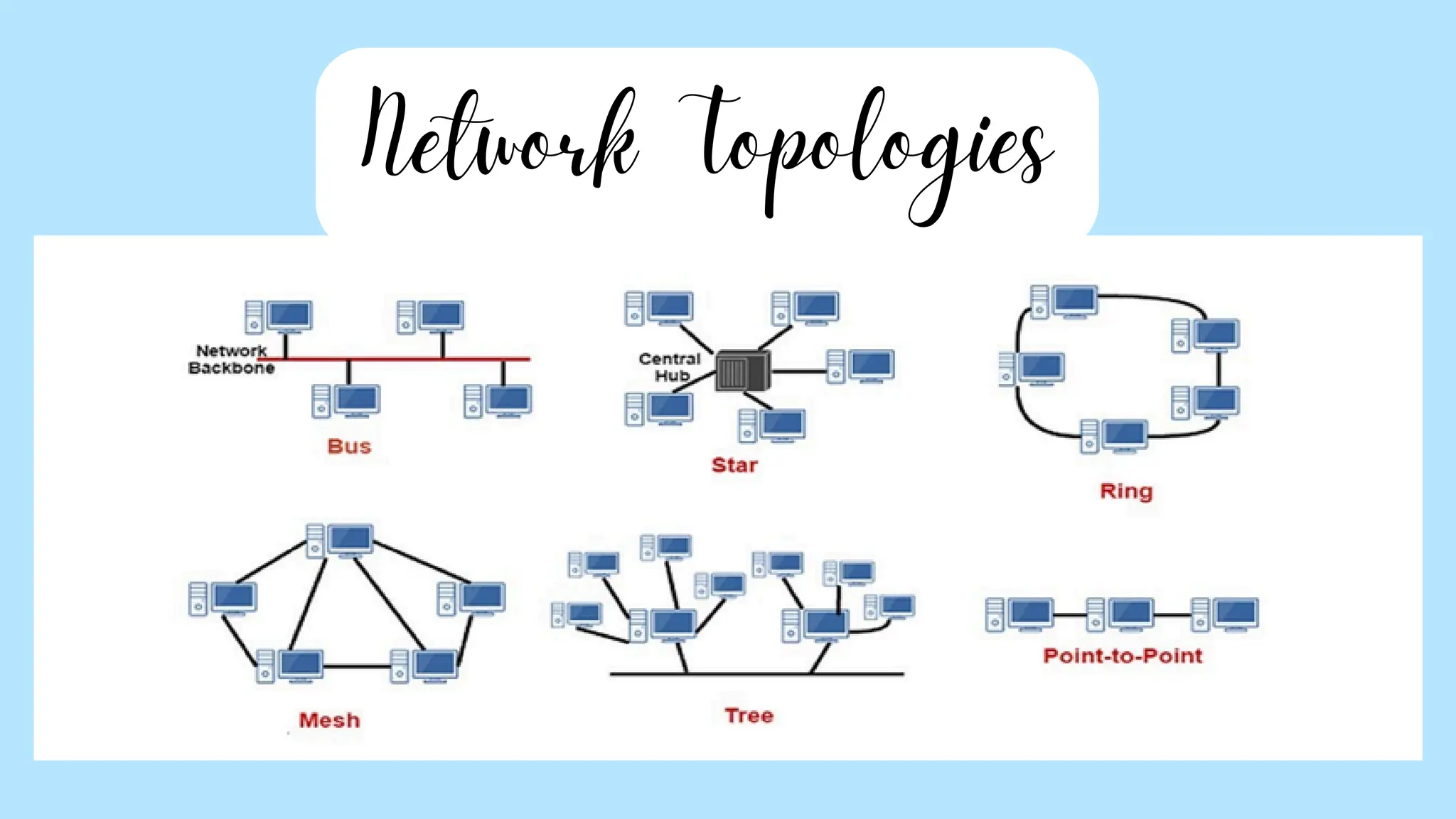
Network Topologies
1. Point-to-Point Topology
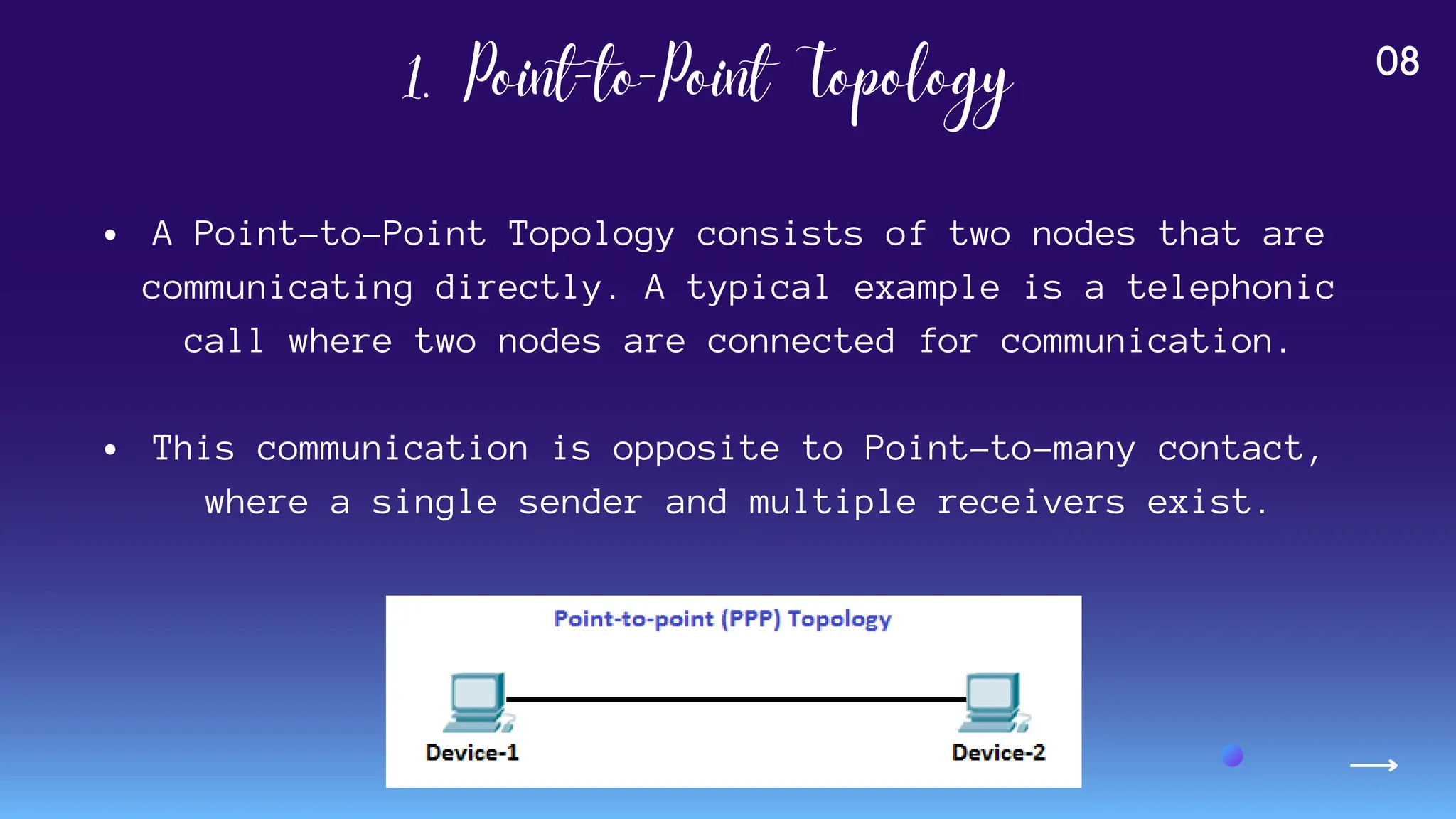
A Point-to-Point Topology consists of two nodes that are
communicating directly. A typical example is a telephonic
call where two nodes are connected for communication.
This communication is opposite to Point-to-many contact,
where a single sender and multiple receivers exist.
08
2. Bus Topology
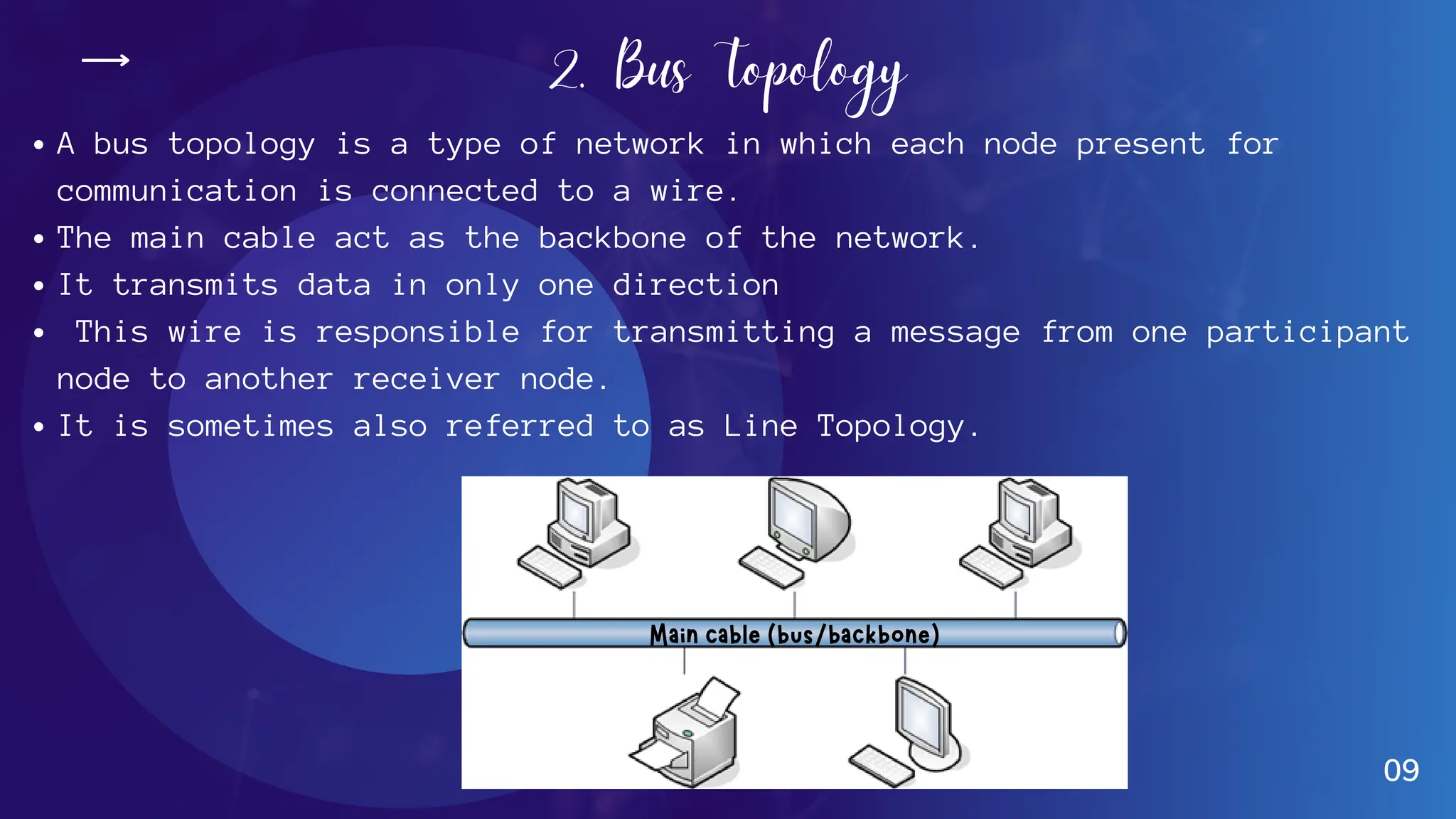
A bus topology is a type of network in which each node present for
communication is connected to a wire.
The main cable act as the backbone of the network.
It transmits data in only one direction
This wire is responsible for transmitting a message from one participant
node to another receiver node.
It is sometimes also referred to as Line Topology.
09
Main cable (bus/backbone)
Uses:
It is generally used over a small network such as LAN.
Here messages need to be transmitted over the limited number
of participant nodes.
Advantages:
Easy to use and understand.
Cost-effective.
Easy to extend the network by simply adding a repeater
(a repeater generally boosts the signal and helps for
transmission to longer distances).
Disadvantages:
A single cable break will bring down the bus topology.
Too many participant nodes make the network slow.
3. Star Topology
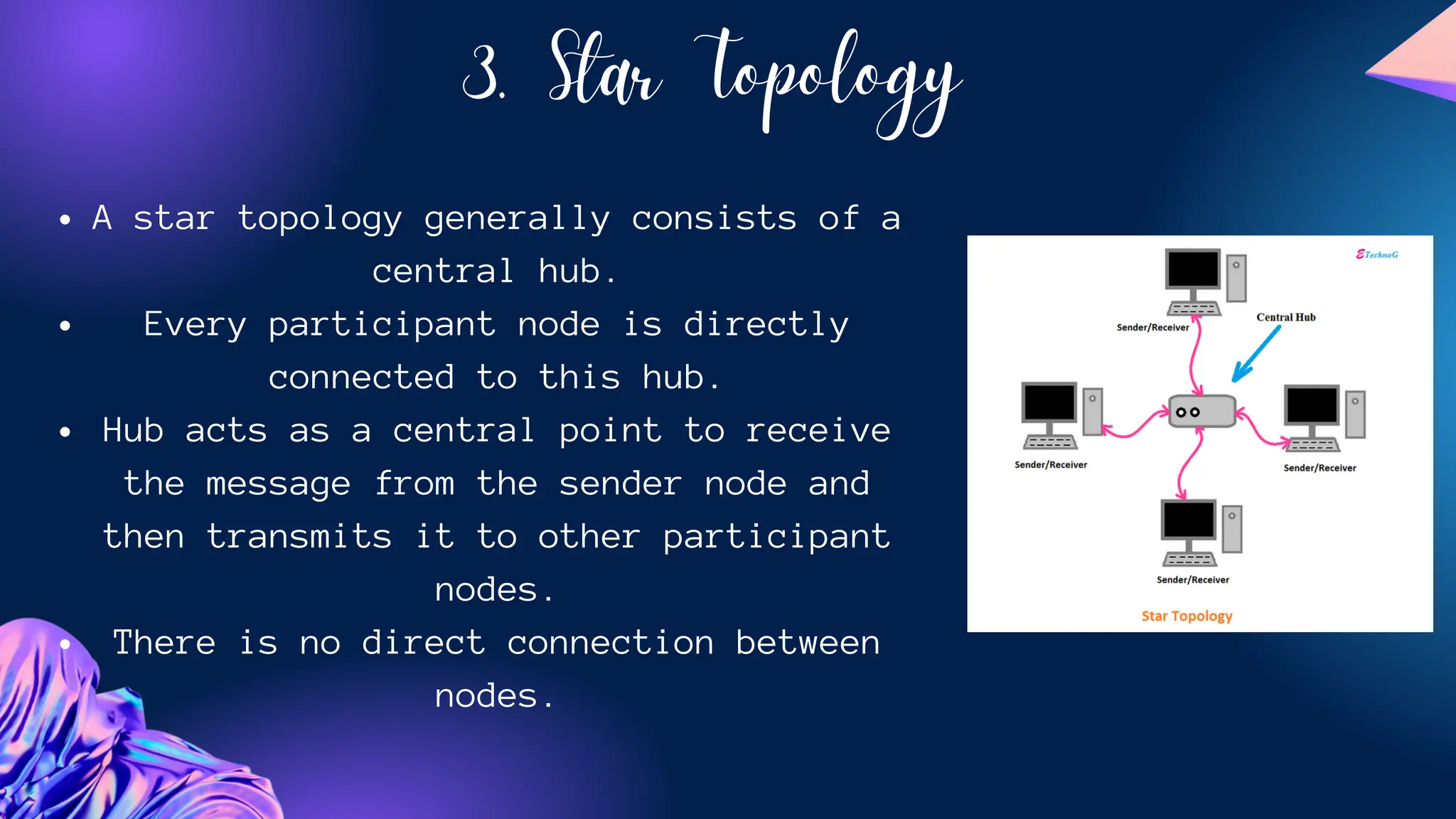
A star topology generally consists of a
central hub.
Every participant node is directly
connected to this hub.
Hub acts as a central point to receive
the message from the sender node and
then transmits it to other participant
nodes.
There is no direct connection between
nodes.
Use:
Large networks using a star topology are usually controlled by one or
more servers. Hence, the client-server model usually uses a star
topology.
Advantages:
A single node failure does not affect the complete network.
The network can run smoothly as far as the centralized hub is
running smoothly.
It is more cost-effective since the centralized network reduces
network administration costs highly.
Disadvantages:
Failure of the central hub will disrupt the whole topology.
It is slightly costly when compared to bus topology.
4. Ring Topology
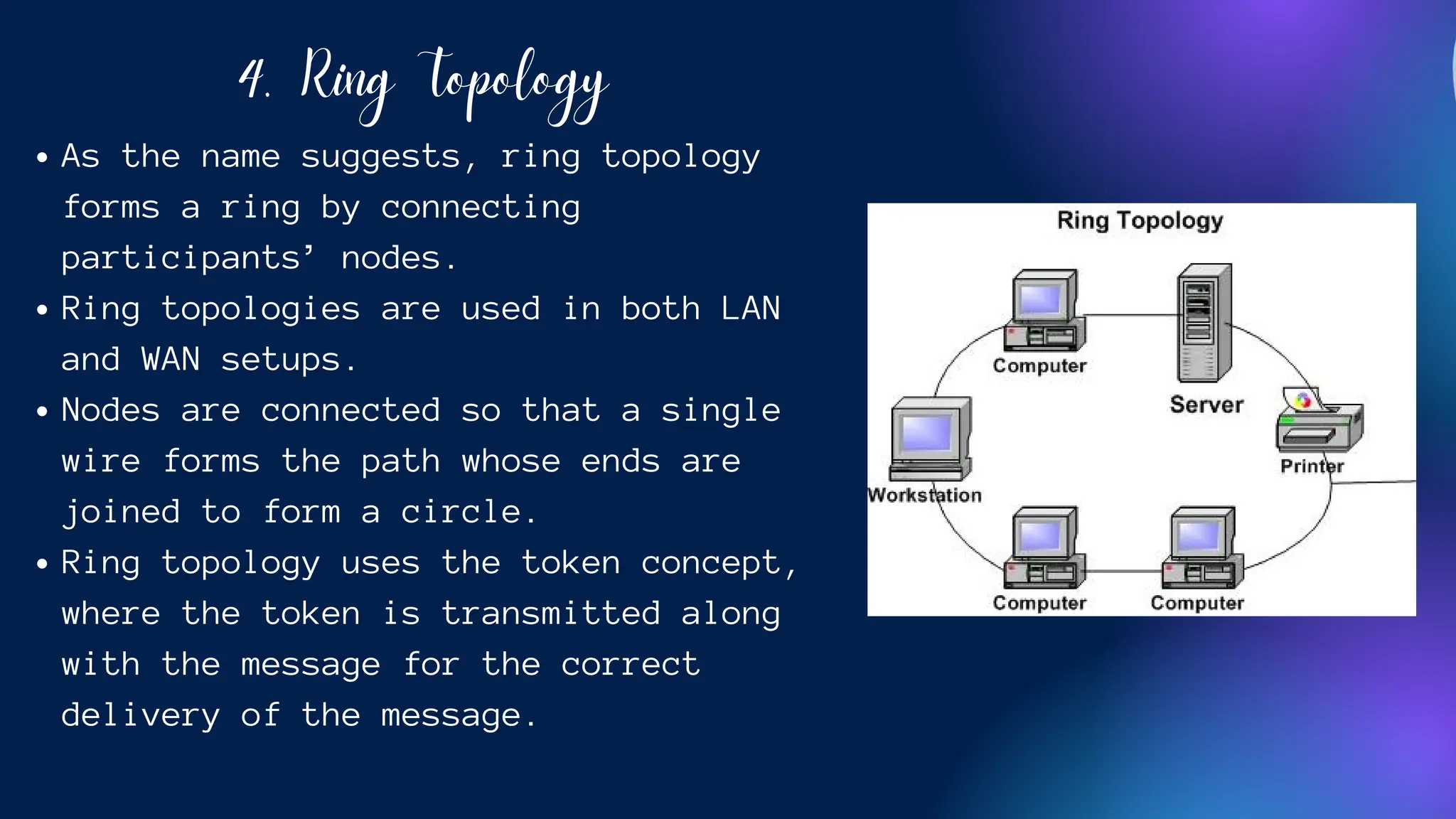
As the name suggests, ring topology
forms a ring by connecting
participants’ nodes.
Ring topologies are used in both LAN
and WAN setups.
Nodes are connected so that a single
wire forms the path whose ends are
joined to form a circle.
Ring topology uses the token concept,
where the token is transmitted along
with the message for the correct
delivery of the message.
Uses:
A ring topology is generally designed in such a way that it
forms a ring-type network either physically or logically.
These rings are made around campus or buildings to form a
high-speed, flexible, reliable network.
Advantages:
No master-slave concept.
Each node has its share of responsibility.
It could work in a high-capacity network.
Disadvantages:
The main disadvantage we have here is that If a single node
failure affects the complete network.
Adding or removing computers disturb the network.
5. Tree Topology
A tree topology is a particular type of
network where many participants’ nodes are
connected to form a tree type of
architecture.
Generally, there is a central initiator node
that could be compared to the root of a
tree.
This root node, on extending further, has
different nodes connected to it, which could
be compared to the branches of a tree.
A tree topology is a combination of bus
topology and star topology.
16
Uses:
Tree topology is usually going to use for recognising the
system in a network into order to distribute data across the
network and to let network operator to link many servers.
Advantages:
Easily scalable since adding a new node leaf node is
easily possible.
Leaf nodes could accommodate new nodes, thus forming the
hierarchical chain.
Other hierarchical nodes do not get affected if
particular nodes fail.
Easy to debug
Disadvantages:
A huge length of wires is required to form the
hierarchical chain.
A lot of maintenance is required.
A Hierarchical network
topology interconnects
multiple groups that are
located on the separate layers
to form a larger network.
A Hierarchical network
topology interconnects
multiple groups that are
located on the separate layers
to form a larger network.
let's know more!
6. Mesh Topology
As the name suggests, Mesh Topology generally forms a mesh
of all the interconnected nodes.
Each node is connected to every other node through a single
one-to-one communication wire.
There is a one-to-one mapping between each node.
Topology
Uses:
A mesh topology is generally used over an extensive network where a single node’s
breakdown shall not affect the complete network.
It is generally used as if a single fault in routes, wires, etc., shall not hamper
complete topology.
Advantages:
Better fault-tolerance capacity.
Failure of one participant node or other devices, such as routers, will
not affect the complete network.
An alternate path is always available if there is a breakdown in one
path between two nodes.
Disadvantages:
The network becomes too complex as there are large participant nodes.
It becomes costly due to the setup of multiple paths.
Thank you!

Topology of the Network class 8 .ppt pdf

  • 1.
    T O PO L O G Y O F T H E T O P O L O G Y O F T H E NETWORK NETWORK NETWORK
  • 2.
    Information technology HolidayHomework Information technology Holiday Homework Presentation by: Presentation by: Anushka Tripathi Anushka Tripathi VIII-A VIII-A ROll no. 6 ROll no. 6
  • 3.
    Point-to-point Bus Topology Star Topology RingTopology Tree Topology Mesh Topology Contents
  • 4.
    04 What are NetworkTopologies Network Topology is a computer communication system’s structure and arrangement of components. Or we can say that Its the layout in which various components of network (nodes, links ,perpherals ,etc) are connected and communicate with each other. Even the Internet depends on Network Topology
  • 5.
    05 Social Media Specialist Digital Marketing Website Developer Graphic Design Expertise ExpertiseExpertise It is made from two words, Network and Topology. Network: A network is an arrangement where two or more computers ( also referred to as nodes ) communicate with each other. These computers or participant nodes actively contribute to the process of communication. Topology: Topology is simply an arrangement of how these nodes will interact. It is a topology that governs data flow between respective nodes.
  • 6.
    07 Classification of NetworkTopologies Point-to-point Bus Topology Star Topology Ring Topology Tree Topology Mesh Topology
  • 7.
  • 8.
    1. Point-to-Point Topology APoint-to-Point Topology consists of two nodes that are communicating directly. A typical example is a telephonic call where two nodes are connected for communication. This communication is opposite to Point-to-many contact, where a single sender and multiple receivers exist. 08
  • 9.
    2. Bus Topology Abus topology is a type of network in which each node present for communication is connected to a wire. The main cable act as the backbone of the network. It transmits data in only one direction This wire is responsible for transmitting a message from one participant node to another receiver node. It is sometimes also referred to as Line Topology. 09 Main cable (bus/backbone)
  • 10.
    Uses: It is generallyused over a small network such as LAN. Here messages need to be transmitted over the limited number of participant nodes. Advantages: Easy to use and understand. Cost-effective. Easy to extend the network by simply adding a repeater (a repeater generally boosts the signal and helps for transmission to longer distances). Disadvantages: A single cable break will bring down the bus topology. Too many participant nodes make the network slow.
  • 11.
    3. Star Topology Astar topology generally consists of a central hub. Every participant node is directly connected to this hub. Hub acts as a central point to receive the message from the sender node and then transmits it to other participant nodes. There is no direct connection between nodes.
  • 12.
    Use: Large networks usinga star topology are usually controlled by one or more servers. Hence, the client-server model usually uses a star topology. Advantages: A single node failure does not affect the complete network. The network can run smoothly as far as the centralized hub is running smoothly. It is more cost-effective since the centralized network reduces network administration costs highly. Disadvantages: Failure of the central hub will disrupt the whole topology. It is slightly costly when compared to bus topology.
  • 13.
    4. Ring Topology Asthe name suggests, ring topology forms a ring by connecting participants’ nodes. Ring topologies are used in both LAN and WAN setups. Nodes are connected so that a single wire forms the path whose ends are joined to form a circle. Ring topology uses the token concept, where the token is transmitted along with the message for the correct delivery of the message.
  • 14.
    Uses: A ring topologyis generally designed in such a way that it forms a ring-type network either physically or logically. These rings are made around campus or buildings to form a high-speed, flexible, reliable network. Advantages: No master-slave concept. Each node has its share of responsibility. It could work in a high-capacity network. Disadvantages: The main disadvantage we have here is that If a single node failure affects the complete network. Adding or removing computers disturb the network.
  • 15.
    5. Tree Topology Atree topology is a particular type of network where many participants’ nodes are connected to form a tree type of architecture. Generally, there is a central initiator node that could be compared to the root of a tree. This root node, on extending further, has different nodes connected to it, which could be compared to the branches of a tree. A tree topology is a combination of bus topology and star topology.
  • 16.
    16 Uses: Tree topology isusually going to use for recognising the system in a network into order to distribute data across the network and to let network operator to link many servers. Advantages: Easily scalable since adding a new node leaf node is easily possible. Leaf nodes could accommodate new nodes, thus forming the hierarchical chain. Other hierarchical nodes do not get affected if particular nodes fail. Easy to debug Disadvantages: A huge length of wires is required to form the hierarchical chain. A lot of maintenance is required. A Hierarchical network topology interconnects multiple groups that are located on the separate layers to form a larger network. A Hierarchical network topology interconnects multiple groups that are located on the separate layers to form a larger network. let's know more!
  • 17.
    6. Mesh Topology Asthe name suggests, Mesh Topology generally forms a mesh of all the interconnected nodes. Each node is connected to every other node through a single one-to-one communication wire. There is a one-to-one mapping between each node. Topology
  • 18.
    Uses: A mesh topologyis generally used over an extensive network where a single node’s breakdown shall not affect the complete network. It is generally used as if a single fault in routes, wires, etc., shall not hamper complete topology. Advantages: Better fault-tolerance capacity. Failure of one participant node or other devices, such as routers, will not affect the complete network. An alternate path is always available if there is a breakdown in one path between two nodes. Disadvantages: The network becomes too complex as there are large participant nodes. It becomes costly due to the setup of multiple paths.
  • 19.