CITY UNIVERSITY
Course Title: Computer Networks
Course Code: CSE317
Topics Name: Network Topology
Submitted By:
Afsana Akther Rubi
ID No: 1834902553
Batch: 49th
Submitted To:
Pranab Bandhu Nath
Senior Lecturer
Department of CSE
City University
Network Topology:
Network topologies describe the methods in which all the elements of a network
are mapped.
Network topologies can be either logical or physical.
1. Physical – The physical network topology refers to the actual connections
(wires, cables, etc.) of how the network is arranged. Setup, maintenance, and
provisioning tasks require insight into the physical network.
2. Logical – The logical network topology is a higher-level idea of how the
network is set up, including which nodes connect to each other and in which ways,
as well as how data is transmitted through the network. Logical network topology
includes any virtual and cloud resources.
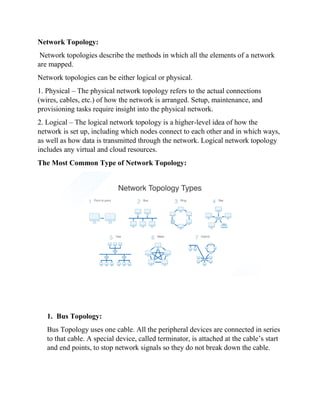
The Most Common Type of Network Topology:
1. Bus Topology:
Bus Topology uses one cable. All the peripheral devices are connected in series
to that cable. A special device, called terminator, is attached at the cable’s start
and end points, to stop network signals so they do not break down the cable.
Advantage of Bus Topology:
Bus Topology is that it uses the less cabling of any topology.
Disadvantage of Bus Topology:
Bus Topology is that extra circuitry ad software are used to keep data packets
from colliding with one another. A broken connection can bring down all part
of the network.
2. Star Topology:
Star Topology probably the most common topology. In star network, all nodes
are connected to a device called hub and communicate through it. Data packets
travel through the hub and are sent to attach nodes, eventually reaching their
destinations. Some hubs - known as intelligent hubs- can monitor traffic and
help prevent collisions.
Advantages of Star Topology:
In star topology a broken connection between a node and the hub does not
affect the rest of the network.
Disadvantage of Star Topology:
If the hub is lost, however all the nodes connected to that hub are unable to
communicate.
3. The Ring Topology :
The Ring Topology connects the network’s nodes in a circular chain, with
each node connected to the next. The last node connected to the first,
completing the ring. Each node examines data as it travels through the ring.
Advantages of Ring Topology:
There is no danger of collisions because only one packet of data travels the
ring at a time.
Disadvantages of Ring Topology:
If the ring is broken, however, the entire network is unable to communicate.
4. Mesh Topology:
Mesh Topology is the least used network topology and the most expensive
to implement. In mesh environment, a cable runs from every computer to
every other computer.
Advantage of Mesh Topology:
The big advantage to this arrangement is that data can never fail to be
delivered. If anyone connection goes down, there are other ways to route the
data to its destination.
Disadvantage of Mesh Topology:
Most expensive network as large amount of cabling is required. Expensive
hardware and software is needed to implement this network.
5. Tree Topology or Hierarchical Topology :
Tree Topology is the combination of the characteristics of a star topology
and a bus topology. In this topology, a star -configured workstation in a
group are connected to cable which acts as a linear bus backbone. The tree
bus can connect only with the hub device directly. It has a central hub acts as
a root of a tree of a network device. It has a central root node which is
connected to one or more nodes present in the lower hierarchical topology.
Advantage of Tree Topology:
Point to point wiring for every segment is the main advantage. It is also
supported by most of the hardware and software vendors.
Disadvantage of Tree Topology:
The type of the cabling limits the overall length of each segment. When the
backbone line breaks, it leads to the breakdown of the complete segment.
Tree topology becomes more difficulty to configure and wire comparison to
the other topologies
6. Hybrid Topology :
Hybrid Topology is a combination of any two or more network topologies.
The topology obtained as a result of connecting two basic network
topologies together retains the basic character of the network and is not a
hybrid network. Consider the example of a tree network which is connected
to another tree network; the resulting network is still a tree network but not a
hybrid network.
Advantage of Hybrid Topology:
1. Reliable
2. Effective
3. Flexible
4. Scalable
Disadvantage of Hybrid Topology:
1. Complexity
2. Expensive
Network Technology:
Network Technology involves the use of data systems to manage and
deliver digital resources over a computer network. A variety of industries
use computer hardware and system software that maintains a network,
creating a need for specialists to manage them.
Intranet:
An intranet is a private network, operated by a large company or other
organization, which uses internet technologies, but is insulated from the
global internet
Extranet:
An extranet is an intranet that is accessible to some people from outside the
company, or possibly shared by more than one organization.
Internet:
An intranet is a computer network for sharing information, collaboration
tools, operational systems, and other computing services within an
organization, usually to the exclusion of access by outsiders.

Network Topology

  • 1.
    CITY UNIVERSITY Course Title:Computer Networks Course Code: CSE317 Topics Name: Network Topology Submitted By: Afsana Akther Rubi ID No: 1834902553 Batch: 49th Submitted To: Pranab Bandhu Nath Senior Lecturer Department of CSE City University
  • 2.
    Network Topology: Network topologiesdescribe the methods in which all the elements of a network are mapped. Network topologies can be either logical or physical. 1. Physical – The physical network topology refers to the actual connections (wires, cables, etc.) of how the network is arranged. Setup, maintenance, and provisioning tasks require insight into the physical network. 2. Logical – The logical network topology is a higher-level idea of how the network is set up, including which nodes connect to each other and in which ways, as well as how data is transmitted through the network. Logical network topology includes any virtual and cloud resources. The Most Common Type of Network Topology: 1. Bus Topology: Bus Topology uses one cable. All the peripheral devices are connected in series to that cable. A special device, called terminator, is attached at the cable’s start and end points, to stop network signals so they do not break down the cable.
  • 3.
    Advantage of BusTopology: Bus Topology is that it uses the less cabling of any topology. Disadvantage of Bus Topology: Bus Topology is that extra circuitry ad software are used to keep data packets from colliding with one another. A broken connection can bring down all part of the network. 2. Star Topology: Star Topology probably the most common topology. In star network, all nodes are connected to a device called hub and communicate through it. Data packets travel through the hub and are sent to attach nodes, eventually reaching their destinations. Some hubs - known as intelligent hubs- can monitor traffic and help prevent collisions. Advantages of Star Topology: In star topology a broken connection between a node and the hub does not affect the rest of the network. Disadvantage of Star Topology: If the hub is lost, however all the nodes connected to that hub are unable to communicate. 3. The Ring Topology : The Ring Topology connects the network’s nodes in a circular chain, with each node connected to the next. The last node connected to the first, completing the ring. Each node examines data as it travels through the ring. Advantages of Ring Topology: There is no danger of collisions because only one packet of data travels the ring at a time. Disadvantages of Ring Topology: If the ring is broken, however, the entire network is unable to communicate.
  • 4.
    4. Mesh Topology: MeshTopology is the least used network topology and the most expensive to implement. In mesh environment, a cable runs from every computer to every other computer. Advantage of Mesh Topology: The big advantage to this arrangement is that data can never fail to be delivered. If anyone connection goes down, there are other ways to route the data to its destination. Disadvantage of Mesh Topology: Most expensive network as large amount of cabling is required. Expensive hardware and software is needed to implement this network. 5. Tree Topology or Hierarchical Topology : Tree Topology is the combination of the characteristics of a star topology and a bus topology. In this topology, a star -configured workstation in a group are connected to cable which acts as a linear bus backbone. The tree bus can connect only with the hub device directly. It has a central hub acts as a root of a tree of a network device. It has a central root node which is connected to one or more nodes present in the lower hierarchical topology. Advantage of Tree Topology: Point to point wiring for every segment is the main advantage. It is also supported by most of the hardware and software vendors. Disadvantage of Tree Topology: The type of the cabling limits the overall length of each segment. When the backbone line breaks, it leads to the breakdown of the complete segment. Tree topology becomes more difficulty to configure and wire comparison to the other topologies 6. Hybrid Topology : Hybrid Topology is a combination of any two or more network topologies. The topology obtained as a result of connecting two basic network topologies together retains the basic character of the network and is not a hybrid network. Consider the example of a tree network which is connected to another tree network; the resulting network is still a tree network but not a hybrid network.
  • 5.
    Advantage of HybridTopology: 1. Reliable 2. Effective 3. Flexible 4. Scalable Disadvantage of Hybrid Topology: 1. Complexity 2. Expensive Network Technology: Network Technology involves the use of data systems to manage and deliver digital resources over a computer network. A variety of industries use computer hardware and system software that maintains a network, creating a need for specialists to manage them. Intranet: An intranet is a private network, operated by a large company or other organization, which uses internet technologies, but is insulated from the global internet Extranet: An extranet is an intranet that is accessible to some people from outside the company, or possibly shared by more than one organization. Internet: An intranet is a computer network for sharing information, collaboration tools, operational systems, and other computing services within an organization, usually to the exclusion of access by outsiders.