NETWORK TOPOLOGY
 Introduction.
 Types of Topologies.
 Bus Topology.
 Ring Topology.
 Star Topology.
 Mesh Topology.
 Tree Topology.
 Hybrid Topology.
 Applications of Topology.
 Conclusion.
 The physical layout or the way in which network connections
are made is known as topology.
 Topology is the arrangement of the elements like
(links, nodes) of a communication network.
 Topology can be used to define or describe the arrangement of
various types of telecommunication networks .
 Topology also describe how the data is transferred between
these nodes.
 There are two types of network topologies:
1) Physical.
2) Logical.
 Physical :- Physical topology emphasizes the physical layout of the
connected devices and nodes.
 Logical :- The logical topology focuses on the pattern of data transfer
between network nodes.
 Bus Topology.
 Star Topology.
 Tree Topology.
 Mesh Topology.
 Star Topology.
 Hybrid Topology.
The combination of two or more topology is called the Hybrid topology.
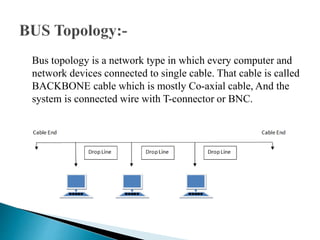
Bus topology is a network type in which every computer and
network devices connected to single cable. That cable is called
BACKBONE cable which is mostly Co-axial cable, And the
system is connected wire with T-connector or BNC.
 It is cost effective means less costly.
 Cable required is least compared to other network topology.
 The Bus topology is generally Used in small networks.
 It is easy to understand as compare to other topology.
 Easy to expand joining more nodes and two cables together .
 If the cables connection is failed then whole network is failed.
 If network’s traffic is heavy or more nodes is connected to the
network than the performance of the network decreases.
 The cable has a limited length.
 It is slower than the Ring topology.
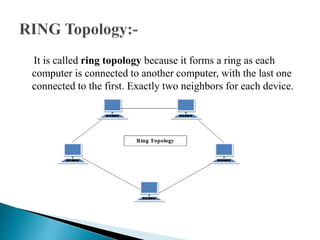
It is called ring topology because it forms a ring as each
computer is connected to another computer, with the last one
connected to the first. Exactly two neighbors for each device.
 Transmitting network is not affected by high traffic or by adding
more nodes, as only the nodes having tokens can transmit data.
 Cheap OR less expensive to install and expand.
 The transmission is unidirectional, but it can be made bidirectional
by having 2 connections between each Network Node, it is
called Dual Ring Topology.
 In Dual Ring Topology, two ring networks are formed, and data
flow is in opposite direction in them. Also, if one ring fails, the
second ring can act as a backup, to keep the network up.
 Troubleshooting is difficult in ring topology.
 Troubleshooting is the process of identifying, planning and
resolving a problem, error or fault within a software or
computer system.
 Adding or deleting the computers disturbs the network
activity.
 Failure of one computer disturbs the whole network.
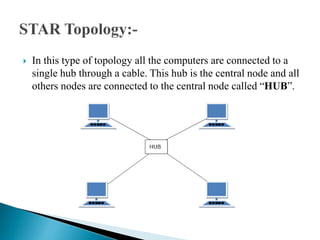
 In this type of topology all the computers are connected to a
single hub through a cable. This hub is the central node and all
others nodes are connected to the central node called “HUB”.
 Fast performance with few nodes and low network traffic.
 The central Node or HUB can be upgraded easily.
 Easy to troubleshoot.
 Easy to setup and modify or easy to expand.
 Only that node is affected which has failed, rest of the nodes
can work smoothly in the Star topology.
 Cost of installation is high or more expensive.
 Expensive to use.
 If the HUB fails then the whole network is stopped because all
the nodes depend son the HUB.
 Performance is based on the HUB that is it depends on its
capacity.
 It is a point-to-point connection to other nodes or devices. All
the network nodes are connected to each other. Mesh
has n(n-1)/2 physical channels to link n devices.
 There are two types of the Mesh topology, they are :
 Partial Mesh Topology : In this topology some of the
systems are connected in the same fashion as mesh topology
but some devices are only connected to two or three devices.
 Full Mesh Topology : Each and every nodes or devices are
connected to each other.
 Each connection can carry its own data load.
 It is robust, A robust product can be one that doesn't break
easily.
 Fault is diagnosed easily, that is we can easily find out that
which node is in the network have some fault and errors.
 Provides security and privacy.
 Installation and configuration of the mesh topology is
difficult.
 Bulk wiring is required . That means we have require more
cable to make a large network system.
 Adding or deleting the nodes in the network is very difficult.
 Cabling cost is more.
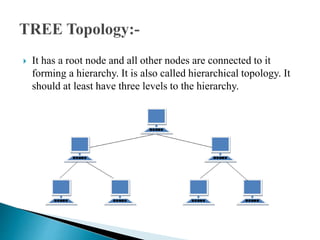
 It has a root node and all other nodes are connected to it
forming a hierarchy. It is also called hierarchical topology. It
should at least have three levels to the hierarchy.
 It is also known as extension of Bus and Star topologies.
 Adding or deleting of nodes is possible in this topology and
easy also.
 It is very easily manage and maintain tree topology.
 Error detection is easily done.
 The tree topology is used in Wide Area Network.
 In the tree topology we used Heavily cabled.
 Due to heavy cabled it is more expensive.
 If we added more nodes in the network than maintenance is
difficult.
 If the central system or HUB fails, than the whole network
fails.
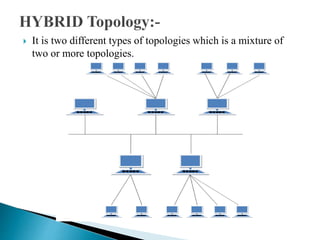
 It is two different types of topologies which is a mixture of
two or more topologies.
 Features of Hybrid Topology:-
1.It is a combination of two or topologies.
2.Inherits the advantages and disadvantages of the topologies
included.
 Advantages of Hybrid Topology:-
1.Reliable as Error detecting and trouble shooting is easy.
2.More Effective than other topologies.
3.Scalable as size can be increased easily.
4.Flexible to add or delete nodes in the network.
 Disadvantages of Hybrid Topology:-
1.Complex in design.
2.Costly.
 The emerging applications of topology is given Below are multiple areas
of study that heavily depend on effective topological implementations.
 Network Science When interconnecting networks that share information
in data packets, whether it’s at home or an office, optimizing the network
topology of the paths’ layout is critical.
 Computational Biology Large polymeric molecules, like human DNA,
entangle and knot themselves due to their long lengths, and because such
structural variations influence the manufacture of their products, biologists
began seeking ways to topologically categorize different knot structures.
 Robotics Modern research in robotics show that topology has an
indispensable role to play in making complex ideas of constructing robots
a reality: robotics takes advantage of topology through what’s called
“configuration spaces”.
This Presentation introduced topology, a relatively modern
branch of biology studying the core shapes and surfaces,
discussed its basic types, and showed the sheer diversity and
immensity in applications of such an abstract field. Through
the compact survey of topological applications in sections
above, this article proves topology’s ascendancy as well as its
auspicious prospects.

presentation on Topology

  • 1.
  • 2.
     Introduction.  Typesof Topologies.  Bus Topology.  Ring Topology.  Star Topology.  Mesh Topology.  Tree Topology.  Hybrid Topology.  Applications of Topology.  Conclusion.
  • 3.
     The physicallayout or the way in which network connections are made is known as topology.  Topology is the arrangement of the elements like (links, nodes) of a communication network.  Topology can be used to define or describe the arrangement of various types of telecommunication networks .  Topology also describe how the data is transferred between these nodes.
  • 4.
     There aretwo types of network topologies: 1) Physical. 2) Logical.  Physical :- Physical topology emphasizes the physical layout of the connected devices and nodes.  Logical :- The logical topology focuses on the pattern of data transfer between network nodes.
  • 5.
     Bus Topology. Star Topology.  Tree Topology.  Mesh Topology.  Star Topology.  Hybrid Topology. The combination of two or more topology is called the Hybrid topology.
  • 6.
    Bus topology isa network type in which every computer and network devices connected to single cable. That cable is called BACKBONE cable which is mostly Co-axial cable, And the system is connected wire with T-connector or BNC.
  • 7.
     It iscost effective means less costly.  Cable required is least compared to other network topology.  The Bus topology is generally Used in small networks.  It is easy to understand as compare to other topology.  Easy to expand joining more nodes and two cables together .
  • 8.
     If thecables connection is failed then whole network is failed.  If network’s traffic is heavy or more nodes is connected to the network than the performance of the network decreases.  The cable has a limited length.  It is slower than the Ring topology.
  • 9.
    It is calledring topology because it forms a ring as each computer is connected to another computer, with the last one connected to the first. Exactly two neighbors for each device.
  • 10.
     Transmitting networkis not affected by high traffic or by adding more nodes, as only the nodes having tokens can transmit data.  Cheap OR less expensive to install and expand.  The transmission is unidirectional, but it can be made bidirectional by having 2 connections between each Network Node, it is called Dual Ring Topology.  In Dual Ring Topology, two ring networks are formed, and data flow is in opposite direction in them. Also, if one ring fails, the second ring can act as a backup, to keep the network up.
  • 11.
     Troubleshooting isdifficult in ring topology.  Troubleshooting is the process of identifying, planning and resolving a problem, error or fault within a software or computer system.  Adding or deleting the computers disturbs the network activity.  Failure of one computer disturbs the whole network.
  • 12.
     In thistype of topology all the computers are connected to a single hub through a cable. This hub is the central node and all others nodes are connected to the central node called “HUB”.
  • 13.
     Fast performancewith few nodes and low network traffic.  The central Node or HUB can be upgraded easily.  Easy to troubleshoot.  Easy to setup and modify or easy to expand.  Only that node is affected which has failed, rest of the nodes can work smoothly in the Star topology.
  • 14.
     Cost ofinstallation is high or more expensive.  Expensive to use.  If the HUB fails then the whole network is stopped because all the nodes depend son the HUB.  Performance is based on the HUB that is it depends on its capacity.
  • 15.
     It isa point-to-point connection to other nodes or devices. All the network nodes are connected to each other. Mesh has n(n-1)/2 physical channels to link n devices.  There are two types of the Mesh topology, they are :  Partial Mesh Topology : In this topology some of the systems are connected in the same fashion as mesh topology but some devices are only connected to two or three devices.  Full Mesh Topology : Each and every nodes or devices are connected to each other.
  • 16.
     Each connectioncan carry its own data load.  It is robust, A robust product can be one that doesn't break easily.  Fault is diagnosed easily, that is we can easily find out that which node is in the network have some fault and errors.  Provides security and privacy.
  • 17.
     Installation andconfiguration of the mesh topology is difficult.  Bulk wiring is required . That means we have require more cable to make a large network system.  Adding or deleting the nodes in the network is very difficult.  Cabling cost is more.
  • 18.
     It hasa root node and all other nodes are connected to it forming a hierarchy. It is also called hierarchical topology. It should at least have three levels to the hierarchy.
  • 19.
     It isalso known as extension of Bus and Star topologies.  Adding or deleting of nodes is possible in this topology and easy also.  It is very easily manage and maintain tree topology.  Error detection is easily done.  The tree topology is used in Wide Area Network.
  • 20.
     In thetree topology we used Heavily cabled.  Due to heavy cabled it is more expensive.  If we added more nodes in the network than maintenance is difficult.  If the central system or HUB fails, than the whole network fails.
  • 21.
     It istwo different types of topologies which is a mixture of two or more topologies.
  • 22.
     Features ofHybrid Topology:- 1.It is a combination of two or topologies. 2.Inherits the advantages and disadvantages of the topologies included.  Advantages of Hybrid Topology:- 1.Reliable as Error detecting and trouble shooting is easy. 2.More Effective than other topologies. 3.Scalable as size can be increased easily. 4.Flexible to add or delete nodes in the network.  Disadvantages of Hybrid Topology:- 1.Complex in design. 2.Costly.
  • 23.
     The emergingapplications of topology is given Below are multiple areas of study that heavily depend on effective topological implementations.  Network Science When interconnecting networks that share information in data packets, whether it’s at home or an office, optimizing the network topology of the paths’ layout is critical.  Computational Biology Large polymeric molecules, like human DNA, entangle and knot themselves due to their long lengths, and because such structural variations influence the manufacture of their products, biologists began seeking ways to topologically categorize different knot structures.  Robotics Modern research in robotics show that topology has an indispensable role to play in making complex ideas of constructing robots a reality: robotics takes advantage of topology through what’s called “configuration spaces”.
  • 24.
    This Presentation introducedtopology, a relatively modern branch of biology studying the core shapes and surfaces, discussed its basic types, and showed the sheer diversity and immensity in applications of such an abstract field. Through the compact survey of topological applications in sections above, this article proves topology’s ascendancy as well as its auspicious prospects.