

BY
R.SURESH
B TECH II Year I Sem
ELECTRONICS & COMMUNICATION ENGINEERING
ANNAMACHARYA INSTITUTE OF TECHNOLOGY AND SCIENCES
(AN AUTONOMOUS INSTITUTION)
(Approved by AICTE,NEW DELHI & Affiliated to J.N.T.U Anantapuramu)
New Boyanapalli, RAJAMPET-516 126 (A.P)
•Introduction
•What is Network
•What is Topology
•Different types of Topology
•Advantages & Disadvantages of different Topology
•Applications of Different Topology
•Conclusion
Contents
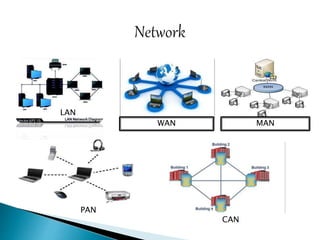
WAN
PAN
CAN
MAN
LAN
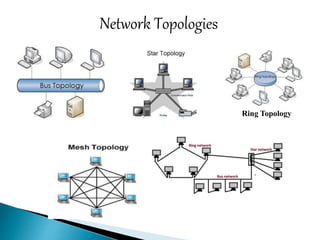
Network Topologies
Ring Topology
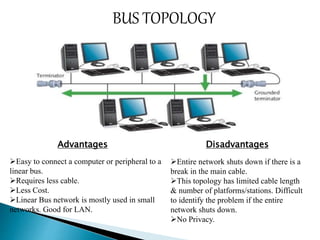
BUS TOPOLOGY
Entire network shuts down if there is a
break in the main cable.
This topology has limited cable length
& number of platforms/stations. Difficult
to identify the problem if the entire
network shuts down.
No Privacy.
Advantages Disadvantages
Easy to connect a computer or peripheral to a
linear bus.
Requires less cable.
Less Cost.
Linear Bus network is mostly used in small
networks. Good for LAN.
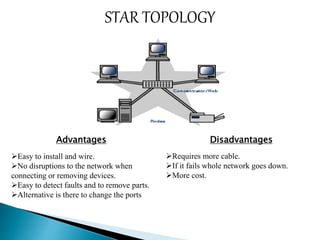
STAR TOPOLOGY
Advantages Disadvantages
Easy to install and wire.
No disruptions to the network when
connecting or removing devices.
Easy to detect faults and to remove parts.
Alternative is there to change the ports
Requires more cable.
If it fails whole network goes down.
More cost.
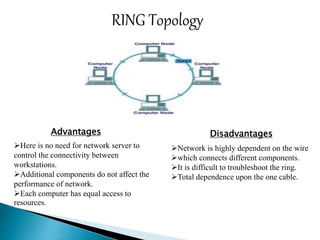
RING Topology
Advantages Disadvantages
Here is no need for network server to
control the connectivity between
workstations.
Additional components do not affect the
performance of network.
Each computer has equal access to
resources.
Network is highly dependent on the wire
which connects different components.
It is difficult to troubleshoot the ring.
Total dependence upon the one cable.
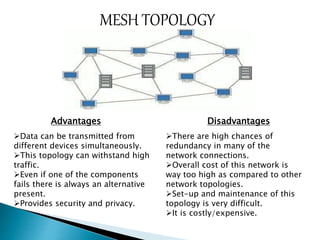
MESH TOPOLOGY
Advantages Disadvantages
Data can be transmitted from
different devices simultaneously.
This topology can withstand high
traffic.
Even if one of the components
fails there is always an alternative
present.
Provides security and privacy.
There are high chances of
redundancy in many of the
network connections.
Overall cost of this network is
way too high as compared to other
network topologies.
Set-up and maintenance of this
topology is very difficult.
It is costly/expensive.
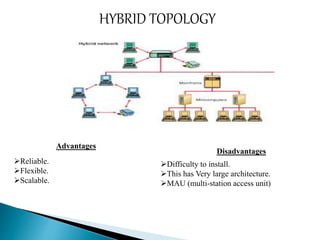
HYBRID TOPOLOGY
Advantages
Disadvantages
Reliable.
Flexible.
Scalable.
Difficulty to install.
This has Very large architecture.
MAU (multi-station access unit)
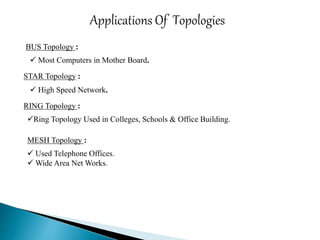
Applications Of Topologies
BUS Topology :
 Most Computers in Mother Board.
STAR Topology :
 High Speed Network.
RING Topology :
Ring Topology Used in Colleges, Schools & Office Building.
MESH Topology :
 Used Telephone Offices.
 Wide Area Net Works.
Conclusion
The Network of Topology differs form place to
place. But how ever, all of them have their advantages &
Distavanges. If the server Problem occurs or Server gets
down, Then topology faces its failure.
Network topology
Network topology

Network topology

  • 1.
    BY R.SURESH B TECH IIYear I Sem ELECTRONICS & COMMUNICATION ENGINEERING ANNAMACHARYA INSTITUTE OF TECHNOLOGY AND SCIENCES (AN AUTONOMOUS INSTITUTION) (Approved by AICTE,NEW DELHI & Affiliated to J.N.T.U Anantapuramu) New Boyanapalli, RAJAMPET-516 126 (A.P)
  • 2.
    •Introduction •What is Network •Whatis Topology •Different types of Topology •Advantages & Disadvantages of different Topology •Applications of Different Topology •Conclusion Contents
  • 3.
  • 4.
  • 5.
    BUS TOPOLOGY Entire networkshuts down if there is a break in the main cable. This topology has limited cable length & number of platforms/stations. Difficult to identify the problem if the entire network shuts down. No Privacy. Advantages Disadvantages Easy to connect a computer or peripheral to a linear bus. Requires less cable. Less Cost. Linear Bus network is mostly used in small networks. Good for LAN.
  • 6.
    STAR TOPOLOGY Advantages Disadvantages Easyto install and wire. No disruptions to the network when connecting or removing devices. Easy to detect faults and to remove parts. Alternative is there to change the ports Requires more cable. If it fails whole network goes down. More cost.
  • 7.
    RING Topology Advantages Disadvantages Hereis no need for network server to control the connectivity between workstations. Additional components do not affect the performance of network. Each computer has equal access to resources. Network is highly dependent on the wire which connects different components. It is difficult to troubleshoot the ring. Total dependence upon the one cable.
  • 8.
    MESH TOPOLOGY Advantages Disadvantages Datacan be transmitted from different devices simultaneously. This topology can withstand high traffic. Even if one of the components fails there is always an alternative present. Provides security and privacy. There are high chances of redundancy in many of the network connections. Overall cost of this network is way too high as compared to other network topologies. Set-up and maintenance of this topology is very difficult. It is costly/expensive.
  • 9.
    HYBRID TOPOLOGY Advantages Disadvantages Reliable. Flexible. Scalable. Difficulty toinstall. This has Very large architecture. MAU (multi-station access unit)
  • 10.
    Applications Of Topologies BUSTopology :  Most Computers in Mother Board. STAR Topology :  High Speed Network. RING Topology : Ring Topology Used in Colleges, Schools & Office Building. MESH Topology :  Used Telephone Offices.  Wide Area Net Works.
  • 11.
    Conclusion The Network ofTopology differs form place to place. But how ever, all of them have their advantages & Distavanges. If the server Problem occurs or Server gets down, Then topology faces its failure.