Topographic anatomy of the
brain and brain part of the skull
Rustam Sultonov
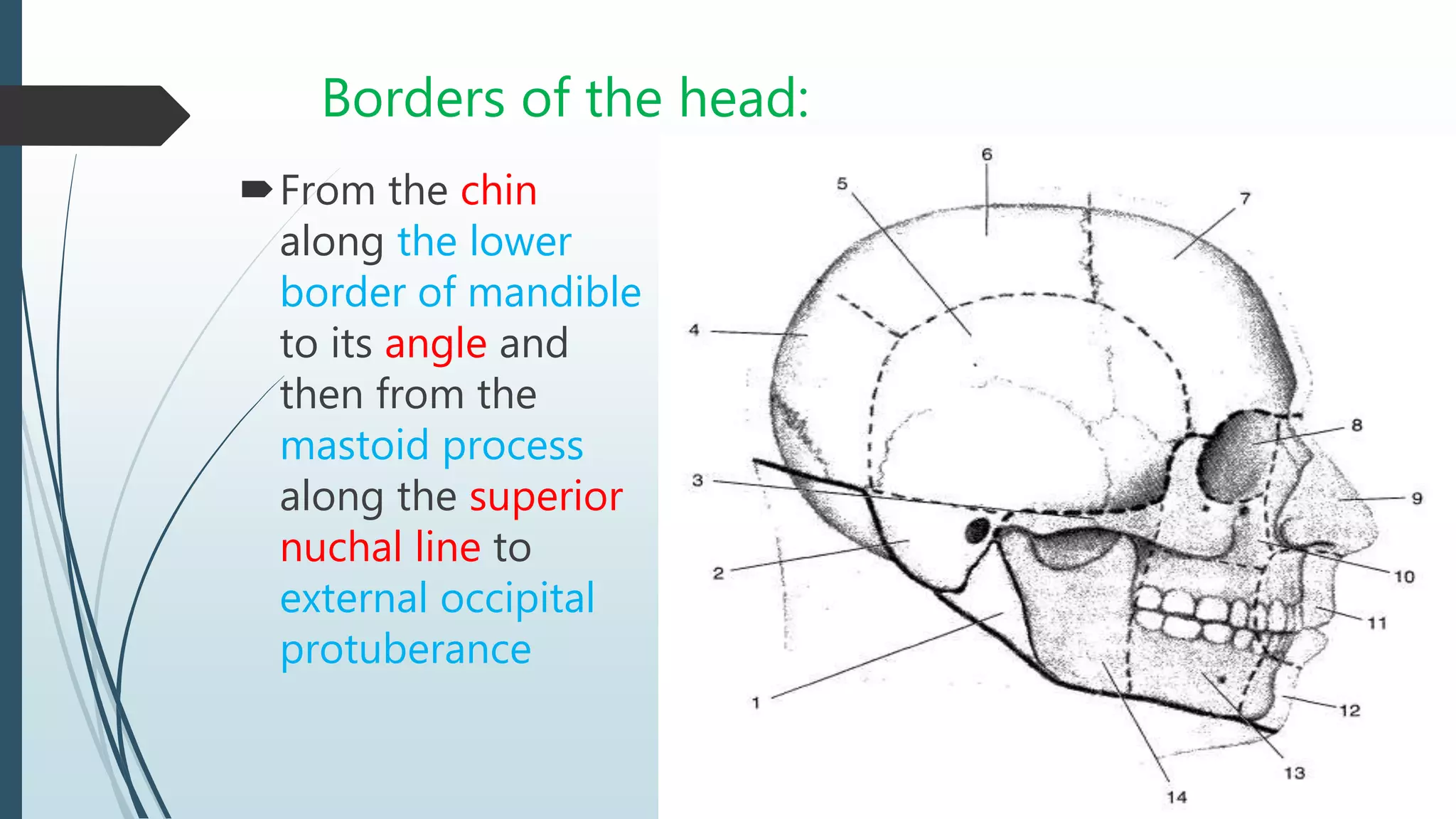
Borders of the head:
From the chin
along the lower
border of mandible
to its angle and
then from the
mastoid process
along the superior
nuchal line to
external occipital
protuberance
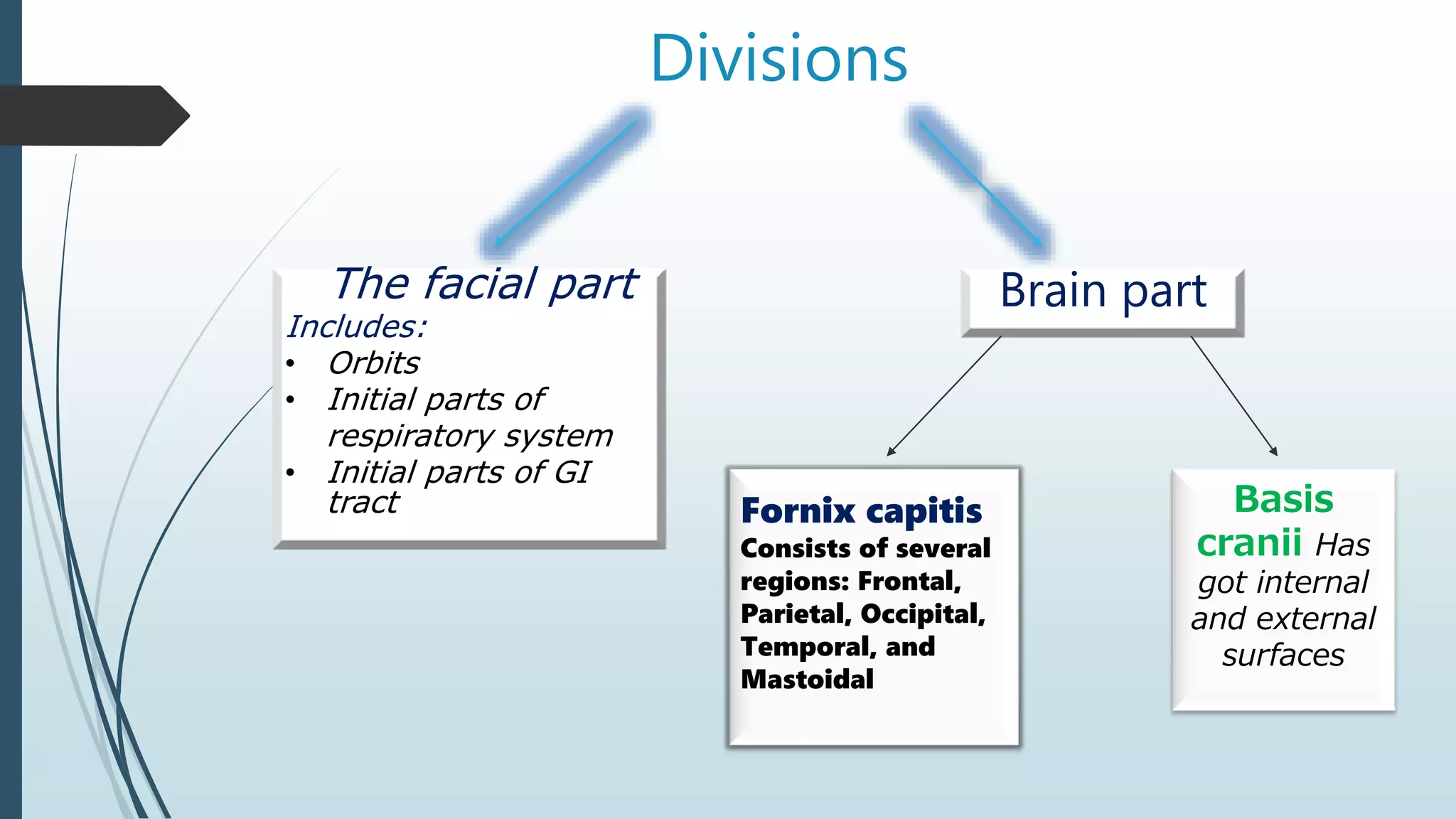
Divisions
The facial part
Includes:
• Orbits
• Initial parts of
respiratory system
• Initial parts of GI
tract
Brain part
Fornix capitis
Consists of several
regions: Frontal,
Parietal, Occipital,
Temporal, and
Mastoidal
Basis
cranii Has
got internal
and external
surfaces
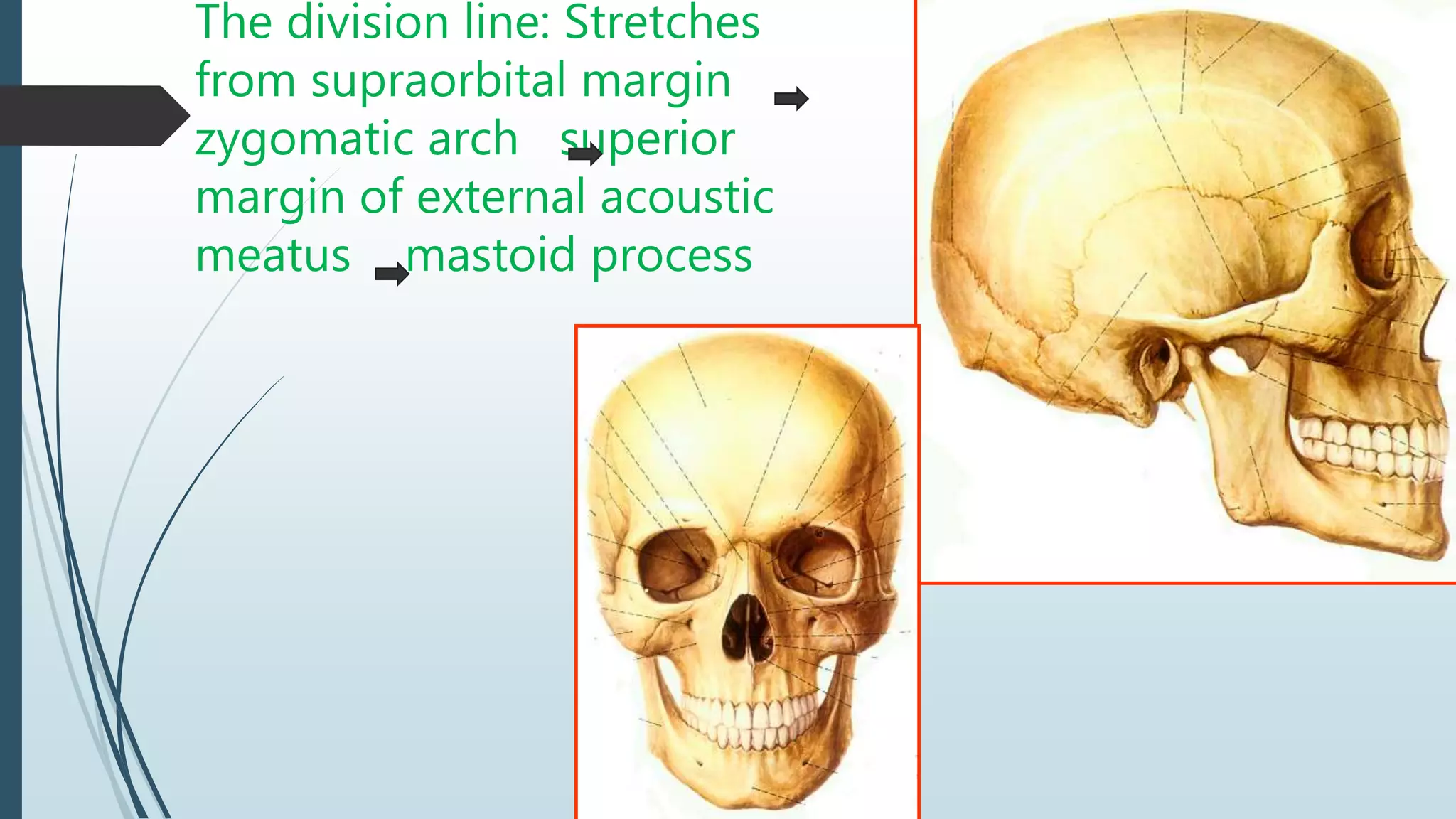
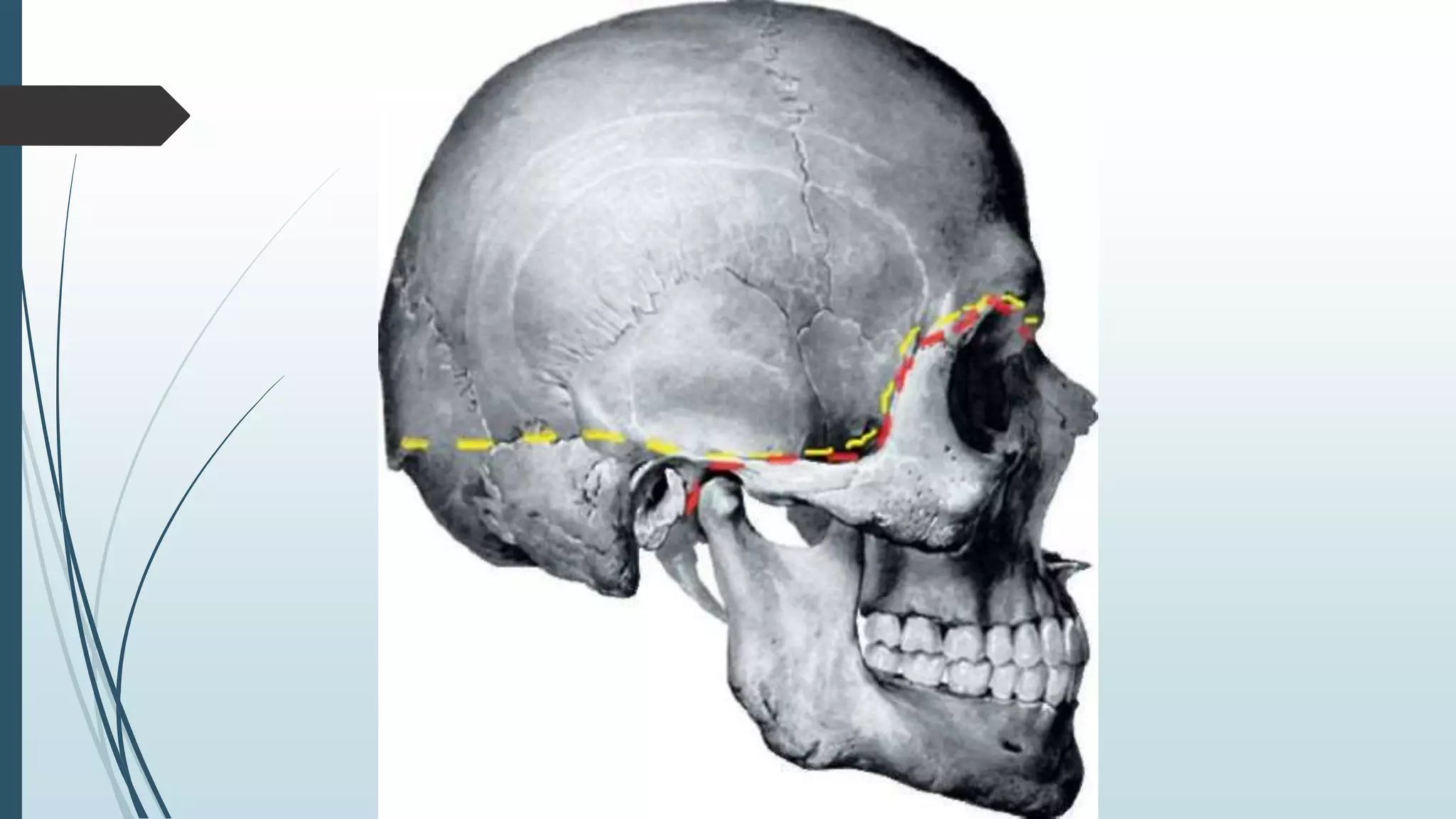
The division line: Stretches
from supraorbital margin
zygomatic arch superior
margin of external acoustic
meatus mastoid process
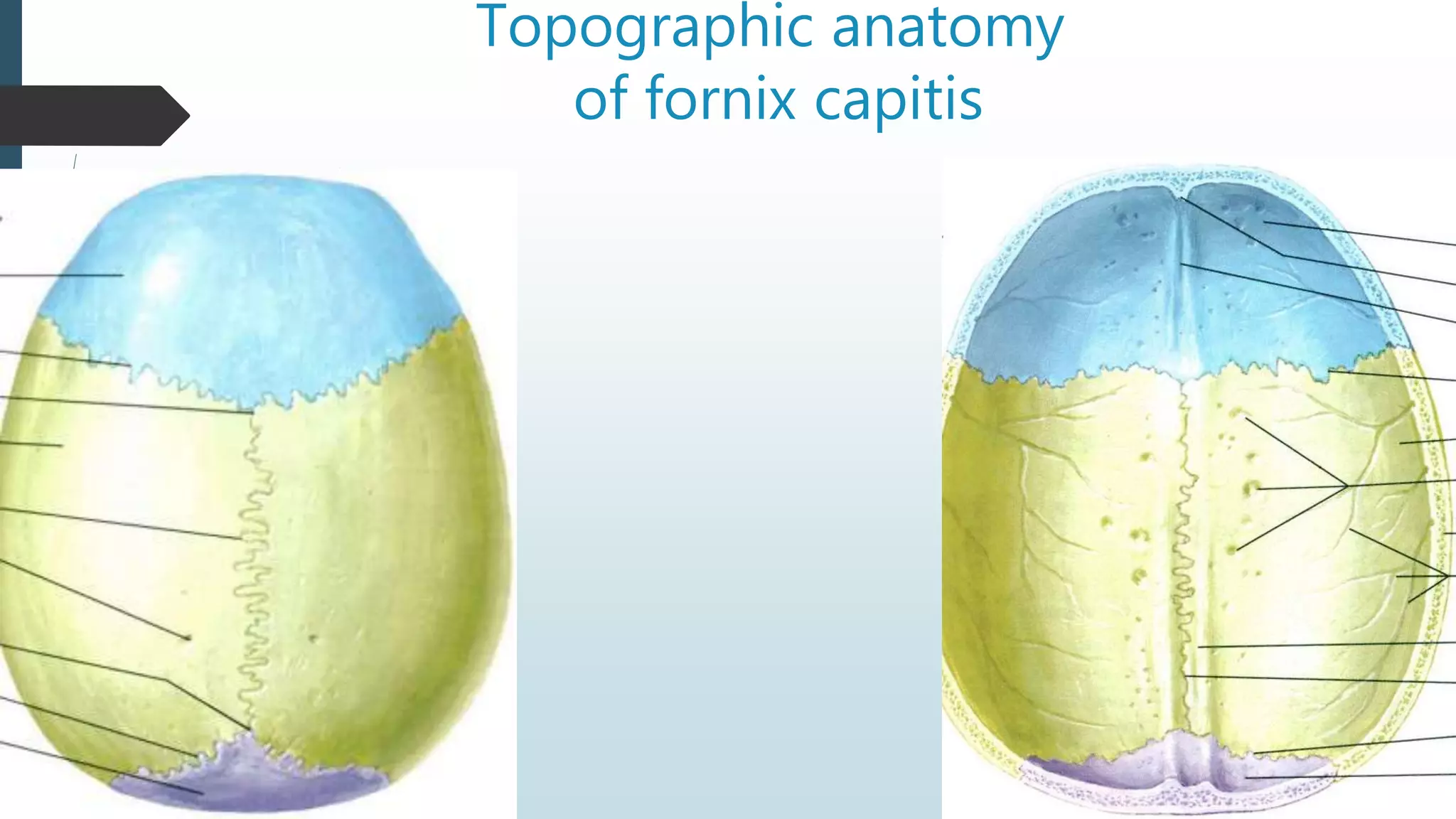
Topographic anatomy
of fornix capitis
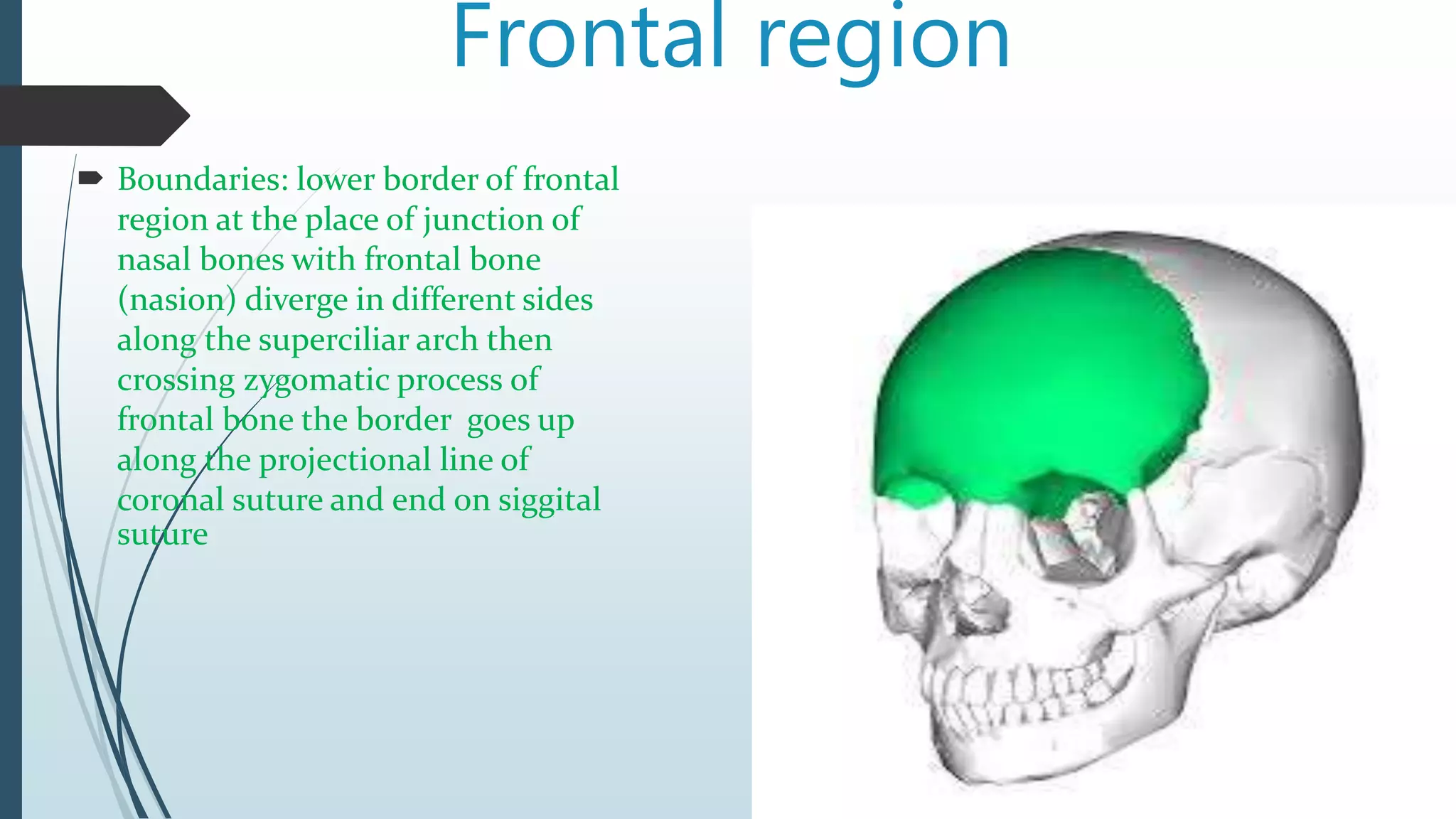
Frontal region
 Boundaries: lower border of frontal
region at the place of junction of
nasal bones with frontal bone
(nasion) diverge in different sides
along the superciliar arch then
crossing zygomatic process of
frontal bone the border goes up
along the projectional line of
coronal suture and end on siggital
suture
 Blood supply: a. supratrochlearis, a. supraorbitalis (from a.
ophtalmica)
 Venous drainage: v. supratrochlearis, v. supraorbitalis
 Lymph drainage: lymph vessels drain into nodi lymphatici
parotidei superficiales
 Innervation: Sensitive nerves are n. supratrochlearis, n.
supraorbitalis (from n. ophtalmicus. Motor nerves: rami
temporalis n. facialis (branches go to m. frontalis)
Parietal region
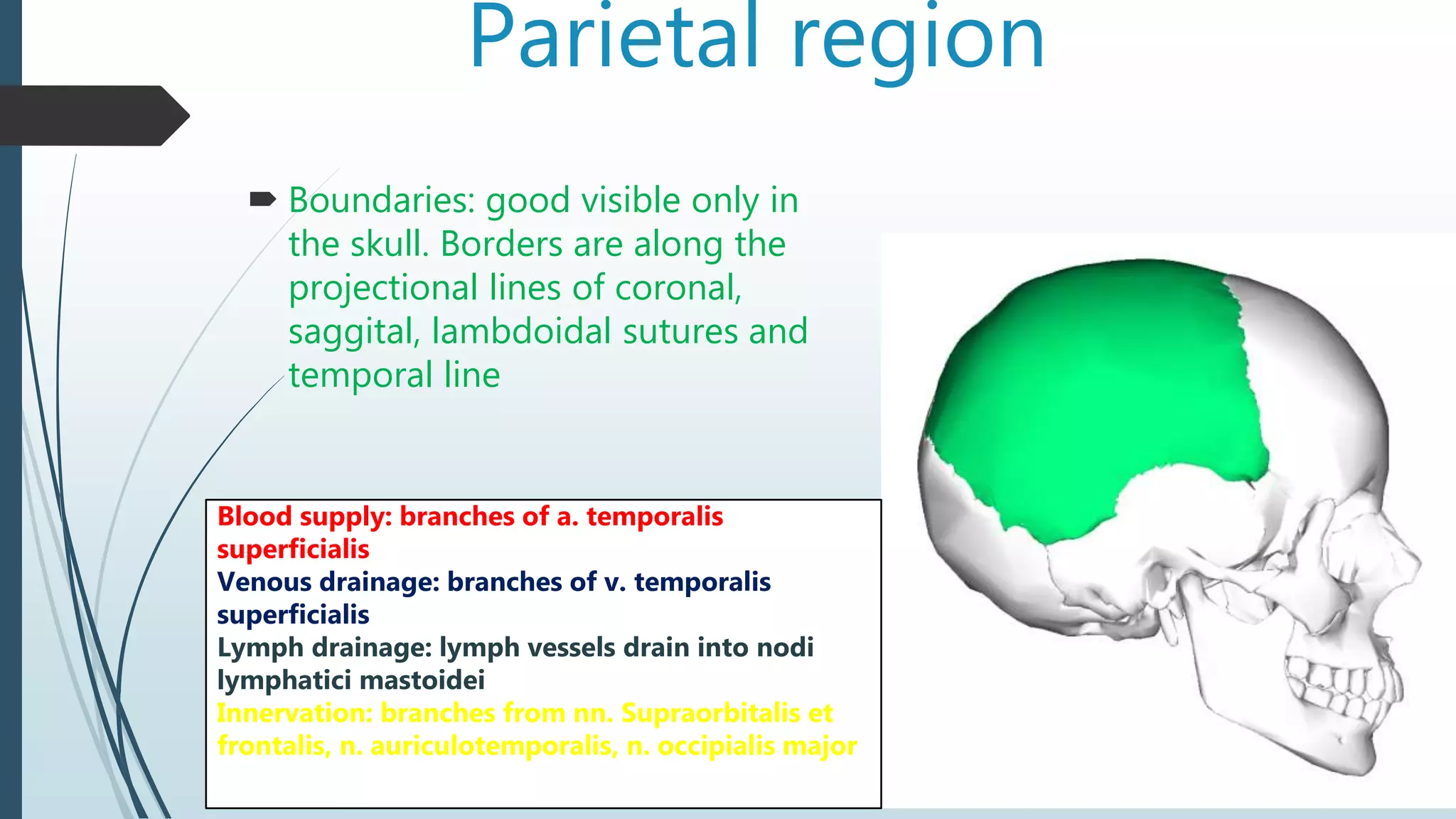
 Boundaries: good visible only in
the skull. Borders are along the
projectional lines of coronal,
saggital, lambdoidal sutures and
temporal line
Blood supply: branches of a. temporalis
superficialis
Venous drainage: branches of v. temporalis
superficialis
Lymph drainage: lymph vessels drain into nodi
lymphatici mastoidei
Innervation: branches from nn. Supraorbitalis et
frontalis, n. auriculotemporalis, n. occipialis major
Occipital region
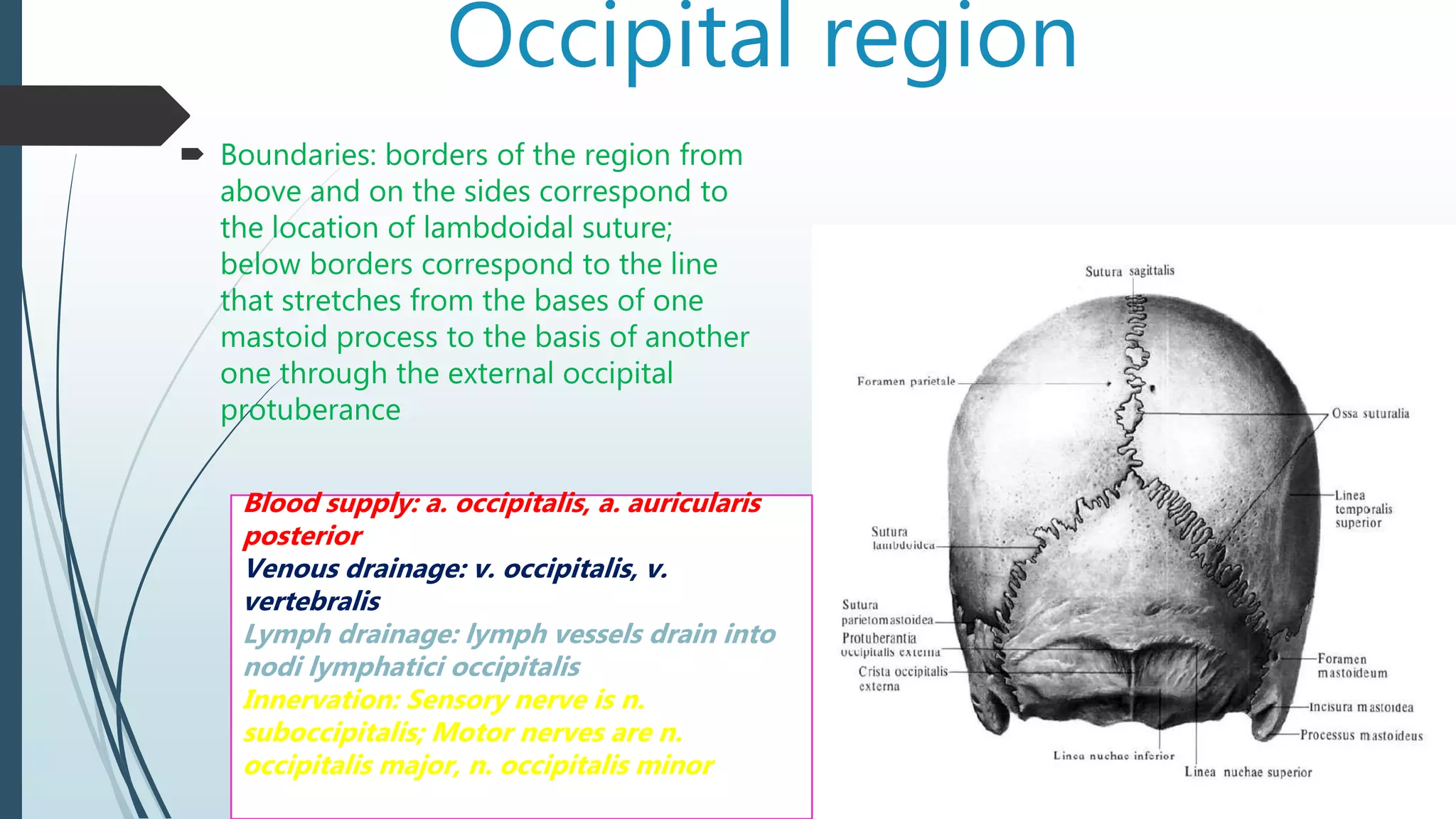
 Boundaries: borders of the region from
above and on the sides correspond to
the location of lambdoidal suture;
below borders correspond to the line
that stretches from the bases of one
mastoid process to the basis of another
one through the external occipital
protuberance
Blood supply: a. occipitalis, a. auricularis
posterior
Venous drainage: v. occipitalis, v.
vertebralis
Lymph drainage: lymph vessels drain into
nodi lymphatici occipitalis
Innervation: Sensory nerve is n.
suboccipitalis; Motor nerves are n.
occipitalis major, n. occipitalis minor
Layers and spaces of frontal, parietal and
occipital regions
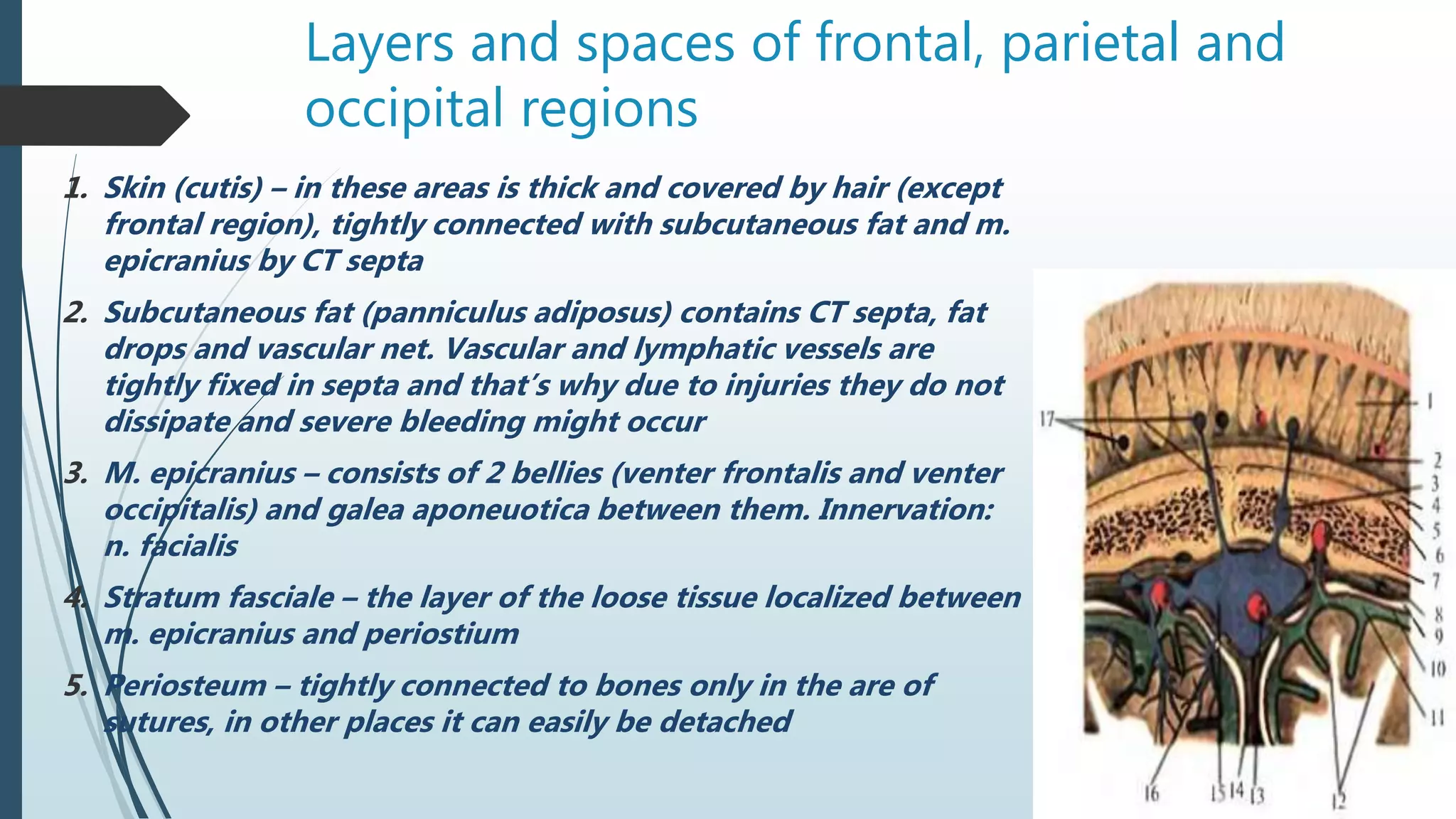
1. Skin (cutis) – in these areas is thick and covered by hair (except
frontal region), tightly connected with subcutaneous fat and m.
epicranius by CT septa
2. Subcutaneous fat (panniculus adiposus) contains CT septa, fat
drops and vascular net. Vascular and lymphatic vessels are
tightly fixed in septa and that’s why due to injuries they do not
dissipate and severe bleeding might occur
3. M. epicranius – consists of 2 bellies (venter frontalis and venter
occipitalis) and galea aponeuotica between them. Innervation:
n. facialis
4. Stratum fasciale – the layer of the loose tissue localized between
m. epicranius and periostium
5. Periosteum – tightly connected to bones only in the are of
sutures, in other places it can easily be detached
6. Skull bones (ossa cranii) - thickness varies in different zones.
These bones do not possess ability to regenerate ( that’s why
defect after trepanation is closed only by fibrous tissue). Skull
bones have 3 layers: lamina externa, diploe(spongy layer), lamina
interna
7. Epidural space (cavitas epiduralis) – between internal laminae
and dura mater
8. Dura mater encephali – consists of dense fibrous CT
9. Spatium subdurale – a space between dura mater and
arachnoidea encephali containing fluid
10. Arachnoidea encephali – passes from one gyri to another, not
dropping in sulci.
11. Cavitas arachnoidalis – contains cerebrospinal fluid
12. Pia mater encephali – contains many blood vessels. Covering
all the brain enters into sulci
13. Gray matter of brain
Topographic
anatomy of
brain
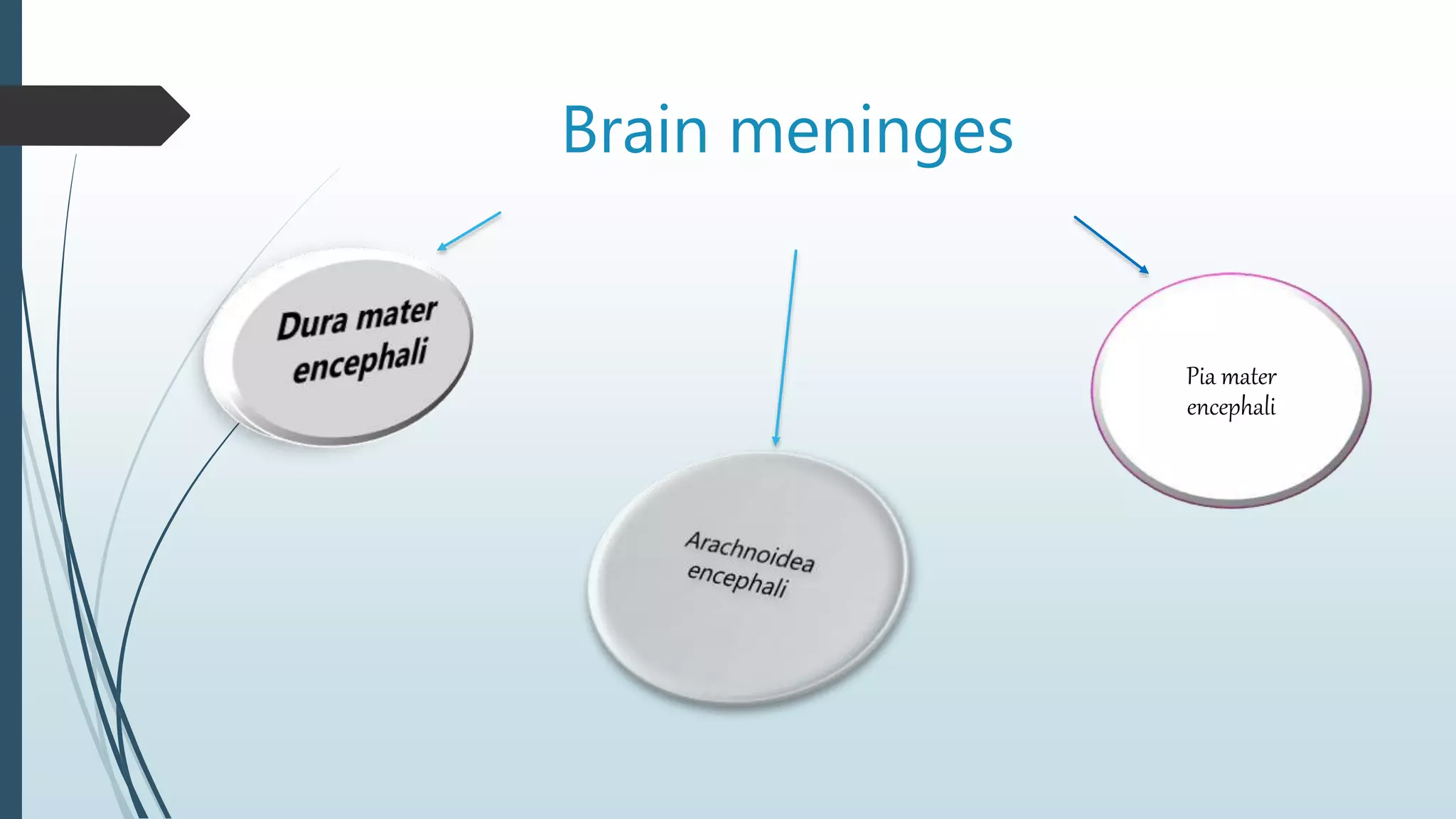
Brain meninges
Pia mater
encephali
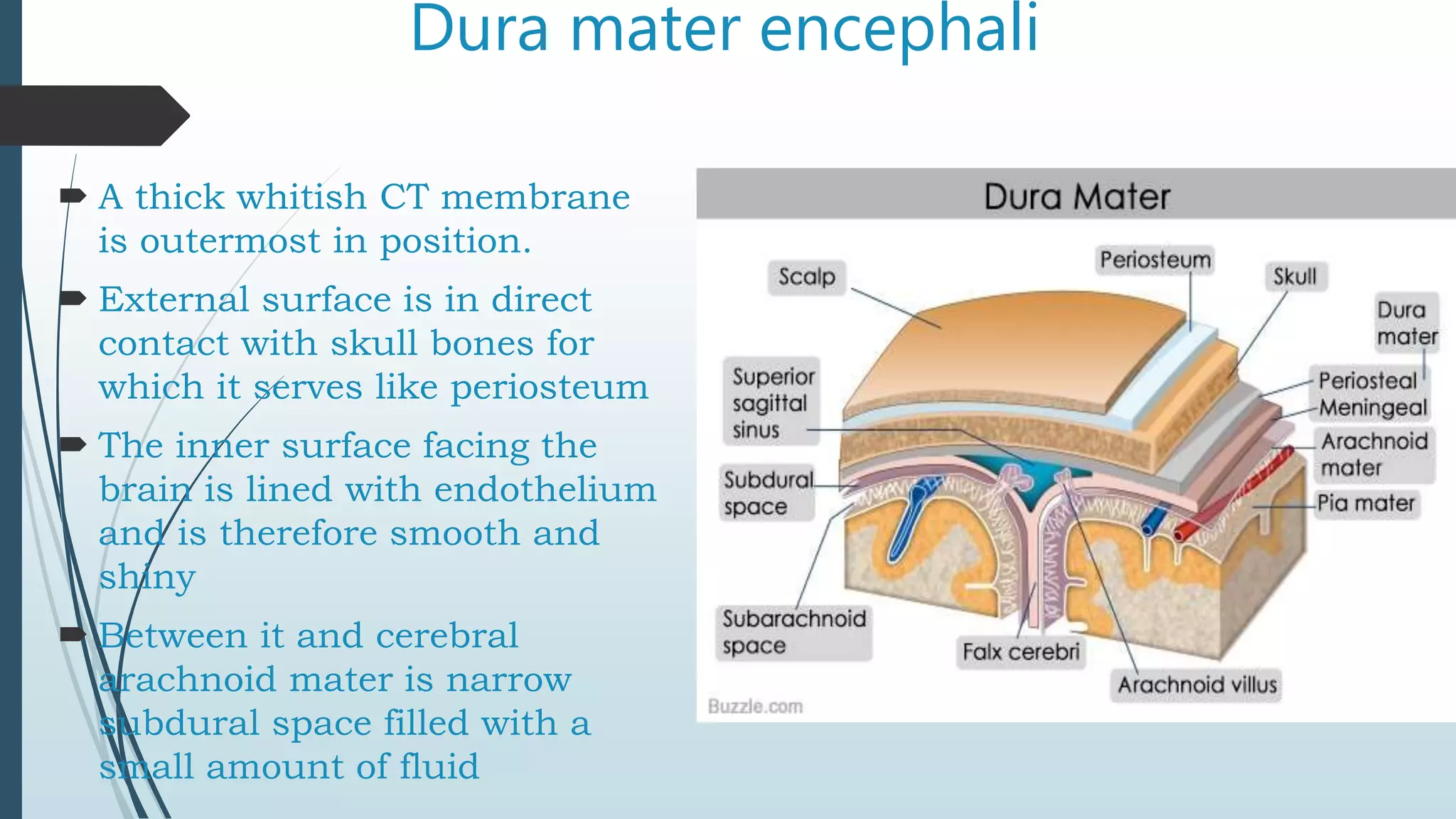
Dura mater encephali
 A thick whitish CT membrane
is outermost in position.
 External surface is in direct
contact with skull bones for
which it serves like periosteum
 The inner surface facing the
brain is lined with endothelium
and is therefore smooth and
shiny
 Between it and cerebral
arachnoid mater is narrow
subdural space filled with a
small amount of fluid
Inner surface gives off several processes, which penetrate between the parts
of the brain and separate one part from another:
The Falx cerebri – lies sagittal between both cerebral hemispheres. Anterior
narrow end grows into the crista galli, while the wide posterior end blend
with the superior surface of tentorium cerebelli
The Tentorium cerebelli – separates the cerebral occipital lobes from the
cerebellum
The Falx cerebelli – lies in saggital plane and separates cerebellar
hemispheres
 Blood supply: a. meningea anterior, a. meningea media, a.
meningea posterior, ramus meningeus a. occipitalis
 Innervation: r. tentorii n. ophtalmici, r. meningeus n.
maxillaris, r. meningeus n. mandibularis, r. meningeus n.
vagi
Arachnoidea encephali
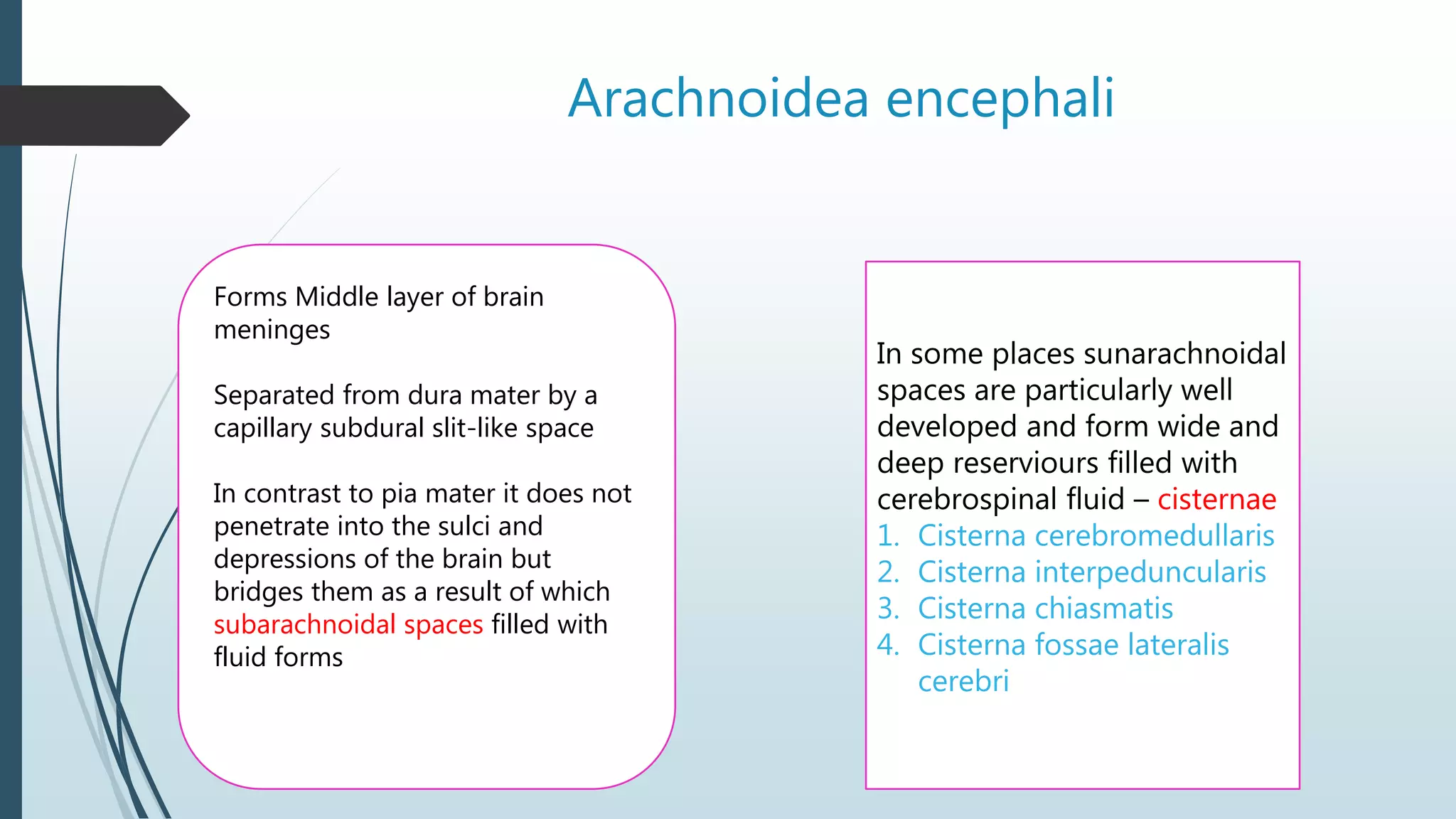
Forms Middle layer of brain
meninges
Separated from dura mater by a
capillary subdural slit-like space
In contrast to pia mater it does not
penetrate into the sulci and
depressions of the brain but
bridges them as a result of which
subarachnoidal spaces filled with
fluid forms
In some places sunarachnoidal
spaces are particularly well
developed and form wide and
deep reserviours filled with
cerebrospinal fluid – cisternae
1. Cisterna cerebromedullaris
2. Cisterna interpeduncularis
3. Cisterna chiasmatis
4. Cisterna fossae lateralis
cerebri
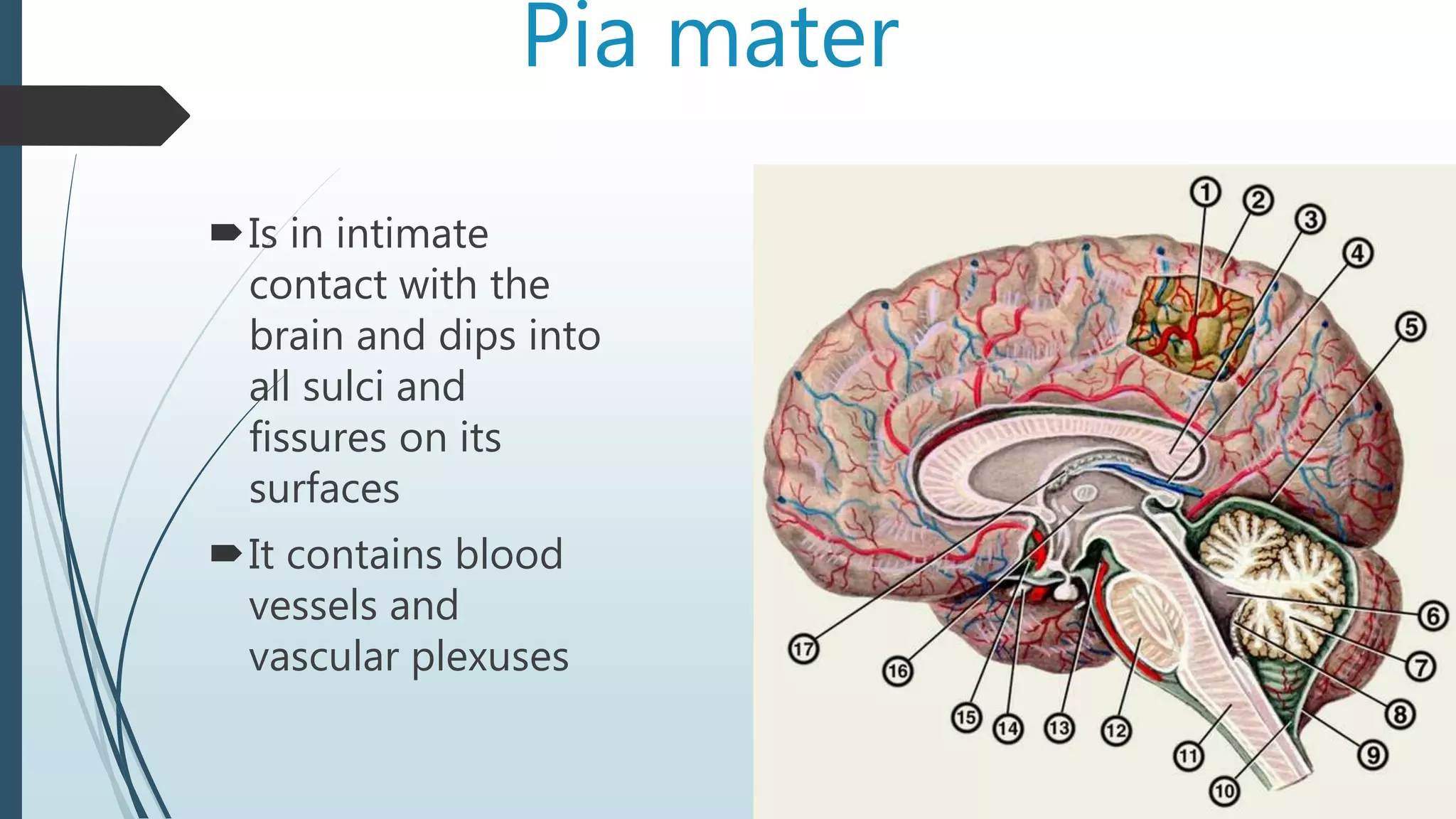
Pia mater
Is in intimate
contact with the
brain and dips into
all sulci and
fissures on its
surfaces
It contains blood
vessels and
vascular plexuses
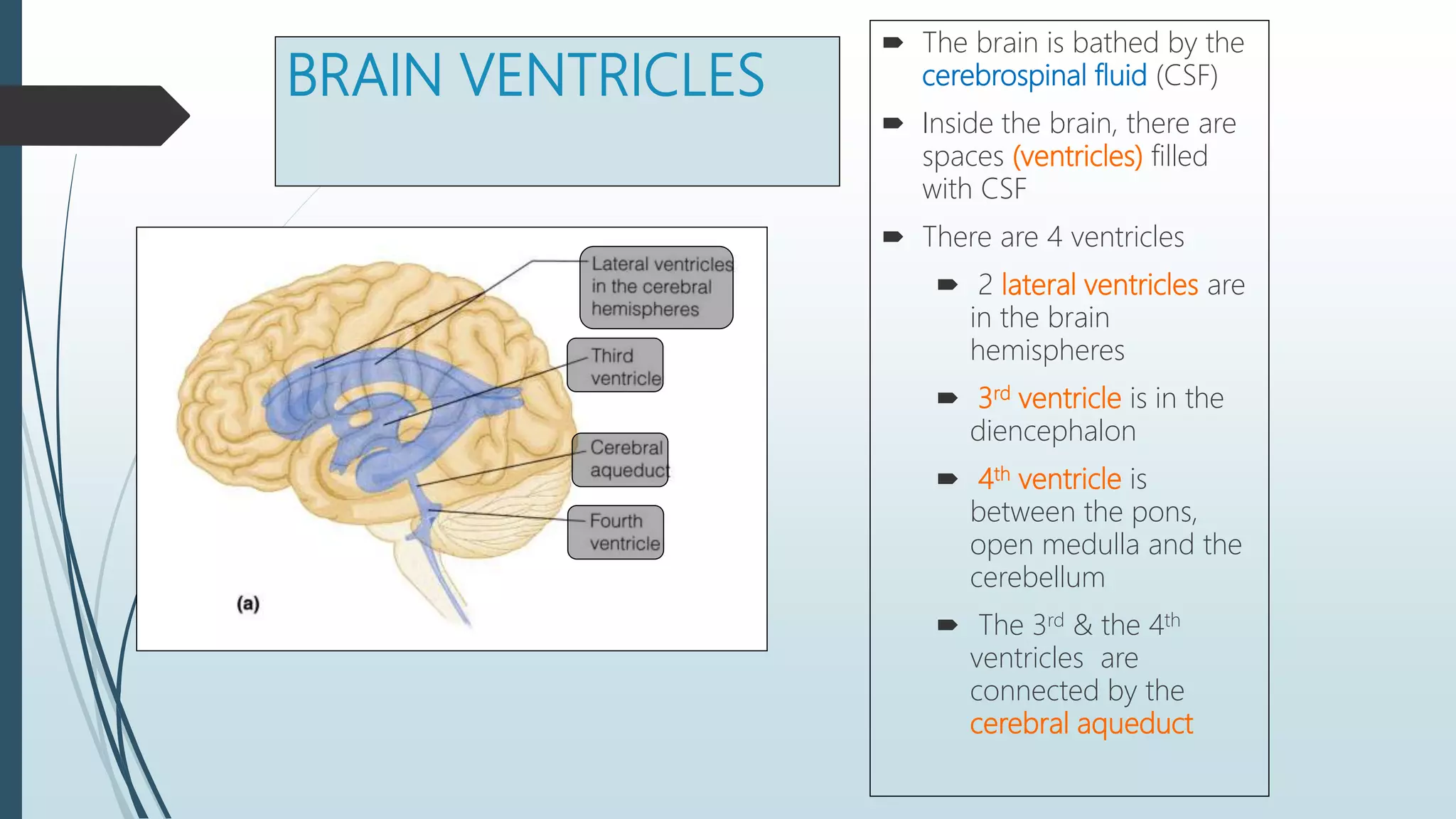
BRAIN VENTRICLES
 The brain is bathed by the
cerebrospinal fluid (CSF)
 Inside the brain, there are
spaces (ventricles) filled
with CSF
 There are 4 ventricles
 2 lateral ventricles are
in the brain
hemispheres
 3rd ventricle is in the
diencephalon
 4th ventricle is
between the pons,
open medulla and the
cerebellum
 The 3rd & the 4th
ventricles are
connected by the
cerebral aqueduct
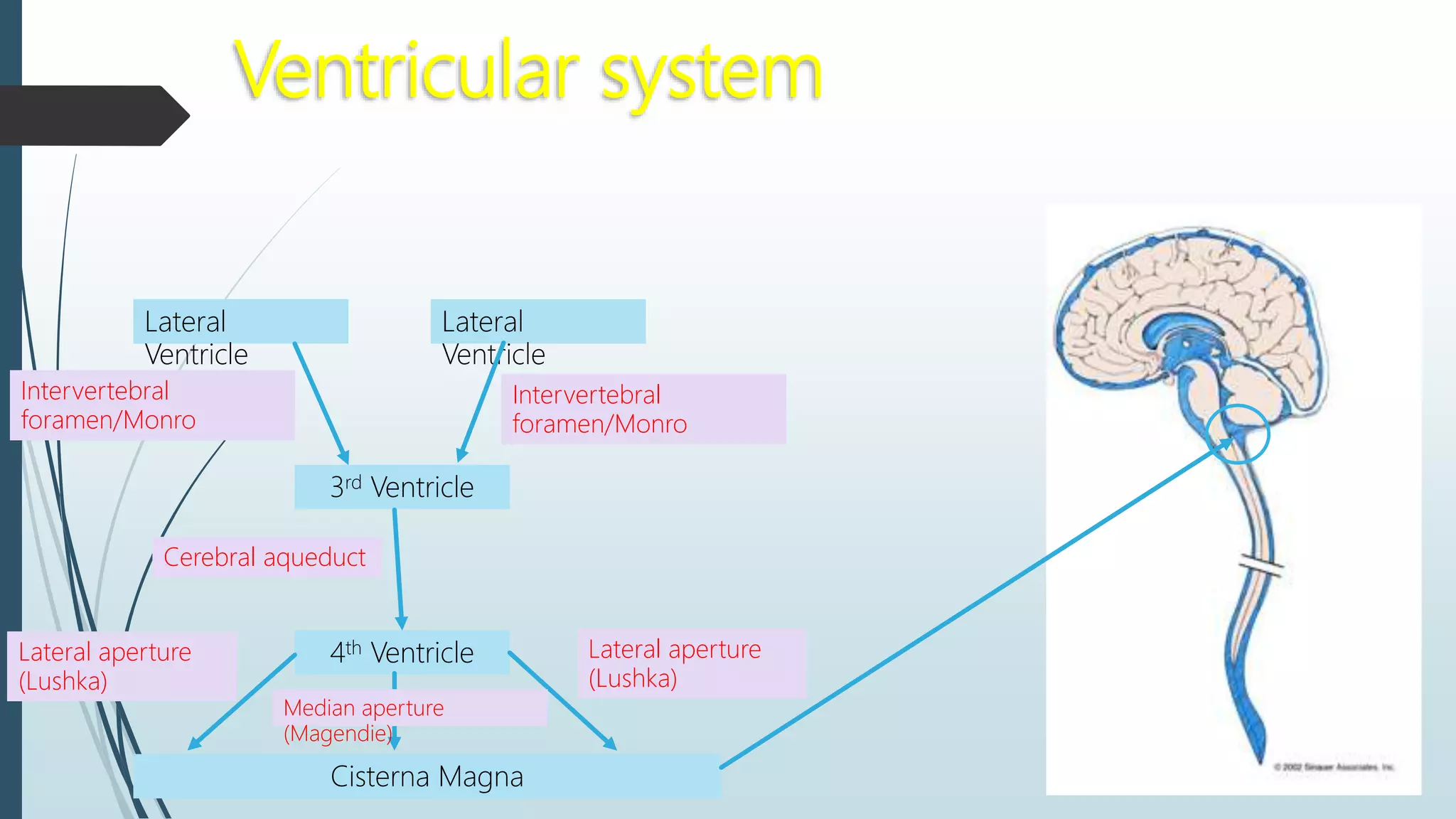
Ventricular system
Lateral
Ventricle
Lateral
Ventricle
3rd Ventricle
4th Ventricle
Cisterna Magna
Intervertebral
foramen/Monro
Cerebral aqueduct
Lateral aperture
(Lushka)
Median aperture
(Magendie)
Lateral aperture
(Lushka)
Intervertebral
foramen/Monro
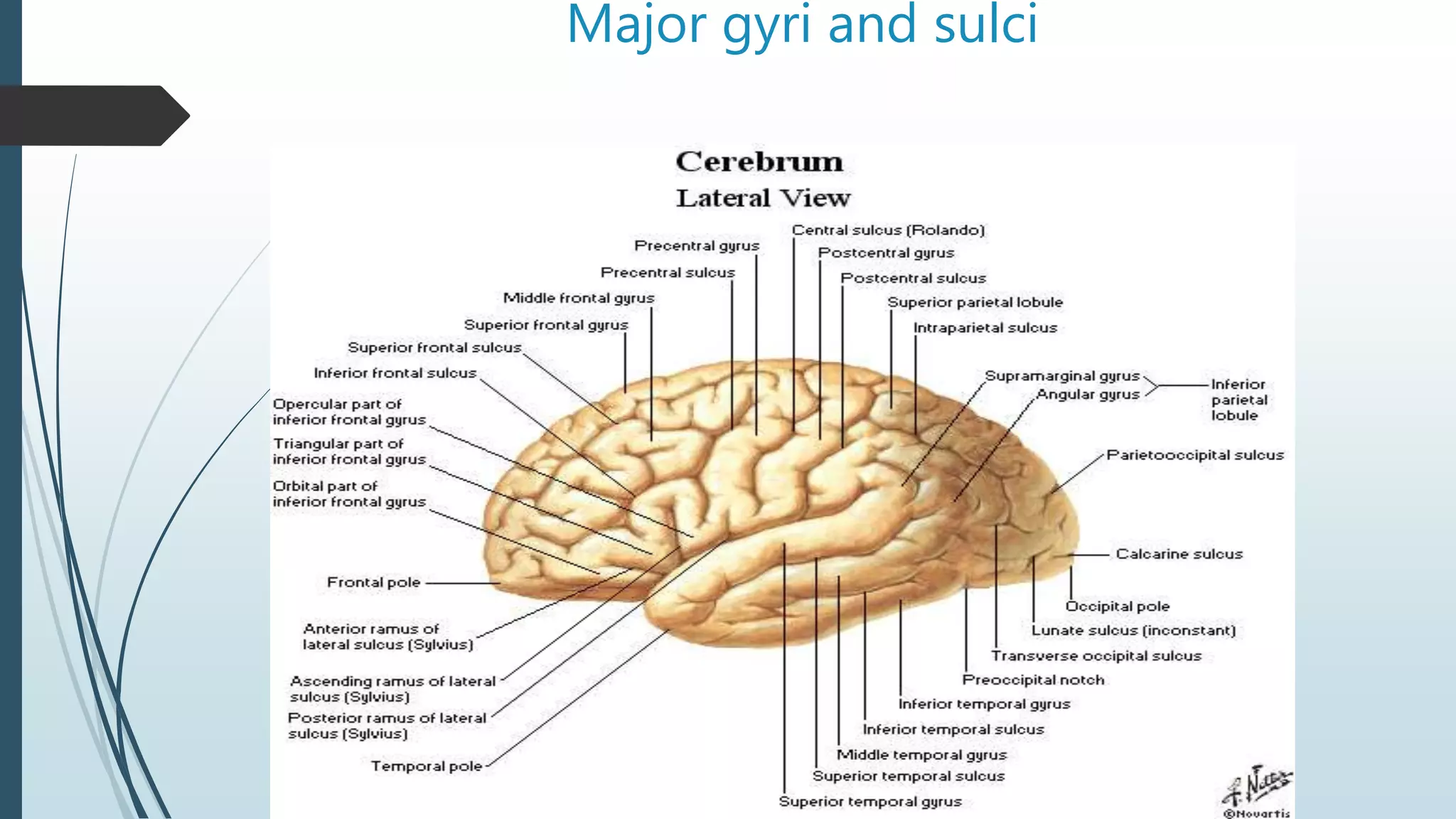
Major gyri and sulci
Lobes
 Frontal lobe
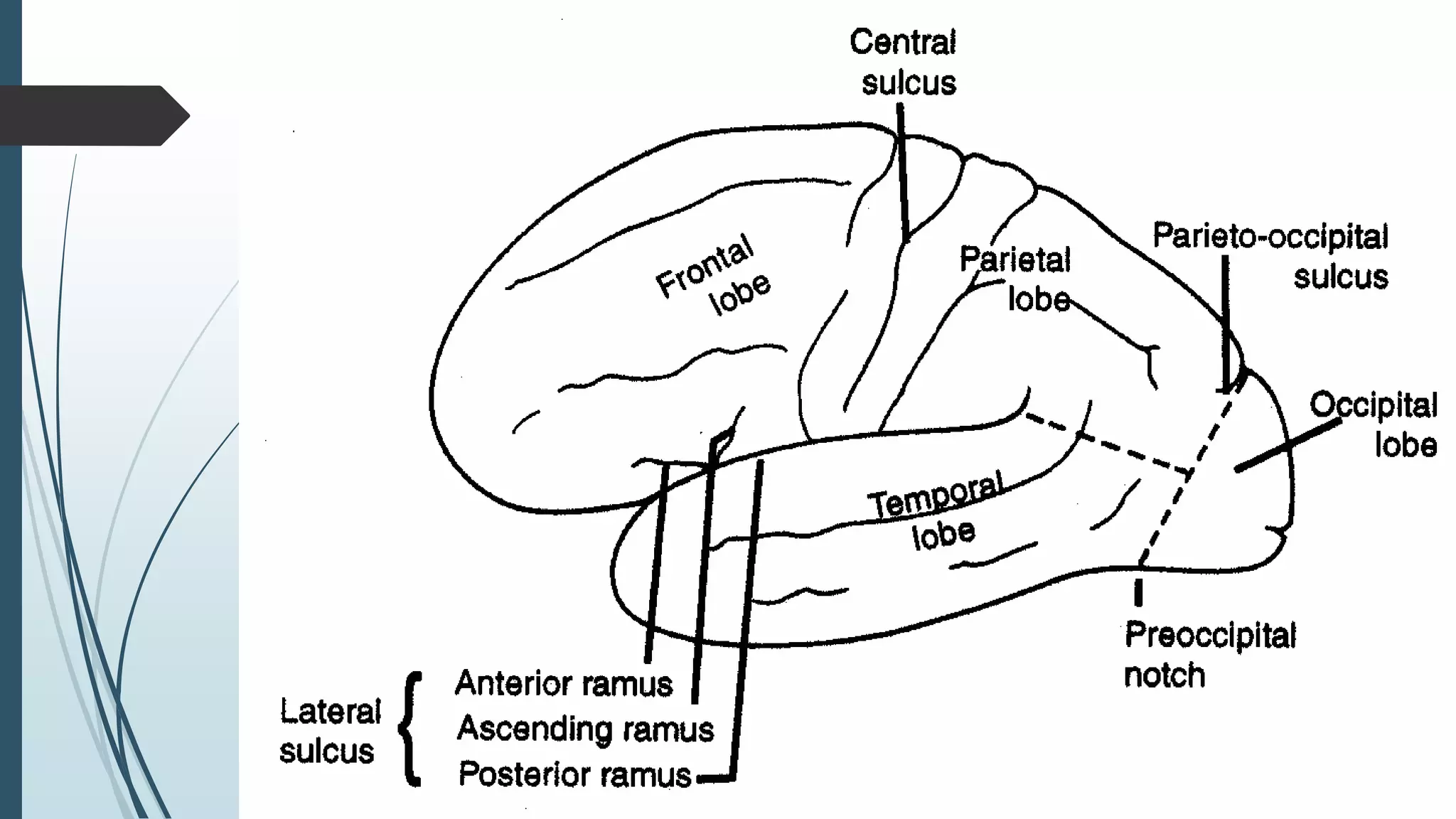
 in front of central sulcus and above lateral sulcus, line from central sulcus down
to corpus collosum
 Parietal lobes
 behind central sulcus and above lateral sulcus. A line between parieto-occipital
sulcus and preoccipital notch and middle of the line above to the lateral sulcus
(See Picture 13-1 on P261)
 Temporal lobes
 lateral sulcus and line described above, a line from anterior end of calcarine
sulcus and preoccipital notch (see Pic 13-2 on P 262)
 Occipital lobe
 medial surface of the hemisphere, separated from temporal lobe.
 Insula
 bottom of lateral sulcus.
THANK YOU
FOR
your attention! Any
question? No ?
Great! Bye!)))

Topographic anatomy of the brain and brain part of the skull

  • 1.
    Topographic anatomy ofthe brain and brain part of the skull Rustam Sultonov
  • 2.
    Borders of thehead: From the chin along the lower border of mandible to its angle and then from the mastoid process along the superior nuchal line to external occipital protuberance
  • 3.
    Divisions The facial part Includes: •Orbits • Initial parts of respiratory system • Initial parts of GI tract Brain part Fornix capitis Consists of several regions: Frontal, Parietal, Occipital, Temporal, and Mastoidal Basis cranii Has got internal and external surfaces
  • 4.
    The division line:Stretches from supraorbital margin zygomatic arch superior margin of external acoustic meatus mastoid process
  • 5.
  • 7.
    Frontal region  Boundaries:lower border of frontal region at the place of junction of nasal bones with frontal bone (nasion) diverge in different sides along the superciliar arch then crossing zygomatic process of frontal bone the border goes up along the projectional line of coronal suture and end on siggital suture
  • 8.
     Blood supply:a. supratrochlearis, a. supraorbitalis (from a. ophtalmica)  Venous drainage: v. supratrochlearis, v. supraorbitalis  Lymph drainage: lymph vessels drain into nodi lymphatici parotidei superficiales  Innervation: Sensitive nerves are n. supratrochlearis, n. supraorbitalis (from n. ophtalmicus. Motor nerves: rami temporalis n. facialis (branches go to m. frontalis)
  • 9.
    Parietal region  Boundaries:good visible only in the skull. Borders are along the projectional lines of coronal, saggital, lambdoidal sutures and temporal line Blood supply: branches of a. temporalis superficialis Venous drainage: branches of v. temporalis superficialis Lymph drainage: lymph vessels drain into nodi lymphatici mastoidei Innervation: branches from nn. Supraorbitalis et frontalis, n. auriculotemporalis, n. occipialis major
  • 10.
    Occipital region  Boundaries:borders of the region from above and on the sides correspond to the location of lambdoidal suture; below borders correspond to the line that stretches from the bases of one mastoid process to the basis of another one through the external occipital protuberance Blood supply: a. occipitalis, a. auricularis posterior Venous drainage: v. occipitalis, v. vertebralis Lymph drainage: lymph vessels drain into nodi lymphatici occipitalis Innervation: Sensory nerve is n. suboccipitalis; Motor nerves are n. occipitalis major, n. occipitalis minor
  • 11.
    Layers and spacesof frontal, parietal and occipital regions 1. Skin (cutis) – in these areas is thick and covered by hair (except frontal region), tightly connected with subcutaneous fat and m. epicranius by CT septa 2. Subcutaneous fat (panniculus adiposus) contains CT septa, fat drops and vascular net. Vascular and lymphatic vessels are tightly fixed in septa and that’s why due to injuries they do not dissipate and severe bleeding might occur 3. M. epicranius – consists of 2 bellies (venter frontalis and venter occipitalis) and galea aponeuotica between them. Innervation: n. facialis 4. Stratum fasciale – the layer of the loose tissue localized between m. epicranius and periostium 5. Periosteum – tightly connected to bones only in the are of sutures, in other places it can easily be detached
  • 12.
    6. Skull bones(ossa cranii) - thickness varies in different zones. These bones do not possess ability to regenerate ( that’s why defect after trepanation is closed only by fibrous tissue). Skull bones have 3 layers: lamina externa, diploe(spongy layer), lamina interna 7. Epidural space (cavitas epiduralis) – between internal laminae and dura mater 8. Dura mater encephali – consists of dense fibrous CT 9. Spatium subdurale – a space between dura mater and arachnoidea encephali containing fluid 10. Arachnoidea encephali – passes from one gyri to another, not dropping in sulci. 11. Cavitas arachnoidalis – contains cerebrospinal fluid 12. Pia mater encephali – contains many blood vessels. Covering all the brain enters into sulci 13. Gray matter of brain
  • 13.
  • 14.
  • 15.
    Dura mater encephali A thick whitish CT membrane is outermost in position.  External surface is in direct contact with skull bones for which it serves like periosteum  The inner surface facing the brain is lined with endothelium and is therefore smooth and shiny  Between it and cerebral arachnoid mater is narrow subdural space filled with a small amount of fluid
  • 16.
    Inner surface givesoff several processes, which penetrate between the parts of the brain and separate one part from another: The Falx cerebri – lies sagittal between both cerebral hemispheres. Anterior narrow end grows into the crista galli, while the wide posterior end blend with the superior surface of tentorium cerebelli The Tentorium cerebelli – separates the cerebral occipital lobes from the cerebellum The Falx cerebelli – lies in saggital plane and separates cerebellar hemispheres  Blood supply: a. meningea anterior, a. meningea media, a. meningea posterior, ramus meningeus a. occipitalis  Innervation: r. tentorii n. ophtalmici, r. meningeus n. maxillaris, r. meningeus n. mandibularis, r. meningeus n. vagi
  • 17.
    Arachnoidea encephali Forms Middlelayer of brain meninges Separated from dura mater by a capillary subdural slit-like space In contrast to pia mater it does not penetrate into the sulci and depressions of the brain but bridges them as a result of which subarachnoidal spaces filled with fluid forms In some places sunarachnoidal spaces are particularly well developed and form wide and deep reserviours filled with cerebrospinal fluid – cisternae 1. Cisterna cerebromedullaris 2. Cisterna interpeduncularis 3. Cisterna chiasmatis 4. Cisterna fossae lateralis cerebri
  • 18.
    Pia mater Is inintimate contact with the brain and dips into all sulci and fissures on its surfaces It contains blood vessels and vascular plexuses
  • 19.
    BRAIN VENTRICLES  Thebrain is bathed by the cerebrospinal fluid (CSF)  Inside the brain, there are spaces (ventricles) filled with CSF  There are 4 ventricles  2 lateral ventricles are in the brain hemispheres  3rd ventricle is in the diencephalon  4th ventricle is between the pons, open medulla and the cerebellum  The 3rd & the 4th ventricles are connected by the cerebral aqueduct
  • 20.
    Ventricular system Lateral Ventricle Lateral Ventricle 3rd Ventricle 4thVentricle Cisterna Magna Intervertebral foramen/Monro Cerebral aqueduct Lateral aperture (Lushka) Median aperture (Magendie) Lateral aperture (Lushka) Intervertebral foramen/Monro
  • 21.
  • 22.
    Lobes  Frontal lobe in front of central sulcus and above lateral sulcus, line from central sulcus down to corpus collosum  Parietal lobes  behind central sulcus and above lateral sulcus. A line between parieto-occipital sulcus and preoccipital notch and middle of the line above to the lateral sulcus (See Picture 13-1 on P261)  Temporal lobes  lateral sulcus and line described above, a line from anterior end of calcarine sulcus and preoccipital notch (see Pic 13-2 on P 262)  Occipital lobe  medial surface of the hemisphere, separated from temporal lobe.  Insula  bottom of lateral sulcus.
  • 24.
    THANK YOU FOR your attention!Any question? No ? Great! Bye!)))